Building a Turbo-fast Data
Warehousing Platform with
Databricks
Parviz Deyhim
Agenda
• Introduction to Databricks
• Building a end-to-end Data warehouse platform
• Infrastructure
• Data ingest
• ETL
• Performance optimizations
• Process & Visualize
• Securing your platform
• Conclusion
3
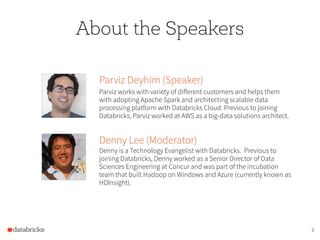
Parviz Deyhim (Speaker)
Parviz works with variety of different customers and helps them
with adopting Apache Spark and architecting scalable data
processing platform with Databricks Cloud. Previous to joining
Databricks, Parviz worked at AWS as a big-data solutions architect.
Denny Lee (Moderator)
Denny is a Technology Evangelist with Databricks. Previous to
joining Databricks, Denny worked as a Senior Director of Data
Sciences Engineering at Concur and was part of the incubation
team that built Hadoop on Windows and Azure (currently known as
HDInsight).
About the Speakers
Introduction to Databricks
We are Databricks, the company behind Spark
• Founded by the creators of Apache Spark
• Contributed ~75% of the Spark code in 2014
• Created Databricks cloud, a cloud-based big data platform
on top of Spark to make big data simple
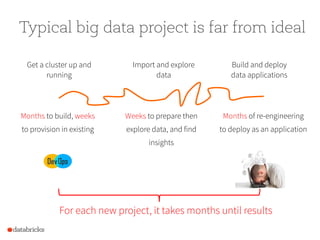
Typical big data project is far from ideal
Weeks to prepare then
explore data, and find
insights
Import and explore
data
Months to build, weeks
to provision in existing
Get a cluster up and
running
Months of re-engineering
to deploy as an application
Build and deploy
data applications
For each new project, it takes months until results
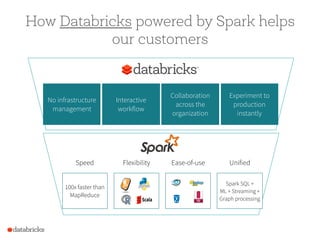
How Databricks powered by Spark helps
our customers
No infrastructure
management
Interactive
workflow
Collaboration
across the
organization
Experiment to
production
instantly
100x faster than
MapReduce
Spark SQL +
ML + Streaming +
Graph processing
Speed Flexibility Ease-of-use Unified
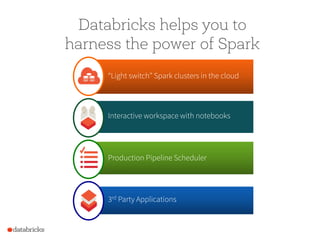
Databricks helps you to
harness the power of Spark
“Light switch” Spark clusters in the cloud
3rd Party Applications
Interactive workspace with notebooks
Production Pipeline Scheduler
Databricks Internal Data
Warehouse Use Case
10
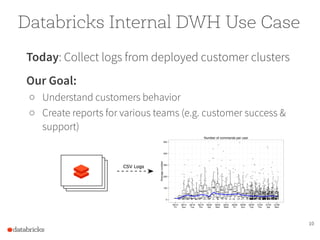
Databricks Internal DWH Use Case
Today: Collect logs from deployed customer clusters
Our Goal:
○ Understand customers behavior
○ Create reports for various teams (e.g. customer success &
support)
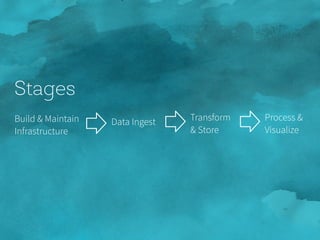
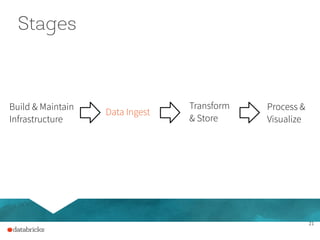
Stages
Build & Maintain
Infrastructure
Data Ingest Process &
Visualize
Transform
& Store
12
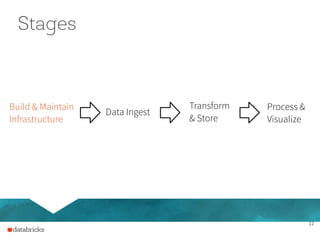
Stages
Build & Maintain
Infrastructure
Data Ingest
Process &
Visualize
Transform
& Store
13
Challenges of Building a Data Warehouse
Datacenter or Cloud?
• Build/rent data center or use a public cloud offering?
Picking the right resources
• If datacenter: what server sizes and types? Storage?
• In cloud: what instance size, how large of a disk/SSD to use?
Deployment and Automation
• How to automate the deployment process:
• Chef, Puppet, Cloudformation and etc
14
Maintenance
• How to perform seamless upgrades?
Securing the platform
• How to encrypt datasets?
• Controls, Policies, Audits
Challenges of Building a Data Warehouse
15
Databricks Hosted Platform
Managed and automated hosted platform
• Fully deployed on AWS
• Create resources with a single click
• Zero touch maintenance
16
Compute Resources
Automatic Instance Provisioning
• R3.2xlarge instances
• Use SSD for caching
• No EBS
• Deployed in major regions and more coming
17
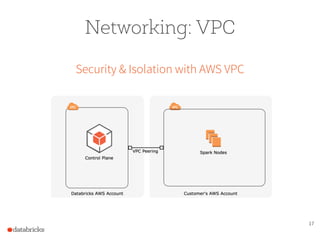
Networking: VPC
Security & Isolation with AWS VPC
18
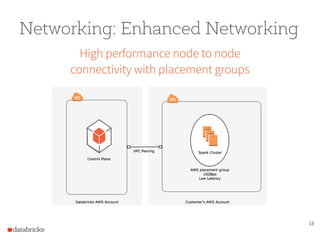
Networking: Enhanced Networking
High performance node to node
connectivity with placement groups
19
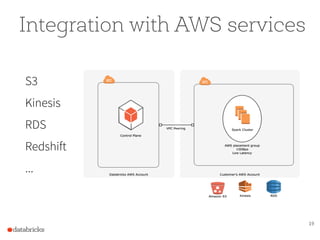
Integration with AWS services
S3
Kinesis
RDS
Redshift
...
20
Databricks Demo
21
Stages
Build & Maintain
Infrastructure
Data Ingest
Process &
Visualize
Transform
& Store
22
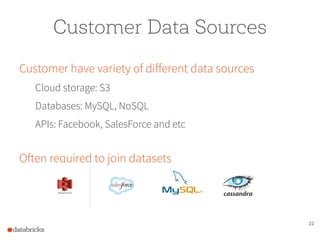
Customer Data Sources
Customer have variety of different data sources
Cloud storage: S3
Databases: MySQL, NoSQL
APIs: Facebook, SalesForce and etc
Often required to join datasets
23
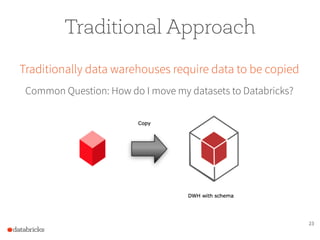
Traditional Approach
Traditionally data warehouses require data to be copied
Common Question: How do I move my datasets to Databricks?
24
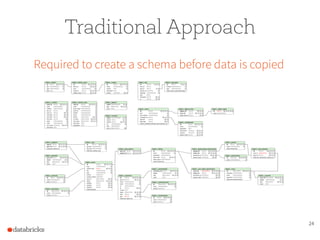
Traditional Approach
Required to create a schema before data is copied
25
Traditional Approach: Challenges
Moving Data:
• Very expensive and time consuming
• Creates inconsistency as data gets updated
Predefined Schema:
• Challenging to change schema for different
use-case
26
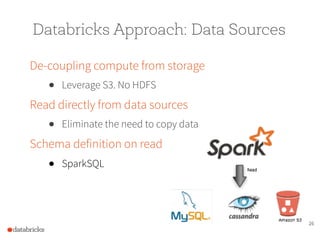
Databricks Approach: Data Sources
De-coupling compute from storage
● Leverage S3. No HDFS
Read directly from data sources
● Eliminate the need to copy data
Schema definition on read
● SparkSQL
27
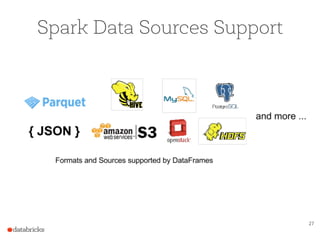
Spark Data Sources Support
28
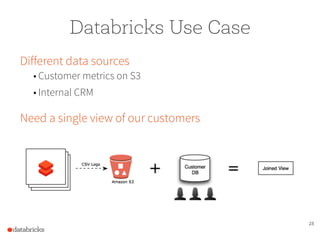
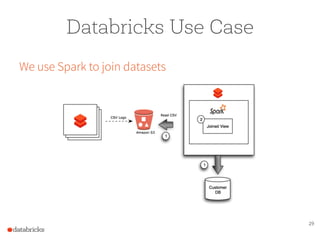
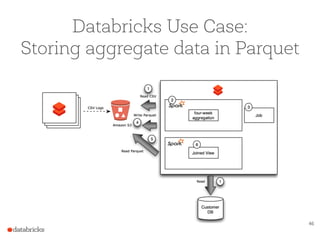
Databricks Use Case
Different data sources
• Customer metrics on S3
• Internal CRM
Need a single view of our customers
29
Databricks Use Case
We use Spark to join datasets
30
Databricks Demo
1. Reading data from external API
2. Reading usage logs data from S3
3. Joining usage and external datasets
Link
31
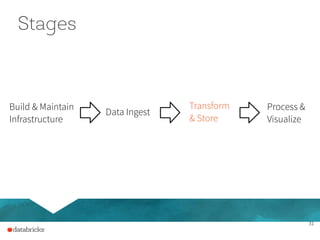
Stages
Build & Maintain
Infrastructure
Data Ingest
Process &
Visualize
Transform
& Store
32
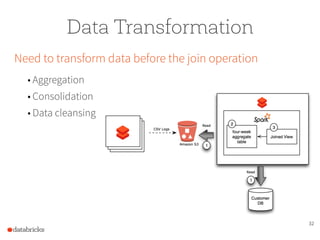
Data Transformation
Need to transform data before the join operation
• Aggregation
• Consolidation
• Data cleansing
33
Databricks Demo
Link
34
ETL: Common Approaches
Two common approaches
• Offline
• Streaming/real-time
35
Extract & Transformation
Offline ET
• Data gets stored in raw format (as is)
• Some recurring job perform ET on the dataset
• New transformed dataset gets stored for later processing
Advantage
• Easy and quick to setup
Disadvantages
• Traditionally slow process
36
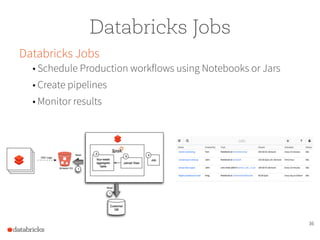
Databricks Jobs
Databricks Jobs
• Schedule Production workflows using Notebooks or Jars
• Create pipelines
• Monitor results
37
Databricks Demo
Jobs
Performance Optimizations
39
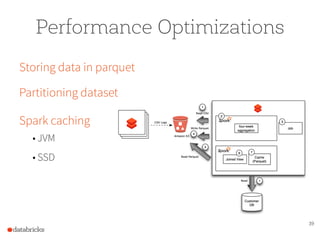
Performance Optimizations
Storing data in parquet
Partitioning dataset
Spark caching
• JVM
• SSD
40
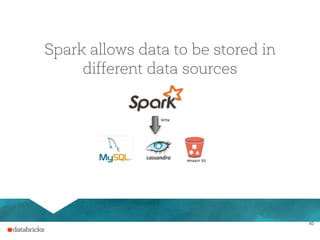
Spark allows data to be stored in
different data sources
41
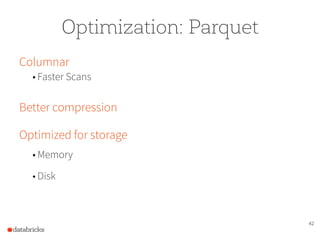
Parquet: Efficient columnar storage
format for data warehousing use-cases
42
Optimization: Parquet
Columnar
• Faster Scans
Better compression

Optimized for storage
• Memory
• Disk
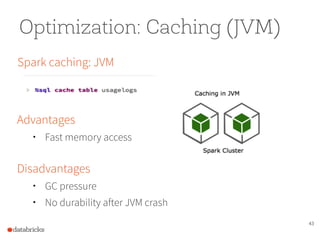
Advantages
• Fast memory access

Disadvantages
• GC pressure
• No durability after JVM crash
43
Optimization: Caching (JVM)
Spark caching: JVM
44
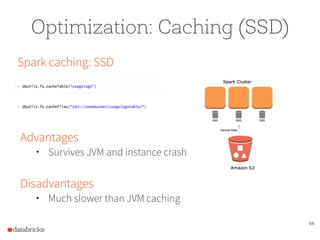
Optimization: Caching (SSD)
Spark caching: SSD
Advantages
• Survives JVM and instance crash

Disadvantages
• Much slower than JVM caching
45
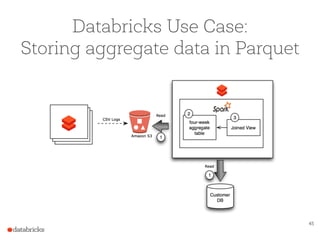
Databricks Use Case:
Storing aggregate data in Parquet
46
Databricks Use Case:
Storing aggregate data in Parquet
47
Databricks Demo
Link
48
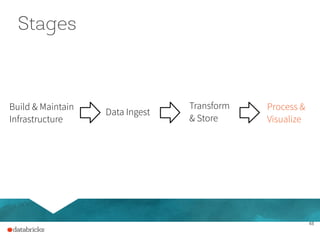
Stages
Build & Maintain
Infrastructure
Data Ingest
Process &
Visualize
Transform
& Store
49
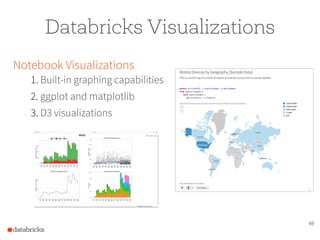
Databricks Visualizations
Notebook Visualizations
1. Built-in graphing capabilities
2. ggplot and matplotlib
3. D3 visualizations
50
Databricks Visualizations
Notebook Visualizations (DEMO)
D3/SVG
51
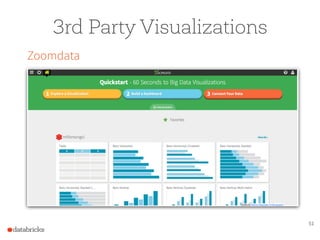
3rd Party Visualizations
Zoomdata
52
Securing Your Platform
53
Secure Platform
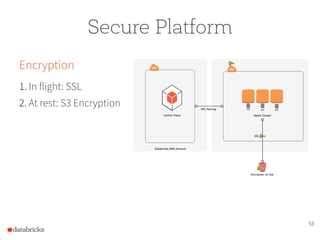
Encryption
1. In flight: SSL
2. At rest: S3 Encryption
54
Secure Platform
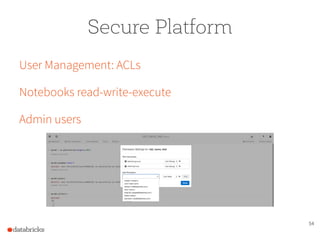
User Management: ACLs
Notebooks read-write-execute
Admin users
55
Secure Platform
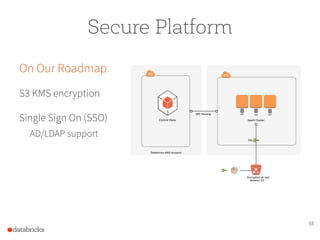
On Our Roadmap
S3 KMS encryption
Single Sign On (SSO)
AD/LDAP support
56
Secure Platform
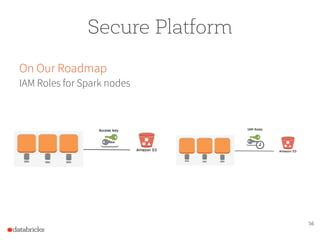
On Our Roadmap
IAM Roles for Spark nodes
Thank you

Building a Turbo-fast Data Warehousing Platform with Databricks