© 2011 Cornucopia Creations Excerpt from Building a Brand | 1
Building a Logo
To borrow from the old expression, “A good paint job is ninety percent preparation,” the
same is true for designing a company logo.
Sure, any ole’ bloke can slap on a company name, some artwork and call it done! But will it
sell your company, your brand? Further, will the collection of words and image(s) in the logo
(provided by the bloke) accurately convey what you want to say about your brand?
The scene: You work tirelessly to develop your company name, the message, plan a
marketing strategy and actually get seen by a prospective customer online – your website,
a review, a Facebook fan page. What thoughts should come to his/her mind upon seeing the
logo for the first time?
Many visual cues may make this prospect jump to several conclusions about your brand
(right or wrong). Elements such as color, shape, texture, composition (including fonts),
style, content and so on, all influence him/her about buying your product or service.
Further, if you garner that much interest, does the price match initial impressions? (But
that’s another white paper altogether!)
Before I jump into using this color ‘n’ that font, I’d like you to think about the broad picture
to ensure I’m designing to the right crowd. You wouldn’t wear jeans to a black tie dinner
and vice versa.
1. First, take a hard look at WHO your customer is. What are their demographics? What
do they think about? How do they feel about certain things?
2. Next, examine a bit about your competition. What’s different about your
competition? What makes YOUR BRAND different? What appeals do they make to the
target market you share that are different, better or worse? How do customers feel
about them instead?
 
© 2011 Cornucopia Creations Excerpt from Building a Brand | 2
3. Finally, take a look at YOUR BRAND. Now that you know more about your customers
and your competition it should be a lot easier to understand what your brand should
convey to the target market. What impression do you want to make? What words
would you like customers to say? How do you want them to feel? How would you like
them to refer you to other friends? What should they say about your product or
services?
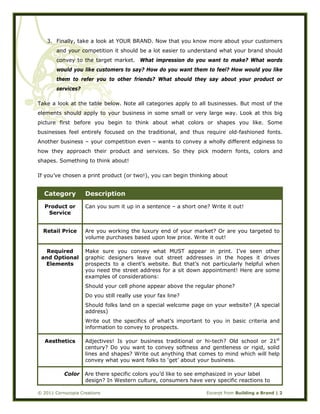
Take a look at the table below. Note all categories apply to all businesses. But most of the
elements should apply to your business in some small or very large way. Look at this big
picture first before you begin to think about what colors or shapes you like. Some
businesses feel entirely focused on the traditional, and thus require old-fashioned fonts.
Another business – your competition even – wants to convey a wholly different edginess to
how they approach their product and services. So they pick modern fonts, colors and
shapes. Something to think about!
If you’ve chosen a print product (or two!), you can begin thinking about
Category Description
Product or
Service
Can you sum it up in a sentence – a short one? Write it out!
Retail Price Are you working the luxury end of your market? Or are you targeted to
volume purchases based upon low price. Write it out!
Required
and Optional
Elements
Make sure you convey what MUST appear in print. I’ve seen other
graphic designers leave out street addresses in the hopes it drives
prospects to a client’s website. But that’s not particularly helpful when
you need the street address for a sit down appointment! Here are some
examples of considerations:
Should your cell phone appear above the regular phone?
Do you still really use your fax line?
Should folks land on a special welcome page on your website? (A special
address)
Write out the specifics of what’s important to you in basic criteria and
information to convey to prospects.
Aesthetics Adjectives! Is your business traditional or hi-tech? Old school or 21st
century? Do you want to convey softness and gentleness or rigid, solid
lines and shapes? Write out anything that comes to mind which will help
convey what you want folks to ‘get’ about your business.
Color Are there specific colors you’d like to see emphasized in your label
design? In Western culture, consumers have very specific reactions to
 
© 2011 Cornucopia Creations Excerpt from Building a Brand | 3
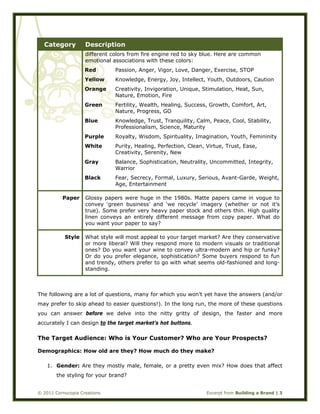
Category Description
different colors from fire engine red to sky blue. Here are common
emotional associations with these colors:
Red Passion, Anger, Vigor, Love, Danger, Exercise, STOP
Yellow Knowledge, Energy, Joy, Intellect, Youth, Outdoors, Caution
Orange Creativity, Invigoration, Unique, Stimulation, Heat, Sun,
Nature, Emotion, Fire
Green Fertility, Wealth, Healing, Success, Growth, Comfort, Art,
Nature, Progress, GO
Blue Knowledge, Trust, Tranquility, Calm, Peace, Cool, Stability,
Professionalism, Science, Maturity
Purple Royalty, Wisdom, Spirituality, Imagination, Youth, Femininity
White Purity, Healing, Perfection, Clean, Virtue, Trust, Ease,
Creativity, Serenity, New
Gray Balance, Sophistication, Neutrality, Uncommitted, Integrity,
Warrior
Black Fear, Secrecy, Formal, Luxury, Serious, Avant-Garde, Weight,
Age, Entertainment
Paper Glossy papers were huge in the 1980s. Matte papers came in vogue to
convey ‘green business’ and ‘we recycle’ imagery (whether or not it’s
true). Some prefer very heavy paper stock and others thin. High quality
linen conveys an entirely different message from copy paper. What do
you want your paper to say?
Style What style will most appeal to your target market? Are they conservative
or more liberal? Will they respond more to modern visuals or traditional
ones? Do you want your wine to convey ultra-modern and hip or funky?
Or do you prefer elegance, sophistication? Some buyers respond to fun
and trendy, others prefer to go with what seems old-fashioned and long-
standing.
The following are a lot of questions, many for which you won’t yet have the answers (and/or
may prefer to skip ahead to easier questions!). In the long run, the more of these questions
you can answer before we delve into the nitty gritty of design, the faster and more
accurately I can design to the target market’s hot buttons.
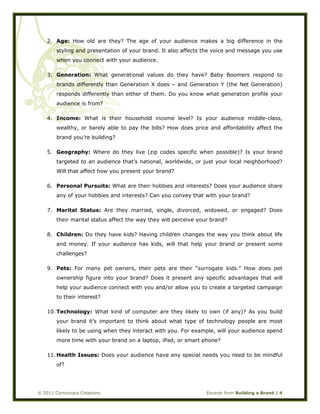
The Target Audience: Who is Your Customer? Who are Your Prospects?
Demographics: How old are they? How much do they make?
1. Gender: Are they mostly male, female, or a pretty even mix? How does that affect
the styling for your brand?
 
© 2011 Cornucopia Creations Excerpt from Building a Brand | 4
2. Age: How old are they? The age of your audience makes a big difference in the
styling and presentation of your brand. It also affects the voice and message you use
when you connect with your audience.
3. Generation: What generational values do they have? Baby Boomers respond to
brands differently than Generation X does – and Generation Y (the Net Generation)
responds differently than either of them. Do you know what generation profile your
audience is from?
4. Income: What is their household income level? Is your audience middle-class,
wealthy, or barely able to pay the bills? How does price and affordability affect the
brand you’re building?
5. Geography: Where do they live (zip codes specific when possible)? Is your brand
targeted to an audience that’s national, worldwide, or just your local neighborhood?
Will that affect how you present your brand?
6. Personal Pursuits: What are their hobbies and interests? Does your audience share
any of your hobbies and interests? Can you convey that with your brand?
7. Marital Status: Are they married, single, divorced, widowed, or engaged? Does
their marital status affect the way they will perceive your brand?
8. Children: Do they have kids? Having children changes the way you think about life
and money. If your audience has kids, will that help your brand or present some
challenges?
9. Pets: For many pet owners, their pets are their “surrogate kids.” How does pet
ownership figure into your brand? Does it present any specific advantages that will
help your audience connect with you and/or allow you to create a targeted campaign
to their interest?
10. Technology: What kind of computer are they likely to own (if any)? As you build
your brand it’s important to think about what type of technology people are most
likely to be using when they interact with you. For example, will your audience spend
more time with your brand on a laptop, iPad, or smart phone?
11. Health Issues: Does your audience have any special needs you need to be mindful
of?
 
© 2011 Cornucopia Creations Excerpt from Building a Brand | 5
12. Entertainment: What TV shows or movie types do they prefer? Which television
shows people watch can tell you a lot about their personalities. For example,
according to a study done by Mindset Media, people who watch the hit show “Mad
Men” are creative and socially liberal. Knowing what shows they watch can give you
clues about how to build a brand that they relate to.
13. Vehicles: What do they drive? Are they on starter, second-hand cars or do they buy
a new Cadillac every two years? What does this tell you (if anything) about what
they buy from you?
14. Internet: This is an important area! What blogs do they read? Is your audience avid
blog readers? Do they even know what a blog is? Knowing what blogs your audience
frequents will help give you insight into the topics that interest them so you can
incorporate that into your branding. What about Facebook, Twitter and other sites?
This helps inform you how much marketing effort to put into your digital
infrastructure.
15. Career: What career level are they at? Millennials eschew traditional, push
advertising and marketing. How does that affect your branding?
16. Education Level: Is your audience high school dropouts, college graduates, or do
they have a PhD? How does their level of education change the way you present your
brand and its sophistication?
17. Shopping: How much of their shopping is done online? How much is done locally?
Knowing how comfortable your audience is making purchases online is important if
your brand will have a heavy online presence.
18. Reading Material: Do they subscribe to any magazines or publications? Knowing
which magazines your audience subscribes to can be a great source of research. Are
they “Food & Wine” lovers or subscribers of “National Review”? Or are they more
likely to be found reading USA Today? TIP: most magazines have media kits
available on their websites that detail the demographics and lifestyle of their readers.
Psychographics: How Do They Think About Life?
19. What is their greatest fear? More specifically, what hesitations do they make
about buying your product or service? Developing your brand around something that
reduces or eliminates the fear your audience feels over a topic or situation is a
powerful means of attracting them to your brand.
 
© 2011 Cornucopia Creations Excerpt from Building a Brand | 6
20. What is their greatest frustration? If your audience is frustrated over a problem,
how can you build your brand around the solution? If you can do that, your audience
will feel excited they’ve found the answer to their problem in your brand.
21. What is their greatest hope or dream? Does your audience have a common hope
or dream you can incorporate into your brand that they relate to?
22. What problem or event triggers their initial search for your product? Are they
looking for your specific product? How can you position your brand as the solution to
that problem?
23. Are there any products or services they buy regularly? Does your audience
always shop at high-end luxury retailers, or technology stores? Knowing where your
audience shops will help you craft a style that feels familiar and inviting to them.
24. What do you have in common with them? Sharing a common interest, problem,
skill, or passion with your audience can give you a huge advantage when building
your brand. The common ground you have will help your audience identify with your
brand and engage them faster – encouraging interaction and more sales.
Your Competition: Who are they? How are they similar? How are they
different? …And How Does that Affect Your Marketing Strategy?
25. Who is your competition?
26. What makes them a competitor? Are they offering the same things you are to the
same audience? Are they a friend that you compete with for fun?
27. How do they describe what makes them unique? What words and tone of voice
are they using to convey what they do? How does their description differ from yours?
Do you need to adjust your branding to make your description more appealing to
your audience than theirs is?
28. What do they offer? What services, products, and information do they offer to their
audience? Do they offer anything you don’t? How can you adjust your branding
accordingly so what they offer seems outdated, inferior, or irrelevant?
29. Do they charge differently for what they offer? If so, how does their pricing
compare to yours? Do you need to tweak your brand to look more / less expensive
than what they offer, or look like a better value for the money?
 
© 2011 Cornucopia Creations Excerpt from Building a Brand | 7
30. Are they marketing to the same audience as you? If it appears they’re
marketing to a different audience, you might need to re-evaluate whom your
audience really is.
31. What are they better at than you? Take an objective look at their business, their
services, and their brand. What do they do better than you? How will that affect your
branding? Do you need to compensate for that weakness, or display it proudly?
32. What are you better at than them? Which of your strengths can you emphasize in
your branding to give yourself a competitive advantage?
33. What colors do they use in their brand? Pay attention to the colors your
competitors are using. If they’re all using similar color schemes, it could be because
your audience prefers those colors. You also want to make sure you don’t use the
exact same colors as a competitor and confuse your audience about who’s who.
34. How would you describe the design style of their brand? Is it modern,
conservative, traditional, futuristic, elegant, fun or funky? How does their style
compare with what you’ve learned about your audience’s tastes? Do you need to
adjust your style to connect with your audience at a deeper level than they do?
35. What kind of Internet marketing presence do they have? Do they seem to be
everywhere, or do they barely have a functional website? Does that make it easier
for you to launch your brand online, or more challenging? Do they offer online sales?
Through their Facebook Fan page?
36. Are they trying to attract an audience from a specific geographic area? Are
they targeting a local, regional, national, or international audience? Where do they
have gaps in their coverage that you could fill?
37. How active are they in promoting their brand? Is their brand a household name
in your industry, or has nobody heard of them? How can you position your brand as
the leader in your niche?
38. What “voice” do they use in their branding? Do they communicate with their
audience in a formal or informal manner? Does their style seem to be more
conversational or professional? How does that compare with your brand?
39. How much of a “threat” are they as a competitor? Do you expect to be
competing with them for the attention (or money) of your audience, or do they pose
 
© 2011 Cornucopia Creations Excerpt from Building a Brand | 8
no threat to you? Is there an opportunity for you to position your brand as the leader
in your niche?
40. What is their value proposition? Is the value they provide their audience obvious,
or is it difficult to find? Can you do a better job of conveying value to the same
audience with your brand?
41. What are they really selling? Just like you, what they offer and what their
audience really wants may be two different things. Does it look like they understand
this point, or is there an opportunity for your brand to outshine them in this area?
What is it?
42. What is their style? Are they corporate or informal? Do they seem cold, distant,
and mechanical, or do they seem warm, approachable, and human? Do you see any
obvious reason they chose that style? How does their style compare with the one
you’ve planned for your brand?
43. Why do you think their audience likes them? This is somewhat speculative, but
do you notice a predominant reason their audience is drawn to them? Does that need
to be addressed with your brand?
44. Is there anything they might have overlooked? Is there something they’ve
overlooked in their branding you can capitalize on to connect with your audience
better, and make them irrelevant at the same time?
45. How strong is their relationship with their audience? Is their audience highly
engaged with them, or is there an opportunity for your brand to take the top spot in
their audience’s mind?
46. How responsive are they? Do they keep their audience waiting and wondering, or
are do they have stellar communication skills? How will you need to address
responsiveness with your brand to be competitive?
47. Is what they offer readily available? Does their audience have trouble getting
what your competition offers, or can they easily get their hands on it? How will you
position your brand in relation to that level of availability?
48. What emotional need do they fill for their audience? Are they satisfying the
core need their audience has, or is there room for your brand to provide a higher
level of satisfaction?
 
© 2011 Cornucopia Creations Excerpt from Building a Brand | 9
Your Brand: Components that Provide Clues About the Brand and
Product(s) to Customers
Now that we’re a lot clearer about who your customer is (or will be) and who your
competition is (or will be), we should have a sense of what key advantages you have in the
market. For example, if you anticipate your market to be primarily Millennials, then you may
give far more consideration to including a QR code on your business card for this techno-
savvy market.
Conclusions
Luckily for you it’s my job to take all the answers from this questionnaire and convert them
into a fabulous logo for you! Is a picture worth 1,000 words? We’ll find out!
The beauty of this exercise is that it helps everyone focus on the target market. Any one of
the previous questions may trigger you to realize that your customer has a passion about
something we can incorporate in your branding. From a sunset in the artwork to the story in
the tag line, every element contributes to the whole.
I look forward to capturing all these elements into a design to which you respond, “Aha!
That’s it exactly!”
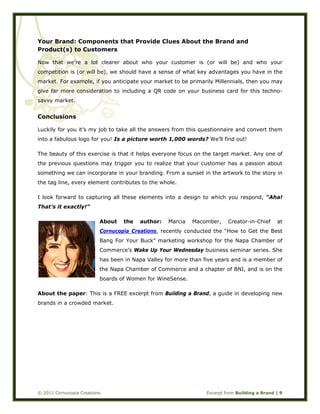
About the author: Marcia Macomber, Creator-in-Chief at
Cornucopia Creations, recently conducted the “How to Get the Best
Bang For Your Buck” marketing workshop for the Napa Chamber of
Commerce’s Wake Up Your Wednesday business seminar series. She
has been in Napa Valley for more than five years and is a member of
the Napa Chamber of Commerce and a chapter of BNI, and is on the
boards of Women for WineSense.
About the paper: This is a FREE excerpt from Building a Brand, a guide in developing new
brands in a crowded market.

Building a Logo

  • 1.
      © 2011 CornucopiaCreations Excerpt from Building a Brand | 1 Building a Logo To borrow from the old expression, “A good paint job is ninety percent preparation,” the same is true for designing a company logo. Sure, any ole’ bloke can slap on a company name, some artwork and call it done! But will it sell your company, your brand? Further, will the collection of words and image(s) in the logo (provided by the bloke) accurately convey what you want to say about your brand? The scene: You work tirelessly to develop your company name, the message, plan a marketing strategy and actually get seen by a prospective customer online – your website, a review, a Facebook fan page. What thoughts should come to his/her mind upon seeing the logo for the first time? Many visual cues may make this prospect jump to several conclusions about your brand (right or wrong). Elements such as color, shape, texture, composition (including fonts), style, content and so on, all influence him/her about buying your product or service. Further, if you garner that much interest, does the price match initial impressions? (But that’s another white paper altogether!) Before I jump into using this color ‘n’ that font, I’d like you to think about the broad picture to ensure I’m designing to the right crowd. You wouldn’t wear jeans to a black tie dinner and vice versa. 1. First, take a hard look at WHO your customer is. What are their demographics? What do they think about? How do they feel about certain things? 2. Next, examine a bit about your competition. What’s different about your competition? What makes YOUR BRAND different? What appeals do they make to the target market you share that are different, better or worse? How do customers feel about them instead?
  • 2.
      © 2011 CornucopiaCreations Excerpt from Building a Brand | 2 3. Finally, take a look at YOUR BRAND. Now that you know more about your customers and your competition it should be a lot easier to understand what your brand should convey to the target market. What impression do you want to make? What words would you like customers to say? How do you want them to feel? How would you like them to refer you to other friends? What should they say about your product or services? Take a look at the table below. Note all categories apply to all businesses. But most of the elements should apply to your business in some small or very large way. Look at this big picture first before you begin to think about what colors or shapes you like. Some businesses feel entirely focused on the traditional, and thus require old-fashioned fonts. Another business – your competition even – wants to convey a wholly different edginess to how they approach their product and services. So they pick modern fonts, colors and shapes. Something to think about! If you’ve chosen a print product (or two!), you can begin thinking about Category Description Product or Service Can you sum it up in a sentence – a short one? Write it out! Retail Price Are you working the luxury end of your market? Or are you targeted to volume purchases based upon low price. Write it out! Required and Optional Elements Make sure you convey what MUST appear in print. I’ve seen other graphic designers leave out street addresses in the hopes it drives prospects to a client’s website. But that’s not particularly helpful when you need the street address for a sit down appointment! Here are some examples of considerations: Should your cell phone appear above the regular phone? Do you still really use your fax line? Should folks land on a special welcome page on your website? (A special address) Write out the specifics of what’s important to you in basic criteria and information to convey to prospects. Aesthetics Adjectives! Is your business traditional or hi-tech? Old school or 21st century? Do you want to convey softness and gentleness or rigid, solid lines and shapes? Write out anything that comes to mind which will help convey what you want folks to ‘get’ about your business. Color Are there specific colors you’d like to see emphasized in your label design? In Western culture, consumers have very specific reactions to
  • 3.
      © 2011 CornucopiaCreations Excerpt from Building a Brand | 3 Category Description different colors from fire engine red to sky blue. Here are common emotional associations with these colors: Red Passion, Anger, Vigor, Love, Danger, Exercise, STOP Yellow Knowledge, Energy, Joy, Intellect, Youth, Outdoors, Caution Orange Creativity, Invigoration, Unique, Stimulation, Heat, Sun, Nature, Emotion, Fire Green Fertility, Wealth, Healing, Success, Growth, Comfort, Art, Nature, Progress, GO Blue Knowledge, Trust, Tranquility, Calm, Peace, Cool, Stability, Professionalism, Science, Maturity Purple Royalty, Wisdom, Spirituality, Imagination, Youth, Femininity White Purity, Healing, Perfection, Clean, Virtue, Trust, Ease, Creativity, Serenity, New Gray Balance, Sophistication, Neutrality, Uncommitted, Integrity, Warrior Black Fear, Secrecy, Formal, Luxury, Serious, Avant-Garde, Weight, Age, Entertainment Paper Glossy papers were huge in the 1980s. Matte papers came in vogue to convey ‘green business’ and ‘we recycle’ imagery (whether or not it’s true). Some prefer very heavy paper stock and others thin. High quality linen conveys an entirely different message from copy paper. What do you want your paper to say? Style What style will most appeal to your target market? Are they conservative or more liberal? Will they respond more to modern visuals or traditional ones? Do you want your wine to convey ultra-modern and hip or funky? Or do you prefer elegance, sophistication? Some buyers respond to fun and trendy, others prefer to go with what seems old-fashioned and long- standing. The following are a lot of questions, many for which you won’t yet have the answers (and/or may prefer to skip ahead to easier questions!). In the long run, the more of these questions you can answer before we delve into the nitty gritty of design, the faster and more accurately I can design to the target market’s hot buttons. The Target Audience: Who is Your Customer? Who are Your Prospects? Demographics: How old are they? How much do they make? 1. Gender: Are they mostly male, female, or a pretty even mix? How does that affect the styling for your brand?
  • 4.
      © 2011 CornucopiaCreations Excerpt from Building a Brand | 4 2. Age: How old are they? The age of your audience makes a big difference in the styling and presentation of your brand. It also affects the voice and message you use when you connect with your audience. 3. Generation: What generational values do they have? Baby Boomers respond to brands differently than Generation X does – and Generation Y (the Net Generation) responds differently than either of them. Do you know what generation profile your audience is from? 4. Income: What is their household income level? Is your audience middle-class, wealthy, or barely able to pay the bills? How does price and affordability affect the brand you’re building? 5. Geography: Where do they live (zip codes specific when possible)? Is your brand targeted to an audience that’s national, worldwide, or just your local neighborhood? Will that affect how you present your brand? 6. Personal Pursuits: What are their hobbies and interests? Does your audience share any of your hobbies and interests? Can you convey that with your brand? 7. Marital Status: Are they married, single, divorced, widowed, or engaged? Does their marital status affect the way they will perceive your brand? 8. Children: Do they have kids? Having children changes the way you think about life and money. If your audience has kids, will that help your brand or present some challenges? 9. Pets: For many pet owners, their pets are their “surrogate kids.” How does pet ownership figure into your brand? Does it present any specific advantages that will help your audience connect with you and/or allow you to create a targeted campaign to their interest? 10. Technology: What kind of computer are they likely to own (if any)? As you build your brand it’s important to think about what type of technology people are most likely to be using when they interact with you. For example, will your audience spend more time with your brand on a laptop, iPad, or smart phone? 11. Health Issues: Does your audience have any special needs you need to be mindful of?
  • 5.
      © 2011 CornucopiaCreations Excerpt from Building a Brand | 5 12. Entertainment: What TV shows or movie types do they prefer? Which television shows people watch can tell you a lot about their personalities. For example, according to a study done by Mindset Media, people who watch the hit show “Mad Men” are creative and socially liberal. Knowing what shows they watch can give you clues about how to build a brand that they relate to. 13. Vehicles: What do they drive? Are they on starter, second-hand cars or do they buy a new Cadillac every two years? What does this tell you (if anything) about what they buy from you? 14. Internet: This is an important area! What blogs do they read? Is your audience avid blog readers? Do they even know what a blog is? Knowing what blogs your audience frequents will help give you insight into the topics that interest them so you can incorporate that into your branding. What about Facebook, Twitter and other sites? This helps inform you how much marketing effort to put into your digital infrastructure. 15. Career: What career level are they at? Millennials eschew traditional, push advertising and marketing. How does that affect your branding? 16. Education Level: Is your audience high school dropouts, college graduates, or do they have a PhD? How does their level of education change the way you present your brand and its sophistication? 17. Shopping: How much of their shopping is done online? How much is done locally? Knowing how comfortable your audience is making purchases online is important if your brand will have a heavy online presence. 18. Reading Material: Do they subscribe to any magazines or publications? Knowing which magazines your audience subscribes to can be a great source of research. Are they “Food & Wine” lovers or subscribers of “National Review”? Or are they more likely to be found reading USA Today? TIP: most magazines have media kits available on their websites that detail the demographics and lifestyle of their readers. Psychographics: How Do They Think About Life? 19. What is their greatest fear? More specifically, what hesitations do they make about buying your product or service? Developing your brand around something that reduces or eliminates the fear your audience feels over a topic or situation is a powerful means of attracting them to your brand.
  • 6.
      © 2011 CornucopiaCreations Excerpt from Building a Brand | 6 20. What is their greatest frustration? If your audience is frustrated over a problem, how can you build your brand around the solution? If you can do that, your audience will feel excited they’ve found the answer to their problem in your brand. 21. What is their greatest hope or dream? Does your audience have a common hope or dream you can incorporate into your brand that they relate to? 22. What problem or event triggers their initial search for your product? Are they looking for your specific product? How can you position your brand as the solution to that problem? 23. Are there any products or services they buy regularly? Does your audience always shop at high-end luxury retailers, or technology stores? Knowing where your audience shops will help you craft a style that feels familiar and inviting to them. 24. What do you have in common with them? Sharing a common interest, problem, skill, or passion with your audience can give you a huge advantage when building your brand. The common ground you have will help your audience identify with your brand and engage them faster – encouraging interaction and more sales. Your Competition: Who are they? How are they similar? How are they different? …And How Does that Affect Your Marketing Strategy? 25. Who is your competition? 26. What makes them a competitor? Are they offering the same things you are to the same audience? Are they a friend that you compete with for fun? 27. How do they describe what makes them unique? What words and tone of voice are they using to convey what they do? How does their description differ from yours? Do you need to adjust your branding to make your description more appealing to your audience than theirs is? 28. What do they offer? What services, products, and information do they offer to their audience? Do they offer anything you don’t? How can you adjust your branding accordingly so what they offer seems outdated, inferior, or irrelevant? 29. Do they charge differently for what they offer? If so, how does their pricing compare to yours? Do you need to tweak your brand to look more / less expensive than what they offer, or look like a better value for the money?
  • 7.
      © 2011 CornucopiaCreations Excerpt from Building a Brand | 7 30. Are they marketing to the same audience as you? If it appears they’re marketing to a different audience, you might need to re-evaluate whom your audience really is. 31. What are they better at than you? Take an objective look at their business, their services, and their brand. What do they do better than you? How will that affect your branding? Do you need to compensate for that weakness, or display it proudly? 32. What are you better at than them? Which of your strengths can you emphasize in your branding to give yourself a competitive advantage? 33. What colors do they use in their brand? Pay attention to the colors your competitors are using. If they’re all using similar color schemes, it could be because your audience prefers those colors. You also want to make sure you don’t use the exact same colors as a competitor and confuse your audience about who’s who. 34. How would you describe the design style of their brand? Is it modern, conservative, traditional, futuristic, elegant, fun or funky? How does their style compare with what you’ve learned about your audience’s tastes? Do you need to adjust your style to connect with your audience at a deeper level than they do? 35. What kind of Internet marketing presence do they have? Do they seem to be everywhere, or do they barely have a functional website? Does that make it easier for you to launch your brand online, or more challenging? Do they offer online sales? Through their Facebook Fan page? 36. Are they trying to attract an audience from a specific geographic area? Are they targeting a local, regional, national, or international audience? Where do they have gaps in their coverage that you could fill? 37. How active are they in promoting their brand? Is their brand a household name in your industry, or has nobody heard of them? How can you position your brand as the leader in your niche? 38. What “voice” do they use in their branding? Do they communicate with their audience in a formal or informal manner? Does their style seem to be more conversational or professional? How does that compare with your brand? 39. How much of a “threat” are they as a competitor? Do you expect to be competing with them for the attention (or money) of your audience, or do they pose
  • 8.
      © 2011 CornucopiaCreations Excerpt from Building a Brand | 8 no threat to you? Is there an opportunity for you to position your brand as the leader in your niche? 40. What is their value proposition? Is the value they provide their audience obvious, or is it difficult to find? Can you do a better job of conveying value to the same audience with your brand? 41. What are they really selling? Just like you, what they offer and what their audience really wants may be two different things. Does it look like they understand this point, or is there an opportunity for your brand to outshine them in this area? What is it? 42. What is their style? Are they corporate or informal? Do they seem cold, distant, and mechanical, or do they seem warm, approachable, and human? Do you see any obvious reason they chose that style? How does their style compare with the one you’ve planned for your brand? 43. Why do you think their audience likes them? This is somewhat speculative, but do you notice a predominant reason their audience is drawn to them? Does that need to be addressed with your brand? 44. Is there anything they might have overlooked? Is there something they’ve overlooked in their branding you can capitalize on to connect with your audience better, and make them irrelevant at the same time? 45. How strong is their relationship with their audience? Is their audience highly engaged with them, or is there an opportunity for your brand to take the top spot in their audience’s mind? 46. How responsive are they? Do they keep their audience waiting and wondering, or are do they have stellar communication skills? How will you need to address responsiveness with your brand to be competitive? 47. Is what they offer readily available? Does their audience have trouble getting what your competition offers, or can they easily get their hands on it? How will you position your brand in relation to that level of availability? 48. What emotional need do they fill for their audience? Are they satisfying the core need their audience has, or is there room for your brand to provide a higher level of satisfaction?
  • 9.
      © 2011 CornucopiaCreations Excerpt from Building a Brand | 9 Your Brand: Components that Provide Clues About the Brand and Product(s) to Customers Now that we’re a lot clearer about who your customer is (or will be) and who your competition is (or will be), we should have a sense of what key advantages you have in the market. For example, if you anticipate your market to be primarily Millennials, then you may give far more consideration to including a QR code on your business card for this techno- savvy market. Conclusions Luckily for you it’s my job to take all the answers from this questionnaire and convert them into a fabulous logo for you! Is a picture worth 1,000 words? We’ll find out! The beauty of this exercise is that it helps everyone focus on the target market. Any one of the previous questions may trigger you to realize that your customer has a passion about something we can incorporate in your branding. From a sunset in the artwork to the story in the tag line, every element contributes to the whole. I look forward to capturing all these elements into a design to which you respond, “Aha! That’s it exactly!” About the author: Marcia Macomber, Creator-in-Chief at Cornucopia Creations, recently conducted the “How to Get the Best Bang For Your Buck” marketing workshop for the Napa Chamber of Commerce’s Wake Up Your Wednesday business seminar series. She has been in Napa Valley for more than five years and is a member of the Napa Chamber of Commerce and a chapter of BNI, and is on the boards of Women for WineSense. About the paper: This is a FREE excerpt from Building a Brand, a guide in developing new brands in a crowded market.