Marketing / PR – Brand
• A promise that gets kept consistently
• Defines your organization
• It creates a personality and a life for
  your products/services
• A unique and consistent look, feel, tone
  and voice for all communications
• Conveys-at a-glance the distinctive
  attributes of your organization
• Over time, it builds awareness of and
  an attitude towards your organization
Marketing / PR – Brand -II
• Strengthens the impact of all messages
• Paves the way for new customer
  relationships
• Provides employees with a greater
  sense of commitment
• It’s essential to your success in the
  marketplace
• No business is too small and no
  product too generic to develop a brand
  identity
Key Elements
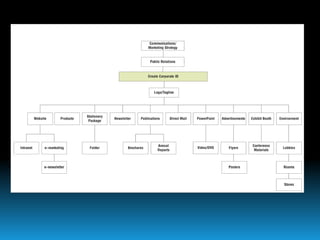
•   Brand Name-name, tagline, logo
•   Brand Position-description of your organization
•   Brand Promise-The single most important thing your
    organization promises to deliver every time
•   Brand Personality-what you want your brand to be known for
    (fun, serious, magical , forceful ,imaginative , etc.)
•   Brand Tone-edgy, humorous, conservative, subtle
•   Brand Story-Your organizational history and how it adds value
    to the brand, highlights how your products and services grew
    from that background and how your methodology impacts
    what you offer
•   Brand Associations-colors, taglines, images, fonts, uniforms,
    signage, equipment, etc.
Marketing Vehicles
   Brochures
   Print and e-newsletters
   Website, Screen savers
   Events
   Banner ads
   Print ads
   Public relations
   Direct Mail
   Flyers and posters
   Transit media
   Power point presentations
   Exhibit booth/signage
   CD/multimedia
   Facilities
Determine the purpose
Each marketing vehicle requires a unique tweak of the
brand to fit the medium.
   Brochures need more marketing copy and detail
   Websites are a quick read, interactive with the audience
   Ads are mini billboards, only the most critical info required
   Posters are colorful and entertaining
   Newsletters are informational, with regular features
   Exhibit booths are backdrops
   Multimedia is entertainment/educational
How much does it cost?
 It depends on what you want
 Bundling projects will save you money
 Itemizing each project will cost you more
 The cost range for branding is broad and will
  be determined based on scope of work
 Don’t buy low bid! You get what you pay for
  as in any other industry or service
 Projects are based on Periods
Steps
Step One

• Learn marketing objectives and strategy
• Prioritize projects
• Audit existing and competitive materials
  and strategies
• Interviews/focus group
• Write creative brief and define messages
• Create timelines and budgets
Steps    (continued)

Step Two

• Develop concepts/taglines/site
  architecture
• Start visual research
• Present initial creative approaches
Steps     (continued)

Step Three
• Develop outline and copy points per
  selected concept
• Develop media strategy
• Explore layout options
• Begin creating visual materials
  (photos/illustrations)
Steps      (continued)

Step Four
• Write full copy draft
• Revise and write final copy as per
  client comments
• Start layouts
Steps      (continued)

Step Five
• Create and present full layout and/or e-
  design
Step Six
• Develop final electronic files for print, or
  coding for web
• Final execution and management of
  products (website launch, launch media
  campaign, exhibit built, print pieces to
  printer, ads placed, press releases sent,
  etc.)
Keys to building successful
          brands
   Find the right advertising/branding agency
   Top management must be committed to this effort
   Assign one point person to work with the agency
   Do not make decisions by committee
   Keep brand consistent internally and externally
   Don’t rush the process-make sure you have enough time
    budgeted
   Give the brand time to work
   Create a brand style guide and give to every employee
   Refresh/update brand after a few years
What a good strategy does
 Strengthens employees loyalty
 Attracts clients/customers
 Keeps current relationships strong
 Builds confidence
 Builds feelings of security and trust
 Creates a memorable, positive
  experience
TechnoCrant
  Our Heart bit is Tech bit


  www.TechnoCrant.com
  info@technocrant.com
    CSR :09293184197

Marketing pr services

  • 2.
    Marketing / PR– Brand • A promise that gets kept consistently • Defines your organization • It creates a personality and a life for your products/services • A unique and consistent look, feel, tone and voice for all communications • Conveys-at a-glance the distinctive attributes of your organization • Over time, it builds awareness of and an attitude towards your organization
  • 3.
    Marketing / PR– Brand -II • Strengthens the impact of all messages • Paves the way for new customer relationships • Provides employees with a greater sense of commitment • It’s essential to your success in the marketplace • No business is too small and no product too generic to develop a brand identity
  • 4.
    Key Elements • Brand Name-name, tagline, logo • Brand Position-description of your organization • Brand Promise-The single most important thing your organization promises to deliver every time • Brand Personality-what you want your brand to be known for (fun, serious, magical , forceful ,imaginative , etc.) • Brand Tone-edgy, humorous, conservative, subtle • Brand Story-Your organizational history and how it adds value to the brand, highlights how your products and services grew from that background and how your methodology impacts what you offer • Brand Associations-colors, taglines, images, fonts, uniforms, signage, equipment, etc.
  • 6.
    Marketing Vehicles  Brochures  Print and e-newsletters  Website, Screen savers  Events  Banner ads  Print ads  Public relations  Direct Mail  Flyers and posters  Transit media  Power point presentations  Exhibit booth/signage  CD/multimedia  Facilities
  • 7.
    Determine the purpose Eachmarketing vehicle requires a unique tweak of the brand to fit the medium.  Brochures need more marketing copy and detail  Websites are a quick read, interactive with the audience  Ads are mini billboards, only the most critical info required  Posters are colorful and entertaining  Newsletters are informational, with regular features  Exhibit booths are backdrops  Multimedia is entertainment/educational
  • 8.
    How much doesit cost?  It depends on what you want  Bundling projects will save you money  Itemizing each project will cost you more  The cost range for branding is broad and will be determined based on scope of work  Don’t buy low bid! You get what you pay for as in any other industry or service  Projects are based on Periods
  • 9.
    Steps Step One • Learnmarketing objectives and strategy • Prioritize projects • Audit existing and competitive materials and strategies • Interviews/focus group • Write creative brief and define messages • Create timelines and budgets
  • 10.
    Steps (continued) Step Two • Develop concepts/taglines/site architecture • Start visual research • Present initial creative approaches
  • 11.
    Steps (continued) Step Three • Develop outline and copy points per selected concept • Develop media strategy • Explore layout options • Begin creating visual materials (photos/illustrations)
  • 12.
    Steps (continued) Step Four • Write full copy draft • Revise and write final copy as per client comments • Start layouts
  • 13.
    Steps (continued) Step Five • Create and present full layout and/or e- design Step Six • Develop final electronic files for print, or coding for web • Final execution and management of products (website launch, launch media campaign, exhibit built, print pieces to printer, ads placed, press releases sent, etc.)
  • 14.
    Keys to buildingsuccessful brands  Find the right advertising/branding agency  Top management must be committed to this effort  Assign one point person to work with the agency  Do not make decisions by committee  Keep brand consistent internally and externally  Don’t rush the process-make sure you have enough time budgeted  Give the brand time to work  Create a brand style guide and give to every employee  Refresh/update brand after a few years
  • 15.
    What a goodstrategy does  Strengthens employees loyalty  Attracts clients/customers  Keeps current relationships strong  Builds confidence  Builds feelings of security and trust  Creates a memorable, positive experience
  • 16.
    TechnoCrant OurHeart bit is Tech bit www.TechnoCrant.com info@technocrant.com CSR :09293184197