Everything you need to define a brand in one place
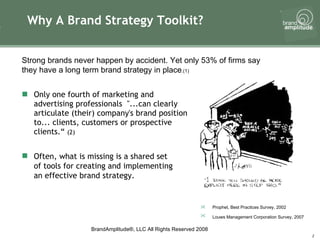
Why A Brand Strategy Toolkit? Only one fourth of marketing and advertising professionals  "...can clearly articulate (their) company's brand position to... clients, customers or prospective clients.“  (2) Strong brands never happen by accident. Yet only 53% of firms say they have a long term brand strategy in place .(1)   Prophet, Best Practices Survey, 2002 Louws Management Corporation Survey, 2007   Often, what is missing is a shared set of tools for creating and implementing an effective brand strategy.
What is Brand Strategy? A brand strategy is simply a plan for developing a coherent brand. It provides the means for systematically creating differentiation and consumer appeal by empowering better brand decisions across the organization.  “ There is no tool better than the brand for uniting the forces and the stakeholders inside and around your company.” Thomas Gad, 4-D Branding: Cracking the Corporate Code of the   Network Economy, 2001 “ The role of brands has evolved; brands are now company DNA, the spark from which all corporate life grows.”  Will Murray, Brand Storm: A Tale of Passion, Betrayal, and Revenge, 2001  “ ...ideally, the brand will make black and white decisions not just at the top of the house, but also all the way down the line.” David F. D’Allesandro, Brand Warfare: 10 Rules for Building the Killer Brand, 2001 An effective brand strategy influences the total operation of a business to ensure consistent brand experiences for the customer.
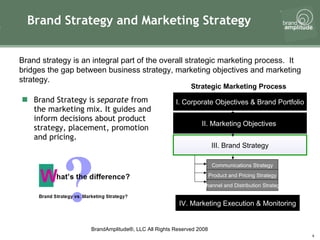
Brand Strategy and Marketing Strategy Brand Strategy is  separate  from the marketing mix. It guides and inform decisions about product strategy, placement, promotion and pricing. Brand strategy is an integral part of the overall strategic marketing process.  It bridges the gap between business strategy, marketing objectives and marketing strategy. I. Corporate Objectives & Brand Portfolio II. Marketing Objectives  III. Brand Strategy Communications Strategy Product and Pricing Strategy Channel and Distribution Strategy IV. Marketing Execution & Monitoring Strategic Marketing Process
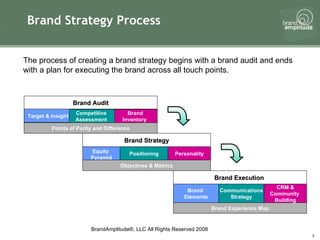
Brand Strategy Process Target & Insight Brand Execution  Brand  Elements Competitive  Assessment  Brand  Inventory  Equity  Pyramid Positioning Objectives & Metrics Personality Communications Strategy Brand Experience Map Brand Strategy Brand Audit CRM & Community  Building Points of Parity and Difference The process of creating a brand strategy begins with a brand audit and ends with a plan for executing the brand across all touch points.
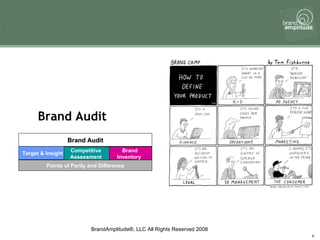
Brand Audit Target & Insight Competitive  Assessment  Brand  Inventory  Brand Audit Points of Parity and Difference
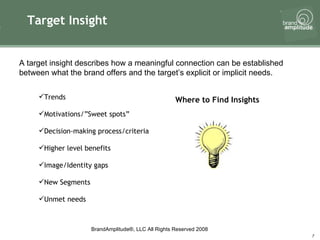
Target Insight Where to Find Insights A target insight describes how a meaningful connection can be established between what the brand offers and the target’s explicit or implicit needs.  Trends Motivations/”Sweet spots” Decision-making process/criteria Higher level benefits Image/Identity gaps New Segments  Unmet needs
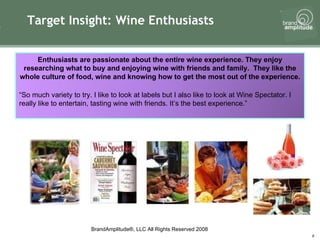
Target Insight: Wine Enthusiasts Enthusiasts are passionate about the entire wine experience. They enjoy researching what to buy and enjoying wine with friends and family.  They like the whole culture of food, wine and knowing how to get the most out of the experience. “ So much variety to try. I like to look at labels but I also like to look at Wine Spectator. I really like to entertain, tasting wine with friends. It’s the best experience.”
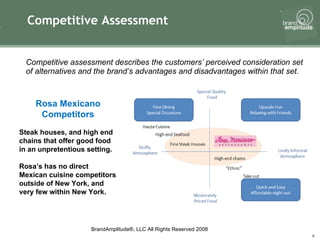
Competitive Assessment Competitive assessment describes the customers’ perceived consideration set of alternatives and the brand’s advantages and disadvantages within that set. Rosa Mexicano Competitors Steak houses, and high end chains that offer good food in an unpretentious setting.  Rosa’s has no direct Mexican cuisine competitors outside of New York, and very few within New York.
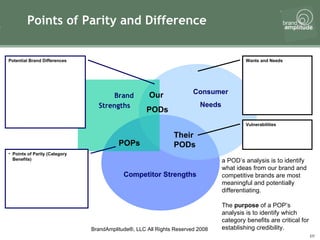
Points of Parity and Difference Brand  Strengths   Consumer Needs Competitor Strengths Our  PODs Potential Brand Differences POPs Points of Parity (Category Benefits) Vulnerabilities Their PODs Wants and Needs a POD’s analysis is to identify what ideas from our brand and competitive brands are most meaningful and potentially differentiating.  The  purpose  of a POP’s analysis is to identify which category benefits are critical for  establishing credibility.
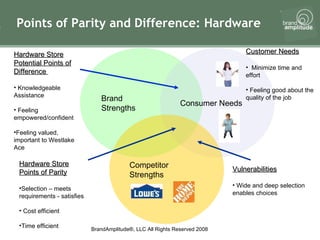
Points of Parity and Difference: Hardware Brand Strengths Consumer Needs Competitor Strengths Hardware Store Potential Points of Difference   Knowledgeable Assistance Feeling empowered/confident Feeling valued, important to Westlake Ace Hardware Store Points of Parity Selection – meets requirements - satisfies Cost efficient Time efficient Vulnerabilities Wide and deep selection enables choices Customer Needs Minimize time and effort Feeling good about the quality of the job
Brand Inventory Heritage/Historical Positionings (existing products) Brand Identity logos, icons or symbols Secondary associations Gaps between identity and image Organizational strengths Brand Values/Vision Product performance claims, proprietary technology/patents Third-party ratings or endorsements Where to Find Assets or Gaps A brand inventory identifies existing or potential assets that can be leveraged or gaps that need to be addressed to build or create sustainable points of differentiation.
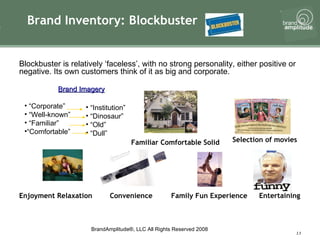
Brand Inventory: Blockbuster 8.10.06 Brand Imagery “ Corporate” “ Well-known” “ Familiar” “ Comfortable”  “ Institution” “ Dinosaur” “ Old” “ Dull” Familiar Comfortable Solid Selection of movies Entertaining Family Fun Experience Convenience Enjoyment Relaxation Blockbuster is relatively ‘faceless’, with no strong personality, either positive or negative. Its own customers think of it as big and corporate.
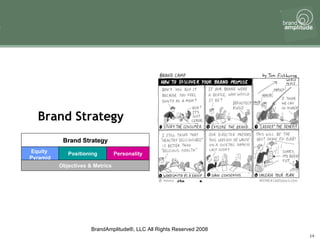
Brand Strategy Equity  Pyramid Positioning Objectives & Metrics Personality Brand Strategy
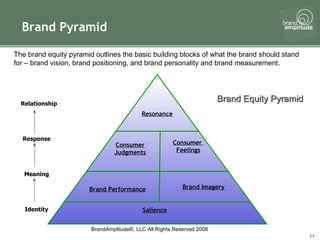
Brand Pyramid The brand equity pyramid outlines the basic building blocks of what the brand should stand for – brand vision, brand positioning, and brand personality and brand measurement.  Identity Relationship Response Meaning Brand Equity Pyramid  Resonance Consumer Judgments Consumer  Feelings Brand Imagery Brand Performance Salience
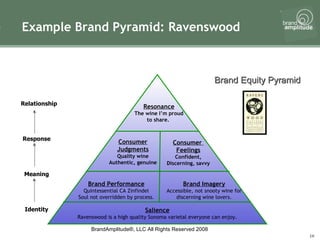
Example Brand Pyramid: Ravenswood Identity Relationship Response Meaning Brand Equity Pyramid  Resonance The wine I’m proud to share.  Consumer Judgments Quality wine Authentic, genuine Consumer  Feelings Confident, Discerning, savvy Brand Imagery Accessible, not snooty wine for discerning wine lovers. Brand Performance Quintessential CA Zinfindel Soul not overridden by process. Salience Ravenswood is a high quality Sonoma varietal everyone can enjoy.
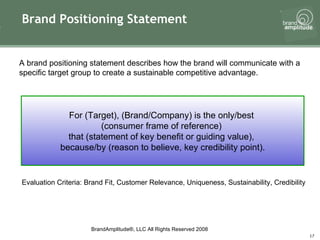
Brand Positioning Statement A brand positioning statement describes how the brand will communicate with a specific target group to create a sustainable competitive advantage. For (Target), (Brand/Company) is the only/best  (consumer frame of reference)  that (statement of key benefit or guiding value),  because/by (reason to believe, key credibility point). Evaluation Criteria: Brand Fit, Customer Relevance, Uniqueness, Sustainability, Credibility
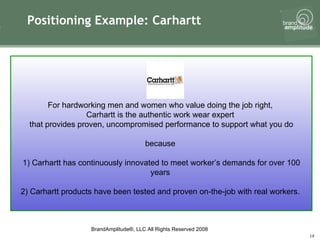
Positioning Example: Carhartt For hardworking men and women who value doing the job right,  Carhartt is the authentic work wear expert  that provides proven, uncompromised performance to support what you do because  1) Carhartt has continuously innovated to meet worker’s demands for over 100 years  2) Carhartt products have been tested and proven on-the-job with real workers.
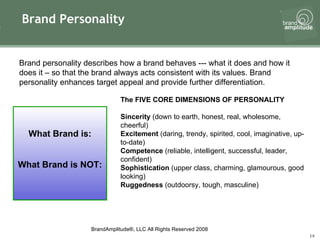
Brand Personality Brand personality describes how a brand behaves --- what it does and how it does it – so that the brand always acts consistent with its values. Brand personality enhances target appeal and provide further differentiation.  What Brand is: What Brand is NOT: The FIVE CORE DIMENSIONS OF PERSONALITY Sincerity  (down to earth, honest, real, wholesome, cheerful) Excitement  (daring, trendy, spirited, cool, imaginative, up-to-date) Competence  (reliable, intelligent, successful, leader, confident) Sophistication  (upper class, charming, glamourous, good looking) Ruggedness  (outdoorsy, tough, masculine)
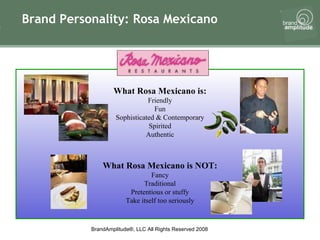
Brand Personality: Rosa Mexicano What Rosa Mexicano is: Friendly Fun Sophisticated & Contemporary Spirited Authentic What Rosa Mexicano is NOT: Fancy Traditional Pretentious or stuffy Take itself too seriously
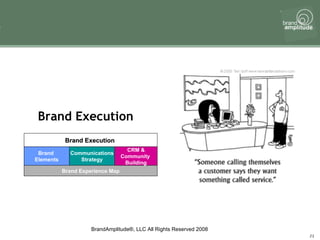
Brand Execution Brand Execution  Brand  Elements Communications Strategy Brand Experience Map CRM & Community  Building
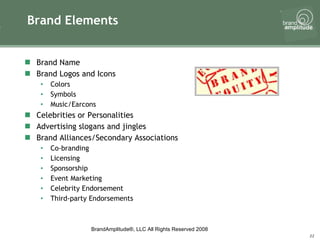
Brand Elements Brand Name Brand Logos and Icons Colors Symbols Music/Earcons Celebrities or Personalities Advertising slogans and jingles Brand Alliances/Secondary Associations Co-branding Licensing Sponsorship Event Marketing Celebrity Endorsement Third-party Endorsements
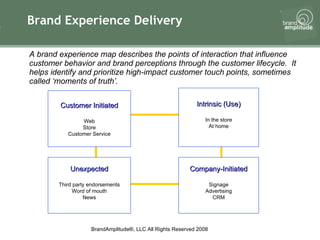
Brand Experience Delivery A brand experience map describes the points of interaction that influence customer behavior and brand perceptions through the customer lifecycle.  It helps identify and prioritize high-impact customer touch points, sometimes called ‘moments of truth’. Customer Initiated Web Store Customer Service Company-Initiated Signage Advertising CRM Unexpected Third party endorsements Word of mouth News Intrinsic (Use) In the store At home
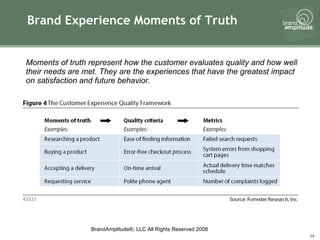
Brand Experience Moments of Truth Moments of truth represent how the customer evaluates quality and how well their needs are met. They are the experiences that have the greatest impact on satisfaction and future behavior.
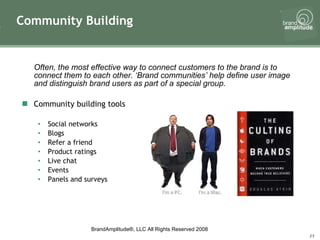
Often, the most effective way to connect customers to the brand is to connect them to each other. ‘Brand communities’ help define user image and distinguish brand users as part of a special group.  Community building tools Social networks Blogs Refer a friend Product ratings Live chat Events Panels and surveys Community Building
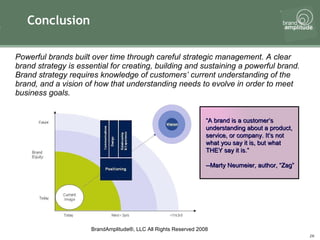
Conclusion Powerful brands built over time through careful strategic management. A clear brand strategy is essential for creating, building and sustaining a powerful brand.  Brand strategy requires knowledge of customers’ current understanding of the brand, and a vision of how that understanding needs to evolve in order to meet business goals.  “ A brand is a customer’s understanding about a product, service, or company. It’s not what you say it is, but what THEY say it is.” --Marty Neumeier, author, “Zag”

Brand strategy toolkit

  • 1.
    Everything you needto define a brand in one place
  • 2.
    Why A BrandStrategy Toolkit? Only one fourth of marketing and advertising professionals "...can clearly articulate (their) company's brand position to... clients, customers or prospective clients.“ (2) Strong brands never happen by accident. Yet only 53% of firms say they have a long term brand strategy in place .(1) Prophet, Best Practices Survey, 2002 Louws Management Corporation Survey, 2007 Often, what is missing is a shared set of tools for creating and implementing an effective brand strategy.
  • 3.
    What is BrandStrategy? A brand strategy is simply a plan for developing a coherent brand. It provides the means for systematically creating differentiation and consumer appeal by empowering better brand decisions across the organization. “ There is no tool better than the brand for uniting the forces and the stakeholders inside and around your company.” Thomas Gad, 4-D Branding: Cracking the Corporate Code of the Network Economy, 2001 “ The role of brands has evolved; brands are now company DNA, the spark from which all corporate life grows.” Will Murray, Brand Storm: A Tale of Passion, Betrayal, and Revenge, 2001 “ ...ideally, the brand will make black and white decisions not just at the top of the house, but also all the way down the line.” David F. D’Allesandro, Brand Warfare: 10 Rules for Building the Killer Brand, 2001 An effective brand strategy influences the total operation of a business to ensure consistent brand experiences for the customer.
  • 4.
    Brand Strategy andMarketing Strategy Brand Strategy is separate from the marketing mix. It guides and inform decisions about product strategy, placement, promotion and pricing. Brand strategy is an integral part of the overall strategic marketing process. It bridges the gap between business strategy, marketing objectives and marketing strategy. I. Corporate Objectives & Brand Portfolio II. Marketing Objectives III. Brand Strategy Communications Strategy Product and Pricing Strategy Channel and Distribution Strategy IV. Marketing Execution & Monitoring Strategic Marketing Process
  • 5.
    Brand Strategy ProcessTarget & Insight Brand Execution Brand Elements Competitive Assessment Brand Inventory Equity Pyramid Positioning Objectives & Metrics Personality Communications Strategy Brand Experience Map Brand Strategy Brand Audit CRM & Community Building Points of Parity and Difference The process of creating a brand strategy begins with a brand audit and ends with a plan for executing the brand across all touch points.
  • 6.
    Brand Audit Target& Insight Competitive Assessment Brand Inventory Brand Audit Points of Parity and Difference
  • 7.
    Target Insight Whereto Find Insights A target insight describes how a meaningful connection can be established between what the brand offers and the target’s explicit or implicit needs. Trends Motivations/”Sweet spots” Decision-making process/criteria Higher level benefits Image/Identity gaps New Segments Unmet needs
  • 8.
    Target Insight: WineEnthusiasts Enthusiasts are passionate about the entire wine experience. They enjoy researching what to buy and enjoying wine with friends and family. They like the whole culture of food, wine and knowing how to get the most out of the experience. “ So much variety to try. I like to look at labels but I also like to look at Wine Spectator. I really like to entertain, tasting wine with friends. It’s the best experience.”
  • 9.
    Competitive Assessment Competitiveassessment describes the customers’ perceived consideration set of alternatives and the brand’s advantages and disadvantages within that set. Rosa Mexicano Competitors Steak houses, and high end chains that offer good food in an unpretentious setting. Rosa’s has no direct Mexican cuisine competitors outside of New York, and very few within New York.
  • 10.
    Points of Parityand Difference Brand Strengths Consumer Needs Competitor Strengths Our PODs Potential Brand Differences POPs Points of Parity (Category Benefits) Vulnerabilities Their PODs Wants and Needs a POD’s analysis is to identify what ideas from our brand and competitive brands are most meaningful and potentially differentiating. The purpose of a POP’s analysis is to identify which category benefits are critical for establishing credibility.
  • 11.
    Points of Parityand Difference: Hardware Brand Strengths Consumer Needs Competitor Strengths Hardware Store Potential Points of Difference Knowledgeable Assistance Feeling empowered/confident Feeling valued, important to Westlake Ace Hardware Store Points of Parity Selection – meets requirements - satisfies Cost efficient Time efficient Vulnerabilities Wide and deep selection enables choices Customer Needs Minimize time and effort Feeling good about the quality of the job
  • 12.
    Brand Inventory Heritage/HistoricalPositionings (existing products) Brand Identity logos, icons or symbols Secondary associations Gaps between identity and image Organizational strengths Brand Values/Vision Product performance claims, proprietary technology/patents Third-party ratings or endorsements Where to Find Assets or Gaps A brand inventory identifies existing or potential assets that can be leveraged or gaps that need to be addressed to build or create sustainable points of differentiation.
  • 13.
    Brand Inventory: Blockbuster8.10.06 Brand Imagery “ Corporate” “ Well-known” “ Familiar” “ Comfortable” “ Institution” “ Dinosaur” “ Old” “ Dull” Familiar Comfortable Solid Selection of movies Entertaining Family Fun Experience Convenience Enjoyment Relaxation Blockbuster is relatively ‘faceless’, with no strong personality, either positive or negative. Its own customers think of it as big and corporate.
  • 14.
    Brand Strategy Equity Pyramid Positioning Objectives & Metrics Personality Brand Strategy
  • 15.
    Brand Pyramid Thebrand equity pyramid outlines the basic building blocks of what the brand should stand for – brand vision, brand positioning, and brand personality and brand measurement. Identity Relationship Response Meaning Brand Equity Pyramid Resonance Consumer Judgments Consumer Feelings Brand Imagery Brand Performance Salience
  • 16.
    Example Brand Pyramid:Ravenswood Identity Relationship Response Meaning Brand Equity Pyramid Resonance The wine I’m proud to share. Consumer Judgments Quality wine Authentic, genuine Consumer Feelings Confident, Discerning, savvy Brand Imagery Accessible, not snooty wine for discerning wine lovers. Brand Performance Quintessential CA Zinfindel Soul not overridden by process. Salience Ravenswood is a high quality Sonoma varietal everyone can enjoy.
  • 17.
    Brand Positioning StatementA brand positioning statement describes how the brand will communicate with a specific target group to create a sustainable competitive advantage. For (Target), (Brand/Company) is the only/best (consumer frame of reference) that (statement of key benefit or guiding value), because/by (reason to believe, key credibility point). Evaluation Criteria: Brand Fit, Customer Relevance, Uniqueness, Sustainability, Credibility
  • 18.
    Positioning Example: CarharttFor hardworking men and women who value doing the job right, Carhartt is the authentic work wear expert that provides proven, uncompromised performance to support what you do because 1) Carhartt has continuously innovated to meet worker’s demands for over 100 years 2) Carhartt products have been tested and proven on-the-job with real workers.
  • 19.
    Brand Personality Brandpersonality describes how a brand behaves --- what it does and how it does it – so that the brand always acts consistent with its values. Brand personality enhances target appeal and provide further differentiation. What Brand is: What Brand is NOT: The FIVE CORE DIMENSIONS OF PERSONALITY Sincerity (down to earth, honest, real, wholesome, cheerful) Excitement (daring, trendy, spirited, cool, imaginative, up-to-date) Competence (reliable, intelligent, successful, leader, confident) Sophistication (upper class, charming, glamourous, good looking) Ruggedness (outdoorsy, tough, masculine)
  • 20.
    Brand Personality: RosaMexicano What Rosa Mexicano is: Friendly Fun Sophisticated & Contemporary Spirited Authentic What Rosa Mexicano is NOT: Fancy Traditional Pretentious or stuffy Take itself too seriously
  • 21.
    Brand Execution BrandExecution Brand Elements Communications Strategy Brand Experience Map CRM & Community Building
  • 22.
    Brand Elements BrandName Brand Logos and Icons Colors Symbols Music/Earcons Celebrities or Personalities Advertising slogans and jingles Brand Alliances/Secondary Associations Co-branding Licensing Sponsorship Event Marketing Celebrity Endorsement Third-party Endorsements
  • 23.
    Brand Experience DeliveryA brand experience map describes the points of interaction that influence customer behavior and brand perceptions through the customer lifecycle. It helps identify and prioritize high-impact customer touch points, sometimes called ‘moments of truth’. Customer Initiated Web Store Customer Service Company-Initiated Signage Advertising CRM Unexpected Third party endorsements Word of mouth News Intrinsic (Use) In the store At home
  • 24.
    Brand Experience Momentsof Truth Moments of truth represent how the customer evaluates quality and how well their needs are met. They are the experiences that have the greatest impact on satisfaction and future behavior.
  • 25.
    Often, the mosteffective way to connect customers to the brand is to connect them to each other. ‘Brand communities’ help define user image and distinguish brand users as part of a special group. Community building tools Social networks Blogs Refer a friend Product ratings Live chat Events Panels and surveys Community Building
  • 26.
    Conclusion Powerful brandsbuilt over time through careful strategic management. A clear brand strategy is essential for creating, building and sustaining a powerful brand. Brand strategy requires knowledge of customers’ current understanding of the brand, and a vision of how that understanding needs to evolve in order to meet business goals. “ A brand is a customer’s understanding about a product, service, or company. It’s not what you say it is, but what THEY say it is.” --Marty Neumeier, author, “Zag”

Editor's Notes

  • #6 Customer understanding continually feeds the three step process of: Creating your Brand Promise Developing your Brand Strategy and Living your Brand
  • #14 BLOCKBUSTER is a brand that’s respected although not universally loved. As noted earlier, consumers functionally describe their relationship with BLOCKBUSTER, and even the most ardent Advocates are lacking in passion for the brand. The images above were all generated by heavy users – yet note a decided absence of strongly felt or consistent brand perceptions. The primary image is that of a large but dull corporation. Hardly the kind of brand people want to identify with. The underlying positive impressions of BLOCKBUSTER advocates are “neutralized” by the disparaging negativity that’s propagated by disenfranchised consumers. The absence of a deep-seeded passion for BLOCKBUSTER and lack of positive “buzz” translates into low levels of emotional conviction. It also raises concern that customers could be becoming apathetic toward the brand or losing relevance.
  • #16 A structured conversation with the aim of auditing the brand? emotion v fact reputation and values Are we where we need to be today Where’s the future of the brand? where do we want to go What’s the gap What mechanisms, actions, processes are available to drive the brand in the right direction and build appropriate and valuable equity?
  • #17 A structured conversation with the aim of auditing the brand? emotion v fact reputation and values Are we where we need to be today Where’s the future of the brand? where do we want to go What’s the gap What mechanisms, actions, processes are available to drive the brand in the right direction and build appropriate and valuable equity?
  • #18 A structured conversation with the aim of auditing the brand? emotion v fact reputation and values Are we where we need to be today Where’s the future of the brand? where do we want to go What’s the gap What mechanisms, actions, processes are available to drive the brand in the right direction and build appropriate and valuable equity?
  • #20 A structured conversation with the aim of auditing the brand? emotion v fact reputation and values Are we where we need to be today Where’s the future of the brand? where do we want to go What’s the gap What mechanisms, actions, processes are available to drive the brand in the right direction and build appropriate and valuable equity?
  • #24 Identify key behaviors, don’t have to tranform CWSR’s into sales people, start off with a key behaviors.