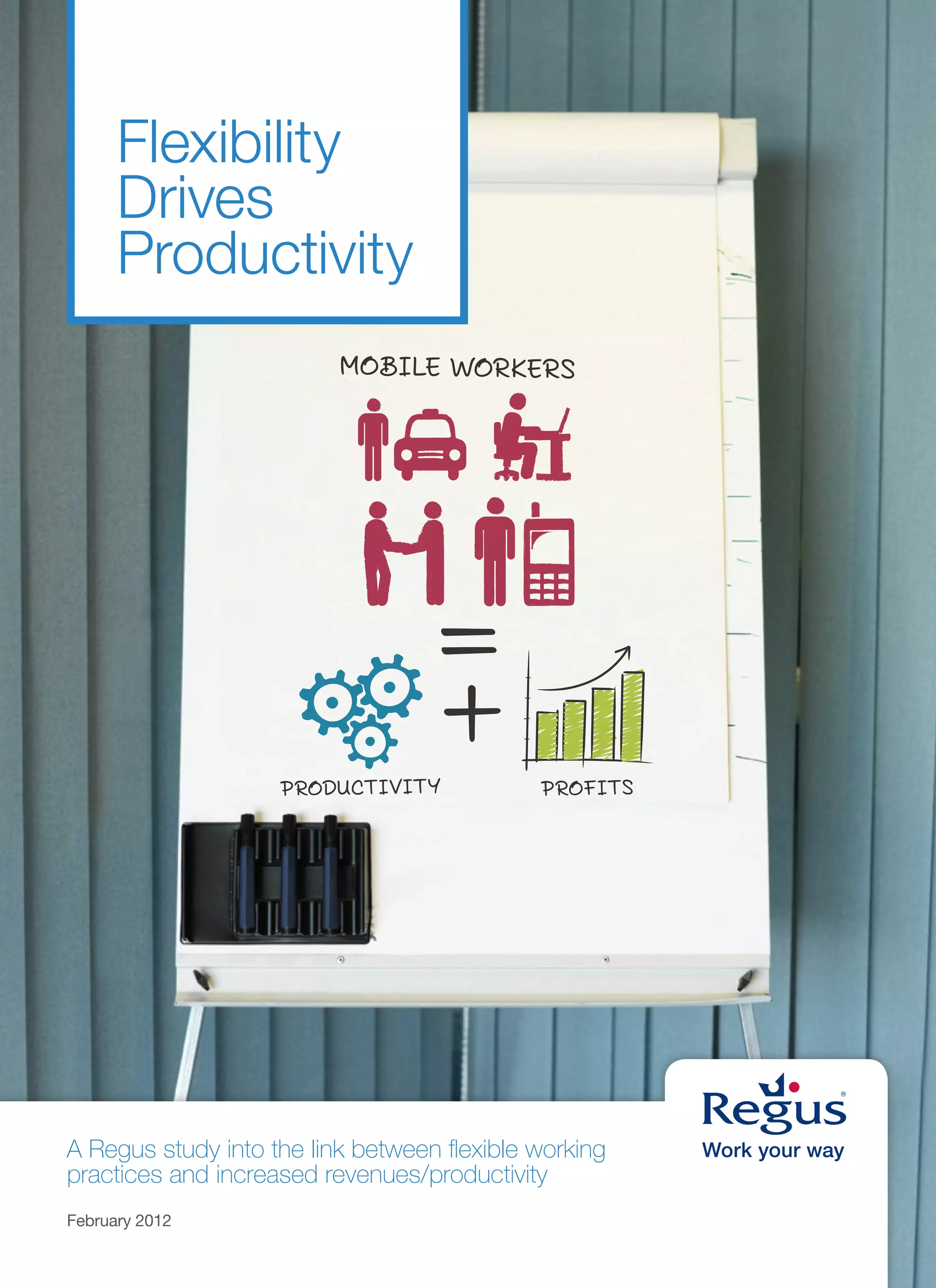
Flexibility
      Drives
      Productivity
                          MOBILE WORKERS


                                   =
                                   +
                    productivity             profits


A Regus study into the link between flexible working
practices and increased revenues/productivity
February 2012
Flexibility
      Drives
      Productivity


A Regus study into the link between flexible working
practices and increased revenues/productivity
February 2012
Abstract

           Flexible ways of working are becoming more the norm
           as businesses and employees enjoy the personal and
           commercial benefits these practices afford. This report
           now provides hard, independent research evidence
           that business internationally have found that flexible
           working produces and enables real increases in
           productivity and greater revenue generation.
           Business managers across the globe report that staff are more energized and
           motivated thanks to flexible working. This results in additional benefits, with
           energized, motivated staff less likely to leave their company. Flexible working is being
           successfully used as an important talent retention tool.

           With more than half of firms internationally looking to hire more freelancers in
           the coming year, there is a growing requirement to provide a flexible working
           environment that accommodates increasingly mixed (full-time, part-time and
           freelance) workforces.


                                     Flexibility Drives Productivity | February 2012 | Page 3
Management summary
        •	 This	report	provides	hard	research	evidence	that	businesses	globally	feel	that	
           flexible working helps companies overcome barriers for growth.

        •	 The	majority	(72%)	of	global	businesses	report	that	increased	productivity	is	a	
           direct result of flexible working practices.

        •	 In	almost	all	cases	(68%)	firms	declare	that	flexible	working	has	led	to	staff	
           generating increased revenue.

        •	 This	is	particularly	the	case	in	emerging	economies	that	appear	to	have	made	
           flexible working a key part of their development push and are even more likely
           than mature economies to directly link work flexibility with greater productivity
           and increased revenues.

        •	 Small	businesses	have	embraced	flexible	working	more	willingly	than	the	norm,	
           with	80%	of	small	company	managers	saying	that	their	company	works	more	
           flexibly	than	it	used	to	compared	with	68%	of	large	business	commentators.

        •	 Although	small	and	large	businesses	globally	agree	that	they	generate	more	
           revenue	working	flexibly	(69%)	small	businesses	are	more	convinced	that	
           productivity	is	a	direct	result	of	flexible	working	(76%)	than	large	businesses	(64%).

        •	 Flexible	working	also	helps	staff	feel	more	energized	and	motivated	(63%),	
           highlighting that flexible working practices are also a key talent-retention tool.

        •	 The	majority	of	workers	report	that	they	are	working	on	the	move	more	than	
           they used to making the availability of work centres in every city an increasingly
           attractive proposition, particularly to small businesses that cannot rely on a
           network of company offices when they leave their headquarters.

        •	 Half	(51%)	of	firms	intend	to	hire	more	freelancers	in	the	next	year,	and	80%	
           respondents believe that there will be a surge in people that plan to go part-
           time in their career path - indicating an increasing demand for a flexible work
           environment to accommodate such staff.


                                  Flexibility Drives Productivity | February 2012 | Page 4
Introduction

                                            Across the globe flexible ways of working are
                                            becoming increasingly the norm in business.1 The
                                            benefits that are leading businesses and workers to
                                            opt for more flexible work solutions, whether flexible
                                            work-time or alternative location arrangements, are
                                            manifold and range from a better work/life balance for
                                            workers, to increased motivation. Flexible working is
                                            also acknowledged to be a driver of economic growth
                                            with governments calling for changes in working
                                            practices. In the UK for example more than three-
                                            quarters of the public (79%) and around two-thirds
                                            (69%) of MPs believe that more needs to be done
                                            to help organisations implement flexible working to
                                            stimulate economic growth.2
The number of                               Similar	calls	to	action	are	being	made	across	the	globe	with	a	survey	report	
                                            authored by Valerie Jarrett, senior advisor and assistant to President Obama for
mobile workers                              intergovernmental	affairs	and	public	engagement,	reporting	that	if	all	U.S.	firms	
in	the	USA	is	                              adopted	flexible	work	schedules,	a	saving	of	$15	billion	per	year	could	be	achieved.	
                                            In	December	2010,	the	Obama	signed	the	Telework	Enhancement	Act,	providing	
expected to grow                            federal agencies with greater flexibility in the workforce.3	In	fact,	in	the	USA,	the	
to	119.7	million	                           number	of	mobile	workers	in	the	USA	is	expected	to	grow	to	119.7	million	by	2013	
by	2013                                     and	similar	growth	trends	are	expected	across	the	globe;	In	the	Asia/Pacific	region	
                                            mobile	workers	are	expected	to	hit	734.5	million	in	2013,	compared	to	546.4	million	
                                            in	2008	while	Western	Europe’s	mobile	worker	growth	should	reach	129.5	million	by	
                                            the same date.4

                                            The	Australian	productivity	commission	also	recently	highlighted	the	importance	
                                            of adopting flexible working practices in order to help close the productivity gap
                                            between	Australia	and	other	countries	such	as	the	USA.5	In	Europe,	on	the	other	
                                            hand German research into tension between workplace policies and the level
                                            of	autonomy	given	to	employees	to	carve	out	their	own	work/life	balance	found	
                                            that as the employees were given more autonomy in decisions about their work
                                            arrangements,	they	experienced	less	work/life	conflict.6


1
    Regus	and	ZZA	Responsive	User	Environments,	Why	place	still	matters	in	the	digital	age,	October	2011
2
    Personnel	Today,	More	needs	to	be	done	to	boost	flexible	working,	says	survey,	19th	September	2011
3
    The	Society	for	Human	Resource	management,	White	House	Advisor:	Workplace	Flexibility	‘Will	Keep	America	Competitive’,	21st	June	2011
4
    Source:	IDC,	Worldwide	Mobile	Worker	Population	2009-2013	Forecast,June	2010
5
    Economic	Structure	and	Performance	of	the	Australian	Retail	Industry,	Draft	Report,	p.286.
6
    Kattenbach	R.,	Demerouti	E.,	&	Nachreiner	F.,	(2010)	‘Flexible	working	times:	effects	on	employees’	exhaustion,	work-nonwork	conflict	and	job	performance’,	
    (Career	Development	International),	Vol.15,	No.	3,	pp	279-295


                                                                               Flexibility Drives Productivity | February 2012 | Page 5
Introduction
Flexible working is                          Without a doubt technological advances have made it easier for workers to work
                                             from any location and recent Regus reports show that businesses have given flexible
expected to help                             working	the	vote	of	confidence	with	81%	offering	their	staff	alternative	options	to	
returning mothers                            fixed office working.7 Technology is also becoming more affordable and scalable
                                             with even bootstrapped businesses finding it is easy to operate taking advantage of
to accommodate                               offerings that enable remote working such as low cost or free video conferencing
work and family                              and instant messaging.
demands
                                             Currently	over	half	of	the	world	have	access	to	voice-capable	mobile	telephony	
                                             and	by	2020	the	majority	of	global	population	is	expected	to	have	access	to	mobile	
                                             telephony	(80%)	and	to	smart	phone	or	low	cost	tablet	computers.8 These trends
                                             are	expected	to	impact	working	practices	significantly.	Interestingly,	although,	Japan	
                                             is a leader in consumer mobile technology, ingrained cultural habits mean that
                                             enterprise mobile technologies have seen slower take up.9

                                             Europe	and	Russia-wide	research	confirms	that	67%	of	workers	in	Europe	feel	
                                             that when employees are given freedom and control over their working lives are
                                             happier employees.10 Flexible working is also recognized as an effective practice
                                             for rewarding and retaining employees with families,11 however, it is disappointing
                                             to note that flexible working is too often only associated with this segment of the
                                             workforce and overlooked as a benefit for other demographic groups. Older workers
                                             for	example	were	found	by	Demos	in	the	UK	to	be	the	most	likely	to	have	their	
                                             request for flexible working turned down.12

                                             Studies	show	that	women	that	have	left	the	work	force	at	some	point	in	their	careers	
                                             to	raise	children	still	experience	difficulties	re-entering	the	world	of	work.	In	the	
                                             same	study	only	74	percent	of	returning	mothers	who	sought	re-employment	found	
                                             jobs,	and	only	40	percent	of	those	roles	were	full-time.	Flexible	working	is	expected	
                                             to help returning mothers to accommodate work and family demands improving
                                             employment opportunities and economic growth.13

                                             The	workforce	is	rapidly	changing.	As	retirement	ages	are	raised	by	western	
                                             economies in their deficit shrinking strategies, more and more workers consider
                                             alternative ways of winding down their career as they approach retirement age.
                                             A	survey	by	the	Transamerica	Center	for	Retirement	Studies	confirms	that	half	of	
                                             workers	plan	to	remain	employed	after	retirement	mostly	in	part-time	jobs.14 Part-
                                             time arrangements are therefore becoming more common not only for mothers that
                                             work but for older workers and for fathers thanks to legislation encouraging families
                                             to share parenting more evenly.


7
     Regus,	Flexible	working	goes	global,	March	2011
8
     Institute	for	the	Future	+	Rockefeller	Foundation,	2020	Forecast:	The	Future	of	Cities,	Information	and	Inclusion	January	2011
9
     Source:	IDC,	Worldwide	Mobile	Worker	Population	2009-2013	Forecast,June	2010
10
     Avaya/Dynamic	Markets,	Flexible	working	2009,	2009
11
     Regus,	Flexible	working	goes	global,	March	2011
12
     Demos,	Reinventing	the	workplace,	August	2011
13
     Knoll,.	Future	Work	and	Work	Trends,	April	2009
14
     CNBC,	Part-Time	Retirement,	Part-Time	Work


                                                                                  Flexibility Drives Productivity | February 2012 | Page 6
Introduction
60%	of	global	                             Millenials,	or	generation	Y	workers,	are	also	proving	to	be	much	more	driven	by	quality	
                                           of life offered by prospective employment than by salary and their highly technological
workers believe                            mind-set	means	that	they	are	even	more	likely	to	question	the	traditional	9-5	fixed	office	
that flexible                              mentality and favour flexible and mobile working arrangements.15	A	Cisco	survey	of	
                                           young	people	globally	confirming	this	insight	found	that	40%	of	students	and	45%	of	
working practices                          young	employees	would	accept	a	lower-paying	job	if	it	had	more	flexibility	on	device	
improve	work/life	                         choice,	social	media	access,	and	mobility	than	a	higher-paying	job	with	less	flexibility.	
balance                                    29%	of	college	students	believe	that	once	they	begin	working,	it	will	be	their	right	to	
                                           be	able	to	work	remotely	with	a	flexible	schedule,	this	peaks	at	65%	among	Chinese	
                                           college students. By contrast France is the country where face to face interaction in the
                                           office was seen as most important.16

                                           These radical views are shared by new workers in developed and emerging economies
                                           alike	with	22%	of	Indian	young	people	declaring	that	they	‘will	never	join	another	
                                           company	that	does	not	acknowledge	the	benefits	of	remote	workforces	–	they‘re	too	
                                           old-fashioned	in	their	thinking’.	This	compares	with	19%	of	Brazilians,	14%	of	Japanese	
                                           and	only	3%	of	USA	youths.	25%	of	Mexican	college	students	and	young	professionals	
                                           declared	that	they	are	inclined	to	look	for	other	jobs	and	leave	sooner	rather	than	later	if	
                                           they	are	not	offered	remote	access.	11%	of	USA	and	13%	of	UK	young	people	shared	
                                           this view highlighting that flexibility is set to become a vital aspect of employee retention.17

                                           These findings confirm that in the search and selection of new talent firms will no
                                           longer be able to ignore flexible working opportunities, regarded as an important way
                                           of retaining top talent and of singing up valuable employees. Proof that flexible working
                                           is already being successfully used to retain staff was found by a recent Regus report
                                           confirming	that	60%	of	global	workers	believe	that	flexible	working	practices	improve	
                                           work/life	balance	and	21%	feel	that	offering	these	solutions	helps	them	attract	a	wider	
                                           talent pool and even allows them to employ valuable people that live in more remote
                                           areas	(19%).18

                                           In	addition	to	a	changing	workforce,	businesses	are	also	more	aware	than	ever	of	the	
                                           impact that rapid changes in world economic outlook can have on their volume of
                                           business. Remaining lean and scalable is a vital part of being prepared to face all kinds of
                                           conditions from rapid growth to contraction. Businesses globally have in fact been found
                                           to	agree	that	flexible	working	is	more	cost	effective	than	fixed	office	working	(60%).19
                                           In	addition	to	this,	studies	report	that	on	average	55%+	of	desks	are	unused	in	any	
                                           office	at	any	one	point,	which	combined	with	worker’s	demands	for	more	flexible	work	
                                           arrangements, suggests that a more intelligent use of desk space is urgently required.20

                                           Previous	studies	by	Regus	show	that	41%	of	businesses	believe	that	flexible	working	
                                           improves employee productivity and a third believe that motivation also increases when
                                           flexible working is introduced. To shed some light into the actual value that can be
                                           brought to business efficiency through flexible working Regus commissioned global
                                           research	interviewing	over	16,000	senior	manager	and	business	owners	globally.


15
     Regus	and	Unwired	Ventures	Ltd,	VWork:	measuring	the	benefits	of	agility	at	work,	May	2011
16
     Cisco,	Connected	World,	2011
17
     Ibid.
18
     Regus,	Flexible	working	goes	global,	March	2011
19
     Regus,	Flexible	working	goes	global,	March	2011
20
     Regus/Unwired	Research,	Agility@Work,	2010;	see	also,	Regus/	ZZA	Responsive	User	Environments,	Liveable	Lives,	March	2010


                                                                             Flexibility Drives Productivity | February 2012 | Page 7
Key results

          Productivity and revenue generation
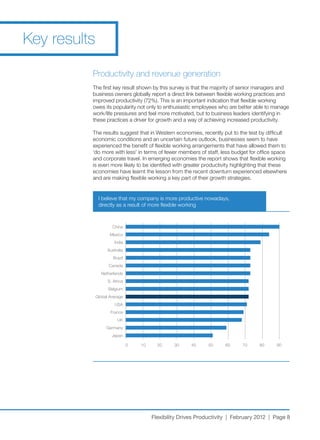
          The	first	key	result	shown	by	this	survey	is	that	the	majority	of	senior	managers	and	
          business owners globally report a direct link between flexible working practices and
          improved	productivity	(72%).	This	is	an	important	indication	that	flexible	working	
          owes its popularity not only to enthusiastic employees who are better able to manage
          work/life	pressures	and	feel	more	motivated,	but	to	business	leaders	identifying	in	
          these practices a driver for growth and a way of achieving increased productivity.

          The results suggest that in Western economies, recently put to the test by difficult
          economic conditions and an uncertain future outlook, businesses seem to have
          experienced the benefit of flexible working arrangements that have allowed them to
          ‘do	more	with	less’	in	terms	of	fewer	members	of	staff,	less	budget	for	office	space	
          and	corporate	travel.	In	emerging	economies	the	report	shows	that	flexible	working	
          is even more likely to be identified with greater productivity highlighting that these
          economies have learnt the lesson from the recent downturn experienced elsewhere
          and are making flexible working a key part of their growth strategies.


               I	believe	that	my	company	is	more	productive	nowadays,	
               directly as a result of more flexible working


                      China
                     Mexico
                        India
                    Australia
                       Brazil
                    Canada
                Netherlands
                    S. Africa
                    Belgium
              Global Average
                        USA
                     France
                         UK
                   Germany
                      Japan

                                0   10     20     30     40     50    60     70     80     90


                                         Flexibility Drives Productivity | February 2012 | Page 8
Key results
          In	particular	China	(90%),	India	(79%),	Mexico	(84%)	are	converts	to	the	productivity	
          benefits brought about by flexible working. Western economies are also enthusiastic
          with	71%	of	respondents	identifying	flexibility	as	the	driver	of	greater	productivity	in	
          the	USA,	69%	in	France	and	68%	in	the	UK.	The	country	least	convinced	is	Japan,	
          where	respondents	are	split	with	only	51%	of	companies	reporting	a	link	between	
          flexible	working	and	productivity.	Japanese	companies	(65%)	are	also	less	likely	to	
          have	increased	their	use	of	flexible	working	practices	(75%)	indicating	that	perhaps,	
          as these practices become more mainstream, the proportion of businesses
          reporting benefits may become more aligned to the global average.

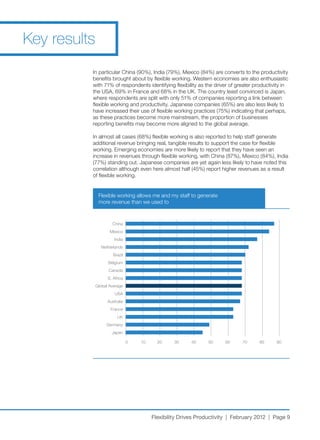
          In	almost	all	cases	(68%)	flexible	working	is	also	reported	to	help	staff	generate	
          additional revenue bringing real, tangible results to support the case for flexible
          working.	Emerging	economies	are	more	likely	to	report	that	they	have	seen	an	
          increase	in	revenues	through	flexible	working,	with	China	(87%),	Mexico	(84%),	India	
          (77%)	standing	out.	Japanese	companies	are	yet	again	less	likely	to	have	noted	this	
          correlation	although	even	here	almost	half	(45%)	report	higher	revenues	as	a	result	
          of flexible working.


               Flexible working allows me and my staff to generate
               more revenue than we used to


                      China
                     Mexico
                        India
                Netherlands
                       Brazil
                    Belgium
                    Canada
                    S. Africa
              Global Average
                        USA
                    Australia
                     France
                         UK
                   Germany
                      Japan

                                0   10     20     30     40     50    60     70      80      90


                                         Flexibility Drives Productivity | February 2012 | Page 9
Key results

          Motivation
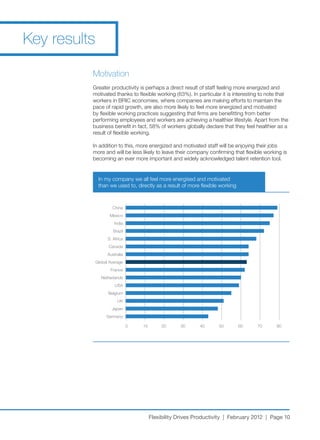
          Greater productivity is perhaps a direct result of staff feeling more energized and
          motivated	thanks	to	flexible	working	(63%).	In	particular	it	is	interesting	to	note	that	
          workers	in	BRIC	economies,	where	companies	are	making	efforts	to	maintain	the	
          pace of rapid growth, are also more likely to feel more energized and motivated
          by flexible working practices suggesting that firms are benefitting from better
          performing	employees	and	workers	are	achieving	a	healthier	lifestyle.	Apart	from	the	
          business	benefit	in	fact,	58%	of	workers	globally	declare	that	they	feel	healthier	as	a	
          result of flexible working.

          In	addition	to	this,	more	energized	and	motivated	staff	will	be	enjoying	their	jobs	
          more and will be less likely to leave their company confirming that flexible working is
          becoming an ever more important and widely acknowledged talent retention tool.


               In	my	company	we	all	feel	more	energised	and	motivated	
               than we used to, directly as a result of more flexible working


                      China
                     Mexico
                        India
                       Brazil
                    S. Africa
                    Canada
                    Australia
              Global Average
                     France
                Netherlands
                        USA
                    Belgium
                         UK
                      Japan
                   Germany

                                0   10        20     30      40      50         60   70      80


                                         Flexibility Drives Productivity | February 2012 | Page 10
Key results

                                         The evolving workforce
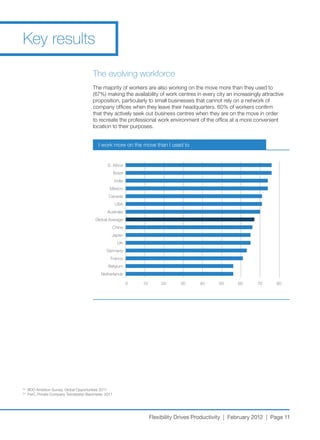
                                         The	majority	of	workers	are	also	working	on	the	move	more	than	they	used	to	
                                         (67%)	making	the	availability	of	work	centres	in	every	city	an	increasingly	attractive	
                                         proposition, particularly to small businesses that cannot rely on a network of
                                         company	offices	when	they	leave	their	headquarters.	60%	of	workers	confirm	
                                         that they actively seek out business centres when they are on the move in order
                                         to recreate the professional work environment of the office at a more convenient
                                         location to their purposes.


                                             I	work	more	on	the	move	than	I	used	to


                                                  S. Africa
                                                        Brazil
                                                        India
                                                   Mexico
                                                  Canada
                                                         USA
                                                  Australia
                                           Global Average
                                                    China
                                                    Japan
                                                          UK
                                                 Germany
                                                   France
                                                  Belgium
                                              Netherlands

                                                                 0   10        20     30      40      50      60     70      80


22
     BDO	Ambition	Survey,	Global	Opportunities	2011
23
     PwC,	Private	Company	Trendsetter	Barometer,	2011


                                                                          Flexibility Drives Productivity | February 2012 | Page 11
Key results
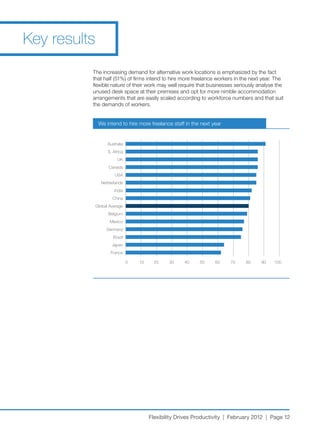
          The increasing demand for alternative work locations is emphasized by the fact
          that	half	(51%)	of	firms	intend	to	hire	more	freelance	workers	in	the	next	year.	The	
          flexible nature of their work may well require that businesses seriously analyse the
          unused desk space at their premises and opt for more nimble accommodation
          arrangements that are easily scaled according to workforce numbers and that suit
          the demands of workers.


               We intend to hire more freelance staff in the next year


                    Australia
                    S. Africa
                         UK
                    Canada
                        USA
                Netherlands
                        India
                      China
              Global Average
                    Belgium
                     Mexico
                   Germany
                       Brazil
                      Japan
                     France

                                0   10     20    30    40    50    60     70    80    90   100


                                         Flexibility Drives Productivity | February 2012 | Page 12
Key results
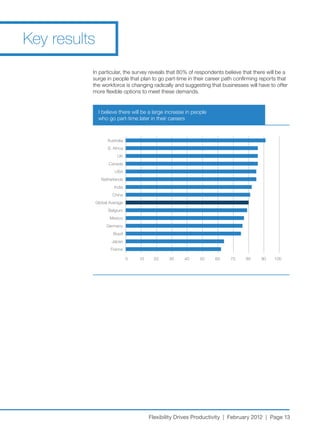
          In	particular,	the	survey	reveals	that	80%	of	respondents	believe	that	there	will	be	a	
          surge in people that plan to go part-time in their career path confirming reports that
          the workforce is changing radically and suggesting that businesses will have to offer
          more flexible options to meet these demands.


               I	believe	there	will	be	a	large	increase	in	people	
               who go part-time later in their careers


                    Australia
                    S. Africa
                         UK
                    Canada
                        USA
                Netherlands
                        India
                      China
              Global Average
                    Belgium
                     Mexico
                   Germany
                       Brazil
                      Japan
                     France

                                0   10     20    30    40     50     60   70    80    90   100


                                         Flexibility Drives Productivity | February 2012 | Page 13
Key results

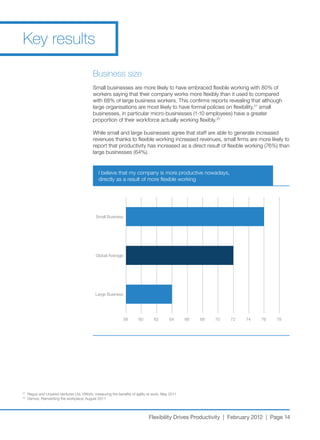
                                            Business size
                                            Small	businesses	are	more	likely	to	have	embraced	flexible	working	with	80%	of	
                                            workers saying that their company works more flexibly than it used to compared
                                            with	68%	of	large	business	workers.	This	confirms	reports	revealing	that	although	
                                            large organisations are most likely to have formal policies on flexibility,21 small
                                            businesses,	in	particular	micro-businesses	(1-10	employees)	have	a	greater	
                                            proportion of their workforce actually working flexibly.22

                                            While small and large businesses agree that staff are able to generate increased
                                            revenues thanks to flexible working increased revenues, small firms are more likely to
                                            report	that	productivity	has	increased	as	a	direct	result	of	flexible	working	(76%)	than	
                                            large	businesses	(64%).


                                               I	believe	that	my	company	is	more	productive	nowadays,	
                                               directly as a result of more flexible working


                                              Small Business


                                              Global Average


                                              Large Business


                                                               58       60       62       64      66   68   70   72   74   76    78


21
     Regus	and	Unwired	Ventures	Ltd,	VWork:	measuring	the	benefits	of	agility	at	work,	May	2011
22
     Demos,	Reinventing	the	workplace,	August	2011


                                                                              Flexibility Drives Productivity | February 2012 | Page 14
Key results

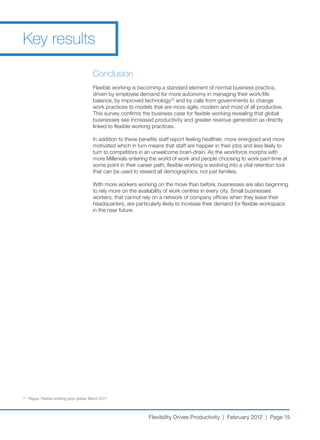
                                            Conclusion
                                            Flexible working is becoming a standard element of normal business practice,
                                            driven	by	employee	demand	for	more	autonomy	in	managing	their	work/life	
                                            balance, by improved technology23 and by calls from governments to change
                                            work practices to models that are more agile, modern and most of all productive.
                                            This survey confirms the business case for flexible working revealing that global
                                            businesses see increased productivity and greater revenue generation as directly
                                            linked to flexible working practices.

                                            In	addition	to	these	benefits	staff	report	feeling	healthier,	more	energized	and	more	
                                            motivated	which	in	turn	means	that	staff	are	happier	in	their	jobs	and	less	likely	to	
                                            turn	to	competitors	in	an	unwelcome	brain-drain.	As	the	workforce	morphs	with	
                                            more Millenials entering the world of work and people choosing to work part-time at
                                            some point in their career path, flexible working is evolving into a vital retention tool
                                            that	can	be	used	to	reward	all	demographics,	not	just	families.	

                                            With more workers working on the move than before, businesses are also beginning
                                            to	rely	more	on	the	availability	of	work	centres	in	every	city.	Small	businesses	
                                            workers, that cannot rely on a network of company offices when they leave their
                                            headquarters, are particularly likely to increase their demand for flexible workspace
                                            in the near future.


23
     	Regus,	Flexible	working	goes	global,	March	2011


                                                                     Flexibility Drives Productivity | February 2012 | Page 15
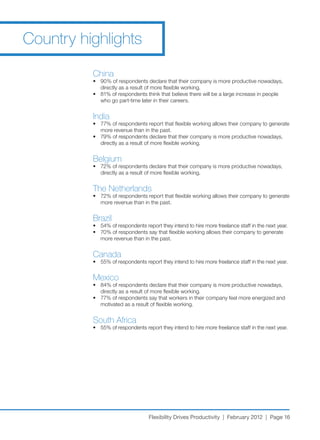
Country highlights

          China
          •	 90%	of	respondents	declare	that	their	company	is	more	productive	nowadays,	
             directly as a result of more flexible working.
          •	 81%	of	respondents	think	that	believe	there	will	be	a	large	increase	in	people	
             who go part-time later in their careers.


          India
          •	 77%	of	respondents	report	that	flexible	working	allows	their	company	to	generate	
             more revenue than in the past.
          •	 79%	of	respondents	declare	that	their	company	is	more	productive	nowadays,	
             directly as a result of more flexible working.


          Belgium
          •	 72%	of	respondents	declare	that	their	company	is	more	productive	nowadays,	
             directly as a result of more flexible working.


          The Netherlands
          •	 72%	of	respondents	report	that	flexible	working	allows	their	company	to	generate	
             more revenue than in the past.


          Brazil
          •	 54%	of	respondents	report	they	intend	to	hire	more	freelance	staff	in	the	next	year.
          •	 70%	of	respondents	say	that	flexible	working	allows	their	company	to	generate	
             more revenue than in the past.


          Canada
          •	 55%	of	respondents	report	they	intend	to	hire	more	freelance	staff	in	the	next	year.


          Mexico
          •	 84%	of	respondents	declare	that	their	company	is	more	productive	nowadays,	
             directly as a result of more flexible working.
          •	 77%	of	respondents	say	that	workers	in	their	company	feel	more	energized	and	
             motivated as a result of flexible working.


          South Africa
          •	 55%	of	respondents	report	they	intend	to	hire	more	freelance	staff	in	the	next	year.


                                  Flexibility Drives Productivity | February 2012 | Page 16
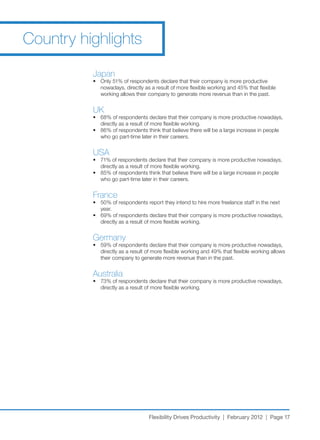
Country highlights

          Japan
          •	 Only	51%	of	respondents	declare	that	their	company	is	more	productive	
             nowadays,	directly	as	a	result	of	more	flexible	working	and	45%	that	flexible	
             working allows their company to generate more revenue than in the past.


          UK
          •	 68%	of	respondents	declare	that	their	company	is	more	productive	nowadays,	
             directly as a result of more flexible working.
          •	 86%	of	respondents	think	that	believe	there	will	be	a	large	increase	in	people	
             who go part-time later in their careers.


          USA
          •	 71%	of	respondents	declare	that	their	company	is	more	productive	nowadays,	
             directly as a result of more flexible working.
          •	 85%	of	respondents	think	that	believe	there	will	be	a	large	increase	in	people	
             who go part-time later in their careers.


          France
          •	 50%	of	respondents	report	they	intend	to	hire	more	freelance	staff	in	the	next	
             year.
          •	 69%	of	respondents	declare	that	their	company	is	more	productive	nowadays,	
             directly as a result of more flexible working.


          Germany
          •	 59%	of	respondents	declare	that	their	company	is	more	productive	nowadays,	
             directly	as	a	result	of	more	flexible	working	and	49%	that	flexible	working	allows	
             their company to generate more revenue than in the past.


          Australia
          •	 73%	of	respondents	declare	that	their	company	is	more	productive	nowadays,	
             directly as a result of more flexible working.


                                  Flexibility Drives Productivity | February 2012 | Page 17
About Regus

        Regus is the world’s largest provider of flexible
        workplaces, with products and services ranging from
        fully equipped offices to professional meeting rooms,
        business lounges and the world’s largest network of
        video communication studios. Regus enables people
        to work their way, whether it’s from home, on the road
        or from an office.
        Customers	such	as	Google,	GlaxoSmithKline,	and	Nokia	join	hundreds	of	thousands	
        of growing small and medium businesses that benefit from outsourcing their office
        and workplace needs to Regus, allowing them to focus on their core activities.

        Over	900,000	customers	a	day	benefit	from	Regus	facilities	spread	across	a	global	
        footprint	of	1,200	locations	in	550	cities	and	94	countries,	which	allow	individuals	
        and companies to work wherever, however and whenever they want to. Regus was
        founded	in	Brussels,	Belgium	in	1989,	is	headquartered	in	Luxembourg	and	listed	on	
        the	London	Stock	Exchange.	For	more	information	please	visit:	www.regus.com


        Methodology
        Over	16,000	business	respondents	from	the	Regus	global	contacts	database	
        spanning	88	countries	were	interviewed	during	January	2012.	The	Regus	
        global	contacts	database	of	over	1	million	business-people	worldwide	is	highly	
        representative of business owners and senior managers across the globe.
        Respondents were asked a wide variety of questions including ones about their ways
        of working, flexible working in their company and its effects along with their intentions
        to hire and views on changes in working practices. The survey was managed and
        administered	by	the	independent	organisation,	Mindmetre	–	www.mindmetre.co.uk.	


                                 Flexibility Drives Productivity | February 2012 | Page 18
Notes


        Flexibility Drives Productivity | February 2012 | Page 19
Whilst every effort has been taken to verify the accuracy
of this information, Regus cannot accept any responsibility
or liability for reliance by any person on this report or any of the
information, opinions or conclusions set out in this report.

Flexibility Drives Productivity

  • 1.
    Flexibility Drives Productivity MOBILE WORKERS = + productivity profits A Regus study into the link between flexible working practices and increased revenues/productivity February 2012
  • 2.
    Flexibility Drives Productivity A Regus study into the link between flexible working practices and increased revenues/productivity February 2012
  • 3.
    Abstract Flexible ways of working are becoming more the norm as businesses and employees enjoy the personal and commercial benefits these practices afford. This report now provides hard, independent research evidence that business internationally have found that flexible working produces and enables real increases in productivity and greater revenue generation. Business managers across the globe report that staff are more energized and motivated thanks to flexible working. This results in additional benefits, with energized, motivated staff less likely to leave their company. Flexible working is being successfully used as an important talent retention tool. With more than half of firms internationally looking to hire more freelancers in the coming year, there is a growing requirement to provide a flexible working environment that accommodates increasingly mixed (full-time, part-time and freelance) workforces. Flexibility Drives Productivity | February 2012 | Page 3
  • 4.
    Management summary • This report provides hard research evidence that businesses globally feel that flexible working helps companies overcome barriers for growth. • The majority (72%) of global businesses report that increased productivity is a direct result of flexible working practices. • In almost all cases (68%) firms declare that flexible working has led to staff generating increased revenue. • This is particularly the case in emerging economies that appear to have made flexible working a key part of their development push and are even more likely than mature economies to directly link work flexibility with greater productivity and increased revenues. • Small businesses have embraced flexible working more willingly than the norm, with 80% of small company managers saying that their company works more flexibly than it used to compared with 68% of large business commentators. • Although small and large businesses globally agree that they generate more revenue working flexibly (69%) small businesses are more convinced that productivity is a direct result of flexible working (76%) than large businesses (64%). • Flexible working also helps staff feel more energized and motivated (63%), highlighting that flexible working practices are also a key talent-retention tool. • The majority of workers report that they are working on the move more than they used to making the availability of work centres in every city an increasingly attractive proposition, particularly to small businesses that cannot rely on a network of company offices when they leave their headquarters. • Half (51%) of firms intend to hire more freelancers in the next year, and 80% respondents believe that there will be a surge in people that plan to go part- time in their career path - indicating an increasing demand for a flexible work environment to accommodate such staff. Flexibility Drives Productivity | February 2012 | Page 4
  • 5.
    Introduction Across the globe flexible ways of working are becoming increasingly the norm in business.1 The benefits that are leading businesses and workers to opt for more flexible work solutions, whether flexible work-time or alternative location arrangements, are manifold and range from a better work/life balance for workers, to increased motivation. Flexible working is also acknowledged to be a driver of economic growth with governments calling for changes in working practices. In the UK for example more than three- quarters of the public (79%) and around two-thirds (69%) of MPs believe that more needs to be done to help organisations implement flexible working to stimulate economic growth.2 The number of Similar calls to action are being made across the globe with a survey report authored by Valerie Jarrett, senior advisor and assistant to President Obama for mobile workers intergovernmental affairs and public engagement, reporting that if all U.S. firms in the USA is adopted flexible work schedules, a saving of $15 billion per year could be achieved. In December 2010, the Obama signed the Telework Enhancement Act, providing expected to grow federal agencies with greater flexibility in the workforce.3 In fact, in the USA, the to 119.7 million number of mobile workers in the USA is expected to grow to 119.7 million by 2013 by 2013 and similar growth trends are expected across the globe; In the Asia/Pacific region mobile workers are expected to hit 734.5 million in 2013, compared to 546.4 million in 2008 while Western Europe’s mobile worker growth should reach 129.5 million by the same date.4 The Australian productivity commission also recently highlighted the importance of adopting flexible working practices in order to help close the productivity gap between Australia and other countries such as the USA.5 In Europe, on the other hand German research into tension between workplace policies and the level of autonomy given to employees to carve out their own work/life balance found that as the employees were given more autonomy in decisions about their work arrangements, they experienced less work/life conflict.6 1 Regus and ZZA Responsive User Environments, Why place still matters in the digital age, October 2011 2 Personnel Today, More needs to be done to boost flexible working, says survey, 19th September 2011 3 The Society for Human Resource management, White House Advisor: Workplace Flexibility ‘Will Keep America Competitive’, 21st June 2011 4 Source: IDC, Worldwide Mobile Worker Population 2009-2013 Forecast,June 2010 5 Economic Structure and Performance of the Australian Retail Industry, Draft Report, p.286. 6 Kattenbach R., Demerouti E., & Nachreiner F., (2010) ‘Flexible working times: effects on employees’ exhaustion, work-nonwork conflict and job performance’, (Career Development International), Vol.15, No. 3, pp 279-295 Flexibility Drives Productivity | February 2012 | Page 5
  • 6.
    Introduction Flexible working is Without a doubt technological advances have made it easier for workers to work from any location and recent Regus reports show that businesses have given flexible expected to help working the vote of confidence with 81% offering their staff alternative options to returning mothers fixed office working.7 Technology is also becoming more affordable and scalable with even bootstrapped businesses finding it is easy to operate taking advantage of to accommodate offerings that enable remote working such as low cost or free video conferencing work and family and instant messaging. demands Currently over half of the world have access to voice-capable mobile telephony and by 2020 the majority of global population is expected to have access to mobile telephony (80%) and to smart phone or low cost tablet computers.8 These trends are expected to impact working practices significantly. Interestingly, although, Japan is a leader in consumer mobile technology, ingrained cultural habits mean that enterprise mobile technologies have seen slower take up.9 Europe and Russia-wide research confirms that 67% of workers in Europe feel that when employees are given freedom and control over their working lives are happier employees.10 Flexible working is also recognized as an effective practice for rewarding and retaining employees with families,11 however, it is disappointing to note that flexible working is too often only associated with this segment of the workforce and overlooked as a benefit for other demographic groups. Older workers for example were found by Demos in the UK to be the most likely to have their request for flexible working turned down.12 Studies show that women that have left the work force at some point in their careers to raise children still experience difficulties re-entering the world of work. In the same study only 74 percent of returning mothers who sought re-employment found jobs, and only 40 percent of those roles were full-time. Flexible working is expected to help returning mothers to accommodate work and family demands improving employment opportunities and economic growth.13 The workforce is rapidly changing. As retirement ages are raised by western economies in their deficit shrinking strategies, more and more workers consider alternative ways of winding down their career as they approach retirement age. A survey by the Transamerica Center for Retirement Studies confirms that half of workers plan to remain employed after retirement mostly in part-time jobs.14 Part- time arrangements are therefore becoming more common not only for mothers that work but for older workers and for fathers thanks to legislation encouraging families to share parenting more evenly. 7 Regus, Flexible working goes global, March 2011 8 Institute for the Future + Rockefeller Foundation, 2020 Forecast: The Future of Cities, Information and Inclusion January 2011 9 Source: IDC, Worldwide Mobile Worker Population 2009-2013 Forecast,June 2010 10 Avaya/Dynamic Markets, Flexible working 2009, 2009 11 Regus, Flexible working goes global, March 2011 12 Demos, Reinventing the workplace, August 2011 13 Knoll,. Future Work and Work Trends, April 2009 14 CNBC, Part-Time Retirement, Part-Time Work Flexibility Drives Productivity | February 2012 | Page 6
  • 7.
    Introduction 60% of global Millenials, or generation Y workers, are also proving to be much more driven by quality of life offered by prospective employment than by salary and their highly technological workers believe mind-set means that they are even more likely to question the traditional 9-5 fixed office that flexible mentality and favour flexible and mobile working arrangements.15 A Cisco survey of young people globally confirming this insight found that 40% of students and 45% of working practices young employees would accept a lower-paying job if it had more flexibility on device improve work/life choice, social media access, and mobility than a higher-paying job with less flexibility. balance 29% of college students believe that once they begin working, it will be their right to be able to work remotely with a flexible schedule, this peaks at 65% among Chinese college students. By contrast France is the country where face to face interaction in the office was seen as most important.16 These radical views are shared by new workers in developed and emerging economies alike with 22% of Indian young people declaring that they ‘will never join another company that does not acknowledge the benefits of remote workforces – they‘re too old-fashioned in their thinking’. This compares with 19% of Brazilians, 14% of Japanese and only 3% of USA youths. 25% of Mexican college students and young professionals declared that they are inclined to look for other jobs and leave sooner rather than later if they are not offered remote access. 11% of USA and 13% of UK young people shared this view highlighting that flexibility is set to become a vital aspect of employee retention.17 These findings confirm that in the search and selection of new talent firms will no longer be able to ignore flexible working opportunities, regarded as an important way of retaining top talent and of singing up valuable employees. Proof that flexible working is already being successfully used to retain staff was found by a recent Regus report confirming that 60% of global workers believe that flexible working practices improve work/life balance and 21% feel that offering these solutions helps them attract a wider talent pool and even allows them to employ valuable people that live in more remote areas (19%).18 In addition to a changing workforce, businesses are also more aware than ever of the impact that rapid changes in world economic outlook can have on their volume of business. Remaining lean and scalable is a vital part of being prepared to face all kinds of conditions from rapid growth to contraction. Businesses globally have in fact been found to agree that flexible working is more cost effective than fixed office working (60%).19 In addition to this, studies report that on average 55%+ of desks are unused in any office at any one point, which combined with worker’s demands for more flexible work arrangements, suggests that a more intelligent use of desk space is urgently required.20 Previous studies by Regus show that 41% of businesses believe that flexible working improves employee productivity and a third believe that motivation also increases when flexible working is introduced. To shed some light into the actual value that can be brought to business efficiency through flexible working Regus commissioned global research interviewing over 16,000 senior manager and business owners globally. 15 Regus and Unwired Ventures Ltd, VWork: measuring the benefits of agility at work, May 2011 16 Cisco, Connected World, 2011 17 Ibid. 18 Regus, Flexible working goes global, March 2011 19 Regus, Flexible working goes global, March 2011 20 Regus/Unwired Research, Agility@Work, 2010; see also, Regus/ ZZA Responsive User Environments, Liveable Lives, March 2010 Flexibility Drives Productivity | February 2012 | Page 7
  • 8.
    Key results Productivity and revenue generation The first key result shown by this survey is that the majority of senior managers and business owners globally report a direct link between flexible working practices and improved productivity (72%). This is an important indication that flexible working owes its popularity not only to enthusiastic employees who are better able to manage work/life pressures and feel more motivated, but to business leaders identifying in these practices a driver for growth and a way of achieving increased productivity. The results suggest that in Western economies, recently put to the test by difficult economic conditions and an uncertain future outlook, businesses seem to have experienced the benefit of flexible working arrangements that have allowed them to ‘do more with less’ in terms of fewer members of staff, less budget for office space and corporate travel. In emerging economies the report shows that flexible working is even more likely to be identified with greater productivity highlighting that these economies have learnt the lesson from the recent downturn experienced elsewhere and are making flexible working a key part of their growth strategies. I believe that my company is more productive nowadays, directly as a result of more flexible working China Mexico India Australia Brazil Canada Netherlands S. Africa Belgium Global Average USA France UK Germany Japan 0 10 20 30 40 50 60 70 80 90 Flexibility Drives Productivity | February 2012 | Page 8
  • 9.
    Key results In particular China (90%), India (79%), Mexico (84%) are converts to the productivity benefits brought about by flexible working. Western economies are also enthusiastic with 71% of respondents identifying flexibility as the driver of greater productivity in the USA, 69% in France and 68% in the UK. The country least convinced is Japan, where respondents are split with only 51% of companies reporting a link between flexible working and productivity. Japanese companies (65%) are also less likely to have increased their use of flexible working practices (75%) indicating that perhaps, as these practices become more mainstream, the proportion of businesses reporting benefits may become more aligned to the global average. In almost all cases (68%) flexible working is also reported to help staff generate additional revenue bringing real, tangible results to support the case for flexible working. Emerging economies are more likely to report that they have seen an increase in revenues through flexible working, with China (87%), Mexico (84%), India (77%) standing out. Japanese companies are yet again less likely to have noted this correlation although even here almost half (45%) report higher revenues as a result of flexible working. Flexible working allows me and my staff to generate more revenue than we used to China Mexico India Netherlands Brazil Belgium Canada S. Africa Global Average USA Australia France UK Germany Japan 0 10 20 30 40 50 60 70 80 90 Flexibility Drives Productivity | February 2012 | Page 9
  • 10.
    Key results Motivation Greater productivity is perhaps a direct result of staff feeling more energized and motivated thanks to flexible working (63%). In particular it is interesting to note that workers in BRIC economies, where companies are making efforts to maintain the pace of rapid growth, are also more likely to feel more energized and motivated by flexible working practices suggesting that firms are benefitting from better performing employees and workers are achieving a healthier lifestyle. Apart from the business benefit in fact, 58% of workers globally declare that they feel healthier as a result of flexible working. In addition to this, more energized and motivated staff will be enjoying their jobs more and will be less likely to leave their company confirming that flexible working is becoming an ever more important and widely acknowledged talent retention tool. In my company we all feel more energised and motivated than we used to, directly as a result of more flexible working China Mexico India Brazil S. Africa Canada Australia Global Average France Netherlands USA Belgium UK Japan Germany 0 10 20 30 40 50 60 70 80 Flexibility Drives Productivity | February 2012 | Page 10
  • 11.
    Key results The evolving workforce The majority of workers are also working on the move more than they used to (67%) making the availability of work centres in every city an increasingly attractive proposition, particularly to small businesses that cannot rely on a network of company offices when they leave their headquarters. 60% of workers confirm that they actively seek out business centres when they are on the move in order to recreate the professional work environment of the office at a more convenient location to their purposes. I work more on the move than I used to S. Africa Brazil India Mexico Canada USA Australia Global Average China Japan UK Germany France Belgium Netherlands 0 10 20 30 40 50 60 70 80 22 BDO Ambition Survey, Global Opportunities 2011 23 PwC, Private Company Trendsetter Barometer, 2011 Flexibility Drives Productivity | February 2012 | Page 11
  • 12.
    Key results The increasing demand for alternative work locations is emphasized by the fact that half (51%) of firms intend to hire more freelance workers in the next year. The flexible nature of their work may well require that businesses seriously analyse the unused desk space at their premises and opt for more nimble accommodation arrangements that are easily scaled according to workforce numbers and that suit the demands of workers. We intend to hire more freelance staff in the next year Australia S. Africa UK Canada USA Netherlands India China Global Average Belgium Mexico Germany Brazil Japan France 0 10 20 30 40 50 60 70 80 90 100 Flexibility Drives Productivity | February 2012 | Page 12
  • 13.
    Key results In particular, the survey reveals that 80% of respondents believe that there will be a surge in people that plan to go part-time in their career path confirming reports that the workforce is changing radically and suggesting that businesses will have to offer more flexible options to meet these demands. I believe there will be a large increase in people who go part-time later in their careers Australia S. Africa UK Canada USA Netherlands India China Global Average Belgium Mexico Germany Brazil Japan France 0 10 20 30 40 50 60 70 80 90 100 Flexibility Drives Productivity | February 2012 | Page 13
  • 14.
    Key results Business size Small businesses are more likely to have embraced flexible working with 80% of workers saying that their company works more flexibly than it used to compared with 68% of large business workers. This confirms reports revealing that although large organisations are most likely to have formal policies on flexibility,21 small businesses, in particular micro-businesses (1-10 employees) have a greater proportion of their workforce actually working flexibly.22 While small and large businesses agree that staff are able to generate increased revenues thanks to flexible working increased revenues, small firms are more likely to report that productivity has increased as a direct result of flexible working (76%) than large businesses (64%). I believe that my company is more productive nowadays, directly as a result of more flexible working Small Business Global Average Large Business 58 60 62 64 66 68 70 72 74 76 78 21 Regus and Unwired Ventures Ltd, VWork: measuring the benefits of agility at work, May 2011 22 Demos, Reinventing the workplace, August 2011 Flexibility Drives Productivity | February 2012 | Page 14
  • 15.
    Key results Conclusion Flexible working is becoming a standard element of normal business practice, driven by employee demand for more autonomy in managing their work/life balance, by improved technology23 and by calls from governments to change work practices to models that are more agile, modern and most of all productive. This survey confirms the business case for flexible working revealing that global businesses see increased productivity and greater revenue generation as directly linked to flexible working practices. In addition to these benefits staff report feeling healthier, more energized and more motivated which in turn means that staff are happier in their jobs and less likely to turn to competitors in an unwelcome brain-drain. As the workforce morphs with more Millenials entering the world of work and people choosing to work part-time at some point in their career path, flexible working is evolving into a vital retention tool that can be used to reward all demographics, not just families. With more workers working on the move than before, businesses are also beginning to rely more on the availability of work centres in every city. Small businesses workers, that cannot rely on a network of company offices when they leave their headquarters, are particularly likely to increase their demand for flexible workspace in the near future. 23 Regus, Flexible working goes global, March 2011 Flexibility Drives Productivity | February 2012 | Page 15
  • 16.
    Country highlights China • 90% of respondents declare that their company is more productive nowadays, directly as a result of more flexible working. • 81% of respondents think that believe there will be a large increase in people who go part-time later in their careers. India • 77% of respondents report that flexible working allows their company to generate more revenue than in the past. • 79% of respondents declare that their company is more productive nowadays, directly as a result of more flexible working. Belgium • 72% of respondents declare that their company is more productive nowadays, directly as a result of more flexible working. The Netherlands • 72% of respondents report that flexible working allows their company to generate more revenue than in the past. Brazil • 54% of respondents report they intend to hire more freelance staff in the next year. • 70% of respondents say that flexible working allows their company to generate more revenue than in the past. Canada • 55% of respondents report they intend to hire more freelance staff in the next year. Mexico • 84% of respondents declare that their company is more productive nowadays, directly as a result of more flexible working. • 77% of respondents say that workers in their company feel more energized and motivated as a result of flexible working. South Africa • 55% of respondents report they intend to hire more freelance staff in the next year. Flexibility Drives Productivity | February 2012 | Page 16
  • 17.
    Country highlights Japan • Only 51% of respondents declare that their company is more productive nowadays, directly as a result of more flexible working and 45% that flexible working allows their company to generate more revenue than in the past. UK • 68% of respondents declare that their company is more productive nowadays, directly as a result of more flexible working. • 86% of respondents think that believe there will be a large increase in people who go part-time later in their careers. USA • 71% of respondents declare that their company is more productive nowadays, directly as a result of more flexible working. • 85% of respondents think that believe there will be a large increase in people who go part-time later in their careers. France • 50% of respondents report they intend to hire more freelance staff in the next year. • 69% of respondents declare that their company is more productive nowadays, directly as a result of more flexible working. Germany • 59% of respondents declare that their company is more productive nowadays, directly as a result of more flexible working and 49% that flexible working allows their company to generate more revenue than in the past. Australia • 73% of respondents declare that their company is more productive nowadays, directly as a result of more flexible working. Flexibility Drives Productivity | February 2012 | Page 17
  • 18.
    About Regus Regus is the world’s largest provider of flexible workplaces, with products and services ranging from fully equipped offices to professional meeting rooms, business lounges and the world’s largest network of video communication studios. Regus enables people to work their way, whether it’s from home, on the road or from an office. Customers such as Google, GlaxoSmithKline, and Nokia join hundreds of thousands of growing small and medium businesses that benefit from outsourcing their office and workplace needs to Regus, allowing them to focus on their core activities. Over 900,000 customers a day benefit from Regus facilities spread across a global footprint of 1,200 locations in 550 cities and 94 countries, which allow individuals and companies to work wherever, however and whenever they want to. Regus was founded in Brussels, Belgium in 1989, is headquartered in Luxembourg and listed on the London Stock Exchange. For more information please visit: www.regus.com Methodology Over 16,000 business respondents from the Regus global contacts database spanning 88 countries were interviewed during January 2012. The Regus global contacts database of over 1 million business-people worldwide is highly representative of business owners and senior managers across the globe. Respondents were asked a wide variety of questions including ones about their ways of working, flexible working in their company and its effects along with their intentions to hire and views on changes in working practices. The survey was managed and administered by the independent organisation, Mindmetre – www.mindmetre.co.uk. Flexibility Drives Productivity | February 2012 | Page 18
  • 19.
    Notes Flexibility Drives Productivity | February 2012 | Page 19
  • 21.
    Whilst every efforthas been taken to verify the accuracy of this information, Regus cannot accept any responsibility or liability for reliance by any person on this report or any of the information, opinions or conclusions set out in this report.