Building a Distributed
 Block Store on Xen
          Julian Chesterfield
Storage & Virtualization Architect, OnApp
         julian.chesterfield@onapp.com
Overview

 Introduction to OnApp and the Storage Platform
 High-Level Goals of the Project
 Project Architecture
 Technical Details
 Additional Feature Set
 Conclusions
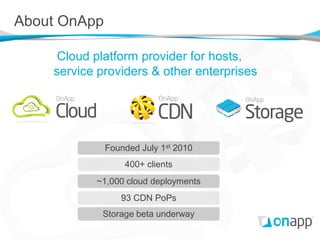
About OnApp

     Cloud platform provider for hosts,
    service providers & other enterprises


              Founded July 1st 2010
                  400+ clients
           ~1,000 cloud deployments
                 93 CDN PoPs
            Storage beta underway
OnApp Cloud Platform

 Infrastructure as a Service platform runs on commodity
  hardware
 Supports OSS Xen, KVM and VMWare ESX HV platforms
 Install and go – includes user-based interface, billing
  integration, over 400 VM templates etc..
 Diskless boot of Hypervisors named CloudBoot
     New feature in 3.0 release
     Uses standalone ramdisk image for control domain
     No persistent installation requirements, servers identified by MAC
      address
=> Over 50% of public cloud deployments today are managed by
OnApp software
The OnApp Storage Platform

 Work began mid-2011
 Storage development team based in Cambridge, UK
   Former XenSource/XenServer developers
   UI experts
 Bringing affordable enterprise-class storage to cloud
  providers
 Bundled for free with the core OnApp cloud product
Common Storage Challenges – Cost

 Storage platform is often the largest investment
  for cloud providers


 Proprietary lock-in ensures costs continue to rise


 Forklift upgrade cost for higher capacity/IO throughput
Common Storage Challenges – IOPS Scalability


  Virtualization infrastructure must share and have access to the
   same storage platform
  Cloud hypervisor infrastructure growth is essentially unlimited
  Scaling a centralized SAN requires massive investment in IO
   controller capacity
    Proportional with the HV infrastructure
    Often proprietary hardware + licensing involved


           Centralized SAN can scale - but slowly,
                    and at significant cost
Common Storage Challenges – Capacity Scale


 Growth of HV infrastructure demands dynamic
  capacity scale:
   Proprietary drives are costly
   Adding disk array units is costly and requires space
   Adjusting RAID group membership can be cumbersome
Common Storage Challenges – Physical Space


 SAN disk arrays have significant physical
  requirements:
   Additional rackspace for all head units, disk array units,
    interconnects etc…
   Independent cooling
   Redundant power supplies
   Redundant IO controllers
   Significant cabling overhead
Platform Design Goals
Platform Goals [1]

 Utilize commodity integrated storage drives within Hypervisors

 Hypervisor agnostic

 Simplify content location and awareness for data
     No complex RAID methodology across servers
     Content location fully exposed through platform APIs
     Optimised co-location of customer VMs with storage data


 Distribute IO load
     Content replicated across physical drives in separate servers
     Read local or read distributed policies
Platform Goals [2]

 Fully Decentralized content management
     No single point of failure across whole system
     All drives operate independently, and can be relocated across any HV
      chassis


 High Performance using commodity hardware
     Negligible metadata overhead
     As close to raw drive IO throughput as possible


 Storage platform runs as a service without impacting
  any other VM workloads
     Utilize HV platform to provide resource and performance isolation


 Resilient to drive and/or server failure without
  impacting data availability
How Did We
Meet These Goals?
OnApp Distributed Storage Platform

 Each HV has a storage VM ‘appliance’ that manages content
  on it’s physical drives
 Appliance VMs communicate over a fast ethernet SAN
  backbone
     Dom0 has access to the SAN network also
     Appliance VMs can have dedicated NIC passthrough hardware, or virtual bridge
      access

 Drives are fully plug and play and auto-discover on startup
     Content remains accessible if replicas are online
     Each drive has it’s own unique ID in the system and can be located in any HV
      chassis

 Drives are classified into performance tiers and logically
  grouped together
 SAN utilises private 10.x/16 address space. Each HV is
  responsible for it’s own /24 space
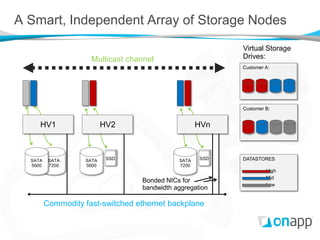
A Smart, Independent Array of Storage Nodes
                                                          Virtual Storage
                     Multicast channel                    Drives:
                                                          Customer A:


                                                          Customer B:


     HV1                  HV2                       HVn


  SATA    SATA     SATA    SSD               SATA   SSD   DATASTORES
  5600    7200     5600                      7200
                                                                   High
                                                                   Mid
                                  Bonded NICs for
                                                                   Low
                                  bandwidth aggregation

         Commodity fast-switched ethernet backplane
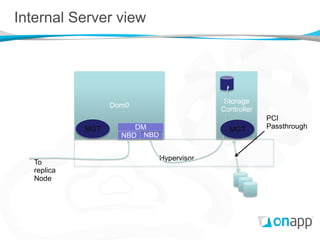
Internal Server view


                                             Storage
                   Dom0
                                            Controller
                                                         PCI
             MGT        DM                    MGT        Passthrough
                     NBD NBD


                               Hypervisor
   To
   replica
   Node
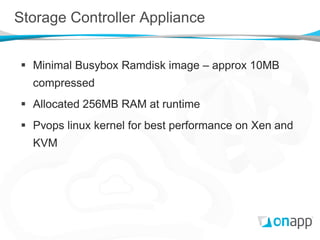
Storage Controller Appliance


 Minimal Busybox Ramdisk image – approx 10MB
  compressed
 Allocated 256MB RAM at runtime
 Pvops linux kernel for best performance on Xen and
  KVM
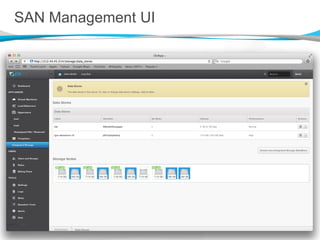
SAN Management UI
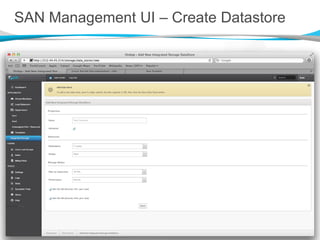
SAN Management UI – Create Datastore
Performance Isolation

 Hardware pass-through of storage controllers to an IO
  controller VM (Hard or soft IOMMU)
     Dom0 has no access to integrated storage drives
     Diskless boot of HVs


 Can also assign dedicated passthrough NICs for complete
  network separation as well


 Controller VM acts as a driver domain on behalf of the whole
  cluster, and manages IO/content handling for all physical
  drives that are present
Decentralized Consistency

   Physical drives are grouped in Datastores (Diskgroups)
       Each drive has unique identifier
       Drives are location independent
       Datastores have a particular replication and striping policy associated


   A new virtual disk object (or LUN) is assigned to a datastore
       Content owning members are selected from the diskgroup
       # of Content replicas/logical stripe members is based on Datastore policy
       Vdisks map directly to VMs as VBDs


   Each vdisk content instance stores information about the other owners *For
    that unique piece of content*
   Simplified Paxos-like commit protocol used for vdisk operations

    Vdisk operations only involve direct communication with a small number of
                         nodes that are owning members
Datapath Performance

 Virtual block device queue can be instantiated from any
  Hypervisor control domain


 IO path is optimal between front end device queue and actual
  content members
     Distributed IO load across the whole infrastructure ensures that there’s
      no centralized IO bottleneck


 Read local policy vs read distributed policy
     VMs can be co-located with content replicas for localized read path only
      (network constrained environments)
     VMs can be hosted anywhere with distributed read policy
      (over-provisioned network bandwidth)
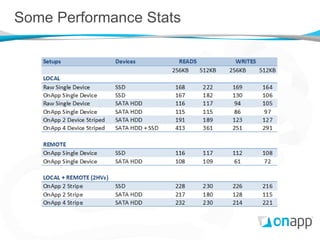
Some Performance Stats
Resilience to Failure

  Content owning members get selected across HVs


  IO queues depend on TCP-based NBD device protocol


  Custom device-mapper failover driver operates above
   individual device queues to failover reads and writes


  Data consistency handled across members via the control path
      Explicitly validated before activating the device queues
Hot Migrate of Data


 Online content migration from one physical drive to
  another (same HV or across HVs)
 Uses content hash mechanism for smarter
  differencing block identification
 Can be used to repair out of synch members and to
  move data replicas to another place
Additional Features

 Online disk snapshot
 Thin provisioned at source to enable disk over-commit
 De-duplication within drives
 Fully integrated into the OnApp cloud management
  platform
Conclusions


 Enterprise SANs costly to purchase and to scale
 OnApp storage platform exposes local storage drives
  across HVs as SAN
 Distributed IO paths decentralise traffic flows to
  provide much better scalability properties
 Smarter location of end-user VMs and storage
  replicas improves IO performance and reduces
  network traffic
Questions?
julian.chesterfield@onapp.com
…and here’s some I prepared earlier 

1. Is this Open Source?
   Not at this time but keen to do so
2. How far will this scale?
   Scalability limits are only really the number of Vdisk objects that
    can be cached and processed usefully by endpoints in the SAN
3. Is server hardware really good enough to meet or
   outperform enterprise SANs?
   Yes. Performance comes from massively distributed IO controller
    points, not the IO throughput of any particular node
4. What are the major differences to other distributed
   blockstore/filesystems?
   Primarily content location awareness for more optimal localised
    read path and no centralised metadata component
Decentralized Consistency [2]

 Storage controller VMs report information only about content
  for which they are authoritative


 Content membership changes are strictly handled across the
  ownership group


 The same vdisk information is always reported by all members
  of the ownership set


        A vdisk object is therefore known about correctly
         by any other member of the SAN, or not at all.

Building a Distributed Block Storage System on Xen

  • 1.
    Building a Distributed Block Store on Xen Julian Chesterfield Storage & Virtualization Architect, OnApp julian.chesterfield@onapp.com
  • 2.
    Overview  Introduction toOnApp and the Storage Platform  High-Level Goals of the Project  Project Architecture  Technical Details  Additional Feature Set  Conclusions
  • 3.
    About OnApp Cloud platform provider for hosts, service providers & other enterprises Founded July 1st 2010 400+ clients ~1,000 cloud deployments 93 CDN PoPs Storage beta underway
  • 4.
    OnApp Cloud Platform Infrastructure as a Service platform runs on commodity hardware  Supports OSS Xen, KVM and VMWare ESX HV platforms  Install and go – includes user-based interface, billing integration, over 400 VM templates etc..  Diskless boot of Hypervisors named CloudBoot  New feature in 3.0 release  Uses standalone ramdisk image for control domain  No persistent installation requirements, servers identified by MAC address => Over 50% of public cloud deployments today are managed by OnApp software
  • 5.
    The OnApp StoragePlatform  Work began mid-2011  Storage development team based in Cambridge, UK  Former XenSource/XenServer developers  UI experts  Bringing affordable enterprise-class storage to cloud providers  Bundled for free with the core OnApp cloud product
  • 6.
    Common Storage Challenges– Cost  Storage platform is often the largest investment for cloud providers  Proprietary lock-in ensures costs continue to rise  Forklift upgrade cost for higher capacity/IO throughput
  • 7.
    Common Storage Challenges– IOPS Scalability  Virtualization infrastructure must share and have access to the same storage platform  Cloud hypervisor infrastructure growth is essentially unlimited  Scaling a centralized SAN requires massive investment in IO controller capacity  Proportional with the HV infrastructure  Often proprietary hardware + licensing involved Centralized SAN can scale - but slowly, and at significant cost
  • 8.
    Common Storage Challenges– Capacity Scale  Growth of HV infrastructure demands dynamic capacity scale:  Proprietary drives are costly  Adding disk array units is costly and requires space  Adjusting RAID group membership can be cumbersome
  • 9.
    Common Storage Challenges– Physical Space  SAN disk arrays have significant physical requirements:  Additional rackspace for all head units, disk array units, interconnects etc…  Independent cooling  Redundant power supplies  Redundant IO controllers  Significant cabling overhead
  • 10.
  • 11.
    Platform Goals [1] Utilize commodity integrated storage drives within Hypervisors  Hypervisor agnostic  Simplify content location and awareness for data  No complex RAID methodology across servers  Content location fully exposed through platform APIs  Optimised co-location of customer VMs with storage data  Distribute IO load  Content replicated across physical drives in separate servers  Read local or read distributed policies
  • 12.
    Platform Goals [2] Fully Decentralized content management  No single point of failure across whole system  All drives operate independently, and can be relocated across any HV chassis  High Performance using commodity hardware  Negligible metadata overhead  As close to raw drive IO throughput as possible  Storage platform runs as a service without impacting any other VM workloads  Utilize HV platform to provide resource and performance isolation  Resilient to drive and/or server failure without impacting data availability
  • 13.
    How Did We MeetThese Goals?
  • 14.
    OnApp Distributed StoragePlatform  Each HV has a storage VM ‘appliance’ that manages content on it’s physical drives  Appliance VMs communicate over a fast ethernet SAN backbone  Dom0 has access to the SAN network also  Appliance VMs can have dedicated NIC passthrough hardware, or virtual bridge access  Drives are fully plug and play and auto-discover on startup  Content remains accessible if replicas are online  Each drive has it’s own unique ID in the system and can be located in any HV chassis  Drives are classified into performance tiers and logically grouped together  SAN utilises private 10.x/16 address space. Each HV is responsible for it’s own /24 space
  • 15.
    A Smart, IndependentArray of Storage Nodes Virtual Storage Multicast channel Drives: Customer A: Customer B: HV1 HV2 HVn SATA SATA SATA SSD SATA SSD DATASTORES 5600 7200 5600 7200 High Mid Bonded NICs for Low bandwidth aggregation Commodity fast-switched ethernet backplane
  • 16.
    Internal Server view Storage Dom0 Controller PCI MGT DM MGT Passthrough NBD NBD Hypervisor To replica Node
  • 17.
    Storage Controller Appliance Minimal Busybox Ramdisk image – approx 10MB compressed  Allocated 256MB RAM at runtime  Pvops linux kernel for best performance on Xen and KVM
  • 18.
  • 19.
    SAN Management UI– Create Datastore
  • 20.
    Performance Isolation  Hardwarepass-through of storage controllers to an IO controller VM (Hard or soft IOMMU)  Dom0 has no access to integrated storage drives  Diskless boot of HVs  Can also assign dedicated passthrough NICs for complete network separation as well  Controller VM acts as a driver domain on behalf of the whole cluster, and manages IO/content handling for all physical drives that are present
  • 21.
    Decentralized Consistency  Physical drives are grouped in Datastores (Diskgroups)  Each drive has unique identifier  Drives are location independent  Datastores have a particular replication and striping policy associated  A new virtual disk object (or LUN) is assigned to a datastore  Content owning members are selected from the diskgroup  # of Content replicas/logical stripe members is based on Datastore policy  Vdisks map directly to VMs as VBDs  Each vdisk content instance stores information about the other owners *For that unique piece of content*  Simplified Paxos-like commit protocol used for vdisk operations Vdisk operations only involve direct communication with a small number of nodes that are owning members
  • 22.
    Datapath Performance  Virtualblock device queue can be instantiated from any Hypervisor control domain  IO path is optimal between front end device queue and actual content members  Distributed IO load across the whole infrastructure ensures that there’s no centralized IO bottleneck  Read local policy vs read distributed policy  VMs can be co-located with content replicas for localized read path only (network constrained environments)  VMs can be hosted anywhere with distributed read policy (over-provisioned network bandwidth)
  • 23.
  • 24.
    Resilience to Failure  Content owning members get selected across HVs  IO queues depend on TCP-based NBD device protocol  Custom device-mapper failover driver operates above individual device queues to failover reads and writes  Data consistency handled across members via the control path  Explicitly validated before activating the device queues
  • 25.
    Hot Migrate ofData  Online content migration from one physical drive to another (same HV or across HVs)  Uses content hash mechanism for smarter differencing block identification  Can be used to repair out of synch members and to move data replicas to another place
  • 26.
    Additional Features  Onlinedisk snapshot  Thin provisioned at source to enable disk over-commit  De-duplication within drives  Fully integrated into the OnApp cloud management platform
  • 27.
    Conclusions  Enterprise SANscostly to purchase and to scale  OnApp storage platform exposes local storage drives across HVs as SAN  Distributed IO paths decentralise traffic flows to provide much better scalability properties  Smarter location of end-user VMs and storage replicas improves IO performance and reduces network traffic
  • 28.
  • 29.
    …and here’s someI prepared earlier  1. Is this Open Source?  Not at this time but keen to do so 2. How far will this scale?  Scalability limits are only really the number of Vdisk objects that can be cached and processed usefully by endpoints in the SAN 3. Is server hardware really good enough to meet or outperform enterprise SANs?  Yes. Performance comes from massively distributed IO controller points, not the IO throughput of any particular node 4. What are the major differences to other distributed blockstore/filesystems?  Primarily content location awareness for more optimal localised read path and no centralised metadata component
  • 30.
    Decentralized Consistency [2] Storage controller VMs report information only about content for which they are authoritative  Content membership changes are strictly handled across the ownership group  The same vdisk information is always reported by all members of the ownership set A vdisk object is therefore known about correctly by any other member of the SAN, or not at all.