Windsor
Domain 0 disaggregation for XenServer

James Bulpin, Director of Technology, XenServer, Citrix

August 28, 2012
Introduction

• XenServer/XenCloudPlatform (XCP): a distribution of Xen, a domain 0 and
  everything else needed to create a platform for virtualization
• A platform for server virtualisation
• A platform for virtual desktops (e.g. XenDesktop)
• A platform for the cloud (e.g. OpenStack and CloudStack)
• A platform for virtualised networking (e.g. NetScaler)
• All use cases are tending towards much higher numbers of guest VMs per host
• Current architecture works now but will hit bottlenecks as servers get bigger
  and more powerful
• Want a flexible, modular solution to scalability
Overview

• XenServer architecture evolution – a brief history
• Limitations of the current architecture
• Windsor: 3rd generation XenServer architecture
 ᵒ Using domain 0 disaggregation for scalability and performance


               This presentation is about the internal technology of
              XenServer/XCP. It is not a statement about the future
              feature set or capabilities of any particular XenServer
                                       release.
XenServer Architecture – a
brief history
XenServer Architecture – a brief history (1)

• First generation architecture in Burbank – XenEnterprise 3.0.0
• Single host virtualisation: no resource pools, no XenMotion
• Based on open-source xend/xm toolstack
• Basic C host agent driving xend
• XenAdmin Java management application
• Initially used a small, read-only dom0
 ᵒ Moved to writable environment in 3.1
XenServer Architecture – a brief history (2)

• Second generation architecture in Rio – XenServer 4.0.0
• Current releases, including XenServer 6.1 coming soon, based on this
• All current versions of XCP based on this
• Sophisticated Ocaml xapi toolstack implementing the XenAPI
 ᵒ Uses only lowest level part of open-source Xen toolstack (libxc)
• Clustered architecture for resource pools, XenMotion and master mobility
• Domain 0 evolved from 1st generation
 ᵒ Fairly full Linux distribution based on CentOS
 ᵒ Writable environment using RPMs for package management
Limitations of the current
architecture
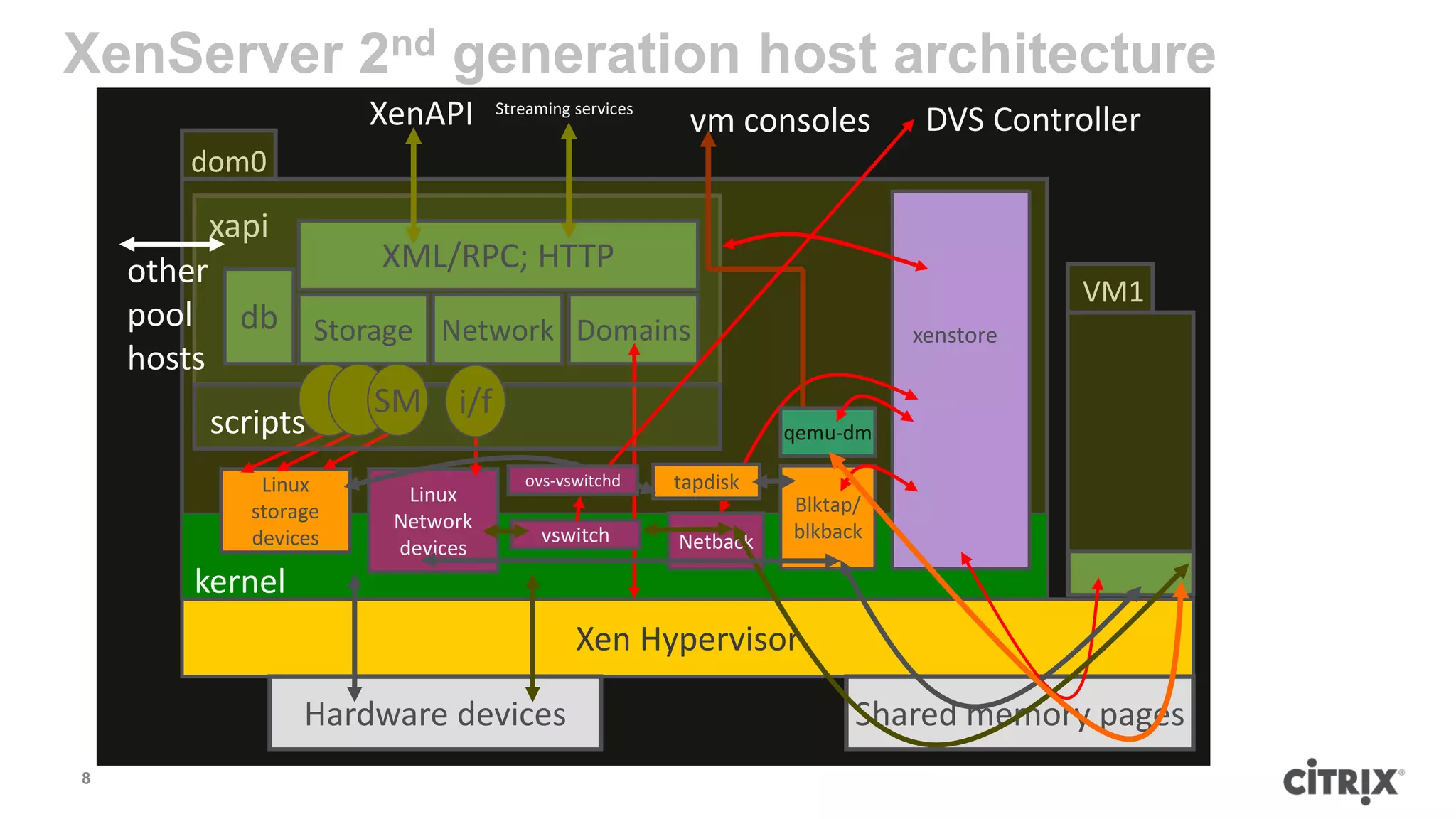
XenServer 2nd generation host architecture
                    XenAPI     Streaming services
                                                     vm consoles         DVS Controller
       dom0

        xapi
    other         XML/RPC; HTTP
                                                                                   VM1
    pool db Storage Network Domains                                     xenstore
    hosts
                  SM i/f
          scripts                                             qemu-dm

           Linux                  ovs-vswitchd      tapdisk
                      Linux                                   Blktap/
          storage    Network
          devices                   vswitch         Netback   blkback
                     devices
       kernel
                                         Xen Hypervisor

                Hardware devices                                    Shared memory pages
8
Limitations of the current architecture

• With future larger, powerful servers domain 0 will become a bottleneck
 ᵒ Will limit scalability and performance
• Lack of failure containment
• Hard to reason about dom0 security
• Non-optimal use of modern NUMA architectures
• Limited third party extensibility
“Windsor” – XenServer’s new
architecture
Goals for the new architecture

• Improved scalability on single XenServer host
• Remove performance bottlenecks
• Cloud scale horizontal scaling of XenServer hosts
• Better isolation for multi-tenancy
• Increased availability and quality of service
• Higher Trusted Computing Base measurement coverage
Design principles and overview

• Scale-out, not scale-up – exploit parallelism and locality
• Disaggregate Domain-0 functionality to other domains
• Encapsulate and simplify
• Clean APIs between components
• Flexibility
• Design for scalability and security
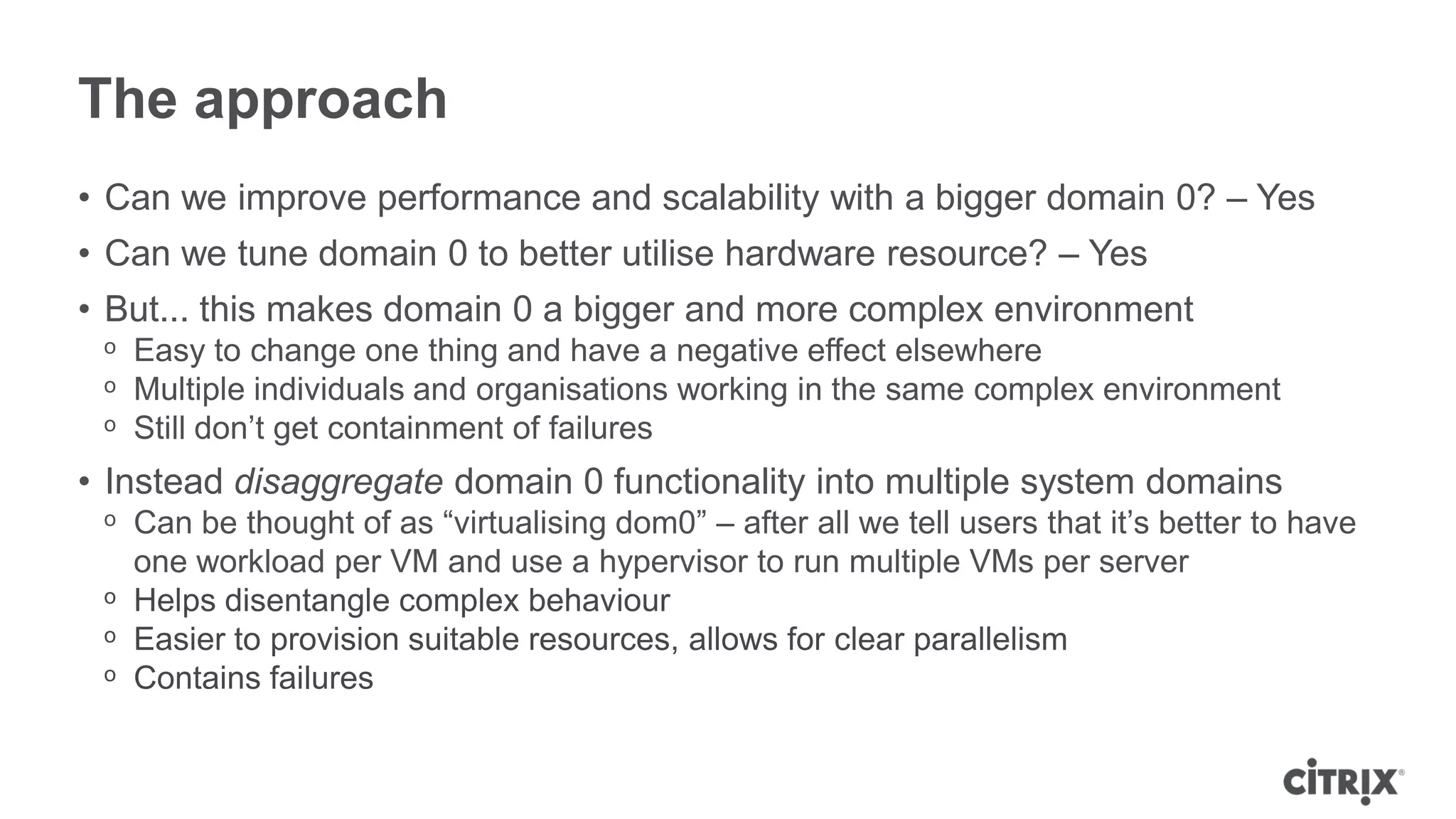
The approach
• Can we improve performance and scalability with a bigger domain 0? – Yes
• Can we tune domain 0 to better utilise hardware resource? – Yes
• But... this makes domain 0 a bigger and more complex environment
 ᵒ Easy to change one thing and have a negative effect elsewhere
 ᵒ Multiple individuals and organisations working in the same complex environment
 ᵒ Still don’t get containment of failures
• Instead disaggregate domain 0 functionality into multiple system domains
 ᵒ Can be thought of as “virtualising dom0” – after all we tell users that it’s better to have
   one workload per VM and use a hypervisor to run multiple VMs per server
 ᵒ Helps disentangle complex behaviour
 ᵒ Easier to provision suitable resources, allows for clear parallelism
 ᵒ Contains failures
Domain 0 disaggregation
• Moving virtualisation functions out of domain 0 into other domains
 ᵒ Driver domains contain backend drivers (netback, blkback) and physical device drivers
    • Use PCI pass-through to give access to physical device to be virtualised
 ᵒ System domains to provide shared services such as logging
 ᵒ Domains for running qemu(s) – per VM stub domains or shared qemu domains
 ᵒ Monitoring, management and interface domains
• Has been around for a while, mostly with a security focus
 ᵒ Improving Xen Security through Disaggregation (Murray et. al., VEE08)
   [http://www.cl.cam.ac.uk/~dgm36/publications/2008-murray2008improving.pdf]
 ᵒ Breaking up is hard to do: Xoar (Colp et. al., SOSP11) [http://www.cs.ubc.ca/~andy/papers/xoar-
   sosp-final.pdf]
 ᵒ Qubes (driver domains) [http://qubes-os.org]
 ᵒ Citrix XenClient XT (network driver domains) [http://www.citrix.com/xenclient]
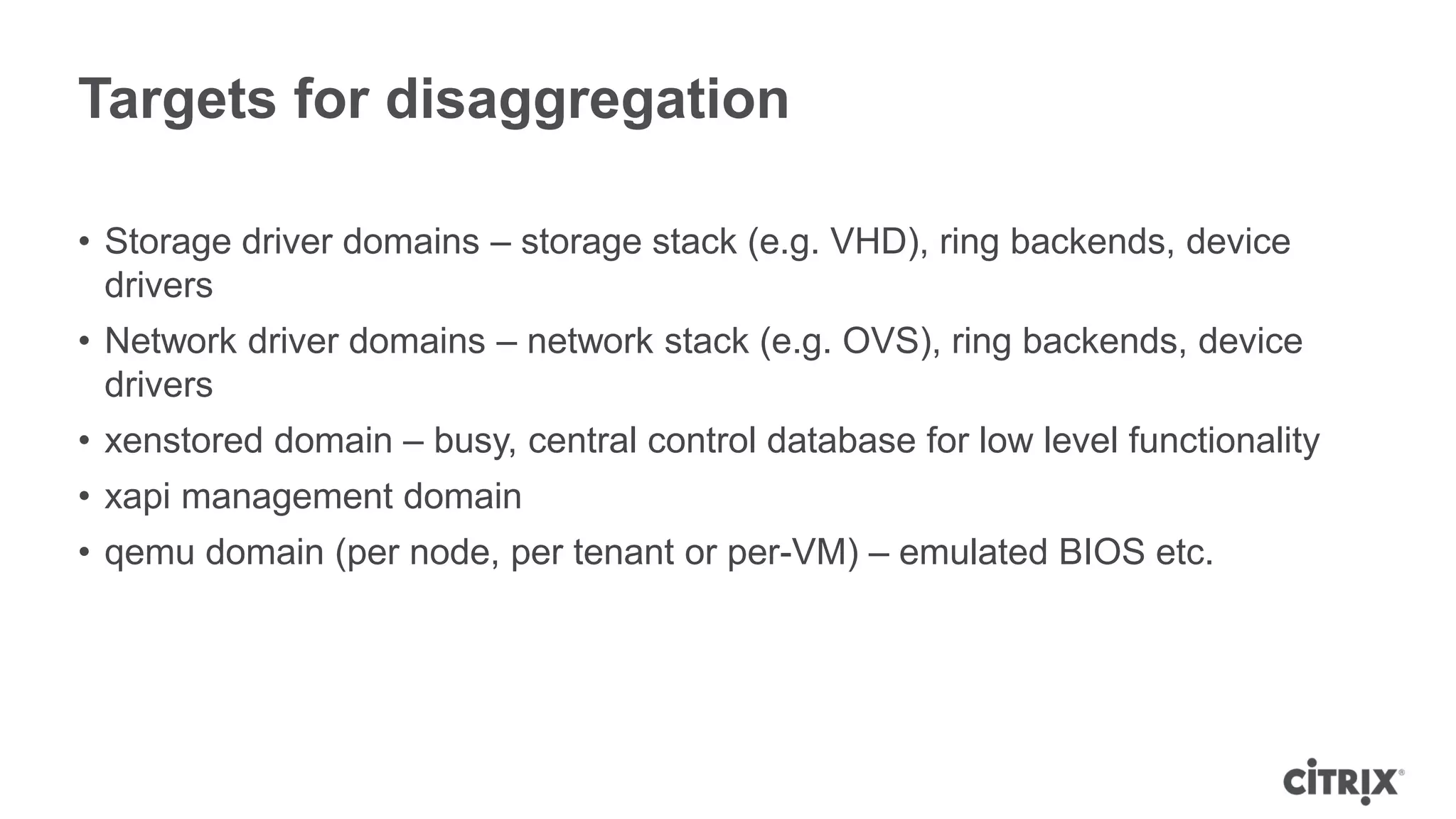
Targets for disaggregation

• Storage driver domains – storage stack (e.g. VHD), ring backends, device
  drivers
• Network driver domains – network stack (e.g. OVS), ring backends, device
  drivers
• xenstored domain – busy, central control database for low level functionality
• xapi management domain
• qemu domain (per node, per tenant or per-VM) – emulated BIOS etc.
Benefits

• Better VM density
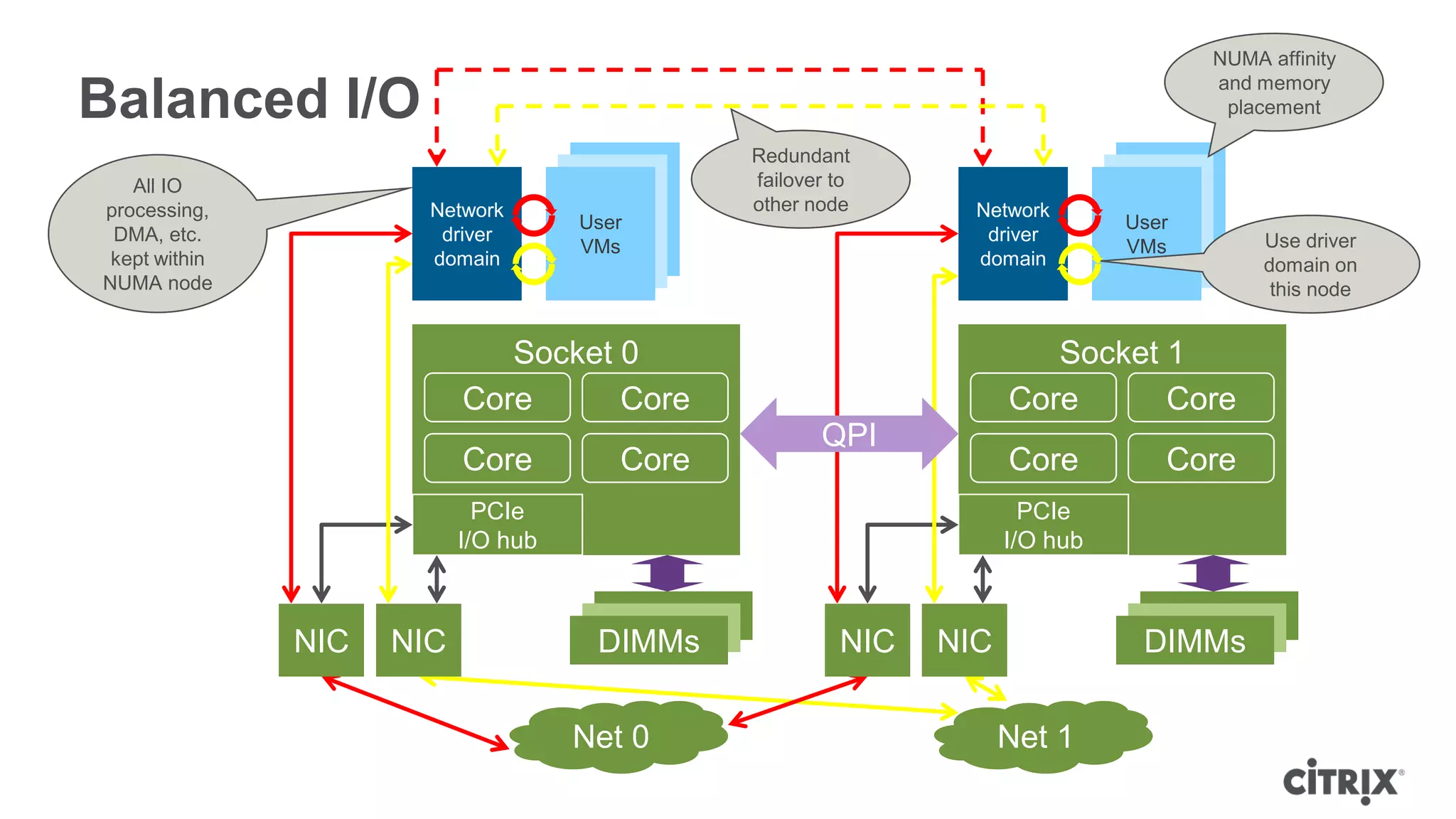
• Better use of scale-out hardware (NUMA, many cores, balanced I/O)
• Improved stability
• Improved availability (fault isolation)
• Opportunity for secure boot etc.
• More extensible, future value-add opportunities
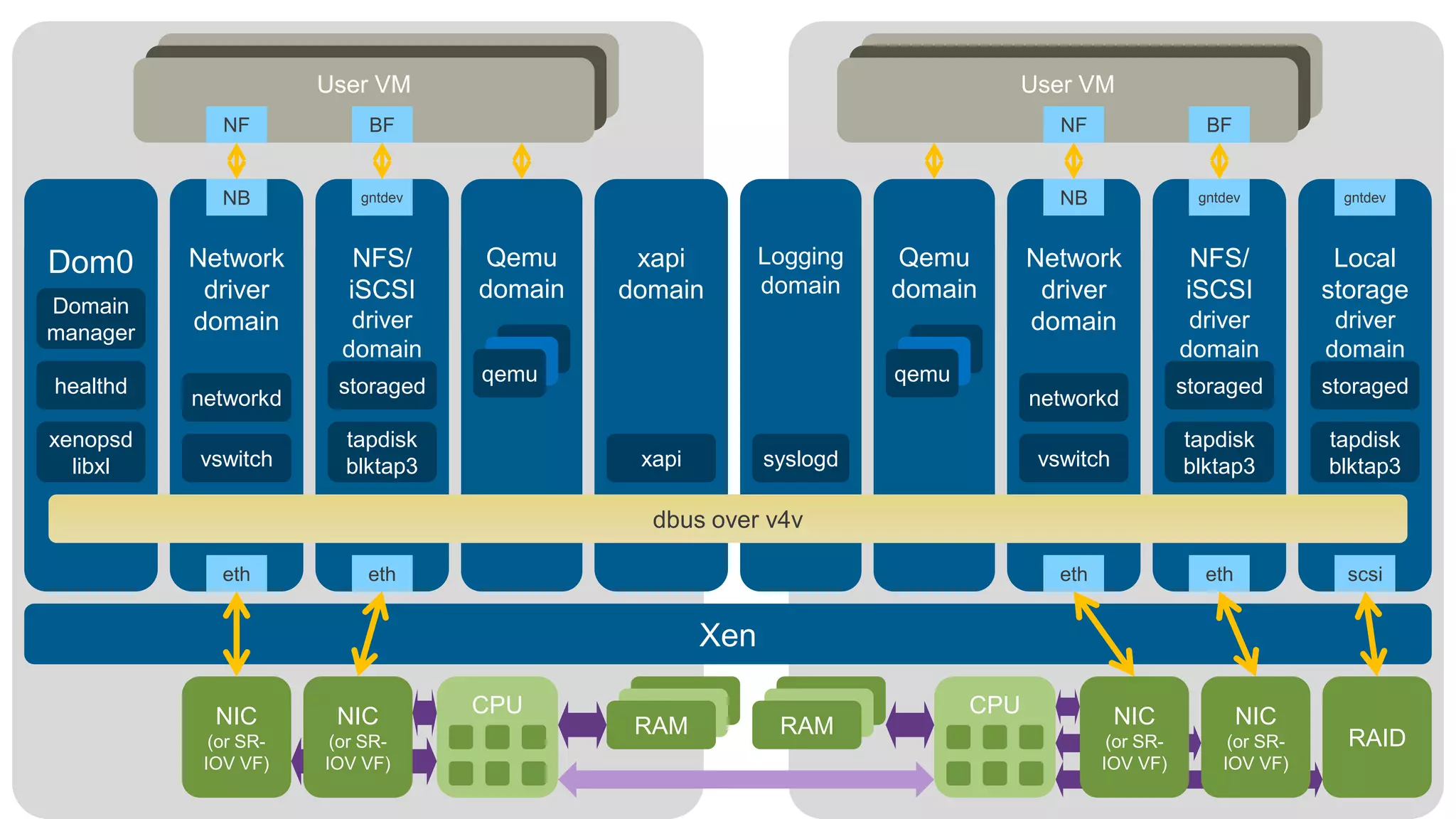
User VM                                                    User VM
             NF            BF                                                       NF                  BF


             NB           gntdev                                                    NB                 gntdev          gntdev


Dom0      Network        NFS/      Qemu      xapi         Logging   Qemu         Network              NFS/            Local
           driver       iSCSI      domain   domain        domain    domain        driver             iSCSI           storage
Domain
manager   domain         driver                                                  domain               driver          driver
                        domain                                                                       domain          domain
                                   qemu                             qemu
healthd                storaged                                                                      storaged        storaged
          networkd                                                               networkd
xenopsd                 tapdisk                                                                      tapdisk         tapdisk
  libxl   vswitch       blktap3              xapi         syslogd                 vswitch            blktap3         blktap3

                                              dbus over v4v

             eth           eth                                                      eth                 eth            scsi


                                                    Xen

            NIC        NIC         CPU                                     CPU              NIC               NIC
                                             RAM           RAM                                                         RAID
            (or SR-    (or SR-                                                             (or SR-         (or SR-
           IOV VF)    IOV VF)                                                             IOV VF)         IOV VF)
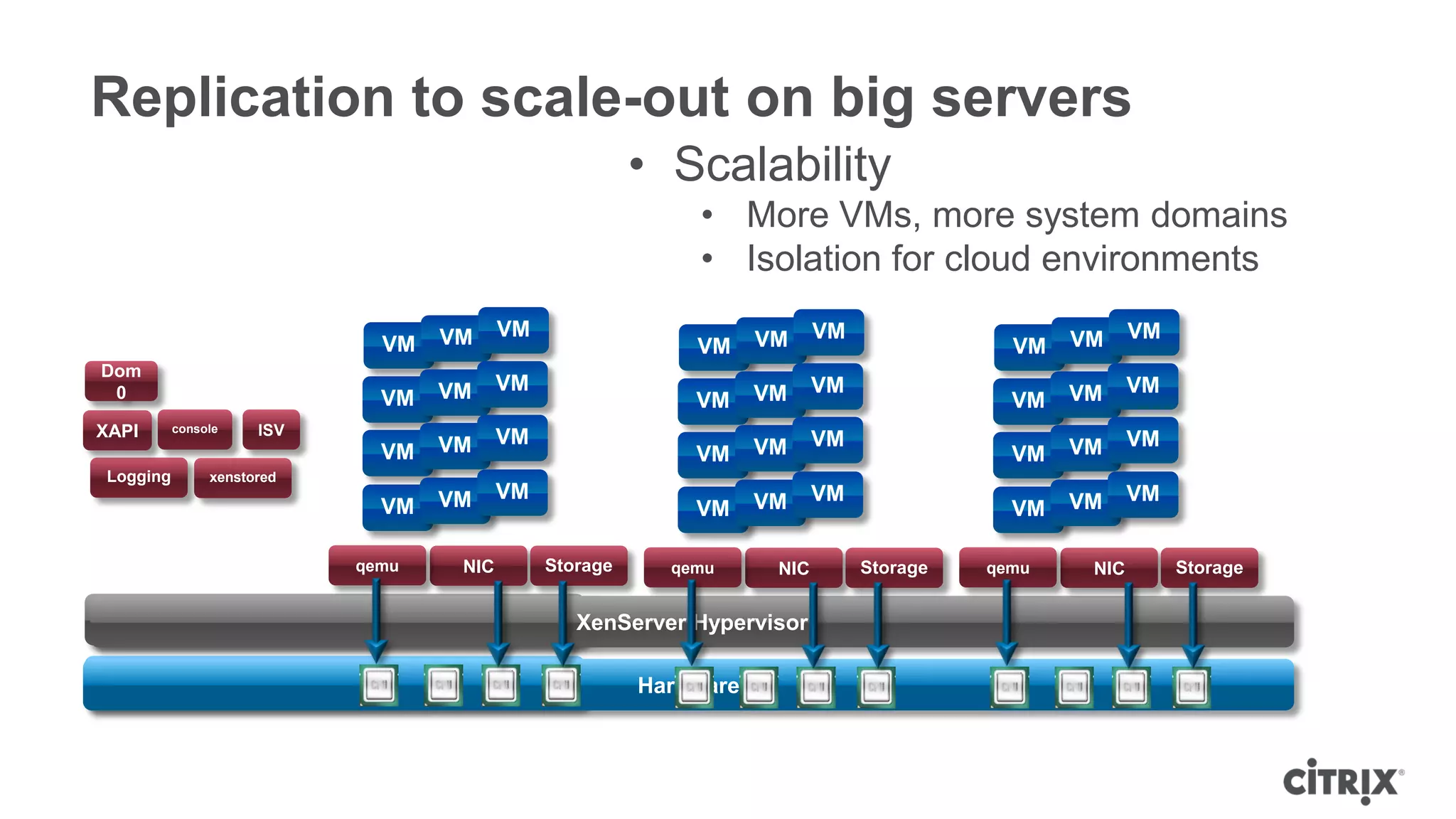
Replication to scale-out on big servers
                                                                 • Scalability
                                                                     • More VMs, more system domains
                                                                     • Isolation for cloud environments

                                        VM        VM                        VM     VM                    VM     VM
                                   VM                                VM                             VM
Dom
 0                                      VM        VM                        VM     VM                    VM     VM
                                   VM                                VM                             VM
XAPI       console      ISV
                                        VM        VM                        VM     VM                    VM     VM
                                   VM                                VM                             VM
 Logging        xenstored
                                        VM        VM                        VM     VM                    VM     VM
                                   VM                                VM                             VM

                                 qemu       NIC        Storage     qemu      NIC        Storage   qemu    NIC        Storage

                     XenServer Hypervisor                 XenServer Hypervisor

                            Hardware                             Hardware
NUMA affinity
                                                                                     and memory
Balanced I/O                                                                          placement

                                               Redundant
   All IO                                      failover to
processing,            Network                 other node       Network
                                     User                                     User
 DMA, etc.              driver                                   driver                   Use driver
                                     VMs                                      VMs
 kept within           domain                                   domain                    domain on
NUMA node                                                                                  this node


                              Socket 0                                 Socket 1
                           Core      Core                           Core      Core
                                                      QPI
                           Core         Core                        Core         Core
                             PCIe                                     PCIe
                           I/O hub                                  I/O hub


               NIC   NIC              DIMMs             NIC   NIC              DIMMs

                                     Net 0                          Net 1
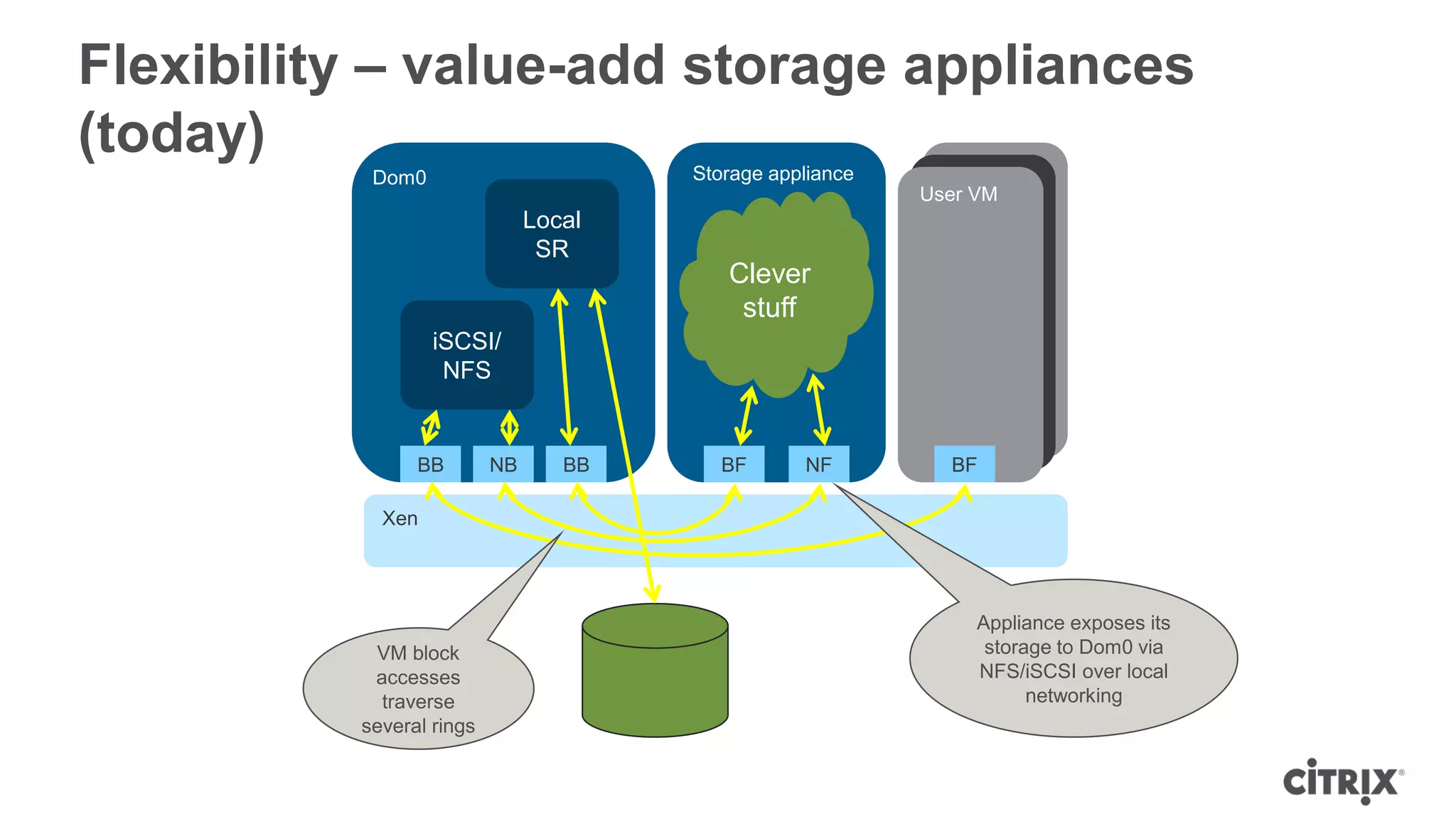
Flexibility – value-add storage appliances
(today)
           Dom0                        Storage appliance
                                                           User VM
                               Local
                                SR
                                          Clever
                                           stuff
                  iSCSI/
                   NFS


                BB        NB      BB      BF      NF         BF

            Xen


                                                                Appliance exposes its
           VM block                                              storage to Dom0 via
           accesses                                             NFS/iSCSI over local
            traverse                                                  networking
          several rings
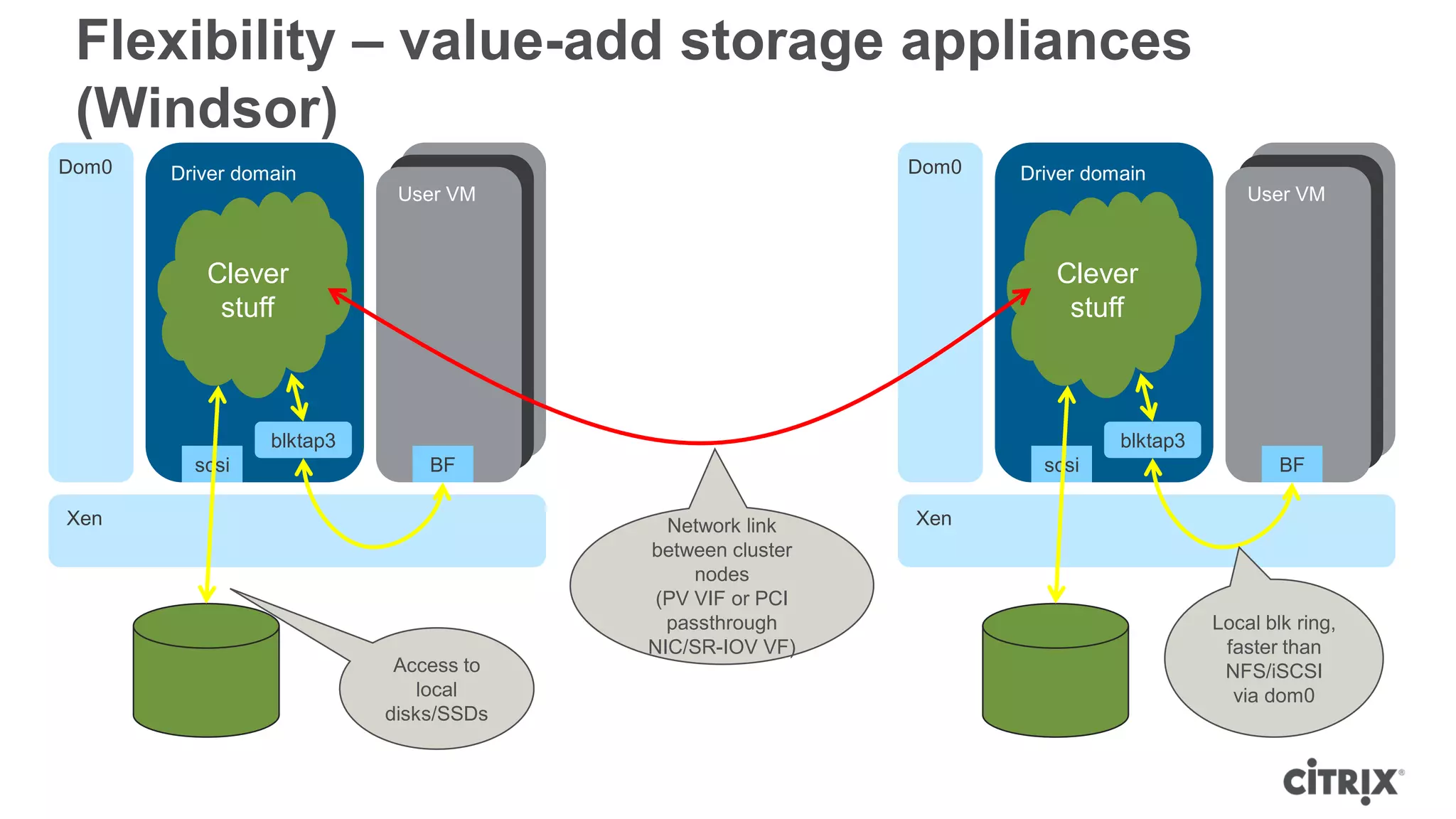
Flexibility – value-add storage appliances
 (Windsor)
Dom0   Driver domain                                      Dom0   Driver domain
                            User VM                                                      User VM


          Clever                                                    Clever
           stuff                                                     stuff


                 blktap3                                                   blktap3
         scsi                  BF                                  scsi                      BF

Xen                                       Network link    Xen
                                        between cluster
                                             nodes
                                         (PV VIF or PCI
                                          passthrough                                Local blk ring,
                                        NIC/SR-IOV VF)                                faster than
                            Access to                                                 NFS/iSCSI
                               local                                                   via dom0
                           disks/SSDs
Summary

• Next generation XenServer architecture built to scale-out using domain 0
  disaggregation techniques
 ᵒ Scale with the workload and server size
 ᵒ Expect to significantly enhance scalability and aggregate performance
• Well defined APIs between components will allow better extensibility
• Avoids complexity of single, large, multi-function domain 0
 ᵒ Easier to reason about
 ᵒ Easier to maintain and debug
 ᵒ Containment of failures
Work better. Live better.

Windsor: Domain 0 Disaggregation for XenServer and XCP

  • 1.
    Windsor Domain 0 disaggregationfor XenServer James Bulpin, Director of Technology, XenServer, Citrix August 28, 2012
  • 2.
    Introduction • XenServer/XenCloudPlatform (XCP):a distribution of Xen, a domain 0 and everything else needed to create a platform for virtualization • A platform for server virtualisation • A platform for virtual desktops (e.g. XenDesktop) • A platform for the cloud (e.g. OpenStack and CloudStack) • A platform for virtualised networking (e.g. NetScaler) • All use cases are tending towards much higher numbers of guest VMs per host • Current architecture works now but will hit bottlenecks as servers get bigger and more powerful • Want a flexible, modular solution to scalability
  • 3.
    Overview • XenServer architectureevolution – a brief history • Limitations of the current architecture • Windsor: 3rd generation XenServer architecture ᵒ Using domain 0 disaggregation for scalability and performance This presentation is about the internal technology of XenServer/XCP. It is not a statement about the future feature set or capabilities of any particular XenServer release.
  • 4.
  • 5.
    XenServer Architecture –a brief history (1) • First generation architecture in Burbank – XenEnterprise 3.0.0 • Single host virtualisation: no resource pools, no XenMotion • Based on open-source xend/xm toolstack • Basic C host agent driving xend • XenAdmin Java management application • Initially used a small, read-only dom0 ᵒ Moved to writable environment in 3.1
  • 6.
    XenServer Architecture –a brief history (2) • Second generation architecture in Rio – XenServer 4.0.0 • Current releases, including XenServer 6.1 coming soon, based on this • All current versions of XCP based on this • Sophisticated Ocaml xapi toolstack implementing the XenAPI ᵒ Uses only lowest level part of open-source Xen toolstack (libxc) • Clustered architecture for resource pools, XenMotion and master mobility • Domain 0 evolved from 1st generation ᵒ Fairly full Linux distribution based on CentOS ᵒ Writable environment using RPMs for package management
  • 7.
    Limitations of thecurrent architecture
  • 8.
    XenServer 2nd generationhost architecture XenAPI Streaming services vm consoles DVS Controller dom0 xapi other XML/RPC; HTTP VM1 pool db Storage Network Domains xenstore hosts SM i/f scripts qemu-dm Linux ovs-vswitchd tapdisk Linux Blktap/ storage Network devices vswitch Netback blkback devices kernel Xen Hypervisor Hardware devices Shared memory pages 8
  • 9.
    Limitations of thecurrent architecture • With future larger, powerful servers domain 0 will become a bottleneck ᵒ Will limit scalability and performance • Lack of failure containment • Hard to reason about dom0 security • Non-optimal use of modern NUMA architectures • Limited third party extensibility
  • 10.
  • 11.
    Goals for thenew architecture • Improved scalability on single XenServer host • Remove performance bottlenecks • Cloud scale horizontal scaling of XenServer hosts • Better isolation for multi-tenancy • Increased availability and quality of service • Higher Trusted Computing Base measurement coverage
  • 12.
    Design principles andoverview • Scale-out, not scale-up – exploit parallelism and locality • Disaggregate Domain-0 functionality to other domains • Encapsulate and simplify • Clean APIs between components • Flexibility • Design for scalability and security
  • 13.
    The approach • Canwe improve performance and scalability with a bigger domain 0? – Yes • Can we tune domain 0 to better utilise hardware resource? – Yes • But... this makes domain 0 a bigger and more complex environment ᵒ Easy to change one thing and have a negative effect elsewhere ᵒ Multiple individuals and organisations working in the same complex environment ᵒ Still don’t get containment of failures • Instead disaggregate domain 0 functionality into multiple system domains ᵒ Can be thought of as “virtualising dom0” – after all we tell users that it’s better to have one workload per VM and use a hypervisor to run multiple VMs per server ᵒ Helps disentangle complex behaviour ᵒ Easier to provision suitable resources, allows for clear parallelism ᵒ Contains failures
  • 14.
    Domain 0 disaggregation •Moving virtualisation functions out of domain 0 into other domains ᵒ Driver domains contain backend drivers (netback, blkback) and physical device drivers • Use PCI pass-through to give access to physical device to be virtualised ᵒ System domains to provide shared services such as logging ᵒ Domains for running qemu(s) – per VM stub domains or shared qemu domains ᵒ Monitoring, management and interface domains • Has been around for a while, mostly with a security focus ᵒ Improving Xen Security through Disaggregation (Murray et. al., VEE08) [http://www.cl.cam.ac.uk/~dgm36/publications/2008-murray2008improving.pdf] ᵒ Breaking up is hard to do: Xoar (Colp et. al., SOSP11) [http://www.cs.ubc.ca/~andy/papers/xoar- sosp-final.pdf] ᵒ Qubes (driver domains) [http://qubes-os.org] ᵒ Citrix XenClient XT (network driver domains) [http://www.citrix.com/xenclient]
  • 15.
    Targets for disaggregation •Storage driver domains – storage stack (e.g. VHD), ring backends, device drivers • Network driver domains – network stack (e.g. OVS), ring backends, device drivers • xenstored domain – busy, central control database for low level functionality • xapi management domain • qemu domain (per node, per tenant or per-VM) – emulated BIOS etc.
  • 16.
    Benefits • Better VMdensity • Better use of scale-out hardware (NUMA, many cores, balanced I/O) • Improved stability • Improved availability (fault isolation) • Opportunity for secure boot etc. • More extensible, future value-add opportunities
  • 17.
    User VM User VM NF BF NF BF NB gntdev NB gntdev gntdev Dom0 Network NFS/ Qemu xapi Logging Qemu Network NFS/ Local driver iSCSI domain domain domain domain driver iSCSI storage Domain manager domain driver domain driver driver domain domain domain qemu qemu healthd storaged storaged storaged networkd networkd xenopsd tapdisk tapdisk tapdisk libxl vswitch blktap3 xapi syslogd vswitch blktap3 blktap3 dbus over v4v eth eth eth eth scsi Xen NIC NIC CPU CPU NIC NIC RAM RAM RAID (or SR- (or SR- (or SR- (or SR- IOV VF) IOV VF) IOV VF) IOV VF)
  • 18.
    Replication to scale-outon big servers • Scalability • More VMs, more system domains • Isolation for cloud environments VM VM VM VM VM VM VM VM VM Dom 0 VM VM VM VM VM VM VM VM VM XAPI console ISV VM VM VM VM VM VM VM VM VM Logging xenstored VM VM VM VM VM VM VM VM VM qemu NIC Storage qemu NIC Storage qemu NIC Storage XenServer Hypervisor XenServer Hypervisor Hardware Hardware
  • 19.
    NUMA affinity and memory Balanced I/O placement Redundant All IO failover to processing, Network other node Network User User DMA, etc. driver driver Use driver VMs VMs kept within domain domain domain on NUMA node this node Socket 0 Socket 1 Core Core Core Core QPI Core Core Core Core PCIe PCIe I/O hub I/O hub NIC NIC DIMMs NIC NIC DIMMs Net 0 Net 1
  • 20.
    Flexibility – value-addstorage appliances (today) Dom0 Storage appliance User VM Local SR Clever stuff iSCSI/ NFS BB NB BB BF NF BF Xen Appliance exposes its VM block storage to Dom0 via accesses NFS/iSCSI over local traverse networking several rings
  • 21.
    Flexibility – value-addstorage appliances (Windsor) Dom0 Driver domain Dom0 Driver domain User VM User VM Clever Clever stuff stuff blktap3 blktap3 scsi BF scsi BF Xen Network link Xen between cluster nodes (PV VIF or PCI passthrough Local blk ring, NIC/SR-IOV VF) faster than Access to NFS/iSCSI local via dom0 disks/SSDs
  • 22.
    Summary • Next generationXenServer architecture built to scale-out using domain 0 disaggregation techniques ᵒ Scale with the workload and server size ᵒ Expect to significantly enhance scalability and aggregate performance • Well defined APIs between components will allow better extensibility • Avoids complexity of single, large, multi-function domain 0 ᵒ Easier to reason about ᵒ Easier to maintain and debug ᵒ Containment of failures
  • 23.