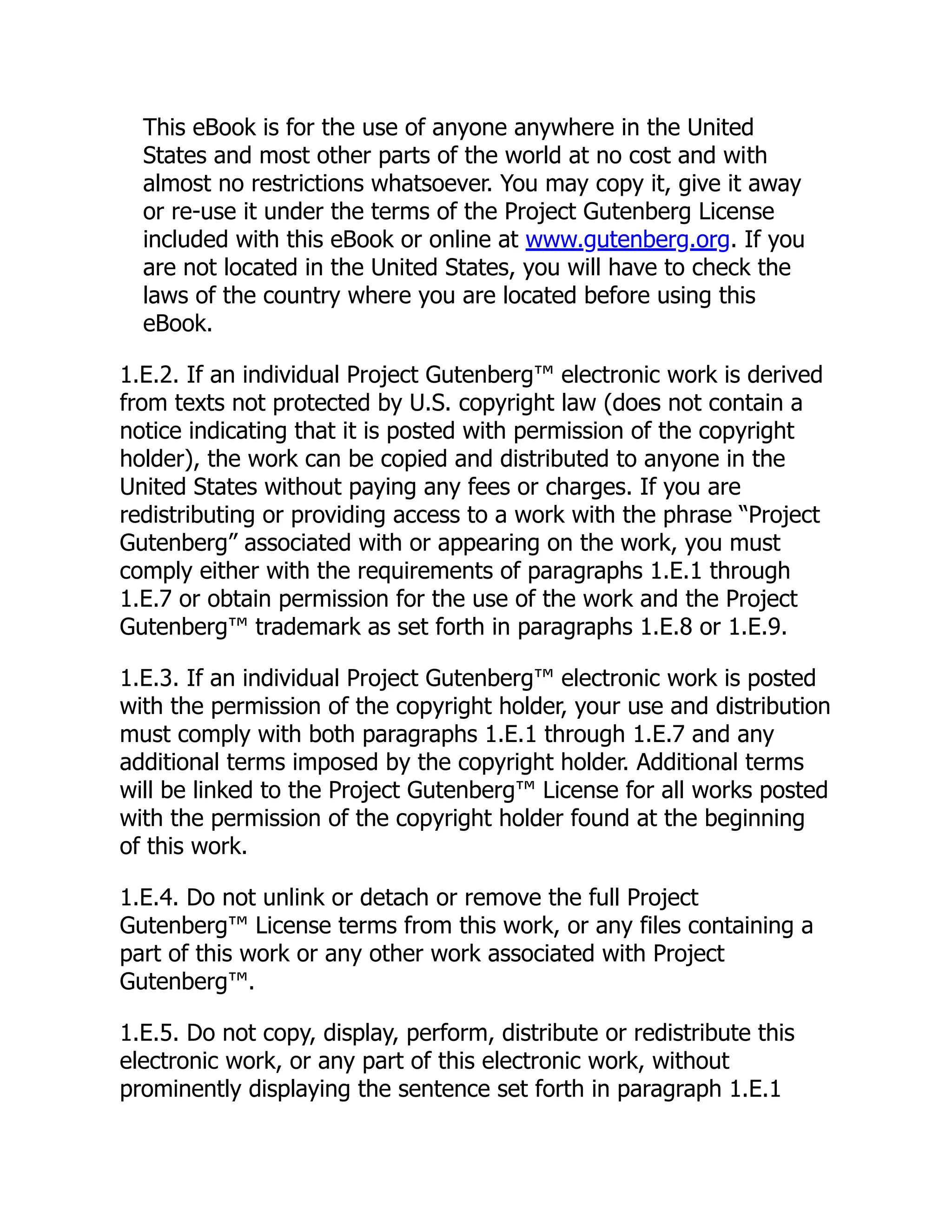
VMware Software Defined Storage A Design Guide
to the Policy Driven Software Defined Storage
Era 1st Edition Martin Hosken install download
https://ebookmeta.com/product/vmware-software-defined-storage-a-
design-guide-to-the-policy-driven-software-defined-storage-
era-1st-edition-martin-hosken/
Download more ebook from https://ebookmeta.com
We believe these products will be a great fit for you. Click
the link to download now, or visit ebookmeta.com
to discover even more!
Software-Defined Radio for Engineers Travis F Collins
https://ebookmeta.com/product/software-defined-radio-for-
engineers-travis-f-collins/
Software Defined Internet of Everything Gagangeet Singh
Aujla (Editor)
https://ebookmeta.com/product/software-defined-internet-of-
everything-gagangeet-singh-aujla-editor/
Software Defined Radio with Zynq UltraScale+ RFSoC
First Edition Louise Crockett
https://ebookmeta.com/product/software-defined-radio-with-zynq-
ultrascale-rfsoc-first-edition-louise-crockett/
Mass Spectrometry in Food Analysis 1st Edition Leo M.L.
Nollet (Editor)
https://ebookmeta.com/product/mass-spectrometry-in-food-
analysis-1st-edition-leo-m-l-nollet-editor/
A Flora of the Marshes of California Herbert L. Mason
https://ebookmeta.com/product/a-flora-of-the-marshes-of-
california-herbert-l-mason/
Clinico-Investigative Ophthalmology (Modern System of
Ophthalmology (MSO) Series) (Oct 30,
2018)_(9387964183)_(CBS Publishers & Distributors Pvt
Ltd, India) Khurana
https://ebookmeta.com/product/clinico-investigative-
ophthalmology-modern-system-of-ophthalmology-mso-series-
oct-30-2018_9387964183_cbs-publishers-distributors-pvt-ltd-india-
khurana/
Cruel Magic 1st Edition Eva Chase
https://ebookmeta.com/product/cruel-magic-1st-edition-eva-chase/
Terror And Modernity Donatella Di Cesare Murtha Baca
Translator
https://ebookmeta.com/product/terror-and-modernity-donatella-di-
cesare-murtha-baca-translator/
Disney Junior Valentine s Day Disney Books
https://ebookmeta.com/product/disney-junior-valentine-s-day-
disney-books/
American Pendulum Recurring Debates in U S Grand
Strategy 2nd Edition Christopher Hemmer
https://ebookmeta.com/product/american-pendulum-recurring-
debates-in-u-s-grand-strategy-2nd-edition-christopher-hemmer/
Table of Contents
Foreword by Duncan Epping
Introduction
Who Should Read This Book?
What Is Covered in This Book?
Chapter 1: Software-Defined Storage Design
Software-Defined Compute
Software-Defined Networking
Software-Defined Storage
Designing VMware Storage Environments
The Economics of Storage
Implementing a Software-Defined Storage Strategy
Software-Defined Storage Summary
Chapter 2: Classic Storage Models and Constructs
Classic Storage Concepts
vSphere Storage Technologies
Chapter 3: Fabric Connectivity and Storage I/O Architecture
Fibre Channel SAN
iSCSI Storage Transport Protocol
NFS Storage Transport Protocol
Fibre Channel over Ethernet Protocol
Multipathing Module
Direct-Attached Storage
Evaluating Switch Design Characteristics
Fabric Connectivity and Storage I/O Architecture Summary
Chapter 4: Policy-Driven Storage Design with Virtual SAN
Virtual SAN Overview
Virtual SAN Architecture
Virtual SAN Design Requirements
Virtual SAN Network Fabric Design
Virtual SAN Storage Policy Design
Virtual SAN Datastore Design and Sizing
Designing for Availability
Virtual SAN Internal Component Technologies
Virtual SAN Integration and Interoperability
Chapter 5: Virtual SAN Stretched Cluster Design
Stretched Cluster Use Cases
Fault Domain Architecture
Witness Appliance
Network Design Requirements
Stretched Cluster Deployment Scenarios
Default Gateway and Static Routes
Stretched Cluster Storage Policy Design
Preferred and Nonpreferred Site Concepts
Stretched Cluster Read/Write Locality
Distributed Resource Scheduler Configurations
High Availability Configuration
Stretched Cluster WAN Interconnect Design
Deploying Stretched VLANs
Data Center Interconnect Design Considerations Summary
Stretched Cluster Solution Architecture Example
Stretched Cluster Failure Scenarios
Stretched Cluster Interoperability
Chapter 6: Designing for Web-Scale Virtual SAN Platforms
Scale-up Architecture
Scale-out Architecture
Designing vSphere Host Clusters for Web-Scale
Building-Block Clusters and Scale-out Web-Scale Architecture
Scalability and Designing Physical Resources for Web-Scale
Leaf-Spine Web-Scale Architecture
Chapter 7: Virtual SAN Use Case Library
Use Cases Overview
Solution Architecture Example: Building a Cloud
Management Platform with Virtual SAN
Chapter 8: Policy-Driven Storage Design with Virtual Volumes
Introduction to Virtual Volumes Technology
Management Plane
Data Plane
Storage Policy–Based Management with Virtual Volumes
Benefits of Designing for Virtual Volumes
Virtual Volumes Key Design Requirements
vSphere Storage Feature Interoperability
VAAI and Virtual Volumes
Virtual Volumes Summary
Chapter 9: Delivering a Storage-as-a-Service Design
STaaS Service Definition
Cloud Platforms Overview
Cloud Management Platform Architectural Overview
The Combined Solution Stack
Workflow Examples
Summary
Chapter 10: Monitoring and Storage Operations Design
Storage Monitoring
Storage Component Monitoring
Storage Monitoring Challenges
Common Storage Management and Monitoring Standards
Virtual SAN Monitoring and Operational Tools
vRealize Operations Manager
vRealize Log Insight
Log Insight Syslog Design
End-to-End Monitoring Solution Summary
Storage Capacity Management and Planning
Summary
End User License Agreement
List of Illustrations
Chapter 1: Software-Defined Storage Design
Figure 1.1 Software-defined data center conceptual model
Figure 1.2 Example of a design sequence methodology
Figure 1.3 Storage architecture business drivers and design
factors
Figure 1.4 Hard disk drive cost per gigabyte
Figure 1.5 Hard disk drive capacity improvements
Figure 1.6 Breakdown of total cost of ownership of storage
hardware
Figure 1.7 Simplifi ed annual total cost of ownership
Figure 1.8 Storage cost per gigabyte example
Figure 1.9 Information Lifecycle Management key challenges
Figure 1.10 Hybrid Virtual Volumes and Virtual SAN platform
Chapter 2: Classic Storage Models and Constructs
Figure 2.1 Classic storage model
Figure 2.2 Storage LUN provisioning mechanisms
Figure 2.3 Strips and stripes
Figure 2.4 Performance in striping
Figure 2.5 Redundancy through parity
Figure 2.6 Redundancy in disk mirroring
Figure 2.7 RAID 0 striped disk array without fault tolerance
Figure 2.8 RAID 1 disk mirroring and duplexing
Figure 2.9 RAID 1+0 mirroring and striping
Figure 2.10 RAID 3 parallel transfer with dedicated parity disk
Figure 2.11 RAID 5 independent data disks with distributed
parity blocks
Figure 2.12 RAID 6 independent data disks with two
independent parity schemes
Figure 2.13 Virtual provisioning
Figure 2.14 Traditional provisioning versus virtual
provisioning
Figure 2.15 Virtual provisioning layering
Figure 2.16 Tiered storage systems
Figure 2.17 Storage tiering design example
Figure 2.18 Storage-tiering mechanisms
Figure 2.19 Scaling storage in a building-block approach
Figure 2.20 Snapshots and clones
Figure 2.21 vSphere Metro Storage Cluster design
Figure 2.22 Identifying the demarcation line between the
vSphere layer and the storage array layer
Figure 2.23 vSphere storage controller stack
Figure 2.24 Example of a multiple storage controller virtual
machine design, for splitting workload across storage
controllers
Figure 2.25 Volume, datastore, and LUN
Figure 2.26 Types of datastore and storage network
Figure 2.27 VMFS datastores
Figure 2.28 Raw device mapping connection topology
Figure 2.29 Cluster Across Boxes, Windows Server Failover
Clustering example
Figure 2.30 Datastore cluster design example
Figure 2.31 Storage DRS affinity rules
Figure 2.32 Storage I/O control mechanism
Figure 2.33 VASA 1.0 vCenter server and storage array
integration
Figure 2.34 Classic storage policies
Figure 2.35 Static storage tier presentation model
Figure 2.36 Mixed storage tier presentation model
Figure 2.37 Fully auto-tiered presentation model
Figure 2.38 VMware dedicated disk subsystem
Figure 2.39 VMware shared disk subsystem
Chapter 3: Fabric Connectivity and Storage I/O Architecture
Figure 3.1 Fibre Channel Protocol layers
Figure 3.2 Fibre Channel : component topology
Figure 3.3 Physical storage array architecture
Figure 3.4 Fibre Channel address mechanism
Figure 3.5 Fibre Channel port naming
Figure 3.6 WWW device addressing
Figure 3.7 World Wide Name (WWN) device addressing
Figure 3.8 SAN management topology
Figure 3.9 Point-to-point (FC-P2P) topology
Figure 3.10 Arbitrated loop : (FC-AL) connectivity
Figure 3.11 Switched fabric : (FC-SW) connectivity
Figure 3.12 Single-core, core-edge fabric topology
Figure 3.13 Dual-core, core-edge fabric topology
Figure 3.14 Edge-core-edge, dual-core, fabric topology
Figure 3.15 Full mesh topology
Figure 3.16 Partial mesh topology
Figure 3.17 Fabric zoning
Figure 3.18 Zoning / zone set
Figure 3.19 Virtual Fabric architecture example
Figure 3.20 Virtual Fabric sample use case
Figure 3.21 N_Port Virtualization (NPV) and N_Port ID
Virtualization (NPIV)
Figure 3.22 NPV and NPIV use cases
Figure 3.23 Boot from SAN example
Figure 3.24 iSCSI protocol : component architecture
Figure 3.25 Jumbo frames data path configuration
Figure 3.26 iSCSI Qualified Name (IQN) structure
Figure 3.27 iSCSI off-load adapter comparison
Figure 3.28 Network I/O Control design example
Figure 3.29 Single virtual switch iSCSI design
Figure 3.30 Multiple virtual switch iSCSI design
Figure 3.31 Aggregated switch IP SAN design example
Figure 3.32 NAS network clients
Figure 3.33 Unified NAS system architecture example
Figure 3.34 Gateway NAS : system architecture example
Figure 3.35 NFS export stack
Figure 3.36 Single virtual switch / single network design
example
Figure 3.37 Single virtual switch / multiple network design
example
Figure 3.38 Fibre Channel over Ethernet converged protocol
Figure 3.39 Fibre Channel over Ethernet frame
Figure 3.40 Converged network adapter (CNA)
Figure 3.41 Fibre Channel over Ethernet switch architecture
Figure 3.42 FCoE infrastructure example (Cisco UCS Blade
system)
Figure 3.43 Edge Fibre Channel over Ethernet design
Figure 3.44 End-to-End Fibre Channel over Ethernet design
Figure 3.45 Fibre Channel : multipathing : example
configuration
Figure 3.46 Active/passive disk arrays
Figure 3.47 ALUA-capable array path
Figure 3.48 vSphere Pluggable Storage Architecture
Figure 3.49 Native and third-party multipathing plug-ins
Figure 3.50 iSCSI storage multipathing failover and load
balancing
Figure 3.51 NFS version 3 : configuration example
Figure 3.52 NFS version 4.1 configuration example
Figure 3.53 Direct-attached storage model at ROBO site
Figure 3.54 Lenovo’s Flex SEN with x240 Blade Series
Figure 3.55 Storage protocol design factors
Chapter 4: Policy-Driven Storage Design with Virtual SAN
Figure 4.1 Software-defined enterprise storage
Figure 4.2 Disk group configuration
Figure 4.3 Virtual SAN hybrid disk group configuration
Figure 4.4 Virtual SAN all-flash disk group configuration
Figure 4.5 Disk group configuration example
Figure 4.6 Anatomy of a hybrid solution read, write, and
destaging operation
Figure 4.7 Anatomy of an all-flash solution read, write, and
destaging operation
Figure 4.8 Deduplication and compression web client
configuration
Figure 4.9 Deduplication mechanism
Figure 4.10 Virtual SAN distributed datastore
Figure 4.11 Multiple virtual SAN datastore design
Figure 4.12 Virtual SAN disk components
Figure 4.13 Witness metadata failure scenario
Figure 4.14 Software : checksum web : client configuration
Figure 4.15 Virtual SAN configuration with PCIe-based flash
devices
Figure 4.16 Geometry of a mechanical disk
Figure 4.17 Tiered workload virtual SAN clusters
Figure 4.18 Virtual SAN logical network design
Figure 4.19 Network I/O Control
Figure 4.20 The core, aggregation, and access network model
Figure 4.21 Leaf-spine network model
Figure 4.22 Virtual SAN optimum rack design
Figure 4.23 Leaf-spine network oversubscription
Figure 4.24 Storage policy–based management framework via
the vSphere web client
Figure 4.25 Virtual SAN storage policy object provisioning
mechanism
Figure 4.26 Storage profile rule sets 253
Figure 4.27 Number of failures to tolerate component
distribution 255
Figure 4.28 RAID 5 erasure coding
Figure 4.29 RAID 6 erasure coding
Figure 4.30 Erasure coding web client configuration
Figure 4.31 The Number of Disk Stripes per Object component
distribution
Figure 4.32 Object space reservation capability
Figure 4.33 Flash read cache reservation capability
Figure 4.34 Virtual machine compliance status
Figure 4.35 Force provisioning capability
Figure 4.36 Quality of service (QoS) use case
Figure 4.37 Storage policy–based management quality of
service rule
Figure 4.38 Storage capabilities and recommended practices
Figure 4.39 I/O blender effect
Figure 4.40 Multiple disk group building-block configuration
Figure 4.41 Virtual SAN total cost of ownership (TCO) and
sizing calculator
Figure 4.42 Virtual SAN availability by design
Figure 4.43 Rebalance operations
Figure 4.44 Calculating vSphere HA admission control policy
and the number of failures to tolerate capability
Figure 4.45 vSphere high availability network communication
Figure 4.46 Virtual SAN network partition scenario
Figure 4.47 Virtual SAN : maintenance mode evacuation
options
Figure 4.48 Quorum logic failure scenario
Figure 4.49 Virtual SAN 1 object placement
Figure 4.50 Virtual SAN 6 object placement (fault domain–
enabled environment)
Figure 4.51 Fault domain design
Figure 4.52 Fault domain sample architecture
Figure 4.53 Virtual SAN internal component technologies and
driver architecture
Figure 4.54 Distributed Object Manager object mirror I/O
path
Chapter 5: Virtual SAN Stretched Cluster Design
Figure 5.1 Virtual SAN stretched cluster
Figure 5.2 Stretched cluster fault domain architecture
Figure 5.3 Layer 2 extension
Figure 5.4 Virtual SAN stretched cluster overview
Figure 5.5 Stretched cluster optimal layer 2 and layer 3
configurations
Figure 5.6 Anatomy of stretched cluster local read operation
Figure 5.7 Anatomy of stretched cluster write operation
Figure 5.8 Stretched cluster vSphere DRS affinity rule
configuration
Figure 5.9 Configuring a DRS affinity rule set for a Virtual
SAN stretched cluster
Figure 5.10 Admission control policy configuration
Figure 5.11 Stretched Cluster host isolation advanced settings
Figure 5.12 Dark fiber interconnect
Figure 5.13 Dense wave division multiplexing (DWDM)
Figure 5.14 SONET or SDH
Figure 5.15 Multiprotocol Label Switching (MPLS)
Figure 5.16 Stretched VLANs
Figure 5.17 Stretched VLANs over dark fiber
Figure 5.18 Stretched VLANs over MPLS
Figure 5.19 Stretched VLANs over L2TP version
Figure 5.20 Use case example logical architecture
Figure 5.21 Physical architecture overview
Figure 5.22 Cisco vPC domain
Figure 5.23 OTV deployment over DWDM and dark fiber
Chapter 6: Designing for Web-Scale Virtual SAN Platforms
Figure 6.1 Disk group scale-up strategy (adding capacity
disks)
Figure 6.2 Disk group scale-up strategy (adding disk groups)
Figure 6.3 Virtual SAN–enabled vSphere cluster scaled up and
out to eight hosts
Figure 6.4 Web-scale pod logical architecture
Figure 6.5 Web-scale pod scale-out data-center strategy
Figure 6.6 Web-scale leaf-spine architecture
Chapter 7: Virtual SAN Use Case Library
Figure 7.1 Virtual SAN use cases overview
Figure 7.2 Virtual SAN island cluster design
Figure 7.3 Disaster-recovery solution architecture example
Figure 7.4 Isolated edge cluster design in an NSX
implementation
Figure 7.5 Remote office / branch office fault domain
architecture
Figure 7.6 Two-node ROBO solution architecture overview
Figure 7.7 Witness object metadata architecture
Figure 7.8 Virtual SAN and VDI architecture
Figure 7.9 Using Virtual SAN as a generic object storage
platform
Figure 7.10 Architectural overview of enterprise cloud
management cluster
Figure 7.11 Virtual SAN with Cisco UCS environment physical
connectivity details
Figure 7.12 Percentage-based admission control
Figure 7.13 Network I/O Control
Figure 7.14 High-level physical network design
Figure 7.15 Virtual SAN Storage Configuration
Figure 7.16 Virtual SAN hybrid disk group configuration
Figure 7.17 vCenter Server migration option
Figure 7.18 vCenter Server bootstrap option
Chapter 8: Policy-Driven Storage Design with Virtual Volumes
Figure 8.1 Next-generation storage model
Figure 8.2 Comparing the classic storage architecture with
Virtual Volumes
Figure 8.3 vSphere Virtual Volumes component architecture
Figure 8.4 VASA control path
Figure 8.5 Storage container architecture
Figure 8.6 Storage container provisioning process
Figure 8.7 Protocol endpoint architecture
Figure 8.8 Protocol endpoint provisioning process
Figure 8.9 Binding operations
Figure 8.10 Common management platform for policy-driven
storage
Figure 8.11 Storage policy example
Figure 8.12 Storage policy–driven cloud platform
Chapter 9: Delivering a Storage-as-a-Service Design
Figure 9.1 Manual storage provisioning process
Figure 9.2 Complex storage provisioning process
Figure 9.3 Example of a storage-as-a-service request workflow
Figure 9.4 vRealize Automation : storage service : catalog
example
Figure 9.5 IT optimization computing components, delivered
as a service
Figure 9.6 Common cloud computing services
Figure 9.7 Hybrid cloud platform
Figure 9.8 STaaS cloud : software stack
Figure 9.9 vRealize Automation services
Figure 9.10 Advanced Service Design capability examples
Figure 9.11 Advanced Service Designer workflow example
Figure 9.12 Example of a workflow's logical configuration
Figure 9.13 STaaS NAS form design
Figure 9.14 STaaS access rights modification
Chapter 10: Monitoring and Storage Operations Design
Figure 10.1 Storage monitoring challenges
Figure 10.2 SMI-S design and specification
Figure 10.3 Target solution for storage and platform
monitoring
Figure 10.4 Virtual SAN ESXCLI namespace options
Figure 10.5 Virtual SAN RVC namespaces options
Figure 10.6 VSAN Observer user interface
Figure 10.7 Performance : service status and policy
configuration
Figure 10.8 Performance Service monitoring and reporting
491
Figure 10.9 Virtual SAN Health Service feature
Figure 10.10 vRealize Operations Manager logical design
Figure 10.11 Management Pack for Storage Devices dashboard
view
Figure 10.12 Overview of vRealize Operations Manager
integrated solution
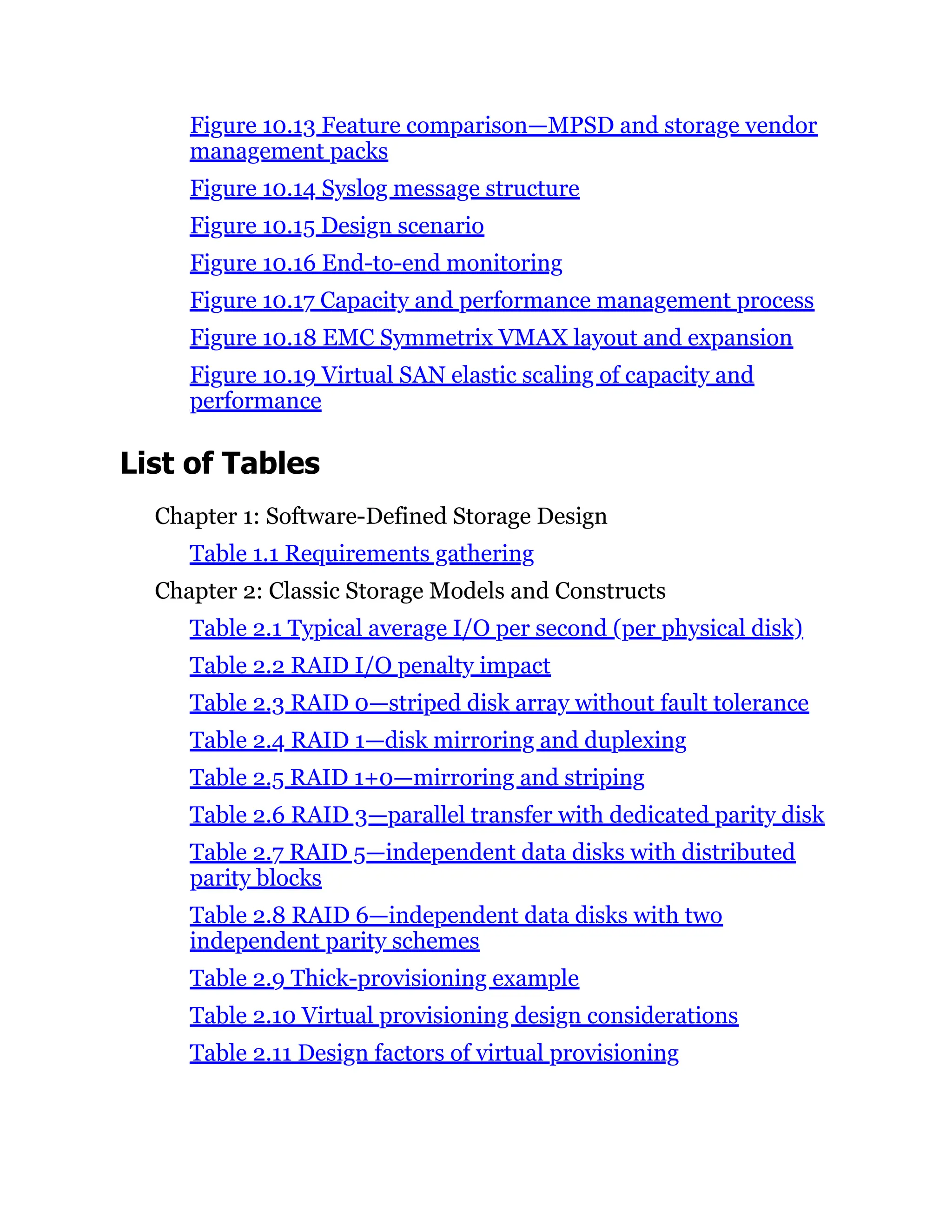
Figure 10.13 Feature comparison—MPSD and storage vendor
management packs
Figure 10.14 Syslog message structure
Figure 10.15 Design scenario
Figure 10.16 End-to-end monitoring
Figure 10.17 Capacity and performance management process
Figure 10.18 EMC Symmetrix VMAX layout and expansion
Figure 10.19 Virtual SAN elastic scaling of capacity and
performance
List of Tables
Chapter 1: Software-Defined Storage Design
Table 1.1 Requirements gathering
Chapter 2: Classic Storage Models and Constructs
Table 2.1 Typical average I/O per second (per physical disk)
Table 2.2 RAID I/O penalty impact
Table 2.3 RAID 0—striped disk array without fault tolerance
Table 2.4 RAID 1—disk mirroring and duplexing
Table 2.5 RAID 1+0—mirroring and striping
Table 2.6 RAID 3—parallel transfer with dedicated parity disk
Table 2.7 RAID 5—independent data disks with distributed
parity blocks
Table 2.8 RAID 6—independent data disks with two
independent parity schemes
Table 2.9 Thick-provisioning example
Table 2.10 Virtual provisioning design considerations
Table 2.11 Design factors of virtual provisioning
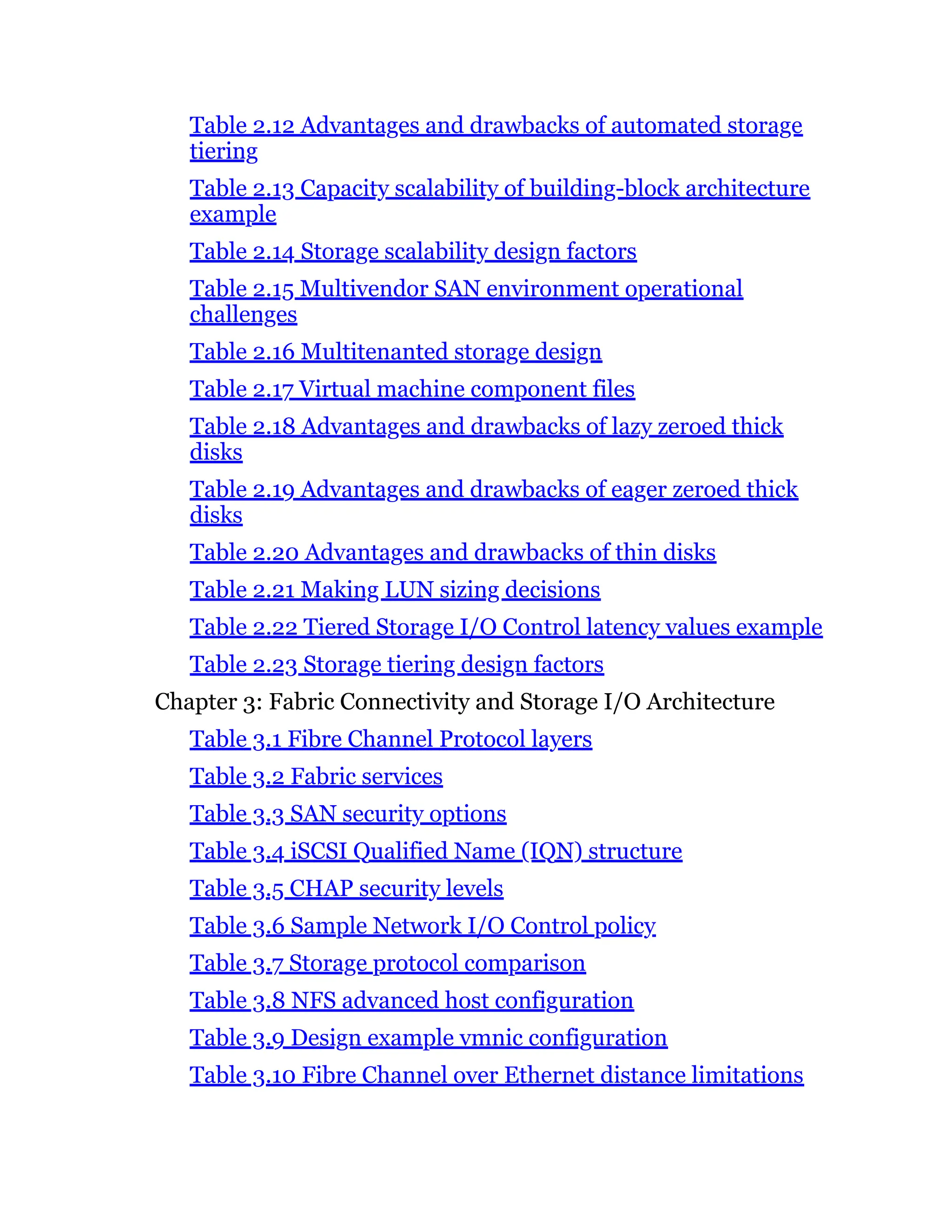
Table 2.12 Advantages and drawbacks of automated storage
tiering
Table 2.13 Capacity scalability of building-block architecture
example
Table 2.14 Storage scalability design factors
Table 2.15 Multivendor SAN environment operational
challenges
Table 2.16 Multitenanted storage design
Table 2.17 Virtual machine component files
Table 2.18 Advantages and drawbacks of lazy zeroed thick
disks
Table 2.19 Advantages and drawbacks of eager zeroed thick
disks
Table 2.20 Advantages and drawbacks of thin disks
Table 2.21 Making LUN sizing decisions
Table 2.22 Tiered Storage I/O Control latency values example
Table 2.23 Storage tiering design factors
Chapter 3: Fabric Connectivity and Storage I/O Architecture
Table 3.1 Fibre Channel Protocol layers
Table 3.2 Fabric services
Table 3.3 SAN security options
Table 3.4 iSCSI Qualified Name (IQN) structure
Table 3.5 CHAP security levels
Table 3.6 Sample Network I/O Control policy
Table 3.7 Storage protocol comparison
Table 3.8 NFS advanced host configuration
Table 3.9 Design example vmnic configuration
Table 3.10 Fibre Channel over Ethernet distance limitations
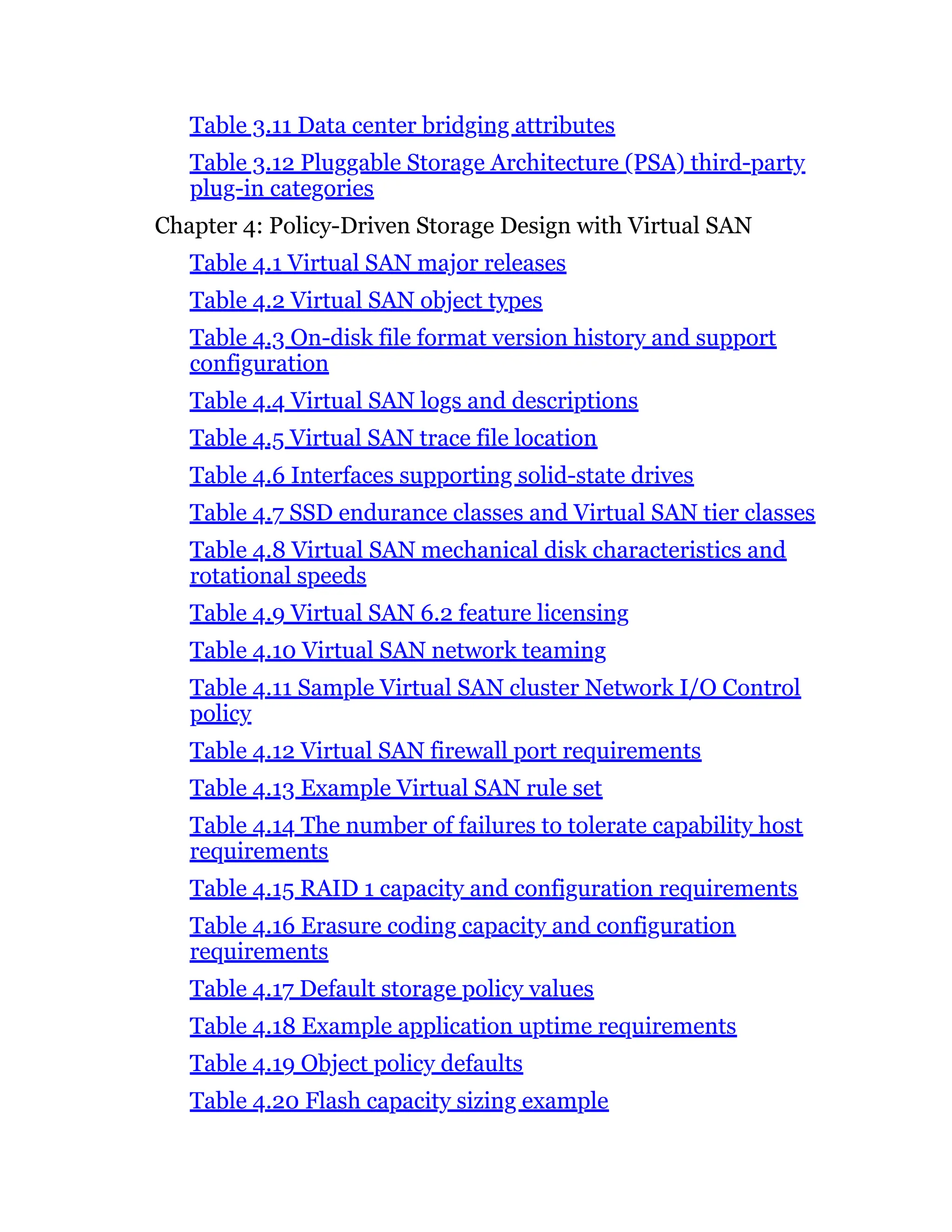
Table 3.11 Data center bridging attributes
Table 3.12 Pluggable Storage Architecture (PSA) third-party
plug-in categories
Chapter 4: Policy-Driven Storage Design with Virtual SAN
Table 4.1 Virtual SAN major releases
Table 4.2 Virtual SAN object types
Table 4.3 On-disk file format version history and support
configuration
Table 4.4 Virtual SAN logs and descriptions
Table 4.5 Virtual SAN trace file location
Table 4.6 Interfaces supporting solid-state drives
Table 4.7 SSD endurance classes and Virtual SAN tier classes
Table 4.8 Virtual SAN mechanical disk characteristics and
rotational speeds
Table 4.9 Virtual SAN 6.2 feature licensing
Table 4.10 Virtual SAN network teaming
Table 4.11 Sample Virtual SAN cluster Network I/O Control
policy
Table 4.12 Virtual SAN firewall port requirements
Table 4.13 Example Virtual SAN rule set
Table 4.14 The number of failures to tolerate capability host
requirements
Table 4.15 RAID 1 capacity and configuration requirements
Table 4.16 Erasure coding capacity and configuration
requirements
Table 4.17 Default storage policy values
Table 4.18 Example application uptime requirements
Table 4.19 Object policy defaults
Table 4.20 Flash capacity sizing example
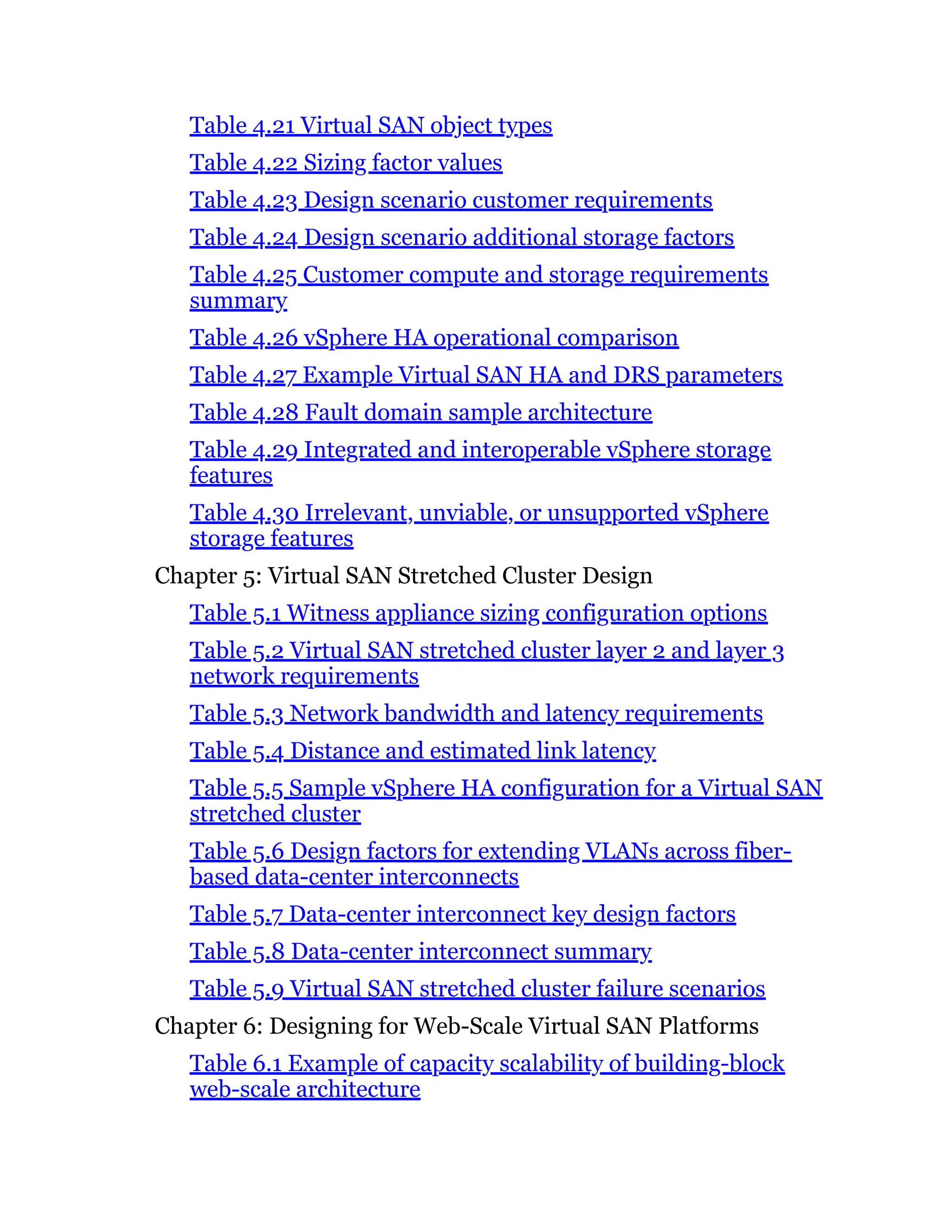
Table 4.21 Virtual SAN object types
Table 4.22 Sizing factor values
Table 4.23 Design scenario customer requirements
Table 4.24 Design scenario additional storage factors
Table 4.25 Customer compute and storage requirements
summary
Table 4.26 vSphere HA operational comparison
Table 4.27 Example Virtual SAN HA and DRS parameters
Table 4.28 Fault domain sample architecture
Table 4.29 Integrated and interoperable vSphere storage
features
Table 4.30 Irrelevant, unviable, or unsupported vSphere
storage features
Chapter 5: Virtual SAN Stretched Cluster Design
Table 5.1 Witness appliance sizing configuration options
Table 5.2 Virtual SAN stretched cluster layer 2 and layer 3
network requirements
Table 5.3 Network bandwidth and latency requirements
Table 5.4 Distance and estimated link latency
Table 5.5 Sample vSphere HA configuration for a Virtual SAN
stretched cluster
Table 5.6 Design factors for extending VLANs across fiber-
based data-center interconnects
Table 5.7 Data-center interconnect key design factors
Table 5.8 Data-center interconnect summary
Table 5.9 Virtual SAN stretched cluster failure scenarios
Chapter 6: Designing for Web-Scale Virtual SAN Platforms
Table 6.1 Example of capacity scalability of building-block
web-scale architecture
Table 6.2 Other Virtual SAN 6.0, 6.1, or 6.2 maximums
Chapter 7: Virtual SAN Use Case Library
Table 7.1 ESXi host hardware specifications
Table 7.2 Host resources
Table 7.3 vSphere HA example design values
Table 7.4 vSphere DRS example design values
Table 7.5 Anti-affinity rule guidelines for cloud management
cluster applications
Table 7.6 vSphere Distributed Switch configuration
Table 7.7 Example CMP Network I/O Control policy
Table 7.8 Cloud management platform virtual machine
requirements
Table 7.9 Example design storage policy specification
Table 7.10 Cloud platform virtual machine security baseline
Table 7.11 Cisco C-Series hardening baseline
Table 7.12 Cisco Nexus 5548UP hardening baseline
Chapter 8: Policy-Driven Storage Design with Virtual Volumes
Table 8.1 vSphere operational priorities
Table 8.2 Virtual Volumes object types
Table 8.3 Comparison of storage container and classic
Volumes/LUNs
Executive Editor: Jody Lefevere
Development Editor: David Clark
Technical Editor: Ray Heffer
Production Editor: Barath Kumar Rajasekaran
Copy Editor: Sharon Wilkey
Editorial Manager: Mary Beth Wakefi eld
Production Manager: Kathleen Wisor
Proofreader: Nancy Bell
Indexer: Nancy Guenther
Project Coordinator, Cover: Brent Savage
Cover Designer: Wiley
Cover Image: ©Mikhail hoboton Popov/Shutterstock
Copyright © 2016 by John Wiley & Sons, Inc., Indianapolis, Indiana
Published simultaneously in Canada
ISBN: 978-1-119-29277-7
ISBN: 978-1-119-29279-1 (ebk.)
ISBN: 978-1-119-29278-4 (ebk.)
No part of this publication may be reproduced, stored in a retrieval system, or
transmitted in any form or by any means, electronic, mechanical, photocopying,
recording, scanning, or otherwise, except as permitted under Sections 107 or 108
of the 1976 United States Copyright Act, without either the prior written
permission of the Publisher, or authorization through payment of the appropriate
per-copy fee to the Copyright Clearance Center, 222 Rosewood Drive, Danvers, MA
01923, (978) 750-8400, fax (978) 646-8600. Requests to the Publisher for
permission should be addressed to the Permissions Department, John Wiley &
Sons, Inc., 111 River Street, Hoboken, NJ 07030, (201) 748-6011, fax (201) 748-
6008, or online at http://www.wiley.com/go/permissions.
Limit of Liability/Disclaimer of Warranty: The publisher and the author make no
representations or warranties with respect to the accuracy or completeness of the
contents of this work and specifi cally disclaim all warranties, including without
limitation warranties of fi tness for a particular purpose. No warranty may be
created or extended by sales or promotional materials. The advice and strategies
contained herein may not be suitable for every situation. This work is sold with the
understanding that the publisher is not engaged in rendering legal, accounting, or
other professional services. If professional assistance is required, the services of a
competent professional person should be sought. Neither the publisher nor the
author shall be liable for damages arising herefrom. The fact that an organization
or website is referred to in this work as a citation and/or a potential source of
further information does not mean that the author or the publisher endorses the
information the organization or website may provide or recommendations it may
make. Further, readers should be aware that Internet websites listed in this work
may have changed or disappeared between when this work was written and when it
is read.
For general information on our other products and services or to obtain technical
support, please contact our Customer Care Department within the U.S. at (877)
762-2974, outside the U.S. at (317) 572-3993 or fax (317) 572-4002.
Wiley publishes in a variety of print and electronic formats and by print-on-
demand. Some material included with standard print versions of this book may not
be included in e-books or in print-on-demand. If this book refers to media such as
a CD or DVD that is not included in the version you purchased, you may download
this material at http://booksupport.wiley.com. For more information about Wiley
products, visit www.wiley.com.
Library of Congress Control Number: 2016944021
TRADEMARKS: Wiley, the Wiley logo, and the Sybex logo are trademarks or
registered trademarks of John Wiley & Sons, Inc. and/or its affi liates, in the
United States and other countries, and may not be used without written
permission. VMware is a registered trademark of VMware, Inc. All other
trademarks are the property of their respective owners. John Wiley & Sons, Inc. is
not associated with any product or vendor mentioned in this book.
About the Author
Martin Hosken is employed as a global cloud architect within the
VMware Global Cloud Practice, which is part of its Cloud Provider
Software Business Unit.
He has extensive experience architecting and consulting with
international customers and designing the transition of
organizations' legacy infrastructure onto VMware cloud-based
platforms. His broad and deep knowledge of physical and virtualized
services, platforms, and cloud infrastructure solutions is based on
involvement and leadership in the global architecture, design,
development, and implementation of large-scale, complex,
multitechnology projects for enterprises and cloud service providers.
He is a specialist in designing, implementing, and integrating best-
of-breed, fully redundant Cisco, EMC, IBM, HP, Dell, and VMware
systems into enterprise environments and cloud service providers'
infrastructure.
In addition, Martin is a double VMware Certified Design Expert
(VCDX #117) in Data Center Virtualization and Cloud Management
and Automation. (See the Official VCDX directory available at
http://vcdx.vmware.com.) Martin also holds a range of industry
certifications from other vendors such as EMC, Cisco, and Microsoft,
including MCITP and MCSE in Windows Server and Messaging.
He has been awarded the annual VMware vExpert title for a number
of years for his significant contribution to the community of VMware
users. (See the VMware Community vExpert Directory available at
https://communities.vmware.com/vexpert.jspa.) This title is
awarded to individuals for their commitment to the sharing of
knowledge and their passion for VMware technology beyond their
job requirements. Martin is also a part of the CTO Ambassador
Program, and as such is responsible for connecting the R&D team at
VMware with customers, partners, and field employees.
Follow Martin on Twitter: @hoskenm.
About the Technical Reviewer
Ray Heffer is employed as a global cloud architect for VMware's
Cloud Provider Software Business Unit. He is also a double VCDX
#122 (Desktop and Datacenter). In his previous roles with End User
Computing (EUC), Technical Marketing, and Professional Services at
VMware, he has led many large-scale platform designs for service
providers, manufacturing, and government organizations.
Since 1997 Ray has specialized in administering, designing, and
implementing solutions ranging from Microsoft Exchange, Linux,
Citrix, and VMware. He deployed his first VMware environment in
2004 while working at a hosting company in the United Kingdom.
Ray is also a regular presenter at VMworld and VMUG events,
covering topics such as Linux desktops and VMware Horizon design
best practices.
Foreword by Duncan Epping
I had just completed the final chapter of the Virtual SAN book I was
working on when Martin reached out and asked if I wanted to write a
foreword for his book. You can imagine I was surprised to find out
that there was another person writing a book on software-defined
storage, and pleasantly surprised to find out that VSAN is one of the
major topics in this book. Not just surprised, but also very pleased.
The world is changing rapidly, and administrators and architects
need guidance along this journey, the journey toward a software-
defined data center.
When talking to customers and partners on the subject of the
software-defined data center, a couple of concerns typically arise.
Two parts of the data center have always been historically
challenging and/or problematic—namely, networking and storage.
Networking problems and concerns (and those related to security,
for that matter) have been largely addressed with VMware NSX,
which allows virtualization and networking administrators to work
closely together on providing a flexible yet very secure foundation for
the workloads they manage. This is done by adding an abstraction
layer on top of the physical environment and moving specific services
closer to the workloads (for instance, firewalling and routing), where
they belong.
Over 30 years ago, RAID was invented, which allowed you to create
logical devices formed out of multiple hard disk drives. This allowed
for more capacity, higher availability, and of course, depending on
the type of RAID used, better performance. It is fair to say, however,
that the RAID construct was created as a result of the many
constraints at the time. Over time, all of these constraints have been
lifted, and the hardware evolution started the (software-defined)
storage revolution. SSDs, PCIe-based flash, NVMe, 10GbE, 25GbE
(and higher), RDMA, 12 Gbps SAS, and many other technologies
allowed storage vendors to innovate again and to make life simpler.
No longer do we need to wide-stripe across many disks to meet
performance expectations, as that single SSD device can now easily
serve 50,000 IOPS. And although some of the abstraction layers,
such as traditional RAID or disk groups, may have been removed,
most storage systems today are not what I would consider
admin/user friendly.
There are different protocols (iSCSI, FCoE, NFS, FC), different
storage systems (spindles, hybrid, all flash), and many different data
services and capabilities these systems provide. As a result, we
cannot simply place an abstraction layer on top as we have done for
networking with NSX. We still need to abstract the resources in some
shape or form and most definitely present them in a different,
simpler manner. Preferably, we leverage a common framework
across the different types of solutions, whether that is a hyper-
converged software solution like Virtual SAN or a more traditional
iSCSI-based storage system with a combination of flash and spindles.
Storage policy–based management is this framework. If there is
anything you need to take away from this book, then it is where your
journey to software-defined storage should start, and that is the
SPBM framework that comes as part of vSphere. SPBM is that
abstraction layer that allows you to consume storage resources
across many different types of storage (with different protocols) in a
simple and uniform way by allowing you to create policies that are
passed down to the respective storage system through the VMware
APIs for Storage Awareness.
In order to be able to create an infrastructure that caters to the needs
of your customers (application owners/users), it is essential that you,
the administrator or architect, have a good understanding of all the
capabilities of the different storage platforms, the requirements of
the application, and how architectural decisions can impact
availability, recoverability, and performance of your workloads.
But before you even get there, this book will provide you with a good
foundational understanding of storage concepts including thin
LUNs, protocols, RAID, and much more. This will be quickly
followed by the software-defined storage options available in a
VMware-based infrastructure, with a big focus on Virtual Volumes
and Virtual SAN.
Many have written on the subject of software-defined storage, but
not many are as qualified as Martin. Martin is one of the few folks
who have managed to accrue two VCDX certifications, and as a
global cloud architect has a wealth of experience in this field. He is
going to take you on a journey through the world of software-defined
storage in a VMware-based infrastructure and teach you the art of
architecture along the way.
I hope you will enjoy reading this book as much as I have.
Duncan Epping
Chief Technologist, Storage and Availability, VMware
Introduction
Storage is typically the most important element of any virtual data
center. It is the key component in system performance, availability,
scalability, and manageability. It has also traditionally been the most
expensive component from a capital and operational cost
perspective.
The storage infrastructure must meet not only today's requirements,
but also the business needs for years to come, because of the capital
expenditure costs historically associated with the hardware. Storage
and vSphere architects must therefore make the most informed
choices possible, designing solutions that take into account multiple
complex and contradictory business requirements, technical goals,
forecasted data growth, constraints, and of course, budget.
In order for you to be confident about undertaking a vSphere storage
design that can meet the needs of a whole range of business and
organization types, you must understand the capabilities of the
platform. Designing a solution that can meet the requirements and
constraints set out by the customer requires calling on your
experience and knowledge, as well as keeping up with advances in
the IT industry. A successful design entails collecting information,
correlating it into a solid design approach, and understanding the
design trade-offs and design decisions.
The primary content of this book addresses various aspects of the
VMware vSphere software-defined storage model, which includes
separate components. Before you continue reading, you should
ensure that you are already well acquainted with the core vSphere
products, such as VMware vCenter Server and ESXi, the type 1
hypervisor on which the infrastructure's virtual machines and guest
operating systems reside.
It is also assumed that you have a good understanding of shared
storage technologies and networking, along with the wider
infrastructure required to support the virtual environment, such as
physical switches, firewalls, server hardware, array hardware, and
the protocols associated with this type of equipment, which include,
but are not limited to, Fibre Channel, iSCSI, NFS, Ethernet, and
FCoE.
Who Should Read This Book?
This book will be most useful to infrastructure architects and
consultants involved in designing new vSphere environments, and
administrators charged with maintaining existing vSphere
deployments who want to further optimize their infrastructure or
gain additional knowledge about storage design. In addition, this
book will be helpful for anyone with a VCA, VCP, or a good
foundational knowledge who wants an in-depth understanding of the
design process for new vSphere storage architectures. Prospective
VCAP, VCIX, or VCDX candidates who already have a range of
vSphere expertise but are searching for that extra bit of detailed
knowledge will also benefit.
What Is Covered in This Book?
VMware-based storage infrastructure has changed a lot in recent
years, with new technologies and new storage vendors stepping all
over the established industry giants, such as EMC, IBM, and NetApp.
However, life-cycle management of the storage platform remains an
ongoing challenge for enterprise IT organizations and service
providers, with hardware renewals occurring on an ongoing basis for
many of VMware's global customer base.
This book aims to help vSphere architects, storage architects, and
administrators alike understand and design for this new generation
of VMware-focused software-defined storage, and to drive efficiency
through simple, less complex technologies that do not require large
numbers of highly trained storage administrators to maintain.
In addition, this book aims to help you understand the design factors
associated with these new vSphere storage options. You will see how
VMware is addressing these data-center challenges through its
software-defined storage offerings, Virtual SAN and Virtual Volumes,
as well as developing cloud automation approaches to these next-
generation storage solutions to further simplify operations.
This book offers you deep knowledge and understanding of these
new storage solutions by
Providing unique insight into Virtual SAN and Virtual Volumes
storage technologies and design
Providing a detailed knowledge transfer of these technologies and
an understanding of the design factors associated with the
architecture of this next generation of VMware-based storage
platform
Providing guidance over delivering storage as a service (STaaS)
and enabling enterprise IT organizations and service providers to
deploy and maintain storage resources via a fully automated
cloud platform
Providing detailed and unique guidance in the design and
implementation of a stretched Virtual SAN architecture,
including an example solution
Providing a detailed knowledge transfer of legacy storage and
protocol concepts, in order to help provide context to the VMware
software-defined storage model
Finally, in writing this book, I hope to help you understand all of the
design factors associated with these new vSphere storage options,
and to provide a complete guide for solution architects and
operational teams to maximize quality storage design for this new
generation of technologies.
The following provides a brief summary of the content in each of the
10 chapters:
Chapter 1: Software-Defined Storage Design This chapter
provides an overview of where vSphere storage technology is
today, and how we've reached this point. This chapter also
introduces software-defined storage, the economics of storage
resources, and enabling storage as a service.
Chapter 2: Classic Storage Models and Constructs This
chapter covers the legacy and classic storage technologies that
have been used in the VMware infrastructure for the last decade.
This chapter provides the background required for you to
understand the focus of this book, VMware vSphere's next-
generation storage technology design.
Chapter 3: Fabric Connectivity and Storage I/O
Architecture This chapter presents storage connectivity and
fabric architecture, which is relevant for legacy storage
technologies as well as next-generation solutions including
Virtual Volumes.
Chapter 4: Policy-Driven Storage Design with Virtual
SAN This chapter addresses all of the design considerations
associated with VMware's Virtual SAN storage technology. The
chapter provides detailed coverage of Virtual SAN functionality,
design factors, and architectural considerations.
Chapter 5: Virtual SAN Stretched Cluster Design This
chapter focuses on one type of Virtual SAN solution, stretched
cluster design. This type of solution has specific design and
implementation considerations that are addressed in depth. This
chapter also provides an example Virtual SAN stretched
architecture design as a reference.
Chapter 6: Designing for Web-Scale Virtual SAN
Platforms This chapter addresses specific considerations
associated with large-scale deployments of Virtual SAN hyper-
converged infrastructure, commonly referred to as web-scale.
Chapter 7 Virtual SAN Use Case Library This chapter
provides an overview of Virtual SAN use cases. It also provides a
detailed solution architecture for a cloud management platform
that you can use as a reference.
Chapter 8: Policy-Driven Storage Design with Virtual
Volumes This chapter provides detailed coverage of VMware's
Virtual Volumes technology and its associated policydriven
storage concepts This chapter also provides a lowlevel knowledge
transfer as well as addressing in detail the design factors and
architectural concepts associated with implementing Virtual
Volumes
Chapter 9: Delivering a Storage-as-a-Service Design This
chapter explains how IT organizations and service providers can
design and deliver storage as a service in a cloud-enabled data
center by using VMware's cloud management platform
technologies.
Chapter 10: Monitoring and Storage Operations Design
To ensure that a storage design can deliver an operationally
efficient storage platform end to end, this final chapter covers
storage monitoring and alerting design in the software-defined
storage data center.
Chapter 1
Software-Defined Storage Design
VMware is the global leader in providing virtualization solutions. The
VMware ESXi software provides a hypervisor platform that abstracts
CPU, memory, and storage resources to run multiple virtual
machines concurrently on the same physical server.
To successfully design a virtual infrastructure, other products are
required in addition to the hypervisor, in order to manage, monitor,
automate, and secure the environment. Fortunately, VMware also
provides many of the products required to design an end-to-end
solution, and to develop an infrastructure that is software driven, as
opposed to hardware driven. This is commonly described as the
software-defined data center (SDDC), illustrated in Figure 1.1.
Figure 1.1 Software-defined data center conceptual model
The SDDC is not a single product sold by VMware or anyone else. It
is an approach whereby management and orchestration tools are
configured to manage, monitor, and operationalize the entire
infrastructure. This might include products such as vSphere, NSX,
vRealize Automation, vRealize Operations Manager, and Virtual SAN
from VMware, but it could also include solutions such as VMware
Integrated OpenStack, CloudStack, or any custom cloud-
management solution that can deliver the required platform
management and orchestration capabilities.
The primary aim of the SDDC is to decouple the infrastructure from
its underlying hardware, in order to allow software to take advantage
of the physical network, server, and storage. This makes the SDDC
location-independent, and as such, it may be housed in a single
physical data center, span multiple private data centers, or even
extend into hybrid and public cloud facilities.
From the end user’s perspective, applications that are delivered from
an SDDC are consumed in exactly the same way as they otherwise
would be—through mobile, desktop, and virtual desktop interfaces—
from anywhere, any time, with any device.
However, with the SDDC infrastructure decoupled from the physical
hardware, the operational model of a virtual machine—with on-
demand provisioning, isolation, mobility, speed, and agility—can be
replicated for the entire data-center environment (including
networking and storage), with complete visibility, security, and scale.
The overall aim is that an SDDC can be achieved with the customer’s
existing physical infrastructure, and also provide the flexibility for
added capacity and new deployments.
Software-Defined Compute
In this book, software-defined compute refers to the compute
virtualization of the x86 architecture. What is virtualization? If you
don’t know the answer to this question, you’re probably reading the
wrong book, but in any case, let’s make sure we’re on the same page.
In the IT industry, the term virtualization can refer to various
technologies. However, from a VMware perspective, virtualization is
the technique used for abstracting the physical hardware away from
the operating system. This technique allows multiple guest operating
systems (logical servers or desktops) to run concurrently on a single
physical server. This allows these logical servers to become a
portable virtual compute resource, called virtual machines. Each
virtual machine runs its own guest operating system and applications
in an isolated manner.
Compute virtualization is achieved by a hypervisor layer, which
exists between the hardware of the physical server and the virtual
machines. The hypervisor is used to provide hardware resources,
such as CPU, memory, and network to all the virtual machines
running on that physical host. A physical server can run numerous
virtual machines, depending on the hardware resources available.
Although a virtual machine is a logical entity, to its operating system
and end users, it seems like a physical host with its own CPU,
memory, network controller, and disks. However, all virtual
machines running on a host share the same underlying physical
hardware, but each taking its own share in an isolated manner. From
the hypervisor’s perspective, each virtual machine is simply a
discrete set of files, which include a configuration file, virtual disk
files, log files, and so on.
It is VMware’s ESXi software that provides the hypervisor platform,
which is designed from the ground up to run multiple virtual
machines concurrently, on the same physical server hardware.
Software-Defined Networking
Traditional physical network architectures can no longer scale
sufficiently to meet the requirements of large enterprises and cloud
service providers. This has come about as the daily operational
management of networks is typically the most time-consuming
aspect in the process of provisioning new virtual workloads.
Software-defined networking helps to overcome this problem by
providing networking to virtual environments, which allows network
administrators to manage network services through an abstracted
higher-level functionality.
As with all of the components that make up the SDDC model, the
primary aim is to provide a simplified and more efficient mechanism
to operationalize the virtual data-center platform. Through the use of
software-defined networking, the majority of the time spent
provisioning and configuring individual network components in the
infrastructure can be performed programmatically, in a virtualized
network environment. This approach allows network administrators
to get around this inflexibility of having to pre-provision and
configure physical networks, which has proved to be a major
constraint to the development of cloud platforms.
In a software-defined networking architecture, the control and data
planes are decoupled from one another, and the underlying physical
network infrastructure is abstracted from the applications. As a
result, enterprises and cloud service providers obtain unprecedented
­
programmability, automation, and network control. This enables
them to build highly scalable, flexible networks with cloud agility,
which can easily adapt to changing business needs by
Providing centralized management and control of networking
devices from multiple vendors.
Improving automation and management agility by employing
common application program interfaces (APIs) to abstract the
underlying networking from the orchestration and provisioning
processes, without the need to configure individual devices.
Increasing network reliability and security as a result of
centralized and automated management of the network devices,
which provides this unified security policy enforcement model,
which in turn reduces configuration errors.
Providing more-granular network control, with the ability to
apply a wide range of policies at the session, user, device, or
application level.
NSX is VMware’s software-defined networking platform, which
enables this approach to be taken through an integrated stack of
technologies. These include the NSX Controller, NSX vSwitch, NSX
API, vCenter Server, and NSX Manager. By using these components,
NSX can create layer 2 logical switches, which are associated with
logical routers, both north/south and east/west firewalling, load
balancers, security policies, VPNs, and much more.
Software-Defined Storage
Where the data lives! That is the description used by the marketing
department of a large financial services organization that I worked at
several years ago. The marketing team regularly used this term in an
endearing way when trying to describe the business-critical storage
systems that maintained customer data, its availability, performance
level, and compliance status.
Since then, we have seen a monumental shift in the technologies
available to vSphere for virtual machine and application storage,
with more and more storage vendors trying to catch up, and for
some, steam ahead. The way modern data centers operate to store
data has been changing, and this is set to continue over the coming
years with the continuing shift toward the next-generation data
center, and what is commonly described as software-defined
storage.
VMware has undoubtedly brought about massive change to
enterprise IT organizations and service-provider data centers across
the world, and has also significantly improved the operational
management and fundamental economics of running IT
infrastructure. However, as application workloads have become
more demanding, storage devices have failed to keep up with IT
organizations’ requirements for far more flexibility from their
storage solutions, with greater scalability, performance, and
availability. These design challenges have become an everyday
conversation for operational teams and IT managers.
The primary challenge is that many of the most common storage
systems we see in data centers all over the world are based on
outdated technology, are complex to manage, and are highly
proprietary. This ties organizations into long-term support deals
with hardware vendors.
This approach is not how the biggest cloud providers have become so
successful at scaling their storage operations. The likes of Amazon,
Microsoft, and Google have scaled their cloud storage platforms by
trading their traditional storage systems for low-cost commodity
hardware, and employed the use of powerful software around it to
achieve their goals, such as availability, data protection, operational
simplification, and performance. With this approach, and through
the economies of scale, these large public cloud providers have
achieved their supremacy at a significantly lower cost than deploying
traditional monolithic centralized storage systems. This
methodology, known as web-scale, is addressed further in Chapter 6,
“Designing for Web-Scale Virtual SAN Platforms (10,000 VMS+).”
The aim of this book is to help you understand the new vSphere
storage options, and how VMware is addressing these data-center
challenges through its software-defined storage offerings, Virtual
SAN and Virtual Volumes. The primary aim of these two next-
generation storage solutions is to drive efficiency through simple,
less complex technologies that do not require large numbers of
highly trained storage administrators to maintain. It is these
software-defined data-center concepts that are going to completely
transform all aspects of vSphere data-center storage, allowing these
hypervisor-driven concepts to bind together the compute,
networking, and software-defined storage layers.
The goal of software-defined storage is to separate the physical
storage hardware from the logic that determines where the data
lives, and what storage services are applied to the virtual machines
and data during read and write operations.
As a result of VMware’s next-generation storage offerings, a storage
layer can be achieved that is more flexible and that can easily be
adjusted based on changing application requirements. In addition,
the aim is to move away from complex proprietary vendor systems,
to a virtual data center made up of a coherent data fabric that
provides full visibility of each virtual machine through a single
management toolset, the so-called single pane of glass. These
features, along with lowered costs, automation, and application-
centric services, are the primary drivers for enterprise IT
organizations and cloud service providers to begin to rethink their
entire storage architectural approach.
The next point to address is what software-defined storage isn’t, as it
can sometimes be hard to wade through all the marketing hype
typically generated by storage vendors. Just because a hardware
vendor sells or bundles management software with their products,
doesn’t make it a software-defined solution. Likewise, a data center
full of different storage systems from a multitude of vendors,
managed by a single common software platform, does not equate to a
software-defined storage solution. As each of the underlining storage
systems still has its legacy constructs, such as disk pools and LUNs,
this is referred to as a federated storage solution and not software-
defined. These two approaches are sometimes confused by storage
vendors, as understandably, manufacturers always want to use the
latest buzzwords in their marketing material.
Despite everything that has been said up until now, software-defined
storage isn’t just about software. At some point, you have to consider
the underlying disk system that provides the storage capacity and
performance. If you go out and purchase a lot of preused 5,400 RPM
hard drives from eBay, you can’t then expect solid-state flash-like
performance just because you’ve put a smart layer of software on top
of it.
Designing VMware Storage Environments
Gathering requirements and documenting driving factors is a key
objective for you, the architect. Understanding the customer’s
business objectives, challenges, and requirements should always be
the first task you undertake, before any design can be produced.
From this activity, you can translate the outcomes into design
factors, requirements, constraints, risks, and assumptions, which are
all critical to the success of the vSphere storage design.
Architects use many approaches and methodologies to provide
customers with a meaningful design that meets their current and
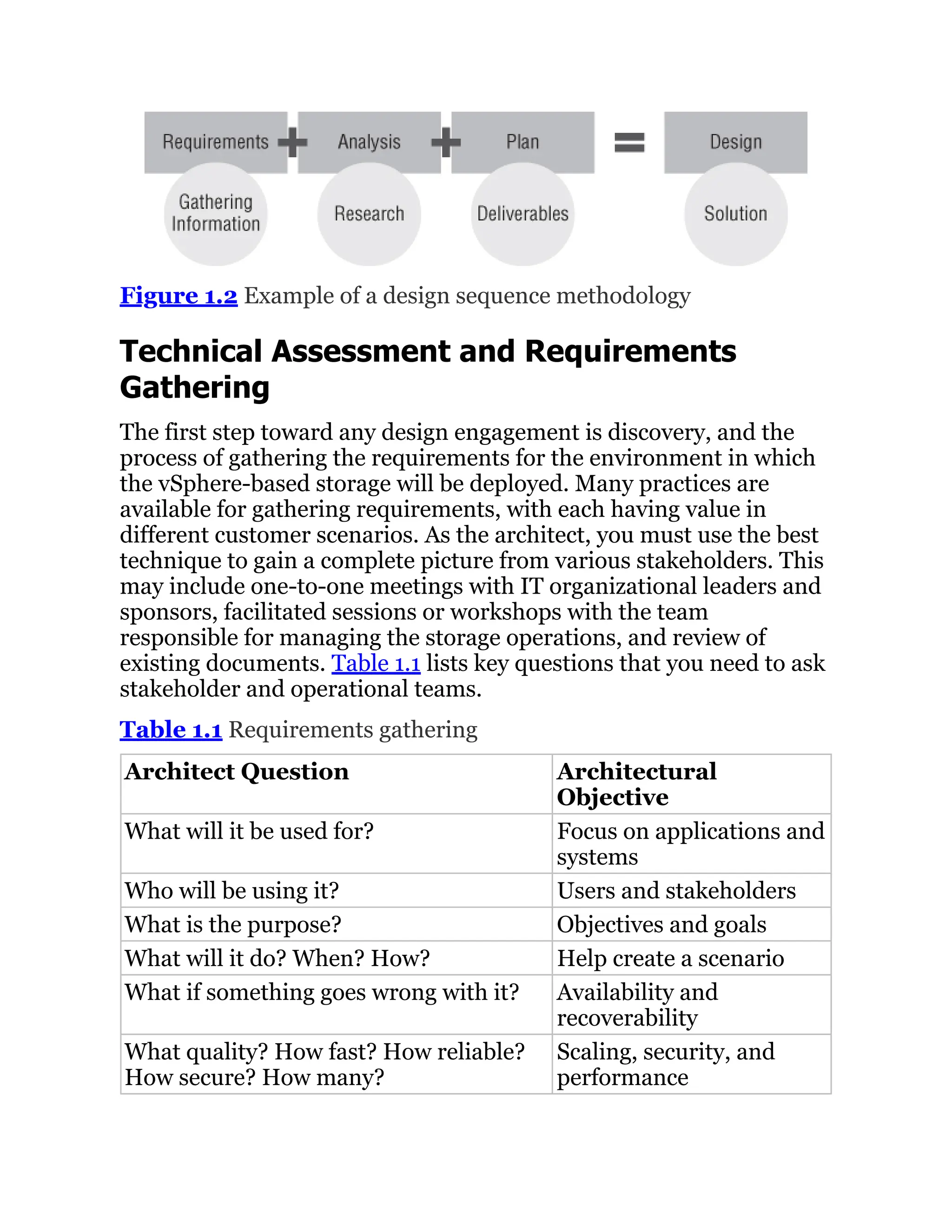
future needs. Figure 1.2 illustrates one such method, which provides
an elastic sequence of activities that can typically fulfill all stages of
the design process. However, many organizations have their own
approach, which may dictate this process and mandate specific
deliverables and project methodologies.
Figure 1.2 Example of a design sequence methodology
Technical Assessment and Requirements
Gathering
The first step toward any design engagement is discovery, and the
process of gathering the requirements for the environment in which
the vSphere-based storage will be deployed. Many practices are
available for gathering requirements, with each having value in
different customer scenarios. As the architect, you must use the best
technique to gain a complete picture from various stakeholders. This
may include one-to-one meetings with IT organizational leaders and
sponsors, facilitated sessions or workshops with the team
responsible for managing the storage operations, and review of
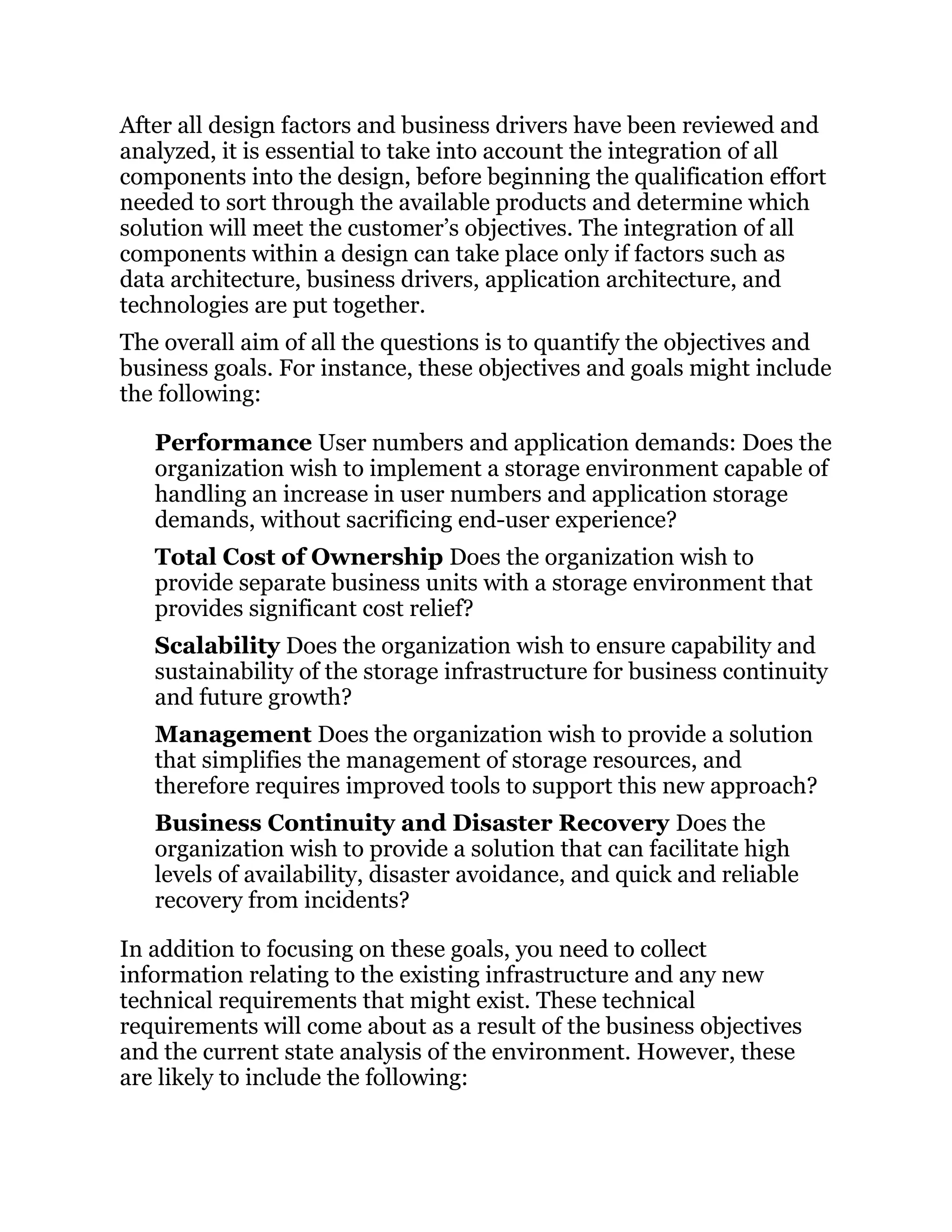
existing documents. Table 1.1 lists key questions that you need to ask
stakeholder and operational teams.
Table 1.1 Requirements gathering
Architect Question Architectural
Objective
What will it be used for? Focus on applications and
systems
Who will be using it? Users and stakeholders
What is the purpose? Objectives and goals
What will it do? When? How? Help create a scenario
What if something goes wrong with it? Availability and
recoverability
What quality? How fast? How reliable?
How secure? How many?
Scaling, security, and
performance
After all design factors and business drivers have been reviewed and
analyzed, it is essential to take into account the integration of all
components into the design, before beginning the qualification effort
needed to sort through the available products and determine which
solution will meet the customer’s objectives. The integration of all
components within a design can take place only if factors such as
data architecture, business drivers, application architecture, and
technologies are put together.
The overall aim of all the questions is to quantify the objectives and
business goals. For instance, these objectives and goals might include
the following:
Performance User numbers and application demands: Does the
organization wish to implement a storage environment capable of
handling an increase in user numbers and application storage
demands, without sacrificing end-user experience?
Total Cost of Ownership Does the organization wish to
provide separate business units with a storage environment that
provides significant cost relief?
Scalability Does the organization wish to ensure capability and
sustainability of the storage infrastructure for business continuity
and future growth?
Management Does the organization wish to provide a solution
that simplifies the management of storage resources, and
therefore requires improved tools to support this new approach?
Business Continuity and Disaster Recovery Does the
organization wish to provide a solution that can facilitate high
levels of availability, disaster avoidance, and quick and reliable
recovery from incidents?
In addition to focusing on these goals, you need to collect
information relating to the existing infrastructure and any new
technical requirements that might exist. These technical
requirements will come about as a result of the business objectives
and the current state analysis of the environment. However, these
are likely to include the following:
Application classification
Physical and virtual network constraints
Host server options
Virtual machines and workload deployment methodology
Network-attached storage (NAS) systems
Storage area network (SAN) systems
Understanding the customer’s business goals is critical, but what
makes it such a challenge is that no two projects are ever the same.
Whether it is different hardware, operating systems, maintenance
levels, physical or virtual servers, or number of volumes, the new
design must be validated for each component within each customer’s
specific infrastructure. In addition, just as every environment is
different, no two workloads are the same either. For instance, peak
times can vary from site to site and from customer to customer.
These individual differentiators must be validated one by one, in
order to determine the configuration required to meet the customer’s
design objectives.
Establishing Storage Design Factors
Establishing storage design factors is key to any architecture.
However, as previously stated, the elements will vary from one
engagement to another. Nevertheless, and this is important, the
design should focus on the business drivers and design factors, and
not the product features or latest technology specification from the
customer’s preferred storage hardware vendor. A customer-preferred
storage device could well be the best product ever, but may not align
with the customer use cases, regardless of what they’re being told by
their supplier. Therefore, creating an architecture that focuses on the
hardware specification and not the business goals is likely to
introduce significant risks and ultimately fail as a design.
Although the business drivers and design factors for each customer
will be different, with all having their own priorities and goals that
need to be factored into the design, you likely will see many common
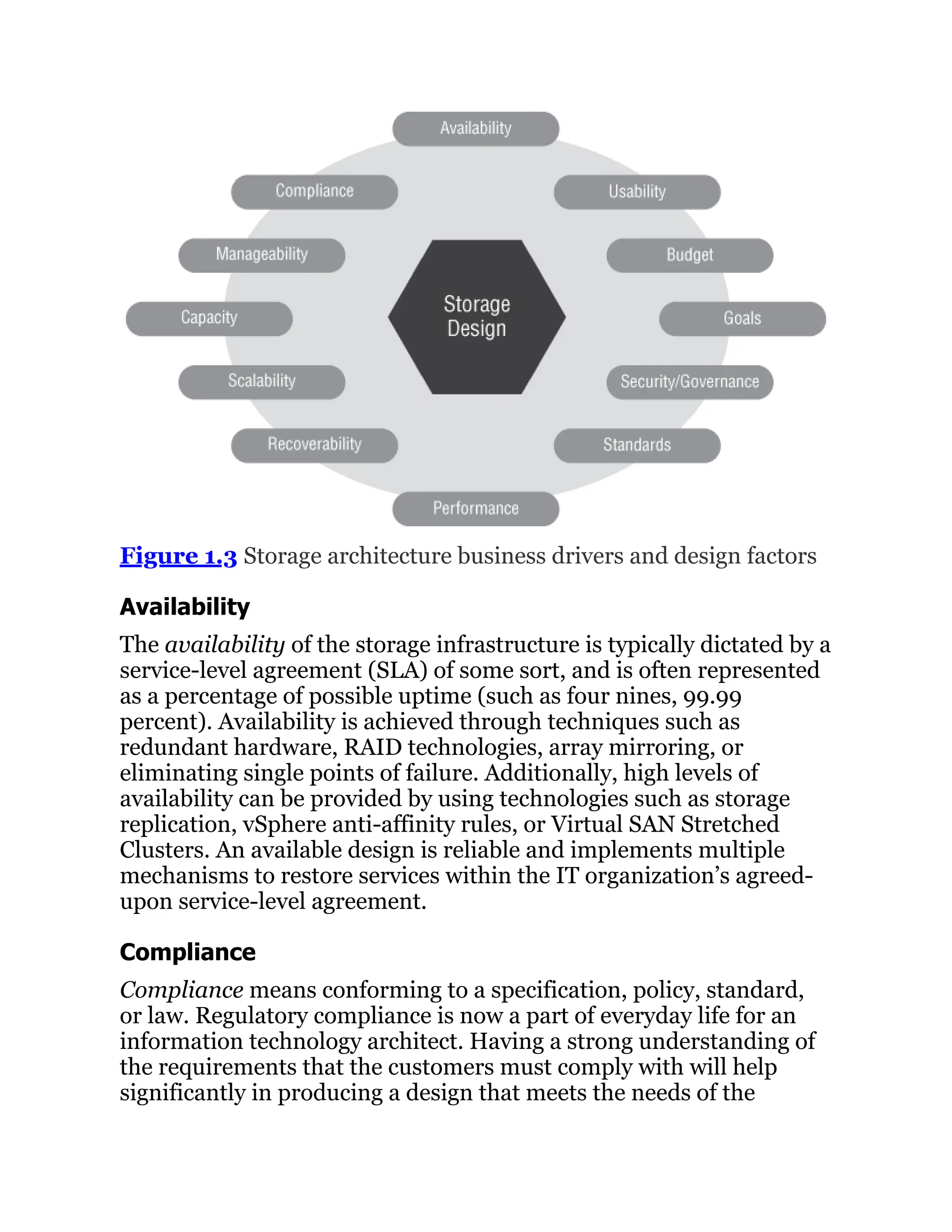
design qualities, illustrated in Figure 1.3, time and time again.
Figure 1.3 Storage architecture business drivers and design factors
Availability
The availability of the storage infrastructure is typically dictated by a
service-level agreement (SLA) of some sort, and is often represented
as a percentage of possible uptime (such as four nines, 99.99
percent). Availability is achieved through techniques such as
redundant hardware, RAID technologies, array mirroring, or
eliminating single points of failure. Additionally, high levels of
availability can be provided by using technologies such as storage
replication, vSphere anti-affinity rules, or Virtual SAN Stretched
Clusters. An available design is reliable and implements multiple
mechanisms to restore services within the IT organization’s agreed-
upon ­
service-level agreement.
Compliance
Compliance means conforming to a specification, policy, standard,
or law. Regulatory compliance is now a part of everyday life for an
information technology architect. Having a strong understanding of
the requirements that the customers must comply with will help
significantly in producing a design that meets the needs of the
organization you’re working with. Compliance goals also differ for
different countries. For instance, in the United States, architects may
be familiar with the Sarbanes–Oxley Act of 2002 or the Health
Insurance Portability and Accountability Act of 1996 (HIPAA). In
addition, global compliance standards, such as the Payment Card
Industry Data Security Standard (PCI DSS), cross geographical
boundaries.
Usability
Usability is the ease of use and learnability of the day-to-day
operations associated with the storage platform. As the architect, one
of your tasks will be to ensure that the customer’s operational team
or administrators are able to manage the environment after you
leave and move on to the next project. This, of course, links into
manageability, and you may be required to provide operational
documentation, or partake in knowledge transfer and training as
defined in the scope of work.
Budget
Unfortunately, few projects have unlimited budgets. Cost is always at
the forefront of stakeholders’ minds, and, as the architect, you will
probably find that justifying costs associated with the design will
often come down to you. I can assure you from personal experience
that CFOs and their representatives can be scary and love to ask
difficult and challenging questions. (To be fair, all they are trying to
do is justify costs, so let’s not be too hard on them.) Your goal is to
meet the organization’s business needs, while remaining within
budget. If this is not possible, you must be able to explain and justify
the best course of action to the organization’s key stakeholders, who
hold the purse strings.
The budget will depend on multiple factors. It might be too small a
number, and you can think of it as a design constraint. In an ideal
world, the design should focus only on system readiness,
performance, and capacity, with an aim to provide a world-class
solution with the future in mind, regardless of the cost. However,
this is rarely the case; typically, the task of an architect is to take in
all of the requirements and provide the best solution with the lowest
Random documents with unrelated
content Scribd suggests to you:
exclaimed, 'Thank the Lord, that at last He's let me see enough of
something!'"
"Yes, it's emancipation. Linda and I have often remarked that it
would seem impossible to have narrow thoughts here. She doesn't
wish to intrude, Bertram, but she would like to come to see you."
King met the sweet, questioning expression of his companion's eyes.
"I see plainly," he answered with a smile, "that you and I must have
it out about Linda. Your persistent references to her each time you
come show that she is very much on your mind."
"She is very much on my mind," returned Mrs. Porter gravely. "I wish
you would send a kindly message to her by me, and say that you
would be glad to see her."
"But I wouldn't, Maud," returned King mildly. "What would you do in
that case? Of course, you know the whole situation, and know that
Whitcomb with his grand little revelation bouleversed all Linda's fixed
ideas."
"Oh, she is so changed, Bertram," exclaimed Mrs. Porter. "She's not
the Linda you knew."
"Perhaps; but it's safe to say that she's still—still tremendous. I'm
more or less shaky yet; and I must confess that the prospect of an
interview with Linda in a cyclone of repentance makes me—well,
shrink. It croozles me, if you know what that means. Sort of takes
me in the pit of the stomach."
"You're all wrong. She has been through the fire, and she has
learned self-control." Mrs. Porter paused to choose her words. "She
longs, Bertram—longs for your forgiveness.
"I've nothing to forgive her," he returned pleasantly. "She had plenty
of company in the mistake she made."
Something in Mrs. Porter's loving look and wistful eyes caused the
speaker to change his tone.
"I won't fence with you, Maud. I told you once I loved Linda. I did,
with a depth which seemed to exhaust my power of loving. It's true
that one doesn't feel a pin-prick when at the same moment he is
struck a mortal blow. The fatal fact was not that Linda blamed me
for the sorrow that had fallen upon her. It was that there was no
desire on her part to give me a chance: to hear my side of the story:
none of the extenuation which one ray of love would have naturally
expressed. Instead, there was hatred in her eyes. That was the only
thing that mattered."
King leaned back against the rock, breathing fast. "I tell you this,
Maud. You're the only person in the world who will know it, and we
won't speak of it again. I know Linda so well. I know how this
revulsion of feeling would express itself with her. She would like to
come over here and wait on me by inches. My wish would be her
law; but that would matter no more than her mistake about the
Antlers. The essential fact has been revealed, and—nothing else
matters."
"Is your present feeling for her dislike, then?" asked Mrs. Porter.
"Certainly not."
"It would be no pain to you to meet her?"
"It would be a bore," returned King gently. "Isn't that enough? Of
course, it will have to come some day; but I've been a good deal
indulged lately, and I believe in putting off an evil day. I should like
Linda to have worked off some of her repentant steam before we
meet."
King, his self-possession regained, smiled again into his companion's
face. "Whitcomb is devoted to her. Let her work it off on him," he
added.
"She will never marry him," said Mrs. Porter.
"Oh, I'm sorry to hear that," was the polite response.
Mrs. Porter leaned toward her companion with her broad, charming
smile.
"Bertram King, that's a lie," she remarked slowly.
He winked and lifted his eyebrows.
"There's a lot for you to learn about love," she went on. "To love
unselfishly is the best thing that can happen to anybody."
"There's no such thing as unselfish love," declared King.
"Oh, yes there is, and you proved that you experienced it. You put
Linda's happiness above your own. You willingly endured injustice to
mitigate her pain. Don't you know that your nature was enriched by
that? Don't you know that your action, now that she understands it,
reflects upon her, and uplifts her nature and her ideals? We can't
crystallize, because we're the children of God; and God is Infinite
Love, and Love is a divine principle which is ever active. You assume
too much when you hold Linda to the narrow development of her
school-girl days. You can remain behind your human defenses and
refuse to forgive her if you choose—"
"I told you, and honestly, that I have nothing to forgive."
Mrs. Porter shook her head. "God doesn't treat us so when we turn
to Him repentantly. He doesn't say there is nothing to forgive and
leave us with the sharp thorn unremoved. That sweet sense that
God is Love is borne in upon us after a genuine repentance, and
gives the consciousness that we shall be upheld if we long to be,
and guarded from a repetition of the offense."
"My dear Maud, you're way beyond my depth."
"No, Bertram, I am not. You reflected something of the divine in that
tender protecting love you felt for Linda. I don't despair of you. In
spite of all the things you have been saying to fortify your human
self, I know, for actions speak louder than words, that a very lofty
affection once found place in your heart, and that pure flame cannot
die because it was a reflection of that which is immortal and eternal.
Never mind Linda. God will take care of her, too. Your business is
with your own thought, to keep it in a high place, trusting to be led
to that happiness which God has prepared for them that love Him,
without outlining what that happiness shall consist in."
King drew a long breath and smiled, looking long and affectionately
at his companion.
"Isn't she the great little preacher!" he remarked.
"Oh, it's all so simple!" exclaimed Mrs. Porter softly, clasping her
hands together. "Why can't everybody see it!"
When she went home to-day, she told Linda nothing of this
interview. The girl had ceased to cross-question her friend on her
return from these visits; for she never received any satisfaction, and
the invitation she longed for never came.
Blanche Aurora was very much alive to the fact that her adored one
was the only member of the family who had not called on the
convalescent. She was not entirely satisfied to have it so. King's
photograph had been framed, and Blanche Aurora in the growing
scarcity of wild roses made little bouquets of clover and daisies and
placed them between the two pictures, and she noticed that Linda
allowed the sharing.
Whitcomb came to call sometimes, but between his attentions to
King and the carrying out of Madge's various plans, his time was
pretty well occupied.
Late one afternoon Blanche Aurora found Linda in the hammock and
alone. She seized her opportunity.
"Say, Miss Linda," she began, "we've got a real good Bavarian cream
for Mr. King's supper. 'Tain't convenient for me to take it over. I
wonder if you could."
Linda sat up, and regarded the white-aproned short figure. The pink
bow atop quivered with the depth of its owner's imaginings and
deep-laid schemes. The keen eyes observed that Linda flushed and
hesitated.
"Mrs. Porter is still in Portland?" she asked.
"Why, yes, and didn't you know Miss Barry went too? I've got to get
their supper, you see; and the cream come out awful good."
Linda rose. "Yes, I'll go," she said quietly; but there was no quiet
within.
All the way across the field, her heart hurried. She had never called
at the Benslow house. To go for the first time to see King, without
his request, and risk his betraying, perhaps, before the others, that
she was unwelcome, was an ordeal which she dreaded, but the
desire to see him rose above the confusion of her crowding
thoughts, and though her hands trembled on the covered bowl she
pushed on.
The lovely late afternoon light struck across the field. Bertram King,
wandering down from the piazza, noted the golden sheen upon the
grass and the majestic cloud-effects in the vast arch above. His
near-sighted eyes beheld a white figure advancing in the golden
light.
He hastened his steps in welcome.
"Good for you," he cried. "I was getting very tired of myself. There's
been an exodus from here to Portland to-day. I know I'm a big boy
now, since Whitcomb was willing to leave me. Even Miss Benslow is
out and I'm holding the fort."
All the time that his words were calling through the still air, he was
walking toward the visitor. Linda's face from doubt grew radiant. The
relieved, happy color rose in her cheeks. Her lovely eyes beamed. In
her white gown and with her shining, grateful joy, she was very
beautiful as her light springing step brought her near and into King's
field of vision. His breath caught in the shock and he stood stock-
still.
"I'm glad to see you, too, Bertram," she cried. Her eyes were starry,
her smile enchanting.
"Why, Linda! I beg your pardon. I thought you were Maud," he
exclaimed.
The change in his tone, his blank surprise and ebbing eagerness, set
Linda's heart to beating wildly. The stricture in her bosom drew back
the radiant promise from her face.
King saw the transformation with a pang. "Forgive my shouting at
you like that," he went on, struggling for his self-possession. It was
as if Linda's soul had been revealed to him for an instant, joyous,
hopeful, humble: the new Linda of whom Maud had spoken.
"You have something for me, I'll wager," he continued. He could see
the white napkin trembling in the suddenly unsteady hands. "Let me
take it," suiting the action to the word. "I've grown arrogantly used
to bowls coming across this field filled with something delicious,
designed to upholster these bones."
Linda had made good use of the time he gave her. Her throat was
free again. She could speak. "You look better than I expected," she
said quietly.
"And you, too, Linda. You do credit to the place." King was trying to
regain some of the plans he had formulated for their first interview;
but they had been designed to baffle effusiveness, and this girl in
the white gown seemed to radiate calm.
"Yes," she returned. "I have Blanche Aurora's word for it that the
Bavarian cream in that bowl is good. There has been an exodus to
Portland from our house, too, so she asked me to bring it over."
"Awfully good of you," said King, hot with mingled sensations.
"There never was any one so spoiled as I."
"I must run back now," said Linda. "I can see that you will soon
have the freedom of the neighborhood, and we shall be looking for
you at Aunt Belinda's."
"Oh, don't desert me," begged King. It was as if he had obtained the
promise of a wonderful gift: the lavish outpouring of a rich nature. A
veil had fallen, concealing it: a veil, pure, white, impenetrable.
Linda's eyes and voice were friendly, self-possessed.
"Blanche Aurora says snacks are good for you when you're sick and
delicate," he went on; "but never have I been reduced to eating a
snack alone. It's tea-time, too. Couldn't you make me some tea?"
Linda's dimple appeared. "I'm afraid the duty of a host presses upon
you. I'd better not. I've never called at the Benslows'. Besides, you
say there's not a chaperone on the place."
"There are the hens," said King eagerly. "Won't they do? You never
saw so many in your life. Come. We'll have tea on the piazza.
Whitcomb has rigged up an old sail across one end so Boreas shan't
strike my frail form too roughly."
He turned back toward the house, beseeching her with his eyes, and
Linda followed in silence. "I'm getting to know this bowl," continued
King, lifting it and investigating its blue stripes. "It's a magic one,
never empty excepting when I get through with it. We'll have two
spoons. I'm not stingy."
As they ascended the rickety piazza steps, King continued: "The tea-
table is in there in the living-room. I'll get—" he staggered, and
stopped. Whitcomb had been right when he said that his friend
couldn't yet bear excitement.
Linda, looking up, saw him grow ghastly pale.
"Oh, confound it!" he gasped.
The blue-and-white bowl fell from his hands down among Luella's
sweet-pea vines. He managed to take a step toward the steamer
chair, collapsed into it, and fainted away ignominiously.
Linda threw herself on her knees beside him. "Bertram, Bertram!"
she cried in grief and terror. It was for her father and for her that
the strong man had come to this. She slipped her arm around him.
In her inexperience she thought he might be dying.
"Oh, Bertram, speak to me!" she cried. There was a pitcher of water
on the neighboring table. She dipped her handkerchief into it and
dabbed his brow and his fair hair, and softly between dry sobs she
called his name. They were alone in the remote, tumbledown house.
Even the ocean's mighty grasp of its rocks sounded distant. There
was no one to call upon save the invisible Reality, and Linda turned
her full heart to the very present help.
In a minute, which seemed to her an hour, consciousness began to
return to King. Her arm was around him; she had drawn his cheek
against her bosom. As he slowly realized his position and heard her
low voice, he seemed again to see Linda as she had come toward
him in her white gown across the green gold of the field. Every
paining haunting memory was submerged in a strange, ineffable
bliss.
Without opening his eyes he spoke her name.
"Yes, Bertram, yes," she responded joyfully.
"I love you, Linda."
Her heart bounded, and he felt it; and she did not change her
position.
"I shall always love you. Whitcomb has stirred your gratitude toward
me. I don't care for it."
"Yes, I know," answered the girl, still holding him close.
"You wouldn't palm that off on me, would you?"
"I want to be fair"—the response was low. King's hands lay loosely
before him. "All that I am sure of is that I belong to you, Bertram."
"Are you certain that's all? It's a good deal, but it's not enough."
Linda's bosom labored. She remembered the longings of the last
weeks, the many moments of despair.
"Father loved you so," she uttered.
"That's not enough, either."
She drew herself gently away from him, but remained on her knees.
He sat up in the low chair, and their faces were on a level. Into hers
returned that look of riches unutterable and her eyes poured their
gift into his. She clasped her hands across her breast as she gazed.
The arms that had held him so close and protectingly felt empty.
"I love you, Bertram," she said, the words falling from her lips like a
vow.
Instantly the man's loose-lying hands became vital. King clasped her
to him. Their cheeks clung together and they kissed.
CHAPTER XXVI
A DIPLOMATIST
Luella Benslow had enjoyed her round of afternoon calls. She had
paraded the importance of the guests she was "accommodating" and
had swelled with satisfaction in the interest she had elicited.
In this complacent state of mind she was passing near Belinda
Barry's cottage on the way home when she observed a strange
object on the roof of the shed. The thing, whatever it was, moved,
seeming to grow and shrink again before her eyes. Luella owned
some spectacles, but they were worn only in private and reposed in
these days in the kitchen drawer, from which they occasionally
emerged stealthily when some exigency arose like the reading of a
label on a spice box.
It was out of her way to go nearer to the cottage, but that
mysterious manifestation on the roof of the shed was too great a
temptation for flesh and blood to resist.
She changed her route and approached. In a minute the object,
recognizing her, rose to its full height and faced her cautious
advance.
"For the land's sake!" exclaimed Miss Benslow in a minute more. She
stood still.
"Blanche Aurora Martin, what under the canopy are you doin' up
there? Don't you know you'll defame them shingles?"
Blanche Aurora looked down on the newcomer, who was dressed in
her very best. About her neck hung chains enough to excite the
envy of the aborigines. On her head she wore a hat with an ostrich
feather which stood up bravely, although its appearance suggested
that a sea-bath had been one of its many trying experiences.
"I'll bet Belinda ain't to home," went on Miss Benslow accusingly,
and the culprit stood at ease, her arms akimbo.
"I should think you was old enough by this time not to go caperin'
around on roofs. What you up there for?"
"Lookin' for my gum," replied Blanche Aurora.
"You needed a spyglass for that, did you?"
Indeed, the accused was balancing a long slender glass on one hip.
"You know the store Miss Barry sets by that glass, and I'll bet she
wouldn't let you touch it. Your folks must be all out, the way you're
actin'. The idea o' stickin' your gum up on that roof. Get it and come
down this minute. It's dretful bad for them shingles."
"Oh, I don't care 'bout my gum anyway. I don't chaw no more 'cause
Miss Linda don't like to have me."
With surprising ease and carelessness the speaker dropped to a
sitting posture, slid down the low shed roof and landed upright at
Miss Benslow's feet.
The visitor started back. "My heart!" she exclaimed, clapping to her
breast the hand not burdened with a blue parasol. "A wonder you
didn't drop that glass, you naughty girl."
"Oh, dry up!" remarked Blanche Aurora nonchalantly.
"How dare you address me so! Don't you know your sister is in my
employ?"
"What's that got to do with the high price o' putty?" inquired the
other in a swaggering manner.
"Well!" ejaculated Miss Benslow wrathfully. "Your wonderful Miss
Linda don't seem to have improved your manners as much as she
has your attire. I hope Letty Martin knows there's nobody at my
house that's goin' to rig her up in pink ribbons. We ain't such fools
over there: though I guess the Lindsays could buy and sell Linda
Barry since her c'lamities, and the gentlemen that I'm
accawmodatin'—" Miss Benslow raised her scanty eyebrows
impressively—"is simply made o' money! Good gracious," she added
in a different tone, "here I am wastin' my time with you, and Mr.
King left alone all this time. He might want somethin'!" She turned
with an air of pressing business.
Blanche Aurora had pricked up her ears at the last remark.
"Alone?" she repeated, with sudden interest. "Has your folks all gone
too?"
The spyglass from the roof had discerned a white gown on the
Benslow piazza, but the disturbing question had been to whom it
belonged. Mrs. Lindsay or her daughter might have been keeping
the invalid company, while Miss Linda wandered away for a walk.
The little girl's brain worked fast.
"Say, I'm sorry I was impident to you," she said, with conciliatory
meekness.
"Well, you'd better be," snapped Luella, pausing to loosen a point of
her parasol from the fringe of her cape.
"Say, you don't need to hurry right off, do you? I'm all alone."
Miss Benslow looked suspiciously at the speaker. It was too much to
ask one to believe that saucy Blanche Aurora, with her tip-tilted nose
and her bold eyes, was really penitent.
"Yes, I do," she retorted, unmollified. "If this pesky parasol will ever
let go that fringe."
"Let me fix it," offered the meek one; and she did fix it so effectively
that for almost five minutes more Miss Benslow stood there, fuming.
"Oh, pshaw, let it go!" she exclaimed at last, jerking away; and with
the jerk the parasol freed itself.
"Oh, say, Luella—I mean Miss Benslow. I feel so kind o' lonely.
You've got a fireless cooker, hain't you? I don't see why you have to
hurry so."
"Of course I've got a fireless cooker, and a new blue-flame stove,
and a receipt book better than any thing you ever saw."
"Well, I was only goin' to say wouldn't you like some violet perfume
on your handkercher? I've got some perfectly ellergunt and you're a-
carryin' such a pretty handkercher."
"That there handkercher," announced Miss Benslow proudly, "was
brought me by a gentleman, the last time he was to Portland."
"Oh, I didn't know as Mr. King was strong enough to go to Portland,"
said Blanche Aurora humbly, touching the handkerchief admiringly.
"He ain't," declared the visitor, with a grand air. "'T warn't him. 'T
was somebody quite different: somebody that calls me Luella." The
visitor giggled. "He asked me if he might."
"I wonder," said Blanche Aurora with an awestruck air, "if it could 'a'
ben that spullendid Mr. Whitcomb!"
"Well," returned the other, smiling and bridling, "that's jest who it is.
He wants me to call him Fred, but I'm awful shy that way. I may
some day, but I haven't yet. You needn't tell nobody, but Madge
Lindsay is perfectly crazy over him. She tries to hide it, but she can't
from me. I've got eyes and ears. She sings to him on the piazza
these moonlight nights and plays on a thing that looks like a big
potater-bug. She calls it a bandelin."
"I think you're real smart to get along with such a big family," said
Blanche Aurora with the same admiring air.
"Well, I didn't know's I could, fust off; but you see, it was this way.
Miss Lindsay she confided in me. Madge was gittin' strong and
beginnin' to hanker to git away where things was gay,—the merry
whirl, you know—"
Oh, yes; Blanche Aurora's nod, and her close, respectful attention
showed that though young and inexperienced she did know.
—"So jest at that crucical time there come this appeal from Fred—I
mean Mr. Whitcomb—in Chicago, and Mis' Lindsay says to me, she
says, 'I b'lieve if my daughter had her cousin here to play with she'd
settle down contented again. I don't want her to go away yet.'
Cousin!"—contemptuously—"'T ain't any very near cousin, I guess;
and I can tell you she does play with him—and to him—and at him.
Oh"—with sudden recollection—"ain't I smart! I must go."
"Well, jest a minute, Miss Benslow. I'll bet it would please Mr.
Whitcomb like everything to have that spullendid handkercher
smellin' good. Jest come in my room a minute."
Once in the room Luella found her hostess so entertaining that she
stayed another ten minutes, admiring the pretty things which closet
and dresser revealed, and which under ordinary circumstances their
owner would have guarded sedulously from these inquisitive eyes
and loquacious lips. However, it was all for Miss Linda. Of course,
Blanche Aurora couldn't be certain that her adored one wanted this
extra latitude, but her absorption in Linda had made her
preternaturally observing; besides, she remembered those sobs.
Her quick conclusion was that it were better to let Luella Benslow tell
all over the neighborhood about her stockings and petticoats than to
interrupt the interview which the spyglass had revealed.
"Why, it must be time for the folks to be gettin' home!" ejaculated
Miss Benslow at last, with a return of panic. "I'll have to run every
step o' the way."
Blanche Aurora gave a sweet smile of contentment and sought no
further to detain her guest. She watched from the window, and
laughed wickedly as the ostrich feather veered and swung in the
half-lope, half-run of its conscience-smitten wearer.
Halfway across the field Miss Benslow met a white-clothed figure
moving unhurriedly.
"Why, Miss Linda, I thought you was to Portland," she said,
breathless from her race. At the same time a hope sprang within her.
"Was you to my house?" she added.
"Yes."
"I'm real sorry we was all out, 'cause you ain't ben neighborly." Miss
Benslow strove for easy elegance, but she was out of breath, and
again that pesky parasol had caught in her fringe. "Did you see Mr.
King?"
"Yes."
"I'd ought to ben home sooner to give him his tea, but I hadn't a
time-piece with me."
"I gave him his tea."
"Oh, I'm so thankful! Now I can ketch my breath. You'll call again,
won't you?"
The radiant young girl blessed Miss Benslow with a wonderful smile.
"Yes. I'll come again to-morrow," she answered graciously, and
passed on her way.
Miss Benslow turned to look after the lithe, graceful figure crossing
Elysian fields.
"It's the first time I ever got a square look at her," she soliloquized in
surprise at her own impression. "She's a—a"—she hesitated for a
simile for the perfect simplicity of the girl's appearance, and that
enchanting smile. "I'd call her a sunlight beauty," she finished, and
trudged on.
Blanche Aurora, watching the road at the back of the house for
Captain Jerry's carriage, didn't see Linda until she had nearly
reached the piazza. The child then ran to the front door and in her
eagerness slammed the screen behind her and stood waiting.
As soon as she met her friend's eyes she began to flush. Yes, it had
been worth while! It surely had been worth while! Her heart
hammered.
The white figure came on out of the sunshine into the shadow
where Blanche Aurora stood transfixed.
"You good little thing," said Linda slowly, and she put an arm around
the small shoulders and stooping, kissed a burning cheek.
"Where's the bowl?" demanded Blanche Aurora, her emotion driving
her to take refuge in the practical.
"Among Miss Benslow's sweet-pea vines," returned Linda, her dimple
at its deepest. "He—we dropped it, and it broke."
"And that Bavarian cream?"
"I suppose the hens ate it up in no time," confessed the messenger.
"I won't trust you again," said Blanche Aurora, with shining eyes.
"Mr. King must be starved."
"No, I fed him with tea and cakes. Please trust me again. Please
send me back to-morrow."
The little girl and the big girl exchanged a long look; and during it
the possibility dawned upon the elder that this infant had designed
and carried out a plan!
She colored slowly, continuing to gaze into the shining eyes, but
Blanche Aurora retired demurely with a word about supper, and
alone in the kitchen executed a dance which threatened every stick
of furniture in the place.
Linda was still standing there watching the violet sea, so different
from its morning dazzle of blue, when Jerry Holt's carryall
approached. His voice was loud and defensive.
"I telled Mis' Lindsay and Madge they could sqwut to the depot till I
got back," he was saying.
"Why, Jerry," said Miss Barry. "I would have let you take them home
first. I thought they decided to go in the street car and walk the
half-mile."
"My rule's fust come, fust served," responded Captain Jerry
inexorably. "I seen you git off the train fust."
"But they have an invalid over at their house," pursued Miss Barry.
"I know they hev. Thet Whitcomb feller seen a car comin' and he
said he could make it quicker'n Molly could." The Captain's feelings
had evidently been hurt in the most sensitive spot. "Says I, 'Go it
then, young man;' and I made up my mind to haul you fust. Madge
wanted to go with him, but her mother didn't want to sqwut alone,
nor she didn't want to walk the half-mile neither, so Madge stayed."
"Why, we had room for Mrs. Lindsay," said Mrs. Porter.
"No"—the driver's response was firm. "Not with all them bags and
bundles." He smiled a smile of satisfaction at the punishment he had
meted out. "Now, I guess I'll go back and haul 'em," he added, as
his passengers alighted. "They'll be tired o' sqwuttin'. They're dretful
uneasy folks, anyway. What ye lookin' at, Linda?" he added, loud
and cheerfully.
The girl turned toward him, and came to meet the arrivals. "My
future," she answered.
He regarded her admiringly. He had never seen her like this.
"Seems to be a bright one," he remarked, grinning. "Ye'd better git
some smoked glasses if ye're goin' to look at it long. Git ap, Molly."
With a grating of wheels the old carryall turned around and moved
on its way.
"You bet the Cape agrees with them city folks," he soliloquized.
CHAPTER XXVII
THE FULL MOON
"I declare that was too bad of Jerry," said Miss Barry. "He's usually
so"—her voice died away because she became aware of Linda,
standing before her, a sort of glorified presence. "Hey?" she finished
sharply.
The girl had one of Mrs. Porter's hands and with the other arm she
now softly embraced her bewildered aunt, then drew away far
enough to look into the questioning eyes of first one and then the
other.
"You've both had so much trouble with me," she said.
"Well?" returned Miss Barry crisply. "Is it over?"
The girl nodded.
"Linda," said Mrs. Porter, with excited urgency, "what has happened,
dear?"
The girl continued to look at them for a moment of silence, as if
loath to let her secret pass her lips.
"Bertram!" exclaimed Mrs. Porter.
Linda nodded.
Miss Barry gave her niece a shake. "Speak out," she said, cross in
the mounting excitement of the moment. "Has he been over here?"
"No. I went there. Blanche Aurora sent me with a snack. The hens
got the snack; but—we had tea."
"Oh, you darling!" exclaimed Mrs. Porter under the eloquent eyes
and dimples. "You shall kiss her first, Miss Barry. Hurry up. I can't
wait."
"I don't see any reason for kissing her," said Miss Barry, and her
earrings quivered with what she was repressing. "Feeding dainties to
the hens. The idea!"
"Oh, there is a reason, there is a reason, Aunt Belinda." Her
namesake spoke softly, and taking her in her arms kissed her. "How
good you've been to me!" she said tenderly.
Then Mrs. Porter had her turn, and the eyes of both women grew
wet in their long embrace.
"Well, give me some place to sit down," said Miss Barry desperately.
She looked around and found a piazza chair, into which she dropped.
"In all my born days I never saw such a girl. She's either got to hang
a man to a sour apple tree, or else she's got to marry him!"
Over at the homestead Bertram King was winning golden laurels
from his self-appointed caretaker.
At the supper table his novel vivacity and good appetite gave him
the appearance of complete recovery.
"See here," remarked Whitcomb, "solitary confinement is evidently
all you've been needing. We'll clear out soon again. Even you went
away, didn't you, Luella?" The speaker turned to Miss Benslow,
whom on his return he had discovered scrambling about to get
supper in her robes of state. She was now waiting on table and
blessing Jerry Holt for his dilatoriness in bringing the Lindsays home.
"I did step out for a spell," she returned in her best manner; "but I
guess I warn't missed," she added coyly. "Miss Linda Barry gave Mr.
King his tea."
"Really!" drawled Madge Lindsay. "How cleverly she chose the right
moment for her first call."
"There are cats in the room," announced Whitcomb, helping himself
to honey.
Madge lifted her eyebrows and made a defiant grimace.
"I met her as she was a-comin' back," said Luella. "I guess she felt
dretful bad not findin' me home, 'cause she said she'd call again to-
morrer."
This remark coming under the head of what Madge called "juices,"
she glanced at Whitcomb for sympathy, but he was preoccupied. He
was looking curiously at King's debonair countenance.
"It's jest as well I warn't in, I think," continued Miss Benslow, casting
Whitcomb her most kittenish glance. "Mr. King's tay-a-tay seems to
'a' done him a world o' good."
The object of her remark caught his friend's eye and laughed frankly.
Whitcomb reflected the laugh with a smile, but his curious interest
precluded much notice of Luella's sallies. He regarded King's good
cheer and increased color questioningly. Evidently Linda had used
tact and succeeded in making her peace, and the talk had relieved
King as well as herself. He wondered whether his friend would tell
him of the interview or leave it to his imagination.
"To-morrow, tennis!" cried Madge triumphantly; "and don't we
deserve it, Freddy?"
"We do, we do," he replied, returning with gusto to the hot biscuit
and honey and lobster salad.
When the meal was finished, Whitcomb pantomimed throwing a ball
at Madge and raised questioning eyebrows.
"All right," she said, rising with alacrity.
"Oh, you crazy children," protested Mrs. Lindsay, "are you going to
play ball? Can't you be satisfied to be still a minute? Freddy, you'll
take all her nice new ten pounds off her."
But the young people only laughed. Though Madge Lindsay might
drawl, she could throw a ball like a boy, and in default of King,
Whitcomb, whose muscles were always crying out to be used, was
glad to accept her.
Mrs. Lindsay went to the kitchen with Luella to bestow the provisions
she had purchased, and King strolled out on the piazza and watched
his friend and Madge.
The girl was still in her smart tailor gown. From previous observation
of her tactics he believed that when the game was over she would
change her dress before starting in on her evening; and he watched
for that psychological moment when she should disappear.
The moon was full to-night, and with the marvelous obligingness of
Maine weather the wind had gone down with the sun, making the
out-of-doors even more attractive by night than by day. As the
twilight deepened, the great planet changed from silver to gold.
When at last the ball players took off their leather gloves, Madge
spoke wistfully.
"I wish we could go out on that moon path! Think of this heavenly
night and no boat except that old smelly tub of Mr. Benslow's! When
we come again, Freddy—"
She stopped, and he smiled down at her brilliant dark face, rosy with
exercise and brown from the sun.
"Yes, next time sure," he said. "You see I didn't want to do anything
about a boat so long as King couldn't go out."
"You're the best friend I ever knew," declared the girl. "Wait till I get
on another frock. We'll drag him with us over to the rock. The
Loreleis will be singing to-night, I am sure."
"One will, I hope," returned Whitcomb. She skipped before him.
"You've never seen me dance," she said. "Before the moon goes I
must dance for you on the grass. I have a costume here and my
castanets."
"You'd be a wonderful Carmen," returned Whitcomb, regarding her
lithe dipping and swinging, admiringly.
"Oh, mar-velous!" she rejoined. "So long," and taking the rickety
piazza steps two at a time she disappeared into the house.
King immediately buttonholed his friend. "Come over to the tent, will
you?" he said.
"Sure thing," returned Whitcomb, flinging an arm around the other's
shoulders.
They crossed the grass and entering the tent sat down on camp-
stools in the opening, where the increasing mystery and magic of
the night was spread before them.
"I can see that you and Linda have fixed it up," said Whitcomb. "She
has worried her head off for fear the old friendship would never be
renewed. She thinks an awful lot of you, old man."
At the beginning of this speech King looked up eagerly. Could it be
that his task was going to be so easy?
But as Whitcomb continued, his look veered away, back to the moon
path.
"Yes, we fixed it up," he replied.
There was a space of silence during which he tried to decide how to
go on.
"You've been frank with me, Freddy, at various times regarding
Linda, and I've been rather surprised lately to notice that you're not
very assiduous in your attentions over there."
Whitcomb's eyes also sought the moon path and a perplexed line
came in his forehead.
"No," he admitted. "Something has happened to Linda. She's
different. I can't say that she ever let me come very near to her, but
now—since she left Chicago, she has grown away from me; far
away. She seems to have a lot of new ideas that I can't follow. I
don't seem to get on with her."
"And you do get on with Madge Lindsay?" suggested King.
"Isn't she a peach?" ejaculated Whitcomb, turning to his companion
a suddenly bright face. "Why, it's like owning a whole vaudeville
company to be with her. Little slender thing that looks as if you could
snap her in two between your thumb and finger; but game! Gee, but
she's game!"
"She is game," agreed King, the vapor-cloud which had obscured a
trifle the full sun of his happiness melting away.
"Of course, a man doesn't connect sentiment with that sort of girl,"
went on Whitcomb, "but she's a comrade: just as good as a chap,
you know."
"I understand perfectly," returned King, "but sometimes these
delightful chaps in petticoats have very feminine hearts; and you
don't want to break them in two between thumb and finger."
"Oh, rot," returned Whitcomb, trying not to look pleased. "There she
is," he continued, starting up from his camp-stool as a figure in a
pale wrap of some sort came out on the piazza. "That's another
thing about Madge. She can change her clothes in a jiffy."
"Hold on a bit, will you?" said King quietly.
"Sure. Long as you like. Madge and I thought perhaps you'd come
over to the rock with us and listen to the Loreleis."
"I haven't quite finished telling you, Freddy. You know I said
something to you about the past being dead and all that."
"Yes."
"Well—I was mistaken. Linda and I—"
Whitcomb turned like a flash and dropped back on the camp-stool.
"What?"
"We fixed it up this afternoon for all time."
"What!"
"Yes. It's a trite thing for a fellow to call himself the happiest man on
earth, but Linda has given me back everything I had lost. I am as
much a new man as if I had been created to-day."
The quiet words thrilled through Whitcomb. He tried to answer and
gulped. Tried again, and shook his friend's responsive hand.
"You deserve it," was all he could manage to utter.
"I want to go over there to-night, Freddy."
"You can't walk that far."
"Try me. I've never seen Miss Barry's cottage, and I—well, I can't
stay away."
"We'll walk over with you, then," said Whitcomb gravely. He walked
toward Madge and called her, and she came springing across the
grass.
"Ho for the rock?" she cried gayly.
"No. King wants to go to Miss Barry's. He thinks he's up to it. We'll
walk over with him."
The three moved away across the enchanted field. The night was
hushed. Even the tide whispered. Not yet sounded the crescendo
which would culminate at midnight in a crashing, magnificent choral.
Madge scented something novel in the mental atmosphere. Her
companions were grateful for her easy chatter.
When they neared the shingled cottage she protested tentatively.
"Oh, do we have to go into the house on such a glorious night?"
"You and I are not going in," answered Whitcomb quietly.
They stood a moment near the piazza steps.
"Good-night, King." The two men shook hands. "I think that is Linda
now over there in the hammock. Give my love to her, will you?"
"I will."
Above the dazzle of golden water and under the pulsing beat of the
stars, King moved up the steps.
There was a stir in the shadow at the end of the piazza and in a
moment one word sounded on the still air.
"Bertram!"
The voice and its tone wrenched some deeply rooted fiber in
Whitcomb's being and all his blood seemed trying to rush at once to
his heart.
Madge, too, heard the revealing joy of the single word. As they
turned to walk back, her clinging silken draperies stirred, and she
slipped her hand through her companion's arm, and clasped it.
"It's a vast sea," she said softly.
Transcriber's
Note:
The book cover image was created by the
transcriber and is placed in the public domain.
*** END OF THE PROJECT GUTENBERG EBOOK INSTEAD OF THE
THORN: A NOVEL ***
Updated editions will replace the previous one—the old editions will
be renamed.
Creating the works from print editions not protected by U.S.
copyright law means that no one owns a United States copyright in
these works, so the Foundation (and you!) can copy and distribute it
in the United States without permission and without paying
copyright royalties. Special rules, set forth in the General Terms of
Use part of this license, apply to copying and distributing Project
Gutenberg™ electronic works to protect the PROJECT GUTENBERG™
concept and trademark. Project Gutenberg is a registered trademark,
and may not be used if you charge for an eBook, except by following
the terms of the trademark license, including paying royalties for use
of the Project Gutenberg trademark. If you do not charge anything
for copies of this eBook, complying with the trademark license is
very easy. You may use this eBook for nearly any purpose such as
creation of derivative works, reports, performances and research.
Project Gutenberg eBooks may be modified and printed and given
away—you may do practically ANYTHING in the United States with
eBooks not protected by U.S. copyright law. Redistribution is subject
to the trademark license, especially commercial redistribution.
START: FULL LICENSE
THE FULL PROJECT GUTENBERG LICENSE
PLEASE READ THIS BEFORE YOU DISTRIBUTE OR USE THIS WORK
To protect the Project Gutenberg™ mission of promoting the free
distribution of electronic works, by using or distributing this work (or
any other work associated in any way with the phrase “Project
Gutenberg”), you agree to comply with all the terms of the Full
Project Gutenberg™ License available with this file or online at
www.gutenberg.org/license.
Section 1. General Terms of Use and
Redistributing Project Gutenberg™
electronic works
1.A. By reading or using any part of this Project Gutenberg™
electronic work, you indicate that you have read, understand, agree
to and accept all the terms of this license and intellectual property
(trademark/copyright) agreement. If you do not agree to abide by all
the terms of this agreement, you must cease using and return or
destroy all copies of Project Gutenberg™ electronic works in your
possession. If you paid a fee for obtaining a copy of or access to a
Project Gutenberg™ electronic work and you do not agree to be
bound by the terms of this agreement, you may obtain a refund
from the person or entity to whom you paid the fee as set forth in
paragraph 1.E.8.
1.B. “Project Gutenberg” is a registered trademark. It may only be
used on or associated in any way with an electronic work by people
who agree to be bound by the terms of this agreement. There are a
few things that you can do with most Project Gutenberg™ electronic
works even without complying with the full terms of this agreement.
See paragraph 1.C below. There are a lot of things you can do with
Project Gutenberg™ electronic works if you follow the terms of this
agreement and help preserve free future access to Project
Gutenberg™ electronic works. See paragraph 1.E below.
1.C. The Project Gutenberg Literary Archive Foundation (“the
Foundation” or PGLAF), owns a compilation copyright in the
collection of Project Gutenberg™ electronic works. Nearly all the
individual works in the collection are in the public domain in the
United States. If an individual work is unprotected by copyright law
in the United States and you are located in the United States, we do
not claim a right to prevent you from copying, distributing,
performing, displaying or creating derivative works based on the
work as long as all references to Project Gutenberg are removed. Of
course, we hope that you will support the Project Gutenberg™
mission of promoting free access to electronic works by freely
sharing Project Gutenberg™ works in compliance with the terms of
this agreement for keeping the Project Gutenberg™ name associated
with the work. You can easily comply with the terms of this
agreement by keeping this work in the same format with its attached
full Project Gutenberg™ License when you share it without charge
with others.
1.D. The copyright laws of the place where you are located also
govern what you can do with this work. Copyright laws in most
countries are in a constant state of change. If you are outside the
United States, check the laws of your country in addition to the
terms of this agreement before downloading, copying, displaying,
performing, distributing or creating derivative works based on this
work or any other Project Gutenberg™ work. The Foundation makes
no representations concerning the copyright status of any work in
any country other than the United States.
1.E. Unless you have removed all references to Project Gutenberg:
1.E.1. The following sentence, with active links to, or other
immediate access to, the full Project Gutenberg™ License must
appear prominently whenever any copy of a Project Gutenberg™
work (any work on which the phrase “Project Gutenberg” appears,
or with which the phrase “Project Gutenberg” is associated) is
accessed, displayed, performed, viewed, copied or distributed:
This eBook is for the use of anyone anywhere in the United
States and most other parts of the world at no cost and with
almost no restrictions whatsoever. You may copy it, give it away
or re-use it under the terms of the Project Gutenberg License
included with this eBook or online at www.gutenberg.org. If you
are not located in the United States, you will have to check the
laws of the country where you are located before using this
eBook.
1.E.2. If an individual Project Gutenberg™ electronic work is derived
from texts not protected by U.S. copyright law (does not contain a
notice indicating that it is posted with permission of the copyright
holder), the work can be copied and distributed to anyone in the
United States without paying any fees or charges. If you are
redistributing or providing access to a work with the phrase “Project
Gutenberg” associated with or appearing on the work, you must
comply either with the requirements of paragraphs 1.E.1 through
1.E.7 or obtain permission for the use of the work and the Project
Gutenberg™ trademark as set forth in paragraphs 1.E.8 or 1.E.9.
1.E.3. If an individual Project Gutenberg™ electronic work is posted
with the permission of the copyright holder, your use and distribution
must comply with both paragraphs 1.E.1 through 1.E.7 and any
additional terms imposed by the copyright holder. Additional terms
will be linked to the Project Gutenberg™ License for all works posted
with the permission of the copyright holder found at the beginning
of this work.
1.E.4. Do not unlink or detach or remove the full Project
Gutenberg™ License terms from this work, or any files containing a
part of this work or any other work associated with Project
Gutenberg™.
1.E.5. Do not copy, display, perform, distribute or redistribute this
electronic work, or any part of this electronic work, without
prominently displaying the sentence set forth in paragraph 1.E.1

VMware Software Defined Storage A Design Guide to the Policy Driven Software Defined Storage Era 1st Edition Martin Hosken

  • 1.
    VMware Software DefinedStorage A Design Guide to the Policy Driven Software Defined Storage Era 1st Edition Martin Hosken install download https://ebookmeta.com/product/vmware-software-defined-storage-a- design-guide-to-the-policy-driven-software-defined-storage- era-1st-edition-martin-hosken/ Download more ebook from https://ebookmeta.com
  • 2.
    We believe theseproducts will be a great fit for you. Click the link to download now, or visit ebookmeta.com to discover even more! Software-Defined Radio for Engineers Travis F Collins https://ebookmeta.com/product/software-defined-radio-for- engineers-travis-f-collins/ Software Defined Internet of Everything Gagangeet Singh Aujla (Editor) https://ebookmeta.com/product/software-defined-internet-of- everything-gagangeet-singh-aujla-editor/ Software Defined Radio with Zynq UltraScale+ RFSoC First Edition Louise Crockett https://ebookmeta.com/product/software-defined-radio-with-zynq- ultrascale-rfsoc-first-edition-louise-crockett/ Mass Spectrometry in Food Analysis 1st Edition Leo M.L. Nollet (Editor) https://ebookmeta.com/product/mass-spectrometry-in-food- analysis-1st-edition-leo-m-l-nollet-editor/
  • 3.
    A Flora ofthe Marshes of California Herbert L. Mason https://ebookmeta.com/product/a-flora-of-the-marshes-of- california-herbert-l-mason/ Clinico-Investigative Ophthalmology (Modern System of Ophthalmology (MSO) Series) (Oct 30, 2018)_(9387964183)_(CBS Publishers & Distributors Pvt Ltd, India) Khurana https://ebookmeta.com/product/clinico-investigative- ophthalmology-modern-system-of-ophthalmology-mso-series- oct-30-2018_9387964183_cbs-publishers-distributors-pvt-ltd-india- khurana/ Cruel Magic 1st Edition Eva Chase https://ebookmeta.com/product/cruel-magic-1st-edition-eva-chase/ Terror And Modernity Donatella Di Cesare Murtha Baca Translator https://ebookmeta.com/product/terror-and-modernity-donatella-di- cesare-murtha-baca-translator/ Disney Junior Valentine s Day Disney Books https://ebookmeta.com/product/disney-junior-valentine-s-day- disney-books/
  • 4.
    American Pendulum RecurringDebates in U S Grand Strategy 2nd Edition Christopher Hemmer https://ebookmeta.com/product/american-pendulum-recurring- debates-in-u-s-grand-strategy-2nd-edition-christopher-hemmer/
  • 6.
    Table of Contents Forewordby Duncan Epping Introduction Who Should Read This Book? What Is Covered in This Book? Chapter 1: Software-Defined Storage Design Software-Defined Compute Software-Defined Networking Software-Defined Storage Designing VMware Storage Environments The Economics of Storage Implementing a Software-Defined Storage Strategy Software-Defined Storage Summary Chapter 2: Classic Storage Models and Constructs Classic Storage Concepts vSphere Storage Technologies Chapter 3: Fabric Connectivity and Storage I/O Architecture Fibre Channel SAN iSCSI Storage Transport Protocol NFS Storage Transport Protocol Fibre Channel over Ethernet Protocol Multipathing Module Direct-Attached Storage Evaluating Switch Design Characteristics Fabric Connectivity and Storage I/O Architecture Summary Chapter 4: Policy-Driven Storage Design with Virtual SAN Virtual SAN Overview Virtual SAN Architecture
  • 7.
    Virtual SAN DesignRequirements Virtual SAN Network Fabric Design Virtual SAN Storage Policy Design Virtual SAN Datastore Design and Sizing Designing for Availability Virtual SAN Internal Component Technologies Virtual SAN Integration and Interoperability Chapter 5: Virtual SAN Stretched Cluster Design Stretched Cluster Use Cases Fault Domain Architecture Witness Appliance Network Design Requirements Stretched Cluster Deployment Scenarios Default Gateway and Static Routes Stretched Cluster Storage Policy Design Preferred and Nonpreferred Site Concepts Stretched Cluster Read/Write Locality Distributed Resource Scheduler Configurations High Availability Configuration Stretched Cluster WAN Interconnect Design Deploying Stretched VLANs Data Center Interconnect Design Considerations Summary Stretched Cluster Solution Architecture Example Stretched Cluster Failure Scenarios Stretched Cluster Interoperability Chapter 6: Designing for Web-Scale Virtual SAN Platforms Scale-up Architecture Scale-out Architecture Designing vSphere Host Clusters for Web-Scale Building-Block Clusters and Scale-out Web-Scale Architecture
  • 8.
    Scalability and DesigningPhysical Resources for Web-Scale Leaf-Spine Web-Scale Architecture Chapter 7: Virtual SAN Use Case Library Use Cases Overview Solution Architecture Example: Building a Cloud Management Platform with Virtual SAN Chapter 8: Policy-Driven Storage Design with Virtual Volumes Introduction to Virtual Volumes Technology Management Plane Data Plane Storage Policy–Based Management with Virtual Volumes Benefits of Designing for Virtual Volumes Virtual Volumes Key Design Requirements vSphere Storage Feature Interoperability VAAI and Virtual Volumes Virtual Volumes Summary Chapter 9: Delivering a Storage-as-a-Service Design STaaS Service Definition Cloud Platforms Overview Cloud Management Platform Architectural Overview The Combined Solution Stack Workflow Examples Summary Chapter 10: Monitoring and Storage Operations Design Storage Monitoring Storage Component Monitoring Storage Monitoring Challenges Common Storage Management and Monitoring Standards Virtual SAN Monitoring and Operational Tools vRealize Operations Manager vRealize Log Insight
  • 9.
    Log Insight SyslogDesign End-to-End Monitoring Solution Summary Storage Capacity Management and Planning Summary End User License Agreement List of Illustrations Chapter 1: Software-Defined Storage Design Figure 1.1 Software-defined data center conceptual model Figure 1.2 Example of a design sequence methodology Figure 1.3 Storage architecture business drivers and design factors Figure 1.4 Hard disk drive cost per gigabyte Figure 1.5 Hard disk drive capacity improvements Figure 1.6 Breakdown of total cost of ownership of storage hardware Figure 1.7 Simplifi ed annual total cost of ownership Figure 1.8 Storage cost per gigabyte example Figure 1.9 Information Lifecycle Management key challenges Figure 1.10 Hybrid Virtual Volumes and Virtual SAN platform Chapter 2: Classic Storage Models and Constructs Figure 2.1 Classic storage model Figure 2.2 Storage LUN provisioning mechanisms Figure 2.3 Strips and stripes Figure 2.4 Performance in striping Figure 2.5 Redundancy through parity Figure 2.6 Redundancy in disk mirroring Figure 2.7 RAID 0 striped disk array without fault tolerance
  • 10.
    Figure 2.8 RAID1 disk mirroring and duplexing Figure 2.9 RAID 1+0 mirroring and striping Figure 2.10 RAID 3 parallel transfer with dedicated parity disk Figure 2.11 RAID 5 independent data disks with distributed parity blocks Figure 2.12 RAID 6 independent data disks with two independent parity schemes Figure 2.13 Virtual provisioning Figure 2.14 Traditional provisioning versus virtual provisioning Figure 2.15 Virtual provisioning layering Figure 2.16 Tiered storage systems Figure 2.17 Storage tiering design example Figure 2.18 Storage-tiering mechanisms Figure 2.19 Scaling storage in a building-block approach Figure 2.20 Snapshots and clones Figure 2.21 vSphere Metro Storage Cluster design Figure 2.22 Identifying the demarcation line between the vSphere layer and the storage array layer Figure 2.23 vSphere storage controller stack Figure 2.24 Example of a multiple storage controller virtual machine design, for splitting workload across storage controllers Figure 2.25 Volume, datastore, and LUN Figure 2.26 Types of datastore and storage network Figure 2.27 VMFS datastores Figure 2.28 Raw device mapping connection topology Figure 2.29 Cluster Across Boxes, Windows Server Failover Clustering example
  • 11.
    Figure 2.30 Datastorecluster design example Figure 2.31 Storage DRS affinity rules Figure 2.32 Storage I/O control mechanism Figure 2.33 VASA 1.0 vCenter server and storage array integration Figure 2.34 Classic storage policies Figure 2.35 Static storage tier presentation model Figure 2.36 Mixed storage tier presentation model Figure 2.37 Fully auto-tiered presentation model Figure 2.38 VMware dedicated disk subsystem Figure 2.39 VMware shared disk subsystem Chapter 3: Fabric Connectivity and Storage I/O Architecture Figure 3.1 Fibre Channel Protocol layers Figure 3.2 Fibre Channel : component topology Figure 3.3 Physical storage array architecture Figure 3.4 Fibre Channel address mechanism Figure 3.5 Fibre Channel port naming Figure 3.6 WWW device addressing Figure 3.7 World Wide Name (WWN) device addressing Figure 3.8 SAN management topology Figure 3.9 Point-to-point (FC-P2P) topology Figure 3.10 Arbitrated loop : (FC-AL) connectivity Figure 3.11 Switched fabric : (FC-SW) connectivity Figure 3.12 Single-core, core-edge fabric topology Figure 3.13 Dual-core, core-edge fabric topology Figure 3.14 Edge-core-edge, dual-core, fabric topology Figure 3.15 Full mesh topology
  • 12.
    Figure 3.16 Partialmesh topology Figure 3.17 Fabric zoning Figure 3.18 Zoning / zone set Figure 3.19 Virtual Fabric architecture example Figure 3.20 Virtual Fabric sample use case Figure 3.21 N_Port Virtualization (NPV) and N_Port ID Virtualization (NPIV) Figure 3.22 NPV and NPIV use cases Figure 3.23 Boot from SAN example Figure 3.24 iSCSI protocol : component architecture Figure 3.25 Jumbo frames data path configuration Figure 3.26 iSCSI Qualified Name (IQN) structure Figure 3.27 iSCSI off-load adapter comparison Figure 3.28 Network I/O Control design example Figure 3.29 Single virtual switch iSCSI design Figure 3.30 Multiple virtual switch iSCSI design Figure 3.31 Aggregated switch IP SAN design example Figure 3.32 NAS network clients Figure 3.33 Unified NAS system architecture example Figure 3.34 Gateway NAS : system architecture example Figure 3.35 NFS export stack Figure 3.36 Single virtual switch / single network design example Figure 3.37 Single virtual switch / multiple network design example Figure 3.38 Fibre Channel over Ethernet converged protocol Figure 3.39 Fibre Channel over Ethernet frame Figure 3.40 Converged network adapter (CNA)
  • 13.
    Figure 3.41 FibreChannel over Ethernet switch architecture Figure 3.42 FCoE infrastructure example (Cisco UCS Blade system) Figure 3.43 Edge Fibre Channel over Ethernet design Figure 3.44 End-to-End Fibre Channel over Ethernet design Figure 3.45 Fibre Channel : multipathing : example configuration Figure 3.46 Active/passive disk arrays Figure 3.47 ALUA-capable array path Figure 3.48 vSphere Pluggable Storage Architecture Figure 3.49 Native and third-party multipathing plug-ins Figure 3.50 iSCSI storage multipathing failover and load balancing Figure 3.51 NFS version 3 : configuration example Figure 3.52 NFS version 4.1 configuration example Figure 3.53 Direct-attached storage model at ROBO site Figure 3.54 Lenovo’s Flex SEN with x240 Blade Series Figure 3.55 Storage protocol design factors Chapter 4: Policy-Driven Storage Design with Virtual SAN Figure 4.1 Software-defined enterprise storage Figure 4.2 Disk group configuration Figure 4.3 Virtual SAN hybrid disk group configuration Figure 4.4 Virtual SAN all-flash disk group configuration Figure 4.5 Disk group configuration example Figure 4.6 Anatomy of a hybrid solution read, write, and destaging operation Figure 4.7 Anatomy of an all-flash solution read, write, and destaging operation
  • 14.
    Figure 4.8 Deduplicationand compression web client configuration Figure 4.9 Deduplication mechanism Figure 4.10 Virtual SAN distributed datastore Figure 4.11 Multiple virtual SAN datastore design Figure 4.12 Virtual SAN disk components Figure 4.13 Witness metadata failure scenario Figure 4.14 Software : checksum web : client configuration Figure 4.15 Virtual SAN configuration with PCIe-based flash devices Figure 4.16 Geometry of a mechanical disk Figure 4.17 Tiered workload virtual SAN clusters Figure 4.18 Virtual SAN logical network design Figure 4.19 Network I/O Control Figure 4.20 The core, aggregation, and access network model Figure 4.21 Leaf-spine network model Figure 4.22 Virtual SAN optimum rack design Figure 4.23 Leaf-spine network oversubscription Figure 4.24 Storage policy–based management framework via the vSphere web client Figure 4.25 Virtual SAN storage policy object provisioning mechanism Figure 4.26 Storage profile rule sets 253 Figure 4.27 Number of failures to tolerate component distribution 255 Figure 4.28 RAID 5 erasure coding Figure 4.29 RAID 6 erasure coding Figure 4.30 Erasure coding web client configuration
  • 15.
    Figure 4.31 TheNumber of Disk Stripes per Object component distribution Figure 4.32 Object space reservation capability Figure 4.33 Flash read cache reservation capability Figure 4.34 Virtual machine compliance status Figure 4.35 Force provisioning capability Figure 4.36 Quality of service (QoS) use case Figure 4.37 Storage policy–based management quality of service rule Figure 4.38 Storage capabilities and recommended practices Figure 4.39 I/O blender effect Figure 4.40 Multiple disk group building-block configuration Figure 4.41 Virtual SAN total cost of ownership (TCO) and sizing calculator Figure 4.42 Virtual SAN availability by design Figure 4.43 Rebalance operations Figure 4.44 Calculating vSphere HA admission control policy and the number of failures to tolerate capability Figure 4.45 vSphere high availability network communication Figure 4.46 Virtual SAN network partition scenario Figure 4.47 Virtual SAN : maintenance mode evacuation options Figure 4.48 Quorum logic failure scenario Figure 4.49 Virtual SAN 1 object placement Figure 4.50 Virtual SAN 6 object placement (fault domain– enabled environment) Figure 4.51 Fault domain design Figure 4.52 Fault domain sample architecture
  • 16.
    Figure 4.53 VirtualSAN internal component technologies and driver architecture Figure 4.54 Distributed Object Manager object mirror I/O path Chapter 5: Virtual SAN Stretched Cluster Design Figure 5.1 Virtual SAN stretched cluster Figure 5.2 Stretched cluster fault domain architecture Figure 5.3 Layer 2 extension Figure 5.4 Virtual SAN stretched cluster overview Figure 5.5 Stretched cluster optimal layer 2 and layer 3 configurations Figure 5.6 Anatomy of stretched cluster local read operation Figure 5.7 Anatomy of stretched cluster write operation Figure 5.8 Stretched cluster vSphere DRS affinity rule configuration Figure 5.9 Configuring a DRS affinity rule set for a Virtual SAN stretched cluster Figure 5.10 Admission control policy configuration Figure 5.11 Stretched Cluster host isolation advanced settings Figure 5.12 Dark fiber interconnect Figure 5.13 Dense wave division multiplexing (DWDM) Figure 5.14 SONET or SDH Figure 5.15 Multiprotocol Label Switching (MPLS) Figure 5.16 Stretched VLANs Figure 5.17 Stretched VLANs over dark fiber Figure 5.18 Stretched VLANs over MPLS Figure 5.19 Stretched VLANs over L2TP version Figure 5.20 Use case example logical architecture
  • 17.
    Figure 5.21 Physicalarchitecture overview Figure 5.22 Cisco vPC domain Figure 5.23 OTV deployment over DWDM and dark fiber Chapter 6: Designing for Web-Scale Virtual SAN Platforms Figure 6.1 Disk group scale-up strategy (adding capacity disks) Figure 6.2 Disk group scale-up strategy (adding disk groups) Figure 6.3 Virtual SAN–enabled vSphere cluster scaled up and out to eight hosts Figure 6.4 Web-scale pod logical architecture Figure 6.5 Web-scale pod scale-out data-center strategy Figure 6.6 Web-scale leaf-spine architecture Chapter 7: Virtual SAN Use Case Library Figure 7.1 Virtual SAN use cases overview Figure 7.2 Virtual SAN island cluster design Figure 7.3 Disaster-recovery solution architecture example Figure 7.4 Isolated edge cluster design in an NSX implementation Figure 7.5 Remote office / branch office fault domain architecture Figure 7.6 Two-node ROBO solution architecture overview Figure 7.7 Witness object metadata architecture Figure 7.8 Virtual SAN and VDI architecture Figure 7.9 Using Virtual SAN as a generic object storage platform Figure 7.10 Architectural overview of enterprise cloud management cluster Figure 7.11 Virtual SAN with Cisco UCS environment physical connectivity details
  • 18.
    Figure 7.12 Percentage-basedadmission control Figure 7.13 Network I/O Control Figure 7.14 High-level physical network design Figure 7.15 Virtual SAN Storage Configuration Figure 7.16 Virtual SAN hybrid disk group configuration Figure 7.17 vCenter Server migration option Figure 7.18 vCenter Server bootstrap option Chapter 8: Policy-Driven Storage Design with Virtual Volumes Figure 8.1 Next-generation storage model Figure 8.2 Comparing the classic storage architecture with Virtual Volumes Figure 8.3 vSphere Virtual Volumes component architecture Figure 8.4 VASA control path Figure 8.5 Storage container architecture Figure 8.6 Storage container provisioning process Figure 8.7 Protocol endpoint architecture Figure 8.8 Protocol endpoint provisioning process Figure 8.9 Binding operations Figure 8.10 Common management platform for policy-driven storage Figure 8.11 Storage policy example Figure 8.12 Storage policy–driven cloud platform Chapter 9: Delivering a Storage-as-a-Service Design Figure 9.1 Manual storage provisioning process Figure 9.2 Complex storage provisioning process Figure 9.3 Example of a storage-as-a-service request workflow Figure 9.4 vRealize Automation : storage service : catalog example
  • 19.
    Figure 9.5 IToptimization computing components, delivered as a service Figure 9.6 Common cloud computing services Figure 9.7 Hybrid cloud platform Figure 9.8 STaaS cloud : software stack Figure 9.9 vRealize Automation services Figure 9.10 Advanced Service Design capability examples Figure 9.11 Advanced Service Designer workflow example Figure 9.12 Example of a workflow's logical configuration Figure 9.13 STaaS NAS form design Figure 9.14 STaaS access rights modification Chapter 10: Monitoring and Storage Operations Design Figure 10.1 Storage monitoring challenges Figure 10.2 SMI-S design and specification Figure 10.3 Target solution for storage and platform monitoring Figure 10.4 Virtual SAN ESXCLI namespace options Figure 10.5 Virtual SAN RVC namespaces options Figure 10.6 VSAN Observer user interface Figure 10.7 Performance : service status and policy configuration Figure 10.8 Performance Service monitoring and reporting 491 Figure 10.9 Virtual SAN Health Service feature Figure 10.10 vRealize Operations Manager logical design Figure 10.11 Management Pack for Storage Devices dashboard view Figure 10.12 Overview of vRealize Operations Manager integrated solution
  • 20.
    Figure 10.13 Featurecomparison—MPSD and storage vendor management packs Figure 10.14 Syslog message structure Figure 10.15 Design scenario Figure 10.16 End-to-end monitoring Figure 10.17 Capacity and performance management process Figure 10.18 EMC Symmetrix VMAX layout and expansion Figure 10.19 Virtual SAN elastic scaling of capacity and performance List of Tables Chapter 1: Software-Defined Storage Design Table 1.1 Requirements gathering Chapter 2: Classic Storage Models and Constructs Table 2.1 Typical average I/O per second (per physical disk) Table 2.2 RAID I/O penalty impact Table 2.3 RAID 0—striped disk array without fault tolerance Table 2.4 RAID 1—disk mirroring and duplexing Table 2.5 RAID 1+0—mirroring and striping Table 2.6 RAID 3—parallel transfer with dedicated parity disk Table 2.7 RAID 5—independent data disks with distributed parity blocks Table 2.8 RAID 6—independent data disks with two independent parity schemes Table 2.9 Thick-provisioning example Table 2.10 Virtual provisioning design considerations Table 2.11 Design factors of virtual provisioning
  • 21.
    Table 2.12 Advantagesand drawbacks of automated storage tiering Table 2.13 Capacity scalability of building-block architecture example Table 2.14 Storage scalability design factors Table 2.15 Multivendor SAN environment operational challenges Table 2.16 Multitenanted storage design Table 2.17 Virtual machine component files Table 2.18 Advantages and drawbacks of lazy zeroed thick disks Table 2.19 Advantages and drawbacks of eager zeroed thick disks Table 2.20 Advantages and drawbacks of thin disks Table 2.21 Making LUN sizing decisions Table 2.22 Tiered Storage I/O Control latency values example Table 2.23 Storage tiering design factors Chapter 3: Fabric Connectivity and Storage I/O Architecture Table 3.1 Fibre Channel Protocol layers Table 3.2 Fabric services Table 3.3 SAN security options Table 3.4 iSCSI Qualified Name (IQN) structure Table 3.5 CHAP security levels Table 3.6 Sample Network I/O Control policy Table 3.7 Storage protocol comparison Table 3.8 NFS advanced host configuration Table 3.9 Design example vmnic configuration Table 3.10 Fibre Channel over Ethernet distance limitations
  • 22.
    Table 3.11 Datacenter bridging attributes Table 3.12 Pluggable Storage Architecture (PSA) third-party plug-in categories Chapter 4: Policy-Driven Storage Design with Virtual SAN Table 4.1 Virtual SAN major releases Table 4.2 Virtual SAN object types Table 4.3 On-disk file format version history and support configuration Table 4.4 Virtual SAN logs and descriptions Table 4.5 Virtual SAN trace file location Table 4.6 Interfaces supporting solid-state drives Table 4.7 SSD endurance classes and Virtual SAN tier classes Table 4.8 Virtual SAN mechanical disk characteristics and rotational speeds Table 4.9 Virtual SAN 6.2 feature licensing Table 4.10 Virtual SAN network teaming Table 4.11 Sample Virtual SAN cluster Network I/O Control policy Table 4.12 Virtual SAN firewall port requirements Table 4.13 Example Virtual SAN rule set Table 4.14 The number of failures to tolerate capability host requirements Table 4.15 RAID 1 capacity and configuration requirements Table 4.16 Erasure coding capacity and configuration requirements Table 4.17 Default storage policy values Table 4.18 Example application uptime requirements Table 4.19 Object policy defaults Table 4.20 Flash capacity sizing example
  • 23.
    Table 4.21 VirtualSAN object types Table 4.22 Sizing factor values Table 4.23 Design scenario customer requirements Table 4.24 Design scenario additional storage factors Table 4.25 Customer compute and storage requirements summary Table 4.26 vSphere HA operational comparison Table 4.27 Example Virtual SAN HA and DRS parameters Table 4.28 Fault domain sample architecture Table 4.29 Integrated and interoperable vSphere storage features Table 4.30 Irrelevant, unviable, or unsupported vSphere storage features Chapter 5: Virtual SAN Stretched Cluster Design Table 5.1 Witness appliance sizing configuration options Table 5.2 Virtual SAN stretched cluster layer 2 and layer 3 network requirements Table 5.3 Network bandwidth and latency requirements Table 5.4 Distance and estimated link latency Table 5.5 Sample vSphere HA configuration for a Virtual SAN stretched cluster Table 5.6 Design factors for extending VLANs across fiber- based data-center interconnects Table 5.7 Data-center interconnect key design factors Table 5.8 Data-center interconnect summary Table 5.9 Virtual SAN stretched cluster failure scenarios Chapter 6: Designing for Web-Scale Virtual SAN Platforms Table 6.1 Example of capacity scalability of building-block web-scale architecture
  • 24.
    Table 6.2 OtherVirtual SAN 6.0, 6.1, or 6.2 maximums Chapter 7: Virtual SAN Use Case Library Table 7.1 ESXi host hardware specifications Table 7.2 Host resources Table 7.3 vSphere HA example design values Table 7.4 vSphere DRS example design values Table 7.5 Anti-affinity rule guidelines for cloud management cluster applications Table 7.6 vSphere Distributed Switch configuration Table 7.7 Example CMP Network I/O Control policy Table 7.8 Cloud management platform virtual machine requirements Table 7.9 Example design storage policy specification Table 7.10 Cloud platform virtual machine security baseline Table 7.11 Cisco C-Series hardening baseline Table 7.12 Cisco Nexus 5548UP hardening baseline Chapter 8: Policy-Driven Storage Design with Virtual Volumes Table 8.1 vSphere operational priorities Table 8.2 Virtual Volumes object types Table 8.3 Comparison of storage container and classic Volumes/LUNs
  • 26.
    Executive Editor: JodyLefevere Development Editor: David Clark Technical Editor: Ray Heffer Production Editor: Barath Kumar Rajasekaran Copy Editor: Sharon Wilkey Editorial Manager: Mary Beth Wakefi eld Production Manager: Kathleen Wisor Proofreader: Nancy Bell Indexer: Nancy Guenther Project Coordinator, Cover: Brent Savage Cover Designer: Wiley Cover Image: ©Mikhail hoboton Popov/Shutterstock Copyright © 2016 by John Wiley & Sons, Inc., Indianapolis, Indiana Published simultaneously in Canada ISBN: 978-1-119-29277-7 ISBN: 978-1-119-29279-1 (ebk.) ISBN: 978-1-119-29278-4 (ebk.) No part of this publication may be reproduced, stored in a retrieval system, or transmitted in any form or by any means, electronic, mechanical, photocopying, recording, scanning, or otherwise, except as permitted under Sections 107 or 108 of the 1976 United States Copyright Act, without either the prior written permission of the Publisher, or authorization through payment of the appropriate per-copy fee to the Copyright Clearance Center, 222 Rosewood Drive, Danvers, MA 01923, (978) 750-8400, fax (978) 646-8600. Requests to the Publisher for permission should be addressed to the Permissions Department, John Wiley & Sons, Inc., 111 River Street, Hoboken, NJ 07030, (201) 748-6011, fax (201) 748- 6008, or online at http://www.wiley.com/go/permissions. Limit of Liability/Disclaimer of Warranty: The publisher and the author make no representations or warranties with respect to the accuracy or completeness of the contents of this work and specifi cally disclaim all warranties, including without limitation warranties of fi tness for a particular purpose. No warranty may be created or extended by sales or promotional materials. The advice and strategies contained herein may not be suitable for every situation. This work is sold with the understanding that the publisher is not engaged in rendering legal, accounting, or other professional services. If professional assistance is required, the services of a competent professional person should be sought. Neither the publisher nor the author shall be liable for damages arising herefrom. The fact that an organization
  • 27.
    or website isreferred to in this work as a citation and/or a potential source of further information does not mean that the author or the publisher endorses the information the organization or website may provide or recommendations it may make. Further, readers should be aware that Internet websites listed in this work may have changed or disappeared between when this work was written and when it is read. For general information on our other products and services or to obtain technical support, please contact our Customer Care Department within the U.S. at (877) 762-2974, outside the U.S. at (317) 572-3993 or fax (317) 572-4002. Wiley publishes in a variety of print and electronic formats and by print-on- demand. Some material included with standard print versions of this book may not be included in e-books or in print-on-demand. If this book refers to media such as a CD or DVD that is not included in the version you purchased, you may download this material at http://booksupport.wiley.com. For more information about Wiley products, visit www.wiley.com. Library of Congress Control Number: 2016944021 TRADEMARKS: Wiley, the Wiley logo, and the Sybex logo are trademarks or registered trademarks of John Wiley & Sons, Inc. and/or its affi liates, in the United States and other countries, and may not be used without written permission. VMware is a registered trademark of VMware, Inc. All other trademarks are the property of their respective owners. John Wiley & Sons, Inc. is not associated with any product or vendor mentioned in this book.
  • 28.
    About the Author MartinHosken is employed as a global cloud architect within the VMware Global Cloud Practice, which is part of its Cloud Provider Software Business Unit. He has extensive experience architecting and consulting with international customers and designing the transition of organizations' legacy infrastructure onto VMware cloud-based platforms. His broad and deep knowledge of physical and virtualized services, platforms, and cloud infrastructure solutions is based on involvement and leadership in the global architecture, design, development, and implementation of large-scale, complex, multitechnology projects for enterprises and cloud service providers. He is a specialist in designing, implementing, and integrating best- of-breed, fully redundant Cisco, EMC, IBM, HP, Dell, and VMware systems into enterprise environments and cloud service providers' infrastructure. In addition, Martin is a double VMware Certified Design Expert (VCDX #117) in Data Center Virtualization and Cloud Management and Automation. (See the Official VCDX directory available at http://vcdx.vmware.com.) Martin also holds a range of industry certifications from other vendors such as EMC, Cisco, and Microsoft, including MCITP and MCSE in Windows Server and Messaging. He has been awarded the annual VMware vExpert title for a number of years for his significant contribution to the community of VMware users. (See the VMware Community vExpert Directory available at https://communities.vmware.com/vexpert.jspa.) This title is awarded to individuals for their commitment to the sharing of knowledge and their passion for VMware technology beyond their job requirements. Martin is also a part of the CTO Ambassador Program, and as such is responsible for connecting the R&D team at VMware with customers, partners, and field employees. Follow Martin on Twitter: @hoskenm.
  • 29.
    About the TechnicalReviewer Ray Heffer is employed as a global cloud architect for VMware's Cloud Provider Software Business Unit. He is also a double VCDX #122 (Desktop and Datacenter). In his previous roles with End User Computing (EUC), Technical Marketing, and Professional Services at VMware, he has led many large-scale platform designs for service providers, manufacturing, and government organizations. Since 1997 Ray has specialized in administering, designing, and implementing solutions ranging from Microsoft Exchange, Linux, Citrix, and VMware. He deployed his first VMware environment in 2004 while working at a hosting company in the United Kingdom. Ray is also a regular presenter at VMworld and VMUG events, covering topics such as Linux desktops and VMware Horizon design best practices.
  • 30.
    Foreword by DuncanEpping I had just completed the final chapter of the Virtual SAN book I was working on when Martin reached out and asked if I wanted to write a foreword for his book. You can imagine I was surprised to find out that there was another person writing a book on software-defined storage, and pleasantly surprised to find out that VSAN is one of the major topics in this book. Not just surprised, but also very pleased. The world is changing rapidly, and administrators and architects need guidance along this journey, the journey toward a software- defined data center. When talking to customers and partners on the subject of the software-defined data center, a couple of concerns typically arise. Two parts of the data center have always been historically challenging and/or problematic—namely, networking and storage. Networking problems and concerns (and those related to security, for that matter) have been largely addressed with VMware NSX, which allows virtualization and networking administrators to work closely together on providing a flexible yet very secure foundation for the workloads they manage. This is done by adding an abstraction layer on top of the physical environment and moving specific services closer to the workloads (for instance, firewalling and routing), where they belong. Over 30 years ago, RAID was invented, which allowed you to create logical devices formed out of multiple hard disk drives. This allowed for more capacity, higher availability, and of course, depending on the type of RAID used, better performance. It is fair to say, however, that the RAID construct was created as a result of the many constraints at the time. Over time, all of these constraints have been lifted, and the hardware evolution started the (software-defined) storage revolution. SSDs, PCIe-based flash, NVMe, 10GbE, 25GbE (and higher), RDMA, 12 Gbps SAS, and many other technologies allowed storage vendors to innovate again and to make life simpler. No longer do we need to wide-stripe across many disks to meet performance expectations, as that single SSD device can now easily
  • 31.
    serve 50,000 IOPS.And although some of the abstraction layers, such as traditional RAID or disk groups, may have been removed, most storage systems today are not what I would consider admin/user friendly. There are different protocols (iSCSI, FCoE, NFS, FC), different storage systems (spindles, hybrid, all flash), and many different data services and capabilities these systems provide. As a result, we cannot simply place an abstraction layer on top as we have done for networking with NSX. We still need to abstract the resources in some shape or form and most definitely present them in a different, simpler manner. Preferably, we leverage a common framework across the different types of solutions, whether that is a hyper- converged software solution like Virtual SAN or a more traditional iSCSI-based storage system with a combination of flash and spindles. Storage policy–based management is this framework. If there is anything you need to take away from this book, then it is where your journey to software-defined storage should start, and that is the SPBM framework that comes as part of vSphere. SPBM is that abstraction layer that allows you to consume storage resources across many different types of storage (with different protocols) in a simple and uniform way by allowing you to create policies that are passed down to the respective storage system through the VMware APIs for Storage Awareness. In order to be able to create an infrastructure that caters to the needs of your customers (application owners/users), it is essential that you, the administrator or architect, have a good understanding of all the capabilities of the different storage platforms, the requirements of the application, and how architectural decisions can impact availability, recoverability, and performance of your workloads. But before you even get there, this book will provide you with a good foundational understanding of storage concepts including thin LUNs, protocols, RAID, and much more. This will be quickly followed by the software-defined storage options available in a VMware-based infrastructure, with a big focus on Virtual Volumes and Virtual SAN. Many have written on the subject of software-defined storage, but not many are as qualified as Martin. Martin is one of the few folks
  • 32.
    who have managedto accrue two VCDX certifications, and as a global cloud architect has a wealth of experience in this field. He is going to take you on a journey through the world of software-defined storage in a VMware-based infrastructure and teach you the art of architecture along the way. I hope you will enjoy reading this book as much as I have. Duncan Epping Chief Technologist, Storage and Availability, VMware
  • 33.
    Introduction Storage is typicallythe most important element of any virtual data center. It is the key component in system performance, availability, scalability, and manageability. It has also traditionally been the most expensive component from a capital and operational cost perspective. The storage infrastructure must meet not only today's requirements, but also the business needs for years to come, because of the capital expenditure costs historically associated with the hardware. Storage and vSphere architects must therefore make the most informed choices possible, designing solutions that take into account multiple complex and contradictory business requirements, technical goals, forecasted data growth, constraints, and of course, budget. In order for you to be confident about undertaking a vSphere storage design that can meet the needs of a whole range of business and organization types, you must understand the capabilities of the platform. Designing a solution that can meet the requirements and constraints set out by the customer requires calling on your experience and knowledge, as well as keeping up with advances in the IT industry. A successful design entails collecting information, correlating it into a solid design approach, and understanding the design trade-offs and design decisions. The primary content of this book addresses various aspects of the VMware vSphere software-defined storage model, which includes separate components. Before you continue reading, you should ensure that you are already well acquainted with the core vSphere products, such as VMware vCenter Server and ESXi, the type 1 hypervisor on which the infrastructure's virtual machines and guest operating systems reside. It is also assumed that you have a good understanding of shared storage technologies and networking, along with the wider infrastructure required to support the virtual environment, such as physical switches, firewalls, server hardware, array hardware, and
  • 34.
    the protocols associatedwith this type of equipment, which include, but are not limited to, Fibre Channel, iSCSI, NFS, Ethernet, and FCoE. Who Should Read This Book? This book will be most useful to infrastructure architects and consultants involved in designing new vSphere environments, and administrators charged with maintaining existing vSphere deployments who want to further optimize their infrastructure or gain additional knowledge about storage design. In addition, this book will be helpful for anyone with a VCA, VCP, or a good foundational knowledge who wants an in-depth understanding of the design process for new vSphere storage architectures. Prospective VCAP, VCIX, or VCDX candidates who already have a range of vSphere expertise but are searching for that extra bit of detailed knowledge will also benefit. What Is Covered in This Book? VMware-based storage infrastructure has changed a lot in recent years, with new technologies and new storage vendors stepping all over the established industry giants, such as EMC, IBM, and NetApp. However, life-cycle management of the storage platform remains an ongoing challenge for enterprise IT organizations and service providers, with hardware renewals occurring on an ongoing basis for many of VMware's global customer base. This book aims to help vSphere architects, storage architects, and administrators alike understand and design for this new generation of VMware-focused software-defined storage, and to drive efficiency through simple, less complex technologies that do not require large numbers of highly trained storage administrators to maintain. In addition, this book aims to help you understand the design factors associated with these new vSphere storage options. You will see how VMware is addressing these data-center challenges through its software-defined storage offerings, Virtual SAN and Virtual Volumes, as well as developing cloud automation approaches to these next- generation storage solutions to further simplify operations.
  • 35.
    This book offersyou deep knowledge and understanding of these new storage solutions by Providing unique insight into Virtual SAN and Virtual Volumes storage technologies and design Providing a detailed knowledge transfer of these technologies and an understanding of the design factors associated with the architecture of this next generation of VMware-based storage platform Providing guidance over delivering storage as a service (STaaS) and enabling enterprise IT organizations and service providers to deploy and maintain storage resources via a fully automated cloud platform Providing detailed and unique guidance in the design and implementation of a stretched Virtual SAN architecture, including an example solution Providing a detailed knowledge transfer of legacy storage and protocol concepts, in order to help provide context to the VMware software-defined storage model Finally, in writing this book, I hope to help you understand all of the design factors associated with these new vSphere storage options, and to provide a complete guide for solution architects and operational teams to maximize quality storage design for this new generation of technologies. The following provides a brief summary of the content in each of the 10 chapters: Chapter 1: Software-Defined Storage Design This chapter provides an overview of where vSphere storage technology is today, and how we've reached this point. This chapter also introduces software-defined storage, the economics of storage resources, and enabling storage as a service. Chapter 2: Classic Storage Models and Constructs This chapter covers the legacy and classic storage technologies that have been used in the VMware infrastructure for the last decade.
  • 36.
    This chapter providesthe background required for you to understand the focus of this book, VMware vSphere's next- generation storage technology design. Chapter 3: Fabric Connectivity and Storage I/O Architecture This chapter presents storage connectivity and fabric architecture, which is relevant for legacy storage technologies as well as next-generation solutions including Virtual Volumes. Chapter 4: Policy-Driven Storage Design with Virtual SAN This chapter addresses all of the design considerations associated with VMware's Virtual SAN storage technology. The chapter provides detailed coverage of Virtual SAN functionality, design factors, and architectural considerations. Chapter 5: Virtual SAN Stretched Cluster Design This chapter focuses on one type of Virtual SAN solution, stretched cluster design. This type of solution has specific design and implementation considerations that are addressed in depth. This chapter also provides an example Virtual SAN stretched architecture design as a reference. Chapter 6: Designing for Web-Scale Virtual SAN Platforms This chapter addresses specific considerations associated with large-scale deployments of Virtual SAN hyper- converged infrastructure, commonly referred to as web-scale. Chapter 7 Virtual SAN Use Case Library This chapter provides an overview of Virtual SAN use cases. It also provides a detailed solution architecture for a cloud management platform that you can use as a reference. Chapter 8: Policy-Driven Storage Design with Virtual Volumes This chapter provides detailed coverage of VMware's Virtual Volumes technology and its associated policydriven storage concepts This chapter also provides a lowlevel knowledge transfer as well as addressing in detail the design factors and architectural concepts associated with implementing Virtual Volumes Chapter 9: Delivering a Storage-as-a-Service Design This chapter explains how IT organizations and service providers can
  • 37.
    design and deliverstorage as a service in a cloud-enabled data center by using VMware's cloud management platform technologies. Chapter 10: Monitoring and Storage Operations Design To ensure that a storage design can deliver an operationally efficient storage platform end to end, this final chapter covers storage monitoring and alerting design in the software-defined storage data center.
  • 38.
    Chapter 1 Software-Defined StorageDesign VMware is the global leader in providing virtualization solutions. The VMware ESXi software provides a hypervisor platform that abstracts CPU, memory, and storage resources to run multiple virtual machines concurrently on the same physical server. To successfully design a virtual infrastructure, other products are required in addition to the hypervisor, in order to manage, monitor, automate, and secure the environment. Fortunately, VMware also provides many of the products required to design an end-to-end solution, and to develop an infrastructure that is software driven, as opposed to hardware driven. This is commonly described as the software-defined data center (SDDC), illustrated in Figure 1.1. Figure 1.1 Software-defined data center conceptual model The SDDC is not a single product sold by VMware or anyone else. It is an approach whereby management and orchestration tools are configured to manage, monitor, and operationalize the entire infrastructure. This might include products such as vSphere, NSX, vRealize Automation, vRealize Operations Manager, and Virtual SAN from VMware, but it could also include solutions such as VMware Integrated OpenStack, CloudStack, or any custom cloud- management solution that can deliver the required platform management and orchestration capabilities.
  • 39.
    The primary aimof the SDDC is to decouple the infrastructure from its underlying hardware, in order to allow software to take advantage of the physical network, server, and storage. This makes the SDDC location-independent, and as such, it may be housed in a single physical data center, span multiple private data centers, or even extend into hybrid and public cloud facilities. From the end user’s perspective, applications that are delivered from an SDDC are consumed in exactly the same way as they otherwise would be—through mobile, desktop, and virtual desktop interfaces— from anywhere, any time, with any device. However, with the SDDC infrastructure decoupled from the physical hardware, the operational model of a virtual machine—with on- demand provisioning, isolation, mobility, speed, and agility—can be replicated for the entire data-center environment (including networking and storage), with complete visibility, security, and scale. The overall aim is that an SDDC can be achieved with the customer’s existing physical infrastructure, and also provide the flexibility for added capacity and new deployments. Software-Defined Compute In this book, software-defined compute refers to the compute virtualization of the x86 architecture. What is virtualization? If you don’t know the answer to this question, you’re probably reading the wrong book, but in any case, let’s make sure we’re on the same page. In the IT industry, the term virtualization can refer to various technologies. However, from a VMware perspective, virtualization is the technique used for abstracting the physical hardware away from the operating system. This technique allows multiple guest operating systems (logical servers or desktops) to run concurrently on a single physical server. This allows these logical servers to become a portable virtual compute resource, called virtual machines. Each virtual machine runs its own guest operating system and applications in an isolated manner. Compute virtualization is achieved by a hypervisor layer, which exists between the hardware of the physical server and the virtual
  • 40.
    machines. The hypervisoris used to provide hardware resources, such as CPU, memory, and network to all the virtual machines running on that physical host. A physical server can run numerous virtual machines, depending on the hardware resources available. Although a virtual machine is a logical entity, to its operating system and end users, it seems like a physical host with its own CPU, memory, network controller, and disks. However, all virtual machines running on a host share the same underlying physical hardware, but each taking its own share in an isolated manner. From the hypervisor’s perspective, each virtual machine is simply a discrete set of files, which include a configuration file, virtual disk files, log files, and so on. It is VMware’s ESXi software that provides the hypervisor platform, which is designed from the ground up to run multiple virtual machines concurrently, on the same physical server hardware. Software-Defined Networking Traditional physical network architectures can no longer scale sufficiently to meet the requirements of large enterprises and cloud service providers. This has come about as the daily operational management of networks is typically the most time-consuming aspect in the process of provisioning new virtual workloads. Software-defined networking helps to overcome this problem by providing networking to virtual environments, which allows network administrators to manage network services through an abstracted higher-level functionality. As with all of the components that make up the SDDC model, the primary aim is to provide a simplified and more efficient mechanism to operationalize the virtual data-center platform. Through the use of software-defined networking, the majority of the time spent provisioning and configuring individual network components in the infrastructure can be performed programmatically, in a virtualized network environment. This approach allows network administrators to get around this inflexibility of having to pre-provision and configure physical networks, which has proved to be a major constraint to the development of cloud platforms.
  • 41.
    In a software-definednetworking architecture, the control and data planes are decoupled from one another, and the underlying physical network infrastructure is abstracted from the applications. As a result, enterprises and cloud service providers obtain unprecedented ­ programmability, automation, and network control. This enables them to build highly scalable, flexible networks with cloud agility, which can easily adapt to changing business needs by Providing centralized management and control of networking devices from multiple vendors. Improving automation and management agility by employing common application program interfaces (APIs) to abstract the underlying networking from the orchestration and provisioning processes, without the need to configure individual devices. Increasing network reliability and security as a result of centralized and automated management of the network devices, which provides this unified security policy enforcement model, which in turn reduces configuration errors. Providing more-granular network control, with the ability to apply a wide range of policies at the session, user, device, or application level. NSX is VMware’s software-defined networking platform, which enables this approach to be taken through an integrated stack of technologies. These include the NSX Controller, NSX vSwitch, NSX API, vCenter Server, and NSX Manager. By using these components, NSX can create layer 2 logical switches, which are associated with logical routers, both north/south and east/west firewalling, load balancers, security policies, VPNs, and much more. Software-Defined Storage Where the data lives! That is the description used by the marketing department of a large financial services organization that I worked at several years ago. The marketing team regularly used this term in an endearing way when trying to describe the business-critical storage
  • 42.
    systems that maintainedcustomer data, its availability, performance level, and compliance status. Since then, we have seen a monumental shift in the technologies available to vSphere for virtual machine and application storage, with more and more storage vendors trying to catch up, and for some, steam ahead. The way modern data centers operate to store data has been changing, and this is set to continue over the coming years with the continuing shift toward the next-generation data center, and what is commonly described as software-defined storage. VMware has undoubtedly brought about massive change to enterprise IT organizations and service-provider data centers across the world, and has also significantly improved the operational management and fundamental economics of running IT infrastructure. However, as application workloads have become more demanding, storage devices have failed to keep up with IT organizations’ requirements for far more flexibility from their storage solutions, with greater scalability, performance, and availability. These design challenges have become an everyday conversation for operational teams and IT managers. The primary challenge is that many of the most common storage systems we see in data centers all over the world are based on outdated technology, are complex to manage, and are highly proprietary. This ties organizations into long-term support deals with hardware vendors. This approach is not how the biggest cloud providers have become so successful at scaling their storage operations. The likes of Amazon, Microsoft, and Google have scaled their cloud storage platforms by trading their traditional storage systems for low-cost commodity hardware, and employed the use of powerful software around it to achieve their goals, such as availability, data protection, operational simplification, and performance. With this approach, and through the economies of scale, these large public cloud providers have achieved their supremacy at a significantly lower cost than deploying traditional monolithic centralized storage systems. This methodology, known as web-scale, is addressed further in Chapter 6, “Designing for Web-Scale Virtual SAN Platforms (10,000 VMS+).”
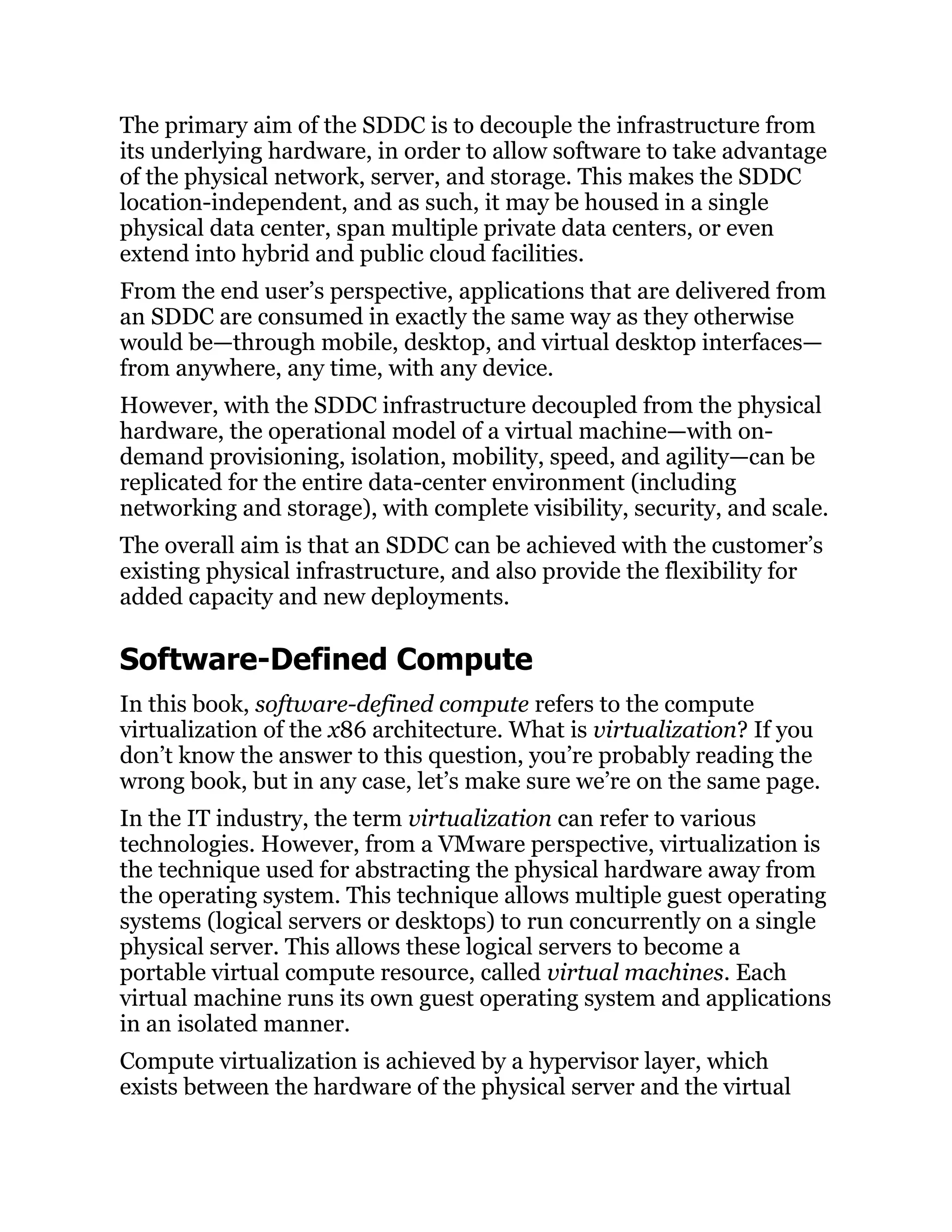
  • 43.
    The aim ofthis book is to help you understand the new vSphere storage options, and how VMware is addressing these data-center challenges through its software-defined storage offerings, Virtual SAN and Virtual Volumes. The primary aim of these two next- generation storage solutions is to drive efficiency through simple, less complex technologies that do not require large numbers of highly trained storage administrators to maintain. It is these software-defined data-center concepts that are going to completely transform all aspects of vSphere data-center storage, allowing these hypervisor-driven concepts to bind together the compute, networking, and software-defined storage layers. The goal of software-defined storage is to separate the physical storage hardware from the logic that determines where the data lives, and what storage services are applied to the virtual machines and data during read and write operations. As a result of VMware’s next-generation storage offerings, a storage layer can be achieved that is more flexible and that can easily be adjusted based on changing application requirements. In addition, the aim is to move away from complex proprietary vendor systems, to a virtual data center made up of a coherent data fabric that provides full visibility of each virtual machine through a single management toolset, the so-called single pane of glass. These features, along with lowered costs, automation, and application- centric services, are the primary drivers for enterprise IT organizations and cloud service providers to begin to rethink their entire storage architectural approach. The next point to address is what software-defined storage isn’t, as it can sometimes be hard to wade through all the marketing hype typically generated by storage vendors. Just because a hardware vendor sells or bundles management software with their products, doesn’t make it a software-defined solution. Likewise, a data center full of different storage systems from a multitude of vendors, managed by a single common software platform, does not equate to a software-defined storage solution. As each of the underlining storage systems still has its legacy constructs, such as disk pools and LUNs, this is referred to as a federated storage solution and not software- defined. These two approaches are sometimes confused by storage
  • 44.
    vendors, as understandably,manufacturers always want to use the latest buzzwords in their marketing material. Despite everything that has been said up until now, software-defined storage isn’t just about software. At some point, you have to consider the underlying disk system that provides the storage capacity and performance. If you go out and purchase a lot of preused 5,400 RPM hard drives from eBay, you can’t then expect solid-state flash-like performance just because you’ve put a smart layer of software on top of it. Designing VMware Storage Environments Gathering requirements and documenting driving factors is a key objective for you, the architect. Understanding the customer’s business objectives, challenges, and requirements should always be the first task you undertake, before any design can be produced. From this activity, you can translate the outcomes into design factors, requirements, constraints, risks, and assumptions, which are all critical to the success of the vSphere storage design. Architects use many approaches and methodologies to provide customers with a meaningful design that meets their current and future needs. Figure 1.2 illustrates one such method, which provides an elastic sequence of activities that can typically fulfill all stages of the design process. However, many organizations have their own approach, which may dictate this process and mandate specific deliverables and project methodologies.
  • 45.
    Figure 1.2 Exampleof a design sequence methodology Technical Assessment and Requirements Gathering The first step toward any design engagement is discovery, and the process of gathering the requirements for the environment in which the vSphere-based storage will be deployed. Many practices are available for gathering requirements, with each having value in different customer scenarios. As the architect, you must use the best technique to gain a complete picture from various stakeholders. This may include one-to-one meetings with IT organizational leaders and sponsors, facilitated sessions or workshops with the team responsible for managing the storage operations, and review of existing documents. Table 1.1 lists key questions that you need to ask stakeholder and operational teams. Table 1.1 Requirements gathering Architect Question Architectural Objective What will it be used for? Focus on applications and systems Who will be using it? Users and stakeholders What is the purpose? Objectives and goals What will it do? When? How? Help create a scenario What if something goes wrong with it? Availability and recoverability What quality? How fast? How reliable? How secure? How many? Scaling, security, and performance
  • 46.
    After all designfactors and business drivers have been reviewed and analyzed, it is essential to take into account the integration of all components into the design, before beginning the qualification effort needed to sort through the available products and determine which solution will meet the customer’s objectives. The integration of all components within a design can take place only if factors such as data architecture, business drivers, application architecture, and technologies are put together. The overall aim of all the questions is to quantify the objectives and business goals. For instance, these objectives and goals might include the following: Performance User numbers and application demands: Does the organization wish to implement a storage environment capable of handling an increase in user numbers and application storage demands, without sacrificing end-user experience? Total Cost of Ownership Does the organization wish to provide separate business units with a storage environment that provides significant cost relief? Scalability Does the organization wish to ensure capability and sustainability of the storage infrastructure for business continuity and future growth? Management Does the organization wish to provide a solution that simplifies the management of storage resources, and therefore requires improved tools to support this new approach? Business Continuity and Disaster Recovery Does the organization wish to provide a solution that can facilitate high levels of availability, disaster avoidance, and quick and reliable recovery from incidents? In addition to focusing on these goals, you need to collect information relating to the existing infrastructure and any new technical requirements that might exist. These technical requirements will come about as a result of the business objectives and the current state analysis of the environment. However, these are likely to include the following:
  • 47.
    Application classification Physical andvirtual network constraints Host server options Virtual machines and workload deployment methodology Network-attached storage (NAS) systems Storage area network (SAN) systems Understanding the customer’s business goals is critical, but what makes it such a challenge is that no two projects are ever the same. Whether it is different hardware, operating systems, maintenance levels, physical or virtual servers, or number of volumes, the new design must be validated for each component within each customer’s specific infrastructure. In addition, just as every environment is different, no two workloads are the same either. For instance, peak times can vary from site to site and from customer to customer. These individual differentiators must be validated one by one, in order to determine the configuration required to meet the customer’s design objectives. Establishing Storage Design Factors Establishing storage design factors is key to any architecture. However, as previously stated, the elements will vary from one engagement to another. Nevertheless, and this is important, the design should focus on the business drivers and design factors, and not the product features or latest technology specification from the customer’s preferred storage hardware vendor. A customer-preferred storage device could well be the best product ever, but may not align with the customer use cases, regardless of what they’re being told by their supplier. Therefore, creating an architecture that focuses on the hardware specification and not the business goals is likely to introduce significant risks and ultimately fail as a design. Although the business drivers and design factors for each customer will be different, with all having their own priorities and goals that need to be factored into the design, you likely will see many common design qualities, illustrated in Figure 1.3, time and time again.
  • 48.
    Figure 1.3 Storagearchitecture business drivers and design factors Availability The availability of the storage infrastructure is typically dictated by a service-level agreement (SLA) of some sort, and is often represented as a percentage of possible uptime (such as four nines, 99.99 percent). Availability is achieved through techniques such as redundant hardware, RAID technologies, array mirroring, or eliminating single points of failure. Additionally, high levels of availability can be provided by using technologies such as storage replication, vSphere anti-affinity rules, or Virtual SAN Stretched Clusters. An available design is reliable and implements multiple mechanisms to restore services within the IT organization’s agreed- upon ­ service-level agreement. Compliance Compliance means conforming to a specification, policy, standard, or law. Regulatory compliance is now a part of everyday life for an information technology architect. Having a strong understanding of the requirements that the customers must comply with will help significantly in producing a design that meets the needs of the
  • 49.
    organization you’re workingwith. Compliance goals also differ for different countries. For instance, in the United States, architects may be familiar with the Sarbanes–Oxley Act of 2002 or the Health Insurance Portability and Accountability Act of 1996 (HIPAA). In addition, global compliance standards, such as the Payment Card Industry Data Security Standard (PCI DSS), cross geographical boundaries. Usability Usability is the ease of use and learnability of the day-to-day operations associated with the storage platform. As the architect, one of your tasks will be to ensure that the customer’s operational team or administrators are able to manage the environment after you leave and move on to the next project. This, of course, links into manageability, and you may be required to provide operational documentation, or partake in knowledge transfer and training as defined in the scope of work. Budget Unfortunately, few projects have unlimited budgets. Cost is always at the forefront of stakeholders’ minds, and, as the architect, you will probably find that justifying costs associated with the design will often come down to you. I can assure you from personal experience that CFOs and their representatives can be scary and love to ask difficult and challenging questions. (To be fair, all they are trying to do is justify costs, so let’s not be too hard on them.) Your goal is to meet the organization’s business needs, while remaining within budget. If this is not possible, you must be able to explain and justify the best course of action to the organization’s key stakeholders, who hold the purse strings. The budget will depend on multiple factors. It might be too small a number, and you can think of it as a design constraint. In an ideal world, the design should focus only on system readiness, performance, and capacity, with an aim to provide a world-class solution with the future in mind, regardless of the cost. However, this is rarely the case; typically, the task of an architect is to take in all of the requirements and provide the best solution with the lowest
  • 50.
    Random documents withunrelated content Scribd suggests to you:
  • 51.
    exclaimed, 'Thank theLord, that at last He's let me see enough of something!'" "Yes, it's emancipation. Linda and I have often remarked that it would seem impossible to have narrow thoughts here. She doesn't wish to intrude, Bertram, but she would like to come to see you." King met the sweet, questioning expression of his companion's eyes. "I see plainly," he answered with a smile, "that you and I must have it out about Linda. Your persistent references to her each time you come show that she is very much on your mind." "She is very much on my mind," returned Mrs. Porter gravely. "I wish you would send a kindly message to her by me, and say that you would be glad to see her." "But I wouldn't, Maud," returned King mildly. "What would you do in that case? Of course, you know the whole situation, and know that Whitcomb with his grand little revelation bouleversed all Linda's fixed ideas." "Oh, she is so changed, Bertram," exclaimed Mrs. Porter. "She's not the Linda you knew." "Perhaps; but it's safe to say that she's still—still tremendous. I'm more or less shaky yet; and I must confess that the prospect of an interview with Linda in a cyclone of repentance makes me—well, shrink. It croozles me, if you know what that means. Sort of takes me in the pit of the stomach." "You're all wrong. She has been through the fire, and she has learned self-control." Mrs. Porter paused to choose her words. "She longs, Bertram—longs for your forgiveness. "I've nothing to forgive her," he returned pleasantly. "She had plenty of company in the mistake she made." Something in Mrs. Porter's loving look and wistful eyes caused the speaker to change his tone.
  • 52.
    "I won't fencewith you, Maud. I told you once I loved Linda. I did, with a depth which seemed to exhaust my power of loving. It's true that one doesn't feel a pin-prick when at the same moment he is struck a mortal blow. The fatal fact was not that Linda blamed me for the sorrow that had fallen upon her. It was that there was no desire on her part to give me a chance: to hear my side of the story: none of the extenuation which one ray of love would have naturally expressed. Instead, there was hatred in her eyes. That was the only thing that mattered." King leaned back against the rock, breathing fast. "I tell you this, Maud. You're the only person in the world who will know it, and we won't speak of it again. I know Linda so well. I know how this revulsion of feeling would express itself with her. She would like to come over here and wait on me by inches. My wish would be her law; but that would matter no more than her mistake about the Antlers. The essential fact has been revealed, and—nothing else matters." "Is your present feeling for her dislike, then?" asked Mrs. Porter. "Certainly not." "It would be no pain to you to meet her?" "It would be a bore," returned King gently. "Isn't that enough? Of course, it will have to come some day; but I've been a good deal indulged lately, and I believe in putting off an evil day. I should like Linda to have worked off some of her repentant steam before we meet." King, his self-possession regained, smiled again into his companion's face. "Whitcomb is devoted to her. Let her work it off on him," he added. "She will never marry him," said Mrs. Porter. "Oh, I'm sorry to hear that," was the polite response. Mrs. Porter leaned toward her companion with her broad, charming smile.
  • 53.
    "Bertram King, that'sa lie," she remarked slowly. He winked and lifted his eyebrows. "There's a lot for you to learn about love," she went on. "To love unselfishly is the best thing that can happen to anybody." "There's no such thing as unselfish love," declared King. "Oh, yes there is, and you proved that you experienced it. You put Linda's happiness above your own. You willingly endured injustice to mitigate her pain. Don't you know that your nature was enriched by that? Don't you know that your action, now that she understands it, reflects upon her, and uplifts her nature and her ideals? We can't crystallize, because we're the children of God; and God is Infinite Love, and Love is a divine principle which is ever active. You assume too much when you hold Linda to the narrow development of her school-girl days. You can remain behind your human defenses and refuse to forgive her if you choose—" "I told you, and honestly, that I have nothing to forgive." Mrs. Porter shook her head. "God doesn't treat us so when we turn to Him repentantly. He doesn't say there is nothing to forgive and leave us with the sharp thorn unremoved. That sweet sense that God is Love is borne in upon us after a genuine repentance, and gives the consciousness that we shall be upheld if we long to be, and guarded from a repetition of the offense." "My dear Maud, you're way beyond my depth." "No, Bertram, I am not. You reflected something of the divine in that tender protecting love you felt for Linda. I don't despair of you. In spite of all the things you have been saying to fortify your human self, I know, for actions speak louder than words, that a very lofty affection once found place in your heart, and that pure flame cannot die because it was a reflection of that which is immortal and eternal. Never mind Linda. God will take care of her, too. Your business is with your own thought, to keep it in a high place, trusting to be led
  • 54.
    to that happinesswhich God has prepared for them that love Him, without outlining what that happiness shall consist in." King drew a long breath and smiled, looking long and affectionately at his companion. "Isn't she the great little preacher!" he remarked. "Oh, it's all so simple!" exclaimed Mrs. Porter softly, clasping her hands together. "Why can't everybody see it!" When she went home to-day, she told Linda nothing of this interview. The girl had ceased to cross-question her friend on her return from these visits; for she never received any satisfaction, and the invitation she longed for never came. Blanche Aurora was very much alive to the fact that her adored one was the only member of the family who had not called on the convalescent. She was not entirely satisfied to have it so. King's photograph had been framed, and Blanche Aurora in the growing scarcity of wild roses made little bouquets of clover and daisies and placed them between the two pictures, and she noticed that Linda allowed the sharing. Whitcomb came to call sometimes, but between his attentions to King and the carrying out of Madge's various plans, his time was pretty well occupied. Late one afternoon Blanche Aurora found Linda in the hammock and alone. She seized her opportunity. "Say, Miss Linda," she began, "we've got a real good Bavarian cream for Mr. King's supper. 'Tain't convenient for me to take it over. I wonder if you could." Linda sat up, and regarded the white-aproned short figure. The pink bow atop quivered with the depth of its owner's imaginings and deep-laid schemes. The keen eyes observed that Linda flushed and hesitated. "Mrs. Porter is still in Portland?" she asked.
  • 55.
    "Why, yes, anddidn't you know Miss Barry went too? I've got to get their supper, you see; and the cream come out awful good." Linda rose. "Yes, I'll go," she said quietly; but there was no quiet within. All the way across the field, her heart hurried. She had never called at the Benslow house. To go for the first time to see King, without his request, and risk his betraying, perhaps, before the others, that she was unwelcome, was an ordeal which she dreaded, but the desire to see him rose above the confusion of her crowding thoughts, and though her hands trembled on the covered bowl she pushed on. The lovely late afternoon light struck across the field. Bertram King, wandering down from the piazza, noted the golden sheen upon the grass and the majestic cloud-effects in the vast arch above. His near-sighted eyes beheld a white figure advancing in the golden light. He hastened his steps in welcome. "Good for you," he cried. "I was getting very tired of myself. There's been an exodus from here to Portland to-day. I know I'm a big boy now, since Whitcomb was willing to leave me. Even Miss Benslow is out and I'm holding the fort." All the time that his words were calling through the still air, he was walking toward the visitor. Linda's face from doubt grew radiant. The relieved, happy color rose in her cheeks. Her lovely eyes beamed. In her white gown and with her shining, grateful joy, she was very beautiful as her light springing step brought her near and into King's field of vision. His breath caught in the shock and he stood stock- still. "I'm glad to see you, too, Bertram," she cried. Her eyes were starry, her smile enchanting. "Why, Linda! I beg your pardon. I thought you were Maud," he exclaimed.
  • 56.
    The change inhis tone, his blank surprise and ebbing eagerness, set Linda's heart to beating wildly. The stricture in her bosom drew back the radiant promise from her face. King saw the transformation with a pang. "Forgive my shouting at you like that," he went on, struggling for his self-possession. It was as if Linda's soul had been revealed to him for an instant, joyous, hopeful, humble: the new Linda of whom Maud had spoken. "You have something for me, I'll wager," he continued. He could see the white napkin trembling in the suddenly unsteady hands. "Let me take it," suiting the action to the word. "I've grown arrogantly used to bowls coming across this field filled with something delicious, designed to upholster these bones." Linda had made good use of the time he gave her. Her throat was free again. She could speak. "You look better than I expected," she said quietly. "And you, too, Linda. You do credit to the place." King was trying to regain some of the plans he had formulated for their first interview; but they had been designed to baffle effusiveness, and this girl in the white gown seemed to radiate calm. "Yes," she returned. "I have Blanche Aurora's word for it that the Bavarian cream in that bowl is good. There has been an exodus to Portland from our house, too, so she asked me to bring it over." "Awfully good of you," said King, hot with mingled sensations. "There never was any one so spoiled as I." "I must run back now," said Linda. "I can see that you will soon have the freedom of the neighborhood, and we shall be looking for you at Aunt Belinda's." "Oh, don't desert me," begged King. It was as if he had obtained the promise of a wonderful gift: the lavish outpouring of a rich nature. A veil had fallen, concealing it: a veil, pure, white, impenetrable. Linda's eyes and voice were friendly, self-possessed.
  • 57.
    "Blanche Aurora sayssnacks are good for you when you're sick and delicate," he went on; "but never have I been reduced to eating a snack alone. It's tea-time, too. Couldn't you make me some tea?" Linda's dimple appeared. "I'm afraid the duty of a host presses upon you. I'd better not. I've never called at the Benslows'. Besides, you say there's not a chaperone on the place." "There are the hens," said King eagerly. "Won't they do? You never saw so many in your life. Come. We'll have tea on the piazza. Whitcomb has rigged up an old sail across one end so Boreas shan't strike my frail form too roughly." He turned back toward the house, beseeching her with his eyes, and Linda followed in silence. "I'm getting to know this bowl," continued King, lifting it and investigating its blue stripes. "It's a magic one, never empty excepting when I get through with it. We'll have two spoons. I'm not stingy." As they ascended the rickety piazza steps, King continued: "The tea- table is in there in the living-room. I'll get—" he staggered, and stopped. Whitcomb had been right when he said that his friend couldn't yet bear excitement. Linda, looking up, saw him grow ghastly pale. "Oh, confound it!" he gasped. The blue-and-white bowl fell from his hands down among Luella's sweet-pea vines. He managed to take a step toward the steamer chair, collapsed into it, and fainted away ignominiously. Linda threw herself on her knees beside him. "Bertram, Bertram!" she cried in grief and terror. It was for her father and for her that the strong man had come to this. She slipped her arm around him. In her inexperience she thought he might be dying. "Oh, Bertram, speak to me!" she cried. There was a pitcher of water on the neighboring table. She dipped her handkerchief into it and dabbed his brow and his fair hair, and softly between dry sobs she called his name. They were alone in the remote, tumbledown house.
  • 58.
    Even the ocean'smighty grasp of its rocks sounded distant. There was no one to call upon save the invisible Reality, and Linda turned her full heart to the very present help. In a minute, which seemed to her an hour, consciousness began to return to King. Her arm was around him; she had drawn his cheek against her bosom. As he slowly realized his position and heard her low voice, he seemed again to see Linda as she had come toward him in her white gown across the green gold of the field. Every paining haunting memory was submerged in a strange, ineffable bliss. Without opening his eyes he spoke her name. "Yes, Bertram, yes," she responded joyfully. "I love you, Linda." Her heart bounded, and he felt it; and she did not change her position. "I shall always love you. Whitcomb has stirred your gratitude toward me. I don't care for it." "Yes, I know," answered the girl, still holding him close. "You wouldn't palm that off on me, would you?" "I want to be fair"—the response was low. King's hands lay loosely before him. "All that I am sure of is that I belong to you, Bertram." "Are you certain that's all? It's a good deal, but it's not enough." Linda's bosom labored. She remembered the longings of the last weeks, the many moments of despair. "Father loved you so," she uttered. "That's not enough, either." She drew herself gently away from him, but remained on her knees. He sat up in the low chair, and their faces were on a level. Into hers returned that look of riches unutterable and her eyes poured their gift into his. She clasped her hands across her breast as she gazed.
  • 59.
    The arms thathad held him so close and protectingly felt empty. "I love you, Bertram," she said, the words falling from her lips like a vow. Instantly the man's loose-lying hands became vital. King clasped her to him. Their cheeks clung together and they kissed.
  • 60.
    CHAPTER XXVI A DIPLOMATIST LuellaBenslow had enjoyed her round of afternoon calls. She had paraded the importance of the guests she was "accommodating" and had swelled with satisfaction in the interest she had elicited. In this complacent state of mind she was passing near Belinda Barry's cottage on the way home when she observed a strange object on the roof of the shed. The thing, whatever it was, moved, seeming to grow and shrink again before her eyes. Luella owned some spectacles, but they were worn only in private and reposed in these days in the kitchen drawer, from which they occasionally emerged stealthily when some exigency arose like the reading of a label on a spice box. It was out of her way to go nearer to the cottage, but that mysterious manifestation on the roof of the shed was too great a temptation for flesh and blood to resist. She changed her route and approached. In a minute the object, recognizing her, rose to its full height and faced her cautious advance. "For the land's sake!" exclaimed Miss Benslow in a minute more. She stood still. "Blanche Aurora Martin, what under the canopy are you doin' up there? Don't you know you'll defame them shingles?" Blanche Aurora looked down on the newcomer, who was dressed in her very best. About her neck hung chains enough to excite the envy of the aborigines. On her head she wore a hat with an ostrich feather which stood up bravely, although its appearance suggested that a sea-bath had been one of its many trying experiences.
  • 61.
    "I'll bet Belindaain't to home," went on Miss Benslow accusingly, and the culprit stood at ease, her arms akimbo. "I should think you was old enough by this time not to go caperin' around on roofs. What you up there for?" "Lookin' for my gum," replied Blanche Aurora. "You needed a spyglass for that, did you?" Indeed, the accused was balancing a long slender glass on one hip. "You know the store Miss Barry sets by that glass, and I'll bet she wouldn't let you touch it. Your folks must be all out, the way you're actin'. The idea o' stickin' your gum up on that roof. Get it and come down this minute. It's dretful bad for them shingles." "Oh, I don't care 'bout my gum anyway. I don't chaw no more 'cause Miss Linda don't like to have me." With surprising ease and carelessness the speaker dropped to a sitting posture, slid down the low shed roof and landed upright at Miss Benslow's feet. The visitor started back. "My heart!" she exclaimed, clapping to her breast the hand not burdened with a blue parasol. "A wonder you didn't drop that glass, you naughty girl." "Oh, dry up!" remarked Blanche Aurora nonchalantly. "How dare you address me so! Don't you know your sister is in my employ?" "What's that got to do with the high price o' putty?" inquired the other in a swaggering manner. "Well!" ejaculated Miss Benslow wrathfully. "Your wonderful Miss Linda don't seem to have improved your manners as much as she has your attire. I hope Letty Martin knows there's nobody at my house that's goin' to rig her up in pink ribbons. We ain't such fools over there: though I guess the Lindsays could buy and sell Linda Barry since her c'lamities, and the gentlemen that I'm
  • 62.
    accawmodatin'—" Miss Benslowraised her scanty eyebrows impressively—"is simply made o' money! Good gracious," she added in a different tone, "here I am wastin' my time with you, and Mr. King left alone all this time. He might want somethin'!" She turned with an air of pressing business. Blanche Aurora had pricked up her ears at the last remark. "Alone?" she repeated, with sudden interest. "Has your folks all gone too?" The spyglass from the roof had discerned a white gown on the Benslow piazza, but the disturbing question had been to whom it belonged. Mrs. Lindsay or her daughter might have been keeping the invalid company, while Miss Linda wandered away for a walk. The little girl's brain worked fast. "Say, I'm sorry I was impident to you," she said, with conciliatory meekness. "Well, you'd better be," snapped Luella, pausing to loosen a point of her parasol from the fringe of her cape. "Say, you don't need to hurry right off, do you? I'm all alone." Miss Benslow looked suspiciously at the speaker. It was too much to ask one to believe that saucy Blanche Aurora, with her tip-tilted nose and her bold eyes, was really penitent. "Yes, I do," she retorted, unmollified. "If this pesky parasol will ever let go that fringe." "Let me fix it," offered the meek one; and she did fix it so effectively that for almost five minutes more Miss Benslow stood there, fuming. "Oh, pshaw, let it go!" she exclaimed at last, jerking away; and with the jerk the parasol freed itself. "Oh, say, Luella—I mean Miss Benslow. I feel so kind o' lonely. You've got a fireless cooker, hain't you? I don't see why you have to hurry so."
  • 63.
    "Of course I'vegot a fireless cooker, and a new blue-flame stove, and a receipt book better than any thing you ever saw." "Well, I was only goin' to say wouldn't you like some violet perfume on your handkercher? I've got some perfectly ellergunt and you're a- carryin' such a pretty handkercher." "That there handkercher," announced Miss Benslow proudly, "was brought me by a gentleman, the last time he was to Portland." "Oh, I didn't know as Mr. King was strong enough to go to Portland," said Blanche Aurora humbly, touching the handkerchief admiringly. "He ain't," declared the visitor, with a grand air. "'T warn't him. 'T was somebody quite different: somebody that calls me Luella." The visitor giggled. "He asked me if he might." "I wonder," said Blanche Aurora with an awestruck air, "if it could 'a' ben that spullendid Mr. Whitcomb!" "Well," returned the other, smiling and bridling, "that's jest who it is. He wants me to call him Fred, but I'm awful shy that way. I may some day, but I haven't yet. You needn't tell nobody, but Madge Lindsay is perfectly crazy over him. She tries to hide it, but she can't from me. I've got eyes and ears. She sings to him on the piazza these moonlight nights and plays on a thing that looks like a big potater-bug. She calls it a bandelin." "I think you're real smart to get along with such a big family," said Blanche Aurora with the same admiring air. "Well, I didn't know's I could, fust off; but you see, it was this way. Miss Lindsay she confided in me. Madge was gittin' strong and beginnin' to hanker to git away where things was gay,—the merry whirl, you know—" Oh, yes; Blanche Aurora's nod, and her close, respectful attention showed that though young and inexperienced she did know. —"So jest at that crucical time there come this appeal from Fred—I mean Mr. Whitcomb—in Chicago, and Mis' Lindsay says to me, she
  • 64.
    says, 'I b'lieveif my daughter had her cousin here to play with she'd settle down contented again. I don't want her to go away yet.' Cousin!"—contemptuously—"'T ain't any very near cousin, I guess; and I can tell you she does play with him—and to him—and at him. Oh"—with sudden recollection—"ain't I smart! I must go." "Well, jest a minute, Miss Benslow. I'll bet it would please Mr. Whitcomb like everything to have that spullendid handkercher smellin' good. Jest come in my room a minute." Once in the room Luella found her hostess so entertaining that she stayed another ten minutes, admiring the pretty things which closet and dresser revealed, and which under ordinary circumstances their owner would have guarded sedulously from these inquisitive eyes and loquacious lips. However, it was all for Miss Linda. Of course, Blanche Aurora couldn't be certain that her adored one wanted this extra latitude, but her absorption in Linda had made her preternaturally observing; besides, she remembered those sobs. Her quick conclusion was that it were better to let Luella Benslow tell all over the neighborhood about her stockings and petticoats than to interrupt the interview which the spyglass had revealed. "Why, it must be time for the folks to be gettin' home!" ejaculated Miss Benslow at last, with a return of panic. "I'll have to run every step o' the way." Blanche Aurora gave a sweet smile of contentment and sought no further to detain her guest. She watched from the window, and laughed wickedly as the ostrich feather veered and swung in the half-lope, half-run of its conscience-smitten wearer. Halfway across the field Miss Benslow met a white-clothed figure moving unhurriedly. "Why, Miss Linda, I thought you was to Portland," she said, breathless from her race. At the same time a hope sprang within her. "Was you to my house?" she added. "Yes."
  • 65.
    "I'm real sorrywe was all out, 'cause you ain't ben neighborly." Miss Benslow strove for easy elegance, but she was out of breath, and again that pesky parasol had caught in her fringe. "Did you see Mr. King?" "Yes." "I'd ought to ben home sooner to give him his tea, but I hadn't a time-piece with me." "I gave him his tea." "Oh, I'm so thankful! Now I can ketch my breath. You'll call again, won't you?" The radiant young girl blessed Miss Benslow with a wonderful smile. "Yes. I'll come again to-morrow," she answered graciously, and passed on her way. Miss Benslow turned to look after the lithe, graceful figure crossing Elysian fields. "It's the first time I ever got a square look at her," she soliloquized in surprise at her own impression. "She's a—a"—she hesitated for a simile for the perfect simplicity of the girl's appearance, and that enchanting smile. "I'd call her a sunlight beauty," she finished, and trudged on. Blanche Aurora, watching the road at the back of the house for Captain Jerry's carriage, didn't see Linda until she had nearly reached the piazza. The child then ran to the front door and in her eagerness slammed the screen behind her and stood waiting. As soon as she met her friend's eyes she began to flush. Yes, it had been worth while! It surely had been worth while! Her heart hammered. The white figure came on out of the sunshine into the shadow where Blanche Aurora stood transfixed.
  • 66.
    "You good littlething," said Linda slowly, and she put an arm around the small shoulders and stooping, kissed a burning cheek. "Where's the bowl?" demanded Blanche Aurora, her emotion driving her to take refuge in the practical. "Among Miss Benslow's sweet-pea vines," returned Linda, her dimple at its deepest. "He—we dropped it, and it broke." "And that Bavarian cream?" "I suppose the hens ate it up in no time," confessed the messenger. "I won't trust you again," said Blanche Aurora, with shining eyes. "Mr. King must be starved." "No, I fed him with tea and cakes. Please trust me again. Please send me back to-morrow." The little girl and the big girl exchanged a long look; and during it the possibility dawned upon the elder that this infant had designed and carried out a plan! She colored slowly, continuing to gaze into the shining eyes, but Blanche Aurora retired demurely with a word about supper, and alone in the kitchen executed a dance which threatened every stick of furniture in the place. Linda was still standing there watching the violet sea, so different from its morning dazzle of blue, when Jerry Holt's carryall approached. His voice was loud and defensive. "I telled Mis' Lindsay and Madge they could sqwut to the depot till I got back," he was saying. "Why, Jerry," said Miss Barry. "I would have let you take them home first. I thought they decided to go in the street car and walk the half-mile." "My rule's fust come, fust served," responded Captain Jerry inexorably. "I seen you git off the train fust." "But they have an invalid over at their house," pursued Miss Barry.
  • 67.
    "I know theyhev. Thet Whitcomb feller seen a car comin' and he said he could make it quicker'n Molly could." The Captain's feelings had evidently been hurt in the most sensitive spot. "Says I, 'Go it then, young man;' and I made up my mind to haul you fust. Madge wanted to go with him, but her mother didn't want to sqwut alone, nor she didn't want to walk the half-mile neither, so Madge stayed." "Why, we had room for Mrs. Lindsay," said Mrs. Porter. "No"—the driver's response was firm. "Not with all them bags and bundles." He smiled a smile of satisfaction at the punishment he had meted out. "Now, I guess I'll go back and haul 'em," he added, as his passengers alighted. "They'll be tired o' sqwuttin'. They're dretful uneasy folks, anyway. What ye lookin' at, Linda?" he added, loud and cheerfully. The girl turned toward him, and came to meet the arrivals. "My future," she answered. He regarded her admiringly. He had never seen her like this. "Seems to be a bright one," he remarked, grinning. "Ye'd better git some smoked glasses if ye're goin' to look at it long. Git ap, Molly." With a grating of wheels the old carryall turned around and moved on its way. "You bet the Cape agrees with them city folks," he soliloquized.
  • 68.
    CHAPTER XXVII THE FULLMOON "I declare that was too bad of Jerry," said Miss Barry. "He's usually so"—her voice died away because she became aware of Linda, standing before her, a sort of glorified presence. "Hey?" she finished sharply. The girl had one of Mrs. Porter's hands and with the other arm she now softly embraced her bewildered aunt, then drew away far enough to look into the questioning eyes of first one and then the other. "You've both had so much trouble with me," she said. "Well?" returned Miss Barry crisply. "Is it over?" The girl nodded. "Linda," said Mrs. Porter, with excited urgency, "what has happened, dear?" The girl continued to look at them for a moment of silence, as if loath to let her secret pass her lips. "Bertram!" exclaimed Mrs. Porter. Linda nodded. Miss Barry gave her niece a shake. "Speak out," she said, cross in the mounting excitement of the moment. "Has he been over here?" "No. I went there. Blanche Aurora sent me with a snack. The hens got the snack; but—we had tea." "Oh, you darling!" exclaimed Mrs. Porter under the eloquent eyes and dimples. "You shall kiss her first, Miss Barry. Hurry up. I can't wait."
  • 69.
    "I don't seeany reason for kissing her," said Miss Barry, and her earrings quivered with what she was repressing. "Feeding dainties to the hens. The idea!" "Oh, there is a reason, there is a reason, Aunt Belinda." Her namesake spoke softly, and taking her in her arms kissed her. "How good you've been to me!" she said tenderly. Then Mrs. Porter had her turn, and the eyes of both women grew wet in their long embrace. "Well, give me some place to sit down," said Miss Barry desperately. She looked around and found a piazza chair, into which she dropped. "In all my born days I never saw such a girl. She's either got to hang a man to a sour apple tree, or else she's got to marry him!" Over at the homestead Bertram King was winning golden laurels from his self-appointed caretaker. At the supper table his novel vivacity and good appetite gave him the appearance of complete recovery. "See here," remarked Whitcomb, "solitary confinement is evidently all you've been needing. We'll clear out soon again. Even you went away, didn't you, Luella?" The speaker turned to Miss Benslow, whom on his return he had discovered scrambling about to get supper in her robes of state. She was now waiting on table and blessing Jerry Holt for his dilatoriness in bringing the Lindsays home. "I did step out for a spell," she returned in her best manner; "but I guess I warn't missed," she added coyly. "Miss Linda Barry gave Mr. King his tea." "Really!" drawled Madge Lindsay. "How cleverly she chose the right moment for her first call." "There are cats in the room," announced Whitcomb, helping himself to honey.
  • 70.
    Madge lifted hereyebrows and made a defiant grimace. "I met her as she was a-comin' back," said Luella. "I guess she felt dretful bad not findin' me home, 'cause she said she'd call again to- morrer." This remark coming under the head of what Madge called "juices," she glanced at Whitcomb for sympathy, but he was preoccupied. He was looking curiously at King's debonair countenance. "It's jest as well I warn't in, I think," continued Miss Benslow, casting Whitcomb her most kittenish glance. "Mr. King's tay-a-tay seems to 'a' done him a world o' good." The object of her remark caught his friend's eye and laughed frankly. Whitcomb reflected the laugh with a smile, but his curious interest precluded much notice of Luella's sallies. He regarded King's good cheer and increased color questioningly. Evidently Linda had used tact and succeeded in making her peace, and the talk had relieved King as well as herself. He wondered whether his friend would tell him of the interview or leave it to his imagination. "To-morrow, tennis!" cried Madge triumphantly; "and don't we deserve it, Freddy?" "We do, we do," he replied, returning with gusto to the hot biscuit and honey and lobster salad. When the meal was finished, Whitcomb pantomimed throwing a ball at Madge and raised questioning eyebrows. "All right," she said, rising with alacrity. "Oh, you crazy children," protested Mrs. Lindsay, "are you going to play ball? Can't you be satisfied to be still a minute? Freddy, you'll take all her nice new ten pounds off her." But the young people only laughed. Though Madge Lindsay might drawl, she could throw a ball like a boy, and in default of King, Whitcomb, whose muscles were always crying out to be used, was glad to accept her.
  • 71.
    Mrs. Lindsay wentto the kitchen with Luella to bestow the provisions she had purchased, and King strolled out on the piazza and watched his friend and Madge. The girl was still in her smart tailor gown. From previous observation of her tactics he believed that when the game was over she would change her dress before starting in on her evening; and he watched for that psychological moment when she should disappear. The moon was full to-night, and with the marvelous obligingness of Maine weather the wind had gone down with the sun, making the out-of-doors even more attractive by night than by day. As the twilight deepened, the great planet changed from silver to gold. When at last the ball players took off their leather gloves, Madge spoke wistfully. "I wish we could go out on that moon path! Think of this heavenly night and no boat except that old smelly tub of Mr. Benslow's! When we come again, Freddy—" She stopped, and he smiled down at her brilliant dark face, rosy with exercise and brown from the sun. "Yes, next time sure," he said. "You see I didn't want to do anything about a boat so long as King couldn't go out." "You're the best friend I ever knew," declared the girl. "Wait till I get on another frock. We'll drag him with us over to the rock. The Loreleis will be singing to-night, I am sure." "One will, I hope," returned Whitcomb. She skipped before him. "You've never seen me dance," she said. "Before the moon goes I must dance for you on the grass. I have a costume here and my castanets." "You'd be a wonderful Carmen," returned Whitcomb, regarding her lithe dipping and swinging, admiringly. "Oh, mar-velous!" she rejoined. "So long," and taking the rickety piazza steps two at a time she disappeared into the house.
  • 72.
    King immediately buttonholedhis friend. "Come over to the tent, will you?" he said. "Sure thing," returned Whitcomb, flinging an arm around the other's shoulders. They crossed the grass and entering the tent sat down on camp- stools in the opening, where the increasing mystery and magic of the night was spread before them. "I can see that you and Linda have fixed it up," said Whitcomb. "She has worried her head off for fear the old friendship would never be renewed. She thinks an awful lot of you, old man." At the beginning of this speech King looked up eagerly. Could it be that his task was going to be so easy? But as Whitcomb continued, his look veered away, back to the moon path. "Yes, we fixed it up," he replied. There was a space of silence during which he tried to decide how to go on. "You've been frank with me, Freddy, at various times regarding Linda, and I've been rather surprised lately to notice that you're not very assiduous in your attentions over there." Whitcomb's eyes also sought the moon path and a perplexed line came in his forehead. "No," he admitted. "Something has happened to Linda. She's different. I can't say that she ever let me come very near to her, but now—since she left Chicago, she has grown away from me; far away. She seems to have a lot of new ideas that I can't follow. I don't seem to get on with her." "And you do get on with Madge Lindsay?" suggested King. "Isn't she a peach?" ejaculated Whitcomb, turning to his companion a suddenly bright face. "Why, it's like owning a whole vaudeville
  • 73.
    company to bewith her. Little slender thing that looks as if you could snap her in two between your thumb and finger; but game! Gee, but she's game!" "She is game," agreed King, the vapor-cloud which had obscured a trifle the full sun of his happiness melting away. "Of course, a man doesn't connect sentiment with that sort of girl," went on Whitcomb, "but she's a comrade: just as good as a chap, you know." "I understand perfectly," returned King, "but sometimes these delightful chaps in petticoats have very feminine hearts; and you don't want to break them in two between thumb and finger." "Oh, rot," returned Whitcomb, trying not to look pleased. "There she is," he continued, starting up from his camp-stool as a figure in a pale wrap of some sort came out on the piazza. "That's another thing about Madge. She can change her clothes in a jiffy." "Hold on a bit, will you?" said King quietly. "Sure. Long as you like. Madge and I thought perhaps you'd come over to the rock with us and listen to the Loreleis." "I haven't quite finished telling you, Freddy. You know I said something to you about the past being dead and all that." "Yes." "Well—I was mistaken. Linda and I—" Whitcomb turned like a flash and dropped back on the camp-stool. "What?" "We fixed it up this afternoon for all time." "What!" "Yes. It's a trite thing for a fellow to call himself the happiest man on earth, but Linda has given me back everything I had lost. I am as much a new man as if I had been created to-day."
  • 74.
    The quiet wordsthrilled through Whitcomb. He tried to answer and gulped. Tried again, and shook his friend's responsive hand. "You deserve it," was all he could manage to utter. "I want to go over there to-night, Freddy." "You can't walk that far." "Try me. I've never seen Miss Barry's cottage, and I—well, I can't stay away." "We'll walk over with you, then," said Whitcomb gravely. He walked toward Madge and called her, and she came springing across the grass. "Ho for the rock?" she cried gayly. "No. King wants to go to Miss Barry's. He thinks he's up to it. We'll walk over with him." The three moved away across the enchanted field. The night was hushed. Even the tide whispered. Not yet sounded the crescendo which would culminate at midnight in a crashing, magnificent choral. Madge scented something novel in the mental atmosphere. Her companions were grateful for her easy chatter. When they neared the shingled cottage she protested tentatively. "Oh, do we have to go into the house on such a glorious night?" "You and I are not going in," answered Whitcomb quietly. They stood a moment near the piazza steps. "Good-night, King." The two men shook hands. "I think that is Linda now over there in the hammock. Give my love to her, will you?" "I will." Above the dazzle of golden water and under the pulsing beat of the stars, King moved up the steps.
  • 75.
    There was astir in the shadow at the end of the piazza and in a moment one word sounded on the still air. "Bertram!" The voice and its tone wrenched some deeply rooted fiber in Whitcomb's being and all his blood seemed trying to rush at once to his heart. Madge, too, heard the revealing joy of the single word. As they turned to walk back, her clinging silken draperies stirred, and she slipped her hand through her companion's arm, and clasped it. "It's a vast sea," she said softly. Transcriber's Note: The book cover image was created by the transcriber and is placed in the public domain.
  • 76.
    *** END OFTHE PROJECT GUTENBERG EBOOK INSTEAD OF THE THORN: A NOVEL *** Updated editions will replace the previous one—the old editions will be renamed. Creating the works from print editions not protected by U.S. copyright law means that no one owns a United States copyright in these works, so the Foundation (and you!) can copy and distribute it in the United States without permission and without paying copyright royalties. Special rules, set forth in the General Terms of Use part of this license, apply to copying and distributing Project Gutenberg™ electronic works to protect the PROJECT GUTENBERG™ concept and trademark. Project Gutenberg is a registered trademark, and may not be used if you charge for an eBook, except by following the terms of the trademark license, including paying royalties for use of the Project Gutenberg trademark. If you do not charge anything for copies of this eBook, complying with the trademark license is very easy. You may use this eBook for nearly any purpose such as creation of derivative works, reports, performances and research. Project Gutenberg eBooks may be modified and printed and given away—you may do practically ANYTHING in the United States with eBooks not protected by U.S. copyright law. Redistribution is subject to the trademark license, especially commercial redistribution. START: FULL LICENSE
  • 77.
    THE FULL PROJECTGUTENBERG LICENSE
  • 78.
    PLEASE READ THISBEFORE YOU DISTRIBUTE OR USE THIS WORK To protect the Project Gutenberg™ mission of promoting the free distribution of electronic works, by using or distributing this work (or any other work associated in any way with the phrase “Project Gutenberg”), you agree to comply with all the terms of the Full Project Gutenberg™ License available with this file or online at www.gutenberg.org/license. Section 1. General Terms of Use and Redistributing Project Gutenberg™ electronic works 1.A. By reading or using any part of this Project Gutenberg™ electronic work, you indicate that you have read, understand, agree to and accept all the terms of this license and intellectual property (trademark/copyright) agreement. If you do not agree to abide by all the terms of this agreement, you must cease using and return or destroy all copies of Project Gutenberg™ electronic works in your possession. If you paid a fee for obtaining a copy of or access to a Project Gutenberg™ electronic work and you do not agree to be bound by the terms of this agreement, you may obtain a refund from the person or entity to whom you paid the fee as set forth in paragraph 1.E.8. 1.B. “Project Gutenberg” is a registered trademark. It may only be used on or associated in any way with an electronic work by people who agree to be bound by the terms of this agreement. There are a few things that you can do with most Project Gutenberg™ electronic works even without complying with the full terms of this agreement. See paragraph 1.C below. There are a lot of things you can do with Project Gutenberg™ electronic works if you follow the terms of this agreement and help preserve free future access to Project Gutenberg™ electronic works. See paragraph 1.E below.
  • 79.
    1.C. The ProjectGutenberg Literary Archive Foundation (“the Foundation” or PGLAF), owns a compilation copyright in the collection of Project Gutenberg™ electronic works. Nearly all the individual works in the collection are in the public domain in the United States. If an individual work is unprotected by copyright law in the United States and you are located in the United States, we do not claim a right to prevent you from copying, distributing, performing, displaying or creating derivative works based on the work as long as all references to Project Gutenberg are removed. Of course, we hope that you will support the Project Gutenberg™ mission of promoting free access to electronic works by freely sharing Project Gutenberg™ works in compliance with the terms of this agreement for keeping the Project Gutenberg™ name associated with the work. You can easily comply with the terms of this agreement by keeping this work in the same format with its attached full Project Gutenberg™ License when you share it without charge with others. 1.D. The copyright laws of the place where you are located also govern what you can do with this work. Copyright laws in most countries are in a constant state of change. If you are outside the United States, check the laws of your country in addition to the terms of this agreement before downloading, copying, displaying, performing, distributing or creating derivative works based on this work or any other Project Gutenberg™ work. The Foundation makes no representations concerning the copyright status of any work in any country other than the United States. 1.E. Unless you have removed all references to Project Gutenberg: 1.E.1. The following sentence, with active links to, or other immediate access to, the full Project Gutenberg™ License must appear prominently whenever any copy of a Project Gutenberg™ work (any work on which the phrase “Project Gutenberg” appears, or with which the phrase “Project Gutenberg” is associated) is accessed, displayed, performed, viewed, copied or distributed:
  • 80.
    This eBook isfor the use of anyone anywhere in the United States and most other parts of the world at no cost and with almost no restrictions whatsoever. You may copy it, give it away or re-use it under the terms of the Project Gutenberg License included with this eBook or online at www.gutenberg.org. If you are not located in the United States, you will have to check the laws of the country where you are located before using this eBook. 1.E.2. If an individual Project Gutenberg™ electronic work is derived from texts not protected by U.S. copyright law (does not contain a notice indicating that it is posted with permission of the copyright holder), the work can be copied and distributed to anyone in the United States without paying any fees or charges. If you are redistributing or providing access to a work with the phrase “Project Gutenberg” associated with or appearing on the work, you must comply either with the requirements of paragraphs 1.E.1 through 1.E.7 or obtain permission for the use of the work and the Project Gutenberg™ trademark as set forth in paragraphs 1.E.8 or 1.E.9. 1.E.3. If an individual Project Gutenberg™ electronic work is posted with the permission of the copyright holder, your use and distribution must comply with both paragraphs 1.E.1 through 1.E.7 and any additional terms imposed by the copyright holder. Additional terms will be linked to the Project Gutenberg™ License for all works posted with the permission of the copyright holder found at the beginning of this work. 1.E.4. Do not unlink or detach or remove the full Project Gutenberg™ License terms from this work, or any files containing a part of this work or any other work associated with Project Gutenberg™. 1.E.5. Do not copy, display, perform, distribute or redistribute this electronic work, or any part of this electronic work, without prominently displaying the sentence set forth in paragraph 1.E.1