The Architect’s View

         Chris M Evans
   Director, Langton Blue Ltd
 blog.thestoragearchitect.com
        @chrismevans
Introduction
• I am an independent consultant 
• I have no marketing budget – no giveaways 
• I don’t know everything (although my wife
  says I think I do) 
• Let’s make this interactive 

    I realise I am between you and lunch….
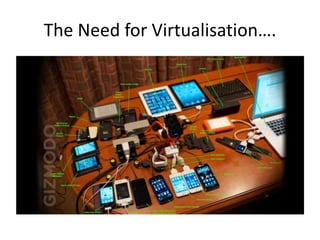
The Need for Virtualisation….
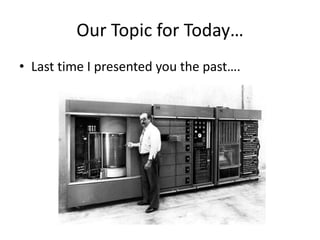
Our Topic for Today…
• Last time I presented you the past….
Our Topic for Today…
• Today I give you – The Future!
How is Virtualisation Driving Storage Use?
• High I/O density
   – Consolidation of servers and IOPS into single LUNs
   – VDI desktop consolidation
   – Array based copy (VAAI)
• High Concentration of Risk
   – Multiple dependent systems in one server/cluster
• Consistent Performance
   – No I/O spikes – bad for any workload, catastrophic for gaming &
     financial workloads
• I/O Blender
   – Virtualisation creates highly random workload

Increased levels of virtualisation require significant improvements in
                              I/O density
Requirements
• Consistent high performance
  – Low latency – 1ms or less
  – High IOPS > 500K
  – Reliability – no failures
• Management
  – APIs & RESTful interfaces
  – Private Cloud integration
• Advanced Features in Arrays
  – VAAI, VASA support
Enter Flash!
•   Solid State Storage
•   Very high IOPS – both read and write
•   Low latency
•   Low Power
•   “enterprise” SLC and consumer “MLC” grade
•   SAS/SATA form factor compatible
•   Great at managing random workload….

But…..

• Relatively high cost (SLC especially so)
• Finite lifetime – they will wear out and fail
How Can Flash Be Used?
• In-Server
   – PCIe SSD – Fusion-IO, VFCache, etc
   – SAS SSD devices
   – Very high low latency, local performance
   – Data is isolated in the server, not shared between
     members of a cluster
   – No redundancy in the case of failure

    Great solution if you can tolerate some failure & data loss
                            (web cache)

       In-Server SSD usage will rely on application integration
How Can Flash Be Used?
• Enhance existing storage
  – SSD in existing traditional arrays
  – Quick solution
  – Either partially or entirely fill an array
  – May not get best performance from SSD
  – Requires automated tiering to get best results
     • Dynamic Tiering, e.g. EMC’s FAST
How Can Flash Be Used?
• Dedicated SSD arrays
  – New vendors and products coming to market
  – All flash solid state devices
  – Hardware tuned to work with solid state media
     • I/O Spike avoidance
     • Wear levelling
     • RAID & controller redundancy
  – Consistent performance with scale
     • IOPS & Latency
  – Next wave of products will bring scale to match
    performance
It’s About $/IOPS not $/GB
• Cost models need to evolve
  – $/GB doesn’t work for SSD today, HDD still
    cheaper
  – Vendors using tricks (like post-dedupe and
    compression capacity) to fix $/GB numbers
• Better comparison is $/IOPS
  – Have to quantify cost benefit of faster I/O
  – Can be justified in certain workloads
Vendors With Products Today
The Drawbacks
• Is this a hammer to crack a nut?
  – All SSD means all data is expensive
  – What about low priority I/O?
  – What about inactive data?
  – What about secondary data copies?
  – What about replication?

                Is there another way?
The Mavericks
• Some vendors are taking alternative
  approaches
  – Virsto – random to sequential workload
  – Atlantis Computing – I/O reduction
  – Tintri – VMware aware storage
  – Nutanix – Hybrid storage & hypervisor
Migration of Control
• With SAN, storage arrays owned the data
   – Decided on placement
   – Managed clones and replication
   – Managed redundancy/failover
• With Virtualisation, control shifts to the
  hypervisor
   –   Storage capabilities advertised with VASA
   –   Data replication with VAAI
   –   Data placement with Storage DRS
   –   Bandwidth/throughput management with Storage I/O
       Control
Where Should Control Lie?
• Both array and hypervisor now allow for
  – Thin Provisioning
  – Tiered Storage
  – Initial and Dynamic Data placement
  – Replication

   Where should control lie? Open Question – I don’t
       have an answer, but I have an opinion!
What about DAS & NAS?
• Nothing wrong with NAS or DAS but…
  – There are no all-flash NAS arrays (yet)
  – DAS is just SSD in the server with the same issues
    of reliability of a single device
• NAS & DAS have a place, but not with high-
  performance/high-density deployments

  Ultimately the protocol is less relevant than
     the service capabilities of the storage
The Future
• SSD is here to stay
• So are Hard Drives – cheap and easy
• All-SSD arrays have to evolve
   – 90% Flash as primary storage
   – 10% HDD as archive of inactive working set
• It’s not fully clear whether storage arrays will require
  advanced functionality in all-virtualised environments
• Application vendors will be heavily involved
• Big issues still to solve
   – Long distance replication
   – Proper DR
Questions/Thoughts/Opinions?
• Follow up questions;
  – chris@brookend.com
  – http://blog.thestoragearchitect.com
  – @chrismevans

London VMUG Presentation 19th July 2012

  • 1.
    The Architect’s View Chris M Evans Director, Langton Blue Ltd blog.thestoragearchitect.com @chrismevans
  • 2.
    Introduction • I aman independent consultant  • I have no marketing budget – no giveaways  • I don’t know everything (although my wife says I think I do)  • Let’s make this interactive  I realise I am between you and lunch….
  • 3.
    The Need forVirtualisation….
  • 4.
    Our Topic forToday… • Last time I presented you the past….
  • 5.
    Our Topic forToday… • Today I give you – The Future!
  • 6.
    How is VirtualisationDriving Storage Use? • High I/O density – Consolidation of servers and IOPS into single LUNs – VDI desktop consolidation – Array based copy (VAAI) • High Concentration of Risk – Multiple dependent systems in one server/cluster • Consistent Performance – No I/O spikes – bad for any workload, catastrophic for gaming & financial workloads • I/O Blender – Virtualisation creates highly random workload Increased levels of virtualisation require significant improvements in I/O density
  • 7.
    Requirements • Consistent highperformance – Low latency – 1ms or less – High IOPS > 500K – Reliability – no failures • Management – APIs & RESTful interfaces – Private Cloud integration • Advanced Features in Arrays – VAAI, VASA support
  • 8.
    Enter Flash! • Solid State Storage • Very high IOPS – both read and write • Low latency • Low Power • “enterprise” SLC and consumer “MLC” grade • SAS/SATA form factor compatible • Great at managing random workload…. But….. • Relatively high cost (SLC especially so) • Finite lifetime – they will wear out and fail
  • 9.
    How Can FlashBe Used? • In-Server – PCIe SSD – Fusion-IO, VFCache, etc – SAS SSD devices – Very high low latency, local performance – Data is isolated in the server, not shared between members of a cluster – No redundancy in the case of failure Great solution if you can tolerate some failure & data loss (web cache) In-Server SSD usage will rely on application integration
  • 10.
    How Can FlashBe Used? • Enhance existing storage – SSD in existing traditional arrays – Quick solution – Either partially or entirely fill an array – May not get best performance from SSD – Requires automated tiering to get best results • Dynamic Tiering, e.g. EMC’s FAST
  • 11.
    How Can FlashBe Used? • Dedicated SSD arrays – New vendors and products coming to market – All flash solid state devices – Hardware tuned to work with solid state media • I/O Spike avoidance • Wear levelling • RAID & controller redundancy – Consistent performance with scale • IOPS & Latency – Next wave of products will bring scale to match performance
  • 12.
    It’s About $/IOPSnot $/GB • Cost models need to evolve – $/GB doesn’t work for SSD today, HDD still cheaper – Vendors using tricks (like post-dedupe and compression capacity) to fix $/GB numbers • Better comparison is $/IOPS – Have to quantify cost benefit of faster I/O – Can be justified in certain workloads
  • 13.
  • 14.
    The Drawbacks • Isthis a hammer to crack a nut? – All SSD means all data is expensive – What about low priority I/O? – What about inactive data? – What about secondary data copies? – What about replication? Is there another way?
  • 15.
    The Mavericks • Somevendors are taking alternative approaches – Virsto – random to sequential workload – Atlantis Computing – I/O reduction – Tintri – VMware aware storage – Nutanix – Hybrid storage & hypervisor
  • 16.
    Migration of Control •With SAN, storage arrays owned the data – Decided on placement – Managed clones and replication – Managed redundancy/failover • With Virtualisation, control shifts to the hypervisor – Storage capabilities advertised with VASA – Data replication with VAAI – Data placement with Storage DRS – Bandwidth/throughput management with Storage I/O Control
  • 17.
    Where Should ControlLie? • Both array and hypervisor now allow for – Thin Provisioning – Tiered Storage – Initial and Dynamic Data placement – Replication Where should control lie? Open Question – I don’t have an answer, but I have an opinion!
  • 18.
    What about DAS& NAS? • Nothing wrong with NAS or DAS but… – There are no all-flash NAS arrays (yet) – DAS is just SSD in the server with the same issues of reliability of a single device • NAS & DAS have a place, but not with high- performance/high-density deployments Ultimately the protocol is less relevant than the service capabilities of the storage
  • 19.
    The Future • SSDis here to stay • So are Hard Drives – cheap and easy • All-SSD arrays have to evolve – 90% Flash as primary storage – 10% HDD as archive of inactive working set • It’s not fully clear whether storage arrays will require advanced functionality in all-virtualised environments • Application vendors will be heavily involved • Big issues still to solve – Long distance replication – Proper DR
  • 20.
    Questions/Thoughts/Opinions? • Follow upquestions; – chris@brookend.com – http://blog.thestoragearchitect.com – @chrismevans