Half-Wave Rectifiers
PLT207 Power Electronics
1
Course Learning Outcome (CLO)
CLO1
• Ability to analyse operation and applications of power electronic
devices and addressing the needs of EMC requirements.
CLO2
• Ability to evaluate the performance of AC-DC converters.
CLO3
• Ability to evaluate the performance of AC-AC converters.
CLO4
• Ability to evaluate the performance of DC-DC converters.
CLO5
• Ability to evaluate the performance of DC-AC converters.
2
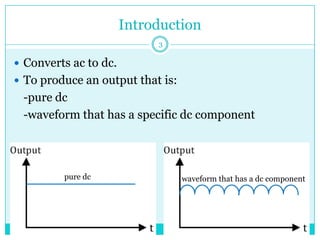
Introduction
 Converts ac to dc.
 To produce an output that is:
-pure dc
-waveform that has a specific dc component
pure dc waveform that has a dc component
3
Resistive Load
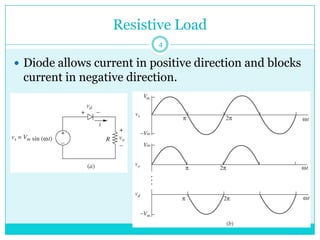
 Diode allows current in positive direction and blocks
current in negative direction.
4
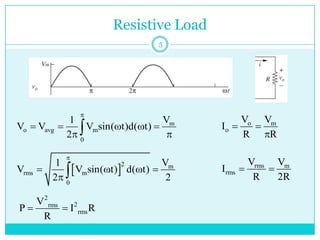
Resistive Load
m
o avg m
0
V
1
V V V sin( t)d( t)
2

    
 

o m
o
V V
I
R R
 

 2 m
rms m
0
V
1
V V sin( t) d( t)
2 2

   
 
rms m
rms
V V
I
R 2R
 
2
2
rms
rms
V
P I R
R
 
5
6
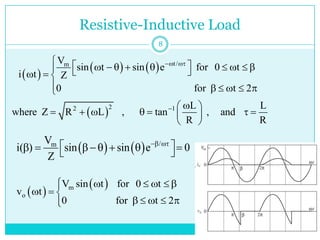
Resistive-Inductive Load
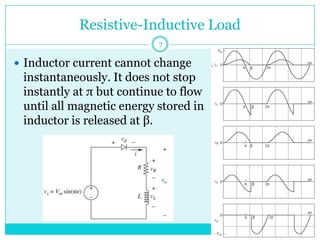
 Inductor current cannot change
instantaneously. It does not stop
instantly at π but continue to flow
until all magnetic energy stored in
inductor is released at β.
7
Resistive-Inductive Load
    /
m
V
i( ) sin sin e 0
Z
 
 
      
 
 
   
 
t/
m
2
2 1
V
sin t sin e for 0 t
i t Z
0 for t 2
L L
where Z R L , tan , and
R R
 

  
        
  
  
     


 
      
 
 
 
 
m
o
V sin t for 0 t
v t
0 for t 2
     

  
    


8
9
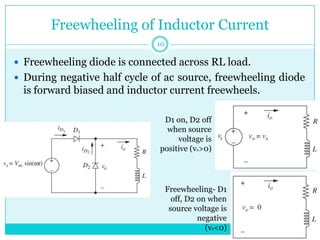
Freewheeling of Inductor Current
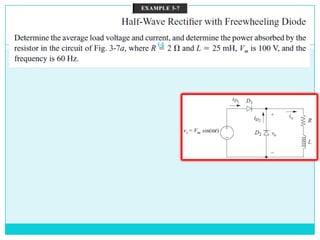
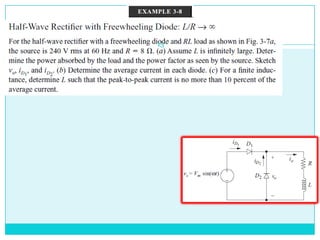
 Freewheeling diode is connected across RL load.
 During negative half cycle of ac source, freewheeling diode
is forward biased and inductor current freewheels.
D1 on, D2 off
when source
voltage is
positive (vs>0)
Freewheeling- D1
off, D2 on when
source voltage is
negative
(vs<0)
10
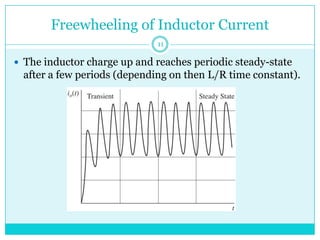
Freewheeling of Inductor Current
 The inductor charge up and reaches periodic steady-state
after a few periods (depending on then L/R time constant).
11
Freewheeling of Inductor Current
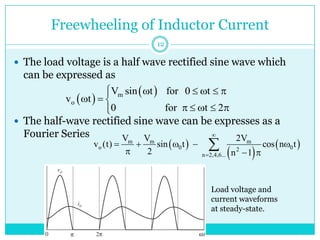
 The load voltage is a half wave rectified sine wave which
can be expressed as
 The half-wave rectified sine wave can be expresses as a
Fourier Series
 
 
m
o
V sin t for 0 t
v t
0 for t 2
     

  
    


Load voltage and
current waveforms
at steady-state.
 
 
 
m m m
o 0 0
2
n 2,4,6...
V V 2V
v (t) sin t cos n t
2 n 1


    
  

12
Freewheeling of Inductor Current
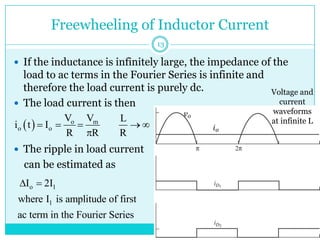
 If the inductance is infinitely large, the impedance of the
load to ac terms in the Fourier Series is infinite and
therefore the load current is purely dc.
 The load current is then
 The ripple in load current
can be estimated as
  o m
o o
V V L
i t I
R R R
    

o 1
1
I 2I
where I is amplitude of first
ac term in the Fourier Series
 
Voltage and
current
waveforms
at infinite L
13
14
15
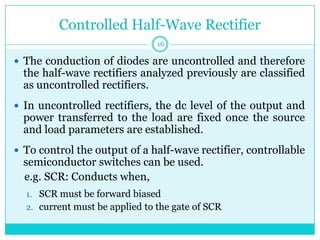
Controlled Half-Wave Rectifier
 The conduction of diodes are uncontrolled and therefore
the half-wave rectifiers analyzed previously are classified
as uncontrolled rectifiers.
 In uncontrolled rectifiers, the dc level of the output and
power transferred to the load are fixed once the source
and load parameters are established.
 To control the output of a half-wave rectifier, controllable
semiconductor switches can be used.
e.g. SCR: Conducts when,
1. SCR must be forward biased
2. current must be applied to the gate of SCR
16
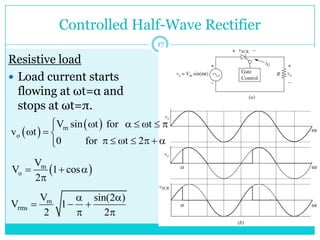
Controlled Half-Wave Rectifier
Resistive load
 Load current starts
flowing at ωt=α and
stops at ωt=π.
 
 
m
o
V sin t for t
v t
0 for t 2
      

  
      


 
m
o
V
V 1 cos
2
  

m
rms
V sin(2 )
V 1
2 2
 
  
 
17
18
Controlled Half-Wave Rectifier
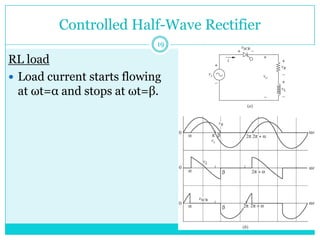
RL load
 Load current starts flowing
at ωt=α and stops at ωt=β.
19
Controlled Half-Wave Rectifier
RL load
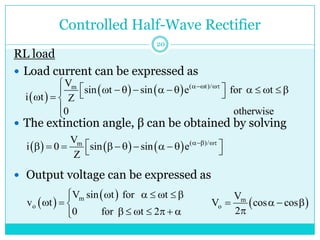
 Load current can be expressed as
 The extinction angle, β can be obtained by solving
 Output voltage can be expressed as
 
    ( t)/
m
V
sin t sin e for t
i t Z
0 otherwise
 
  
           
  
  


      ( )/
m
V
i 0 sin sin e
Z
 
 
         
 
 
 
m
o
V sin t for t
v t
0 for t 2
      

  
      


 
m
o
V
V cos cos
2
   

20
21

3. Half-Wave Rectifier_verstud.pdf

  • 1.
  • 2.
    Course Learning Outcome(CLO) CLO1 • Ability to analyse operation and applications of power electronic devices and addressing the needs of EMC requirements. CLO2 • Ability to evaluate the performance of AC-DC converters. CLO3 • Ability to evaluate the performance of AC-AC converters. CLO4 • Ability to evaluate the performance of DC-DC converters. CLO5 • Ability to evaluate the performance of DC-AC converters. 2
  • 3.
    Introduction  Converts acto dc.  To produce an output that is: -pure dc -waveform that has a specific dc component pure dc waveform that has a dc component 3
  • 4.
    Resistive Load  Diodeallows current in positive direction and blocks current in negative direction. 4
  • 5.
    Resistive Load m o avgm 0 V 1 V V V sin( t)d( t) 2          o m o V V I R R     2 m rms m 0 V 1 V V sin( t) d( t) 2 2        rms m rms V V I R 2R   2 2 rms rms V P I R R   5
  • 6.
  • 7.
    Resistive-Inductive Load  Inductorcurrent cannot change instantaneously. It does not stop instantly at π but continue to flow until all magnetic energy stored in inductor is released at β. 7
  • 8.
    Resistive-Inductive Load    / m V i( ) sin sin e 0 Z                      t/ m 2 2 1 V sin t sin e for 0 t i t Z 0 for t 2 L L where Z R L , tan , and R R                                               m o V sin t for 0 t v t 0 for t 2                  8
  • 9.
  • 10.
    Freewheeling of InductorCurrent  Freewheeling diode is connected across RL load.  During negative half cycle of ac source, freewheeling diode is forward biased and inductor current freewheels. D1 on, D2 off when source voltage is positive (vs>0) Freewheeling- D1 off, D2 on when source voltage is negative (vs<0) 10
  • 11.
    Freewheeling of InductorCurrent  The inductor charge up and reaches periodic steady-state after a few periods (depending on then L/R time constant). 11
  • 12.
    Freewheeling of InductorCurrent  The load voltage is a half wave rectified sine wave which can be expressed as  The half-wave rectified sine wave can be expresses as a Fourier Series     m o V sin t for 0 t v t 0 for t 2                  Load voltage and current waveforms at steady-state.       m m m o 0 0 2 n 2,4,6... V V 2V v (t) sin t cos n t 2 n 1            12
  • 13.
    Freewheeling of InductorCurrent  If the inductance is infinitely large, the impedance of the load to ac terms in the Fourier Series is infinite and therefore the load current is purely dc.  The load current is then  The ripple in load current can be estimated as   o m o o V V L i t I R R R       o 1 1 I 2I where I is amplitude of first ac term in the Fourier Series   Voltage and current waveforms at infinite L 13
  • 14.
  • 15.
  • 16.
    Controlled Half-Wave Rectifier The conduction of diodes are uncontrolled and therefore the half-wave rectifiers analyzed previously are classified as uncontrolled rectifiers.  In uncontrolled rectifiers, the dc level of the output and power transferred to the load are fixed once the source and load parameters are established.  To control the output of a half-wave rectifier, controllable semiconductor switches can be used. e.g. SCR: Conducts when, 1. SCR must be forward biased 2. current must be applied to the gate of SCR 16
  • 17.
    Controlled Half-Wave Rectifier Resistiveload  Load current starts flowing at ωt=α and stops at ωt=π.     m o V sin t for t v t 0 for t 2                       m o V V 1 cos 2     m rms V sin(2 ) V 1 2 2        17
  • 18.
  • 19.
    Controlled Half-Wave Rectifier RLload  Load current starts flowing at ωt=α and stops at ωt=β. 19
  • 20.
    Controlled Half-Wave Rectifier RLload  Load current can be expressed as  The extinction angle, β can be obtained by solving  Output voltage can be expressed as       ( t)/ m V sin t sin e for t i t Z 0 otherwise                                ( )/ m V i 0 sin sin e Z                     m o V sin t for t v t 0 for t 2                       m o V V cos cos 2      20
  • 21.