8/28/2009Rapid Deployment of BMC Remedy Solutions Antonio RolleVP of Professional ServicesgenerationE Technologies
8/28/2009©2006 BMC Software2AgendaIssues Affecting BMC Remedy DeploymentsA Case for a Rapid Deployment MethodologyThe generationE BMC Remedy Rapid Deployment MethodologyCase Study Review
8/28/2009©2006 BMC Software3AgendaIssues Affecting BMC Remedy DeploymentsA Case for a Rapid Deployment MethodologyThe generationE BMC Remedy Rapid Deployment MethodologyCase Study Review
8/28/2009©2006 BMC Software4Issues Affecting BMC Remedy DeploymentsDeveloper Productivity (Backlogs)Skills ShortageTime to MarketComplexityMomentum
8/28/2009©2006 BMC Software5AgendagenerationE Technologies OverviewIssues Affecting BMC Remedy DeploymentsA Case for a Rapid Deployment MethodologyThe generationE BMC Remedy Rapid Deployment MethodologyCase Study Review
8/28/2009©2006 BMC Software6What is Rapid Application Development?“Rapid Application Development (RAD) is a development lifecycle designed to give much faster development and higher-quality results than those achieved with the traditional lifecycle. It is designed to take the maximum advantage of powerful development software that has evolved recently.”  - James Martin Information Engineering: Introduction. Prentice Hall, 1991
8/28/2009©2006 BMC Software7What is Rapid Application Development?RAD is a methodology for compressing the analysis, design, build and test phases into a series of short, iterative development cycles. RAD proposes that products can be developed faster and of higher quality by: Using workshops or focus groups to gather requirements Prototyping and user testing of designs Re-using software componentsFollowing a schedule that defers design improvements to the next product versionKeeping review meetings and other team communication informal
8/28/2009©2006 BMC Software8RAD – Goals & PropertiesBring together the power of ITHelp to deliver on the promise of ‘Activate the Business’Manage the futurePlace emphasis on user involvement and responsibility throughout the developmentPropertiesSpecification is fluidMust be delivered in 2 - 6 months Split into increments if necessary Each increment is implemented separately with frequent delivery of working parts of system.
8/28/2009©2006 BMC Software9A Case for a BMC Remedy Rapid Deployment MethodologyTime to AdoptionTime to MarketCost (Vilfredo Pareto’s 80/20 Rule)Leveraging “out of the box” functionalityExtensibilityPartner Commitment
8/28/2009©2006 BMC Software10A Case Against RAD…PROJECT SCOPEBroad scope where the business objectives are obscure or broadPROJECT DECISIONSMany people must be involved in the decisions on the project, the decision makers are not available on a timely basis or they are geographically dispersedPROJECT TEAMThe project team is large, or there are multiple teams whose work needs to be coordinated
8/28/2009©2006 BMC Software11AgendagenerationE Technologies OverviewIssues Affecting BMC Remedy DeploymentsA Case for a Rapid Deployment MethodologyThe generationE BMC Remedy Rapid Deployment MethodologyCase Study Review
8/28/2009©2006 BMC Software12Traditional Development CyclePlanningAnalysisDesignBuildTestDeploy
8/28/2009©2006 BMC Software13Traditional Development CycleAlthough quality and speed of delivery are paramount, this does not mean what is good in traditional system development is thrown away. There must be:Effective project managementAppropriate & Current Documentation Requirements SpecificationsAppropriate MaintainabilityTesting	Quality AssuranceDesignsReuse
8/28/2009©2006 BMC Software14RAD Core ElementsPrototypingIterative developmentTime boxingTeam membersManagement approachRAD tools
8/28/2009©2006 BMC Software15RAD Core Elements: PrototypingThe construction of a feature-light, reduced-scalability application in a short amount of time. The objective is to create a working application to help a user flesh out requirements.The characteristics of prototyping can be summarized as:Involves versions of part of a software systemEvaluation is done in collaboration with users to optimize qualityA joint learning process between users and developersFacilitation of the discovery of errors (testing)
8/28/2009©2006 BMC Software16RAD Core Elements: Interactive DevelopmentThe creation of increasingly feature-rich versions of applications in short development cycles, where each release produces user requirements that feed the next releaseInvolves splitting projects into smaller mini-projectsRequires initial research and analysis of the project as wholeIncrements are self-contained systems, which aredevelopeddocumented deliveredEach increment typically involves iterative development and prototyping
8/28/2009©2006 BMC Software17RAD Core Elements: Time BoxingSupports iterative development by pushing off features to future versions in order to complete iterative cycles as quickly as possible. Time boxing is extremely important to help reduce scope creep, but it requires watchful and involved management.
8/28/2009©2006 BMC Software18RAD Core Elements: Team MembersTeams should be small and should consist of experienced, versatile, and motivated members that are able to perform multiple roles. These roles consist of:UserGood inter‑personal skillsPersonal confidenceA non‑parochial viewRepresentative of the user communityDeveloperPatience, diplomacy, perception, acceptability, objectivity, non‑ intimidating Good communication skills, patience, interpersonal skills, empathy with user Accepts criticism humblyProject ManagerOpen minded, prepared to be flexible, and dynamicPossess excellent leadership skills
8/28/2009©2006 BMC Software19RAD Core Elements: Management ApproachSpecifies that management should be very involved in keeping development cycles short and enforcing deadlines. Furthermore management should help keep high team motivation, and should focus on clearing bureaucratic or political obstacles.
8/28/2009©2006 BMC Software20RAD Core Elements: RAD ToolsSpecifies that development speed is more important than cost of tools and so the latest technologies should be used to increase development speed
8/28/2009©2006 BMC Software21BMC Remedy RAD ProcessesPre-Project ActivitiesRequirements PlanningUser DesignConstructionImplementationPost-Project Activities
8/28/2009©2006 BMC Software22BMC Remedy RAD Processes: Pre-Project ActivitiesDevelop Project Management PlanIdentify Risks and Mitigation StrategiesDefine the Development ScheduleIdentify Milestones and DeliverablesIdentify Desired End ResultsIdentify Project ConstraintsIdentify Financial Considerations
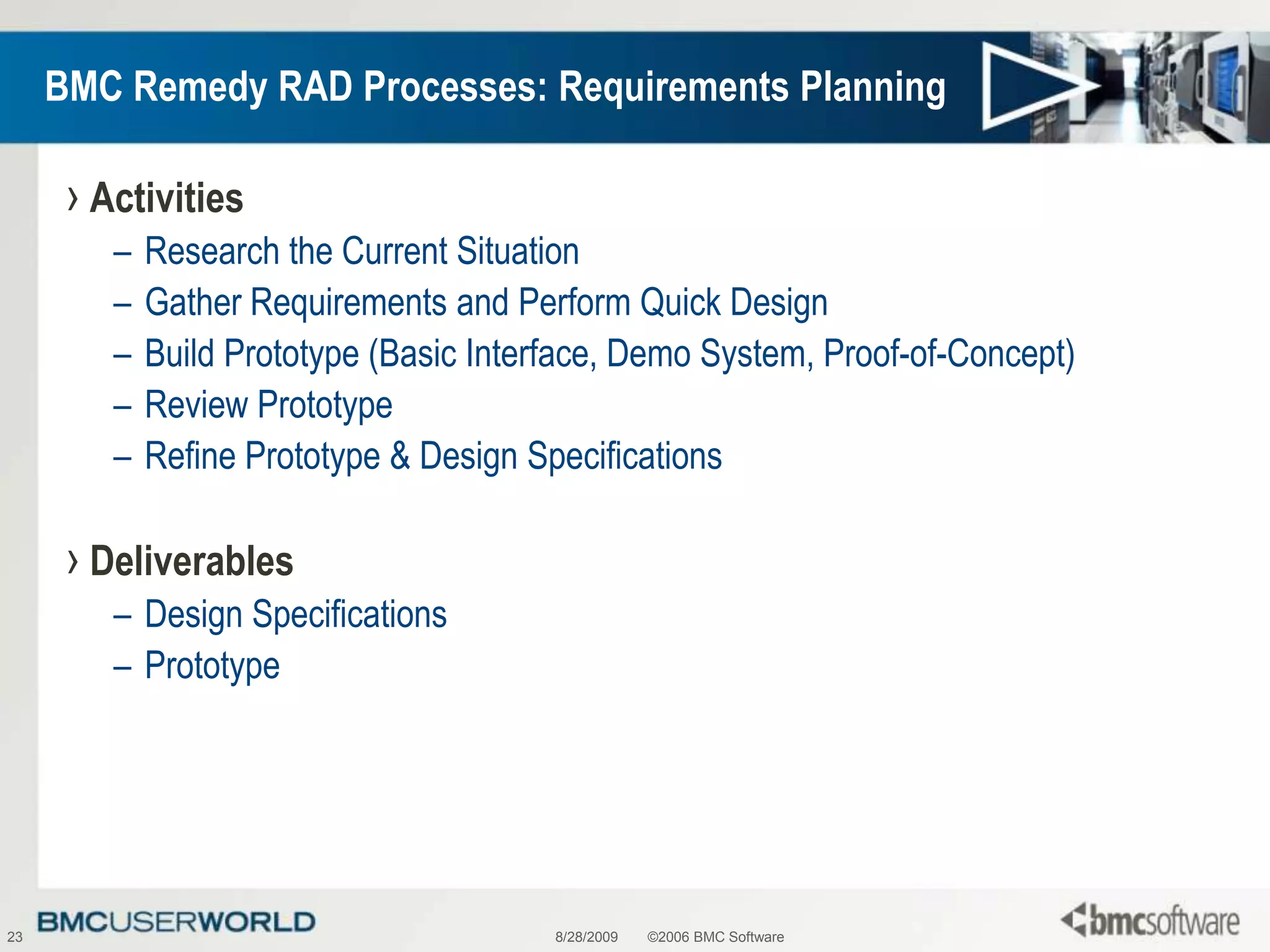
8/28/2009©2006 BMC Software23BMC Remedy RAD Processes: Requirements PlanningActivitiesResearch the Current SituationGather Requirements and Perform Quick Design Build Prototype (Basic Interface, Demo System, Proof-of-Concept)Review PrototypeRefine Prototype & Design SpecificationsDeliverablesDesign SpecificationsPrototype
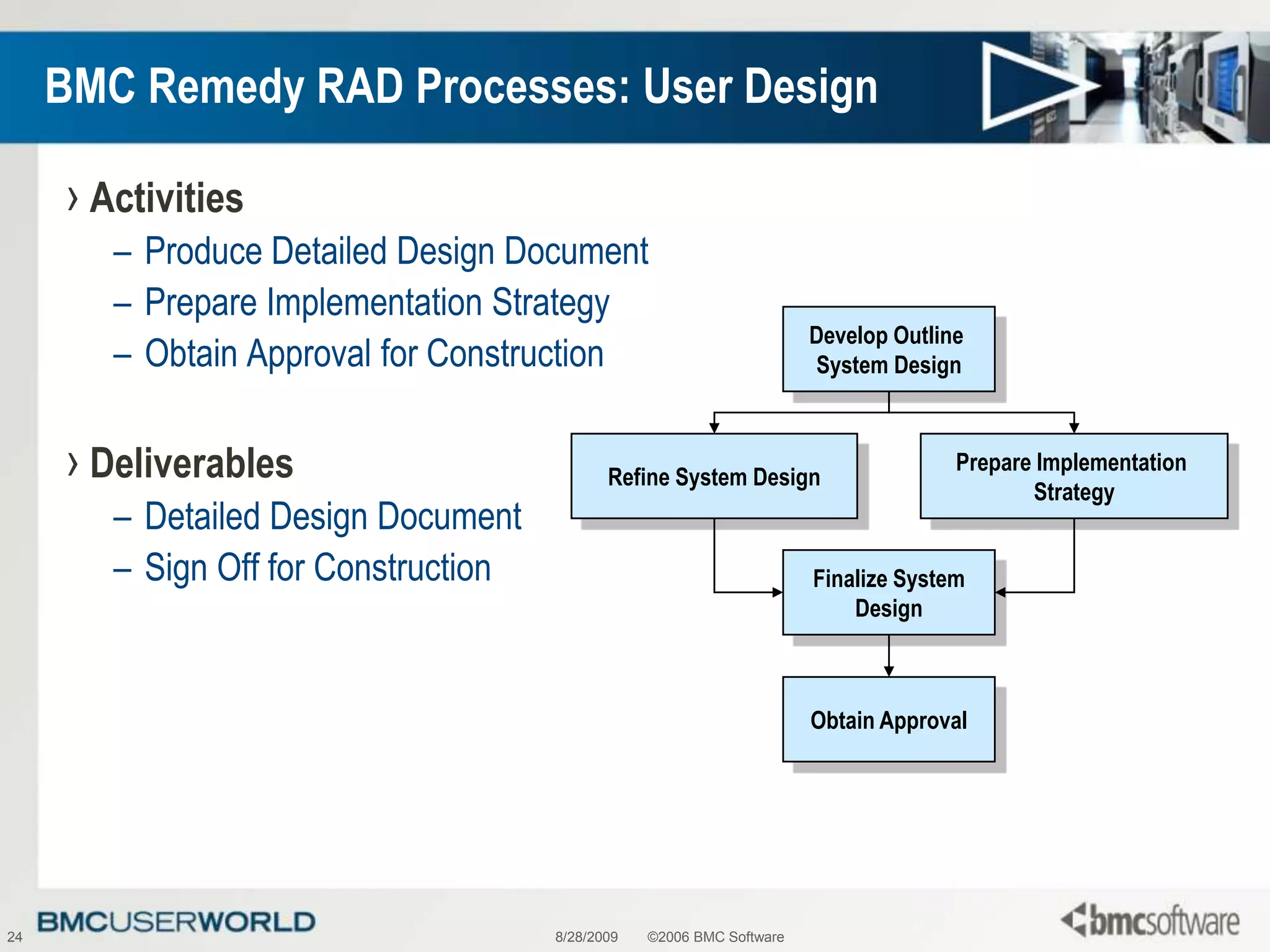
8/28/2009©2006 BMC Software24BMC Remedy RAD Processes: User DesignActivitiesProduce Detailed Design DocumentPrepare Implementation StrategyObtain Approval for ConstructionDeliverablesDetailed Design DocumentSign Off for ConstructionDevelop Outline System DesignRefine System DesignPrepare Implementation StrategyFinalize SystemDesignObtain Approval
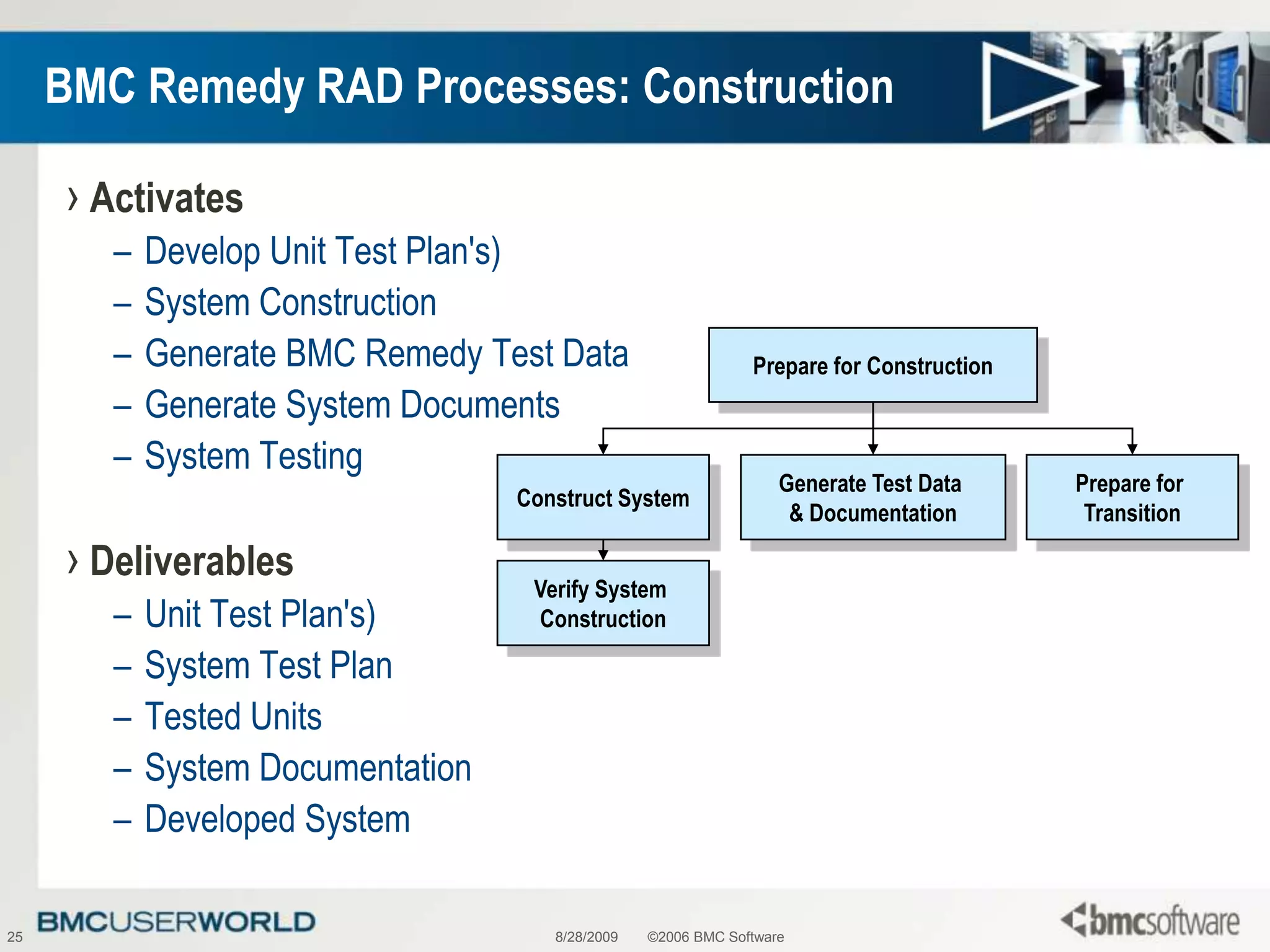
8/28/2009©2006 BMC Software25BMC Remedy RAD Processes: ConstructionActivatesDevelop Unit Test Plan's)System ConstructionGenerate BMC Remedy Test DataGenerate System DocumentsSystem TestingDeliverablesUnit Test Plan's)System Test PlanTested UnitsSystem DocumentationDeveloped SystemPrepare for ConstructionConstruct SystemGenerate Test Data & DocumentationPrepare for TransitionVerify System Construction
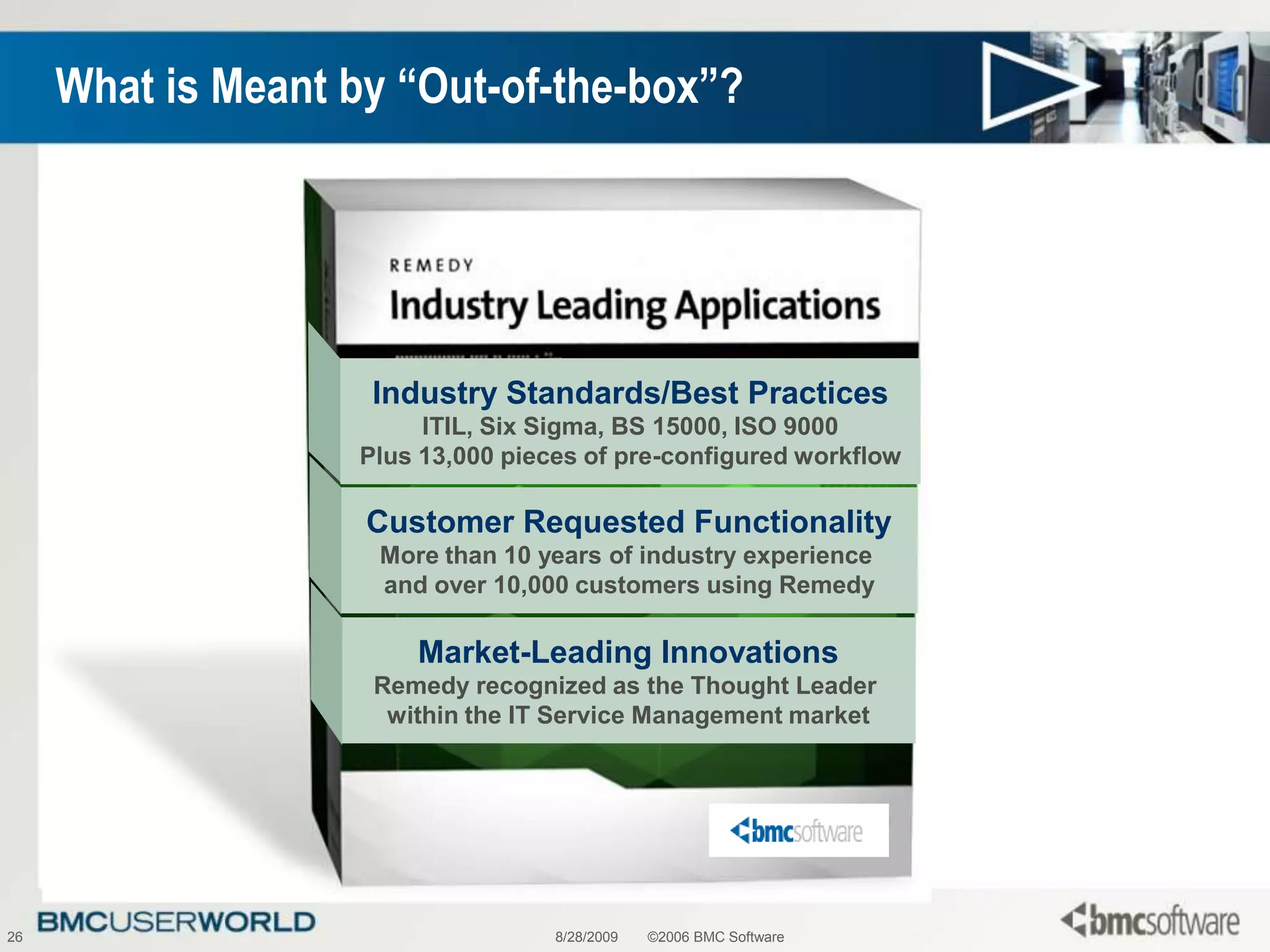
8/28/2009©2006 BMC Software26 What is Meant by “Out-of-the-box”?Industry Standards/Best PracticesITIL, Six Sigma, BS 15000, ISO 9000Plus 13,000 pieces of pre-configured workflowCustomer Requested FunctionalityMore than 10 years of industry experience and over 10,000 customers using RemedyMarket-Leading InnovationsRemedy recognized as the Thought Leader within the IT Service Management market
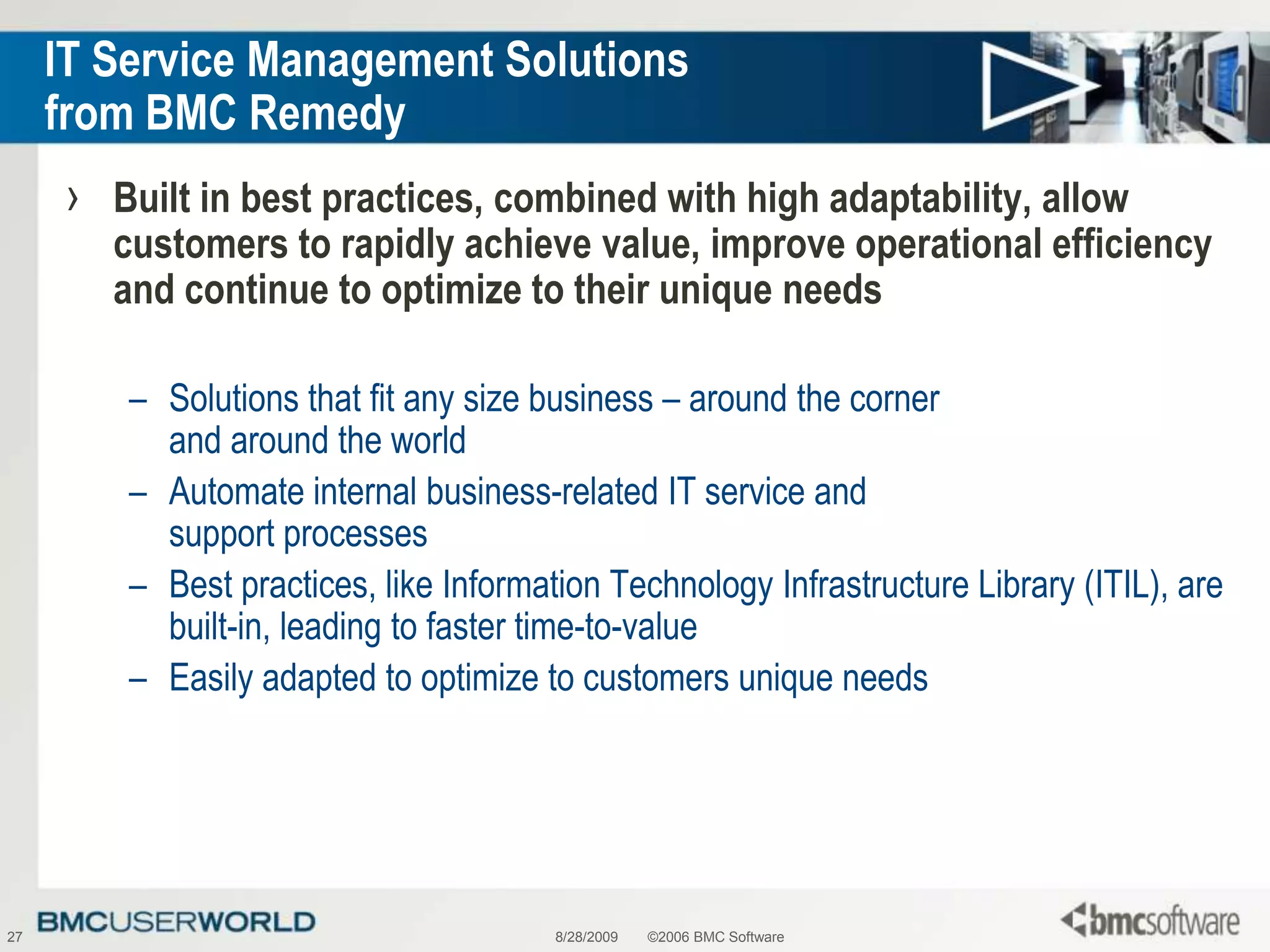
8/28/2009©2006 BMC Software27IT Service Management Solutions from BMC RemedyBuilt in best practices, combined with high adaptability, allow customers to rapidly achieve value, improve operational efficiency and continue to optimize to their unique needsSolutions that fit any size business – around the corner and around the worldAutomate internal business-related IT service and support processesBest practices, like Information Technology Infrastructure Library (ITIL), are built-in, leading to faster time-to-valueEasily adapted to optimize to customers unique needs
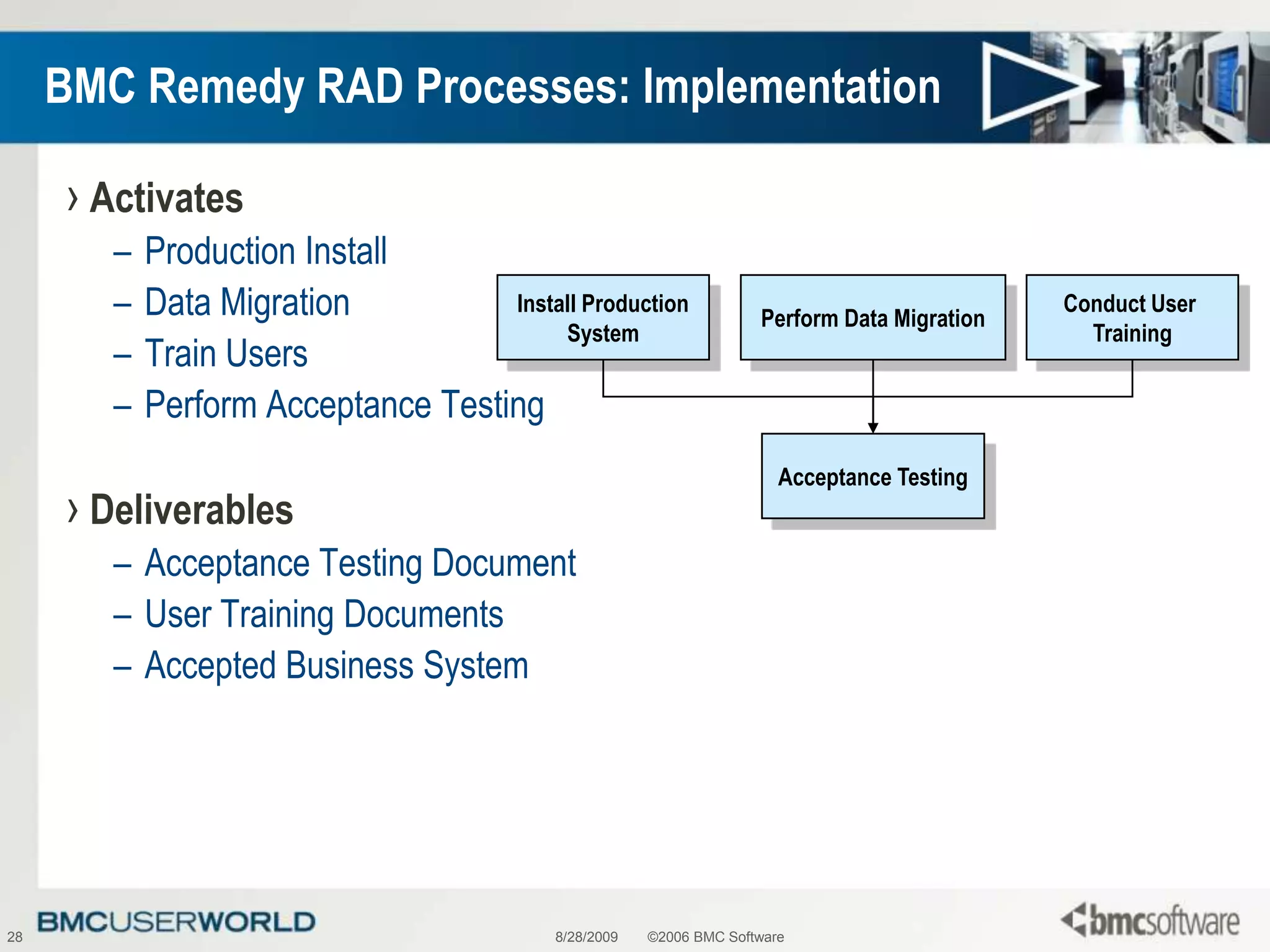
8/28/2009©2006 BMC Software28BMC Remedy RAD Processes: ImplementationActivatesProduction InstallData MigrationTrain UsersPerform Acceptance TestingDeliverablesAcceptance Testing DocumentUser Training DocumentsAccepted Business SystemInstall ProductionSystemPerform Data MigrationConduct User TrainingAcceptance Testing
8/28/2009©2006 BMC Software29BMC Remedy RAD Processes: Post- Project ActivitiesActivitiesReview & Document Project MetricsOrganize and Store Project AssetsPrepare Lessons Learned DocumentDeliverablesDocument StoreLessons Learned Document
8/28/2009©2006 BMC Software30AgendagenerationE Technologies OverviewIssues Affecting BMC Remedy DeploymentsA Case for a Rapid Deployment MethodologyThe generationE BMC Remedy Rapid Deployment MethodologyCase Study Review
8/28/2009©2006 BMC Software31Case Study“There are only two things of importance. One is the customer, and the other is the product. If you take care of customers, they come back. If you take care of the product, it doesn’t come back. It’s just that simple. And it’s just that difficult.”– Stanley Marcus, Neiman Marcus
8/28/2009©2006 BMC Software32Case StudyBusiness Profile:IT infrastructure and managed services company that provides 24x7 availability for their hosted business applications, as well as disaster recovery and co-location services. Existing BMC Remedy v5 solution acquired via acquisitionOrganizational changes and business requirements not mapped to existing BMC Remedy workflowManagement requirements to quickly deploy the solutionSoftware Solutions:BMC® Configuration ManagerBMC® Remedy® Asset Management ApplicationBMC® Remedy® Service DeskBMC® Remedy®  Service Level ManagementBMC® Remedy ®  Enterprise Integration Engine
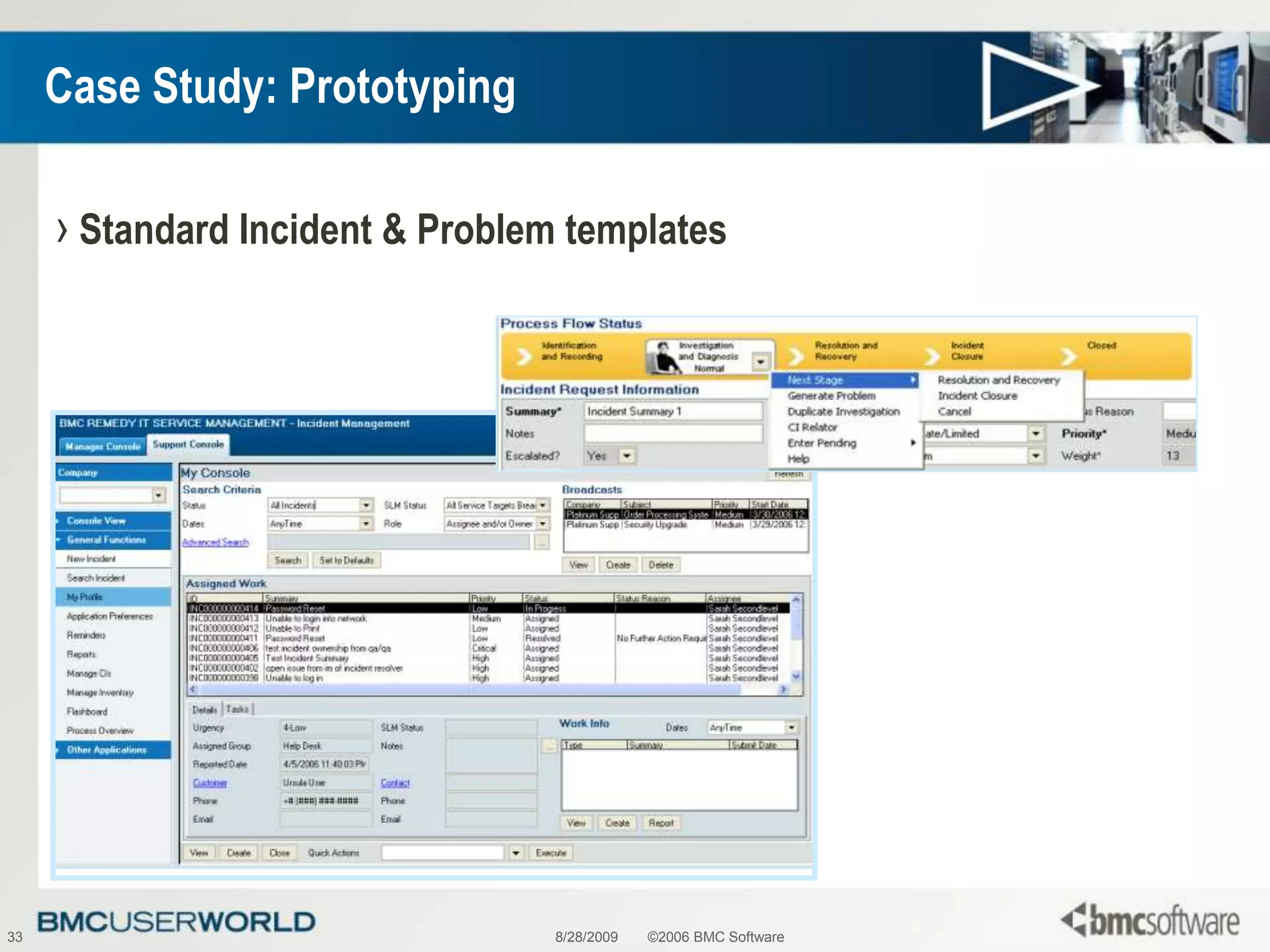
8/28/2009©2006 BMC Software33Case Study: PrototypingStandard Incident & Problem templates
8/28/2009©2006 BMC Software34Case Study: Interactive Development & Time BoxingLeverage BMC Remedy “Out of the Box” featuresSplit project in multiple phasesMapping of business requirements to ITIL best practices and BMC Remedy work flowVilfred Pareto’s 80/20 Rule for each phaseStrict project management procedures
8/28/2009©2006 BMC Software35Case Study: Team Members & Management ApproachTeam managed by business objectivesFocus on team contributionIndividuals co-operateDeliver the best business solutionDevelopments work along side usersDoubtful business functions were excludedQuality is measured against business benefit
8/28/2009©2006 BMC Software36Case Study: Lessons LearnedPrototype meetings were key to successMotivated users can lead to excellent systemsUncritical users will lead to systems failingCommunication can be markedly improvedIncremental delivery motivates usersDocumentation need not be a problemBoundaries will shiftControl and estimation is difficultShort delivery times can irritate developers
8/28/2009©2006 BMC Software37Other MethodologiesXP methodologybreaks a project into tiny phases, and developers cannot continue on to the next phase until the first phase is completeAgile methodologyA form of XP, aims for customer satisfaction through early and continuous delivery of useful software componentsAgile is similar to XP but with less focus on team coding and more on limiting project scopeAn agile project sets a minimum number of requirements and turns them into a deliverable product

Rapid Deployment of BMC Remedy Solutions 2006

  • 1.
    8/28/2009Rapid Deployment ofBMC Remedy Solutions Antonio RolleVP of Professional ServicesgenerationE Technologies
  • 2.
    8/28/2009©2006 BMC Software2AgendaIssuesAffecting BMC Remedy DeploymentsA Case for a Rapid Deployment MethodologyThe generationE BMC Remedy Rapid Deployment MethodologyCase Study Review
  • 3.
    8/28/2009©2006 BMC Software3AgendaIssuesAffecting BMC Remedy DeploymentsA Case for a Rapid Deployment MethodologyThe generationE BMC Remedy Rapid Deployment MethodologyCase Study Review
  • 4.
    8/28/2009©2006 BMC Software4IssuesAffecting BMC Remedy DeploymentsDeveloper Productivity (Backlogs)Skills ShortageTime to MarketComplexityMomentum
  • 5.
    8/28/2009©2006 BMC Software5AgendagenerationETechnologies OverviewIssues Affecting BMC Remedy DeploymentsA Case for a Rapid Deployment MethodologyThe generationE BMC Remedy Rapid Deployment MethodologyCase Study Review
  • 6.
    8/28/2009©2006 BMC Software6Whatis Rapid Application Development?“Rapid Application Development (RAD) is a development lifecycle designed to give much faster development and higher-quality results than those achieved with the traditional lifecycle. It is designed to take the maximum advantage of powerful development software that has evolved recently.” - James Martin Information Engineering: Introduction. Prentice Hall, 1991
  • 7.
    8/28/2009©2006 BMC Software7Whatis Rapid Application Development?RAD is a methodology for compressing the analysis, design, build and test phases into a series of short, iterative development cycles. RAD proposes that products can be developed faster and of higher quality by: Using workshops or focus groups to gather requirements Prototyping and user testing of designs Re-using software componentsFollowing a schedule that defers design improvements to the next product versionKeeping review meetings and other team communication informal
  • 8.
    8/28/2009©2006 BMC Software8RAD– Goals & PropertiesBring together the power of ITHelp to deliver on the promise of ‘Activate the Business’Manage the futurePlace emphasis on user involvement and responsibility throughout the developmentPropertiesSpecification is fluidMust be delivered in 2 - 6 months Split into increments if necessary Each increment is implemented separately with frequent delivery of working parts of system.
  • 9.
    8/28/2009©2006 BMC Software9ACase for a BMC Remedy Rapid Deployment MethodologyTime to AdoptionTime to MarketCost (Vilfredo Pareto’s 80/20 Rule)Leveraging “out of the box” functionalityExtensibilityPartner Commitment
  • 10.
    8/28/2009©2006 BMC Software10ACase Against RAD…PROJECT SCOPEBroad scope where the business objectives are obscure or broadPROJECT DECISIONSMany people must be involved in the decisions on the project, the decision makers are not available on a timely basis or they are geographically dispersedPROJECT TEAMThe project team is large, or there are multiple teams whose work needs to be coordinated
  • 11.
    8/28/2009©2006 BMC Software11AgendagenerationETechnologies OverviewIssues Affecting BMC Remedy DeploymentsA Case for a Rapid Deployment MethodologyThe generationE BMC Remedy Rapid Deployment MethodologyCase Study Review
  • 12.
    8/28/2009©2006 BMC Software12TraditionalDevelopment CyclePlanningAnalysisDesignBuildTestDeploy
  • 13.
    8/28/2009©2006 BMC Software13TraditionalDevelopment CycleAlthough quality and speed of delivery are paramount, this does not mean what is good in traditional system development is thrown away. There must be:Effective project managementAppropriate & Current Documentation Requirements SpecificationsAppropriate MaintainabilityTesting Quality AssuranceDesignsReuse
  • 14.
    8/28/2009©2006 BMC Software14RADCore ElementsPrototypingIterative developmentTime boxingTeam membersManagement approachRAD tools
  • 15.
    8/28/2009©2006 BMC Software15RADCore Elements: PrototypingThe construction of a feature-light, reduced-scalability application in a short amount of time. The objective is to create a working application to help a user flesh out requirements.The characteristics of prototyping can be summarized as:Involves versions of part of a software systemEvaluation is done in collaboration with users to optimize qualityA joint learning process between users and developersFacilitation of the discovery of errors (testing)
  • 16.
    8/28/2009©2006 BMC Software16RADCore Elements: Interactive DevelopmentThe creation of increasingly feature-rich versions of applications in short development cycles, where each release produces user requirements that feed the next releaseInvolves splitting projects into smaller mini-projectsRequires initial research and analysis of the project as wholeIncrements are self-contained systems, which aredevelopeddocumented deliveredEach increment typically involves iterative development and prototyping
  • 17.
    8/28/2009©2006 BMC Software17RADCore Elements: Time BoxingSupports iterative development by pushing off features to future versions in order to complete iterative cycles as quickly as possible. Time boxing is extremely important to help reduce scope creep, but it requires watchful and involved management.
  • 18.
    8/28/2009©2006 BMC Software18RADCore Elements: Team MembersTeams should be small and should consist of experienced, versatile, and motivated members that are able to perform multiple roles. These roles consist of:UserGood inter‑personal skillsPersonal confidenceA non‑parochial viewRepresentative of the user communityDeveloperPatience, diplomacy, perception, acceptability, objectivity, non‑ intimidating Good communication skills, patience, interpersonal skills, empathy with user Accepts criticism humblyProject ManagerOpen minded, prepared to be flexible, and dynamicPossess excellent leadership skills
  • 19.
    8/28/2009©2006 BMC Software19RADCore Elements: Management ApproachSpecifies that management should be very involved in keeping development cycles short and enforcing deadlines. Furthermore management should help keep high team motivation, and should focus on clearing bureaucratic or political obstacles.
  • 20.
    8/28/2009©2006 BMC Software20RADCore Elements: RAD ToolsSpecifies that development speed is more important than cost of tools and so the latest technologies should be used to increase development speed
  • 21.
    8/28/2009©2006 BMC Software21BMCRemedy RAD ProcessesPre-Project ActivitiesRequirements PlanningUser DesignConstructionImplementationPost-Project Activities
  • 22.
    8/28/2009©2006 BMC Software22BMCRemedy RAD Processes: Pre-Project ActivitiesDevelop Project Management PlanIdentify Risks and Mitigation StrategiesDefine the Development ScheduleIdentify Milestones and DeliverablesIdentify Desired End ResultsIdentify Project ConstraintsIdentify Financial Considerations
  • 23.
    8/28/2009©2006 BMC Software23BMCRemedy RAD Processes: Requirements PlanningActivitiesResearch the Current SituationGather Requirements and Perform Quick Design Build Prototype (Basic Interface, Demo System, Proof-of-Concept)Review PrototypeRefine Prototype & Design SpecificationsDeliverablesDesign SpecificationsPrototype
  • 24.
    8/28/2009©2006 BMC Software24BMCRemedy RAD Processes: User DesignActivitiesProduce Detailed Design DocumentPrepare Implementation StrategyObtain Approval for ConstructionDeliverablesDetailed Design DocumentSign Off for ConstructionDevelop Outline System DesignRefine System DesignPrepare Implementation StrategyFinalize SystemDesignObtain Approval
  • 25.
    8/28/2009©2006 BMC Software25BMCRemedy RAD Processes: ConstructionActivatesDevelop Unit Test Plan's)System ConstructionGenerate BMC Remedy Test DataGenerate System DocumentsSystem TestingDeliverablesUnit Test Plan's)System Test PlanTested UnitsSystem DocumentationDeveloped SystemPrepare for ConstructionConstruct SystemGenerate Test Data & DocumentationPrepare for TransitionVerify System Construction
  • 26.
    8/28/2009©2006 BMC Software26What is Meant by “Out-of-the-box”?Industry Standards/Best PracticesITIL, Six Sigma, BS 15000, ISO 9000Plus 13,000 pieces of pre-configured workflowCustomer Requested FunctionalityMore than 10 years of industry experience and over 10,000 customers using RemedyMarket-Leading InnovationsRemedy recognized as the Thought Leader within the IT Service Management market
  • 27.
    8/28/2009©2006 BMC Software27ITService Management Solutions from BMC RemedyBuilt in best practices, combined with high adaptability, allow customers to rapidly achieve value, improve operational efficiency and continue to optimize to their unique needsSolutions that fit any size business – around the corner and around the worldAutomate internal business-related IT service and support processesBest practices, like Information Technology Infrastructure Library (ITIL), are built-in, leading to faster time-to-valueEasily adapted to optimize to customers unique needs
  • 28.
    8/28/2009©2006 BMC Software28BMCRemedy RAD Processes: ImplementationActivatesProduction InstallData MigrationTrain UsersPerform Acceptance TestingDeliverablesAcceptance Testing DocumentUser Training DocumentsAccepted Business SystemInstall ProductionSystemPerform Data MigrationConduct User TrainingAcceptance Testing
  • 29.
    8/28/2009©2006 BMC Software29BMCRemedy RAD Processes: Post- Project ActivitiesActivitiesReview & Document Project MetricsOrganize and Store Project AssetsPrepare Lessons Learned DocumentDeliverablesDocument StoreLessons Learned Document
  • 30.
    8/28/2009©2006 BMC Software30AgendagenerationETechnologies OverviewIssues Affecting BMC Remedy DeploymentsA Case for a Rapid Deployment MethodologyThe generationE BMC Remedy Rapid Deployment MethodologyCase Study Review
  • 31.
    8/28/2009©2006 BMC Software31CaseStudy“There are only two things of importance. One is the customer, and the other is the product. If you take care of customers, they come back. If you take care of the product, it doesn’t come back. It’s just that simple. And it’s just that difficult.”– Stanley Marcus, Neiman Marcus
  • 32.
    8/28/2009©2006 BMC Software32CaseStudyBusiness Profile:IT infrastructure and managed services company that provides 24x7 availability for their hosted business applications, as well as disaster recovery and co-location services. Existing BMC Remedy v5 solution acquired via acquisitionOrganizational changes and business requirements not mapped to existing BMC Remedy workflowManagement requirements to quickly deploy the solutionSoftware Solutions:BMC® Configuration ManagerBMC® Remedy® Asset Management ApplicationBMC® Remedy® Service DeskBMC® Remedy® Service Level ManagementBMC® Remedy ® Enterprise Integration Engine
  • 33.
    8/28/2009©2006 BMC Software33CaseStudy: PrototypingStandard Incident & Problem templates
  • 34.
    8/28/2009©2006 BMC Software34CaseStudy: Interactive Development & Time BoxingLeverage BMC Remedy “Out of the Box” featuresSplit project in multiple phasesMapping of business requirements to ITIL best practices and BMC Remedy work flowVilfred Pareto’s 80/20 Rule for each phaseStrict project management procedures
  • 35.
    8/28/2009©2006 BMC Software35CaseStudy: Team Members & Management ApproachTeam managed by business objectivesFocus on team contributionIndividuals co-operateDeliver the best business solutionDevelopments work along side usersDoubtful business functions were excludedQuality is measured against business benefit
  • 36.
    8/28/2009©2006 BMC Software36CaseStudy: Lessons LearnedPrototype meetings were key to successMotivated users can lead to excellent systemsUncritical users will lead to systems failingCommunication can be markedly improvedIncremental delivery motivates usersDocumentation need not be a problemBoundaries will shiftControl and estimation is difficultShort delivery times can irritate developers
  • 37.
    8/28/2009©2006 BMC Software37OtherMethodologiesXP methodologybreaks a project into tiny phases, and developers cannot continue on to the next phase until the first phase is completeAgile methodologyA form of XP, aims for customer satisfaction through early and continuous delivery of useful software componentsAgile is similar to XP but with less focus on team coding and more on limiting project scopeAn agile project sets a minimum number of requirements and turns them into a deliverable product