1


BSBMKG502B – Establish and adjust the
marketing mix
Presentation Four

Place (Distribution)
Fourth of the Four P’s
   Product (and service)
   Price
   Promotion
   Place(ment)
2


Physical placement
 • The process of planning,
   implementing and controlling the
   physical flow of materials from point
   of origin to points of use for the
   purpose of conforming to customer
   requirements at a profit. (Kotler)
3


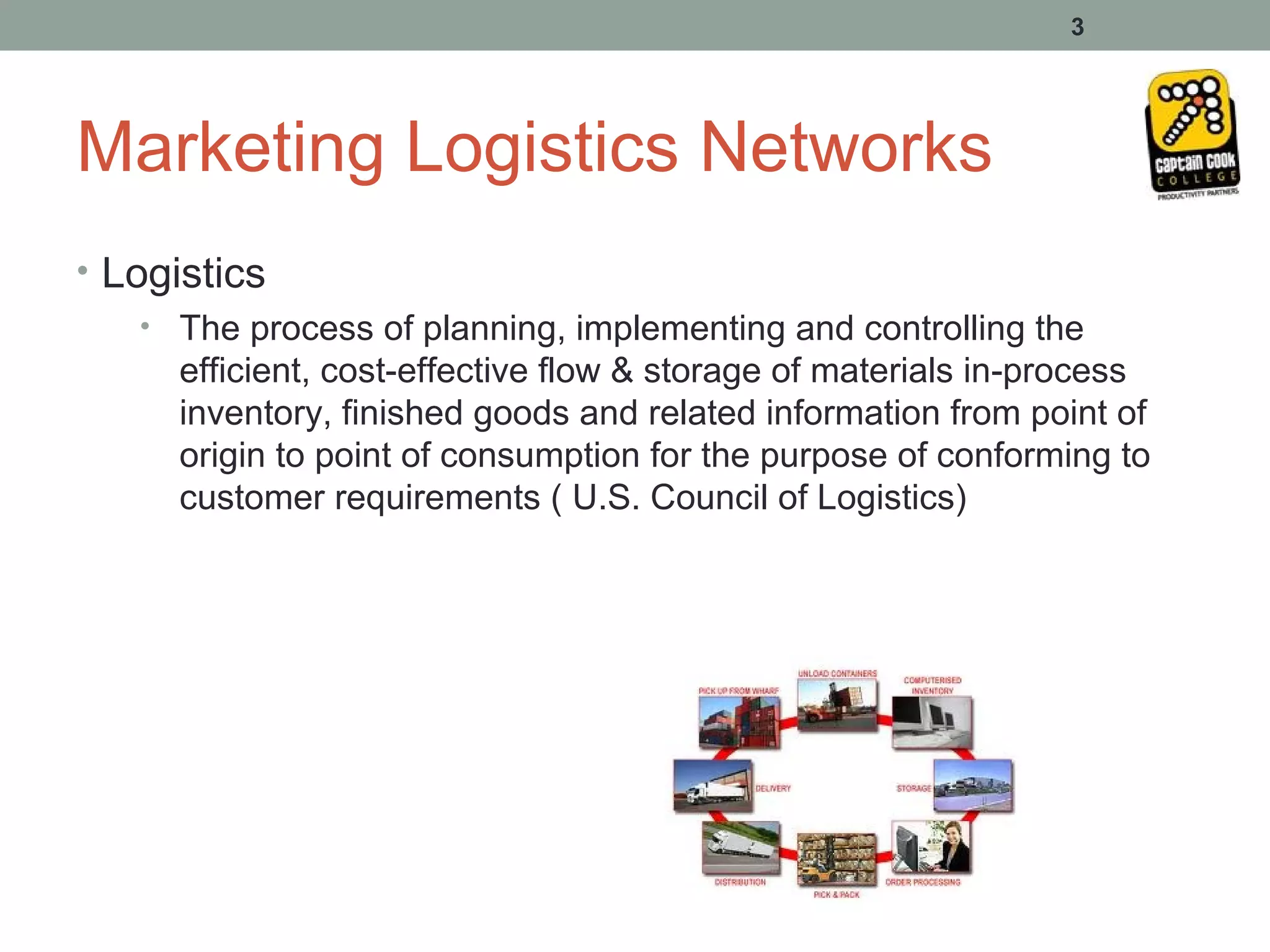
Marketing Logistics Networks
• Logistics
    • The process of planning, implementing and controlling the
      efficient, cost-effective flow & storage of materials in-process
      inventory, finished goods and related information from point of
      origin to point of consumption for the purpose of conforming to
      customer requirements ( U.S. Council of Logistics)
4


Demand Chain Management

• Value-adding by coordinating flows from suppliers to
  ultimate users
• Coordinating suppliers, purchasing agents,
  manufacturers, marketers, channel members,
  customers & end-users
• Managing information systems such as:
   • computers, point-of-sale (P.O.S.) terminals, uniform
     product codes, satellite tracking, electronic data
     interchange (EDI) and electronic funds transfer (EFT)
5


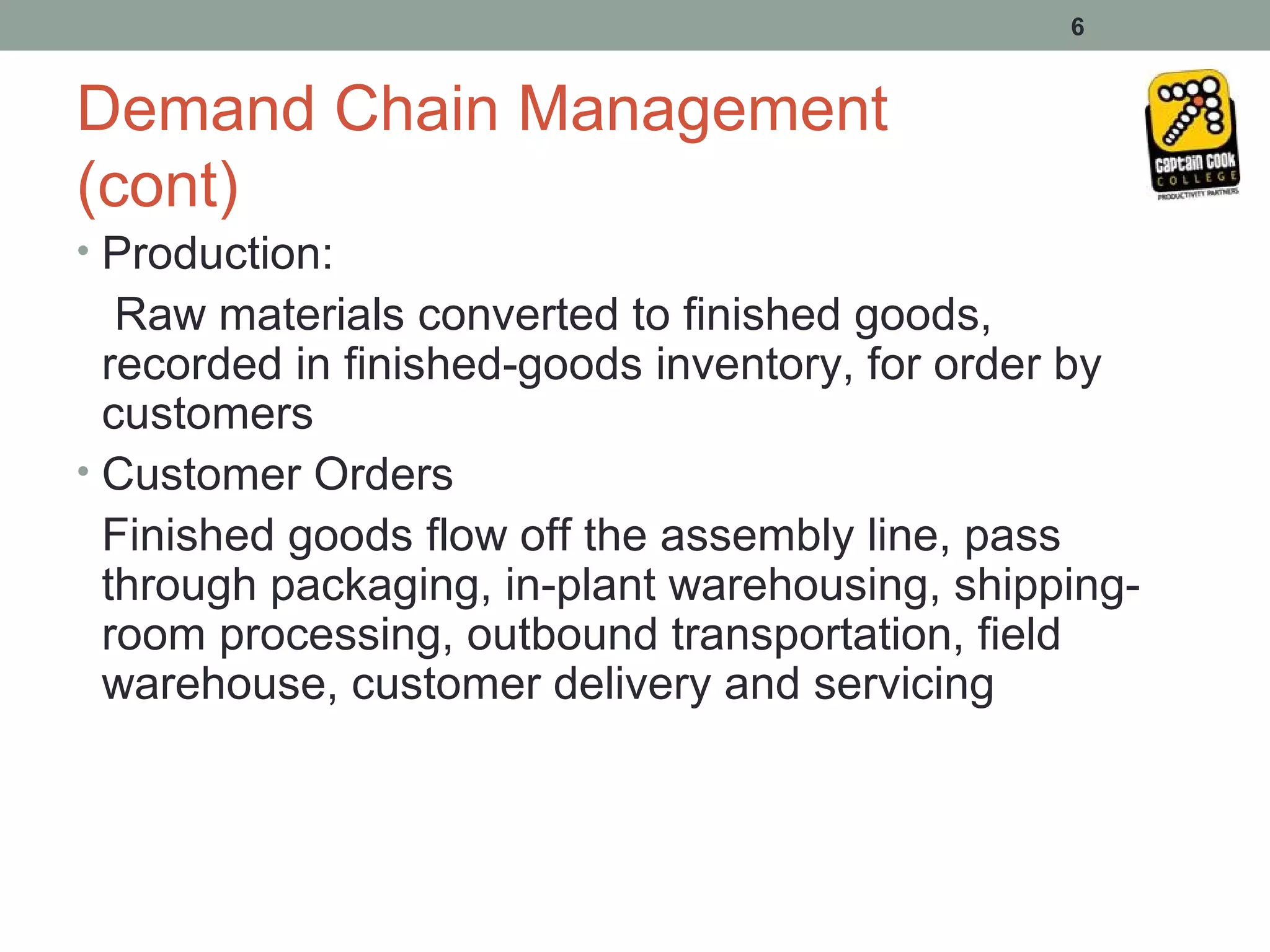
Demand Chain Management

• Sales Forecasting:
    • production schedules, inventory levels, and distribution
• Production planning:
    • materials to be ordered by purchasing
• Inbound materials management:
    • inbound transportation, goods receiving,
      storage and raw-materials inventory
6


Demand Chain Management
(cont)
• Production:
   Raw materials converted to finished goods,
  recorded in finished-goods inventory, for order by
  customers
• Customer Orders
  Finished goods flow off the assembly line, pass
  through packaging, in-plant warehousing, shipping-
  room processing, outbound transportation, field
  warehouse, customer delivery and servicing
7


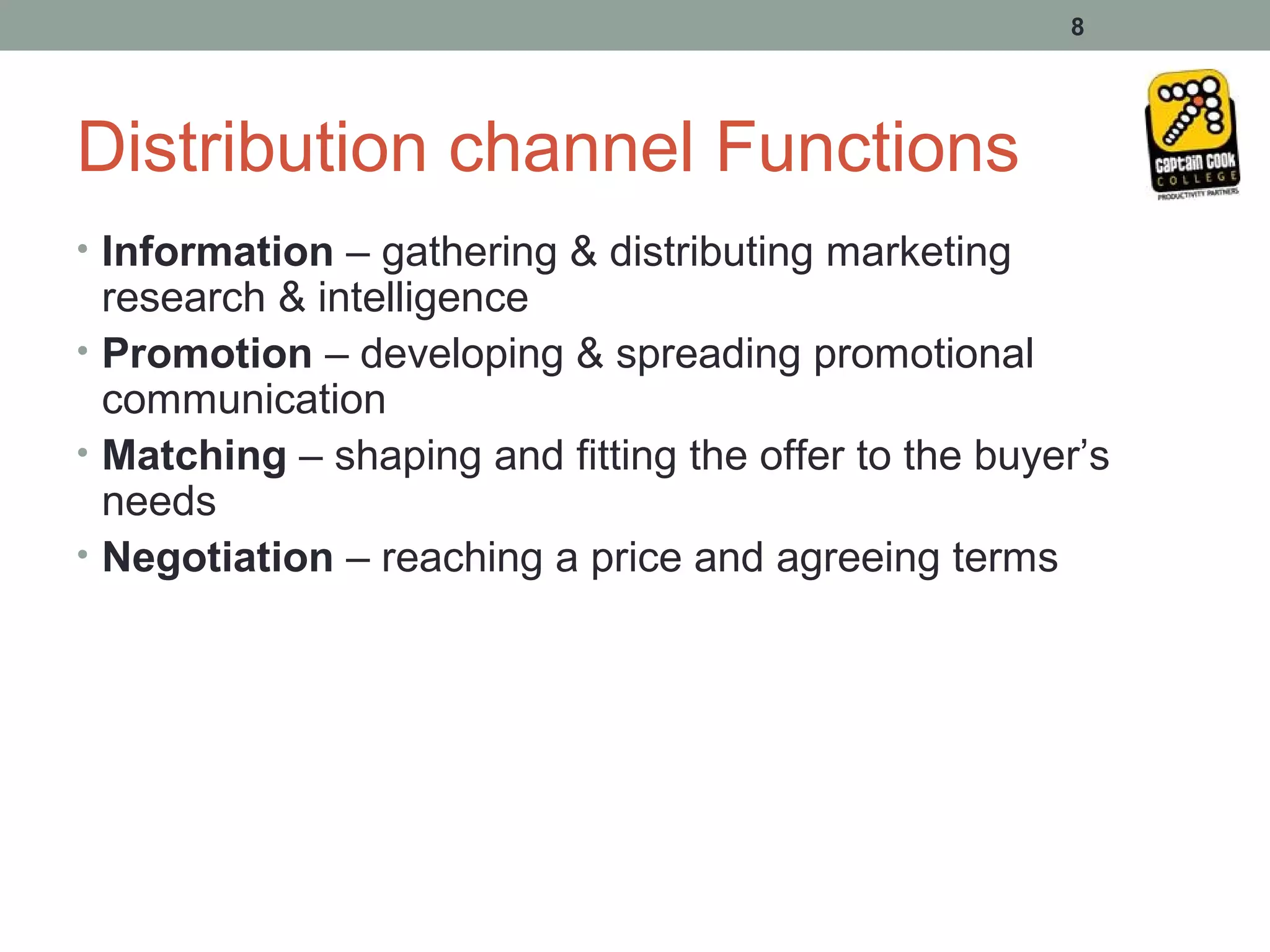
Marketing Channels
• A marketing channel is a set of interdependent
 organisations involved in making a product or service
 available for use or consumption by the consumer or end
 user.
8


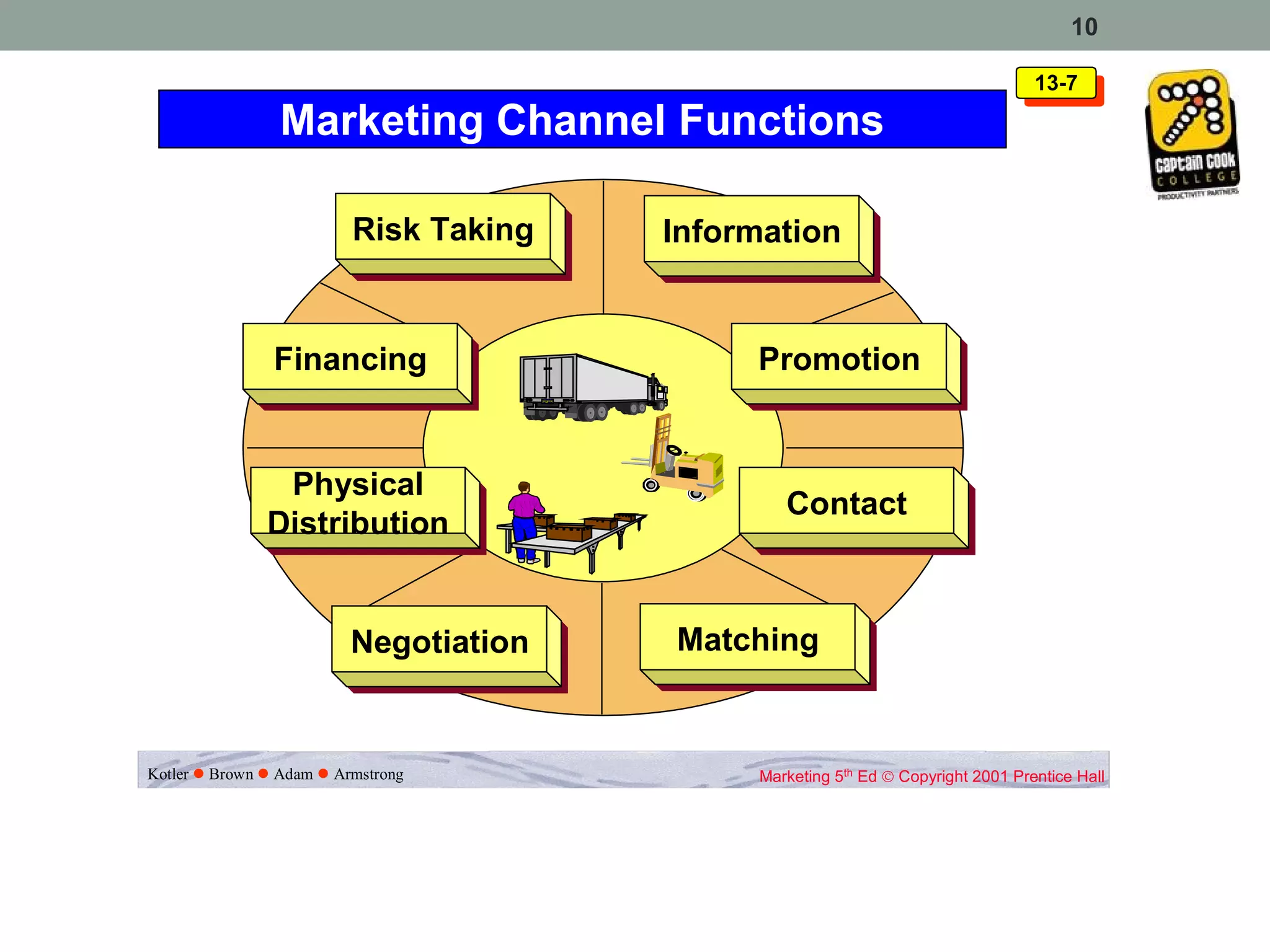
Distribution channel Functions
• Information – gathering & distributing marketing
  research & intelligence
• Promotion – developing & spreading promotional
  communication
• Matching – shaping and fitting the offer to the buyer’s
  needs
• Negotiation – reaching a price and agreeing terms
9


Marketing Channel Functions (cont)
• Physical Distribution – transporting & storing goods
• Financing – covering the cost of channel work, often
  extending credit to retailers
• Risk Taking – assumes the risk of channel work.
10

                                                                                13-7
                                                                                 13-7
               Marketing Channel Functions

                       Risk Taking
                       Risk Taking   Information
                                      Information


              Financing
              Financing                    Promotion
                                           Promotion


               Physical
                Physical                      Contact
                                              Contact
              Distribution
              Distribution


                       Negotiation
                       Negotiation   Matching
                                     Matching


Kotler Brown Adam Armstrong             Marketing 5th Ed © Copyright 2001 Prentice Hall
11


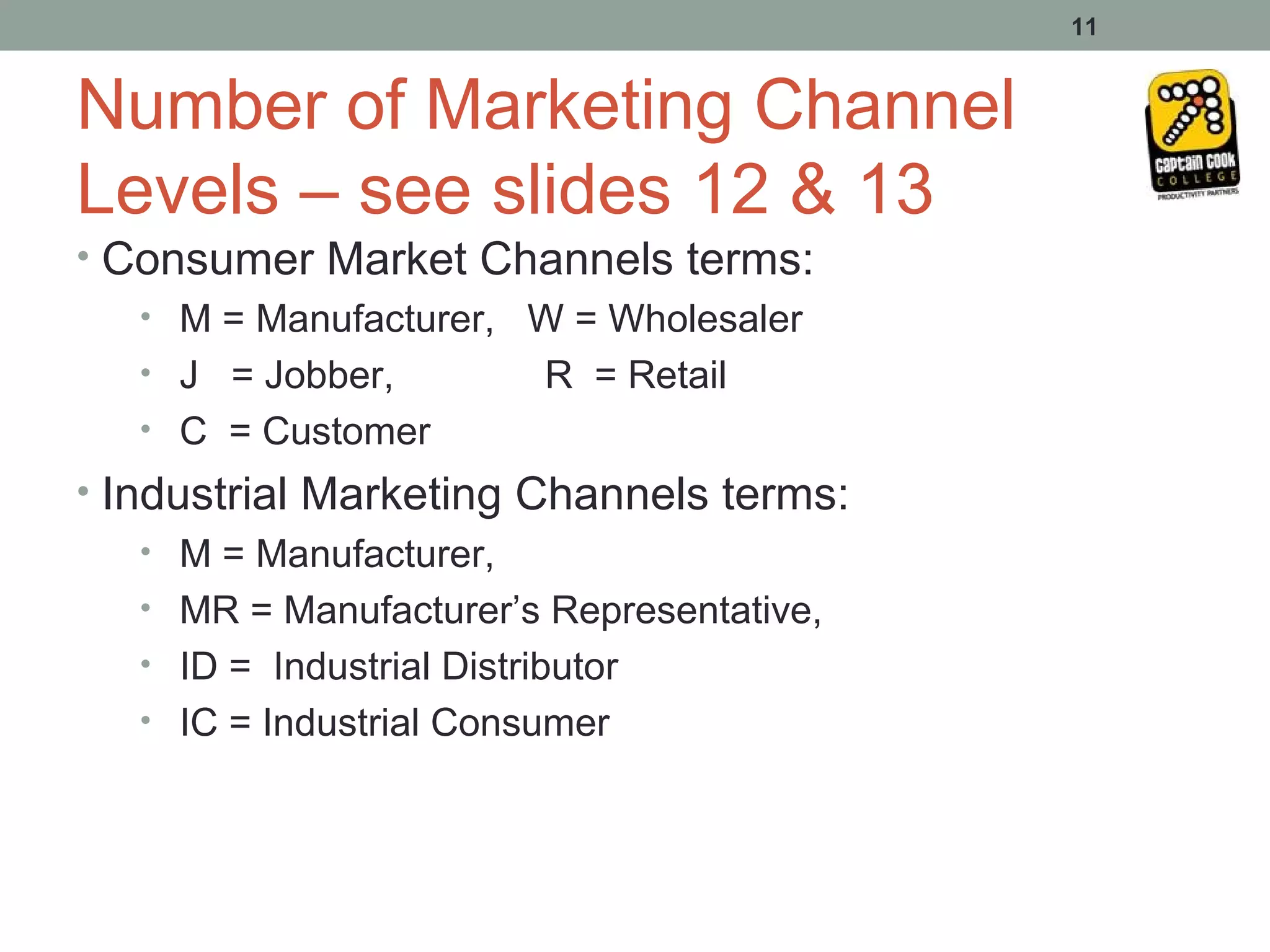
Number of Marketing Channel
Levels – see slides 12 & 13
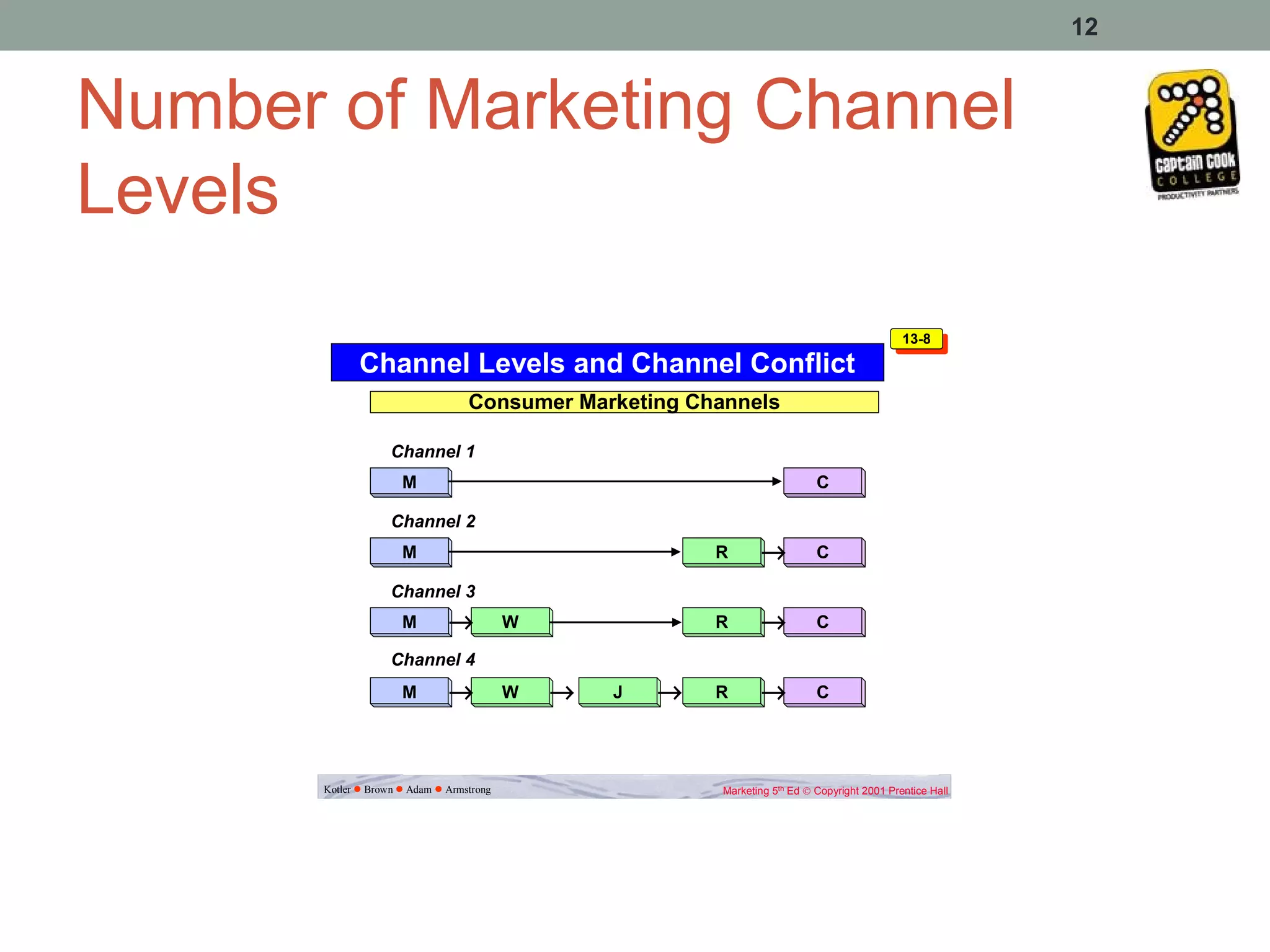
• Consumer Market Channels terms:
   • M = Manufacturer, W = Wholesaler
   • J = Jobber,       R = Retail
   • C = Customer
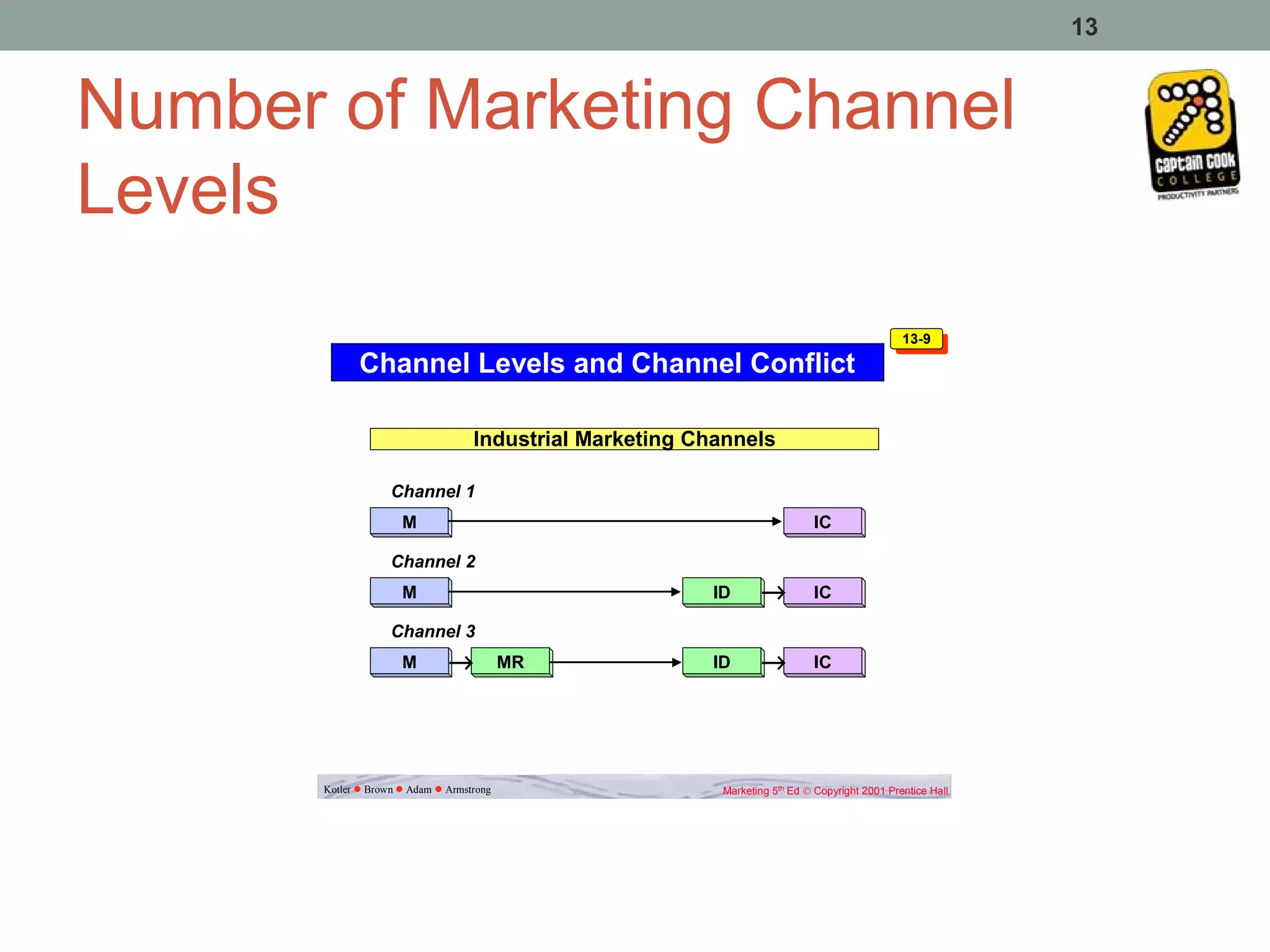
• Industrial Marketing Channels terms:
    • M = Manufacturer,
    • MR = Manufacturer’s Representative,
    • ID = Industrial Distributor
    • IC = Industrial Consumer
12


Number of Marketing Channel
Levels
                                                                                             13-8
                                                                                              13-8
             Channel Levels and Channel Conflict
                                Consumer Marketing Channels

                   Channel 1
                     M                                                     C

                   Channel 2
                     M                                  R      →           C

                   Channel 3
                     M       →          W               R      →           C

                   Channel 4
                     M       →          W   →   J   →   R      →           C


       Kotler Brown Adam Armstrong                   Marketing 5th Ed © Copyright 2001 Prentice Hall
13


Number of Marketing Channel
Levels
                                                                                             13-9
                                                                                              13-9
             Channel Levels and Channel Conflict

                                 Industrial Marketing Channels

                   Channel 1
                     M                                                    IC

                   Channel 2
                     M                                 ID      →          IC

                   Channel 3
                     M       →          MR             ID      →          IC


       Kotler Brown Adam Armstrong                   Marketing 5th Ed © Copyright 2001 Prentice Hall
14


Channel Design Decisions
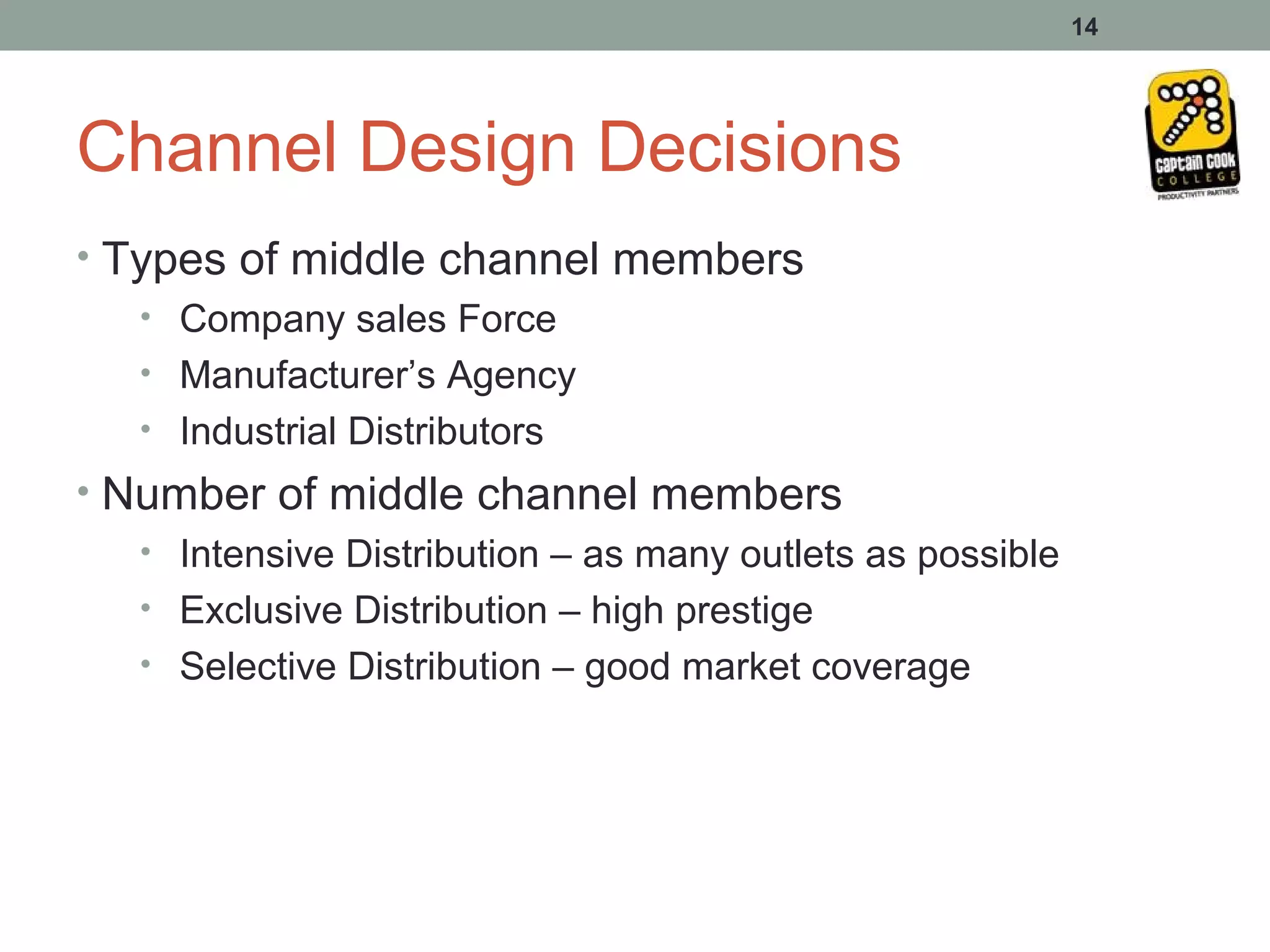
• Types of middle channel members
   • Company sales Force
   • Manufacturer’s Agency
   • Industrial Distributors
• Number of middle channel members
   • Intensive Distribution – as many outlets as possible
   • Exclusive Distribution – high prestige
   • Selective Distribution – good market coverage
15


Responsibility of Channel Members
• Agreement on Price Policies
• Conditions of Sale
• Territory rights (who is authorised to sell in a particular area)
• Specific services to be performed by
 each member
16


Evaluating Major Alternatives
• Economic Criteria - Different levels and cost for each
  alternative
• Control Criteria – benefits of directing channel against
  benefits of using outside businesses
• Adaptive Criteria – benefits of each criteria against loss
  of flexibility of long-term contracts
17


Channel Management Decisions
• Selecting Channel Members – to value-add to
  process
• Motivating Channel Members – high margins,
  special deals, premiums, advertising & promotional
  allowances, sales contests
• Evaluating Channel Members – measurement
  against criteria for sales, inventory control, customer
  delivery time, training, customer service
18


Channel Management Decisions
(cont)
• Cycle time reduction decisions – reduce time to
  develop new products & to manufacture & distribute
  finished products
• Quick response-systems solution: EDI (electronic data
  interchange), EFTPOS, Quick Response Retail
  Technology (QRRT), Quick Response Service
  Technology (QRST) to reduce cycle time and
  increase efficiency and improve customer service
19


Channel Management Decisions
(cont)
• Conversion Operations Location Decisions –
  location has major impact on costs
• Make or Buy Vertically Integrated or Network
  Decisions
• Input Suppliers Networks - closer economic
  relationships between channel members
• Manufacturing & Operations Decisions –to order
  or to develop an inventory
20


Channel Management Decisions
(cont)
• Order Processing Decisions – mail, telephone, fax,
  salespersons, online, EDI, internet
• Warehousing Decisions – if inventory carried: storage,
  distribution, company or intermediary owned
• Inventory Decisions – reduce unnecessary inventory
  costs
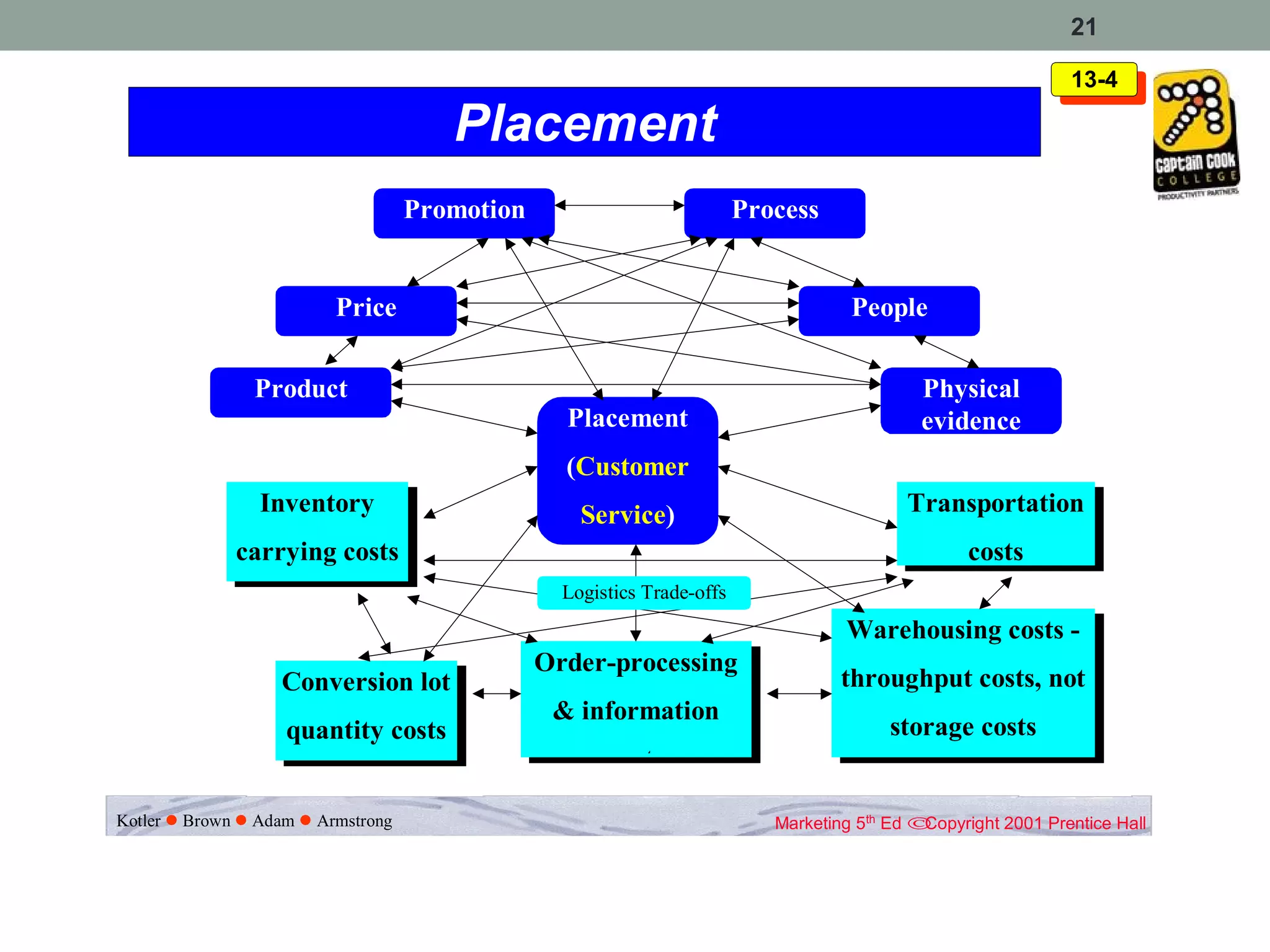
21

                                                                                                             13-4
                                                                                                              13-4
                                    Placement
                                 Promotion                            Process


                       Price                                                      People

               Product                                                                     Physical
                                               Placement                                   evidence
                                               (Customer
               Inventory                         Service)                                Transportation
            carrying costs                                                                      costs
                                               Logistics Trade-offs
                                                                                 Warehousing costs -
                                             Order-processing
                 Conversion lot                                                  throughput costs, not
                                              & information
                  quantity costs                                                       storage costs
                                                    costs

Kotler Brown Adam Armstrong                                           Marketing 5th Ed ©Copyright 2001 Prentice Hall
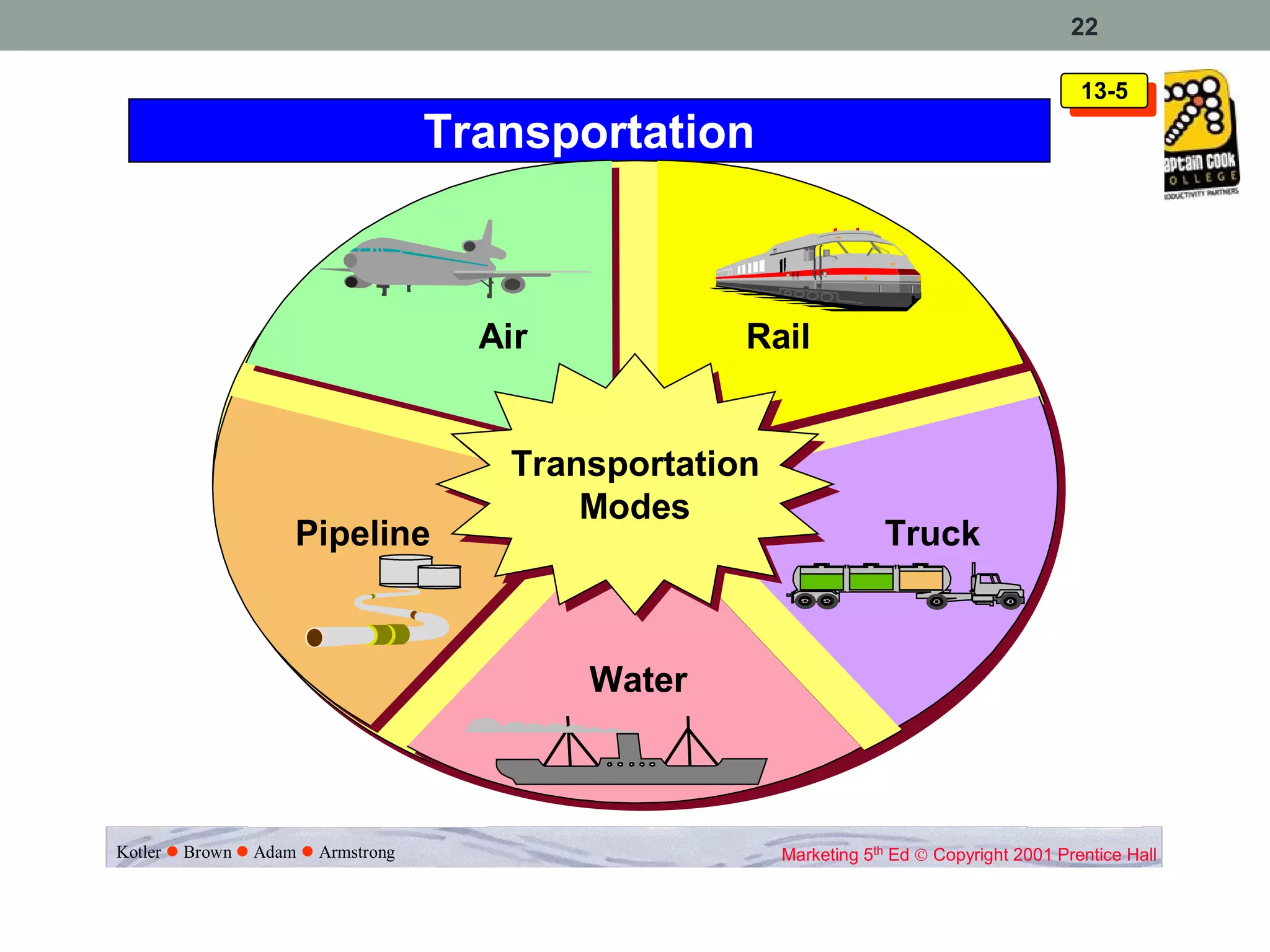
22

                                                                                          13-5
                                                                                           13-5
                                 Transportation


                                   Air           Rail


                                    Transportation
                                    Transportation
                                        Modes
                                        Modes
                   Pipeline                                      Truck


                                         Water


Kotler Brown Adam Armstrong                       Marketing 5th Ed © Copyright 2001 Prentice Hall
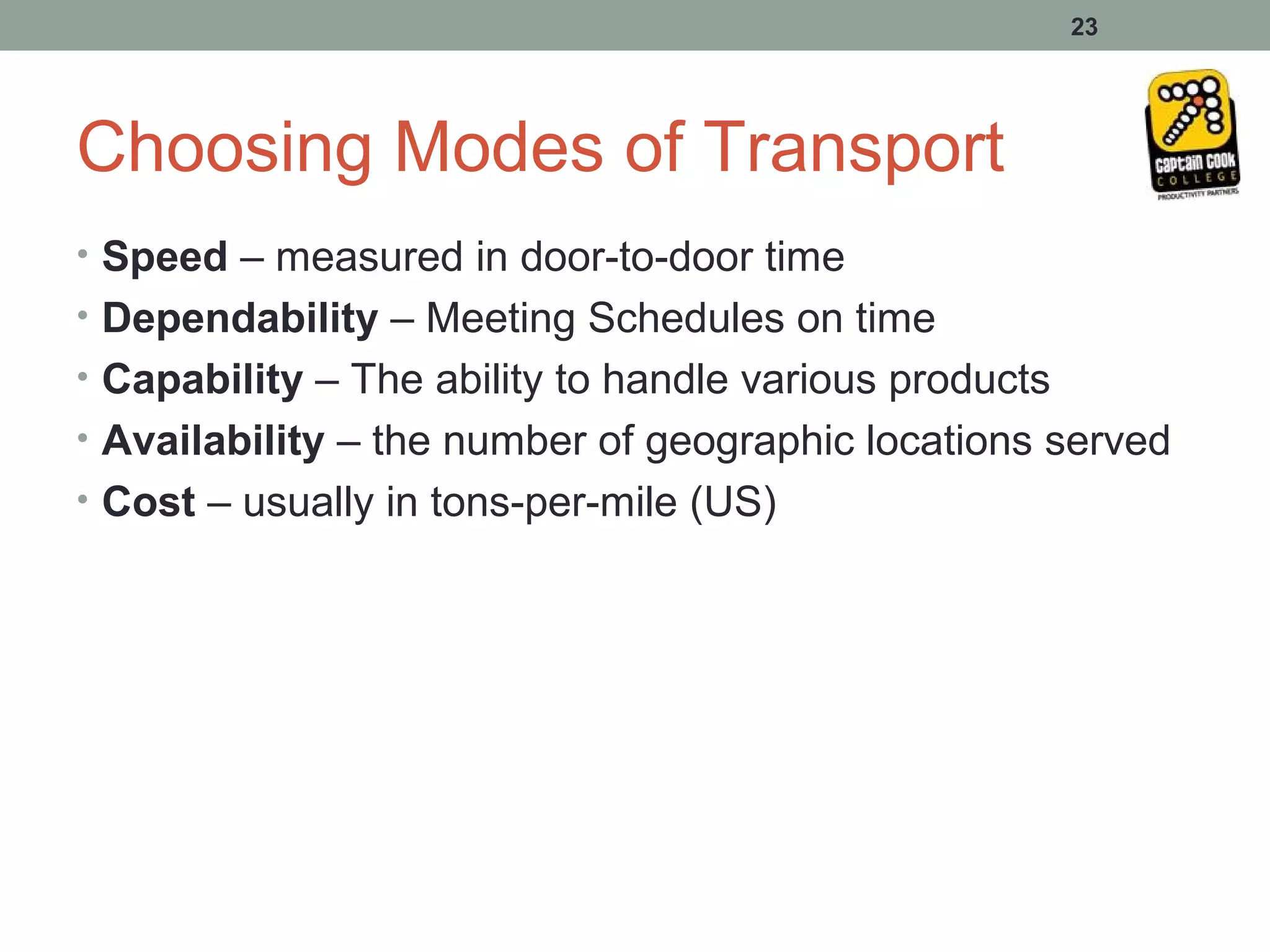
23


Choosing Modes of Transport
• Speed – measured in door-to-door time
• Dependability – Meeting Schedules on time
• Capability – The ability to handle various products
• Availability – the number of geographic locations served
• Cost – usually in tons-per-mile (US)
24


   Conclusion
• Logistics management requires great trade-offs
  between functional units
• Management must focus on communication and
  strategic objectives to ensure co-operation
• Distribution can often be that part of the mix which
  irritates the customer the most e.g. failed deliveries,
  damaged goods, wrong orders ....

Bsbmkg502 b – session i vb

  • 1.
    1 BSBMKG502B – Establishand adjust the marketing mix Presentation Four Place (Distribution) Fourth of the Four P’s Product (and service) Price Promotion Place(ment)
  • 2.
    2 Physical placement •The process of planning, implementing and controlling the physical flow of materials from point of origin to points of use for the purpose of conforming to customer requirements at a profit. (Kotler)
  • 3.
    3 Marketing Logistics Networks •Logistics • The process of planning, implementing and controlling the efficient, cost-effective flow & storage of materials in-process inventory, finished goods and related information from point of origin to point of consumption for the purpose of conforming to customer requirements ( U.S. Council of Logistics)
  • 4.
    4 Demand Chain Management •Value-adding by coordinating flows from suppliers to ultimate users • Coordinating suppliers, purchasing agents, manufacturers, marketers, channel members, customers & end-users • Managing information systems such as: • computers, point-of-sale (P.O.S.) terminals, uniform product codes, satellite tracking, electronic data interchange (EDI) and electronic funds transfer (EFT)
  • 5.
    5 Demand Chain Management •Sales Forecasting: • production schedules, inventory levels, and distribution • Production planning: • materials to be ordered by purchasing • Inbound materials management: • inbound transportation, goods receiving, storage and raw-materials inventory
  • 6.
    6 Demand Chain Management (cont) •Production: Raw materials converted to finished goods, recorded in finished-goods inventory, for order by customers • Customer Orders Finished goods flow off the assembly line, pass through packaging, in-plant warehousing, shipping- room processing, outbound transportation, field warehouse, customer delivery and servicing
  • 7.
    7 Marketing Channels • Amarketing channel is a set of interdependent organisations involved in making a product or service available for use or consumption by the consumer or end user.
  • 8.
    8 Distribution channel Functions •Information – gathering & distributing marketing research & intelligence • Promotion – developing & spreading promotional communication • Matching – shaping and fitting the offer to the buyer’s needs • Negotiation – reaching a price and agreeing terms
  • 9.
    9 Marketing Channel Functions(cont) • Physical Distribution – transporting & storing goods • Financing – covering the cost of channel work, often extending credit to retailers • Risk Taking – assumes the risk of channel work.
  • 10.
    10 13-7 13-7 Marketing Channel Functions Risk Taking Risk Taking Information Information Financing Financing Promotion Promotion Physical Physical Contact Contact Distribution Distribution Negotiation Negotiation Matching Matching Kotler Brown Adam Armstrong Marketing 5th Ed © Copyright 2001 Prentice Hall
  • 11.
    11 Number of MarketingChannel Levels – see slides 12 & 13 • Consumer Market Channels terms: • M = Manufacturer, W = Wholesaler • J = Jobber, R = Retail • C = Customer • Industrial Marketing Channels terms: • M = Manufacturer, • MR = Manufacturer’s Representative, • ID = Industrial Distributor • IC = Industrial Consumer
  • 12.
    12 Number of MarketingChannel Levels 13-8 13-8 Channel Levels and Channel Conflict Consumer Marketing Channels Channel 1 M C Channel 2 M R → C Channel 3 M → W R → C Channel 4 M → W → J → R → C Kotler Brown Adam Armstrong Marketing 5th Ed © Copyright 2001 Prentice Hall
  • 13.
    13 Number of MarketingChannel Levels 13-9 13-9 Channel Levels and Channel Conflict Industrial Marketing Channels Channel 1 M IC Channel 2 M ID → IC Channel 3 M → MR ID → IC Kotler Brown Adam Armstrong Marketing 5th Ed © Copyright 2001 Prentice Hall
  • 14.
    14 Channel Design Decisions •Types of middle channel members • Company sales Force • Manufacturer’s Agency • Industrial Distributors • Number of middle channel members • Intensive Distribution – as many outlets as possible • Exclusive Distribution – high prestige • Selective Distribution – good market coverage
  • 15.
    15 Responsibility of ChannelMembers • Agreement on Price Policies • Conditions of Sale • Territory rights (who is authorised to sell in a particular area) • Specific services to be performed by each member
  • 16.
    16 Evaluating Major Alternatives •Economic Criteria - Different levels and cost for each alternative • Control Criteria – benefits of directing channel against benefits of using outside businesses • Adaptive Criteria – benefits of each criteria against loss of flexibility of long-term contracts
  • 17.
    17 Channel Management Decisions •Selecting Channel Members – to value-add to process • Motivating Channel Members – high margins, special deals, premiums, advertising & promotional allowances, sales contests • Evaluating Channel Members – measurement against criteria for sales, inventory control, customer delivery time, training, customer service
  • 18.
    18 Channel Management Decisions (cont) •Cycle time reduction decisions – reduce time to develop new products & to manufacture & distribute finished products • Quick response-systems solution: EDI (electronic data interchange), EFTPOS, Quick Response Retail Technology (QRRT), Quick Response Service Technology (QRST) to reduce cycle time and increase efficiency and improve customer service
  • 19.
    19 Channel Management Decisions (cont) •Conversion Operations Location Decisions – location has major impact on costs • Make or Buy Vertically Integrated or Network Decisions • Input Suppliers Networks - closer economic relationships between channel members • Manufacturing & Operations Decisions –to order or to develop an inventory
  • 20.
    20 Channel Management Decisions (cont) •Order Processing Decisions – mail, telephone, fax, salespersons, online, EDI, internet • Warehousing Decisions – if inventory carried: storage, distribution, company or intermediary owned • Inventory Decisions – reduce unnecessary inventory costs
  • 21.
    21 13-4 13-4 Placement Promotion Process Price People Product Physical Placement evidence (Customer Inventory Service) Transportation carrying costs costs Logistics Trade-offs Warehousing costs - Order-processing Conversion lot throughput costs, not & information quantity costs storage costs costs Kotler Brown Adam Armstrong Marketing 5th Ed ©Copyright 2001 Prentice Hall
  • 22.
    22 13-5 13-5 Transportation Air Rail Transportation Transportation Modes Modes Pipeline Truck Water Kotler Brown Adam Armstrong Marketing 5th Ed © Copyright 2001 Prentice Hall
  • 23.
    23 Choosing Modes ofTransport • Speed – measured in door-to-door time • Dependability – Meeting Schedules on time • Capability – The ability to handle various products • Availability – the number of geographic locations served • Cost – usually in tons-per-mile (US)
  • 24.
    24 Conclusion • Logistics management requires great trade-offs between functional units • Management must focus on communication and strategic objectives to ensure co-operation • Distribution can often be that part of the mix which irritates the customer the most e.g. failed deliveries, damaged goods, wrong orders ....