Chapter 13:
Retailers,
Wholesalers, and
Their Strategy
Planning


                   For use only with Perreault and McCarthy texts.
                        © The McGraw-Hill Companies, Inc., 1999
                                                 Irwin/McGraw-Hill
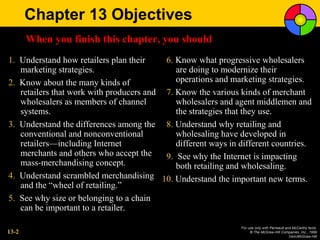
Chapter 13 Objectives
       When you finish this chapter, you should
1. Understand how retailers plan their    6. Know what progressive wholesalers
   marketing strategies.                     are doing to modernize their
2. Know about the many kinds of              operations and marketing strategies.
   retailers that work with producers and 7. Know the various kinds of merchant
   wholesalers as members of channel         wholesalers and agent middlemen and
   systems.                                  the strategies that they use.
3. Understand the differences among the 8. Understand why retailing and
   conventional and nonconventional          wholesaling have developed in
   retailers—including Internet              different ways in different countries.
   merchants and others who accept the    9. See why the Internet is impacting
   mass-merchandising concept.               both retailing and wholesaling.
4. Understand scrambled merchandising 10. Understand the important new terms.
   and the “wheel of retailing.”
5. See why size or belonging to a chain
   can be important to a retailer.

                                                               For use only with Perreault and McCarthy texts.
13-2                                                                © The McGraw-Hill Companies, Inc., 1999
                                                                                             Irwin/McGraw-Hill
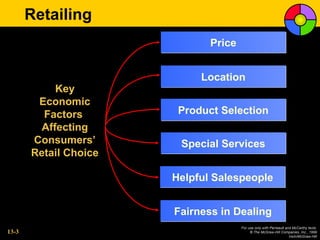
Retailing
                              Price


                            Location
            Key
        Economic
         Factors        Product Selection
         Affecting
       Consumers’       Special Services
       Retail Choice

                       Helpful Salespeople


                       Fairness in Dealing
                                      For use only with Perreault and McCarthy texts.
13-3                                       © The McGraw-Hill Companies, Inc., 1999
                                                                    Irwin/McGraw-Hill
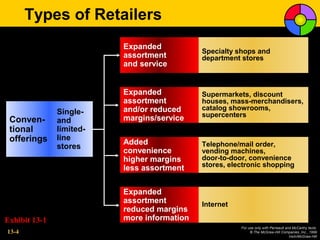
Types of Retailers
                          Expanded
                                             Specialty shops and
                          assortment         department stores
                          and service


                          Expanded           Supermarkets, discount
                          assortment         houses, mass-merchandisers,
                          and/or reduced     catalog showrooms,
               Single-                       supercenters
 Conven-       and        margins/service
 tional        limited-
 offerings     line
                          Added              Telephone/mail order,
               stores
                          convenience        vending machines,
                          higher margins     door-to-door, convenience
                          less assortment    stores, electronic shopping


                          Expanded
                          assortment         Internet
                          reduced margins
Exhibit 13-1              more information
                                                        For use only with Perreault and McCarthy texts.
13-4                                                         © The McGraw-Hill Companies, Inc., 1999
                                                                                      Irwin/McGraw-Hill
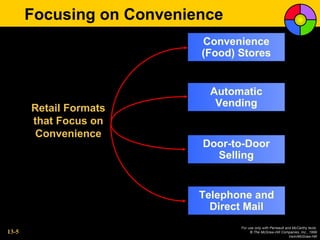
Focusing on Convenience
                           Convenience
                           (Food) Stores


                            Automatic
       Retail Formats        Vending
       that Focus on
        Convenience
                           Door-to-Door
                             Selling


                           Telephone and
                             Direct Mail
                                  For use only with Perreault and McCarthy texts.
13-5                                   © The McGraw-Hill Companies, Inc., 1999
                                                                Irwin/McGraw-Hill
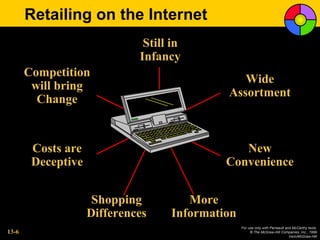
Retailing on the Internet
                              Still in
                             Infancy
       Competition
                                               Wide
        will bring
                                            Assortment
         Change


        Costs are                              New
        Deceptive                           Convenience


                     Shopping         More
                    Differences    Information
                                                 For use only with Perreault and McCarthy texts.
13-6                                                  © The McGraw-Hill Companies, Inc., 1999
                                                                               Irwin/McGraw-Hill
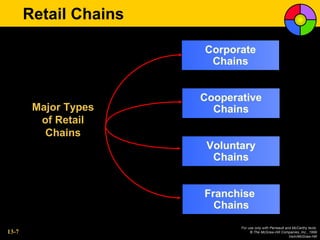
Retail Chains

                       Corporate
                        Chains


                       Cooperative
        Major Types      Chains
         of Retail
          Chains
                        Voluntary
                         Chains


                       Franchise
                         Chains
                              For use only with Perreault and McCarthy texts.
13-7                               © The McGraw-Hill Companies, Inc., 1999
                                                            Irwin/McGraw-Hill
The New Face of Wholesaling


  ????????               Producing Profits
                         Producing Profits


  ????????
  ????????                Progress of Fail
                          Progress of Fail


  ????????
  ????????                New Strategies
                          New Strategies
                         Needed to Survive
                         Needed to Survive


                                     For use only with Perreault and McCarthy texts.
13-8                                      © The McGraw-Hill Companies, Inc., 1999
                                                                   Irwin/McGraw-Hill
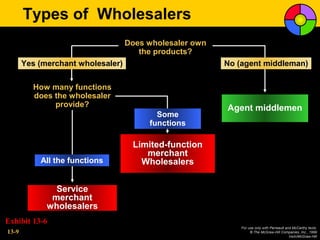
Types of Wholesalers
                                   Does wholesaler own
                                      the products?
       Yes (merchant wholesaler)                         No (agent middleman)

         How many functions
         does the wholesaler
              provide?                                   Agent middlemen
                                          Some
                                        functions

                                    Limited-function
                                       merchant
           All the functions          Wholesalers


               Service
              merchant
             wholesalers
Exhibit 13-6
                                                             For use only with Perreault and McCarthy texts.
13-9                                                              © The McGraw-Hill Companies, Inc., 1999
                                                                                           Irwin/McGraw-Hill
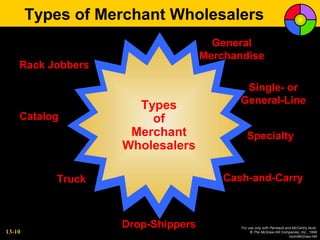
Types of Merchant Wholesalers
                                     General
                                   Merchandise
    Rack Jobbers

                                           Single- or
                                          General-Line
                     Types
    Catalog            of
                    Merchant                 Specialty
                   Wholesalers

           Truck                       Cash-and-Carry


                   Drop-Shippers          For use only with Perreault and McCarthy texts.
13-10                                          © The McGraw-Hill Companies, Inc., 1999
                                                                        Irwin/McGraw-Hill
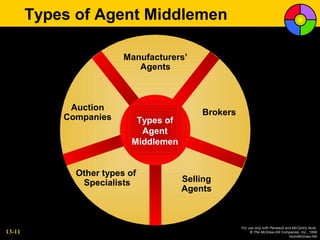
Types of Agent Middlemen

                         Manufacturers’
                            Agents


             Auction
                                          Brokers
            Companies      Types of
                            Agent
                          Middlemen


              Other types of
               Specialists            Selling
                                      Agents


                                                    For use only with Perreault and McCarthy texts.
13-11                                                    © The McGraw-Hill Companies, Inc., 1999
                                                                                  Irwin/McGraw-Hill
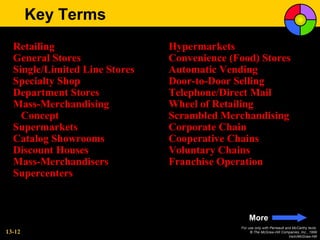
Key Terms
  Retailing                    Hypermarkets
  General Stores               Convenience (Food) Stores
  Single/Limited Line Stores   Automatic Vending
  Specialty Shop               Door-to-Door Selling
  Department Stores            Telephone/Direct Mail
  Mass-Merchandising           Wheel of Retailing
    Concept                    Scrambled Merchandising
  Supermarkets                 Corporate Chain
  Catalog Showrooms            Cooperative Chains
  Discount Houses              Voluntary Chains
  Mass-Merchandisers           Franchise Operation
  Supercenters


                                                 More
                                             For use only with Perreault and McCarthy texts.
13-12                                             © The McGraw-Hill Companies, Inc., 1999
                                                                           Irwin/McGraw-Hill
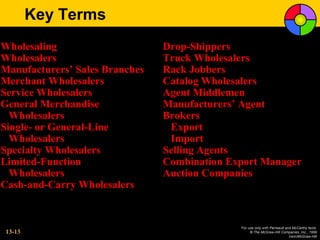
Key Terms
Wholesaling                     Drop-Shippers
Wholesalers                     Truck Wholesalers
Manufacturers’ Sales Branches   Rack Jobbers
Merchant Wholesalers            Catalog Wholesalers
Service Wholesalers             Agent Middlemen
General Merchandise             Manufacturers’ Agent
  Wholesalers                   Brokers
Single- or General-Line          Export
  Wholesalers                    Import
Specialty Wholesalers           Selling Agents
Limited-Function                Combination Export Manager
  Wholesalers                   Auction Companies
Cash-and-Carry Wholesalers


                                              For use only with Perreault and McCarthy texts.
 13-13                                             © The McGraw-Hill Companies, Inc., 1999
                                                                            Irwin/McGraw-Hill

Bm13ch13

  • 1.
    Chapter 13: Retailers, Wholesalers, and TheirStrategy Planning For use only with Perreault and McCarthy texts. © The McGraw-Hill Companies, Inc., 1999 Irwin/McGraw-Hill
  • 2.
    Chapter 13 Objectives When you finish this chapter, you should 1. Understand how retailers plan their 6. Know what progressive wholesalers marketing strategies. are doing to modernize their 2. Know about the many kinds of operations and marketing strategies. retailers that work with producers and 7. Know the various kinds of merchant wholesalers as members of channel wholesalers and agent middlemen and systems. the strategies that they use. 3. Understand the differences among the 8. Understand why retailing and conventional and nonconventional wholesaling have developed in retailers—including Internet different ways in different countries. merchants and others who accept the 9. See why the Internet is impacting mass-merchandising concept. both retailing and wholesaling. 4. Understand scrambled merchandising 10. Understand the important new terms. and the “wheel of retailing.” 5. See why size or belonging to a chain can be important to a retailer. For use only with Perreault and McCarthy texts. 13-2 © The McGraw-Hill Companies, Inc., 1999 Irwin/McGraw-Hill
  • 3.
    Retailing Price Location Key Economic Factors Product Selection Affecting Consumers’ Special Services Retail Choice Helpful Salespeople Fairness in Dealing For use only with Perreault and McCarthy texts. 13-3 © The McGraw-Hill Companies, Inc., 1999 Irwin/McGraw-Hill
  • 4.
    Types of Retailers Expanded Specialty shops and assortment department stores and service Expanded Supermarkets, discount assortment houses, mass-merchandisers, and/or reduced catalog showrooms, Single- supercenters Conven- and margins/service tional limited- offerings line Added Telephone/mail order, stores convenience vending machines, higher margins door-to-door, convenience less assortment stores, electronic shopping Expanded assortment Internet reduced margins Exhibit 13-1 more information For use only with Perreault and McCarthy texts. 13-4 © The McGraw-Hill Companies, Inc., 1999 Irwin/McGraw-Hill
  • 5.
    Focusing on Convenience Convenience (Food) Stores Automatic Retail Formats Vending that Focus on Convenience Door-to-Door Selling Telephone and Direct Mail For use only with Perreault and McCarthy texts. 13-5 © The McGraw-Hill Companies, Inc., 1999 Irwin/McGraw-Hill
  • 6.
    Retailing on theInternet Still in Infancy Competition Wide will bring Assortment Change Costs are New Deceptive Convenience Shopping More Differences Information For use only with Perreault and McCarthy texts. 13-6 © The McGraw-Hill Companies, Inc., 1999 Irwin/McGraw-Hill
  • 7.
    Retail Chains Corporate Chains Cooperative Major Types Chains of Retail Chains Voluntary Chains Franchise Chains For use only with Perreault and McCarthy texts. 13-7 © The McGraw-Hill Companies, Inc., 1999 Irwin/McGraw-Hill
  • 8.
    The New Faceof Wholesaling ???????? Producing Profits Producing Profits ???????? ???????? Progress of Fail Progress of Fail ???????? ???????? New Strategies New Strategies Needed to Survive Needed to Survive For use only with Perreault and McCarthy texts. 13-8 © The McGraw-Hill Companies, Inc., 1999 Irwin/McGraw-Hill
  • 9.
    Types of Wholesalers Does wholesaler own the products? Yes (merchant wholesaler) No (agent middleman) How many functions does the wholesaler provide? Agent middlemen Some functions Limited-function merchant All the functions Wholesalers Service merchant wholesalers Exhibit 13-6 For use only with Perreault and McCarthy texts. 13-9 © The McGraw-Hill Companies, Inc., 1999 Irwin/McGraw-Hill
  • 10.
    Types of MerchantWholesalers General Merchandise Rack Jobbers Single- or General-Line Types Catalog of Merchant Specialty Wholesalers Truck Cash-and-Carry Drop-Shippers For use only with Perreault and McCarthy texts. 13-10 © The McGraw-Hill Companies, Inc., 1999 Irwin/McGraw-Hill
  • 11.
    Types of AgentMiddlemen Manufacturers’ Agents Auction Brokers Companies Types of Agent Middlemen Other types of Specialists Selling Agents For use only with Perreault and McCarthy texts. 13-11 © The McGraw-Hill Companies, Inc., 1999 Irwin/McGraw-Hill
  • 12.
    Key Terms Retailing Hypermarkets General Stores Convenience (Food) Stores Single/Limited Line Stores Automatic Vending Specialty Shop Door-to-Door Selling Department Stores Telephone/Direct Mail Mass-Merchandising Wheel of Retailing Concept Scrambled Merchandising Supermarkets Corporate Chain Catalog Showrooms Cooperative Chains Discount Houses Voluntary Chains Mass-Merchandisers Franchise Operation Supercenters More For use only with Perreault and McCarthy texts. 13-12 © The McGraw-Hill Companies, Inc., 1999 Irwin/McGraw-Hill
  • 13.
    Key Terms Wholesaling Drop-Shippers Wholesalers Truck Wholesalers Manufacturers’ Sales Branches Rack Jobbers Merchant Wholesalers Catalog Wholesalers Service Wholesalers Agent Middlemen General Merchandise Manufacturers’ Agent Wholesalers Brokers Single- or General-Line Export Wholesalers Import Specialty Wholesalers Selling Agents Limited-Function Combination Export Manager Wholesalers Auction Companies Cash-and-Carry Wholesalers For use only with Perreault and McCarthy texts. 13-13 © The McGraw-Hill Companies, Inc., 1999 Irwin/McGraw-Hill

Editor's Notes

  • #4 Summary Overview Retailing covers all of the activities involved in the sale of products to final consumers. Because retail outlets are where consumers take possession of goods, retailing is crucial to consumers in every macro-marketing system. In the case of service retailing, the retailer is also the producer. Retailing Customers often have good reasons for preferring one retailer over another. A consumer’s emotional and social needs may affect the choice. Economic needs--which store has the best value?--are also very important. Some of the most important economic factors include: Price . Customers use price to weigh the value offered. Price can further be varied by use of credit terms and special discounts. Discussion Note: Using discounts and credit to offer customers better value is sometimes a sensible part of a marketing mix. But, using false discounts (made up “prices” then “marked down” to the actual price) or credit terms that obscure high interest charges is unethical. Location . Customers want reasonable convenience in retail outlets, appropriate to their expectations for the product class. Product Selection . Most customers want variety and choice requiring a width and depth of assortment and quality. Special Services . For some products, customers look for special services like delivery. Helpful Salespeople . Retail salespeople who are knowledgeable, courteous, prompt, and quick at the checkout can be a principal reason for choosing a particular retailer. Fairness in Dealing . Customers want to know that the retailer is honest, especially in relation to return privileges. This slide relates to the material on pp. 348-350. See Transparencies 83-84 and Overheads 119-120.
  • #5 Summary Overview Before industrialization, most stores in the US were general stores which carried anything they could sell in reasonable volume. These were replaced by single-line (limited-line) stores that specialized in a product area and offered a wide assortment in that area. The US market now offers many outlets, each seeking to fill customer needs in a specific way. Other Types of Retailers: Specialty Shops . A specialty shop, a type of conventional limited-line store, is usually small and has a distinct “personality” or shopping environment. Specialty shops focus on a narrow target market they know well with better service, knowledgeable salespeople, and a unique assortment. This combination generally supports higher prices for products. Department Stores . These are larger stores that are organized into many separate departments and offer many product lines. They average about $17.6 million in annual sales, but the number of department stores and their average sales per store are dropping. Supermarkets . Supermarkets are large stores specializing in groceries with self-service and wide assortments. Supermarkets were the earliest retail form to adopt the mass-merchandising concept -- which says that retailers should offer low prices to get faster turnover and greater sales volume. Catalog Showrooms . These retailers sell several lines out of a catalog and display showroom, with backup inventories. Discount Houses . This retail form started out by offering wide assortments of name brand goods at 20 to 30% off the list price. Discounters had lower costs -- low rent, less convenient locations, and less service, although many have become “respectable” today. Mass-Merchandisers . These are large, self-service stores with many departments that emphasize “soft goods” and staples, with low prices and lower margins to get faster turnover. Supercenters (Hypermarkets) . These are very large stores (averaging over 150,000 sq. ft. and 50,000 items) that carry groceries and all kinds of routinely purchased goods and services. Warehouse Clubs . Consumers pay a membership fee to shop in these large, bare-bone facilities that carry homogeneous shopping items. Single-Line Mass-Merchandisers . These stores are called category killers because it is so hard for less-specialized retailers to compete. This slide relates to the material on pp. 350-356. Instructor’s Note: This slide corresponds to Exhibit 13-1 on p. 352 and Transparency 85. See also Overheads 121-122.
  • #6 Summary Overview Some consumers look specifically for convenience when selecting a retail outlet. Key forms of retailing that focus on convenience include: Retailers Focusing on Convenience Convenience (Food) Stores . These stores carry limited assortment lines of fast moving items and are located conveniently near people’s homes. Convenience comes at a price as their goods cost 10 to 20% more than at supermarkets. Automatic Vending . This is the selling and delivering of products through vending machines. Machines are expensive and their goods are priced high but they do offer 24-hour availability. Door-to-Door Selling . This form of retailing accounts for less than 1% of retail sales but is still appropriate for marketing goods or services that require detailed demonstration and/or personal service. Many unsought goods are marketed door-to-door. Telephone and Direct Mail . These retail forms allow consumers to shop at home, usually choosing items in a catalog and calling a toll-free number to place orders. For many time-poor consumers, this retail form is very convenient and often competitively priced. The latest variation on the direct mail catalog is the TV or computer version -- simply tune in (ex: QVC, Home Shopping Network) or visit the web site version of the channel, and buy at your convenience! This slide relates to the material on pp. 356-357.
  • #7 Retailing on the Internet Still in infancy . The potential is huge, but as a share of the overall retail pie, sales are still small -- about $2.7 billion in 1997. Wide Assortment . Web sites are not limited by location is terms of what they can sell and many vendors link with each other to offer their shoppers the widest assortment possible. New Meaning of Convenience . Web shopping on demand does not even require you to go out of the house to buy something. Even more, the shopper controls the pace of shopping, the location of the “store,” and the amount of information sought. More Information . Speaking of information, it’s out there on the web. Unlike live sales personnel, every web offer can have as much (or as little) expert information as the customer likes. Discussion Note: Many innovative web sites, such as those for major book publishers and computer companies let surfers access more information simply by clicking on pictures of products. These visual outlines don’t even require reading until the topic of interest is reached! “ Virtual” Shopping - Some Differences . Internet shopping does not duplicate all shopping experiences. For many shoppers, simply “going to the mall” is a form of recreation and even relaxation -- shopping without a purpose other than enjoying the excitement of the retail environment. Internet shopping malls haven’t come close to that yet. Costs are Still Deceptive . For some products, Internet shopping offers clear cost savings. But total costs for purchases must still take into account delivery costs. Also, unlike large retail stores in traditional malls, the ability to set up an impressive web site quickly and easily can make fertile ground for fraudulent practices. Competitive Effects Will Influence Others . As traditional retailers gain Internet experience, doubtless competition will spur an increase in customer value. Also, look for retailers to try and incorporate ideas from web-marketing into older forms of retail as well. This slide relates to the material on pp. 357-360. See Overhead 123.
  • #8 Summary Overview Large retailers with over $5 million in annual sales own the lion’s share of the retail business -- at 5% of retail stores they account for over 53% of all retail sales. Retail Chains Corporate Chain . A corporate chain is a firm that owns and manages more than one store. The corporate chain uses centralized buying to get quantity discounts and pursue vertical integration, perhaps developing their own distribution centers. Corporate chains can also use EDI and other technology to control inventory and stockouts. Other costs, such as promotion and management, can be spread over many stores. Corporate chains have a great deal of power in dealings with their suppliers because of their economic power in the marketplace. Cooperative Chains . These are retailer-sponsored groups formed by independent retailers that cooperate on promotions while running their individual stores separately. Voluntary Chains . These are wholesaler-sponsored groups that may contract with independent retailers to standardize common operating procedures, storefronts, names, and joint promotions. Franchises . Here a franchisor develops a good marketing strategy and the retail franchise holders carry out the strategy in their own units. The franchisor usually offers training and management support while the franchisees run the individual stores. Some chains have buy-back clauses to ensure that the quality of each store can be maintained. Teaching Tip: Franchising has more self-made millionaires than any other retailing form. This slide relates to the material on pp. 362-365. See Overheads 125-127 and Transparency 89.
  • #9 Summary Overview Wholesaling is concerned with the activities of those persons or establishments which sell to retailers and other merchants, and/or to industrial, institutional, and commercial users, but who do not sell in large amounts to final consumers. Wholesaling is changing rapidly and innovative forms of competition will lead to new business models. Some wholesalers will undoubtedly go out of business while upstarts may set new standards for competitive performance. Notes In earlier days, wholesalers dominated distribution channels in the U.S. and most other countries. However, in the developed nations, as producers became larger many bypassed the wholesalers. Similarly, large retail chains often take control of functions that had been handled by wholesalers. Now, information technologies like EDI and the Internet are making it easier for producers and consumers to connect without having a wholesaler in the middle of the exchange. With all the changes taking place, one could assume that wholesaling won’t adapt fast enough. However, partly due to new management and new strategies, many wholesalers are enjoying significant growth. Many are using technology to offer better service. Also, many wholesalers now offer a basic service at minimum cost (that is attractive to many customers)--and then charge additional fees for any special services. They’ve also streamlined their operations to cut unnecessary costs and improve profits. And many have switched to selective distribution policies. They’re also modernizing their warehouses and physical handling facilities. To survive, each wholesaler must develop a good marketing strategy. This slide relates to the material on pp. 366-369. See Transparency 90 and Overheads 130-132.
  • #10 Notes This slide gives a big-picture view of the major types of wholesalers. There are lots more specialized types, but this will give you a sense of the diversity. Note that a major difference between merchant and agent wholesalers is whether they own the products they sell. Merchant wholesalers own (take title to) the products they sell. Service merchant wholesalers provide all the wholesaling functions. Limited-function merchant wholesalers provide only some wholesaling functions. Agent middlemen do not own (take title to) the products they sell. This slide relates to the material on p. 369 and corresponds to Exhibit 13-6 on p. 369 and Transparency 91.
  • #11 Summary Overview When producers set up separate facilities away from their factories to do their wholesaling activities they create a special type of wholesaler called a manufacturer’s sales branch. Other types of wholesalers are discussed below: Types of Merchant Wholesalers Two general types of merchant wholesalers can be identified. Merchant Wholesalers take title to the products they sell and include: Service Wholesalers . These are merchant wholesalers who provide all the wholesaling functions. There are three basic types of service wholesalers: General Merchandise Wholesalers. These carry a wide variety of nonperishable items. Single- or General-Line Wholesalers. These carry a narrower line, usually specializing in serving a single or limited product line for business or consumer marketers. Specialty Wholesalers. These carry a very narrow range of products and offer specialized technical knowledge related to that area. Limited-Function Wholesalers . These provide only some wholesaling functions: Cash-and-Carry Wholesalers. These operate like service wholesalers except that customers must pay cash. Drop-Shippers. These take title but not physical possession. Instead, they arrange for other buyers who then deliver the goods. Truck Wholesalers. These specialize in delivering products that they stock in their own trucks. Rack Jobbers. These specialize in hard to handle assortments of products, usually presented by the jobber on their own POP display racks. Catalog Wholesalers. These sell out of catalogs that are distributed widely to smaller customers. This slide relates to the material on pp. 370-372. See Overheads 133-137.
  • #12 Summary Overview Agent Middlemen are wholesalers who do not own the products they sell. Their main purpose is to bring together buyers and sellers. Because they offer fewer services than limited-function wholesalers, their selling costs are lower. They are common in international trade where bringing together buyers and sellers requires specialized skills most producers and other types of wholesalers do not have. Agent middlemen normally specialize by customer type and product or product line. Types of Agent Middlemen Manufacturers’ Agent . These sell similar products for several noncompeting producers for a commission on what is actually sold. Such agents can often easily add product lines and “piggyback” sales from a variety of producers to custom-fit a sale to meet the customer’s needs. Export or Import Agents are basically manufacturers’ agents specializing in international trade. Brokers . Brokers bring buyers and sellers together. Their distinction is that their relationship with buyers and sellers tends to be temporary, lasting only while the deal is negotiated. Export and import brokers specialize in bringing together buyers and sellers from different countries. Selling Agents . Selling agents take over the whole marketing job of producers. They have control over pricing, selling, and advertising, operating as the producers’ marketing manager. A combination export manager is a blend of manufacturers’ agent and selling agent. Auction Companies . These provide a place where buyers and sellers can come together and complete a transaction. The Internet has spurred growth of all sorts of auction companies in lines of business where auctions have previously not been common. This slide relates to the material on pp. 373-374. See Overheads 138-141.