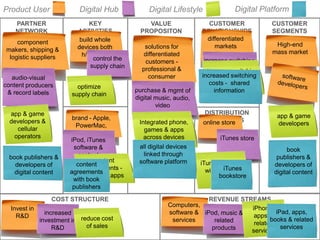
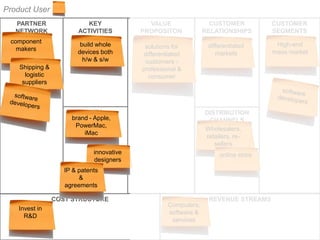
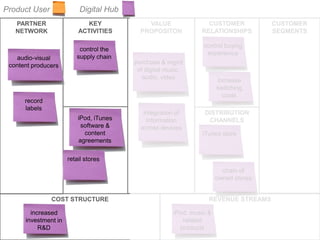
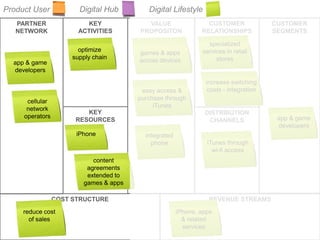
How to Fail Less

 Business Models and
Customer Development


       Steve Blank
    www.steveblank.com
        @sgblank
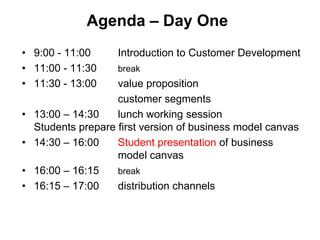
Agenda – Day One
• 9:00 - 11:00       Introduction to Customer Development
• 11:00 - 11:30      break
• 11:30 - 13:00      value proposition
                     customer segments
•   13:00 – 14:30    lunch working session
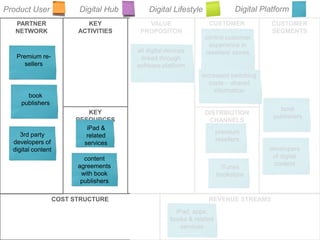
    Students prepare first version of business model canvas
•   14:30 – 16:00    Student presentation of business
                     model canvas
•   16:00 – 16:15    break
•   16:15 – 17:00    distribution channels
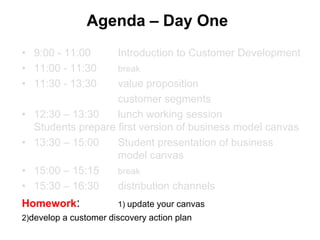
Agenda – Day One
• 9:00 - 11:00         Introduction to Customer Development
• 11:00 - 11:30        break
• 11:30 - 13:30      value proposition
                     customer segments
•   12:30 – 13:30    lunch working session
    Students prepare first version of business model canvas
•   13:30 – 15:00    Student presentation of business
                     model canvas
•   15:00 – 15:15    break
•   15:30 – 16:30    distribution channels
Homework:              1) update your canvas
2)develop a customer discovery action plan
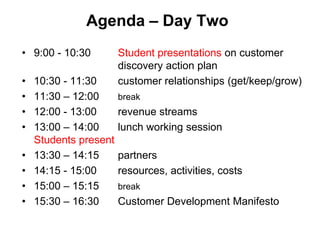
Agenda – Day Two
• 9:00 - 10:30         Student presentations on customer
                       discovery action plan
•   10:30 - 11:30      customer relationships (get/keep/grow)
•   11:30 – 12:00      break
•   12:00 - 13:00      revenue streams
•   13:00 – 14:00      lunch working session
    Students present
•   13:30 – 14:15      partners
•   14:15 - 15:00      resources, activities, costs
•   15:00 – 15:15      break
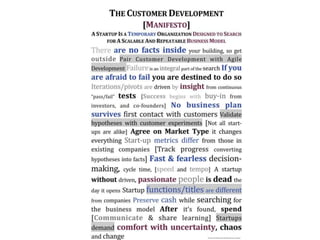
•   15:30 – 16:30      Customer Development Manifesto
The Lean LaunchPad

      Lecture 4:
Distribution Channels
  How does your Product
    Get to Customers?


                          Version 6/22/12
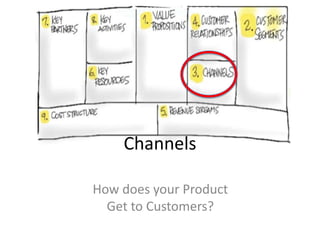
Channels

How does your Product
  Get to Customers?
© 2012 Steve Blank
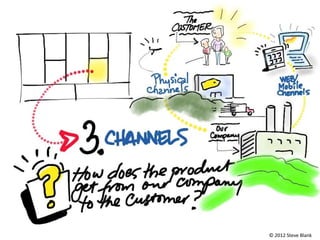
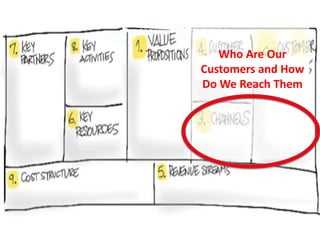
Who Are Our
Customers and How
Do We Reach Them
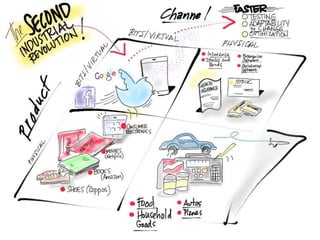
Physical versus Virtual Channels
How Do You Want Your Product to
    Get to Your Customer?

     Yourself

     Through someone else

     Retail

     Wholesale

     Bundled with other goods or services


                                             11
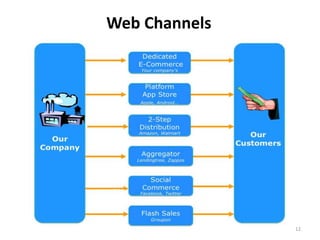
Web Channels


               12
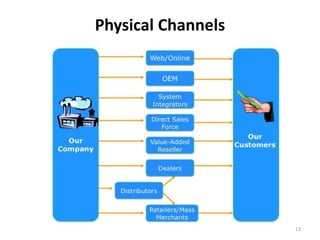
Physical Channels


                    13
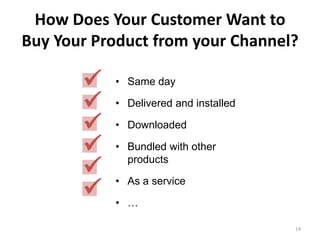
How Does Your Customer Want to
Buy Your Product from your Channel?

          • Same day

          • Delivered and installed

          • Downloaded

          • Bundled with other

            products

           • As a service
          • …

                                       14
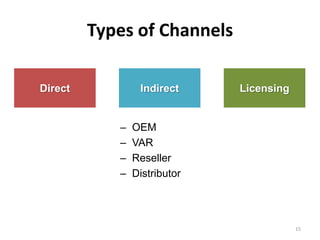
Types of Channels

Direct           Indirect     Licensing


            –   OEM
            –   VAR
            –   Reseller
            –   Distributor


                                          15
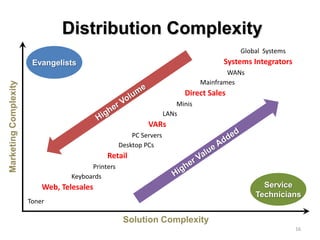
Distribution Complexity
                                                                                           Global Systems
                        Evangelists                                                    Systems Integrators
                                                                                         WANs
                                                                                 Mainframes
Marketing Complexity


                                                                           Direct Sales
                                                                         Minis
                                                                     LANs
                                                             VARs
                                                        PC Servers
                                                    Desktop PCs
                                              Retail
                                         Printers
                                   Keyboards
                           Web, Telesales                                                         Service
                                                                                                Technicians
                       Toner

                                                     Solution Complexity
                                                                                                             16
How Do the Economics Work in
  Different Sales Channel?
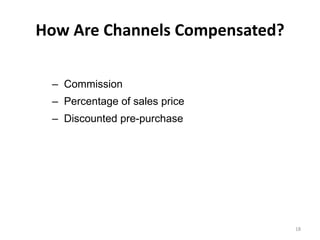
How Are Channels Compensated?

 – Commission
 – Percentage of sales price
 – Discounted pre-purchase


                                18
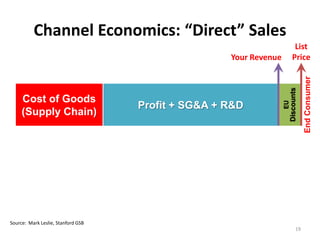
Channel Economics: “Direct” Sales
                                                                           List
                                                    Your Revenue          Price


                                                                                    End Consumer
                                                                        Discounts
     Cost of Goods


                                                                   EU
                                    Profit + SG&A + R&D
     (Supply Chain)


Source: Mark Leslie, Stanford GSB
                                                                               19
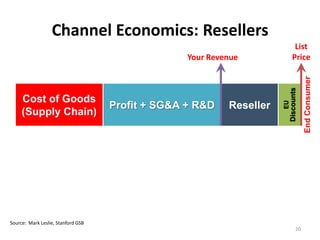
Channel Economics: Resellers
                                                                              List
                                                  Your Revenue               Price


                                                                                       End Consumer
                                                                           Discounts
     Cost of Goods


                                                                      EU
                                    Profit + SG&A + R&D    Reseller
     (Supply Chain)


Source: Mark Leslie, Stanford GSB
                                                                                  20
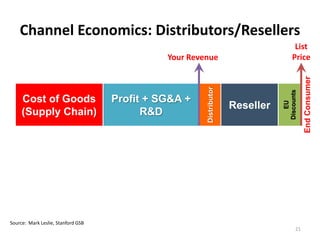
Channel Economics: Distributors/Resellers
                                                                                      List
                                              Your Revenue                           Price


                                                                                             End Consumer
                                                       Distributor


                                                                                Discounts
     Cost of Goods                  Profit + SG&A +


                                                                                   EU
                                                                     Reseller
     (Supply Chain)                       R&D


Source: Mark Leslie, Stanford GSB
                                                                                        21
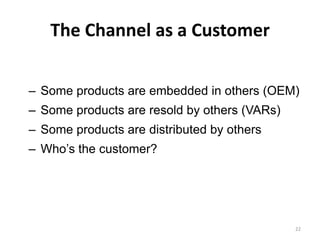
The Channel as a Customer

– Some products are embedded in others (OEM)
– Some products are resold by others (VARs)
– Some products are distributed by others
– Who’s the customer?


                                              22
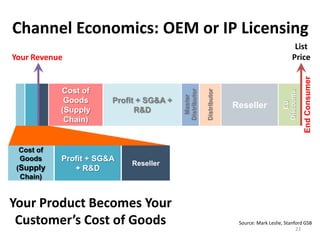
Channel Economics: OEM or IP Licensing
                                                                                                 List
Your Revenue                                                                                    Price


                                                                                                       End Consumer
            Cost of


                                          Distributor

                                                        Distributor


                                                                                           Discounts
                                            Master
             Goods      Profit + SG&A +


                                                                                              EU
                                                                      Reseller
            (Supply           R&D
             Chain)


  Cost of
  Goods     Profit + SG&A
                            Reseller
 (Supply       + R&D
  Chain)


Your Product Becomes Your
 Customer’s Cost of Goods                                              Source: Mark Leslie, Stanford GSB
                                                                                                 23
How Are Channels Motivated or Incented?


– Money! – what makes them the most?
– Training
– Marketing to the channel
– SPIF


                                       24
Book Publishing
Channel Example
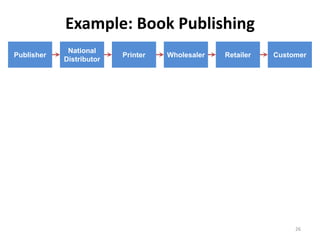
Example: Book Publishing
             National
Publisher                 Printer   Wholesaler   Retailer   Customer
            Distributor


                                                                 26
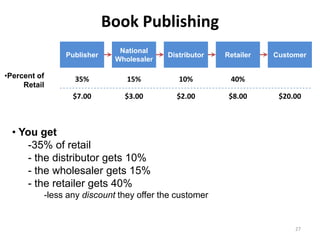
Book Publishing
                             National
               Publisher                 Distributor   Retailer   Customer
                            Wholesaler

•Percent of      35%           15%          10%         40%
     Retail
                 $7.00        $3.00        $2.00        $8.00      $20.00


  • You get
     -35% of retail
     - the distributor gets 10%
     - the wholesaler gets 15%
     - the retailer gets 40%
          -less any discount they offer the customer


                                                                       27
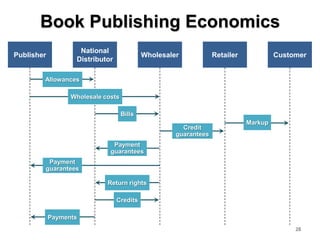
Book Publishing Economics
                    National
Publisher                                   Wholesaler            Retailer            Customer
                   Distributor

        Allowances

                  Wholesale costs

                                    Bills
                                                                             Markup
                                                       Credit
                                                     guarantees
                               Payment
                              guarantees
         Payment
        guarantees

                             Return rights

                                 Credits

            Payments
                                                                                           28
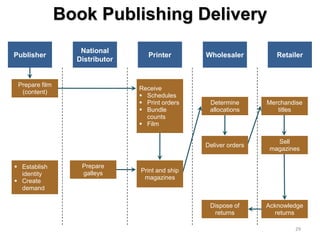
Book Publishing Delivery
                   National
Publisher                          Printer       Wholesaler          Retailer
                  Distributor


 Prepare film
                                Receive
  (content)
                                 Schedules
                                 Print orders    Determine       Merchandise
                                 Bundle          allocations        titles
                                  counts
                                 Film

                                                                     Sell
                                                 Deliver orders
                                                                   magazines

 Establish        Prepare
                   galleys      Print and ship
  identity
                                 magazines
 Create
  demand

                                                  Dispose of      Acknowledge
                                                   returns          returns

                                                                          29
Medical Device
Channel Example
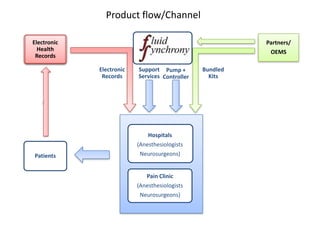
Product flow/Channel

Electronic                                                Partners/
  Health                   Fluid Synchrony
                                                           OEMS
 Records

             Electronic   Support Pump +        Bundled
              Records     Services Controller     Kits


                              Hospitals
                          (Anesthesiologists
Patients                   Neurosurgeons)


                             Pain Clinic
                          (Anesthesiologists
                           Neurosurgeons)
Hospitals

Pain Clinics
                          Channels (Direct)

               • Direct to institutions
                  • Some formularies involved in purchase decisions
                  • Some doctors make purchase decision directly
               • Device company/Doctor relationship is key
               • Heavily influenced by :
                  • Clinical study results
                  • Regulatory approval
                  • Reimbursement
Farm Sensor Industry
  Channel Example
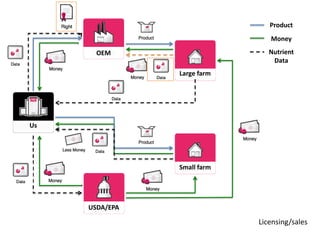
Channel Model: Service Provider

                                            Product
                                             Money

            OEM                             Nutrient
                                             Data
                         Large farm


Us


                         Small farm


          USDA/EPA                     Licensing/sales
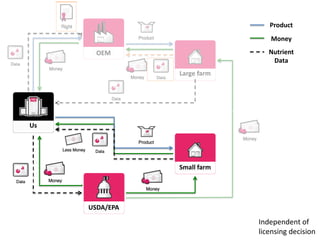
Channel Model: Service Provider

                                            Product
                                             Money

            OEM                             Nutrient
                                             Data
                         Large farm
                                       Product


Us


                         Small farm    Service


          USDA/EPA                     Licensing/sales
Dental Product
Channel Example
COST / PROFIT ANALYSIS

 Licensing Revenue Model


Per unit cost and profit estimation
            Our revenue 4-8% revenues                                      List price


                                                                                        End user
                        Univ.                Manufacturing
        Maintaining               Raw                        License
R&D                    License                    &                    Distribution
            IP           fee     materials                     fee
                                              Packaging


                                                                                             37
Licensing of Technology Ecosystem

             University           Insurance
                                   Agencies
 2-4% license fee
                                          $$$
             DMX
               R&D
             Products
            Procedures
                                 Health-Care
                IPs
                                  Providers:     $$   End
4-8% royalty                      Hospitals           User
                          ~$40   Practitioners
            Customer                Clinics
         segment: Large
           corporations
          J&J, GSK, 3M


                                                             38
Medical Device
Channel Example 2
•
•
•


•
•
•
Dental Product 2
Channel Example
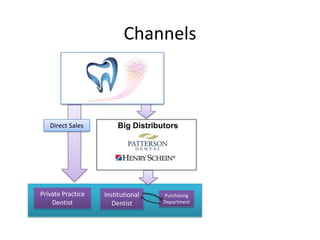
Channels


   Direct Sales        Big Distributors


Private Practice   Institutional   Purchasing
    Dentist           Dentist      Department
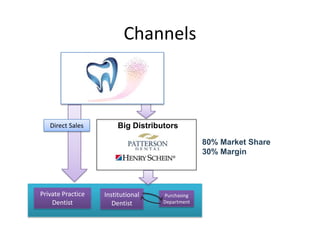
Channels


   Direct Sales        Big Distributors

                                                80% Market Share
                                                30% Margin


Private Practice   Institutional   Purchasing
    Dentist           Dentist      Department
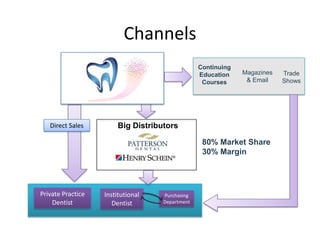
Channels
                                                Continuing
                                                Education    Magazines   Trade
                                                 Courses      & Email    Shows


   Direct Sales        Big Distributors

                                                 80% Market Share
                                                 30% Margin


Private Practice   Institutional   Purchasing
    Dentist           Dentist      Department
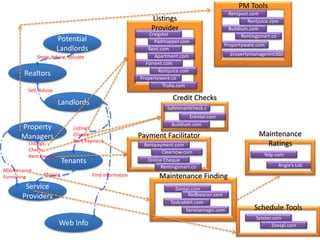
Online Rental
Channel Example
PM Tools
                                                                                               Rentpost.com
                                                             Listings                                  Rentjuice.com
                                                             Provider                          Buildium.com
                                                             Craigslist                              Rentingsmart.co
                        Potential                              Padmapper.com
                                                                                            Propertyware.com
                        Landlords                           Rent.com
                                                               Apartment.com                   propertymanagemnt360
              Show, Advise, Valuate
                                                           Forrent.com
                                                                 Rentjuice.com
        Realtors
                                                         Propertyware.co
                                                                   Trulia.com
         Sell, Advise
                                                                      Credit Checks
                        Landlords
                                                                    Safetenantcheck.c
                                                                              Erenter.com
                                                                      Buildium.com
      Property                Listings,
      Managers                Checks                     Payment Facilitator                               Maintenance
                              Rent Payment
         Listings,                                        Rentpayment.com                                    Ratings
         Checks                                                  Clearnow.com
         Rent Payment                                                                                         Yelp.com
                          Tenants                           Online Cheque
                                                                                                                   Angie’s List
                                                                 Rentingsmart.co
Maintenance
Furnishing       Moving               Find information           Maintenance Finding
        Service                                                        Zoospi.com
       Providers                                                             Redbeacon.com
                                                                     Taskrabbit.com
                                                                            Servicemagic.com             Schedule Tools
                                                                                                          Setster.com
                        Web Info                                                                                  Zoospi.com
                                                                                                                         47
Dental Product 3
Channel Example
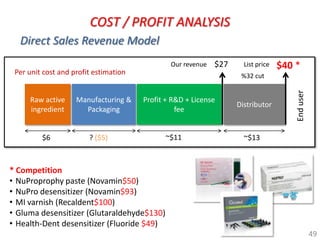
COST / PROFIT ANALYSIS
  Direct Sales Revenue Model
                                               Our revenue   $27     List price   $40 *
 Per unit cost and profit estimation                                %32 cut


                                                                                      End user
     Raw active     Manufacturing &    Profit + R&D + License
                                                                   Distributor
     ingredient       Packaging                  fee


         $6             ? ($5)               ~$11                    ~$13


* Competition
• NuProprophy paste (Novamin$50)
• NuPro desensitizer (Novamin$93)
• MI varnish (Recaldent$100)
• Gluma desensitizer (Glutaraldehyde$130)
• Health-Dent desensitizer (Fluoride $49)
                                                                                                 49
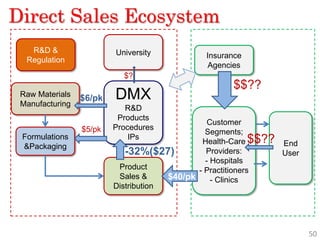
Direct Sales Ecosystem
   R&D &                 University           Insurance
  Regulation
                                               Agencies
                           $?
                                                    $$??
 Raw Materials
 Manufacturing
                 $6/pk   DMX
                            R&D
                          Products
                                                Customer
                 $5/pk   Procedures
                                               Segments;
 Formulations                IPs
                                              Health-Care $$?? End
 &Packaging
                            -32%($27)          Providers:      User
                                               - Hospitals
                          Product            - Practitioners
                          Sales &     $40/pk     - Clinics
                         Distribution


                                                                      50
Channel Example
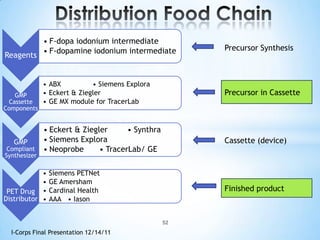
• F-dopa iodonium intermediate
              • F-dopamine iodonium intermediate       Precursor Synthesis
Reagents


              • ABX          • Siemens Explora
   GMP        • Eckert & Ziegler                       Precursor in Cassette
 Cassette     • GE MX module for TracerLab
Components


              • Eckert & Ziegler      • Synthra
   GMP        • Siemens Explora                        Cassette (device)
 Compliant    • Neoprobe      • TracerLab/ GE
Synthesizer

            •   Siemens PETNet
            •   GE Amersham
 PET Drug •     Cardinal Health                        Finished product
Distributor •   AAA • Iason


                                                  52
  I-Corps Final Presentation 12/14/11
Channel Example
Travel Industry
Channel Example
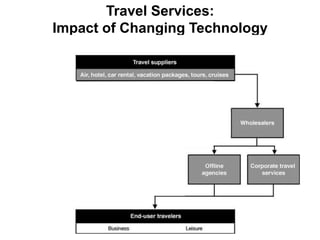
Travel Services:
Impact of Changing Technology
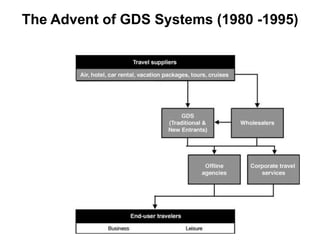
The Advent of GDS Systems (1980 -1995)
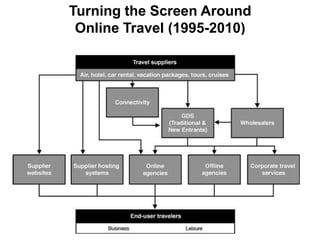
Turning the Screen Around
 Online Travel (1995-2010)
The Lean LaunchPad

         Lecture 5
   Customer Relationships
How Do You Get/Keep/Grow Customers?


                                      Version 6/13/12
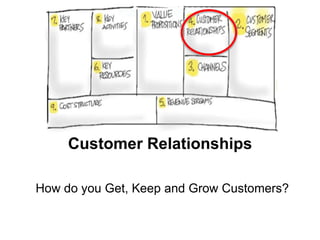
Customer Relationships

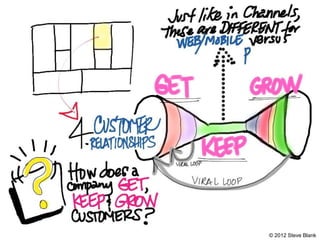
How do you Get, Keep and Grow Customers?
© 2012 Steve Blank
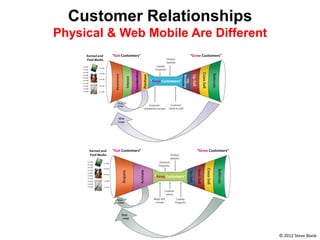
Customer Relationships
Physical & Web Mobile Are Different


                                      © 2012 Steve Blank
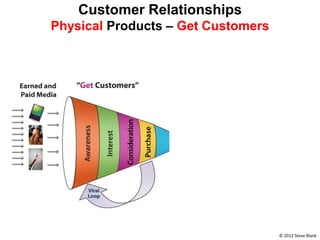
Customer Relationships
Physical Products – Get Customers


                                    © 2012 Steve Blank
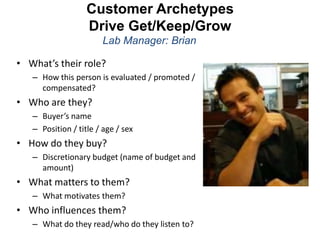
Customer Archetypes
                   Drive Get/Keep/Grow
                       Lab Manager: Brian

• What’s their role?
   – How this person is evaluated / promoted /
     compensated?
• Who are they?
   – Buyer’s name
   – Position / title / age / sex
• How do they buy?
   – Discretionary budget (name of budget and
     amount)
• What matters to them?
   – What motivates them?
• Who influences them?
   – What do they read/who do they listen to?
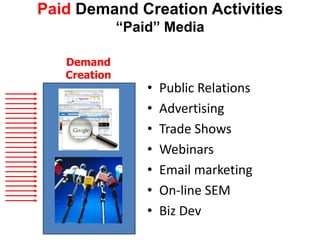
Paid Demand Creation Activities
              “Paid” Media

   Demand
   Creation
                  •   Public Relations
                  •   Advertising
                  •   Trade Shows
                  •   Webinars
                  •   Email marketing
                  •   On-line SEM
                  •   Biz Dev
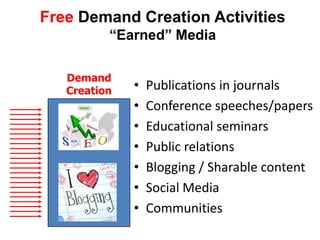
Free Demand Creation Activities
          “Earned” Media

   Demand
   Creation   •   Publications in journals
              •   Conference speeches/papers
              •   Educational seminars
              •   Public relations
              •   Blogging / Sharable content
              •   Social Media
              •   Communities
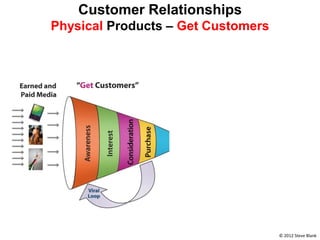
Customer Relationships
Physical Products – Get Customers


                                    © 2012 Steve Blank
Customer Relationships
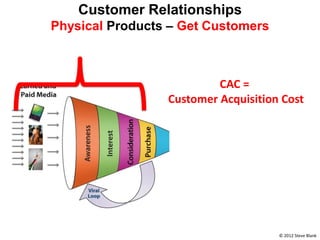
Physical Products – Get Customers


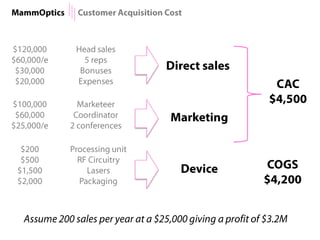
                          CAC =
                 Customer Acquisition Cost


                                     © 2012 Steve Blank
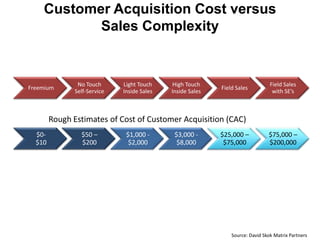
Customer Acquisition Cost versus
           Sales Complexity


                No Touch      Light Touch    High Touch                          Field Sales
Freemium                                                    Field Sales
               Self-Service   Inside Sales   Inside Sales                         with SE’s


        Rough Estimates of Cost of Customer Acquisition (CAC)
  $0-            $50 –         $1,000 -       $3,000 -      $25,000 –           $75,000 –
  $10            $200           $2,000         $8,000        $75,000            $200,000


                                                                Source: David Skok Matrix Partners
Customer Relationships
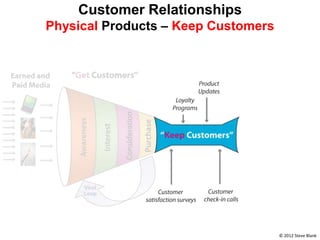
Physical Products – Keep Customers


                                     © 2012 Steve Blank
Customer Relationships
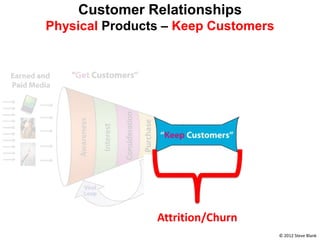
Physical Products – Keep Customers


                Attrition/Churn
                                     © 2012 Steve Blank
Customer Relationships
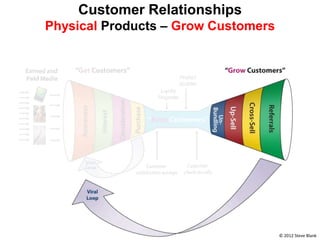
Physical Products – Grow Customers


                                     © 2012 Steve Blank
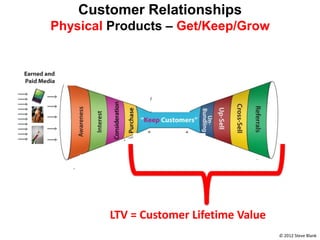
Customer Relationships
Physical Products – Get/Keep/Grow


        LTV = Customer Lifetime Value
                                        © 2012 Steve Blank
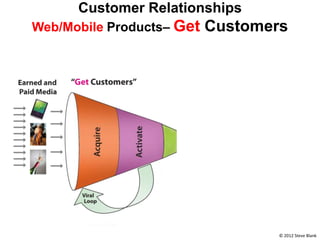
Customer Relationships
Web/Mobile Products– Get   Customers


                                   © 2012 Steve Blank
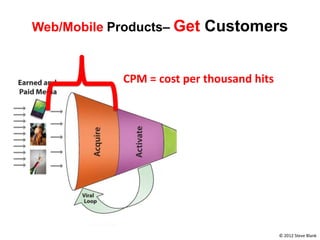
Web/Mobile Products– Get    Customers


             CPM = cost per thousand hits


                                            © 2012 Steve Blank
Web/Mobile Products– Get    Customers


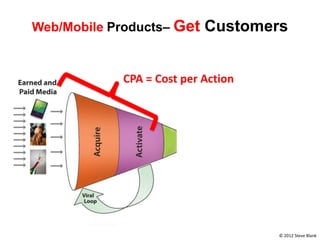
             CPA = Cost per Action


                                     © 2012 Steve Blank
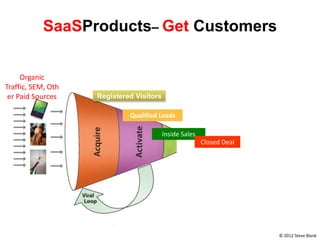
SaaSProducts– Get Customers


     Organic
Traffic, SEM, Oth
 er Paid Sources    Registered Visitors

                                                            Raw Leads
                             Qualified Leads

                                          Inside Sales
                                                         Closed Deal


                                                                        © 2012 Steve Blank
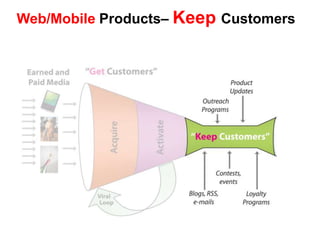
Web/Mobile Products– Keep Customers
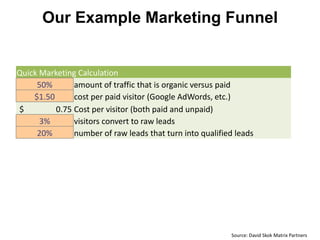
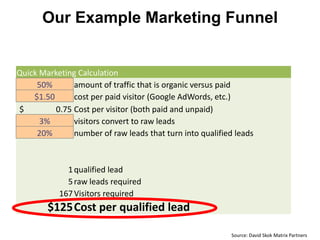
Our Example Marketing Funnel


Quick Marketing Calculation
     50%       amount of traffic that is organic versus paid
    $1.50      cost per paid visitor (Google AdWords, etc.)
$         0.75 Cost per visitor (both paid and unpaid)
      3%       visitors convert to raw leads
     20%       number of raw leads that turn into qualified leads


             1 qualified lead
             5 raw leads required
           167 visitors required
          $125 Cost of visitors (also = Cost per qualified lead)


                                                             Source: David Skok Matrix Partners
Our Example Marketing Funnel


Quick Marketing Calculation
     50%       amount of traffic that is organic versus paid
    $1.50      cost per paid visitor (Google AdWords, etc.)
$         0.75 Cost per visitor (both paid and unpaid)
      3%       visitors convert to raw leads
     20%       number of raw leads that turn into qualified leads


             1 qualified lead
             5 raw leads required
           167 Visitors required
        $125Cost per qualified lead

                                                          Source: David Skok Matrix Partners
Our Example Marketing Funnel


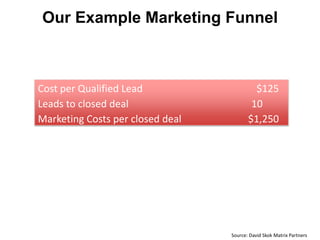
Cost per Qualified Lead                    $125
Leads to closed deal                      10
Marketing Costs per closed deal          $1,250


                                  Source: David Skok Matrix Partners
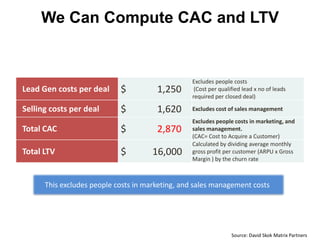
We Can Compute CAC and LTV


                                                 Excludes people costs
Lead Gen costs per deal     $          1,250      (Cost per qualified lead x no of leads
                                                 required per closed deal)

Selling costs per deal      $          1,620     Excludes cost of sales management
                                                 Excludes people costs in marketing, and
Total CAC                   $          2,870     sales management.
                                                 (CAC= Cost to Acquire a Customer)
                                                 Calculated by dividing average monthly
Total LTV                   $         16,000     gross profit per customer (ARPU x Gross
                                                 Margin ) by the churn rate


      This excludes people costs in marketing, and sales management costs


                                                                 Source: David Skok Matrix Partners
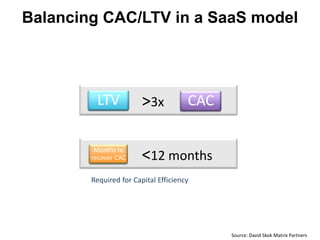
Balancing CAC/LTV in a SaaS model


         LTV            >3x           CAC

         Months to
        recover CAC     <12 months
        Required for Capital Efficiency


                                            Source: David Skok Matrix Partners
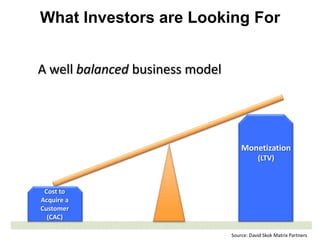
What Investors are Looking For


A well balanced business model


                                     Monetization
                                            (LTV)


 Cost to
Acquire a
Customer
  (CAC)

                                 Source: David Skok Matrix Partners
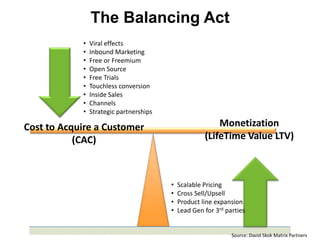
The Balancing Act
            •   Viral effects
            •   Inbound Marketing
            •   Free or Freemium
            •   Open Source
            •   Free Trials
            •   Touchless conversion
            •   Inside Sales
            •   Channels
            •   Strategic partnerships

Cost to Acquire a Customer                                Monetization
           (CAC)                                      (LifeTime Value LTV)


                                         •   Scalable Pricing
                                         •   Cross Sell/Upsell
                                         •   Product line expansion
                                         •   Lead Gen for 3rd parties


                                                                Source: David Skok Matrix Partners
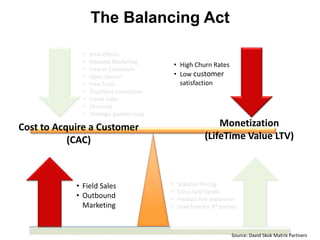
The Balancing Act

              •   Viral effects
              •   Inbound Marketing
                                               • High Churn Rates
              •   Free or Freemium
              •   Open Source                  • Low customer
              •   Free Trials                    satisfaction
              •   Touchless conversion
              •   Inside Sales
              •   Channels
              •   Strategic partnerships

Cost to Acquire a Customer                                     Monetization
           (CAC)                                           (LifeTime Value LTV)


            • Field Sales                  •    Scalable Pricing
                                           •    Cross Sell/Upsell
            • Outbound                     •    Product line expansion
              Marketing                    •    Lead Gen for 3rd parties


                                                                     Source: David Skok Matrix Partners
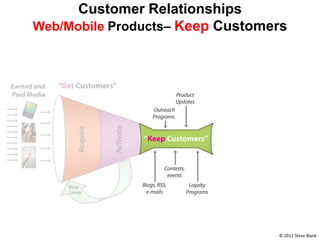
Customer Relationships
Web/Mobile Products– Keep Customers


                                 © 2012 Steve Blank
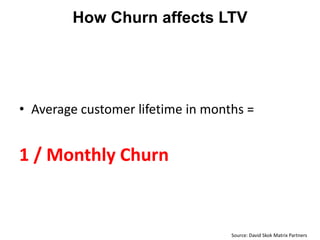
How Churn affects LTV


• Average customer lifetime in months =


1 / Monthly Churn


                                   Source: David Skok Matrix Partners
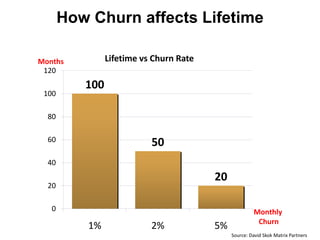
How Churn affects Lifetime

Months          Lifetime vs Churn Rate
 120
          100
 100

  80

  60                       50
  40
                                         20
  20

   0                                                    Monthly
                                                         Churn
          1%               2%            5%
                                              Source: David Skok Matrix Partners
How Churn affects LTV

Lifetime Value


                                           Monthly
                                            Churn
                            Source: David Skok Matrix Partners
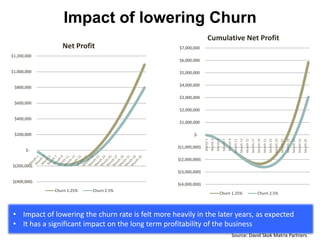
Impact of lowering Churn
                                                                      Cumulative Net Profit
                Net Profit                          $7,000,000
$1,200,000
                                                    $6,000,000

$1,000,000                                          $5,000,000

                                                    $4,000,000
 $800,000

                                                    $3,000,000
 $600,000
                                                    $2,000,000

 $400,000
                                                    $1,000,000

 $200,000                                                  $-


                                                                  Month 1
                                                                            Month 3
                                                                                      Month 5
                                                                                                Month 7
                                                                                                          Month 9
                                                                                                                    Month 11
                                                                                                                               Month 13
                                                                                                                                          Month 15
                                                                                                                                                     Month 17
                                                                                                                                                                Month 19
                                                                                                                                                                           Month 21
                                                                                                                                                                                      Month 23
                                                                                                                                                                                                 Month 25
                                                                                                                                                                                                            Month 27
                                                                                                                                                                                                                       Month 29
                                                                                                                                                                                                                                  Month 31
                                                                                                                                                                                                                                             Month 33
                                                                                                                                                                                                                                                        Month 35
                                                   $(1,000,000)
       $-

                                                   $(2,000,000)
$(200,000)
                                                   $(3,000,000)

$(400,000)
                                                   $(4,000,000)
             Churn 1.25%   Churn 2.5%
                                                                                           Churn 1.25%                                                          Churn 2.5%


• Impact of lowering the churn rate is felt more heavily in the later years, as expected
• It has a significant impact on the long term profitability of the business
                                                                                                                Source: David Skok Matrix Partners
Churn

• 1% to 2.5% churn per month is acceptable
• Higher than that, you are filling a leaky bucket
  – Need to understand why you have low customer
    satisfaction and address the problem


                                      Source: David Skok Matrix Partners
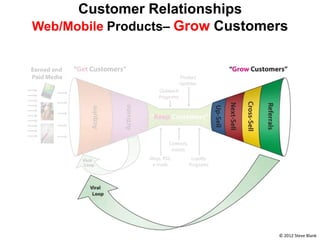
Customer Relationships
Web/Mobile Products– Grow Customers


                                 © 2012 Steve Blank
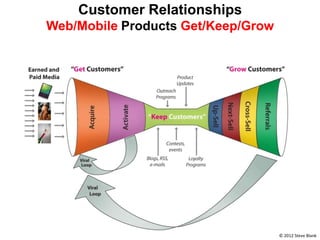
Customer Relationships
Web/Mobile Products Get/Keep/Grow


                                    © 2012 Steve Blank
Ag Robot
Customer Relationships Example
Demand generation plan and budget

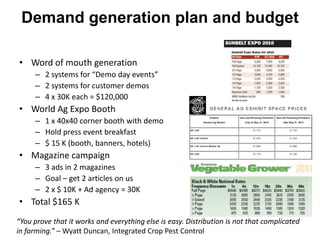
• Word of mouth generation
     – 2 systems for “Demo day events”
     – 2 systems for customer demos
     – 4 x 30K each = $120,000
• World Ag Expo Booth
     – 1 x 40x40 corner booth with demo
     – Hold press event breakfast
     – $ 15 K (booth, banners, hotels)
• Magazine campaign
     – 3 ads in 2 magazines
     – Goal – get 2 articles on us
     – 2 x $ 10K + Ad agency = 30K
• Total $165 K
“You prove that it works and everything else is easy. Distribution is not that complicated
in farming.” – Wyatt Duncan, Integrated Crop Pest Control
Medical Device
Customer Relationships Example
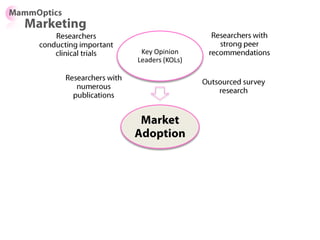
Key Opinion
Leaders (KOLs)
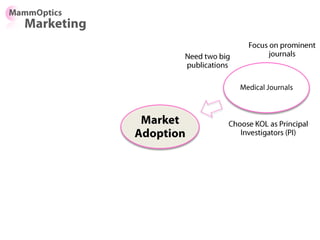
Key Opinion
Leaders (KOLs)
Key Opinion
Leaders (KOLs)
Key Opinion
Leaders (KOLs)
Key Opinion
Leaders (KOLs)
Key Opinion
Leaders (KOLs)
Housing App
Customer Relationship Example
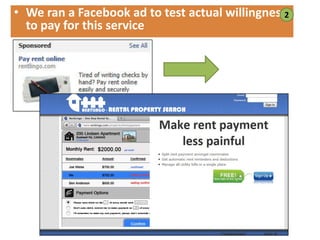
• We ran a Facebook ad to test actual willingness2
  to pay for this service


                                                 107
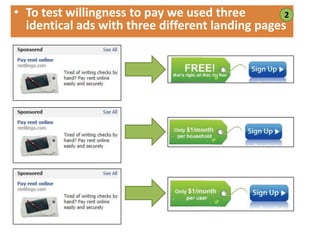
• To test willingness to pay we used three        2
  identical ads with three different landing pages


                                                  108
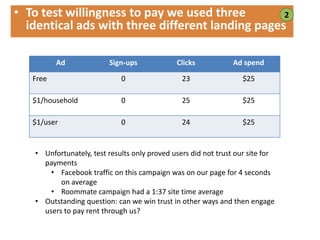
• To test willingness to pay we used three        2
  identical ads with three different landing pages

          Ad             Sign-ups             Clicks            Ad spend

   Free                      0                  23                 $25

   $1/household              0                  25                 $25

   $1/user                   0                  24                 $25


   • Unfortunately, test results only proved users did not trust our site for
     payments
       • Facebook traffic on this campaign was on our page for 4 seconds
          on average
       • Roommate campaign had a 1:37 site time average
   • Outstanding question: can we win trust in other ways and then engage
     users to pay rent through us?

                                                                                109
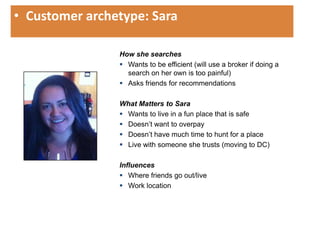
• Customer archetype: Sara

                How she searches
                 Wants to be efficient (will use a broker if doing a
                  search on her own is too painful)
                 Asks friends for recommendations

                What Matters to Sara
                 Wants to live in a fun place that is safe
                 Doesn’t want to overpay
                 Doesn’t have much time to hunt for a place
                 Live with someone she trusts (moving to DC)

                Influences
                 Where friends go out/live
                 Work location


                                                                        110
Online Dating
Customer Relationships Example
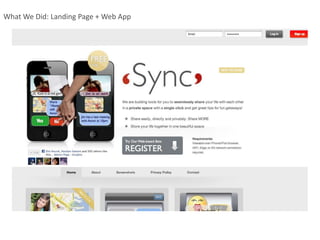
What We Did: Landing Page + Web App
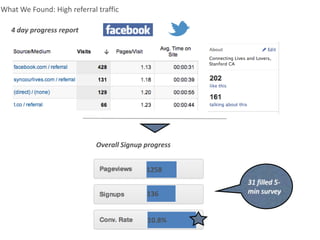
What We Found: High referral traffic

   4 day progress report


                             Overall Signup progress


                                            1258
                                                       31 filled 5-
                                            136        min survey


                                            10.8%
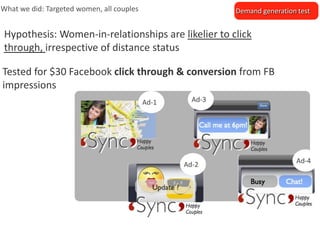
What we did: Targeted women, all couples                   Demand generation test


Hypothesis: Women-in-relationships are likelier to click
through, irrespective of distance status

Tested for $30 Facebook click through & conversion from FB
impressions
                                           Ad-1     Ad-3


                                                  Ad-2                      Ad-4
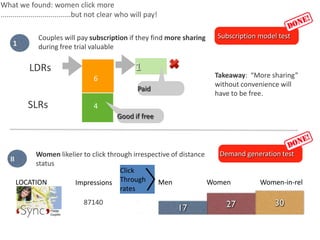
What we found: women click more
...................................but not clear who will pay!

              Couples will pay subscription if they find more sharing   Subscription model test
    1         during free trial valuable

            LDRs                                     1
                                    6                                   Takeaway: “More sharing”
                                                                        without convenience will
                                                      Paid
                                                                        have to be free.
           SLRs                     4
                                              Good if free


             Women likelier to click through irrespective of distance   Demand generation test
   II
             status
                                         Click
        LOCATION         Impressions Through         Men              Women       Women-in-rel
                                         rates
                                87140
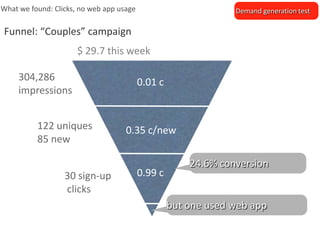
What we found: Clicks, no web app usage                         Demand generation test

Funnel: “Couples” campaign
                      $ 29.7 this week

     304,286                              0.01 c
     impressions


          122 uniques               0.35 c/new
          85 new

                                                       24.6% conversion
                  30 sign-up              0.99 c
                  clicks
                                                   but one used web app
Online Sales
Customer Relationships Example
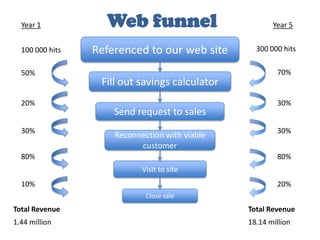
Year 1           Web funnel                          Year 5


  100 000 hits   Referenced to our web site       300 000 hits

  50%                                                   70%
                  Fill out savings calculator
  20%                                                   30%
                     Send request to sales
  30%                                                   30%
                     Reconnection with viable
                           customer
  80%                                                   80%
                            Visit to site
  10%                                                   20%
                             Close sale
Total Revenue                                   Total Revenue
1.44 million                                    18.14 million
Mobile App
Customer Relationships Example
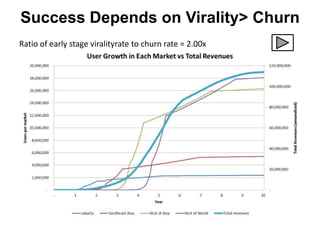
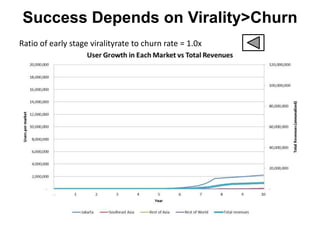
Success Depends on Virality> Churn
Ratio of early stage viralityrate to churn rate = 2.00x
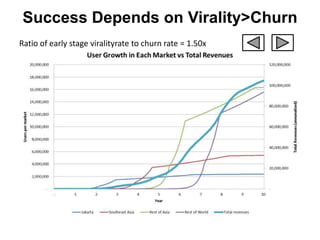
Success Depends on Virality>Churn
Ratio of early stage viralityrate to churn rate = 1.50x
Success Depends on Virality>Churn
Ratio of early stage viralityrate to churn rate = 1.0x
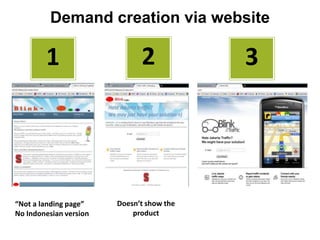
Demand creation via website

        1                     2            3


“Not a landing page”    Doesn’t show the
No Indonesian version       product
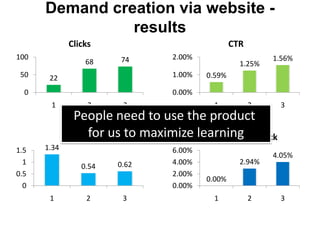
Demand creation via website -
                results
             Clicks                               CTR
100                    74         2.00%                     1.56%
                 68                                 1.25%
 50    22                         1.00%   0.59%

  0                               0.00%
       1          2     3                  1            2    3
             People need to use the product
             CPC for us to maximize Conversions per click
                                     learning
1.5   1.34                        6.00%
                                                            4.05%
  1                    0.62       4.00%             2.94%
                0.54
0.5                               2.00%
                                          0.00%
  0                               0.00%
       1         2      3                  1            2    3
Software Reference Tool
Customer Relationships Example
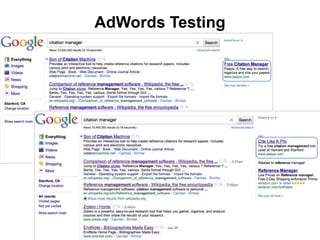
AdWords Testing
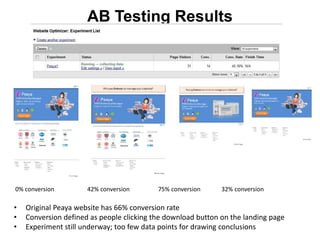
AB Testing Results


0% conversion         42% conversion       75% conversion     32% conversion

•   Original Peaya website has 66% conversion rate
•   Conversion defined as people clicking the download button on the landing page
•   Experiment still underway; too few data points for drawing conclusions
Google &Facebook campaigns


• Keywords: free endnote, reference manager, pdf
  manager, Itunes for digital content, I tunes, manage
  pdf, organize paper, paper manager, citation manager, paper
  citation, cite pdfs
• 24 impressions, 2 clicks on googleadwords
• Clicks on free endnote and organize paper
• No Facebook response
• 1 Post on ResearchGate drew 7 visitors
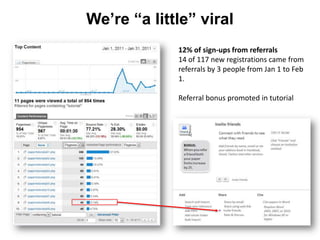
We’re “a little” viral
             12% of sign-ups from referrals
             14 of 117 new registrations came from
             referrals by 3 people from Jan 1 to Feb
             1.

             Referral bonus promoted in tutorial
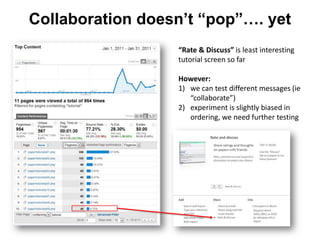
Collaboration doesn’t “pop”…. yet
                  “Rate & Discuss” is least interesting
                  tutorial screen so far

                  However:
                  1) we can test different messages (ie
                     “collaborate”)
                  2) experiment is slightly biased in
                     ordering, we need further testing
Customer Relationships Example
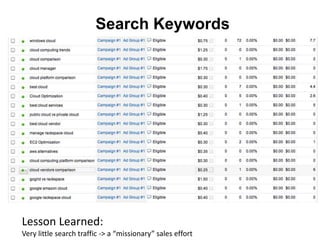
Search Keywords


Lesson Learned:
Very little search traffic -> a “missionary” sales effort
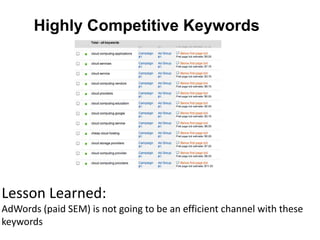
Highly Competitive Keywords


Lesson Learned:
AdWords (paid SEM) is not going to be an efficient channel with these
keywords
Medical Device
Customer Relationships Example
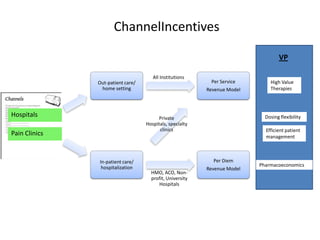
ChannelIncentives

                                                                                  VP

                                      All Institutions
               Out-patient care/                            Per Service       High Value
                home setting                              Revenue Model       Therapies


Hospitals                               Private                             Dosing flexibility
                                   Hospitals, specialty
                                         clinics                            Efficient patient
Pain Clinics                                                                management


               In-patient care/                              Per Diem
                hospitalization                                           Pharmacoeconomics
                                                          Revenue Model
                                     HMO, ACO, Non-
                                     profit, University
                                        Hospitals
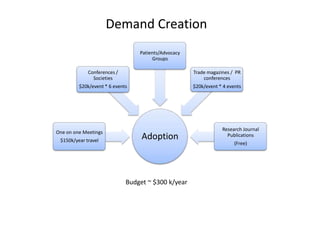
Demand Creation
                                 Patients/Advocacy
                                      Groups

             Conferences /                           Trade magazines / PR
               Societies                                 conferences
         $20k/event * 6 events                       $20k/event * 4 events


                                                                 Research Journal
One on one Meetings
 $150k/year travel
                                  Adoption                         Publications
                                                                       (Free)


                             Budget ~ $300 k/year
NSF I-Corps
  The Lean LaunchPad

Lecture 6: Revenue Streams
   How Do You Make Money?


                             Version 6/22/12
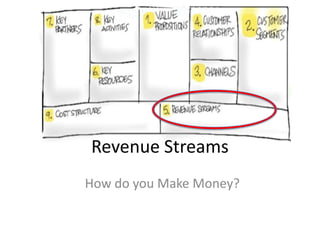
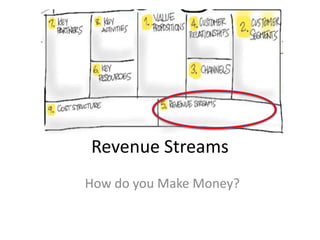
Revenue Streams
How do you Make Money?
© 2012 Steve Blank
The Two Key Questions
• What’s my revenue model?
• Within the revenue model – how do I
  price the product?
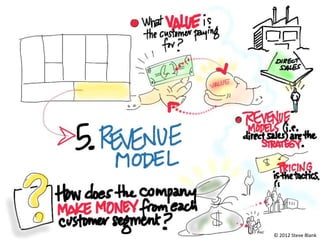
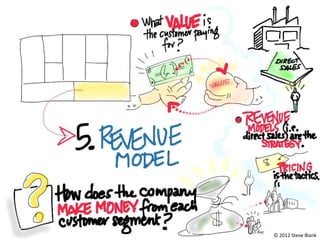
Revenue Model =

 the strategy the company uses to
generate cash from each customer
              segment
Revenue Streams
1. How many will we sell?
2. Where/who is the money coming from?
3. How do we price the product?
4. Does this add up to a
   business worth doing?
How Many Will You Sell?
•   What’s the Market Size & estimate of Market Share?
•   How many can your channel sell?
•   How much will the channel cost?
•   How many customer activations?
        • Revenue? Churn/Attrition rate? customers/?
• How much will it cost to acquire a customer?
        • How many units will they buy from each of these efforts?


     Top down: 10% of a million-person market=100,000 customers
     Bottom up: 1,000 customers/month 1st year => 3,000/month 3rd year
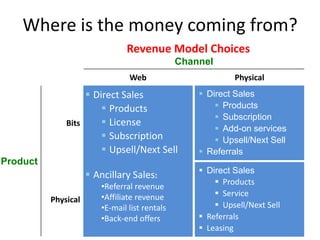
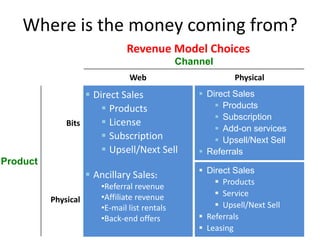
Where is the money coming from?
                               Revenue Model Choices
                                               Channel
                                Web                         Physical
                    Direct Sales                   Direct Sales
                        Products                       Products
                                                        Subscription
              Bits      License
                                                        Add-on services
                        Subscription                   Upsell/Next Sell
                        Upsell/Next Sell           Referrals
Product
                                                    Direct Sales
                      Ancillary Sales:
                                                        Products
                        •Referral revenue
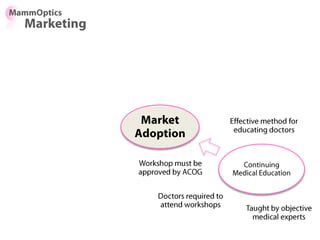
                        •Affiliate revenue              Service
          Physical
                        •E-mail list rentals            Upsell/Next Sell
                        •Back-end offers            Referrals
                                                    Leasing
Key Revenue Model Questions
• What are my customers paying for?
• What capacity do my customers have to
  pay?
• How will you package your product ?
• How will you price the offerings?
Pricing Model =

the tactics you use to set the price in
      each customer segment
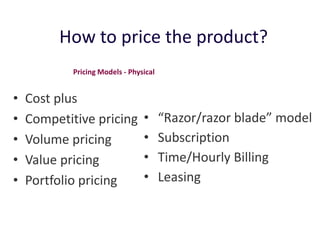
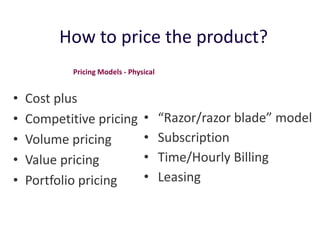
How to price the product?
            Pricing Models - Physical


•   Cost plus
•   Competitive pricing          •      “Razor/razor blade” model
•   Volume pricing               •      Subscription
•   Value pricing                •      Time/Hourly Billing
•   Portfolio pricing            •      Leasing
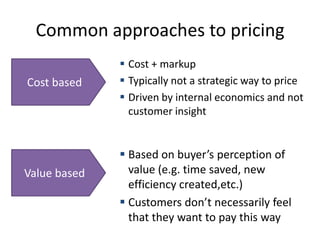
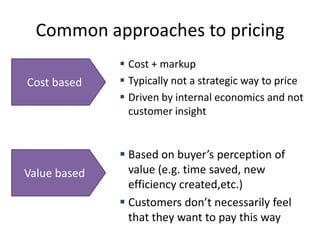
Common approaches to pricing
               Cost + markup
Cost based     Typically not a strategic way to price
               Driven by internal economics and not
                customer insight


               Based on buyer’s perception of
Value based     value (e.g. time saved, new
                efficiency created,etc.)
               Customers don’t necessarily feel
                that they want to pay this way
Additional components of pricing
• Exclusive vs. non-exclusive
• What do you price? What do you give away
  for free?
• How does cost vary at different production
  levels?
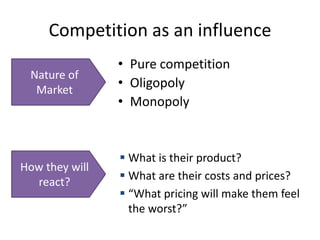
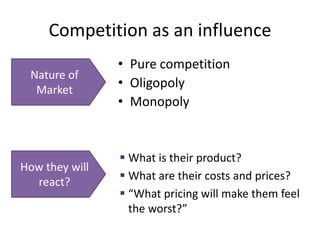
Competition as an influence
                • Pure competition
 Nature of
  Market
                • Oligopoly
                • Monopoly


                 What is their product?
How they will
  react?         What are their costs and prices?
                 “What pricing will make them feel
                  the worst?”
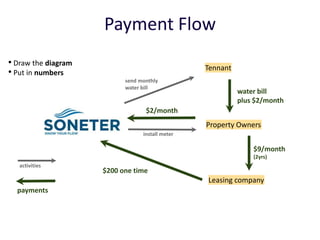
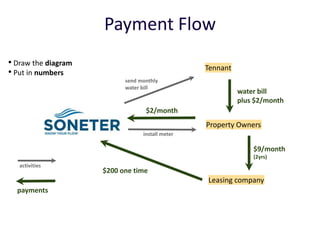
Payment Flow
• Draw the diagram                               Tennant
• Put in numbers
                           send monthly
                           water bill
                                                           water bill
                                                           plus $2/month
                                  $2/month
                                                 Property Owners
                                 install meter

                                                               $9/month
                                                               (2yrs)
   activities
                     $200 one time
                                                 Leasing company
  payments
Single versus
Multi-sided Markets
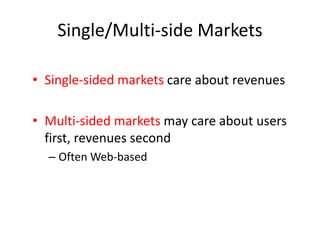
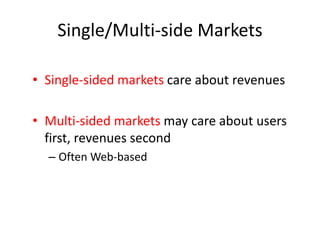
Single/Multi-side Markets

• Single-sided markets care about revenues

• Multi-sided markets may care about users
  first, revenues second
  – Often Web-based
“Users First” Companies
If you say your business is advertising based:

• How do you get to 10M monthly users?
• How do you become one of the top 5 websites
  visited?
• How much do the “payers” actually pay?
“Revenue First” Companies

• Time to doublings for monthly revenues
• Key questions:
• When will I get to $100k/month in
  revenues?
• When will I get to $1M/month in revenues?
• What assumptions about my business am I
  making when I reach these milestones?
Market Type and Revenue
Other Issues
• Distribution channel affects
  revenue streams
• Market type affects revenue streams
• Demand curve affects revenue streams
• Consider lifetime value
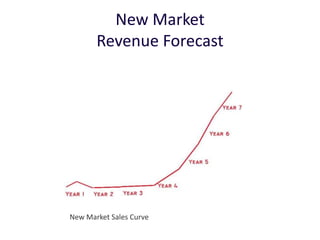
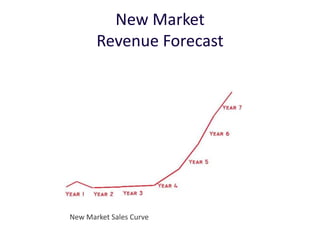
New Market
       Revenue Forecast


New Market Sales Curve
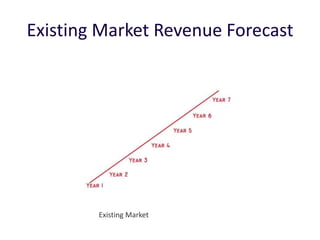
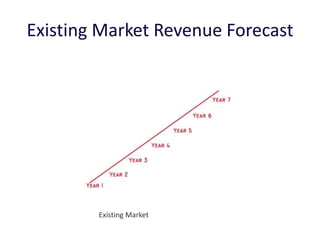
Existing Market Revenue Forecast


        Existing Market
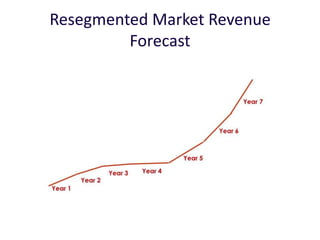
Resegmented Market Revenue
         Forecast
Common categories
of Web/Mobile revenue models
“Direct” revenue models
•   Sales: Product, app, or service sales
•   Subscriptions: SAAS, games, monthly subscription
•   Freemium: use the product for free: upsell/conversion
•   Pay-per-use: revenue on a “per use” basis
•   Virtual goods: selling virtual goods
•   Advertising sales: unique and/or large audience
“Ancillary” revenue models
• Referral revenue: pay for referring traffic/customers to other
  web or mobile sites or products.
• Affiliate revenue: finder’s fees/commissions from other sites
  for directing customers to make purchases at the affiliated site
• E-mail list rentals: rent your customer email lists to
  advertiser partners
• Back-end offers: add-on sales items from other companies as
  part of their registration or purchase confirmation processes, or
  “sell” their existing traffic to a company that strives to monetize it
  and share the resulting revenu3
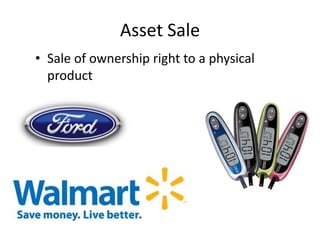
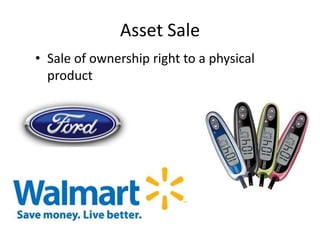
Asset Sale
• Sale of ownership right to a physical
  product
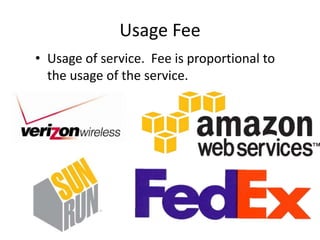
Usage Fee
• Usage of service. Fee is proportional to
  the usage of the service.
Subscription Fee
• Fee for continuous access to a service
Renting
• Fee for temporary access to a good or service
Licensing
• Fee for use of some IP (including software)
Intermediation Fee
• Often found in marketplaces of various
  types, a fee for bringing together two or more
  parties involved in a transaction
Advertising
• Fee paid by brands and companies to get in
  front of potential customers
Revenue Model Summary
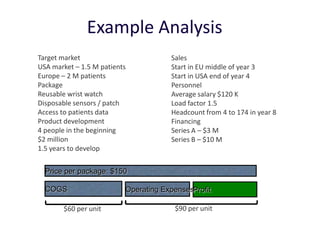
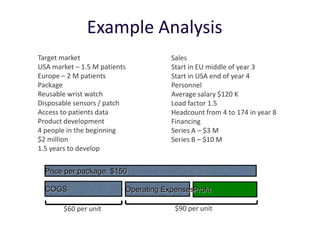
Example Analysis
Target market                         Sales
USA market – 1.5 M patients           Start in EU middle of year 3
Europe – 2 M patients                 Start in USA end of year 4
Package                               Personnel
Reusable wrist watch                  Average salary $120 K
Disposable sensors / patch            Load factor 1.5
Access to patients data               Headcount from 4 to 174 in year 8
Product development                   Financing
4 people in the beginning             Series A – $3 M
$2 million                            Series B – $10 M
1.5 years to develop


  Price per package: $150

  COGS                    Operating ExpensesProfit

       $60 per unit                    $90 per unit
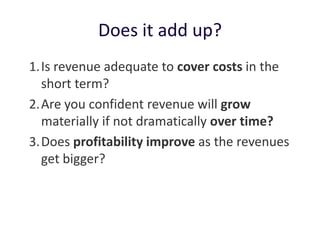
Does it add up?
1. Is revenue adequate to cover costs in the
   short term?
2. Are you confident revenue will grow
   materially if not dramatically over time?
3. Does profitability improve as the revenues
   get bigger?
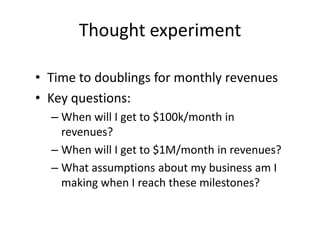
Thought experiment

• Time to doublings for monthly revenues
• Key questions:
  – When will I get to $100k/month in
    revenues?
  – When will I get to $1M/month in revenues?
  – What assumptions about my business am I
    making when I reach these milestones?
Optical Equipment
Revenue Model Example
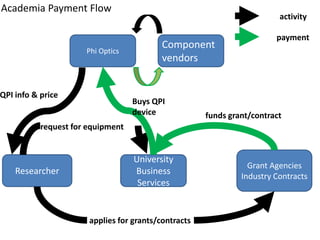
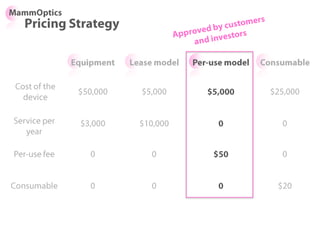
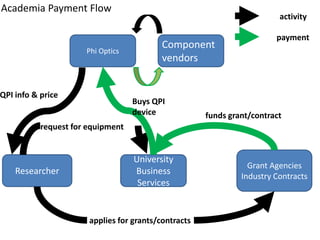
Academia Payment Flow
                                                                         activity

                                                                        payment
                                           Component
                      Phi Optics
                                           vendors


QPI info & price
                                   Buys QPI
                                   device             funds grant/contract
           request for equipment


                                   University
                                                                 Grant Agencies
    Researcher                     Business
                                                               Industry Contracts
                                    Services


                       applies for grants/contracts
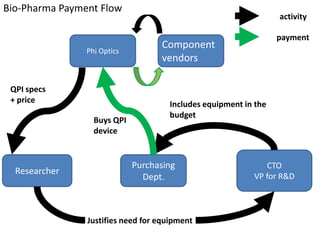
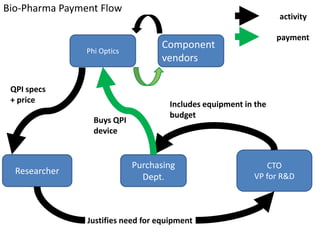
Bio-Pharma Payment Flow
                                                                 activity

                                                                 payment
                                   Component
                Phi Optics
                                   vendors

 QPI specs
 + price                             Includes equipment in the
                                     budget
                  Buys QPI
                  device


                             Purchasing                      CTO
  Researcher
                               Dept.                      VP for R&D


                Justifies need for equipment
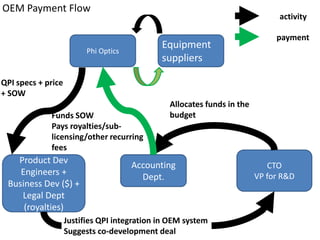
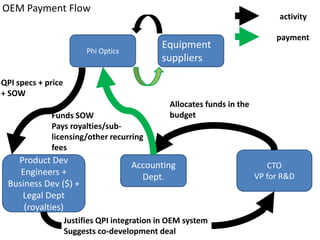
OEM Payment Flow
                                                                               activity

                                                                              payment
                                              Equipment
                          Phi Optics
                                              suppliers

QPI specs + price
+ SOW
                                                Allocates funds in the
             Funds SOW                          budget
             Pays royalties/sub-
             licensing/other recurring
             fees
   Product Dev
                                       Accounting                           CTO
    Engineers +                                                          VP for R&D
                                         Dept.
 Business Dev ($) +
    Legal Dept
     (royalties)
                    Justifies QPI integration in OEM system
                    Suggests co-development deal
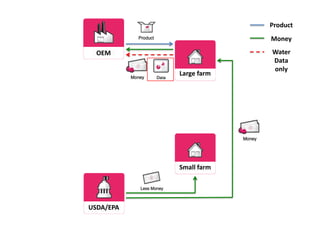
Nitrate Sensor
Revenue Model Example
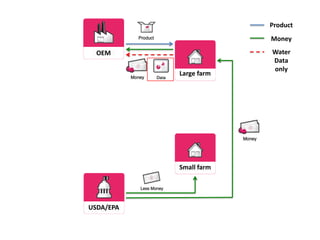
Product
                        Money

  OEM                   Water
                        Data
                        only
           Large farm


           Small farm


USDA/EPA
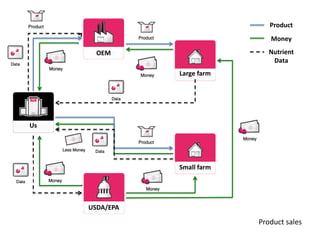
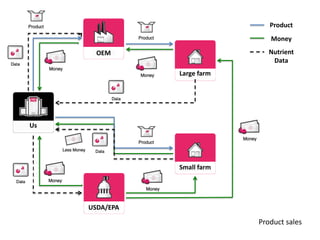
Product
                                Money

       OEM                      Nutrient
                                 Data
                Large farm


Us


                Small farm


     USDA/EPA

                             Product sales
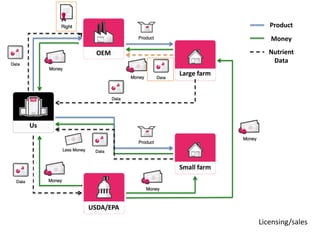
Product
                                Money

       OEM                      Nutrient
                                 Data
                Large farm


Us


                Small farm


     USDA/EPA

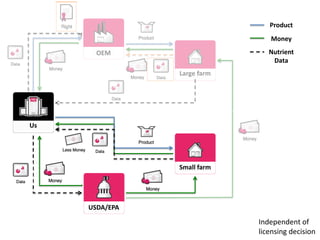
                             Licensing/sales
Product
                                Money

       OEM                      Nutrient
                                 Data
                Large farm


Us


                Small farm


     USDA/EPA

                             Independent of
                             licensing decision
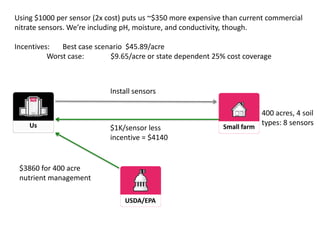
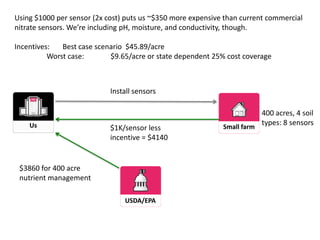
Using $1000 per sensor (2x cost) puts us ~$350 more expensive than current commercial
nitrate sensors. We’re including pH, moisture, and conductivity, though.

Incentives:   Best case scenario $45.89/acre
          Worst case:       $9.65/acre or state dependent 25% cost coverage


                            Install sensors

                                                                        400 acres, 4 soil
    Us                                                       Small farm
                                                                        types: 8 sensors
                            $1K/sensor less
                            incentive = $4140


 $3860 for 400 acre
 nutrient management

                                USDA/EPA
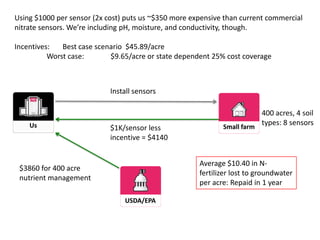
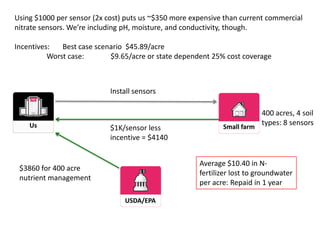
Using $1000 per sensor (2x cost) puts us ~$350 more expensive than current commercial
nitrate sensors. We’re including pH, moisture, and conductivity, though.

Incentives:   Best case scenario $45.89/acre
          Worst case:       $9.65/acre or state dependent 25% cost coverage


                            Install sensors

                                                                        400 acres, 4 soil
    Us                                                       Small farm
                                                                        types: 8 sensors
                            $1K/sensor less
                            incentive = $4140


                                                      Average $10.40 in N-
 $3860 for 400 acre
                                                      fertilizer lost to groundwater
 nutrient management
                                                      per acre: Repaid in 1 year

                                USDA/EPA
Bio-Based Chemical Intermediates
     Revenue Model Example
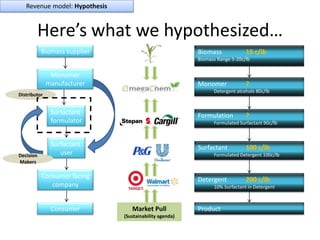
Revenue model: Hypothesis


        Here’s what we hypothesized…
           Biomass supplier                              Biomass             15 c/lb
                                                         Biomass Range 5-20c/lb


               Monomer
              manufacturer                               Monomer             ?
                                                               Detergent alcohols 80c/lb
Distributor


               Surfactant                                Formulation         ?
               formulator                                      Formulated Surfactant 90c/lb


               Surfactant                                Surfactant          100 c/lb
Decision          user                                         Formulated Detergent 100c/lb
Makers

           Consumer facing                               Detergent           200 c/lb
              company                                          10% Surfactant in Detergent


               Consumer           Market Pull            Product
                               (Sustainability agenda)
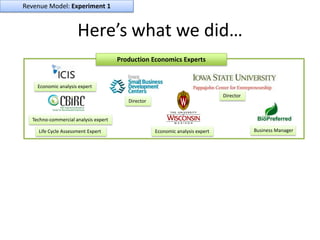
Revenue Model: Experiment 1


                     Here’s what we did…
                                      Production Economics Experts


    Economic analysis expert
                                                                               Director
                                         Director


  Techno-commercial analysis expert

    Life Cycle Assessment Expert                    Economic analysis expert              Business Manager
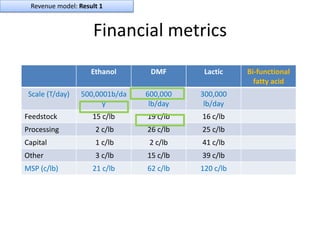
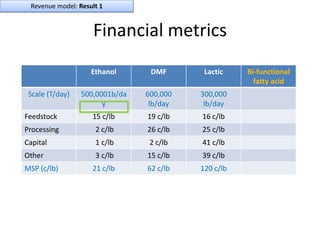
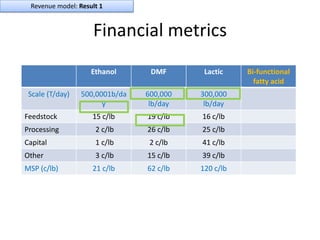
Revenue model: Result 1


                    Financial metrics
                    Ethanol      DMF       Lactic    Bi-functional
                                                       fatty acid
 Scale (T/day)   500,0001b/da   600,000   300,000
                       y         lb/day    lb/day
Feedstock           15 c/lb     19 c/lb   16 c/lb
Processing           2 c/lb     26 c/lb   25 c/lb
Capital              1 c/lb      2 c/lb   41 c/lb
Other                3 c/lb     15 c/lb   39 c/lb
MSP (c/lb)          21 c/lb     62 c/lb   120 c/lb
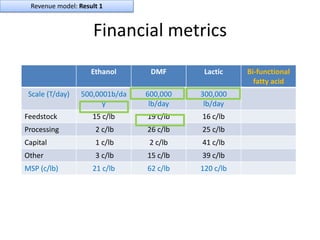
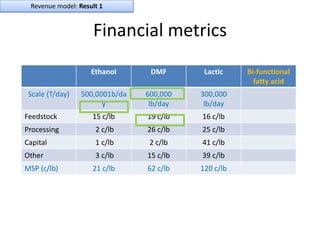
Revenue model: Result 1


                    Financial metrics
                    Ethanol      DMF       Lactic    Bi-functional
                                                       fatty acid
 Scale (T/day)   500,0001b/da   600,000   300,000
                       y         lb/day    lb/day
Feedstock           15 c/lb     19 c/lb   16 c/lb
Processing           2 c/lb     26 c/lb   25 c/lb
Capital              1 c/lb      2 c/lb   41 c/lb
Other                3 c/lb     15 c/lb   39 c/lb
MSP (c/lb)          21 c/lb     62 c/lb   120 c/lb
Revenue model: Result 1


                    Financial metrics
                    Ethanol      DMF       Lactic    Bi-functional
                                                       fatty acid
 Scale (T/day)   500,0001b/da   600,000   300,000
                       y         lb/day    lb/day
Feedstock           15 c/lb     19 c/lb   16 c/lb
Processing           2 c/lb     26 c/lb   25 c/lb
Capital              1 c/lb      2 c/lb   41 c/lb
Other                3 c/lb     15 c/lb   39 c/lb
MSP (c/lb)          21 c/lb     62 c/lb   120 c/lb
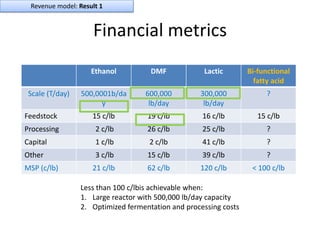
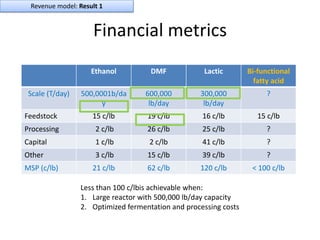
Revenue model: Result 1


                    Financial metrics
                    Ethanol          DMF            Lactic        Bi-functional
                                                                    fatty acid
 Scale (T/day)   500,0001b/da      600,000         300,000             ?
                       y            lb/day          lb/day
Feedstock           15 c/lb         19 c/lb         16 c/lb          15 c/lb
Processing           2 c/lb         26 c/lb         25 c/lb            ?
Capital              1 c/lb         2 c/lb          41 c/lb            ?
Other                3 c/lb         15 c/lb         39 c/lb            ?
MSP (c/lb)          21 c/lb         62 c/lb        120 c/lb        < 100 c/lb

                 Less than 100 c/lbis achievable when:
                 1. Large reactor with 500,000 lb/day capacity
                 2. Optimized fermentation and processing costs
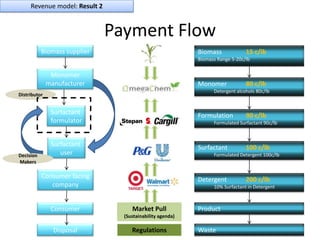
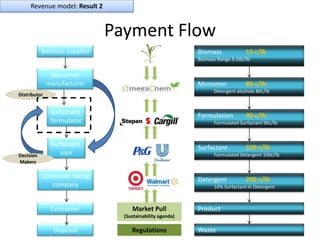
Revenue model: Result 2


                               Payment Flow
           Biomass supplier                                Biomass             15 c/lb
                                                           Biomass Range 5-20c/lb


               Monomer
              manufacturer                                 Monomer             80 c/lb
                                                                 Detergent alcohols 80c/lb
Distributor


               Surfactant                                  Formulation         90 c/lb
               formulator                                        Formulated Surfactant 90c/lb


               Surfactant                                  Surfactant          100 c/lb
Decision          user                                           Formulated Detergent 100c/lb
Makers

           Consumer facing                                 Detergent           200 c/lb
              company                                            10% Surfactant in Detergent


               Consumer             Market Pull            Product
                                 (Sustainability agenda)

                Disposal            Regulations            Waste
Payment Flows Example
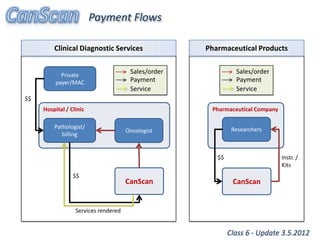
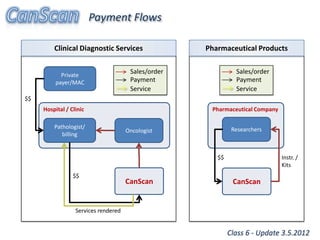
Payment Flows

         Clinical Diagnostic Services                Pharmaceutical Products


            Private
                                       Sales/order             Sales/order
          payer/MAC                    Payment                 Payment
                                       Service                 Service
$$
     Hospital / Clinic                                Pharmaceutical Company

         Pathologist/                                         Researchers
                                      Oncologist
            billing


                                                        $$                     Instr. /
                                                                               Kits
                 $$
                                      CanScan                 CanScan


                  Services rendered


                                                             Class 6 - Update 3.5.2012
Medical Device
Pricing Example
Graphene
Revenue Model Example
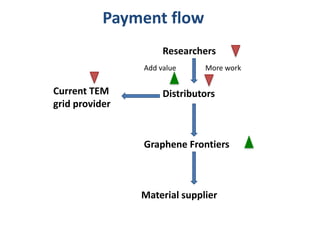
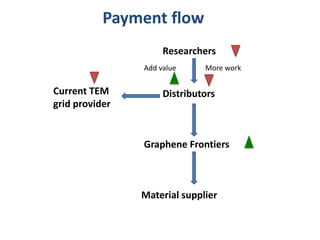
Payment flow
                     Researchers
                Add value     More work

Current TEM          Distributors
grid provider


                Graphene Frontiers


                Material supplier
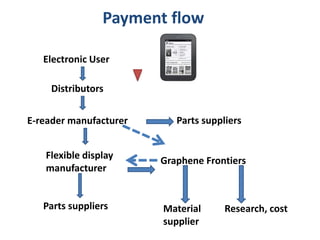
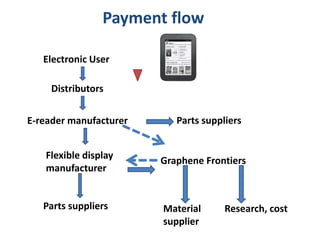
Payment flow

   Electronic User

     Distributors


E-reader manufacturer      Parts suppliers


   Flexible display     Graphene Frontiers
   manufacturer


   Parts suppliers      Material      Research, cost
                        supplier
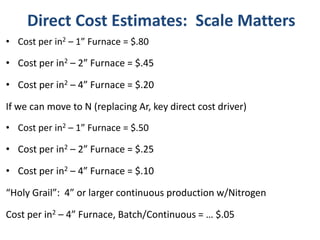
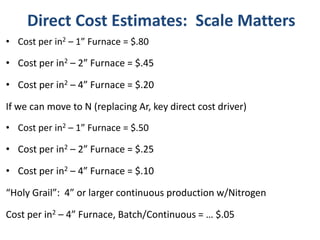
Direct Cost Estimates: Scale Matters
• Cost per in2 – 1” Furnace = $.80

• Cost per in2 – 2” Furnace = $.45

• Cost per in2 – 4” Furnace = $.20

If we can move to N (replacing Ar, key direct cost driver)
• Cost per in2 – 1” Furnace = $.50

• Cost per in2 – 2” Furnace = $.25

• Cost per in2 – 4” Furnace = $.10

“Holy Grail”: 4” or larger continuous production w/Nitrogen

Cost per in2 – 4” Furnace, Batch/Continuous = … $.05
Sensor
Pricing Tactics Example
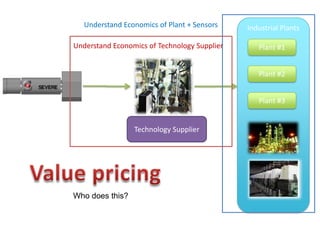
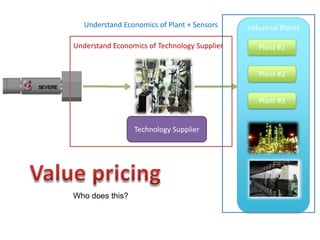
Understand Economics of Plant + Sensors    Industrial Plants

Understand Economics of Technology Supplier      Plant #1


                                                 Plant #2


                                                 Plant #3


                 Technology Supplier


Who does this?
205
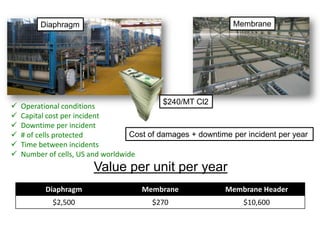
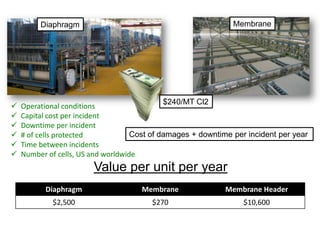
         Diaphragm                                             Membrane


                                             $240/MT Cl2
   Operational conditions
   Capital cost per incident
   Downtime per incident
   # of cells protected            Cost of damages + downtime per incident per year
   Time between incidents
   Number of cells, US and worldwide
                        Value per unit per year
          Diaphragm                  Membrane               Membrane Header
            $2,500                      $270                      $10,600
Soft product launch projected for Q1-Q2 2012
      General launch projected for Q4 2012

Diaphragm                      Membrane                  Membrane Header
 $2,500                             $270                        $10,600


          Year          Type               %     Revenue [/year]
           1      Innovators (US)          2.5      $271,500
          Operating costs for 1st year projected to be $350,000
           2       Early Adopters          16     $15,040,000
           3       Early Majority          50     $47,000,000
           4       Late Majority           84     $78,960,000


                  Full Penetration         100    $94,000,000


                                                                           206
Medical Device
Revenue Model Example
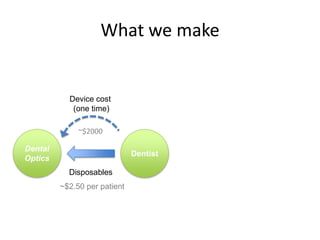
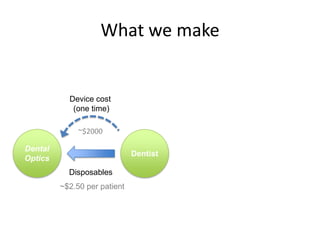
What we make


           Device cost
            (one time)

              ~$2000

Dental
                              Dentist
Optics
           Disposables
         ~$2.50 per patient
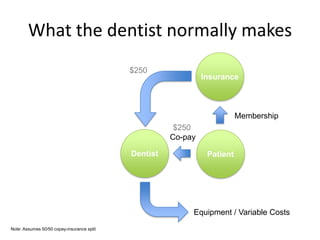
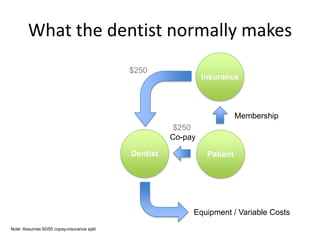
What the dentist normally makes
                                            $250
                                                               Insurance


                                                                          Membership
                                                       $250
                                                      Co-pay

                                            Dentist             Patient


                                                           Equipment / Variable Costs
Note: Assumes 50/50 copay-insurance split
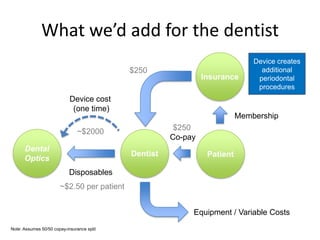
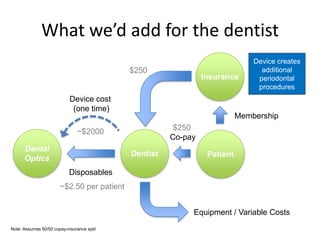
What we’d add for the dentist
                                                                              Device creates
                                            $250                                additional
                                                               Insurance       periodontal
                                                                               procedures
                            Device cost
                             (one time)
                                                                          Membership
                               ~$2000                  $250
                                                      Co-pay
      Dental
                                            Dentist             Patient
      Optics
                            Disposables
                       ~$2.50 per patient


                                                           Equipment / Variable Costs
Note: Assumes 50/50 copay-insurance split
Farm Nitrate Sensor
Revenue Model Example
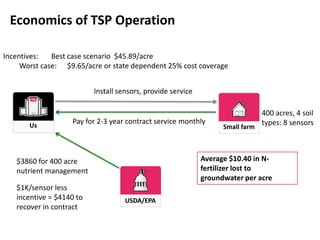
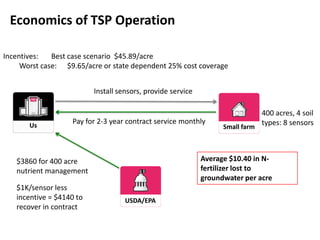
Economics of TSP Operation

Incentives:   Best case scenario $45.89/acre
     Worst case: $9.65/acre or state dependent 25% cost coverage


                          Install sensors, provide service

                                                                              400 acres, 4 soil
       Us
                   Pay for 2-3 year contract service monthly                  types: 8 sensors
                                                                   Small farm


   $3860 for 400 acre                                        Average $10.40 in N-
   nutrient management                                       fertilizer lost to
                                                             groundwater per acre
   $1K/sensor less
   incentive = $4140 to             USDA/EPA
   recover in contract
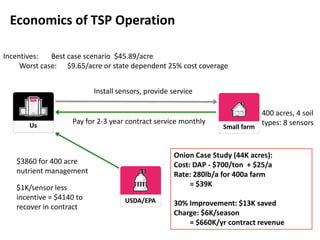
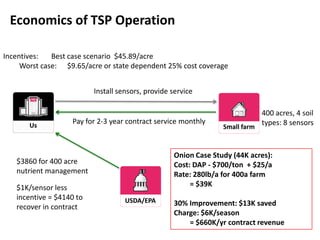
Economics of TSP Operation

Incentives:   Best case scenario $45.89/acre
     Worst case: $9.65/acre or state dependent 25% cost coverage


                          Install sensors, provide service

                                                                            400 acres, 4 soil
       Us
                   Pay for 2-3 year contract service monthly                types: 8 sensors
                                                                 Small farm


                                                   Onion Case Study (44K acres):
   $3860 for 400 acre                              Cost: DAP - $700/ton + $25/a
   nutrient management                             Rate: 280lb/a for 400a farm
   $1K/sensor less                                      = $39K
   incentive = $4140 to             USDA/EPA
   recover in contract                             30% Improvement: $13K saved
                                                   Charge: $6K/season
                                                       = $660K/yr contract revenue
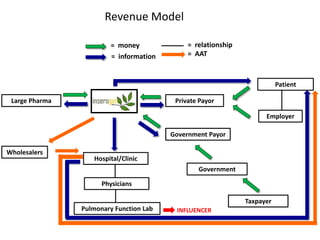
Biofactories for Therapeutics
  Revenue Model Example
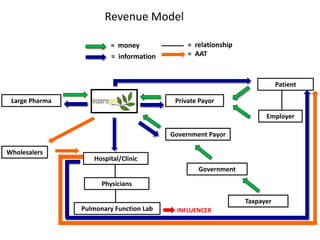
Revenue Model

                         = money              = relationship
                         = information        = AAT


                                                                          Patient

 Large Pharma                             Private Payor

                                                                     Employer

                                         Government Payor

Wholesalers
                   Hospital/Clinic
                                                 Government

                      Physicians

                                                               Taxpayer
                Pulmonary Function Lab    INFLUENCER
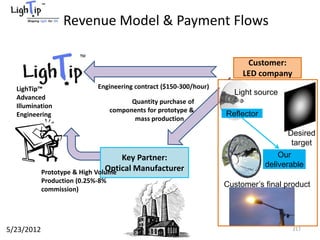
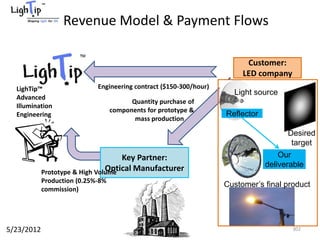
Optics Design Company
Revenue Model Example
™


                  Revenue Model & Payment Flows

                                                                          Customer:
                                                                         LED company
  LighTip™                   Engineering contract ($150-300/hour)
                                                                      Light source
  Advanced
                                         Quantity purchase of
  Illumination
                                   components for prototype &
  Engineering                                                       Reflector
                                          mass production .

                                                                                      Desired
                                                                                       target
                                    Key Partner:                                    Our
                                Optical Manufacturer                            deliverable
            Prototype & High Volume
            Production (0.25%-8%
                                                                    Customer’s final product
            commission)


5/23/2012                                                                              217
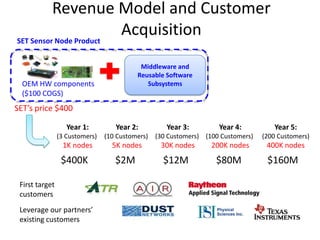
Complex Sensor Networks
 Revenue Model Example
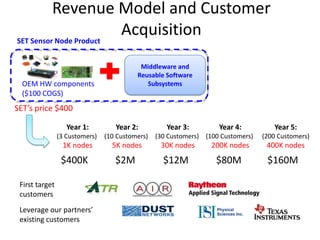
Revenue Model and Customer
SET Sensor Node Product
                        Acquisition
                                           Middleware and
                                          Reusable Software
  OEM HW components                          Subsystems
  ($100 COGS)
SET’s price $400

                   Year 1:         Year 2:          Year 3:         Year 4:          Year 5:
                (3 Customers)   (10 Customers)   (30 Customers) (100 Customers)   (200 Customers)
                 1K nodes         5K nodes        30K nodes       200K nodes       400K nodes
                 $400K             $2M             $12M            $80M            $160M

 First target
 customers
 Leverage our partners’
 existing customers
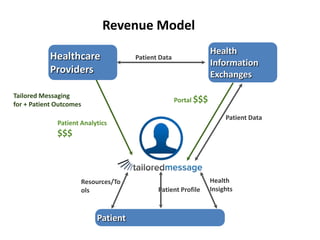
Healthcare Software
Revenue Model Example
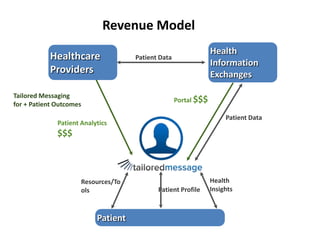
Revenue Model
                                                                 Health
           Healthcare                Patient Data
                                                                 Information
           Providers                                             Exchanges

Tailored Messaging
                                                    Portal $$$
for + Patient Outcomes
                                                                      Patient Data
              Patient Analytics
              $$$


                      Resources/To                               Health
                      ols                   Patient Profile      Insights


                           Patient
The Lean LaunchPad

Lecture 6: Revenue Streams
   How Do You Make Money?


                             Version 6/22/12
Revenue Streams
How do you Make Money?
© 2012 Steve Blank
The Two Key Questions
• What’s my revenue model?
• Within the revenue model – how do I
  price the product?
Revenue Model =

 the strategy the company uses to
generate cash from each customer
              segment
Revenue Streams
1. How many will we sell?
2. Where/who is the money coming from?
3. How do we price the product?
4. Does this add up to a
   business worth doing?
How Many Will You Sell?
•   What’s the Market Size & estimate of Market Share?
•   How many can your channel sell?
•   How much will the channel cost?
•   How many customer activations?
        • Revenue? Churn/Attrition rate? customers/?
• How much will it cost to acquire a customer?
        • How many units will they buy from each of these efforts?


     Top down: 10% of a million-person market=100,000 customers
     Bottom up: 1,000 customers/month 1st year => 3,000/month 3rd year
Where is the money coming from?
                               Revenue Model Choices
                                               Channel
                                Web                         Physical
                    Direct Sales                   Direct Sales
                        Products                       Products
                                                        Subscription
              Bits      License
                                                        Add-on services
                        Subscription                   Upsell/Next Sell
                        Upsell/Next Sell           Referrals
Product
                                                    Direct Sales
                      Ancillary Sales:
                                                        Products
                        •Referral revenue
                        •Affiliate revenue              Service
          Physical
                        •E-mail list rentals            Upsell/Next Sell
                        •Back-end offers            Referrals
                                                    Leasing
Key Revenue Model Questions
• What are my customers paying for?
• What capacity do my customers have to
  pay?
• How will you package your product ?
• How will you price the offerings?
Pricing Model =

the tactics you use to set the price in
      each customer segment
How to price the product?
            Pricing Models - Physical


•   Cost plus
•   Competitive pricing          •      “Razor/razor blade” model
•   Volume pricing               •      Subscription
•   Value pricing                •      Time/Hourly Billing
•   Portfolio pricing            •      Leasing
Common approaches to pricing
               Cost + markup
Cost based     Typically not a strategic way to price
               Driven by internal economics and not
                customer insight


               Based on buyer’s perception of
Value based     value (e.g. time saved, new
                efficiency created,etc.)
               Customers don’t necessarily feel
                that they want to pay this way
Additional components of pricing
• Exclusive vs. non-exclusive
• What do you price? What do you give away
  for free?
• How does cost vary at different production
  levels?
Competition as an influence
                • Pure competition
 Nature of
  Market
                • Oligopoly
                • Monopoly


                 What is their product?
How they will
  react?         What are their costs and prices?
                 “What pricing will make them feel
                  the worst?”
Payment Flow
• Draw the diagram                               Tennant
• Put in numbers
                           send monthly
                           water bill
                                                           water bill
                                                           plus $2/month
                                  $2/month
                                                 Property Owners
                                 install meter

                                                               $9/month
                                                               (2yrs)
   activities
                     $200 one time
                                                 Leasing company
  payments
Single versus
Multi-sided Markets
Single/Multi-side Markets

• Single-sided markets care about revenues

• Multi-sided markets may care about users
  first, revenues second
  – Often Web-based
“Users First” Companies
If you say your business is advertising based:

• How do you get to 10M monthly users?
• How do you become one of the top 5 websites
  visited?
• How much do the “payers” actually pay?
“Revenue First” Companies

• Time to doublings for monthly revenues
• Key questions:
• When will I get to $100k/month in
  revenues?
• When will I get to $1M/month in revenues?
• What assumptions about my business am I
  making when I reach these milestones?
Market Type and Revenue
Other Issues
• Distribution channel affects
  revenue streams
• Market type affects revenue streams
• Demand curve affects revenue streams
• Consider lifetime value
New Market
       Revenue Forecast


New Market Sales Curve
Existing Market Revenue Forecast


        Existing Market
Resegmented Market Revenue
         Forecast
Common categories
of Web/Mobile revenue models
“Direct” revenue models
•   Sales: Product, app, or service sales
•   Subscriptions: SAAS, games, monthly subscription
•   Freemium: use the product for free: upsell/conversion
•   Pay-per-use: revenue on a “per use” basis
•   Virtual goods: selling virtual goods
•   Advertising sales: unique and/or large audience
“Ancillary” revenue models
• Referral revenue: pay for referring traffic/customers to other
  web or mobile sites or products.
• Affiliate revenue: finder’s fees/commissions from other sites
  for directing customers to make purchases at the affiliated site
• E-mail list rentals: rent your customer email lists to
  advertiser partners
• Back-end offers: add-on sales items from other companies as
  part of their registration or purchase confirmation processes, or
  “sell” their existing traffic to a company that strives to monetize it
  and share the resulting revenu3
Asset Sale
• Sale of ownership right to a physical
  product
Usage Fee
• Usage of service. Fee is proportional to
  the usage of the service.
Subscription Fee
• Fee for continuous access to a service
Renting
• Fee for temporary access to a good or service
Licensing
• Fee for use of some IP (including software)
Intermediation Fee
• Often found in marketplaces of various types,
  a fee for bringing together two or more
  parties involved in a transaction
Advertising
• Fee paid by brands and companies to get in
  front of potential customers
Revenue Model Summary
Example Analysis
Target market                         Sales
USA market – 1.5 M patients           Start in EU middle of year 3
Europe – 2 M patients                 Start in USA end of year 4
Package                               Personnel
Reusable wrist watch                  Average salary $120 K
Disposable sensors / patch            Load factor 1.5
Access to patients data               Headcount from 4 to 174 in year 8
Product development                   Financing
4 people in the beginning             Series A – $3 M
$2 million                            Series B – $10 M
1.5 years to develop


  Price per package: $150

  COGS                    Operating ExpensesProfit

       $60 per unit                    $90 per unit
Does it add up?
1. Is revenue adequate to cover costs in the
   short term?
2. Are you confident revenue will grow
   materially if not dramatically over time?
3. Does profitability improve as the revenues
   get bigger?
Thought experiment

• Time to doublings for monthly revenues
• Key questions:
  – When will I get to $100k/month in
    revenues?
  – When will I get to $1M/month in revenues?
  – What assumptions about my business am I
    making when I reach these milestones?
Optical Equipment
Revenue Model Example
Academia Payment Flow
                                                                         activity

                                                                        payment
                                           Component
                      Phi Optics
                                           vendors


QPI info & price
                                   Buys QPI
                                   device             funds grant/contract
           request for equipment


                                   University
                                                                 Grant Agencies
    Researcher                     Business
                                                               Industry Contracts
                                    Services


                       applies for grants/contracts
Bio-Pharma Payment Flow
                                                                 activity

                                                                 payment
                                   Component
                Phi Optics
                                   vendors

 QPI specs
 + price                             Includes equipment in the
                                     budget
                  Buys QPI
                  device


                             Purchasing                      CTO
  Researcher
                               Dept.                      VP for R&D


                Justifies need for equipment
OEM Payment Flow
                                                                               activity

                                                                              payment
                                              Equipment
                          Phi Optics
                                              suppliers

QPI specs + price
+ SOW
                                                Allocates funds in the
             Funds SOW                          budget
             Pays royalties/sub-
             licensing/other recurring
             fees
   Product Dev
                                       Accounting                           CTO
    Engineers +                                                          VP for R&D
                                         Dept.
 Business Dev ($) +
    Legal Dept
     (royalties)
                    Justifies QPI integration in OEM system
                    Suggests co-development deal
Nitrate Sensor
Revenue Model Example
Product
                        Money

  OEM                   Water
                        Data
                        only
           Large farm


           Small farm


USDA/EPA
Product
                                Money

       OEM                      Nutrient
                                 Data
                Large farm


Us


                Small farm


     USDA/EPA

                             Product sales
Product
                                Money

       OEM                      Nutrient
                                 Data
                Large farm


Us


                Small farm


     USDA/EPA

                             Licensing/sales
Product
                                Money

       OEM                      Nutrient
                                 Data
                Large farm


Us


                Small farm


     USDA/EPA

                             Independent of
                             licensing decision
Using $1000 per sensor (2x cost) puts us ~$350 more expensive than current commercial
nitrate sensors. We’re including pH, moisture, and conductivity, though.

Incentives:   Best case scenario $45.89/acre
          Worst case:       $9.65/acre or state dependent 25% cost coverage


                            Install sensors

                                                                        400 acres, 4 soil
    Us                                                       Small farm
                                                                        types: 8 sensors
                            $1K/sensor less
                            incentive = $4140


 $3860 for 400 acre
 nutrient management

                                USDA/EPA
Using $1000 per sensor (2x cost) puts us ~$350 more expensive than current commercial
nitrate sensors. We’re including pH, moisture, and conductivity, though.

Incentives:   Best case scenario $45.89/acre
          Worst case:       $9.65/acre or state dependent 25% cost coverage


                            Install sensors

                                                                        400 acres, 4 soil
    Us                                                       Small farm
                                                                        types: 8 sensors
                            $1K/sensor less
                            incentive = $4140


                                                      Average $10.40 in N-
 $3860 for 400 acre
                                                      fertilizer lost to groundwater
 nutrient management
                                                      per acre: Repaid in 1 year

                                USDA/EPA
Bio-Based Chemical Intermediates
     Revenue Model Example
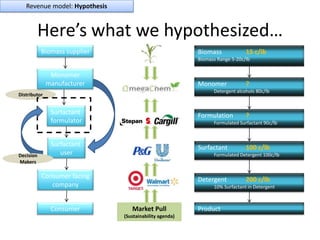
Revenue model: Hypothesis


        Here’s what we hypothesized…
           Biomass supplier                              Biomass             15 c/lb
                                                         Biomass Range 5-20c/lb


               Monomer
              manufacturer                               Monomer             ?
                                                               Detergent alcohols 80c/lb
Distributor


               Surfactant                                Formulation         ?
               formulator                                      Formulated Surfactant 90c/lb


               Surfactant                                Surfactant          100 c/lb
Decision          user                                         Formulated Detergent 100c/lb
Makers

           Consumer facing                               Detergent           200 c/lb
              company                                          10% Surfactant in Detergent


               Consumer           Market Pull            Product
                               (Sustainability agenda)
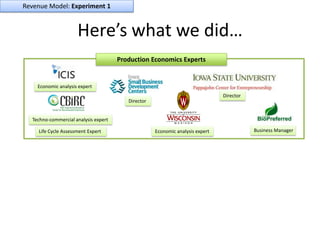
Revenue Model: Experiment 1


                     Here’s what we did…
                                      Production Economics Experts


    Economic analysis expert
                                                                               Director
                                         Director


  Techno-commercial analysis expert

    Life Cycle Assessment Expert                    Economic analysis expert              Business Manager
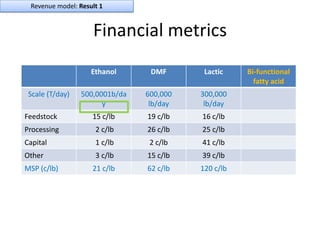
Revenue model: Result 1


                    Financial metrics
                    Ethanol      DMF       Lactic    Bi-functional
                                                       fatty acid
 Scale (T/day)   500,0001b/da   600,000   300,000
                       y         lb/day    lb/day
Feedstock           15 c/lb     19 c/lb   16 c/lb
Processing           2 c/lb     26 c/lb   25 c/lb
Capital              1 c/lb      2 c/lb   41 c/lb
Other                3 c/lb     15 c/lb   39 c/lb
MSP (c/lb)          21 c/lb     62 c/lb   120 c/lb
Revenue model: Result 1


                    Financial metrics
                    Ethanol      DMF       Lactic    Bi-functional
                                                       fatty acid
 Scale (T/day)   500,0001b/da   600,000   300,000
                       y         lb/day    lb/day
Feedstock           15 c/lb     19 c/lb   16 c/lb
Processing           2 c/lb     26 c/lb   25 c/lb
Capital              1 c/lb      2 c/lb   41 c/lb
Other                3 c/lb     15 c/lb   39 c/lb
MSP (c/lb)          21 c/lb     62 c/lb   120 c/lb
Revenue model: Result 1


                    Financial metrics
                    Ethanol      DMF       Lactic    Bi-functional
                                                       fatty acid
 Scale (T/day)   500,0001b/da   600,000   300,000
                       y         lb/day    lb/day
Feedstock           15 c/lb     19 c/lb   16 c/lb
Processing           2 c/lb     26 c/lb   25 c/lb
Capital              1 c/lb      2 c/lb   41 c/lb
Other                3 c/lb     15 c/lb   39 c/lb
MSP (c/lb)          21 c/lb     62 c/lb   120 c/lb
Revenue model: Result 1


                    Financial metrics
                    Ethanol          DMF            Lactic        Bi-functional
                                                                    fatty acid
 Scale (T/day)   500,0001b/da      600,000         300,000             ?
                       y            lb/day          lb/day
Feedstock           15 c/lb         19 c/lb         16 c/lb          15 c/lb
Processing           2 c/lb         26 c/lb         25 c/lb            ?
Capital              1 c/lb         2 c/lb          41 c/lb            ?
Other                3 c/lb         15 c/lb         39 c/lb            ?
MSP (c/lb)          21 c/lb         62 c/lb        120 c/lb        < 100 c/lb

                 Less than 100 c/lbis achievable when:
                 1. Large reactor with 500,000 lb/day capacity
                 2. Optimized fermentation and processing costs
Revenue model: Result 2


                               Payment Flow
           Biomass supplier                                Biomass             15 c/lb
                                                           Biomass Range 5-20c/lb


               Monomer
              manufacturer                                 Monomer             80 c/lb
                                                                 Detergent alcohols 80c/lb
Distributor


               Surfactant                                  Formulation         90 c/lb
               formulator                                        Formulated Surfactant 90c/lb


               Surfactant                                  Surfactant          100 c/lb
Decision          user                                           Formulated Detergent 100c/lb
Makers

           Consumer facing                                 Detergent           200 c/lb
              company                                            10% Surfactant in Detergent


               Consumer             Market Pull            Product
                                 (Sustainability agenda)

                Disposal            Regulations            Waste
Payment Flows Example
Payment Flows

         Clinical Diagnostic Services                Pharmaceutical Products


            Private
                                       Sales/order             Sales/order
          payer/MAC                    Payment                 Payment
                                       Service                 Service
$$
     Hospital / Clinic                                Pharmaceutical Company

         Pathologist/                                         Researchers
                                      Oncologist
            billing


                                                        $$                     Instr. /
                                                                               Kits
                 $$
                                      CanScan                 CanScan


                  Services rendered


                                                             Class 6 - Update 3.5.2012
Medical Device
Pricing Example
Graphene
Revenue Model Example
Payment flow
                     Researchers
                Add value     More work

Current TEM          Distributors
grid provider


                Graphene Frontiers


                Material supplier
Payment flow

   Electronic User

     Distributors


E-reader manufacturer      Parts suppliers


   Flexible display     Graphene Frontiers
   manufacturer


   Parts suppliers      Material      Research, cost
                        supplier
Direct Cost Estimates: Scale Matters
• Cost per in2 – 1” Furnace = $.80

• Cost per in2 – 2” Furnace = $.45

• Cost per in2 – 4” Furnace = $.20

If we can move to N (replacing Ar, key direct cost driver)
• Cost per in2 – 1” Furnace = $.50

• Cost per in2 – 2” Furnace = $.25

• Cost per in2 – 4” Furnace = $.10

“Holy Grail”: 4” or larger continuous production w/Nitrogen

Cost per in2 – 4” Furnace, Batch/Continuous = … $.05
Sensor
Pricing Tactics Example
Understand Economics of Plant + Sensors    Industrial Plants

Understand Economics of Technology Supplier      Plant #1


                                                 Plant #2


                                                 Plant #3


                 Technology Supplier


Who does this?
290
         Diaphragm                                             Membrane


                                             $240/MT Cl2
   Operational conditions
   Capital cost per incident
   Downtime per incident
   # of cells protected            Cost of damages + downtime per incident per year
   Time between incidents
   Number of cells, US and worldwide
                        Value per unit per year
          Diaphragm                  Membrane               Membrane Header
            $2,500                      $270                      $10,600
Soft product launch projected for Q1-Q2 2012
      General launch projected for Q4 2012

Diaphragm                      Membrane                  Membrane Header
 $2,500                             $270                        $10,600


          Year          Type               %     Revenue [/year]
           1      Innovators (US)          2.5      $271,500
          Operating costs for 1st year projected to be $350,000
           2       Early Adopters          16     $15,040,000
           3       Early Majority          50     $47,000,000
           4       Late Majority           84     $78,960,000


                  Full Penetration         100    $94,000,000


                                                                           291
Medical Device
Revenue Model Example
What we make


           Device cost
            (one time)

              ~$2000

Dental
                              Dentist
Optics
           Disposables
         ~$2.50 per patient
What the dentist normally makes
                                            $250
                                                               Insurance


                                                                          Membership
                                                       $250
                                                      Co-pay

                                            Dentist             Patient


                                                           Equipment / Variable Costs
Note: Assumes 50/50 copay-insurance split
What we’d add for the dentist
                                                                              Device creates
                                            $250                                additional
                                                               Insurance       periodontal
                                                                               procedures
                            Device cost
                             (one time)
                                                                          Membership
                               ~$2000                  $250
                                                      Co-pay
      Dental
                                            Dentist             Patient
      Optics
                            Disposables
                       ~$2.50 per patient


                                                           Equipment / Variable Costs
Note: Assumes 50/50 copay-insurance split
Farm Nitrate Sensor
Revenue Model Example
Economics of TSP Operation

Incentives:   Best case scenario $45.89/acre
     Worst case: $9.65/acre or state dependent 25% cost coverage


                          Install sensors, provide service

                                                                              400 acres, 4 soil
       Us
                   Pay for 2-3 year contract service monthly                  types: 8 sensors
                                                                   Small farm


   $3860 for 400 acre                                        Average $10.40 in N-
   nutrient management                                       fertilizer lost to
                                                             groundwater per acre
   $1K/sensor less
   incentive = $4140 to             USDA/EPA
   recover in contract
Economics of TSP Operation

Incentives:   Best case scenario $45.89/acre
     Worst case: $9.65/acre or state dependent 25% cost coverage


                          Install sensors, provide service

                                                                            400 acres, 4 soil
       Us
                   Pay for 2-3 year contract service monthly                types: 8 sensors
                                                                 Small farm


                                                   Onion Case Study (44K acres):
   $3860 for 400 acre                              Cost: DAP - $700/ton + $25/a
   nutrient management                             Rate: 280lb/a for 400a farm
   $1K/sensor less                                      = $39K
   incentive = $4140 to             USDA/EPA
   recover in contract                             30% Improvement: $13K saved
                                                   Charge: $6K/season
                                                       = $660K/yr contract revenue
Biofactories for Therapeutics
  Revenue Model Example
Revenue Model

                         = money              = relationship
                         = information        = AAT


                                                                          Patient

 Large Pharma                             Private Payor

                                                                     Employer

                                         Government Payor

Wholesalers
                   Hospital/Clinic
                                                 Government

                      Physicians

                                                               Taxpayer
                Pulmonary Function Lab    INFLUENCER
Optics Design Company
Revenue Model Example
™


                  Revenue Model & Payment Flows

                                                                          Customer:
                                                                         LED company
  LighTip™                   Engineering contract ($150-300/hour)
                                                                      Light source
  Advanced
                                         Quantity purchase of
  Illumination
                                   components for prototype &
  Engineering                                                       Reflector
                                          mass production .

                                                                                      Desired
                                                                                       target
                                    Key Partner:                                    Our
                                Optical Manufacturer                            deliverable
            Prototype & High Volume
            Production (0.25%-8%
                                                                    Customer’s final product
            commission)


5/23/2012                                                                              302
Complex Sensor Networks
 Revenue Model Example
Revenue Model and Customer
SET Sensor Node Product
                        Acquisition
                                           Middleware and
                                          Reusable Software
  OEM HW components                          Subsystems
  ($100 COGS)
SET’s price $400

                   Year 1:         Year 2:          Year 3:         Year 4:          Year 5:
                (3 Customers)   (10 Customers)   (30 Customers) (100 Customers)   (200 Customers)
                 1K nodes         5K nodes        30K nodes       200K nodes       400K nodes
                 $400K             $2M             $12M            $80M            $160M

 First target
 customers
 Leverage our partners’
 existing customers
Healthcare Software
Revenue Model Example
Revenue Model
                                                                 Health
           Healthcare                Patient Data
                                                                 Information
           Providers                                             Exchanges

Tailored Messaging
                                                    Portal $$$
for + Patient Outcomes
                                                                      Patient Data
              Patient Analytics
              $$$


                      Resources/To                               Health
                      ols                   Patient Profile      Insights


                           Patient
The Lean LaunchPad

       Lecture 7: Partners

Who are your Partners and Suppliers?


                                   Version 6/13/12
Key Partners
Who are your Partners and Suppliers?
© 2012 Steve Blank
What defines a “Partner?”


• Shared economics
• Mutual success / failure
• Co-development/invention
• Common customer


But remember - you’re a startup
Why Have Partners?


●   Faster time to market
●   Broader product offering
●   More efficient use of capital
●   Unique customer knowledge or expertise
●   Access to new markets


                                    311
Types of Partners


                    312
Partners – Strategic Alliances

• Reduce the list of things your startup needs to build or provide
  to offer a complete product or service.
• Use partners to build the “whole product”
   • using 3rd parties to provide a customer with a complete solution

   • complement your core product with other products or services

   • Training, installation, service, etc
  Example:
  In 1996, Starbucks partnered with Pepsico to bottle, distribute and
  sell the popular coffee-based drink, Frappacino


                                                             313
Partners – Joint Business Development

  • Joint promotion of complementary products
     • Share advertising, marketing, and sales programs
  • One may be the dominant player


    Example:
    Intel offered advertising fees to PC Vendors
Startup mistake
Strategic alliances and joint partnerships

     Not needed for Earlyvangelists
 Are needed for Mainstream customers


              Usually fail


                                    315
Partners – Coopetition

       • Joint promotion of competitive products
       • Competitors might join together in programs to grow
         awareness of their industry
            • Tradeshows
            • Industry Associations
Example:
Automotive Suppliers form the Automotive Industry Action Group (AIAG) - 900 members


                                                                    316
Partners – Key Suppliers

 • Outsource suppliers
      • Backoffice, supply chain, manufacturing
 • Direct suppliers
      • Components, raw materials, etc.


Example:
Apple builds the iPhone from multiple suppliers


                                                  317
Traffic Partners – Virtual Channels

• Long-term agreements with other companies
   • deliver long-term, predictable levels of customers
   • “Cross referral” or swapping basis
   • Paid on a per-referral basis
   • Partners drive traffic using text-links, with onsite promotions, and with
     ads on the referring site
   • Partners sometimes exchange email lists
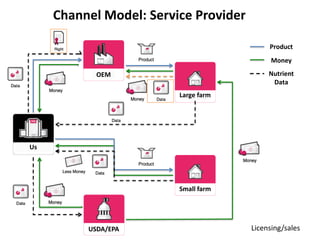
       http://medical-tools.com/dental/
Partner Risks


                319
Partnership Disaster: Boeing


                              Collaborative
                              Looked great
                              on paper.

                              Worst
                              business
                              decision of
                              the 21st
                              century


                        320
Managing partners - Risks


•   Impendence mismatch
•   Longest of partners schedule becomes your longest item
•   No clear ownership of customer
•   Products lack vision – shared product design
•   Different underlying objectives in relationship
•   Churn in partners strategy or personnel
•   IP issues
•   Difficult to unwind or end
Should I take an investment from a
         Large Company?

• They are interested in their bottom line, not yours
• Their objectives are not to make you a large company
• Who’s the sponsor? What’s the motivation?
   • Needs to come from the business side
   • Not the venture side
•Try to get sales deals not investment
• Or try to offer warrants based on sales success
Startup Partner Strategies

•   Don’t confuse partners for Earlyvangelists vs. mainstream
•   Don’t confuse big company partnering with startup strategy
•   Find the one that gives you an unfair advantage
•   Recognize you don’t matter to a large partner


                                                  323
Catalysts
Partner Examples


                   324
Thru-Pore Partners:
Technologies
             Hypothesis and Experiments

     Catalyst
    Companies
                   Research Catalysts, Inc.


     Contract
   Manufacturers


    Distributors
                                              T3
Materials Coating
Partner Examples


                    326
Molecular Diagnostics
 Partner Examples


                        331
Partners
  Back End                         Front End
 Sample Prep     Dx Test Company
(not for RUO)


                                                 Hospitals
   Chip
Manufacturers

                   LiquiLume                    Clinical Labs
  Packaging

   Reagents                                       Doctors
 (IDT, Fisher)

    OEMs           Distributors
                                               Research Labs
                     (Fisher)
Shippers (UPS,
    FedEx)
Back-End Partners

   Type          Examples                   Benefit               Risk / Need
Chip               HTE Labs        Make optofluidic chips (key   High / Critical
manufacturer                        element of technology)
Packaging             ?              Keep device costs low       Low / Essential
OEMs           Laser or detector     Parts needed to build         Low, Med /
                manufacturers        complete instrument            Essential
Reagents          IDT, Fisher      Provide custom probes and     Med / Essential
Supplier                                 control targets.
Sample Prep.       Qiagen           Partner for validation of      Low / Nice
Instrument                           input target samples
Front-End Partners

    Type             Examples                     Benefit                 Risk / Need
Distributor            Fisher                Sell chips, reagents        Low / Not critical
                                                                             for RUO
Research labs    UCSF oncologists,        Will validate technology;       Low / Critical
                 Stanford MDx Lab,        publish; develop assays         during phase I
                  UCSF Micro. Lab
Dx test             Genentech;            Possibly unique test on        Low / Synergistic
company           Companion Dx w         unique platform, partner
                pharma and biotechs;          develops assay
                Specialty Dx test cos.       Strategic alliance

Clinical labs      Quest, LabCorp        Help develop CLIA-waived          Med / Crucial
                                         application; 510(k); clinical    during phase II
                                                    trials
Complex Sensor Networks
   Partner Examples


                     335
Universe of Partners
Sensor device/network co’s           Embedded platform makers


                               SET


                    Application specialists
Potential Partnerships
Sensor device/network co’s           Embedded platform makers


                               SET


                    Application specialists
Medical Device
Partner Examples
The Lean LaunchPad

        Lecture 8:
Resources, Activities & Costs


                                Version 6/22/12
Key Activities
What’s Most Important for the Business?
© 2012 Steve Blank
Key Resources
What’s Are Your Most Important Assets?
Cost Structure
What are the Costs and Expenses
© 2012 Steve Blank
How You Make Money

       <
Key Resources
Four Critical Resources

•   Physical
•   Financial
•   Human
•   Intellectual
Physical Resources


• company facilities
  – office space, company location
• product/services
  – supply of silicon wafers or iron ore, or
    thousands of feet of warehouse space?
• Many physical goods are capital intensive
Financial Resources

•   Friends and Family
•   Crowdfunding
•   Angels
•   Venture Capital
•   Corporate partners
•   Others: SBA or SBIR grants
•   Lease-lines
•   Factoring
•   Vendor-financing
Human Resources

• qualified employees
• mentors, teachers, coaches, advisors
Mentors, Teachers, Coaches

• Mentors, teachers, coaches advance your
  personal career
  – If you want to learn a specific subject find a teacher
  – If you want to hone specific skills or reach an exact
    goal hire a coach
  – If you want to get smarter and better over your career
    find someone who cares about you enough to be a
    mentor
Advisors

• Advisors are people you need to help advance
  your company’s success
  – Founders fail when they believe their visions are facts
  – Listening to experienced advice can help you sort
    through whether your vision is a hallucination
  – Getting an advisory board (by expanding your circle
    of accumulated wisdom past their investors) is so
    important that it’s an explicit step in the Customer
    Development process
Qualified Employees/Culture

• Are the difference between a good idea that
  never went anywhere and a billion dollar firm
MBA295F
Customer Development
                  36
Executive Traits by Stage
                    Entrepreneurial-       Mission-Oriented     Process-Managed
                    Driven Learning and    Management           Execution and Growth
                    Discovery
Personal            Superstar              Leader               Manager of plans,
Contribution                                                    goals, process, and
                                                                personnel

Time Commitment     24/7                   As needed            Long term 9 to 5

Planning            Opportunistic and      Mission- and goal-   Process-, and goal-
                    agile                  driven               driven

Process             Hates and eliminates   As needed, driven Implements and uses
                                           by mission
Management Style    Autocratic, star       Distributed to       May be bureaucratic
                    system                 departments

Span of Control     Hands-on               Mission-driven,      Distributed down the
                                           synchronized         organization

Focus               High and passionate    Mission              Execution
                    vision
Uncertainty/Chaos   Brings order out of    Focuses on fast      Focuses on
                    chaos                  response             repeatability
Executive Traits by Stage
Intellectual Property
Trademark protects branding & marks

•    Trademark gives you the right to prevent others from
     using “confusingly similar” marks and logos
•    Trademark protection lasts as long as you use the mark
•    The more you use the mark, the stronger your protection
•    Trademark registration is optional, but has significant
     advantages if approved
•    Country by country
Copyright protects creative
              works of authorship
• Copyright gives right to prevent others from copying,
  distributing or making derivatives of your work
     – Protects “expressions” of ideas but does not protect the
       underlying ideas
• (Way) more than just technology:
     – songs, books, movies, photos, etc.
• Copyright protection lasts practically forever
• Copyright does not prevent independent development
• Registration is optional, but is required to sue for
  infringement
Trade Secrets

• Information that is kept secret and has economic
  value to the business
• Coke recipe, customer lists, product road maps.
• No registration required
• Can last for as long as you take reasonable
  steps to keep confidential
Contract
• Protection agreed to by contract
• No registration process
• You have whatever protection is defined in the contract
  (e.g., NDA gives you certain rights to protection of your
  confidential information)
• The protection lasts for the time period defined in the
  contract
Patents
• A government granted monopoly
   – prevents others from making, using or selling your invention
   – Even if the other’s infringement was innocent or accidental
• Invention must be non-obvious
• Protection lasts typically for 15-20 years
• Application and examination is required
   – Typical cost for application and exam is $10-30k
   – Typical time for application and exam is 1-4 years
• Must file in U.S. within one year of sale, offer for sale,
  public disclosure or public use
• Provisional application alternative
What Can be Patented?
• Just about anything . . .
   – Circuits, hardware
   – Software, applied algorithms
   – Formulas, designs
   – User interfaces
   – Applications, systems
   – Business processes (sometimes)
• But not these . . .
   –   Scientific principles
   –   Pure mathematical algorithms
• And, pending Supreme Court Case raises concerns regarding
  patentability of “methods” inventions
Costs
Metrics that Matter
Search vs. Execution Metrics
• Existing companies execute plans
• Startups search for them
• Income Statement, Balance Sheet, etc are
  execution documents
• You first need to derive the metrics that matter
Metrics That Matter
• Value proposition: product cost, mkt size/share, competition?
• Customer Relationships: customer acquisition costs, conversion
  rates, lifetime value?
• Market Type: revenue curves
• Operating Costs: basic operating costs of the business?
• Channel: Channel margin, promotion, shelf-space charges?
• Revenue Streams: average selling price, # of customers/year,
 achievable revenue?
• Burn Rate: per month? When will the company run out of cash?
Life Science
Intellectual Property Example
Intellectual Property

       Does           Y         Does           Y          Will they         Y
      Harvard                  Harvard                    license it
      own it?                  want it?                     to us?
       N                        N                            N

                                                                                     Proceed with
                                                        Extreme Pivot                patent filing
                                                                                       and pre-
                                                                                     clinical trials
                                                                           N
                 Does                         Does                      Will they
                Berkeley            Y        Berkeley           Y       license it         Y
                own it?                      want it?                     to us?
                  N                            N

Meeting with Berkeley Technology Transfer at LBNL (This Week)
Meeting with Harvard Technology Office (Next Week)
                                                                        Class 7 - Update 3.12.2012
Robotic Agriculture
Resource, Activities Example
We’ve hit our first milestones
                                                                                    Mar 2013
Jun 2011                 Dec 2011                     Jun 2012                      First unit
Technology Track

           Post-processed        Real-time                                        First unit
                                                  Prototype
           Image recognition     image
                                 recognition
Customer Discovery Track

               Select 1st        Testing agreement Customer trial and
               target crop       with top producer customer order
Finance Track

  Friends and                    Seed Round                   Series A
                    Applied
  family round      for grants


           $125 K                       $800 K                           $3-5 M
           F&F                          Seed                             Series
                                                                         A
                                               Confidential
Medical Device
Resource, Activities & Cost Example
Apple
Resource, Activities & Cost Example
Product User            Digital Hub      Digital Lifestyle            Digital Platform
   PARTNER                  KEY          VALUE                 CUSTOMER          CUSTOMER
   NETWORK             ACTIVITIES      PROPOSITON            RELATIONSHIPS       SEGMENTS
                        build whole                           differentiated
    component                                                                     High-end
                       devices both     solutions for            markets
makers, shipping &                                                               mass market
 logistic suppliers      h/w & s/w     differentiated
                                        customers -
                                       professional &
                                         consumer


                            KEY                              DISTRIBUTION
                      brand - Apple,
                       RESOURCES                               CHANNELS
                       PowerMac,                             online store
                          iMac


                COST STRUCTURE                                 REVENUE STREAMS
                                                Computers,
 Invest in
                                                software &
   R&D
                                                 services
Product User            Digital Hub      Digital Lifestyle            Digital Platform
   PARTNER                  KEY          VALUE                 CUSTOMER          CUSTOMER
   NETWORK             ACTIVITIES      PROPOSITON            RELATIONSHIPS       SEGMENTS
                        build whole                           differentiated
    component                                                                     High-end
                       devices both     solutions for            markets
makers, shipping &                                                               mass market
 logistic suppliers      h/w & s/w     differentiated
                                        customers -
                                       professional &
                                         consumer


                            KEY                              DISTRIBUTION
                      brand - Apple,
                       RESOURCES                               CHANNELS
                       PowerMac,                             online store
                          iMac


                COST STRUCTURE                                 REVENUE STREAMS
                                                Computers,
 Invest in
                                                software &
   R&D
                                                 services
Product User
   PARTNER                 KEY               VALUE                 CUSTOMER          CUSTOMER
   NETWORK               ACTIVITIES        PROPOSITON            RELATIONSHIPS       SEGMENTS
 component               build whole                                                  High-end
   makers                                   solutions for         differentiated
                        devices both       differentiated            markets         mass market
                          h/w & s/w         customers -
    Shipping &                             professional &
      logistic                               consumer
     suppliers


                            KEY                                  DISTRIBUTION
                      brand - Apple,
                       RESOURCES                                  CHANNELS
                       PowerMac,
                                                                 Wholesalers,
                          iMac
                                                                 retailers, re-
                                                                    sellers
                              innovative                              online store
                              designers
                    IP & patents
                         &
                    agreements

                 COST STRUCTURE                                   REVENUE STREAMS
                                                    Computers,
    Invest in
                                                    software &
      R&D
                                                     services
Product User         Digital Hub
   PARTNER             KEY           VALUE        CUSTOMER         CUSTOMER
   NETWORK           ACTIVITIES    PROPOSITON   RELATIONSHIPS      SEGMENTS


                       KEY                      DISTRIBUTION
                    RESOURCES                    CHANNELS


               COST STRUCTURE                    REVENUE STREAMS
Product User         Digital Hub     Digital Lifestyle
   PARTNER             KEY           VALUE             CUSTOMER             CUSTOMER
   NETWORK           ACTIVITIES    PROPOSITON        RELATIONSHIPS          SEGMENTS


                       KEY                               DISTRIBUTION
                    RESOURCES                             CHANNELS


               COST STRUCTURE                             REVENUE STREAMS
Product User         Digital Hub     Digital Lifestyle           Digital Platform
   PARTNER             KEY           VALUE             CUSTOMER             CUSTOMER
   NETWORK           ACTIVITIES    PROPOSITON        RELATIONSHIPS          SEGMENTS


                       KEY                               DISTRIBUTION
                    RESOURCES                             CHANNELS


               COST STRUCTURE                             REVENUE STREAMS
The Customer Development
        Manifesto
      15 Rules to Live By
A Startup is:
       A temporary organization
          designed to search
for a repeatable and scalable business
                model
1. There are No Facts Inside Your Building
2. Pair Customer Development with
         Agile Development
3.Failure is an Integral Part of Search
4. Continuous Iteration and Pivots
5. No Business Plan Survives First
    Contact with Customers
6. Validate Hypotheses with Experiments
7. Market Type Changes Everything
8. Startup Metrics are Different
9. Fast and Fearless Decision-Making
9. Cycle Time, Speed and Tempo
10. Startup Job Titles Are Very
Different from a Large Company’s
11. Preserve Cash While Searching
12. Spend When It’s a Repeatable Model
13. Communicate and Share Learning
14. Startups demand Comfort with
Chaos, Uncertainty and Change
15. It’s Not A Job, It’s All About Passion
Delft climate kic 070212 part 2

Delft climate kic 070212 part 2

  • 1.
    How to FailLess Business Models and Customer Development Steve Blank www.steveblank.com @sgblank
  • 2.
    Agenda – DayOne • 9:00 - 11:00 Introduction to Customer Development • 11:00 - 11:30 break • 11:30 - 13:00 value proposition customer segments • 13:00 – 14:30 lunch working session Students prepare first version of business model canvas • 14:30 – 16:00 Student presentation of business model canvas • 16:00 – 16:15 break • 16:15 – 17:00 distribution channels
  • 3.
    Agenda – DayOne • 9:00 - 11:00 Introduction to Customer Development • 11:00 - 11:30 break • 11:30 - 13:30 value proposition customer segments • 12:30 – 13:30 lunch working session Students prepare first version of business model canvas • 13:30 – 15:00 Student presentation of business model canvas • 15:00 – 15:15 break • 15:30 – 16:30 distribution channels Homework: 1) update your canvas 2)develop a customer discovery action plan
  • 4.
    Agenda – DayTwo • 9:00 - 10:30 Student presentations on customer discovery action plan • 10:30 - 11:30 customer relationships (get/keep/grow) • 11:30 – 12:00 break • 12:00 - 13:00 revenue streams • 13:00 – 14:00 lunch working session Students present • 13:30 – 14:15 partners • 14:15 - 15:00 resources, activities, costs • 15:00 – 15:15 break • 15:30 – 16:30 Customer Development Manifesto
  • 5.
    The Lean LaunchPad Lecture 4: Distribution Channels How does your Product Get to Customers? Version 6/22/12
  • 6.
    Channels How does yourProduct Get to Customers?
  • 7.
  • 8.
    Who Are Our Customersand How Do We Reach Them
  • 9.
  • 11.
    How Do YouWant Your Product to Get to Your Customer?  Yourself  Through someone else  Retail  Wholesale  Bundled with other goods or services 11
  • 12.
  • 13.
  • 14.
    How Does YourCustomer Want to Buy Your Product from your Channel?  • Same day  • Delivered and installed  • Downloaded  • Bundled with other  products • As a service  • … 14
  • 15.
    Types of Channels Direct Indirect Licensing – OEM – VAR – Reseller – Distributor 15
  • 16.
    Distribution Complexity Global Systems Evangelists Systems Integrators WANs Mainframes Marketing Complexity Direct Sales Minis LANs VARs PC Servers Desktop PCs Retail Printers Keyboards Web, Telesales Service Technicians Toner Solution Complexity 16
  • 17.
    How Do theEconomics Work in Different Sales Channel?
  • 18.
    How Are ChannelsCompensated? – Commission – Percentage of sales price – Discounted pre-purchase 18
  • 19.
    Channel Economics: “Direct”Sales List Your Revenue Price End Consumer Discounts Cost of Goods EU Profit + SG&A + R&D (Supply Chain) Source: Mark Leslie, Stanford GSB 19
  • 20.
    Channel Economics: Resellers List Your Revenue Price End Consumer Discounts Cost of Goods EU Profit + SG&A + R&D Reseller (Supply Chain) Source: Mark Leslie, Stanford GSB 20
  • 21.
    Channel Economics: Distributors/Resellers List Your Revenue Price End Consumer Distributor Discounts Cost of Goods Profit + SG&A + EU Reseller (Supply Chain) R&D Source: Mark Leslie, Stanford GSB 21
  • 22.
    The Channel asa Customer – Some products are embedded in others (OEM) – Some products are resold by others (VARs) – Some products are distributed by others – Who’s the customer? 22
  • 23.
    Channel Economics: OEMor IP Licensing List Your Revenue Price End Consumer Cost of Distributor Distributor Discounts Master Goods Profit + SG&A + EU Reseller (Supply R&D Chain) Cost of Goods Profit + SG&A Reseller (Supply + R&D Chain) Your Product Becomes Your Customer’s Cost of Goods Source: Mark Leslie, Stanford GSB 23
  • 24.
    How Are ChannelsMotivated or Incented? – Money! – what makes them the most? – Training – Marketing to the channel – SPIF 24
  • 25.
  • 26.
    Example: Book Publishing National Publisher Printer Wholesaler Retailer Customer Distributor 26
  • 27.
    Book Publishing National Publisher Distributor Retailer Customer Wholesaler •Percent of 35% 15% 10% 40% Retail $7.00 $3.00 $2.00 $8.00 $20.00 • You get -35% of retail - the distributor gets 10% - the wholesaler gets 15% - the retailer gets 40% -less any discount they offer the customer 27
  • 28.
    Book Publishing Economics National Publisher Wholesaler Retailer Customer Distributor Allowances Wholesale costs Bills Markup Credit guarantees Payment guarantees Payment guarantees Return rights Credits Payments 28
  • 29.
    Book Publishing Delivery National Publisher Printer Wholesaler Retailer Distributor Prepare film Receive (content)  Schedules  Print orders Determine Merchandise  Bundle allocations titles counts  Film Sell Deliver orders magazines  Establish Prepare galleys Print and ship identity magazines  Create demand Dispose of Acknowledge returns returns 29
  • 30.
  • 31.
    Product flow/Channel Electronic Partners/ Health Fluid Synchrony OEMS Records Electronic Support Pump + Bundled Records Services Controller Kits Hospitals (Anesthesiologists Patients Neurosurgeons) Pain Clinic (Anesthesiologists Neurosurgeons)
  • 32.
    Hospitals Pain Clinics Channels (Direct) • Direct to institutions • Some formularies involved in purchase decisions • Some doctors make purchase decision directly • Device company/Doctor relationship is key • Heavily influenced by : • Clinical study results • Regulatory approval • Reimbursement
  • 33.
    Farm Sensor Industry Channel Example
  • 34.
    Channel Model: ServiceProvider Product Money OEM Nutrient Data Large farm Us Small farm USDA/EPA Licensing/sales
  • 35.
    Channel Model: ServiceProvider Product Money OEM Nutrient Data Large farm Product Us Small farm Service USDA/EPA Licensing/sales
  • 36.
  • 37.
    COST / PROFITANALYSIS Licensing Revenue Model Per unit cost and profit estimation Our revenue 4-8% revenues List price End user Univ. Manufacturing Maintaining Raw License R&D License & Distribution IP fee materials fee Packaging 37
  • 38.
    Licensing of TechnologyEcosystem University Insurance Agencies 2-4% license fee $$$ DMX R&D Products Procedures Health-Care IPs Providers: $$ End 4-8% royalty Hospitals User ~$40 Practitioners Customer Clinics segment: Large corporations J&J, GSK, 3M 38
  • 39.
  • 40.
  • 42.
  • 43.
    Channels Direct Sales Big Distributors Private Practice Institutional Purchasing Dentist Dentist Department
  • 44.
    Channels Direct Sales Big Distributors 80% Market Share 30% Margin Private Practice Institutional Purchasing Dentist Dentist Department
  • 45.
    Channels Continuing Education Magazines Trade Courses & Email Shows Direct Sales Big Distributors 80% Market Share 30% Margin Private Practice Institutional Purchasing Dentist Dentist Department
  • 46.
  • 47.
    PM Tools Rentpost.com Listings Rentjuice.com Provider Buildium.com Craigslist Rentingsmart.co Potential Padmapper.com Propertyware.com Landlords Rent.com Apartment.com propertymanagemnt360 Show, Advise, Valuate Forrent.com Rentjuice.com Realtors Propertyware.co Trulia.com Sell, Advise Credit Checks Landlords Safetenantcheck.c Erenter.com Buildium.com Property Listings, Managers Checks Payment Facilitator Maintenance Rent Payment Listings, Rentpayment.com Ratings Checks Clearnow.com Rent Payment Yelp.com Tenants Online Cheque Angie’s List Rentingsmart.co Maintenance Furnishing Moving Find information Maintenance Finding Service Zoospi.com Providers Redbeacon.com Taskrabbit.com Servicemagic.com Schedule Tools Setster.com Web Info Zoospi.com 47
  • 48.
  • 49.
    COST / PROFITANALYSIS Direct Sales Revenue Model Our revenue $27 List price $40 * Per unit cost and profit estimation %32 cut End user Raw active Manufacturing & Profit + R&D + License Distributor ingredient Packaging fee $6 ? ($5) ~$11 ~$13 * Competition • NuProprophy paste (Novamin$50) • NuPro desensitizer (Novamin$93) • MI varnish (Recaldent$100) • Gluma desensitizer (Glutaraldehyde$130) • Health-Dent desensitizer (Fluoride $49) 49
  • 50.
    Direct Sales Ecosystem R&D & University Insurance Regulation Agencies $? $$?? Raw Materials Manufacturing $6/pk DMX R&D Products Customer $5/pk Procedures Segments; Formulations IPs Health-Care $$?? End &Packaging -32%($27) Providers: User - Hospitals Product - Practitioners Sales & $40/pk - Clinics Distribution 50
  • 51.
  • 52.
    • F-dopa iodoniumintermediate • F-dopamine iodonium intermediate Precursor Synthesis Reagents • ABX • Siemens Explora GMP • Eckert & Ziegler Precursor in Cassette Cassette • GE MX module for TracerLab Components • Eckert & Ziegler • Synthra GMP • Siemens Explora Cassette (device) Compliant • Neoprobe • TracerLab/ GE Synthesizer • Siemens PETNet • GE Amersham PET Drug • Cardinal Health Finished product Distributor • AAA • Iason 52 I-Corps Final Presentation 12/14/11
  • 53.
  • 54.
  • 55.
    Travel Services: Impact ofChanging Technology
  • 56.
    The Advent ofGDS Systems (1980 -1995)
  • 57.
    Turning the ScreenAround Online Travel (1995-2010)
  • 58.
    The Lean LaunchPad Lecture 5 Customer Relationships How Do You Get/Keep/Grow Customers? Version 6/13/12
  • 59.
    Customer Relationships How doyou Get, Keep and Grow Customers?
  • 60.
  • 61.
    Customer Relationships Physical &Web Mobile Are Different © 2012 Steve Blank
  • 62.
    Customer Relationships Physical Products– Get Customers © 2012 Steve Blank
  • 63.
    Customer Archetypes Drive Get/Keep/Grow Lab Manager: Brian • What’s their role? – How this person is evaluated / promoted / compensated? • Who are they? – Buyer’s name – Position / title / age / sex • How do they buy? – Discretionary budget (name of budget and amount) • What matters to them? – What motivates them? • Who influences them? – What do they read/who do they listen to?
  • 64.
    Paid Demand CreationActivities “Paid” Media Demand Creation • Public Relations • Advertising • Trade Shows • Webinars • Email marketing • On-line SEM • Biz Dev
  • 65.
    Free Demand CreationActivities “Earned” Media Demand Creation • Publications in journals • Conference speeches/papers • Educational seminars • Public relations • Blogging / Sharable content • Social Media • Communities
  • 66.
    Customer Relationships Physical Products– Get Customers © 2012 Steve Blank
  • 67.
    Customer Relationships Physical Products– Get Customers CAC = Customer Acquisition Cost © 2012 Steve Blank
  • 68.
    Customer Acquisition Costversus Sales Complexity No Touch Light Touch High Touch Field Sales Freemium Field Sales Self-Service Inside Sales Inside Sales with SE’s Rough Estimates of Cost of Customer Acquisition (CAC) $0- $50 – $1,000 - $3,000 - $25,000 – $75,000 – $10 $200 $2,000 $8,000 $75,000 $200,000 Source: David Skok Matrix Partners
  • 69.
    Customer Relationships Physical Products– Keep Customers © 2012 Steve Blank
  • 70.
    Customer Relationships Physical Products– Keep Customers Attrition/Churn © 2012 Steve Blank
  • 71.
    Customer Relationships Physical Products– Grow Customers © 2012 Steve Blank
  • 72.
    Customer Relationships Physical Products– Get/Keep/Grow LTV = Customer Lifetime Value © 2012 Steve Blank
  • 73.
    Customer Relationships Web/Mobile Products–Get Customers © 2012 Steve Blank
  • 74.
    Web/Mobile Products– Get Customers CPM = cost per thousand hits © 2012 Steve Blank
  • 75.
    Web/Mobile Products– Get Customers CPA = Cost per Action © 2012 Steve Blank
  • 76.
    SaaSProducts– Get Customers Organic Traffic, SEM, Oth er Paid Sources Registered Visitors Raw Leads Qualified Leads Inside Sales Closed Deal © 2012 Steve Blank
  • 77.
  • 78.
    Our Example MarketingFunnel Quick Marketing Calculation 50% amount of traffic that is organic versus paid $1.50 cost per paid visitor (Google AdWords, etc.) $ 0.75 Cost per visitor (both paid and unpaid) 3% visitors convert to raw leads 20% number of raw leads that turn into qualified leads 1 qualified lead 5 raw leads required 167 visitors required $125 Cost of visitors (also = Cost per qualified lead) Source: David Skok Matrix Partners
  • 79.
    Our Example MarketingFunnel Quick Marketing Calculation 50% amount of traffic that is organic versus paid $1.50 cost per paid visitor (Google AdWords, etc.) $ 0.75 Cost per visitor (both paid and unpaid) 3% visitors convert to raw leads 20% number of raw leads that turn into qualified leads 1 qualified lead 5 raw leads required 167 Visitors required $125Cost per qualified lead Source: David Skok Matrix Partners
  • 80.
    Our Example MarketingFunnel Cost per Qualified Lead $125 Leads to closed deal 10 Marketing Costs per closed deal $1,250 Source: David Skok Matrix Partners
  • 81.
    We Can ComputeCAC and LTV Excludes people costs Lead Gen costs per deal $ 1,250 (Cost per qualified lead x no of leads required per closed deal) Selling costs per deal $ 1,620 Excludes cost of sales management Excludes people costs in marketing, and Total CAC $ 2,870 sales management. (CAC= Cost to Acquire a Customer) Calculated by dividing average monthly Total LTV $ 16,000 gross profit per customer (ARPU x Gross Margin ) by the churn rate This excludes people costs in marketing, and sales management costs Source: David Skok Matrix Partners
  • 82.
    Balancing CAC/LTV ina SaaS model LTV >3x CAC Months to recover CAC <12 months Required for Capital Efficiency Source: David Skok Matrix Partners
  • 83.
    What Investors areLooking For A well balanced business model Monetization (LTV) Cost to Acquire a Customer (CAC) Source: David Skok Matrix Partners
  • 84.
    The Balancing Act • Viral effects • Inbound Marketing • Free or Freemium • Open Source • Free Trials • Touchless conversion • Inside Sales • Channels • Strategic partnerships Cost to Acquire a Customer Monetization (CAC) (LifeTime Value LTV) • Scalable Pricing • Cross Sell/Upsell • Product line expansion • Lead Gen for 3rd parties Source: David Skok Matrix Partners
  • 85.
    The Balancing Act • Viral effects • Inbound Marketing • High Churn Rates • Free or Freemium • Open Source • Low customer • Free Trials satisfaction • Touchless conversion • Inside Sales • Channels • Strategic partnerships Cost to Acquire a Customer Monetization (CAC) (LifeTime Value LTV) • Field Sales • Scalable Pricing • Cross Sell/Upsell • Outbound • Product line expansion Marketing • Lead Gen for 3rd parties Source: David Skok Matrix Partners
  • 86.
    Customer Relationships Web/Mobile Products–Keep Customers © 2012 Steve Blank
  • 87.
    How Churn affectsLTV • Average customer lifetime in months = 1 / Monthly Churn Source: David Skok Matrix Partners
  • 88.
    How Churn affectsLifetime Months Lifetime vs Churn Rate 120 100 100 80 60 50 40 20 20 0 Monthly Churn 1% 2% 5% Source: David Skok Matrix Partners
  • 89.
    How Churn affectsLTV Lifetime Value Monthly Churn Source: David Skok Matrix Partners
  • 90.
    Impact of loweringChurn Cumulative Net Profit Net Profit $7,000,000 $1,200,000 $6,000,000 $1,000,000 $5,000,000 $4,000,000 $800,000 $3,000,000 $600,000 $2,000,000 $400,000 $1,000,000 $200,000 $- Month 1 Month 3 Month 5 Month 7 Month 9 Month 11 Month 13 Month 15 Month 17 Month 19 Month 21 Month 23 Month 25 Month 27 Month 29 Month 31 Month 33 Month 35 $(1,000,000) $- $(2,000,000) $(200,000) $(3,000,000) $(400,000) $(4,000,000) Churn 1.25% Churn 2.5% Churn 1.25% Churn 2.5% • Impact of lowering the churn rate is felt more heavily in the later years, as expected • It has a significant impact on the long term profitability of the business Source: David Skok Matrix Partners
  • 91.
    Churn • 1% to2.5% churn per month is acceptable • Higher than that, you are filling a leaky bucket – Need to understand why you have low customer satisfaction and address the problem Source: David Skok Matrix Partners
  • 92.
    Customer Relationships Web/Mobile Products–Grow Customers © 2012 Steve Blank
  • 93.
    Customer Relationships Web/Mobile ProductsGet/Keep/Grow © 2012 Steve Blank
  • 94.
  • 95.
    Demand generation planand budget • Word of mouth generation – 2 systems for “Demo day events” – 2 systems for customer demos – 4 x 30K each = $120,000 • World Ag Expo Booth – 1 x 40x40 corner booth with demo – Hold press event breakfast – $ 15 K (booth, banners, hotels) • Magazine campaign – 3 ads in 2 magazines – Goal – get 2 articles on us – 2 x $ 10K + Ad agency = 30K • Total $165 K “You prove that it works and everything else is easy. Distribution is not that complicated in farming.” – Wyatt Duncan, Integrated Crop Pest Control
  • 96.
  • 98.
  • 99.
  • 100.
  • 101.
  • 102.
  • 103.
  • 105.
  • 106.
    • We rana Facebook ad to test actual willingness2 to pay for this service 107
  • 107.
    • To testwillingness to pay we used three 2 identical ads with three different landing pages 108
  • 108.
    • To testwillingness to pay we used three 2 identical ads with three different landing pages Ad Sign-ups Clicks Ad spend Free 0 23 $25 $1/household 0 25 $25 $1/user 0 24 $25 • Unfortunately, test results only proved users did not trust our site for payments • Facebook traffic on this campaign was on our page for 4 seconds on average • Roommate campaign had a 1:37 site time average • Outstanding question: can we win trust in other ways and then engage users to pay rent through us? 109
  • 109.
    • Customer archetype:Sara How she searches  Wants to be efficient (will use a broker if doing a search on her own is too painful)  Asks friends for recommendations What Matters to Sara  Wants to live in a fun place that is safe  Doesn’t want to overpay  Doesn’t have much time to hunt for a place  Live with someone she trusts (moving to DC) Influences  Where friends go out/live  Work location 110
  • 110.
  • 111.
    What We Did:Landing Page + Web App
  • 112.
    What We Found:High referral traffic 4 day progress report Overall Signup progress 1258 31 filled 5- 136 min survey 10.8%
  • 113.
    What we did:Targeted women, all couples Demand generation test Hypothesis: Women-in-relationships are likelier to click through, irrespective of distance status Tested for $30 Facebook click through & conversion from FB impressions Ad-1 Ad-3 Ad-2 Ad-4
  • 114.
    What we found:women click more ...................................but not clear who will pay! Couples will pay subscription if they find more sharing Subscription model test 1 during free trial valuable LDRs 1 6 Takeaway: “More sharing” without convenience will Paid have to be free. SLRs 4 Good if free Women likelier to click through irrespective of distance Demand generation test II status Click LOCATION Impressions Through Men Women Women-in-rel rates 87140
  • 115.
    What we found:Clicks, no web app usage Demand generation test Funnel: “Couples” campaign $ 29.7 this week 304,286 0.01 c impressions 122 uniques 0.35 c/new 85 new 24.6% conversion 30 sign-up 0.99 c clicks but one used web app
  • 116.
  • 117.
    Year 1 Web funnel Year 5 100 000 hits Referenced to our web site 300 000 hits 50% 70% Fill out savings calculator 20% 30% Send request to sales 30% 30% Reconnection with viable customer 80% 80% Visit to site 10% 20% Close sale Total Revenue Total Revenue 1.44 million 18.14 million
  • 118.
  • 119.
    Success Depends onVirality> Churn Ratio of early stage viralityrate to churn rate = 2.00x
  • 120.
    Success Depends onVirality>Churn Ratio of early stage viralityrate to churn rate = 1.50x
  • 121.
    Success Depends onVirality>Churn Ratio of early stage viralityrate to churn rate = 1.0x
  • 122.
    Demand creation viawebsite 1 2 3 “Not a landing page” Doesn’t show the No Indonesian version product
  • 123.
    Demand creation viawebsite - results Clicks CTR 100 74 2.00% 1.56% 68 1.25% 50 22 1.00% 0.59% 0 0.00% 1 2 3 1 2 3 People need to use the product CPC for us to maximize Conversions per click learning 1.5 1.34 6.00% 4.05% 1 0.62 4.00% 2.94% 0.54 0.5 2.00% 0.00% 0 0.00% 1 2 3 1 2 3
  • 124.
    Software Reference Tool CustomerRelationships Example
  • 125.
  • 126.
    AB Testing Results 0%conversion 42% conversion 75% conversion 32% conversion • Original Peaya website has 66% conversion rate • Conversion defined as people clicking the download button on the landing page • Experiment still underway; too few data points for drawing conclusions
  • 127.
    Google &Facebook campaigns •Keywords: free endnote, reference manager, pdf manager, Itunes for digital content, I tunes, manage pdf, organize paper, paper manager, citation manager, paper citation, cite pdfs • 24 impressions, 2 clicks on googleadwords • Clicks on free endnote and organize paper • No Facebook response • 1 Post on ResearchGate drew 7 visitors
  • 128.
    We’re “a little”viral 12% of sign-ups from referrals 14 of 117 new registrations came from referrals by 3 people from Jan 1 to Feb 1. Referral bonus promoted in tutorial
  • 129.
    Collaboration doesn’t “pop”….yet “Rate & Discuss” is least interesting tutorial screen so far However: 1) we can test different messages (ie “collaborate”) 2) experiment is slightly biased in ordering, we need further testing
  • 130.
  • 131.
    Search Keywords Lesson Learned: Verylittle search traffic -> a “missionary” sales effort
  • 132.
    Highly Competitive Keywords LessonLearned: AdWords (paid SEM) is not going to be an efficient channel with these keywords
  • 133.
  • 134.
    ChannelIncentives VP All Institutions Out-patient care/ Per Service High Value home setting Revenue Model Therapies Hospitals Private Dosing flexibility Hospitals, specialty clinics Efficient patient Pain Clinics management In-patient care/ Per Diem hospitalization Pharmacoeconomics Revenue Model HMO, ACO, Non- profit, University Hospitals
  • 135.
    Demand Creation Patients/Advocacy Groups Conferences / Trade magazines / PR Societies conferences $20k/event * 6 events $20k/event * 4 events Research Journal One on one Meetings $150k/year travel Adoption Publications (Free) Budget ~ $300 k/year
  • 136.
    NSF I-Corps The Lean LaunchPad Lecture 6: Revenue Streams How Do You Make Money? Version 6/22/12
  • 137.
    Revenue Streams How doyou Make Money?
  • 138.
  • 139.
    The Two KeyQuestions • What’s my revenue model? • Within the revenue model – how do I price the product?
  • 140.
    Revenue Model = the strategy the company uses to generate cash from each customer segment
  • 141.
    Revenue Streams 1. Howmany will we sell? 2. Where/who is the money coming from? 3. How do we price the product? 4. Does this add up to a business worth doing?
  • 142.
    How Many WillYou Sell? • What’s the Market Size & estimate of Market Share? • How many can your channel sell? • How much will the channel cost? • How many customer activations? • Revenue? Churn/Attrition rate? customers/? • How much will it cost to acquire a customer? • How many units will they buy from each of these efforts? Top down: 10% of a million-person market=100,000 customers Bottom up: 1,000 customers/month 1st year => 3,000/month 3rd year
  • 143.
    Where is themoney coming from? Revenue Model Choices Channel Web Physical  Direct Sales  Direct Sales  Products  Products  Subscription Bits  License  Add-on services  Subscription  Upsell/Next Sell  Upsell/Next Sell  Referrals Product  Direct Sales  Ancillary Sales:  Products •Referral revenue •Affiliate revenue  Service Physical •E-mail list rentals  Upsell/Next Sell •Back-end offers  Referrals  Leasing
  • 144.
    Key Revenue ModelQuestions • What are my customers paying for? • What capacity do my customers have to pay? • How will you package your product ? • How will you price the offerings?
  • 145.
    Pricing Model = thetactics you use to set the price in each customer segment
  • 146.
    How to pricethe product? Pricing Models - Physical • Cost plus • Competitive pricing • “Razor/razor blade” model • Volume pricing • Subscription • Value pricing • Time/Hourly Billing • Portfolio pricing • Leasing
  • 147.
    Common approaches topricing  Cost + markup Cost based  Typically not a strategic way to price  Driven by internal economics and not customer insight  Based on buyer’s perception of Value based value (e.g. time saved, new efficiency created,etc.)  Customers don’t necessarily feel that they want to pay this way
  • 148.
    Additional components ofpricing • Exclusive vs. non-exclusive • What do you price? What do you give away for free? • How does cost vary at different production levels?
  • 149.
    Competition as aninfluence • Pure competition Nature of Market • Oligopoly • Monopoly  What is their product? How they will react?  What are their costs and prices?  “What pricing will make them feel the worst?”
  • 150.
    Payment Flow • Drawthe diagram Tennant • Put in numbers send monthly water bill water bill plus $2/month $2/month Property Owners install meter $9/month (2yrs) activities $200 one time Leasing company payments
  • 151.
  • 152.
    Single/Multi-side Markets • Single-sidedmarkets care about revenues • Multi-sided markets may care about users first, revenues second – Often Web-based
  • 153.
    “Users First” Companies Ifyou say your business is advertising based: • How do you get to 10M monthly users? • How do you become one of the top 5 websites visited? • How much do the “payers” actually pay?
  • 154.
    “Revenue First” Companies •Time to doublings for monthly revenues • Key questions: • When will I get to $100k/month in revenues? • When will I get to $1M/month in revenues? • What assumptions about my business am I making when I reach these milestones?
  • 155.
  • 156.
    Other Issues • Distributionchannel affects revenue streams • Market type affects revenue streams • Demand curve affects revenue streams • Consider lifetime value
  • 157.
    New Market Revenue Forecast New Market Sales Curve
  • 158.
    Existing Market RevenueForecast Existing Market
  • 159.
  • 160.
  • 161.
    “Direct” revenue models • Sales: Product, app, or service sales • Subscriptions: SAAS, games, monthly subscription • Freemium: use the product for free: upsell/conversion • Pay-per-use: revenue on a “per use” basis • Virtual goods: selling virtual goods • Advertising sales: unique and/or large audience
  • 162.
    “Ancillary” revenue models •Referral revenue: pay for referring traffic/customers to other web or mobile sites or products. • Affiliate revenue: finder’s fees/commissions from other sites for directing customers to make purchases at the affiliated site • E-mail list rentals: rent your customer email lists to advertiser partners • Back-end offers: add-on sales items from other companies as part of their registration or purchase confirmation processes, or “sell” their existing traffic to a company that strives to monetize it and share the resulting revenu3
  • 163.
    Asset Sale • Saleof ownership right to a physical product
  • 164.
    Usage Fee • Usageof service. Fee is proportional to the usage of the service.
  • 165.
    Subscription Fee • Feefor continuous access to a service
  • 166.
    Renting • Fee fortemporary access to a good or service
  • 167.
    Licensing • Fee foruse of some IP (including software)
  • 168.
    Intermediation Fee • Oftenfound in marketplaces of various types, a fee for bringing together two or more parties involved in a transaction
  • 169.
    Advertising • Fee paidby brands and companies to get in front of potential customers
  • 170.
  • 171.
    Example Analysis Target market Sales USA market – 1.5 M patients Start in EU middle of year 3 Europe – 2 M patients Start in USA end of year 4 Package Personnel Reusable wrist watch Average salary $120 K Disposable sensors / patch Load factor 1.5 Access to patients data Headcount from 4 to 174 in year 8 Product development Financing 4 people in the beginning Series A – $3 M $2 million Series B – $10 M 1.5 years to develop Price per package: $150 COGS Operating ExpensesProfit $60 per unit $90 per unit
  • 172.
    Does it addup? 1. Is revenue adequate to cover costs in the short term? 2. Are you confident revenue will grow materially if not dramatically over time? 3. Does profitability improve as the revenues get bigger?
  • 173.
    Thought experiment • Timeto doublings for monthly revenues • Key questions: – When will I get to $100k/month in revenues? – When will I get to $1M/month in revenues? – What assumptions about my business am I making when I reach these milestones?
  • 174.
  • 175.
    Academia Payment Flow activity payment Component Phi Optics vendors QPI info & price Buys QPI device funds grant/contract request for equipment University Grant Agencies Researcher Business Industry Contracts Services applies for grants/contracts
  • 176.
    Bio-Pharma Payment Flow activity payment Component Phi Optics vendors QPI specs + price Includes equipment in the budget Buys QPI device Purchasing CTO Researcher Dept. VP for R&D Justifies need for equipment
  • 177.
    OEM Payment Flow activity payment Equipment Phi Optics suppliers QPI specs + price + SOW Allocates funds in the Funds SOW budget Pays royalties/sub- licensing/other recurring fees Product Dev Accounting CTO Engineers + VP for R&D Dept. Business Dev ($) + Legal Dept (royalties) Justifies QPI integration in OEM system Suggests co-development deal
  • 178.
  • 179.
    Product Money OEM Water Data only Large farm Small farm USDA/EPA
  • 180.
    Product Money OEM Nutrient Data Large farm Us Small farm USDA/EPA Product sales
  • 181.
    Product Money OEM Nutrient Data Large farm Us Small farm USDA/EPA Licensing/sales
  • 182.
    Product Money OEM Nutrient Data Large farm Us Small farm USDA/EPA Independent of licensing decision
  • 183.
    Using $1000 persensor (2x cost) puts us ~$350 more expensive than current commercial nitrate sensors. We’re including pH, moisture, and conductivity, though. Incentives: Best case scenario $45.89/acre Worst case: $9.65/acre or state dependent 25% cost coverage Install sensors 400 acres, 4 soil Us Small farm types: 8 sensors $1K/sensor less incentive = $4140 $3860 for 400 acre nutrient management USDA/EPA
  • 184.
    Using $1000 persensor (2x cost) puts us ~$350 more expensive than current commercial nitrate sensors. We’re including pH, moisture, and conductivity, though. Incentives: Best case scenario $45.89/acre Worst case: $9.65/acre or state dependent 25% cost coverage Install sensors 400 acres, 4 soil Us Small farm types: 8 sensors $1K/sensor less incentive = $4140 Average $10.40 in N- $3860 for 400 acre fertilizer lost to groundwater nutrient management per acre: Repaid in 1 year USDA/EPA
  • 185.
    Bio-Based Chemical Intermediates Revenue Model Example
  • 186.
    Revenue model: Hypothesis Here’s what we hypothesized… Biomass supplier Biomass 15 c/lb Biomass Range 5-20c/lb Monomer manufacturer Monomer ? Detergent alcohols 80c/lb Distributor Surfactant Formulation ? formulator Formulated Surfactant 90c/lb Surfactant Surfactant 100 c/lb Decision user Formulated Detergent 100c/lb Makers Consumer facing Detergent 200 c/lb company 10% Surfactant in Detergent Consumer Market Pull Product (Sustainability agenda)
  • 187.
    Revenue Model: Experiment1 Here’s what we did… Production Economics Experts Economic analysis expert Director Director Techno-commercial analysis expert Life Cycle Assessment Expert Economic analysis expert Business Manager
  • 188.
    Revenue model: Result1 Financial metrics Ethanol DMF Lactic Bi-functional fatty acid Scale (T/day) 500,0001b/da 600,000 300,000 y lb/day lb/day Feedstock 15 c/lb 19 c/lb 16 c/lb Processing 2 c/lb 26 c/lb 25 c/lb Capital 1 c/lb 2 c/lb 41 c/lb Other 3 c/lb 15 c/lb 39 c/lb MSP (c/lb) 21 c/lb 62 c/lb 120 c/lb
  • 189.
    Revenue model: Result1 Financial metrics Ethanol DMF Lactic Bi-functional fatty acid Scale (T/day) 500,0001b/da 600,000 300,000 y lb/day lb/day Feedstock 15 c/lb 19 c/lb 16 c/lb Processing 2 c/lb 26 c/lb 25 c/lb Capital 1 c/lb 2 c/lb 41 c/lb Other 3 c/lb 15 c/lb 39 c/lb MSP (c/lb) 21 c/lb 62 c/lb 120 c/lb
  • 190.
    Revenue model: Result1 Financial metrics Ethanol DMF Lactic Bi-functional fatty acid Scale (T/day) 500,0001b/da 600,000 300,000 y lb/day lb/day Feedstock 15 c/lb 19 c/lb 16 c/lb Processing 2 c/lb 26 c/lb 25 c/lb Capital 1 c/lb 2 c/lb 41 c/lb Other 3 c/lb 15 c/lb 39 c/lb MSP (c/lb) 21 c/lb 62 c/lb 120 c/lb
  • 191.
    Revenue model: Result1 Financial metrics Ethanol DMF Lactic Bi-functional fatty acid Scale (T/day) 500,0001b/da 600,000 300,000 ? y lb/day lb/day Feedstock 15 c/lb 19 c/lb 16 c/lb 15 c/lb Processing 2 c/lb 26 c/lb 25 c/lb ? Capital 1 c/lb 2 c/lb 41 c/lb ? Other 3 c/lb 15 c/lb 39 c/lb ? MSP (c/lb) 21 c/lb 62 c/lb 120 c/lb < 100 c/lb Less than 100 c/lbis achievable when: 1. Large reactor with 500,000 lb/day capacity 2. Optimized fermentation and processing costs
  • 192.
    Revenue model: Result2 Payment Flow Biomass supplier Biomass 15 c/lb Biomass Range 5-20c/lb Monomer manufacturer Monomer 80 c/lb Detergent alcohols 80c/lb Distributor Surfactant Formulation 90 c/lb formulator Formulated Surfactant 90c/lb Surfactant Surfactant 100 c/lb Decision user Formulated Detergent 100c/lb Makers Consumer facing Detergent 200 c/lb company 10% Surfactant in Detergent Consumer Market Pull Product (Sustainability agenda) Disposal Regulations Waste
  • 193.
  • 194.
    Payment Flows Clinical Diagnostic Services Pharmaceutical Products Private Sales/order Sales/order payer/MAC Payment Payment Service Service $$ Hospital / Clinic Pharmaceutical Company Pathologist/ Researchers Oncologist billing $$ Instr. / Kits $$ CanScan CanScan Services rendered Class 6 - Update 3.5.2012
  • 195.
  • 198.
  • 199.
    Payment flow Researchers Add value More work Current TEM Distributors grid provider Graphene Frontiers Material supplier
  • 200.
    Payment flow Electronic User Distributors E-reader manufacturer Parts suppliers Flexible display Graphene Frontiers manufacturer Parts suppliers Material Research, cost supplier
  • 201.
    Direct Cost Estimates:Scale Matters • Cost per in2 – 1” Furnace = $.80 • Cost per in2 – 2” Furnace = $.45 • Cost per in2 – 4” Furnace = $.20 If we can move to N (replacing Ar, key direct cost driver) • Cost per in2 – 1” Furnace = $.50 • Cost per in2 – 2” Furnace = $.25 • Cost per in2 – 4” Furnace = $.10 “Holy Grail”: 4” or larger continuous production w/Nitrogen Cost per in2 – 4” Furnace, Batch/Continuous = … $.05
  • 202.
  • 203.
    Understand Economics ofPlant + Sensors Industrial Plants Understand Economics of Technology Supplier Plant #1 Plant #2 Plant #3 Technology Supplier Who does this?
  • 204.
    205 Diaphragm Membrane $240/MT Cl2  Operational conditions  Capital cost per incident  Downtime per incident  # of cells protected Cost of damages + downtime per incident per year  Time between incidents  Number of cells, US and worldwide Value per unit per year Diaphragm Membrane Membrane Header $2,500 $270 $10,600
  • 205.
    Soft product launchprojected for Q1-Q2 2012 General launch projected for Q4 2012 Diaphragm Membrane Membrane Header $2,500 $270 $10,600 Year Type % Revenue [/year] 1 Innovators (US) 2.5 $271,500 Operating costs for 1st year projected to be $350,000 2 Early Adopters 16 $15,040,000 3 Early Majority 50 $47,000,000 4 Late Majority 84 $78,960,000 Full Penetration 100 $94,000,000 206
  • 206.
  • 207.
    What we make Device cost (one time) ~$2000 Dental Dentist Optics Disposables ~$2.50 per patient
  • 208.
    What the dentistnormally makes $250 Insurance Membership $250 Co-pay Dentist Patient Equipment / Variable Costs Note: Assumes 50/50 copay-insurance split
  • 209.
    What we’d addfor the dentist Device creates $250 additional Insurance periodontal procedures Device cost (one time) Membership ~$2000 $250 Co-pay Dental Dentist Patient Optics Disposables ~$2.50 per patient Equipment / Variable Costs Note: Assumes 50/50 copay-insurance split
  • 210.
  • 211.
    Economics of TSPOperation Incentives: Best case scenario $45.89/acre Worst case: $9.65/acre or state dependent 25% cost coverage Install sensors, provide service 400 acres, 4 soil Us Pay for 2-3 year contract service monthly types: 8 sensors Small farm $3860 for 400 acre Average $10.40 in N- nutrient management fertilizer lost to groundwater per acre $1K/sensor less incentive = $4140 to USDA/EPA recover in contract
  • 212.
    Economics of TSPOperation Incentives: Best case scenario $45.89/acre Worst case: $9.65/acre or state dependent 25% cost coverage Install sensors, provide service 400 acres, 4 soil Us Pay for 2-3 year contract service monthly types: 8 sensors Small farm Onion Case Study (44K acres): $3860 for 400 acre Cost: DAP - $700/ton + $25/a nutrient management Rate: 280lb/a for 400a farm $1K/sensor less = $39K incentive = $4140 to USDA/EPA recover in contract 30% Improvement: $13K saved Charge: $6K/season = $660K/yr contract revenue
  • 213.
    Biofactories for Therapeutics Revenue Model Example
  • 214.
    Revenue Model = money = relationship = information = AAT Patient Large Pharma Private Payor Employer Government Payor Wholesalers Hospital/Clinic Government Physicians Taxpayer Pulmonary Function Lab INFLUENCER
  • 215.
  • 216.
    Revenue Model & Payment Flows Customer: LED company LighTip™ Engineering contract ($150-300/hour) Light source Advanced Quantity purchase of Illumination components for prototype & Engineering Reflector mass production . Desired target Key Partner: Our Optical Manufacturer deliverable Prototype & High Volume Production (0.25%-8% Customer’s final product commission) 5/23/2012 217
  • 217.
    Complex Sensor Networks Revenue Model Example
  • 218.
    Revenue Model andCustomer SET Sensor Node Product Acquisition Middleware and Reusable Software OEM HW components Subsystems ($100 COGS) SET’s price $400 Year 1: Year 2: Year 3: Year 4: Year 5: (3 Customers) (10 Customers) (30 Customers) (100 Customers) (200 Customers) 1K nodes 5K nodes 30K nodes 200K nodes 400K nodes $400K $2M $12M $80M $160M First target customers Leverage our partners’ existing customers
  • 219.
  • 220.
    Revenue Model Health Healthcare Patient Data Information Providers Exchanges Tailored Messaging Portal $$$ for + Patient Outcomes Patient Data Patient Analytics $$$ Resources/To Health ols Patient Profile Insights Patient
  • 221.
    The Lean LaunchPad Lecture6: Revenue Streams How Do You Make Money? Version 6/22/12
  • 222.
    Revenue Streams How doyou Make Money?
  • 223.
  • 224.
    The Two KeyQuestions • What’s my revenue model? • Within the revenue model – how do I price the product?
  • 225.
    Revenue Model = the strategy the company uses to generate cash from each customer segment
  • 226.
    Revenue Streams 1. Howmany will we sell? 2. Where/who is the money coming from? 3. How do we price the product? 4. Does this add up to a business worth doing?
  • 227.
    How Many WillYou Sell? • What’s the Market Size & estimate of Market Share? • How many can your channel sell? • How much will the channel cost? • How many customer activations? • Revenue? Churn/Attrition rate? customers/? • How much will it cost to acquire a customer? • How many units will they buy from each of these efforts? Top down: 10% of a million-person market=100,000 customers Bottom up: 1,000 customers/month 1st year => 3,000/month 3rd year
  • 228.
    Where is themoney coming from? Revenue Model Choices Channel Web Physical  Direct Sales  Direct Sales  Products  Products  Subscription Bits  License  Add-on services  Subscription  Upsell/Next Sell  Upsell/Next Sell  Referrals Product  Direct Sales  Ancillary Sales:  Products •Referral revenue •Affiliate revenue  Service Physical •E-mail list rentals  Upsell/Next Sell •Back-end offers  Referrals  Leasing
  • 229.
    Key Revenue ModelQuestions • What are my customers paying for? • What capacity do my customers have to pay? • How will you package your product ? • How will you price the offerings?
  • 230.
    Pricing Model = thetactics you use to set the price in each customer segment
  • 231.
    How to pricethe product? Pricing Models - Physical • Cost plus • Competitive pricing • “Razor/razor blade” model • Volume pricing • Subscription • Value pricing • Time/Hourly Billing • Portfolio pricing • Leasing
  • 232.
    Common approaches topricing  Cost + markup Cost based  Typically not a strategic way to price  Driven by internal economics and not customer insight  Based on buyer’s perception of Value based value (e.g. time saved, new efficiency created,etc.)  Customers don’t necessarily feel that they want to pay this way
  • 233.
    Additional components ofpricing • Exclusive vs. non-exclusive • What do you price? What do you give away for free? • How does cost vary at different production levels?
  • 234.
    Competition as aninfluence • Pure competition Nature of Market • Oligopoly • Monopoly  What is their product? How they will react?  What are their costs and prices?  “What pricing will make them feel the worst?”
  • 235.
    Payment Flow • Drawthe diagram Tennant • Put in numbers send monthly water bill water bill plus $2/month $2/month Property Owners install meter $9/month (2yrs) activities $200 one time Leasing company payments
  • 236.
  • 237.
    Single/Multi-side Markets • Single-sidedmarkets care about revenues • Multi-sided markets may care about users first, revenues second – Often Web-based
  • 238.
    “Users First” Companies Ifyou say your business is advertising based: • How do you get to 10M monthly users? • How do you become one of the top 5 websites visited? • How much do the “payers” actually pay?
  • 239.
    “Revenue First” Companies •Time to doublings for monthly revenues • Key questions: • When will I get to $100k/month in revenues? • When will I get to $1M/month in revenues? • What assumptions about my business am I making when I reach these milestones?
  • 240.
  • 241.
    Other Issues • Distributionchannel affects revenue streams • Market type affects revenue streams • Demand curve affects revenue streams • Consider lifetime value
  • 242.
    New Market Revenue Forecast New Market Sales Curve
  • 243.
    Existing Market RevenueForecast Existing Market
  • 244.
  • 245.
  • 246.
    “Direct” revenue models • Sales: Product, app, or service sales • Subscriptions: SAAS, games, monthly subscription • Freemium: use the product for free: upsell/conversion • Pay-per-use: revenue on a “per use” basis • Virtual goods: selling virtual goods • Advertising sales: unique and/or large audience
  • 247.
    “Ancillary” revenue models •Referral revenue: pay for referring traffic/customers to other web or mobile sites or products. • Affiliate revenue: finder’s fees/commissions from other sites for directing customers to make purchases at the affiliated site • E-mail list rentals: rent your customer email lists to advertiser partners • Back-end offers: add-on sales items from other companies as part of their registration or purchase confirmation processes, or “sell” their existing traffic to a company that strives to monetize it and share the resulting revenu3
  • 248.
    Asset Sale • Saleof ownership right to a physical product
  • 249.
    Usage Fee • Usageof service. Fee is proportional to the usage of the service.
  • 250.
    Subscription Fee • Feefor continuous access to a service
  • 251.
    Renting • Fee fortemporary access to a good or service
  • 252.
    Licensing • Fee foruse of some IP (including software)
  • 253.
    Intermediation Fee • Oftenfound in marketplaces of various types, a fee for bringing together two or more parties involved in a transaction
  • 254.
    Advertising • Fee paidby brands and companies to get in front of potential customers
  • 255.
  • 256.
    Example Analysis Target market Sales USA market – 1.5 M patients Start in EU middle of year 3 Europe – 2 M patients Start in USA end of year 4 Package Personnel Reusable wrist watch Average salary $120 K Disposable sensors / patch Load factor 1.5 Access to patients data Headcount from 4 to 174 in year 8 Product development Financing 4 people in the beginning Series A – $3 M $2 million Series B – $10 M 1.5 years to develop Price per package: $150 COGS Operating ExpensesProfit $60 per unit $90 per unit
  • 257.
    Does it addup? 1. Is revenue adequate to cover costs in the short term? 2. Are you confident revenue will grow materially if not dramatically over time? 3. Does profitability improve as the revenues get bigger?
  • 258.
    Thought experiment • Timeto doublings for monthly revenues • Key questions: – When will I get to $100k/month in revenues? – When will I get to $1M/month in revenues? – What assumptions about my business am I making when I reach these milestones?
  • 259.
  • 260.
    Academia Payment Flow activity payment Component Phi Optics vendors QPI info & price Buys QPI device funds grant/contract request for equipment University Grant Agencies Researcher Business Industry Contracts Services applies for grants/contracts
  • 261.
    Bio-Pharma Payment Flow activity payment Component Phi Optics vendors QPI specs + price Includes equipment in the budget Buys QPI device Purchasing CTO Researcher Dept. VP for R&D Justifies need for equipment
  • 262.
    OEM Payment Flow activity payment Equipment Phi Optics suppliers QPI specs + price + SOW Allocates funds in the Funds SOW budget Pays royalties/sub- licensing/other recurring fees Product Dev Accounting CTO Engineers + VP for R&D Dept. Business Dev ($) + Legal Dept (royalties) Justifies QPI integration in OEM system Suggests co-development deal
  • 263.
  • 264.
    Product Money OEM Water Data only Large farm Small farm USDA/EPA
  • 265.
    Product Money OEM Nutrient Data Large farm Us Small farm USDA/EPA Product sales
  • 266.
    Product Money OEM Nutrient Data Large farm Us Small farm USDA/EPA Licensing/sales
  • 267.
    Product Money OEM Nutrient Data Large farm Us Small farm USDA/EPA Independent of licensing decision
  • 268.
    Using $1000 persensor (2x cost) puts us ~$350 more expensive than current commercial nitrate sensors. We’re including pH, moisture, and conductivity, though. Incentives: Best case scenario $45.89/acre Worst case: $9.65/acre or state dependent 25% cost coverage Install sensors 400 acres, 4 soil Us Small farm types: 8 sensors $1K/sensor less incentive = $4140 $3860 for 400 acre nutrient management USDA/EPA
  • 269.
    Using $1000 persensor (2x cost) puts us ~$350 more expensive than current commercial nitrate sensors. We’re including pH, moisture, and conductivity, though. Incentives: Best case scenario $45.89/acre Worst case: $9.65/acre or state dependent 25% cost coverage Install sensors 400 acres, 4 soil Us Small farm types: 8 sensors $1K/sensor less incentive = $4140 Average $10.40 in N- $3860 for 400 acre fertilizer lost to groundwater nutrient management per acre: Repaid in 1 year USDA/EPA
  • 270.
    Bio-Based Chemical Intermediates Revenue Model Example
  • 271.
    Revenue model: Hypothesis Here’s what we hypothesized… Biomass supplier Biomass 15 c/lb Biomass Range 5-20c/lb Monomer manufacturer Monomer ? Detergent alcohols 80c/lb Distributor Surfactant Formulation ? formulator Formulated Surfactant 90c/lb Surfactant Surfactant 100 c/lb Decision user Formulated Detergent 100c/lb Makers Consumer facing Detergent 200 c/lb company 10% Surfactant in Detergent Consumer Market Pull Product (Sustainability agenda)
  • 272.
    Revenue Model: Experiment1 Here’s what we did… Production Economics Experts Economic analysis expert Director Director Techno-commercial analysis expert Life Cycle Assessment Expert Economic analysis expert Business Manager
  • 273.
    Revenue model: Result1 Financial metrics Ethanol DMF Lactic Bi-functional fatty acid Scale (T/day) 500,0001b/da 600,000 300,000 y lb/day lb/day Feedstock 15 c/lb 19 c/lb 16 c/lb Processing 2 c/lb 26 c/lb 25 c/lb Capital 1 c/lb 2 c/lb 41 c/lb Other 3 c/lb 15 c/lb 39 c/lb MSP (c/lb) 21 c/lb 62 c/lb 120 c/lb
  • 274.
    Revenue model: Result1 Financial metrics Ethanol DMF Lactic Bi-functional fatty acid Scale (T/day) 500,0001b/da 600,000 300,000 y lb/day lb/day Feedstock 15 c/lb 19 c/lb 16 c/lb Processing 2 c/lb 26 c/lb 25 c/lb Capital 1 c/lb 2 c/lb 41 c/lb Other 3 c/lb 15 c/lb 39 c/lb MSP (c/lb) 21 c/lb 62 c/lb 120 c/lb
  • 275.
    Revenue model: Result1 Financial metrics Ethanol DMF Lactic Bi-functional fatty acid Scale (T/day) 500,0001b/da 600,000 300,000 y lb/day lb/day Feedstock 15 c/lb 19 c/lb 16 c/lb Processing 2 c/lb 26 c/lb 25 c/lb Capital 1 c/lb 2 c/lb 41 c/lb Other 3 c/lb 15 c/lb 39 c/lb MSP (c/lb) 21 c/lb 62 c/lb 120 c/lb
  • 276.
    Revenue model: Result1 Financial metrics Ethanol DMF Lactic Bi-functional fatty acid Scale (T/day) 500,0001b/da 600,000 300,000 ? y lb/day lb/day Feedstock 15 c/lb 19 c/lb 16 c/lb 15 c/lb Processing 2 c/lb 26 c/lb 25 c/lb ? Capital 1 c/lb 2 c/lb 41 c/lb ? Other 3 c/lb 15 c/lb 39 c/lb ? MSP (c/lb) 21 c/lb 62 c/lb 120 c/lb < 100 c/lb Less than 100 c/lbis achievable when: 1. Large reactor with 500,000 lb/day capacity 2. Optimized fermentation and processing costs
  • 277.
    Revenue model: Result2 Payment Flow Biomass supplier Biomass 15 c/lb Biomass Range 5-20c/lb Monomer manufacturer Monomer 80 c/lb Detergent alcohols 80c/lb Distributor Surfactant Formulation 90 c/lb formulator Formulated Surfactant 90c/lb Surfactant Surfactant 100 c/lb Decision user Formulated Detergent 100c/lb Makers Consumer facing Detergent 200 c/lb company 10% Surfactant in Detergent Consumer Market Pull Product (Sustainability agenda) Disposal Regulations Waste
  • 278.
  • 279.
    Payment Flows Clinical Diagnostic Services Pharmaceutical Products Private Sales/order Sales/order payer/MAC Payment Payment Service Service $$ Hospital / Clinic Pharmaceutical Company Pathologist/ Researchers Oncologist billing $$ Instr. / Kits $$ CanScan CanScan Services rendered Class 6 - Update 3.5.2012
  • 280.
  • 283.
  • 284.
    Payment flow Researchers Add value More work Current TEM Distributors grid provider Graphene Frontiers Material supplier
  • 285.
    Payment flow Electronic User Distributors E-reader manufacturer Parts suppliers Flexible display Graphene Frontiers manufacturer Parts suppliers Material Research, cost supplier
  • 286.
    Direct Cost Estimates:Scale Matters • Cost per in2 – 1” Furnace = $.80 • Cost per in2 – 2” Furnace = $.45 • Cost per in2 – 4” Furnace = $.20 If we can move to N (replacing Ar, key direct cost driver) • Cost per in2 – 1” Furnace = $.50 • Cost per in2 – 2” Furnace = $.25 • Cost per in2 – 4” Furnace = $.10 “Holy Grail”: 4” or larger continuous production w/Nitrogen Cost per in2 – 4” Furnace, Batch/Continuous = … $.05
  • 287.
  • 288.
    Understand Economics ofPlant + Sensors Industrial Plants Understand Economics of Technology Supplier Plant #1 Plant #2 Plant #3 Technology Supplier Who does this?
  • 289.
    290 Diaphragm Membrane $240/MT Cl2  Operational conditions  Capital cost per incident  Downtime per incident  # of cells protected Cost of damages + downtime per incident per year  Time between incidents  Number of cells, US and worldwide Value per unit per year Diaphragm Membrane Membrane Header $2,500 $270 $10,600
  • 290.
    Soft product launchprojected for Q1-Q2 2012 General launch projected for Q4 2012 Diaphragm Membrane Membrane Header $2,500 $270 $10,600 Year Type % Revenue [/year] 1 Innovators (US) 2.5 $271,500 Operating costs for 1st year projected to be $350,000 2 Early Adopters 16 $15,040,000 3 Early Majority 50 $47,000,000 4 Late Majority 84 $78,960,000 Full Penetration 100 $94,000,000 291
  • 291.
  • 292.
    What we make Device cost (one time) ~$2000 Dental Dentist Optics Disposables ~$2.50 per patient
  • 293.
    What the dentistnormally makes $250 Insurance Membership $250 Co-pay Dentist Patient Equipment / Variable Costs Note: Assumes 50/50 copay-insurance split
  • 294.
    What we’d addfor the dentist Device creates $250 additional Insurance periodontal procedures Device cost (one time) Membership ~$2000 $250 Co-pay Dental Dentist Patient Optics Disposables ~$2.50 per patient Equipment / Variable Costs Note: Assumes 50/50 copay-insurance split
  • 295.
  • 296.
    Economics of TSPOperation Incentives: Best case scenario $45.89/acre Worst case: $9.65/acre or state dependent 25% cost coverage Install sensors, provide service 400 acres, 4 soil Us Pay for 2-3 year contract service monthly types: 8 sensors Small farm $3860 for 400 acre Average $10.40 in N- nutrient management fertilizer lost to groundwater per acre $1K/sensor less incentive = $4140 to USDA/EPA recover in contract
  • 297.
    Economics of TSPOperation Incentives: Best case scenario $45.89/acre Worst case: $9.65/acre or state dependent 25% cost coverage Install sensors, provide service 400 acres, 4 soil Us Pay for 2-3 year contract service monthly types: 8 sensors Small farm Onion Case Study (44K acres): $3860 for 400 acre Cost: DAP - $700/ton + $25/a nutrient management Rate: 280lb/a for 400a farm $1K/sensor less = $39K incentive = $4140 to USDA/EPA recover in contract 30% Improvement: $13K saved Charge: $6K/season = $660K/yr contract revenue
  • 298.
    Biofactories for Therapeutics Revenue Model Example
  • 299.
    Revenue Model = money = relationship = information = AAT Patient Large Pharma Private Payor Employer Government Payor Wholesalers Hospital/Clinic Government Physicians Taxpayer Pulmonary Function Lab INFLUENCER
  • 300.
  • 301.
    Revenue Model & Payment Flows Customer: LED company LighTip™ Engineering contract ($150-300/hour) Light source Advanced Quantity purchase of Illumination components for prototype & Engineering Reflector mass production . Desired target Key Partner: Our Optical Manufacturer deliverable Prototype & High Volume Production (0.25%-8% Customer’s final product commission) 5/23/2012 302
  • 302.
    Complex Sensor Networks Revenue Model Example
  • 303.
    Revenue Model andCustomer SET Sensor Node Product Acquisition Middleware and Reusable Software OEM HW components Subsystems ($100 COGS) SET’s price $400 Year 1: Year 2: Year 3: Year 4: Year 5: (3 Customers) (10 Customers) (30 Customers) (100 Customers) (200 Customers) 1K nodes 5K nodes 30K nodes 200K nodes 400K nodes $400K $2M $12M $80M $160M First target customers Leverage our partners’ existing customers
  • 304.
  • 305.
    Revenue Model Health Healthcare Patient Data Information Providers Exchanges Tailored Messaging Portal $$$ for + Patient Outcomes Patient Data Patient Analytics $$$ Resources/To Health ols Patient Profile Insights Patient
  • 306.
    The Lean LaunchPad Lecture 7: Partners Who are your Partners and Suppliers? Version 6/13/12
  • 307.
    Key Partners Who areyour Partners and Suppliers?
  • 308.
  • 309.
    What defines a“Partner?” • Shared economics • Mutual success / failure • Co-development/invention • Common customer But remember - you’re a startup
  • 310.
    Why Have Partners? ● Faster time to market ● Broader product offering ● More efficient use of capital ● Unique customer knowledge or expertise ● Access to new markets 311
  • 311.
  • 312.
    Partners – StrategicAlliances • Reduce the list of things your startup needs to build or provide to offer a complete product or service. • Use partners to build the “whole product” • using 3rd parties to provide a customer with a complete solution • complement your core product with other products or services • Training, installation, service, etc Example: In 1996, Starbucks partnered with Pepsico to bottle, distribute and sell the popular coffee-based drink, Frappacino 313
  • 313.
    Partners – JointBusiness Development • Joint promotion of complementary products • Share advertising, marketing, and sales programs • One may be the dominant player Example: Intel offered advertising fees to PC Vendors
  • 314.
    Startup mistake Strategic alliancesand joint partnerships Not needed for Earlyvangelists Are needed for Mainstream customers Usually fail 315
  • 315.
    Partners – Coopetition • Joint promotion of competitive products • Competitors might join together in programs to grow awareness of their industry • Tradeshows • Industry Associations Example: Automotive Suppliers form the Automotive Industry Action Group (AIAG) - 900 members 316
  • 316.
    Partners – KeySuppliers • Outsource suppliers • Backoffice, supply chain, manufacturing • Direct suppliers • Components, raw materials, etc. Example: Apple builds the iPhone from multiple suppliers 317
  • 317.
    Traffic Partners –Virtual Channels • Long-term agreements with other companies • deliver long-term, predictable levels of customers • “Cross referral” or swapping basis • Paid on a per-referral basis • Partners drive traffic using text-links, with onsite promotions, and with ads on the referring site • Partners sometimes exchange email lists http://medical-tools.com/dental/
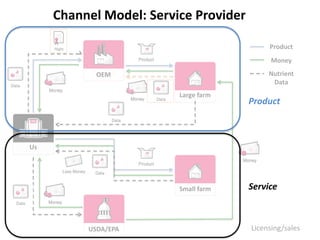
  • 318.
  • 319.
    Partnership Disaster: Boeing Collaborative Looked great on paper. Worst business decision of the 21st century 320
  • 320.
    Managing partners -Risks • Impendence mismatch • Longest of partners schedule becomes your longest item • No clear ownership of customer • Products lack vision – shared product design • Different underlying objectives in relationship • Churn in partners strategy or personnel • IP issues • Difficult to unwind or end
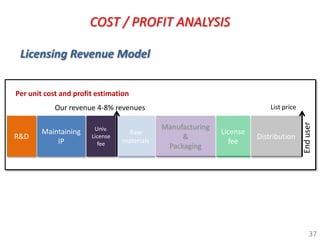
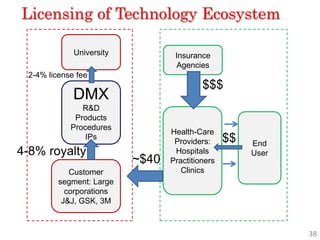
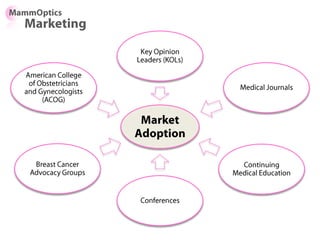
  • 321.
    Should I takean investment from a Large Company? • They are interested in their bottom line, not yours • Their objectives are not to make you a large company • Who’s the sponsor? What’s the motivation? • Needs to come from the business side • Not the venture side •Try to get sales deals not investment • Or try to offer warrants based on sales success
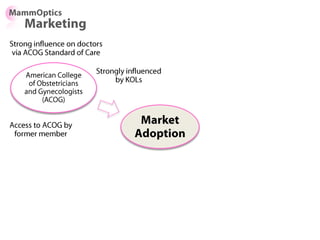
  • 322.
    Startup Partner Strategies • Don’t confuse partners for Earlyvangelists vs. mainstream • Don’t confuse big company partnering with startup strategy • Find the one that gives you an unfair advantage • Recognize you don’t matter to a large partner 323
  • 323.
  • 324.
    Thru-Pore Partners: Technologies Hypothesis and Experiments Catalyst Companies Research Catalysts, Inc. Contract Manufacturers Distributors T3
  • 325.
  • 330.
  • 331.
    Partners BackEnd Front End Sample Prep Dx Test Company (not for RUO) Hospitals Chip Manufacturers LiquiLume Clinical Labs Packaging Reagents Doctors (IDT, Fisher) OEMs Distributors Research Labs (Fisher) Shippers (UPS, FedEx)
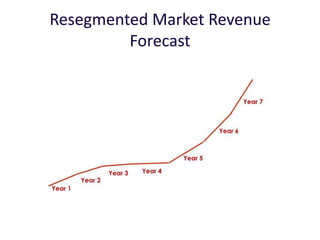
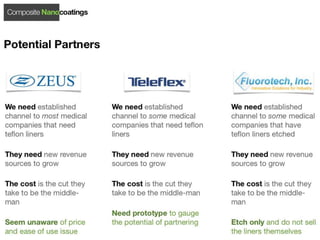
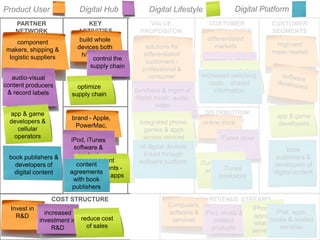
  • 332.
    Back-End Partners Type Examples Benefit Risk / Need Chip HTE Labs Make optofluidic chips (key High / Critical manufacturer element of technology) Packaging ? Keep device costs low Low / Essential OEMs Laser or detector Parts needed to build Low, Med / manufacturers complete instrument Essential Reagents IDT, Fisher Provide custom probes and Med / Essential Supplier control targets. Sample Prep. Qiagen Partner for validation of Low / Nice Instrument input target samples
  • 333.
    Front-End Partners Type Examples Benefit Risk / Need Distributor Fisher Sell chips, reagents Low / Not critical for RUO Research labs UCSF oncologists, Will validate technology; Low / Critical Stanford MDx Lab, publish; develop assays during phase I UCSF Micro. Lab Dx test Genentech; Possibly unique test on Low / Synergistic company Companion Dx w unique platform, partner pharma and biotechs; develops assay Specialty Dx test cos. Strategic alliance Clinical labs Quest, LabCorp Help develop CLIA-waived Med / Crucial application; 510(k); clinical during phase II trials
  • 334.
    Complex Sensor Networks Partner Examples 335
  • 335.
    Universe of Partners Sensordevice/network co’s Embedded platform makers SET Application specialists
  • 336.
    Potential Partnerships Sensor device/networkco’s Embedded platform makers SET Application specialists
  • 337.
  • 342.
    The Lean LaunchPad Lecture 8: Resources, Activities & Costs Version 6/22/12
  • 343.
    Key Activities What’s MostImportant for the Business?
  • 344.
  • 345.
    Key Resources What’s AreYour Most Important Assets?
  • 347.
    Cost Structure What arethe Costs and Expenses
  • 348.
  • 349.
    How You MakeMoney <
  • 350.
  • 351.
    Four Critical Resources • Physical • Financial • Human • Intellectual
  • 352.
    Physical Resources • companyfacilities – office space, company location • product/services – supply of silicon wafers or iron ore, or thousands of feet of warehouse space? • Many physical goods are capital intensive
  • 353.
    Financial Resources • Friends and Family • Crowdfunding • Angels • Venture Capital • Corporate partners • Others: SBA or SBIR grants • Lease-lines • Factoring • Vendor-financing
  • 354.
    Human Resources • qualifiedemployees • mentors, teachers, coaches, advisors
  • 355.
    Mentors, Teachers, Coaches •Mentors, teachers, coaches advance your personal career – If you want to learn a specific subject find a teacher – If you want to hone specific skills or reach an exact goal hire a coach – If you want to get smarter and better over your career find someone who cares about you enough to be a mentor
  • 356.
    Advisors • Advisors arepeople you need to help advance your company’s success – Founders fail when they believe their visions are facts – Listening to experienced advice can help you sort through whether your vision is a hallucination – Getting an advisory board (by expanding your circle of accumulated wisdom past their investors) is so important that it’s an explicit step in the Customer Development process
  • 357.
    Qualified Employees/Culture • Arethe difference between a good idea that never went anywhere and a billion dollar firm
  • 359.
  • 360.
    Executive Traits byStage Entrepreneurial- Mission-Oriented Process-Managed Driven Learning and Management Execution and Growth Discovery Personal Superstar Leader Manager of plans, Contribution goals, process, and personnel Time Commitment 24/7 As needed Long term 9 to 5 Planning Opportunistic and Mission- and goal- Process-, and goal- agile driven driven Process Hates and eliminates As needed, driven Implements and uses by mission Management Style Autocratic, star Distributed to May be bureaucratic system departments Span of Control Hands-on Mission-driven, Distributed down the synchronized organization Focus High and passionate Mission Execution vision Uncertainty/Chaos Brings order out of Focuses on fast Focuses on chaos response repeatability
  • 361.
  • 362.
  • 363.
  • 364.
  • 365.
    Trademark protects branding& marks • Trademark gives you the right to prevent others from using “confusingly similar” marks and logos • Trademark protection lasts as long as you use the mark • The more you use the mark, the stronger your protection • Trademark registration is optional, but has significant advantages if approved • Country by country
  • 366.
    Copyright protects creative works of authorship • Copyright gives right to prevent others from copying, distributing or making derivatives of your work – Protects “expressions” of ideas but does not protect the underlying ideas • (Way) more than just technology: – songs, books, movies, photos, etc. • Copyright protection lasts practically forever • Copyright does not prevent independent development • Registration is optional, but is required to sue for infringement
  • 367.
    Trade Secrets • Informationthat is kept secret and has economic value to the business • Coke recipe, customer lists, product road maps. • No registration required • Can last for as long as you take reasonable steps to keep confidential
  • 368.
    Contract • Protection agreedto by contract • No registration process • You have whatever protection is defined in the contract (e.g., NDA gives you certain rights to protection of your confidential information) • The protection lasts for the time period defined in the contract
  • 369.
    Patents • A governmentgranted monopoly – prevents others from making, using or selling your invention – Even if the other’s infringement was innocent or accidental • Invention must be non-obvious • Protection lasts typically for 15-20 years • Application and examination is required – Typical cost for application and exam is $10-30k – Typical time for application and exam is 1-4 years • Must file in U.S. within one year of sale, offer for sale, public disclosure or public use • Provisional application alternative
  • 370.
    What Can bePatented? • Just about anything . . . – Circuits, hardware – Software, applied algorithms – Formulas, designs – User interfaces – Applications, systems – Business processes (sometimes) • But not these . . . – Scientific principles – Pure mathematical algorithms • And, pending Supreme Court Case raises concerns regarding patentability of “methods” inventions
  • 371.
  • 372.
    Search vs. ExecutionMetrics • Existing companies execute plans • Startups search for them • Income Statement, Balance Sheet, etc are execution documents • You first need to derive the metrics that matter
  • 373.
    Metrics That Matter •Value proposition: product cost, mkt size/share, competition? • Customer Relationships: customer acquisition costs, conversion rates, lifetime value? • Market Type: revenue curves • Operating Costs: basic operating costs of the business? • Channel: Channel margin, promotion, shelf-space charges? • Revenue Streams: average selling price, # of customers/year, achievable revenue? • Burn Rate: per month? When will the company run out of cash?
  • 374.
  • 375.
    Intellectual Property Does Y Does Y Will they Y Harvard Harvard license it own it? want it? to us? N N N Proceed with Extreme Pivot patent filing  and pre- clinical trials N Does Does Will they Berkeley Y Berkeley Y license it Y own it? want it? to us? N N Meeting with Berkeley Technology Transfer at LBNL (This Week) Meeting with Harvard Technology Office (Next Week) Class 7 - Update 3.12.2012
  • 376.
  • 377.
    We’ve hit ourfirst milestones Mar 2013 Jun 2011 Dec 2011 Jun 2012 First unit Technology Track Post-processed Real-time First unit Prototype Image recognition image recognition Customer Discovery Track Select 1st Testing agreement Customer trial and target crop with top producer customer order Finance Track Friends and Seed Round Series A Applied family round for grants $125 K $800 K $3-5 M F&F Seed Series A Confidential
  • 378.
  • 387.
  • 388.
    Product User Digital Hub Digital Lifestyle Digital Platform PARTNER KEY VALUE CUSTOMER CUSTOMER NETWORK ACTIVITIES PROPOSITON RELATIONSHIPS SEGMENTS build whole differentiated component High-end devices both solutions for markets makers, shipping & mass market logistic suppliers h/w & s/w differentiated customers - professional & consumer KEY DISTRIBUTION brand - Apple, RESOURCES CHANNELS PowerMac, online store iMac COST STRUCTURE REVENUE STREAMS Computers, Invest in software & R&D services
  • 389.
    Product User Digital Hub Digital Lifestyle Digital Platform PARTNER KEY VALUE CUSTOMER CUSTOMER NETWORK ACTIVITIES PROPOSITON RELATIONSHIPS SEGMENTS build whole differentiated component High-end devices both solutions for markets makers, shipping & mass market logistic suppliers h/w & s/w differentiated customers - professional & consumer KEY DISTRIBUTION brand - Apple, RESOURCES CHANNELS PowerMac, online store iMac COST STRUCTURE REVENUE STREAMS Computers, Invest in software & R&D services
  • 390.
    Product User PARTNER KEY VALUE CUSTOMER CUSTOMER NETWORK ACTIVITIES PROPOSITON RELATIONSHIPS SEGMENTS component build whole High-end makers solutions for differentiated devices both differentiated markets mass market h/w & s/w customers - Shipping & professional & logistic consumer suppliers KEY DISTRIBUTION brand - Apple, RESOURCES CHANNELS PowerMac, Wholesalers, iMac retailers, re- sellers innovative online store designers IP & patents & agreements COST STRUCTURE REVENUE STREAMS Computers, Invest in software & R&D services
  • 391.
    Product User Digital Hub PARTNER KEY VALUE CUSTOMER CUSTOMER NETWORK ACTIVITIES PROPOSITON RELATIONSHIPS SEGMENTS KEY DISTRIBUTION RESOURCES CHANNELS COST STRUCTURE REVENUE STREAMS
  • 392.
    Product User Digital Hub Digital Lifestyle PARTNER KEY VALUE CUSTOMER CUSTOMER NETWORK ACTIVITIES PROPOSITON RELATIONSHIPS SEGMENTS KEY DISTRIBUTION RESOURCES CHANNELS COST STRUCTURE REVENUE STREAMS
  • 393.
    Product User Digital Hub Digital Lifestyle Digital Platform PARTNER KEY VALUE CUSTOMER CUSTOMER NETWORK ACTIVITIES PROPOSITON RELATIONSHIPS SEGMENTS KEY DISTRIBUTION RESOURCES CHANNELS COST STRUCTURE REVENUE STREAMS
  • 394.
    The Customer Development Manifesto 15 Rules to Live By
  • 395.
    A Startup is: A temporary organization designed to search for a repeatable and scalable business model
  • 396.
    1. There areNo Facts Inside Your Building
  • 397.
    2. Pair CustomerDevelopment with Agile Development
  • 398.
    3.Failure is anIntegral Part of Search
  • 399.
  • 400.
    5. No BusinessPlan Survives First Contact with Customers
  • 401.
    6. Validate Hypotheseswith Experiments
  • 402.
    7. Market TypeChanges Everything
  • 403.
    8. Startup Metricsare Different
  • 404.
    9. Fast andFearless Decision-Making
  • 405.
    9. Cycle Time,Speed and Tempo
  • 406.
    10. Startup JobTitles Are Very Different from a Large Company’s
  • 407.
    11. Preserve CashWhile Searching
  • 408.
    12. Spend WhenIt’s a Repeatable Model
  • 409.
    13. Communicate andShare Learning
  • 410.
    14. Startups demandComfort with Chaos, Uncertainty and Change
  • 411.
    15. It’s NotA Job, It’s All About Passion

Editor's Notes

  • #2 320 SBIR Phase 2 companiesGot $500K50% from academiaMix of technologies20% of you will get phase 2b20% of those will succeed13 of you will succeedMost of you think you are in execution modeMost will be a few years old – thinking they are in execution~25 will be a lot olderNot all in the audience will be founders, some will be employeesGraphene Frontiers is the perfect exampleStart with their slidesEmphasize that this process not just works for software but anything with customer/market riskFix the serendipitous DOW meetingGroun flour pharma as a backup
  • #210 ----- Meeting Notes (3/6/12 10:38) -----what the dentist makes for a perio procedure
  • #220 Progression: larger and larger sensor networks deployed
  • #295 ----- Meeting Notes (3/6/12 10:38) -----what the dentist makes for a perio procedure
  • #305 Progression: larger and larger sensor networks deployed
  • #312 (need to do this as a build…)
  • #377 Are we sure its 5%-10% of revenue and not of profit? ---- Dr. Conti was quoted as saying 5-10% of revenue, but he may have meant profit.