HVAC SYSTEMS
TYPES
HOW AS AN
ARCHITECT TO MAKE A
CHOICE FIT FOR THE
PROJECT TYPE
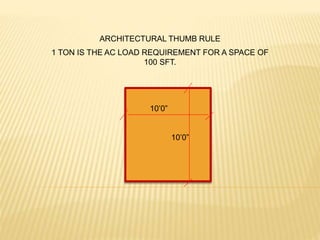
ARCHITECTURAL THUMB RULE
1 TON IS THE AC LOAD REQUIREMENT FOR A SPACE OF
100 SFT.
10’0”
10’0”
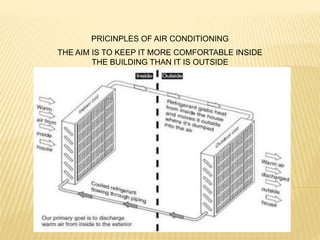
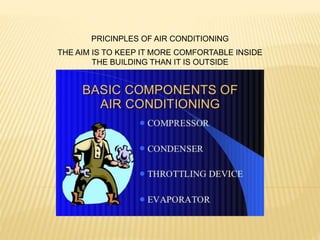
PRICINPLES OF AIR CONDITIONING
THE AIM IS TO KEEP IT MORE COMFORTABLE INSIDE
THE BUILDING THAN IT IS OUTSIDE
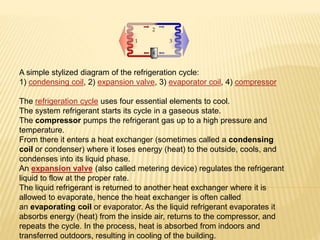
A simple stylized diagram of the refrigeration cycle:
1) condensing coil, 2) expansion valve, 3) evaporator coil, 4) compressor
The refrigeration cycle uses four essential elements to cool.
The system refrigerant starts its cycle in a gaseous state.
The compressor pumps the refrigerant gas up to a high pressure and
temperature.
From there it enters a heat exchanger (sometimes called a condensing
coil or condenser) where it loses energy (heat) to the outside, cools, and
condenses into its liquid phase.
An expansion valve (also called metering device) regulates the refrigerant
liquid to flow at the proper rate.
The liquid refrigerant is returned to another heat exchanger where it is
allowed to evaporate, hence the heat exchanger is often called
an evaporating coil or evaporator. As the liquid refrigerant evaporates it
absorbs energy (heat) from the inside air, returns to the compressor, and
repeats the cycle. In the process, heat is absorbed from indoors and
transferred outdoors, resulting in cooling of the building.
PRICINPLES OF AIR CONDITIONING
THE AIM IS TO KEEP IT MORE COMFORTABLE INSIDE
THE BUILDING THAN IT IS OUTSIDE
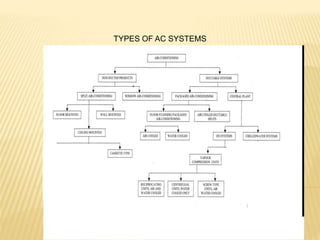
TYPES OF AC SYSTEMS
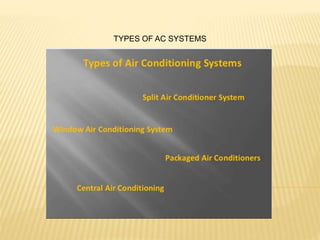
TYPES OF AC SYSTEMS
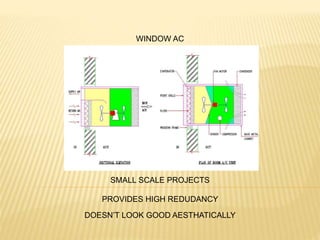
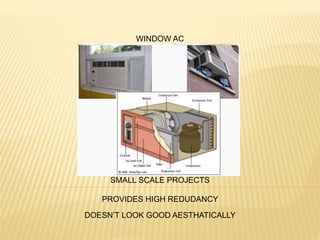
WINDOW AC
SMALL SCALE PROJECTS
PROVIDES HIGH REDUDANCY
DOESN’T LOOK GOOD AESTHATICALLY
WINDOW AC
SMALL SCALE PROJECTS
PROVIDES HIGH REDUDANCY
DOESN’T LOOK GOOD AESTHATICALLY
WINDOW AC
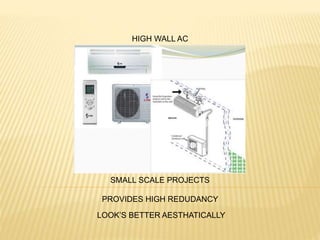
HIGH WALL AC
SMALL SCALE PROJECTS
PROVIDES HIGH REDUDANCY
LOOK’S BETTER AESTHATICALLY
HIGH WALL AC
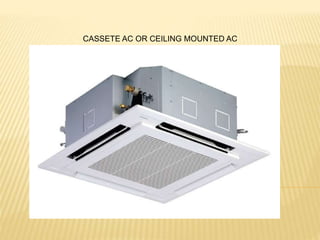
CASSETE AC OR CEILING MOUNTED AC
SYSTEM COMPARISON FOR SERVICES APARTMENTS, RESTAURANTS AND FOOD COURT PROJECT: CONSCIENT ONE DATED: 15 JULY 2013
S No PARAMETER AIR COOLED SPLIT SYSTEM WATER COOLED SPLIT SYSTEM AIR COOLED VRV SYSTEM AIR COOLED SCREW CHILLER WATER COOLED SCREW CHILLER
1 COMPONENTS
Indoor unit. Indoor unit. Indoor unit. Aircooled screw chillers. Watercooled screw chillers.
Aircooled outdoor unit. Watercooled condensing unit. Aircooled outdoor unit. Chilled water pumps. Chilled water pumps.
Refrigerantpiping. Refrigerantpiping. Refrigerantpiping. Chilled water piping. Condenser water pumps.
Cooling towers. Electroniccontrols. Airhandlingunits / Fan coil units. Chilled water piping.
Condenser water pumps. Condenser water piping.
Condenser water piping. Cooling towers.
Air Handling units / Fan coil units.
2 PHASE WISE INSTALLATION Possible Possible Possible Not Possible Not Possible
3 CAPITAL COST L1 L2 H H L3
4
POWER CONSUMPTION HIGH LOW LOW Higher at full load LOW
IKW [Full Load] 1.35 kW/TR 1.1 kW/TR 1.2kW/TR 1.6 kW/TR 1.1 kW/TR
5 OPERATING COST
I
Cooling Requirement at 80%
diversity
382 Tons 382 Tons 382 Tons 382 Tons 382 Tons
IIPower consumption 516 420 459 611 420
6 SPACE REQUIREMENT
IOPEN SPACE for ODUs Required Not Required Required Not Required Not Required
IIOPEN SPACE for PLANT Not Required Not Required Not Required Required Not Required
III
OPEN SPACE for COOLING
TOWERS
Not Required
Required.[for condenser pumps
also]
Not Required Not Required Required
IVBASEMENT SPACE for PLANT Not Required Not Required Not Required Not Required Required
7 REFRIGERANT PIPING Length less than 15 m. Required Length 50m-100m. NA NA
8 BILLING Easiest
Easy, only cooling towers and
pumps are common.
Easy, in case of separate system for
each user.
Difficultdue to common plant Difficultdue to common plant
9 DERATION
High in peak ambient
conditions
Low in peak ambient conditionsHigh in peak ambient conditions High in peak ambient conditions Low in peak ambient conditions
10
SOFT WATER REQUIREMENT NA 8LPH/TR NA NA 8LPH/TR
TOTAL WATER
REQUIREMENT/DAY (12
HOURS)
NA 36710 LITRES/DAY NA NA 36710 LITRES/DAY
11 RECOMMENDATIONS
Not recommendeddue to non
availability of open spaces for
ODUs
Recommended for best
efficiencyand low capex if
water is not scarce.
Not recommendeddue to non
availability of open spaces for ODUs
Recommended due to water scarcity
and good performanceon part loads.
Recommended for best efficiency
and low capex if water is not scarce.
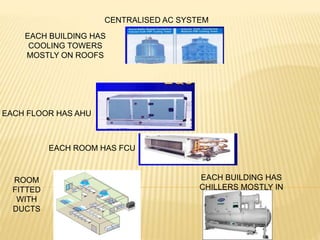
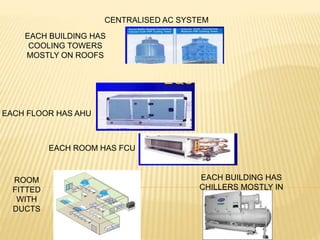
CENTRALISED AC SYSTEM
ROOM
FITTED
WITH
DUCTS
EACH ROOM HAS FCU
EACH FLOOR HAS AHU
EACH BUILDING HAS
COOLING TOWERS
MOSTLY ON ROOFS
EACH BUILDING HAS
CHILLERS MOSTLY IN
BASEMENTS
CENTRALISED AC SYSTEM
ROOM
FITTED
WITH
DUCTS
EACH ROOM HAS FCU
EACH FLOOR HAS AHU
EACH BUILDING HAS
COOLING TOWERS
MOSTLY ON ROOFS
EACH BUILDING HAS
CHILLERS MOSTLY IN
BASEMENTS
BS5 - Lecture 2 HVAC Systems

BS5 - Lecture 2 HVAC Systems

  • 1.
    HVAC SYSTEMS TYPES HOW ASAN ARCHITECT TO MAKE A CHOICE FIT FOR THE PROJECT TYPE
  • 2.
    ARCHITECTURAL THUMB RULE 1TON IS THE AC LOAD REQUIREMENT FOR A SPACE OF 100 SFT. 10’0” 10’0”
  • 3.
    PRICINPLES OF AIRCONDITIONING THE AIM IS TO KEEP IT MORE COMFORTABLE INSIDE THE BUILDING THAN IT IS OUTSIDE
  • 4.
    A simple stylizeddiagram of the refrigeration cycle: 1) condensing coil, 2) expansion valve, 3) evaporator coil, 4) compressor The refrigeration cycle uses four essential elements to cool. The system refrigerant starts its cycle in a gaseous state. The compressor pumps the refrigerant gas up to a high pressure and temperature. From there it enters a heat exchanger (sometimes called a condensing coil or condenser) where it loses energy (heat) to the outside, cools, and condenses into its liquid phase. An expansion valve (also called metering device) regulates the refrigerant liquid to flow at the proper rate. The liquid refrigerant is returned to another heat exchanger where it is allowed to evaporate, hence the heat exchanger is often called an evaporating coil or evaporator. As the liquid refrigerant evaporates it absorbs energy (heat) from the inside air, returns to the compressor, and repeats the cycle. In the process, heat is absorbed from indoors and transferred outdoors, resulting in cooling of the building.
  • 5.
    PRICINPLES OF AIRCONDITIONING THE AIM IS TO KEEP IT MORE COMFORTABLE INSIDE THE BUILDING THAN IT IS OUTSIDE
  • 6.
    TYPES OF ACSYSTEMS
  • 7.
    TYPES OF ACSYSTEMS
  • 8.
    WINDOW AC SMALL SCALEPROJECTS PROVIDES HIGH REDUDANCY DOESN’T LOOK GOOD AESTHATICALLY
  • 9.
    WINDOW AC SMALL SCALEPROJECTS PROVIDES HIGH REDUDANCY DOESN’T LOOK GOOD AESTHATICALLY
  • 10.
  • 11.
    HIGH WALL AC SMALLSCALE PROJECTS PROVIDES HIGH REDUDANCY LOOK’S BETTER AESTHATICALLY
  • 12.
  • 13.
    CASSETE AC ORCEILING MOUNTED AC
  • 14.
    SYSTEM COMPARISON FORSERVICES APARTMENTS, RESTAURANTS AND FOOD COURT PROJECT: CONSCIENT ONE DATED: 15 JULY 2013 S No PARAMETER AIR COOLED SPLIT SYSTEM WATER COOLED SPLIT SYSTEM AIR COOLED VRV SYSTEM AIR COOLED SCREW CHILLER WATER COOLED SCREW CHILLER 1 COMPONENTS Indoor unit. Indoor unit. Indoor unit. Aircooled screw chillers. Watercooled screw chillers. Aircooled outdoor unit. Watercooled condensing unit. Aircooled outdoor unit. Chilled water pumps. Chilled water pumps. Refrigerantpiping. Refrigerantpiping. Refrigerantpiping. Chilled water piping. Condenser water pumps. Cooling towers. Electroniccontrols. Airhandlingunits / Fan coil units. Chilled water piping. Condenser water pumps. Condenser water piping. Condenser water piping. Cooling towers. Air Handling units / Fan coil units. 2 PHASE WISE INSTALLATION Possible Possible Possible Not Possible Not Possible 3 CAPITAL COST L1 L2 H H L3 4 POWER CONSUMPTION HIGH LOW LOW Higher at full load LOW IKW [Full Load] 1.35 kW/TR 1.1 kW/TR 1.2kW/TR 1.6 kW/TR 1.1 kW/TR 5 OPERATING COST I Cooling Requirement at 80% diversity 382 Tons 382 Tons 382 Tons 382 Tons 382 Tons IIPower consumption 516 420 459 611 420 6 SPACE REQUIREMENT IOPEN SPACE for ODUs Required Not Required Required Not Required Not Required IIOPEN SPACE for PLANT Not Required Not Required Not Required Required Not Required III OPEN SPACE for COOLING TOWERS Not Required Required.[for condenser pumps also] Not Required Not Required Required IVBASEMENT SPACE for PLANT Not Required Not Required Not Required Not Required Required 7 REFRIGERANT PIPING Length less than 15 m. Required Length 50m-100m. NA NA 8 BILLING Easiest Easy, only cooling towers and pumps are common. Easy, in case of separate system for each user. Difficultdue to common plant Difficultdue to common plant 9 DERATION High in peak ambient conditions Low in peak ambient conditionsHigh in peak ambient conditions High in peak ambient conditions Low in peak ambient conditions 10 SOFT WATER REQUIREMENT NA 8LPH/TR NA NA 8LPH/TR TOTAL WATER REQUIREMENT/DAY (12 HOURS) NA 36710 LITRES/DAY NA NA 36710 LITRES/DAY 11 RECOMMENDATIONS Not recommendeddue to non availability of open spaces for ODUs Recommended for best efficiencyand low capex if water is not scarce. Not recommendeddue to non availability of open spaces for ODUs Recommended due to water scarcity and good performanceon part loads. Recommended for best efficiency and low capex if water is not scarce.
  • 15.
    CENTRALISED AC SYSTEM ROOM FITTED WITH DUCTS EACHROOM HAS FCU EACH FLOOR HAS AHU EACH BUILDING HAS COOLING TOWERS MOSTLY ON ROOFS EACH BUILDING HAS CHILLERS MOSTLY IN BASEMENTS
  • 16.
    CENTRALISED AC SYSTEM ROOM FITTED WITH DUCTS EACHROOM HAS FCU EACH FLOOR HAS AHU EACH BUILDING HAS COOLING TOWERS MOSTLY ON ROOFS EACH BUILDING HAS CHILLERS MOSTLY IN BASEMENTS