Lifting & Hoisting Best Practices 
Chandra – QHSSE Manager for 
Weatherford Malaysia & Brunei
Facility Orientation 
QHSSE | Lifting & Hoisting - Best Practices
QHSSE | Lifting & Hoisting - Best Practices 
About the presenter 
• Master of Science in Mechanical Engineering (NTU – Singapore) 
• Bachelor of Mechanical Engineering 
• Diploma in Mechanical Engineering 
• 23 Years work experience – Onshore & Offshore, Oil & Gas, Petro-chemical, Power 
Station, FPSO & Marine industry 
• Weatherford, Cameron & SembawangMarine Offshore…etc 
• Expertise: QMS, ISO 9001, ISO 14001, OHSAS 18001, API Q2, Drilling, Completion, 
Welding, FPSO, NDT, Materials, DS-1, NS-2 & Various international standards…. 
• TapRooT® Advanced Root Cause Analysis Team Leader 
• Quality & HSE Advisor 
• ISO 9001:2008 & OHSAS 18001 – 2007 Lead Auditor 
• Singapore Registered Workplace Safety Health Officer & Environmental Control officer
QHSSE | Lifting & Hoisting - Best Practices 
Safety Moment
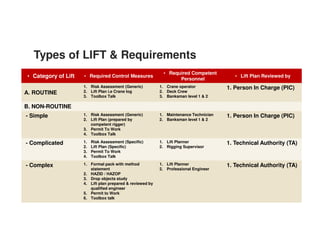
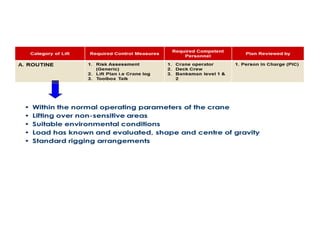
Types of LIFT & Requirements 
• Category of Lift • Required Control Measures 
• Required Competent 
Personnel 
• Lift Plan Reviewed by 
A. ROUTINE 
1. Risk Assessment (Generic) 
2. Lift Plan i.e Crane log 
3. Toolbox Talk 
1. Crane operator 
2. Deck Crew 
3. Banksman level 1 & 2 
1. Person In Charge (PIC) 
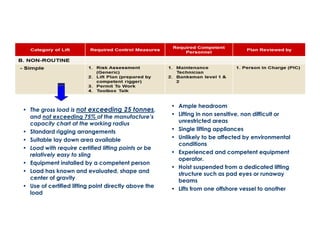
B. NON-ROUTINE 
- Simple 1. Risk Assessment (Generic) 
2. Lift Plan (prepared by 
competent rigger) 
3. Permit To Work 
4. Toolbox Talk 
1. Maintenance Technician 
2. Banksman level 1 & 2 
1. Person In Charge (PIC) 
- Complicated 1. Risk Assessment (Specific) 
2. Lift Plan (Specific) 
3. Permit To Work 
4. Toolbox Talk 
1. Lift Planner 
2. Rigging Supervisor 
1. Technical Authority (TA) 
- Complex 1. Formal pack with method 
statement 
2. HAZID / HAZOP 
3. Drop objects study 
4. Lift plan prepared & reviewed by 
qualified engineer 
5. Permit to Work 
6. Toolbox talk 
1. Lift Planner 
2. Professional Engineer 
1. Technical Authority (TA)
• The gross load is not exceeding 25 tonnes, 
and not exceeding 75% of the manufacture’s 
capacity chart at the working radius 
• Standard rigging arrangements 
• Suitable lay down area available 
• Load with require certified lifting points or be 
relatively easy to sling 
• Equipment installed by a competent person 
• Load has known and evaluated, shape and 
center of gravity 
• Use of certified lifting point directly above the 
load 
• Ample headroom 
• Lifting in non sensitive, non difficult or 
unrestricted areas 
• Single lifting appliances 
• Unlikely to be affected by environmental 
conditions 
• Experienced and competent equipment 
operator. 
• Hoist suspended from a dedicated lifting 
structure such as pad eyes or runaway 
beams 
• Lifts from one offshore vessel to another
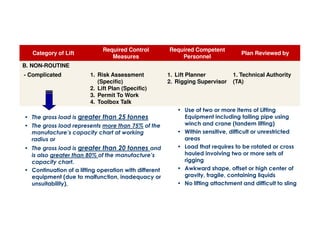
Category of Lift 
Required Control 
Measures 
Required Competent 
Personnel 
Plan Reviewed by 
B. NON-ROUTINE 
- Complicated 1. Risk Assessment 
(Specific) 
2. Lift Plan (Specific) 
3. Permit To Work 
4. Toolbox Talk 
1. Lift Planner 
2. Rigging Supervisor 
1. Technical Authority 
(TA) 
• The gross load is greater than 25 tonnes 
• The gross load represents more than 75% of the 
manufacture’s capacity chart at working 
radius or 
• The gross load is greater than 20 tonnes and 
is also greater than 80% of the manufacture’s 
capacity chart. 
• Continuation of a lifting operation with different 
equipment (due to malfunction, inadequacy or 
unsuitability), 
• Use of two or more items of Lifting 
Equipment including tailing pipe using 
winch and crane (tandem lifting) 
• Within sensitive, difficult or unrestricted 
areas 
• Load that requires to be rotated or cross 
hauled involving two or more sets of 
rigging 
• Awkward shape, offset or high center of 
gravity, fragile, containing liquids 
• No lifting attachment and difficult to sling
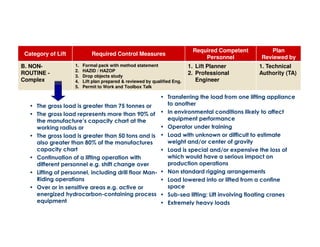
Category of Lift Required Control Measures 
Required Competent 
Personnel 
Plan 
Reviewed by 
B. NON-ROUTINE 
- 
Complex 
1. Formal pack with method statement 
2. HAZID / HAZOP 
3. Drop objects study 
4. Lift plan prepared & reviewed by qualified Eng. 
5. Permit to Work and Toolbox Talk 
1. Lift Planner 
2. Professional 
Engineer 
1. Technical 
Authority (TA) 
• The gross load is greater than 75 tonnes or 
• The gross load represents more than 90% of 
the manufacture’s capacity chart at the 
working radius or 
• The gross load is greater than 50 tons and is 
also greater than 80% of the manufactures 
capacity chart 
• Continuation of a lifting operation with 
different personnel e.g. shift change over 
• Lifting of personnel, including drill floor Man- 
Riding operations 
• Over or in sensitive areas e.g. active or 
energized hydrocarbon-containing process 
equipment 
• Transferring the load from one lifting appliance 
to another 
• In environmental conditions likely to affect 
equipment performance 
• Operator under training 
• Load with unknown or difficult to estimate 
weight and/or center of gravity 
• Load is special and/or expensive the loss of 
which would have a serious impact on 
production operations 
• Non standard rigging arrangements 
• Load lowered into or lifted from a confine 
space 
• Sub-sea lifting; Lift involving floating cranes 
• Extremely heavy loads
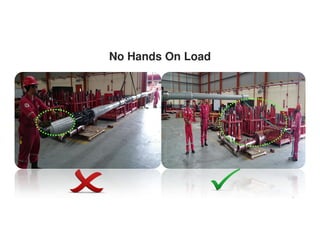
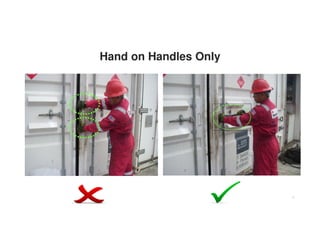
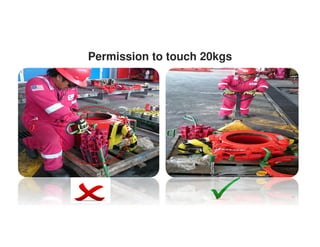
DEVELOP HANDS FREE CULTURE WITH 5 “HANDS-FREE” 
10 
RULES 
1 2 3 
4 
5
No Hands On Load 
11
Hand on Handles Only 
12
Permission to touch 20kgs 
13
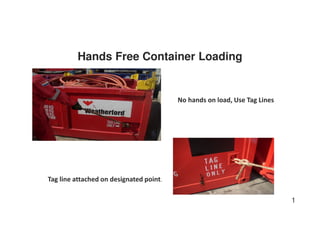
Hands Free Container Loading 
1 
4 
Tag line attached on designated point. 
No hands on load, Use Tag Lines
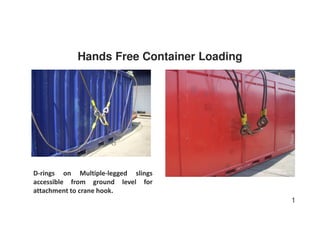
Hands Free Container Loading 
1 
5 
D-rings on Multiple-legged slings 
accessible from ground level for 
attachment to crane hook.
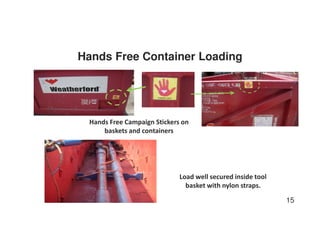
Hands Free Container Loading 
15 
Hands Free Campaign Stickers on 
baskets and containers 
Load well secured inside tool 
basket with nylon straps.
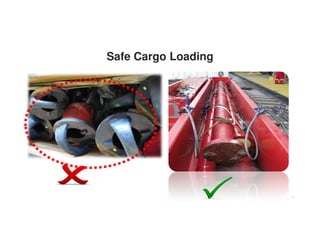
Safe Cargo Loading 
17
Impact Resistant Gloves 
18
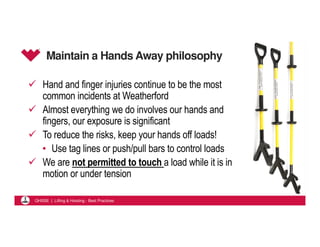
Maintain a Hands Away philosophy 
 Hand and finger injuries continue to be the most 
common incidents at Weatherford 
 Almost everything we do involves our hands and 
fingers, our exposure is significant 
 To reduce the risks, keep your hands off loads! 
• Use tag lines or push/pull bars to control loads 
 We are not permitted to touch a load while it is in 
motion or under tension 
QHSSE | Lifting  Hoisting - Best Practices
HOW TO SELECT CORRECT WIRE ROPE SLINGS 
High Risk Most common non compliance! 
Most of the contractor are using wire rope slings for lifting their equipment to transport 
onshore and offshore premises, however it has been observed that the capacity of the 
wire rope slings being used for the particular equipment, has no Enhancement factor to 
compensate dynamic factors during lifts. 
What is Enhancement factor? 
The enhancement factor is higher degree selection of slings for containers, because 
containers are subject to the most severe dynamic amplification due to dynamic 
amplification that will be experienced in offshore lifting in adverse weather, sea states, 
crane behavior and operator skill.
HOW TO SELECT CORRECT WIRE ROPE SLINGS 
What is Right? 
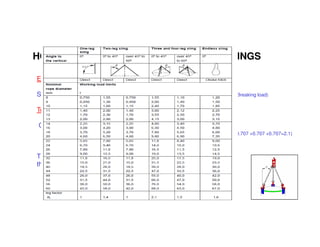
The minimum working load limit, of the lifting sets for offshore containers shall be 
determined for the lifting set and each of its components according to 
enhancement factor , and the rating of a container is multiplied by an 
enhancement factor to give an enhanced requirement for the working load limit 
of the sling as per the standard. If the equipments is designed and fabricated as 
per the relevant standard of BS EN 12079-1-2006 or DNV-2.7.1 
OR 
All lifting equipment and lifting gears used in the lifting process shall be rated at 
30% or more above the maximum load to be lifted as per our Shell Lifting and 
Hoisting standard..
HOW TO SELECT CORRECT WIRE ROPE SLINGS 
Simple Guide of sling selection. 
Slings can be selected in two different method, and the methods are as follows: 
1. Trigonometric method 
2. Uniform method 
1. Trigonometric method: 
The trigonometric method is provides for progressive reductions in the working load 
limit as the angle between the sling legs increase. 
It assumes the operative is trained in the assessment of angle and requires the display 
of a chart showing the working load limits which apply at various angle. 
It strongly recommended that this method should only be used for slings designed for 
a single purpose only.
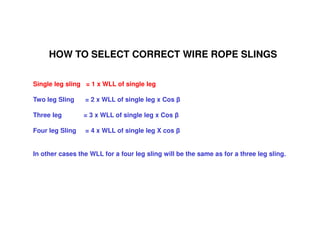
HOW TO SELECT CORRECT WIRE ROPE SLINGS 
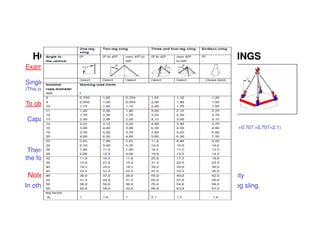
Single leg sling = 1 x WLL of single leg 
Two leg Sling = 2 x WLL of single leg x Cos  
Three leg = 3 x WLL of single leg x Cos  
Four leg Sling = 4 x WLL of single leg X cos  
In other cases the WLL for a four leg sling will be the same as for a three leg sling.
HOW TO SELECT CORRECT WIRE ROPE SLINGS 
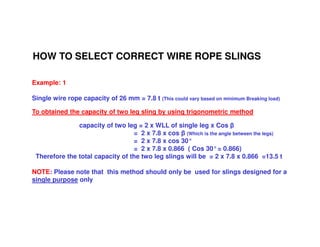
Example: 1 
Single wire rope capacity of 26 mm = 7.8 t (This could vary based on minimum Breaking load) 
To obtained the capacity of two leg sling by using trigonometric method 
capacity of two leg = 2 x WLL of single leg x Cos  
= 2 x 7.8 x cos  (Which is the angle between the legs) 
= 2 x 7.8 x cos 30° 
= 2 x 7.8 x 0.866 ( Cos 30°= 0.866) 
Therefore the total capacity of the two leg slings will be = 2 x 7.8 x 0.866 =13.5 t 
NOTE: Please note that this method should only be used for slings designed for a 
single purpose only
HOW TO SELECT CORRECT WIRE ROPE SLINGS 
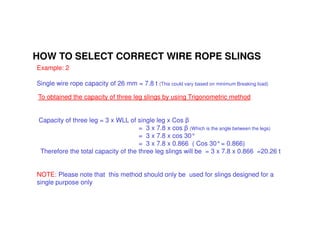
Example: 2 
Single wire rope capacity of 26 mm = 7.8 t (This could vary based on minimum Breaking load) 
To obtained the capacity of three leg slings by using Trigonometric method 
Capacity of three leg = 3 x WLL of single leg x Cos  
= 3 x 7.8 x cos  (Which is the angle between the legs) 
= 3 x 7.8 x cos 30° 
= 3 x 7.8 x 0.866 ( Cos 30°= 0.866) 
Therefore the total capacity of the three leg slings will be = 3 x 7.8 x 0.866 =20.26 t 
NOTE: Please note that this method should only be used for slings designed for a 
single purpose only
HOW TO SELECT CORRECT WIRE ROPE SLINGS 
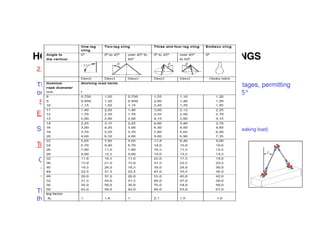
2. Uniform method 
The uniform method is the simple option, having inherent safety advantages, permitting 
only one working load limit to the angle to vertical legs maximum of 0-45° 
Single leg sling = 1 x WLL of single leg 
Example-1 
Single wire rope capacity of 28 mm = 9.0 t (This could vary based on minimum Breaking load) 
To obtained the capacity of two leg slings by using Uniform Method 
Capacity of two leg = WLL of single leg x 1.4 (Mode factor) 
= 9.0 x 1.4 (Which is the angle to the vertical legs cos45°+ cos45°= 0.707 +0.707 =1.4) 
= 9.0 x1.4 = 12.6 t 
Therefore the total capacity of 
the two leg slings will be = 9.0 x 1.4 =12.6 t
HOW TO SELECT CORRECT WIRE ROPE SLINGS 
Example-2 
Single wire rope capacity of 28 mm = 9.0 t (This could vary based on minimum Breaking load) 
To obtained the capacity of Three leg slings by using Uniform Method 
Capacity of Three leg = WLL of single leg x 2.1 (Mode factor) 
= 9.0 x 2.1 (Which is the angle to the vertical legs cos45°+ cos45°= 0.707 +0.707 +0.707=2.1) 
= 9.0 x 2.1 = 18.9 t……say =19 t 
Therefore the total capacity of 
the three leg slings will be = 9.0 x 2.1 =19.0 t
HOW TO SELECT CORRECT WIRE ROPE SLINGS 
Example-3 
Single wire rope capacity of 28 mm = 9.0 t 
(This could vary based on minimum Breaking load) 
To obtained the capacity of Four leg slings by using Uniform Method 
Capacity of Four leg = WLL of single leg x 2.1 (Mode factor) 
= 9.0 x 2.1 (Which is the angle to the vertical legs cos45°+ cos45°= 0.707 +0.707 +0.707=2.1) 
= 9.0 x 2.1 = 18.9 t……say =19 t 
Therefore the total capacity of 
the four leg slings will be = 9.0 x 2.1 =19.0 t 
Note: 4th leg is only retardant sling, hence 3  4 legs remain same capacity 
In other cases the WLL for a four leg sling will be the same as for a three leg sling.
HOW TO SELECT CORRECT WIRE ROPE SLINGS 
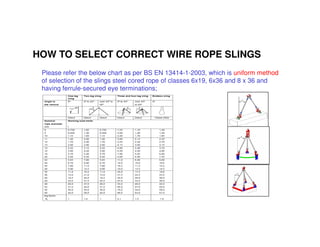
Please refer the below chart as per BS EN 13414-1-2003, which is uniform method 
of selection of the slings steel cored rope of classes 6x19, 6x36 and 8 x 36 and 
having ferrule-secured eye terminations;
HOW TO SELECT CORRECT WIRE ROPE SLINGS 
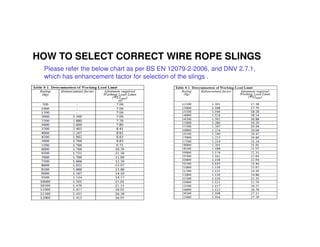
Please refer the below chart as per BS EN 12079-2-2006, and DNV 2.7.1, 
which has enhancement factor for selection of the slings .
Workplace Safety and Health (operation of Cranes) 
Regulations 2011 
• http://www.mom.gov.sg/legislation/occupational-safety-health/ 
Pages/default.aspx 
• Part I – Preliminary 
• Part II – General Provisions 
• Part III – Registration of Crane Operators 
• Part IV – Appointment and Duties of Personnel 
• Part V – Installation, Repair, Alteration, Testing and Dismantling of 
Mobile Crane or Tower Crane 
• Part VI - Miscellaneous
Staying focused Video
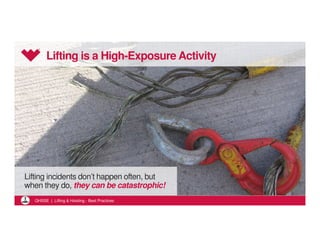
Lifting is a High-Exposure Activity 
Lifting incidents don’t happen often, but 
when they do, they can be catastrophic! 
QHSSE | Lifting  Hoisting - Best Practices
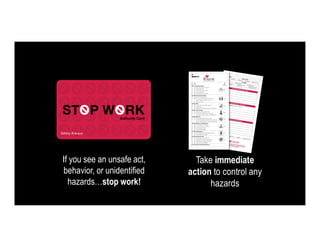
If you see an unsafe act, 
behavior, or unidentified 
hazards…stop work!
QHSSE | Lifting  Hoisting - Best Practices 
THANK YOU 
®

PowerLogistics Asia 2014 - Lifting & Hoisting - Best Practices – P V N Chandrasekaran, Weatherford Brunei Sdn Bhd

  • 1.
    Lifting & HoistingBest Practices Chandra – QHSSE Manager for Weatherford Malaysia & Brunei
  • 2.
    Facility Orientation QHSSE| Lifting & Hoisting - Best Practices
  • 3.
    QHSSE | Lifting& Hoisting - Best Practices About the presenter • Master of Science in Mechanical Engineering (NTU – Singapore) • Bachelor of Mechanical Engineering • Diploma in Mechanical Engineering • 23 Years work experience – Onshore & Offshore, Oil & Gas, Petro-chemical, Power Station, FPSO & Marine industry • Weatherford, Cameron & SembawangMarine Offshore…etc • Expertise: QMS, ISO 9001, ISO 14001, OHSAS 18001, API Q2, Drilling, Completion, Welding, FPSO, NDT, Materials, DS-1, NS-2 & Various international standards…. • TapRooT® Advanced Root Cause Analysis Team Leader • Quality & HSE Advisor • ISO 9001:2008 & OHSAS 18001 – 2007 Lead Auditor • Singapore Registered Workplace Safety Health Officer & Environmental Control officer
  • 4.
    QHSSE | Lifting& Hoisting - Best Practices Safety Moment
  • 5.
    Types of LIFT& Requirements • Category of Lift • Required Control Measures • Required Competent Personnel • Lift Plan Reviewed by A. ROUTINE 1. Risk Assessment (Generic) 2. Lift Plan i.e Crane log 3. Toolbox Talk 1. Crane operator 2. Deck Crew 3. Banksman level 1 & 2 1. Person In Charge (PIC) B. NON-ROUTINE - Simple 1. Risk Assessment (Generic) 2. Lift Plan (prepared by competent rigger) 3. Permit To Work 4. Toolbox Talk 1. Maintenance Technician 2. Banksman level 1 & 2 1. Person In Charge (PIC) - Complicated 1. Risk Assessment (Specific) 2. Lift Plan (Specific) 3. Permit To Work 4. Toolbox Talk 1. Lift Planner 2. Rigging Supervisor 1. Technical Authority (TA) - Complex 1. Formal pack with method statement 2. HAZID / HAZOP 3. Drop objects study 4. Lift plan prepared & reviewed by qualified engineer 5. Permit to Work 6. Toolbox talk 1. Lift Planner 2. Professional Engineer 1. Technical Authority (TA)
  • 7.
    • The grossload is not exceeding 25 tonnes, and not exceeding 75% of the manufacture’s capacity chart at the working radius • Standard rigging arrangements • Suitable lay down area available • Load with require certified lifting points or be relatively easy to sling • Equipment installed by a competent person • Load has known and evaluated, shape and center of gravity • Use of certified lifting point directly above the load • Ample headroom • Lifting in non sensitive, non difficult or unrestricted areas • Single lifting appliances • Unlikely to be affected by environmental conditions • Experienced and competent equipment operator. • Hoist suspended from a dedicated lifting structure such as pad eyes or runaway beams • Lifts from one offshore vessel to another
  • 8.
    Category of Lift Required Control Measures Required Competent Personnel Plan Reviewed by B. NON-ROUTINE - Complicated 1. Risk Assessment (Specific) 2. Lift Plan (Specific) 3. Permit To Work 4. Toolbox Talk 1. Lift Planner 2. Rigging Supervisor 1. Technical Authority (TA) • The gross load is greater than 25 tonnes • The gross load represents more than 75% of the manufacture’s capacity chart at working radius or • The gross load is greater than 20 tonnes and is also greater than 80% of the manufacture’s capacity chart. • Continuation of a lifting operation with different equipment (due to malfunction, inadequacy or unsuitability), • Use of two or more items of Lifting Equipment including tailing pipe using winch and crane (tandem lifting) • Within sensitive, difficult or unrestricted areas • Load that requires to be rotated or cross hauled involving two or more sets of rigging • Awkward shape, offset or high center of gravity, fragile, containing liquids • No lifting attachment and difficult to sling
  • 9.
    Category of LiftRequired Control Measures Required Competent Personnel Plan Reviewed by B. NON-ROUTINE - Complex 1. Formal pack with method statement 2. HAZID / HAZOP 3. Drop objects study 4. Lift plan prepared & reviewed by qualified Eng. 5. Permit to Work and Toolbox Talk 1. Lift Planner 2. Professional Engineer 1. Technical Authority (TA) • The gross load is greater than 75 tonnes or • The gross load represents more than 90% of the manufacture’s capacity chart at the working radius or • The gross load is greater than 50 tons and is also greater than 80% of the manufactures capacity chart • Continuation of a lifting operation with different personnel e.g. shift change over • Lifting of personnel, including drill floor Man- Riding operations • Over or in sensitive areas e.g. active or energized hydrocarbon-containing process equipment • Transferring the load from one lifting appliance to another • In environmental conditions likely to affect equipment performance • Operator under training • Load with unknown or difficult to estimate weight and/or center of gravity • Load is special and/or expensive the loss of which would have a serious impact on production operations • Non standard rigging arrangements • Load lowered into or lifted from a confine space • Sub-sea lifting; Lift involving floating cranes • Extremely heavy loads
  • 10.
    DEVELOP HANDS FREECULTURE WITH 5 “HANDS-FREE” 10 RULES 1 2 3 4 5
  • 11.
    No Hands OnLoad 11
  • 12.
  • 13.
  • 14.
    Hands Free ContainerLoading 1 4 Tag line attached on designated point. No hands on load, Use Tag Lines
  • 15.
    Hands Free ContainerLoading 1 5 D-rings on Multiple-legged slings accessible from ground level for attachment to crane hook.
  • 16.
    Hands Free ContainerLoading 15 Hands Free Campaign Stickers on baskets and containers Load well secured inside tool basket with nylon straps.
  • 17.
  • 18.
  • 19.
    Maintain a HandsAway philosophy Hand and finger injuries continue to be the most common incidents at Weatherford Almost everything we do involves our hands and fingers, our exposure is significant To reduce the risks, keep your hands off loads! • Use tag lines or push/pull bars to control loads We are not permitted to touch a load while it is in motion or under tension QHSSE | Lifting Hoisting - Best Practices
  • 20.
    HOW TO SELECTCORRECT WIRE ROPE SLINGS High Risk Most common non compliance! Most of the contractor are using wire rope slings for lifting their equipment to transport onshore and offshore premises, however it has been observed that the capacity of the wire rope slings being used for the particular equipment, has no Enhancement factor to compensate dynamic factors during lifts. What is Enhancement factor? The enhancement factor is higher degree selection of slings for containers, because containers are subject to the most severe dynamic amplification due to dynamic amplification that will be experienced in offshore lifting in adverse weather, sea states, crane behavior and operator skill.
  • 21.
    HOW TO SELECTCORRECT WIRE ROPE SLINGS What is Right? The minimum working load limit, of the lifting sets for offshore containers shall be determined for the lifting set and each of its components according to enhancement factor , and the rating of a container is multiplied by an enhancement factor to give an enhanced requirement for the working load limit of the sling as per the standard. If the equipments is designed and fabricated as per the relevant standard of BS EN 12079-1-2006 or DNV-2.7.1 OR All lifting equipment and lifting gears used in the lifting process shall be rated at 30% or more above the maximum load to be lifted as per our Shell Lifting and Hoisting standard..
  • 22.
    HOW TO SELECTCORRECT WIRE ROPE SLINGS Simple Guide of sling selection. Slings can be selected in two different method, and the methods are as follows: 1. Trigonometric method 2. Uniform method 1. Trigonometric method: The trigonometric method is provides for progressive reductions in the working load limit as the angle between the sling legs increase. It assumes the operative is trained in the assessment of angle and requires the display of a chart showing the working load limits which apply at various angle. It strongly recommended that this method should only be used for slings designed for a single purpose only.
  • 23.
    HOW TO SELECTCORRECT WIRE ROPE SLINGS Single leg sling = 1 x WLL of single leg Two leg Sling = 2 x WLL of single leg x Cos Three leg = 3 x WLL of single leg x Cos Four leg Sling = 4 x WLL of single leg X cos In other cases the WLL for a four leg sling will be the same as for a three leg sling.
  • 24.
    HOW TO SELECTCORRECT WIRE ROPE SLINGS Example: 1 Single wire rope capacity of 26 mm = 7.8 t (This could vary based on minimum Breaking load) To obtained the capacity of two leg sling by using trigonometric method capacity of two leg = 2 x WLL of single leg x Cos = 2 x 7.8 x cos (Which is the angle between the legs) = 2 x 7.8 x cos 30° = 2 x 7.8 x 0.866 ( Cos 30°= 0.866) Therefore the total capacity of the two leg slings will be = 2 x 7.8 x 0.866 =13.5 t NOTE: Please note that this method should only be used for slings designed for a single purpose only
  • 25.
    HOW TO SELECTCORRECT WIRE ROPE SLINGS Example: 2 Single wire rope capacity of 26 mm = 7.8 t (This could vary based on minimum Breaking load) To obtained the capacity of three leg slings by using Trigonometric method Capacity of three leg = 3 x WLL of single leg x Cos = 3 x 7.8 x cos (Which is the angle between the legs) = 3 x 7.8 x cos 30° = 3 x 7.8 x 0.866 ( Cos 30°= 0.866) Therefore the total capacity of the three leg slings will be = 3 x 7.8 x 0.866 =20.26 t NOTE: Please note that this method should only be used for slings designed for a single purpose only
  • 26.
    HOW TO SELECTCORRECT WIRE ROPE SLINGS 2. Uniform method The uniform method is the simple option, having inherent safety advantages, permitting only one working load limit to the angle to vertical legs maximum of 0-45° Single leg sling = 1 x WLL of single leg Example-1 Single wire rope capacity of 28 mm = 9.0 t (This could vary based on minimum Breaking load) To obtained the capacity of two leg slings by using Uniform Method Capacity of two leg = WLL of single leg x 1.4 (Mode factor) = 9.0 x 1.4 (Which is the angle to the vertical legs cos45°+ cos45°= 0.707 +0.707 =1.4) = 9.0 x1.4 = 12.6 t Therefore the total capacity of the two leg slings will be = 9.0 x 1.4 =12.6 t
  • 27.
    HOW TO SELECTCORRECT WIRE ROPE SLINGS Example-2 Single wire rope capacity of 28 mm = 9.0 t (This could vary based on minimum Breaking load) To obtained the capacity of Three leg slings by using Uniform Method Capacity of Three leg = WLL of single leg x 2.1 (Mode factor) = 9.0 x 2.1 (Which is the angle to the vertical legs cos45°+ cos45°= 0.707 +0.707 +0.707=2.1) = 9.0 x 2.1 = 18.9 t……say =19 t Therefore the total capacity of the three leg slings will be = 9.0 x 2.1 =19.0 t
  • 28.
    HOW TO SELECTCORRECT WIRE ROPE SLINGS Example-3 Single wire rope capacity of 28 mm = 9.0 t (This could vary based on minimum Breaking load) To obtained the capacity of Four leg slings by using Uniform Method Capacity of Four leg = WLL of single leg x 2.1 (Mode factor) = 9.0 x 2.1 (Which is the angle to the vertical legs cos45°+ cos45°= 0.707 +0.707 +0.707=2.1) = 9.0 x 2.1 = 18.9 t……say =19 t Therefore the total capacity of the four leg slings will be = 9.0 x 2.1 =19.0 t Note: 4th leg is only retardant sling, hence 3 4 legs remain same capacity In other cases the WLL for a four leg sling will be the same as for a three leg sling.
  • 29.
    HOW TO SELECTCORRECT WIRE ROPE SLINGS Please refer the below chart as per BS EN 13414-1-2003, which is uniform method of selection of the slings steel cored rope of classes 6x19, 6x36 and 8 x 36 and having ferrule-secured eye terminations;
  • 30.
    HOW TO SELECTCORRECT WIRE ROPE SLINGS Please refer the below chart as per BS EN 12079-2-2006, and DNV 2.7.1, which has enhancement factor for selection of the slings .
  • 31.
    Workplace Safety andHealth (operation of Cranes) Regulations 2011 • http://www.mom.gov.sg/legislation/occupational-safety-health/ Pages/default.aspx • Part I – Preliminary • Part II – General Provisions • Part III – Registration of Crane Operators • Part IV – Appointment and Duties of Personnel • Part V – Installation, Repair, Alteration, Testing and Dismantling of Mobile Crane or Tower Crane • Part VI - Miscellaneous
  • 32.
  • 36.
    Lifting is aHigh-Exposure Activity Lifting incidents don’t happen often, but when they do, they can be catastrophic! QHSSE | Lifting Hoisting - Best Practices
  • 37.
    If you seean unsafe act, behavior, or unidentified hazards…stop work!
  • 38.
    QHSSE | Lifting Hoisting - Best Practices THANK YOU ®