1
Objectives
 Know hazards associated with cranes
 Become familiar with common types of industrial and
construction cranes
 Understand rigging basics, including the importance
of “sling angle”
 Be familiar with methods of controlling crane hazards
and preventing accidents
2
Outline
 Crane Hazards
 Crane types
 Industrial cranes
 Construction cranes
 Rigging (and “sling angle”)
 Controlling hazards
 Inspections and training
 Power lines
 Equipment failure and crane stability
 Other
3
Crane Hazards
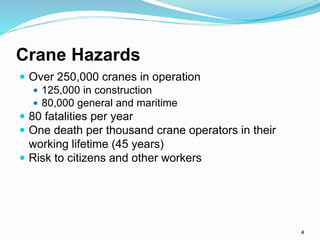
 Over 250,000 cranes in operation
 125,000 in construction
 80,000 general and maritime
 80 fatalities per year
 One death per thousand crane operators in their
working lifetime (45 years)
 Risk to citizens and other workers
4
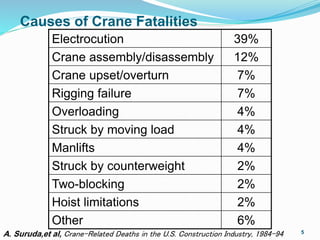
Causes of Crane Fatalities
5
Electrocution 39%
Crane assembly/disassembly 12%
Crane upset/overturn 7%
Rigging failure 7%
Overloading 4%
Struck by moving load 4%
Manlifts 4%
Struck by counterweight 2%
Two-blocking 2%
Hoist limitations 2%
Other 6%
A. Suruda,et al, Crane-Related Deaths in the U.S. Construction Industry, 1984-94
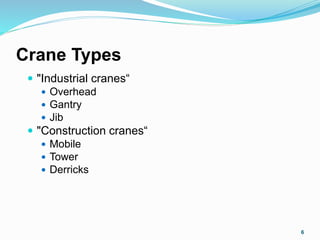
Crane Types
 "Industrial cranes“
 Overhead
 Gantry
 Jib
 "Construction cranes“
 Mobile
 Tower
 Derricks
6
Industrial Cranes
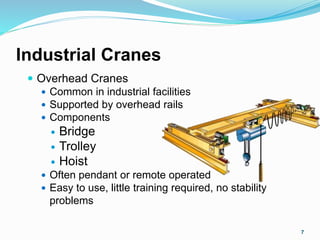
 Overhead Cranes
 Common in industrial facilities
 Supported by overhead rails
 Components
 Bridge
 Trolley
 Hoist
 Often pendant or remote operated
 Easy to use, little training required, no stability
problems
7
Industrial Cranes
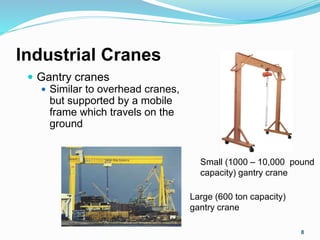
 Gantry cranes
 Similar to overhead cranes,
but supported by a mobile
frame which travels on the
ground
8
Small (1000 – 10,000 pound
capacity) gantry crane
Large (600 ton capacity)
gantry crane
Industrial Cranes
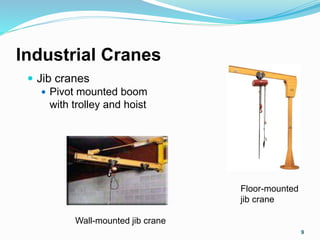
 Jib cranes
 Pivot mounted boom
with trolley and hoist
9
Wall-mounted jib crane
Floor-mounted
jib crane
Industrial Cranes
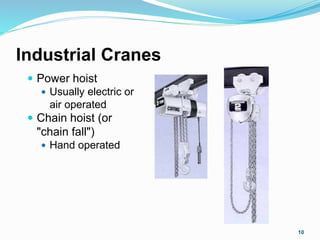
 Power hoist
 Usually electric or
air operated
 Chain hoist (or
"chain fall")
 Hand operated
10
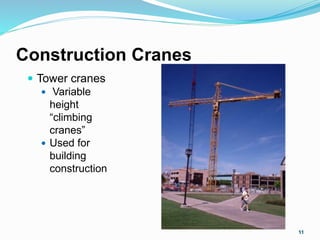
Construction Cranes
 Tower cranes
 Variable
height
“climbing
cranes”
 Used for
building
construction
11
Construction Cranes
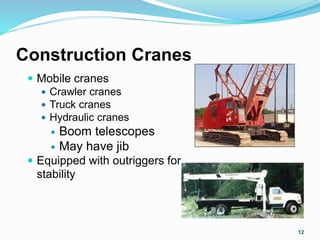
 Mobile cranes
 Crawler cranes
 Truck cranes
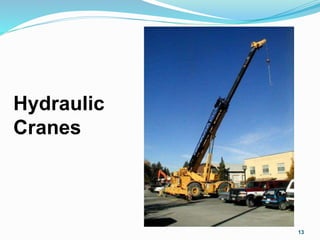
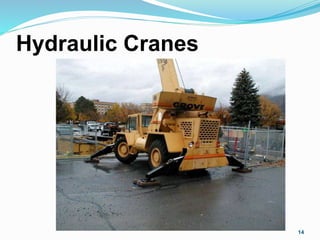
 Hydraulic cranes
 Boom telescopes
 May have jib
 Equipped with outriggers for
stability
12
Hydraulic
Cranes
13
Hydraulic Cranes
14
Construction cranes
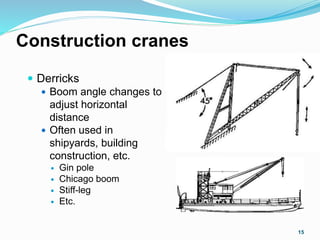
 Derricks
 Boom angle changes to
adjust horizontal
distance
 Often used in
shipyards, building
construction, etc.
 Gin pole
 Chicago boom
 Stiff-leg
 Etc.
15
16
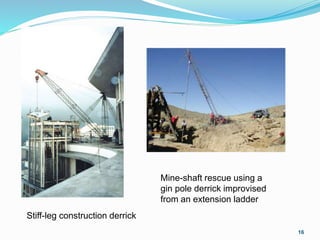
Stiff-leg construction derrick
Mine-shaft rescue using a
gin pole derrick improvised
from an extension ladder
17
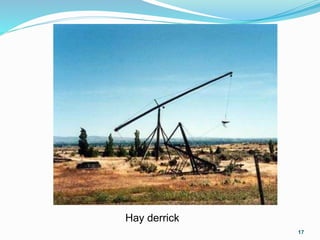
Hay derrick
Rigging
 Rigging: The hardware and
equipment used to safely
attach a load to a lifting
device
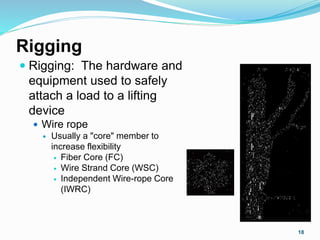
 Wire rope
 Usually a "core" member to
increase flexibility
 Fiber Core (FC)
 Wire Strand Core (WSC)
 Independent Wire-rope Core
(IWRC)
18
Rigging
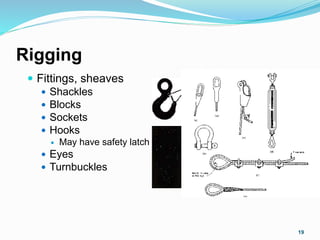
 Fittings, sheaves
 Shackles
 Blocks
 Sockets
 Hooks
 May have safety latch
 Eyes
 Turnbuckles
19
Rigging
 Always use rigging to connect the load to the
hook
 Materials
 Wire rope
 Fabric
 Chain
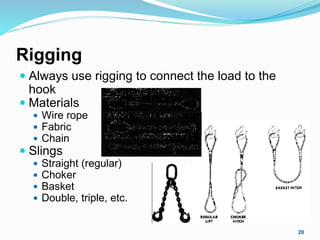
 Slings
 Straight (regular)
 Choker
 Basket
 Double, triple, etc.
20
Rigging
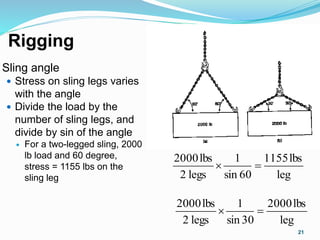
Sling angle
 Stress on sling legs varies
with the angle
 Divide the load by the
number of sling legs, and
divide by sin of the angle
 For a two-legged sling, 2000
lb load and 60 degree,
stress = 1155 lbs on the
sling leg
21
leg
lbs1155
60sin
1
legs2
lbs2000

leg
lbs2000
30sin
1
legs2
lbs2000

Controlling Crane Hazards
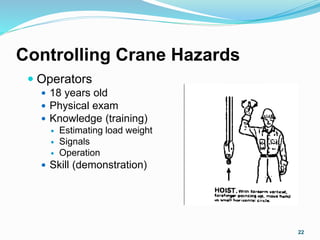
 Operators
 18 years old
 Physical exam
 Knowledge (training)
 Estimating load weight
 Signals
 Operation
 Skill (demonstration)
22
Controlling Crane Hazards
 Inspection
 Frequent
 Daily, monthly
 Hooks, rope, crane operation
 Periodic
 At least annually
 Complete inspection - wear, damage, deterioration,
operation
 slings
 Testing
 Records
23
Preventing Crane Accidents
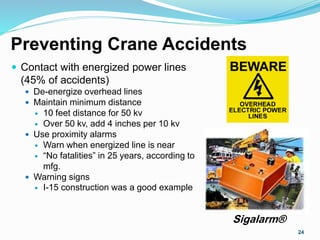
 Contact with energized power lines
(45% of accidents)
 De-energize overhead lines
 Maintain minimum distance
 10 feet distance for 50 kv
 Over 50 kv, add 4 inches per 10 kv
 Use proximity alarms
 Warn when energized line is near
 “No fatalities” in 25 years, according to
mfg.
 Warning signs
 I-15 construction was a good example
24
Sigalarm®
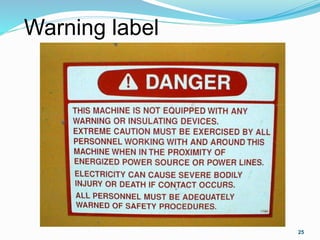
Warning label
25
Preventing Crane Accidents
 Under hook lifting device problems
 Inspect, proper use, etc.
 Overturned cranes
 Assure a level and stable base for the crane
 Comply with load charts
 Weight
 Boom angle and extension
 Only vertical loads
 Wind can cause a significant side load
26
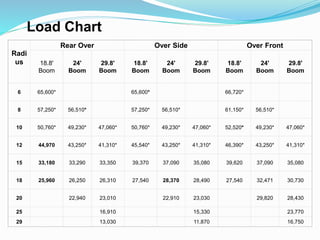
Load Chart
 Load charts inside
the cab include
Structural
capacity and
tipping limits for
the crane
 Capacity is
highest for short
radius “over front”
loads with
outriggers
extended.
27
Load Chart
Radi
us
Rear Over Over Side Over Front
18.8'
Boom
24'
Boom
29.8'
Boom
18.8'
Boom
24'
Boom
29.8'
Boom
18.8'
Boom
24'
Boom
29.8'
Boom
6 65,600* 65,600* 66,720*
8 57,250* 56,510* 57,250* 56,510* 61,150* 56,510*
10 50,760* 49,230* 47,060* 50,760* 49,230* 47,060* 52,520* 49,230* 47,060*
12 44,970 43,250* 41,310* 45,540* 43,250* 41,310* 46,390* 43,250* 41,310*
15 33,180 33,290 33,350 39,370 37,090 35,080 39,620 37,090 35,080
18 25,960 26,250 26,310 27,540 28,370 28,490 27,540 32,471 30,730
20 22,940 23,010 22,910 23,030 29,820 28,430
25 16,910 15,330 23,770
29 13,030 11,870 16,750
Preventing Crane Accidents
 Dropped loads
 Operating anti-two block device (upper limit switch)
 Proper rigging
 Inspection
 Boom collapse
 Inspection
 Stable base
 No overloading
 No horizontal loading
 Crushing by the counter weight
 Stay away from the rear of the crane
29
Preventing Crane Accidents
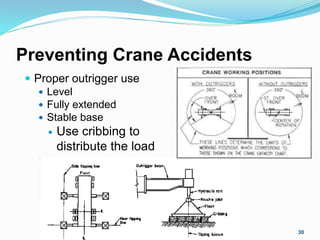
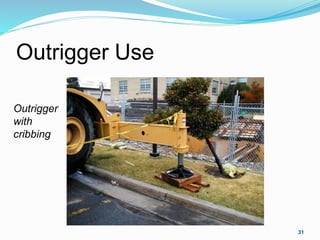
 Proper outrigger use
 Level
 Fully extended
 Stable base
 Use cribbing to
distribute the load
30
Outrigger Use
31
Outrigger
with
cribbing
Preventing Crane Accidents
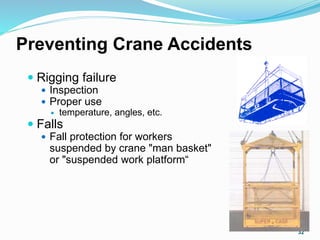
 Rigging failure
 Inspection
 Proper use
 temperature, angles, etc.
 Falls
 Fall protection for workers
suspended by crane "man basket"
or "suspended work platform“
32

Cranes and Hoist Safety

  • 1.
  • 2.
    Objectives  Know hazardsassociated with cranes  Become familiar with common types of industrial and construction cranes  Understand rigging basics, including the importance of “sling angle”  Be familiar with methods of controlling crane hazards and preventing accidents 2
  • 3.
    Outline  Crane Hazards Crane types  Industrial cranes  Construction cranes  Rigging (and “sling angle”)  Controlling hazards  Inspections and training  Power lines  Equipment failure and crane stability  Other 3
  • 4.
    Crane Hazards  Over250,000 cranes in operation  125,000 in construction  80,000 general and maritime  80 fatalities per year  One death per thousand crane operators in their working lifetime (45 years)  Risk to citizens and other workers 4
  • 5.
    Causes of CraneFatalities 5 Electrocution 39% Crane assembly/disassembly 12% Crane upset/overturn 7% Rigging failure 7% Overloading 4% Struck by moving load 4% Manlifts 4% Struck by counterweight 2% Two-blocking 2% Hoist limitations 2% Other 6% A. Suruda,et al, Crane-Related Deaths in the U.S. Construction Industry, 1984-94
  • 6.
    Crane Types  "Industrialcranes“  Overhead  Gantry  Jib  "Construction cranes“  Mobile  Tower  Derricks 6
  • 7.
    Industrial Cranes  OverheadCranes  Common in industrial facilities  Supported by overhead rails  Components  Bridge  Trolley  Hoist  Often pendant or remote operated  Easy to use, little training required, no stability problems 7
  • 8.
    Industrial Cranes  Gantrycranes  Similar to overhead cranes, but supported by a mobile frame which travels on the ground 8 Small (1000 – 10,000 pound capacity) gantry crane Large (600 ton capacity) gantry crane
  • 9.
    Industrial Cranes  Jibcranes  Pivot mounted boom with trolley and hoist 9 Wall-mounted jib crane Floor-mounted jib crane
  • 10.
    Industrial Cranes  Powerhoist  Usually electric or air operated  Chain hoist (or "chain fall")  Hand operated 10
  • 11.
    Construction Cranes  Towercranes  Variable height “climbing cranes”  Used for building construction 11
  • 12.
    Construction Cranes  Mobilecranes  Crawler cranes  Truck cranes  Hydraulic cranes  Boom telescopes  May have jib  Equipped with outriggers for stability 12
  • 13.
  • 14.
  • 15.
    Construction cranes  Derricks Boom angle changes to adjust horizontal distance  Often used in shipyards, building construction, etc.  Gin pole  Chicago boom  Stiff-leg  Etc. 15
  • 16.
    16 Stiff-leg construction derrick Mine-shaftrescue using a gin pole derrick improvised from an extension ladder
  • 17.
  • 18.
    Rigging  Rigging: Thehardware and equipment used to safely attach a load to a lifting device  Wire rope  Usually a "core" member to increase flexibility  Fiber Core (FC)  Wire Strand Core (WSC)  Independent Wire-rope Core (IWRC) 18
  • 19.
    Rigging  Fittings, sheaves Shackles  Blocks  Sockets  Hooks  May have safety latch  Eyes  Turnbuckles 19
  • 20.
    Rigging  Always userigging to connect the load to the hook  Materials  Wire rope  Fabric  Chain  Slings  Straight (regular)  Choker  Basket  Double, triple, etc. 20
  • 21.
    Rigging Sling angle  Stresson sling legs varies with the angle  Divide the load by the number of sling legs, and divide by sin of the angle  For a two-legged sling, 2000 lb load and 60 degree, stress = 1155 lbs on the sling leg 21 leg lbs1155 60sin 1 legs2 lbs2000  leg lbs2000 30sin 1 legs2 lbs2000 
  • 22.
    Controlling Crane Hazards Operators  18 years old  Physical exam  Knowledge (training)  Estimating load weight  Signals  Operation  Skill (demonstration) 22
  • 23.
    Controlling Crane Hazards Inspection  Frequent  Daily, monthly  Hooks, rope, crane operation  Periodic  At least annually  Complete inspection - wear, damage, deterioration, operation  slings  Testing  Records 23
  • 24.
    Preventing Crane Accidents Contact with energized power lines (45% of accidents)  De-energize overhead lines  Maintain minimum distance  10 feet distance for 50 kv  Over 50 kv, add 4 inches per 10 kv  Use proximity alarms  Warn when energized line is near  “No fatalities” in 25 years, according to mfg.  Warning signs  I-15 construction was a good example 24 Sigalarm®
  • 25.
  • 26.
    Preventing Crane Accidents Under hook lifting device problems  Inspect, proper use, etc.  Overturned cranes  Assure a level and stable base for the crane  Comply with load charts  Weight  Boom angle and extension  Only vertical loads  Wind can cause a significant side load 26
  • 27.
    Load Chart  Loadcharts inside the cab include Structural capacity and tipping limits for the crane  Capacity is highest for short radius “over front” loads with outriggers extended. 27
  • 28.
    Load Chart Radi us Rear OverOver Side Over Front 18.8' Boom 24' Boom 29.8' Boom 18.8' Boom 24' Boom 29.8' Boom 18.8' Boom 24' Boom 29.8' Boom 6 65,600* 65,600* 66,720* 8 57,250* 56,510* 57,250* 56,510* 61,150* 56,510* 10 50,760* 49,230* 47,060* 50,760* 49,230* 47,060* 52,520* 49,230* 47,060* 12 44,970 43,250* 41,310* 45,540* 43,250* 41,310* 46,390* 43,250* 41,310* 15 33,180 33,290 33,350 39,370 37,090 35,080 39,620 37,090 35,080 18 25,960 26,250 26,310 27,540 28,370 28,490 27,540 32,471 30,730 20 22,940 23,010 22,910 23,030 29,820 28,430 25 16,910 15,330 23,770 29 13,030 11,870 16,750
  • 29.
    Preventing Crane Accidents Dropped loads  Operating anti-two block device (upper limit switch)  Proper rigging  Inspection  Boom collapse  Inspection  Stable base  No overloading  No horizontal loading  Crushing by the counter weight  Stay away from the rear of the crane 29
  • 30.
    Preventing Crane Accidents Proper outrigger use  Level  Fully extended  Stable base  Use cribbing to distribute the load 30
  • 31.
  • 32.
    Preventing Crane Accidents Rigging failure  Inspection  Proper use  temperature, angles, etc.  Falls  Fall protection for workers suspended by crane "man basket" or "suspended work platform“ 32