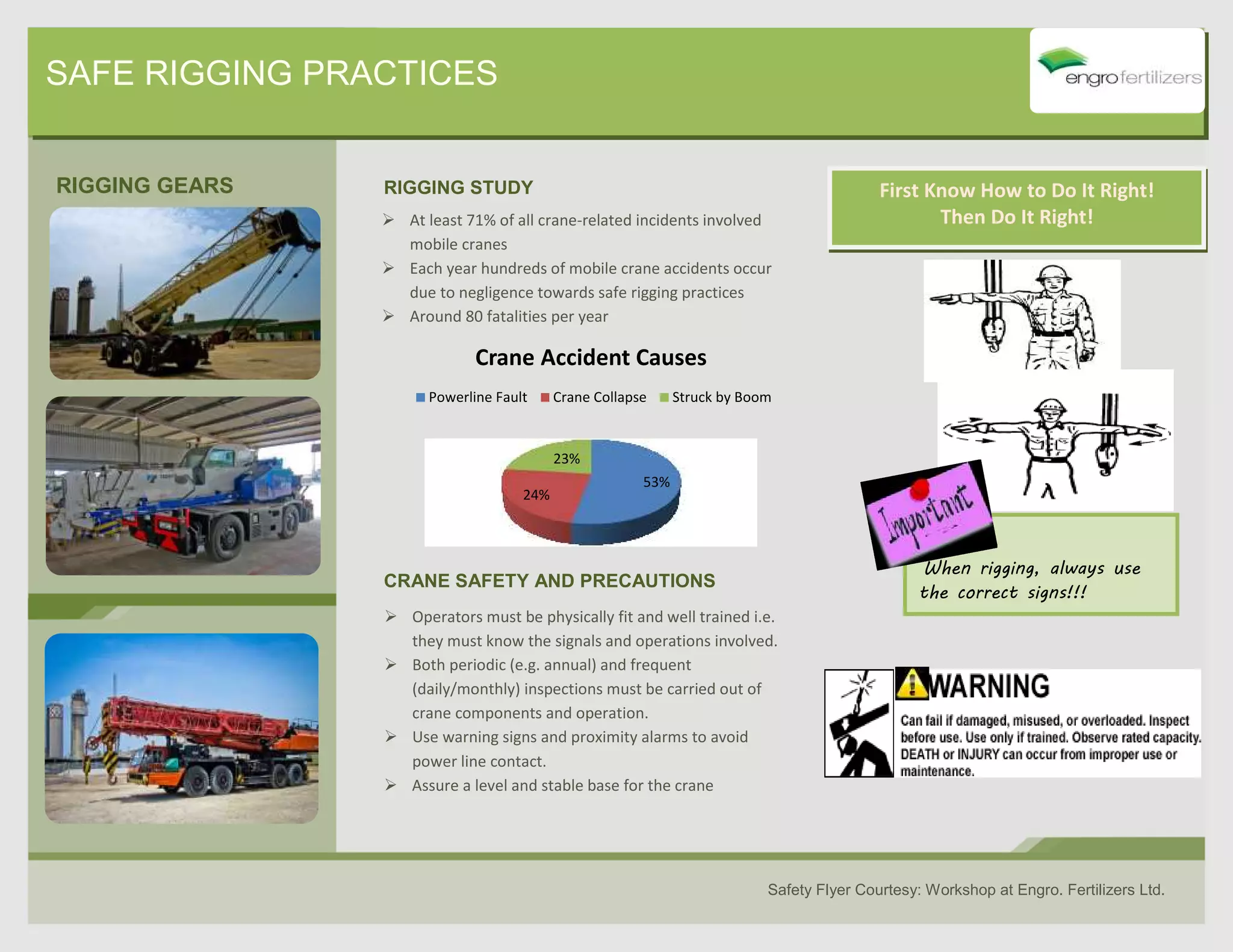
When rigging, always use
the correct signs!!!
RIGGING GEARS First Know How to Do It Right!
Then Do It Right!
SAFE RIGGING PRACTICES
Safety Flyer Courtesy: Workshop at Engro. Fertilizers Ltd.
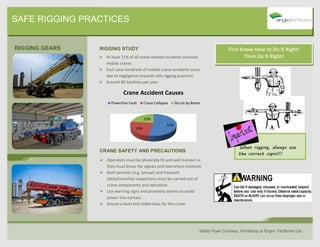
 At least 71% of all crane-related incidents involved
mobile cranes
 Each year hundreds of mobile crane accidents occur
due to negligence towards safe rigging practices
 Around 80 fatalities per year
53%
24%
23%
Crane Accident Causes
Powerline Fault Crane Collapse Struck by Boom
CRANE SAFETY AND PRECAUTIONS
 Operators must be physically fit and well trained i.e.
they must know the signals and operations involved.
 Both periodic (e.g. annual) and frequent
(daily/monthly) inspections must be carried out of
crane components and operation.
 Use warning signs and proximity alarms to avoid
power line contact.
RIGGING STUDY
 Assure a level and stable base for the crane
SAFE RIGGING PRACTICES
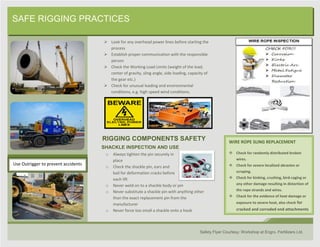
WIRE ROPE SLING REPLACEMENT
 Check for randomly distributed broken
wires.
 Check for severe localized abrasion or
scraping.
 Check for kinking, crushing, bird-caging or
any other damage resulting in distortion of
the rope strands and wires.
 Check for the evidence of heat damage or
exposure to severe heat, also check for
cracked and corroded end attachments
RIGGING COMPONENTS SAFETY
SHACKLE INSPECTION AND USE
o Always tighten the pin securely in
place
o Check the shackle pin, ears and
bail for deformation cracks before
each lift
o Never weld on to a shackle body or pin
o Never substitute a shackle pin with anything other
than the exact replacement pin from the
manufacturer
o Never force too small a shackle onto a hook
Safety Flyer Courtesy: Workshop at Engro. Fertilizers Ltd.
 Look for any overhead power lines before starting the
process
 Establish proper communication with the responsible
person
 Check the Working Load Limits (weight of the load,
center of gravity, sling angle, side loading, capacity of
the gear etc.)
 Check for unusual loading and environmental
conditions, e.g. high speed wind conditions.
Use Outrigger to prevent accidents
Designed by: Omer Abdur Rehman Khan
Supervised by: Imran Raza Sheikh
CAPTION
BASIC SLING OPERATING PRACTICES
(ANSI B30.9)
Whenever any sling is used, the following practices
shall be observed!
1. Slings that are damaged or defective shall not be
used.
2. Slings shall not be shortened with knots or bolts or
other makeshift devices.
3. Sling legs shall not be kinked.
4. Slings shall not be loaded in excess of their rated
capacity.
5. Slings used in a Basket Hitch shall have the load
balanced to prevent slippage.
6. Slings shall be securely attached to the load.
7. Slings shall be padded or protected from the sharp
edges of their loads.
8. Suspended loads shall be kept free of obstructions.
9. All employees shall be kept clear of loads about to
be lifted and of suspended loads.
Safety Flyer Courtesy: Workshop at Engro. Fertilizers Ltd.
CAPTION CAPTION
CAPTION
Delete text and place
photo here.
Delete text and place
photo here.
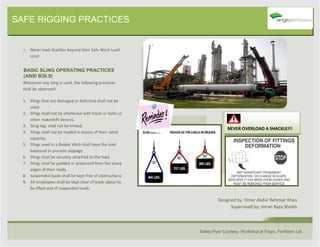
NEVER OVERLOAD A SHACKLE!!!
SAFE RIGGING PRACTICES
o Never load shackles beyond their Safe Work Load
Limit

Safe Rigging Practices

  • 1.
    When rigging, alwaysuse the correct signs!!! RIGGING GEARS First Know How to Do It Right! Then Do It Right! SAFE RIGGING PRACTICES Safety Flyer Courtesy: Workshop at Engro. Fertilizers Ltd.  At least 71% of all crane-related incidents involved mobile cranes  Each year hundreds of mobile crane accidents occur due to negligence towards safe rigging practices  Around 80 fatalities per year 53% 24% 23% Crane Accident Causes Powerline Fault Crane Collapse Struck by Boom CRANE SAFETY AND PRECAUTIONS  Operators must be physically fit and well trained i.e. they must know the signals and operations involved.  Both periodic (e.g. annual) and frequent (daily/monthly) inspections must be carried out of crane components and operation.  Use warning signs and proximity alarms to avoid power line contact. RIGGING STUDY  Assure a level and stable base for the crane
  • 2.
    SAFE RIGGING PRACTICES WIREROPE SLING REPLACEMENT  Check for randomly distributed broken wires.  Check for severe localized abrasion or scraping.  Check for kinking, crushing, bird-caging or any other damage resulting in distortion of the rope strands and wires.  Check for the evidence of heat damage or exposure to severe heat, also check for cracked and corroded end attachments RIGGING COMPONENTS SAFETY SHACKLE INSPECTION AND USE o Always tighten the pin securely in place o Check the shackle pin, ears and bail for deformation cracks before each lift o Never weld on to a shackle body or pin o Never substitute a shackle pin with anything other than the exact replacement pin from the manufacturer o Never force too small a shackle onto a hook Safety Flyer Courtesy: Workshop at Engro. Fertilizers Ltd.  Look for any overhead power lines before starting the process  Establish proper communication with the responsible person  Check the Working Load Limits (weight of the load, center of gravity, sling angle, side loading, capacity of the gear etc.)  Check for unusual loading and environmental conditions, e.g. high speed wind conditions. Use Outrigger to prevent accidents
  • 3.
    Designed by: OmerAbdur Rehman Khan Supervised by: Imran Raza Sheikh CAPTION BASIC SLING OPERATING PRACTICES (ANSI B30.9) Whenever any sling is used, the following practices shall be observed! 1. Slings that are damaged or defective shall not be used. 2. Slings shall not be shortened with knots or bolts or other makeshift devices. 3. Sling legs shall not be kinked. 4. Slings shall not be loaded in excess of their rated capacity. 5. Slings used in a Basket Hitch shall have the load balanced to prevent slippage. 6. Slings shall be securely attached to the load. 7. Slings shall be padded or protected from the sharp edges of their loads. 8. Suspended loads shall be kept free of obstructions. 9. All employees shall be kept clear of loads about to be lifted and of suspended loads. Safety Flyer Courtesy: Workshop at Engro. Fertilizers Ltd. CAPTION CAPTION CAPTION Delete text and place photo here. Delete text and place photo here. NEVER OVERLOAD A SHACKLE!!! SAFE RIGGING PRACTICES o Never load shackles beyond their Safe Work Load Limit