Media Ethics
COM 140
For Journalism, PR, Documentaries, Advertising
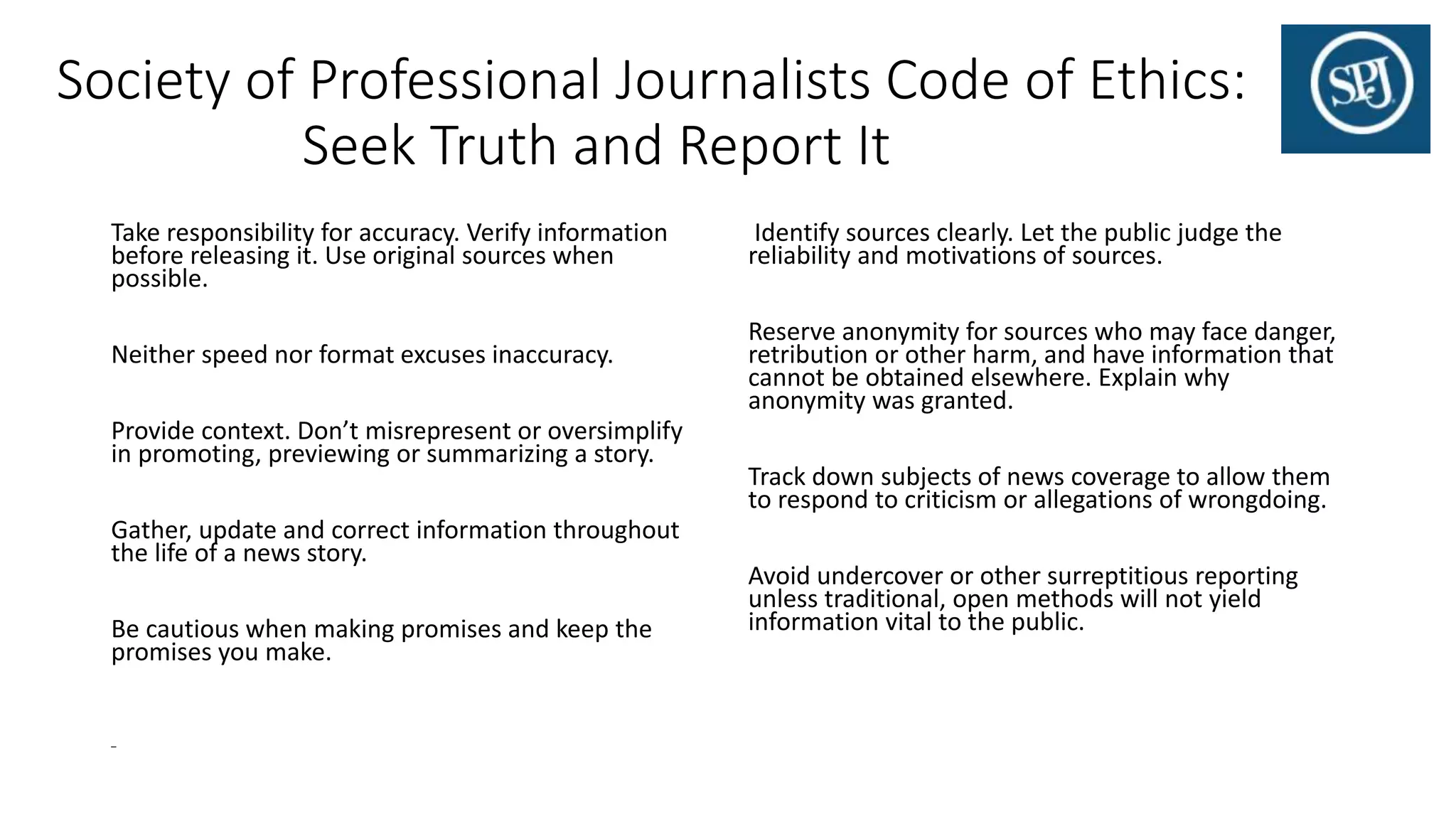
Take responsibility for accuracy. Verify information
before releasing it. Use original sources when
possible.
Neither speed nor format excuses inaccuracy.
Provide context. Don’t misrepresent or oversimplify
in promoting, previewing or summarizing a story.
Gather, update and correct information throughout
the life of a news story.
Be cautious when making promises and keep the
promises you make.
–
Identify sources clearly. Let the public judge the
reliability and motivations of sources.
Reserve anonymity for sources who may face danger,
retribution or other harm, and have information that
cannot be obtained elsewhere. Explain why
anonymity was granted.
Track down subjects of news coverage to allow them
to respond to criticism or allegations of wrongdoing.
Avoid undercover or other surreptitious reporting
unless traditional, open methods will not yield
information vital to the public.
Society of Professional Journalists Code of Ethics:
Seek Truth and Report It
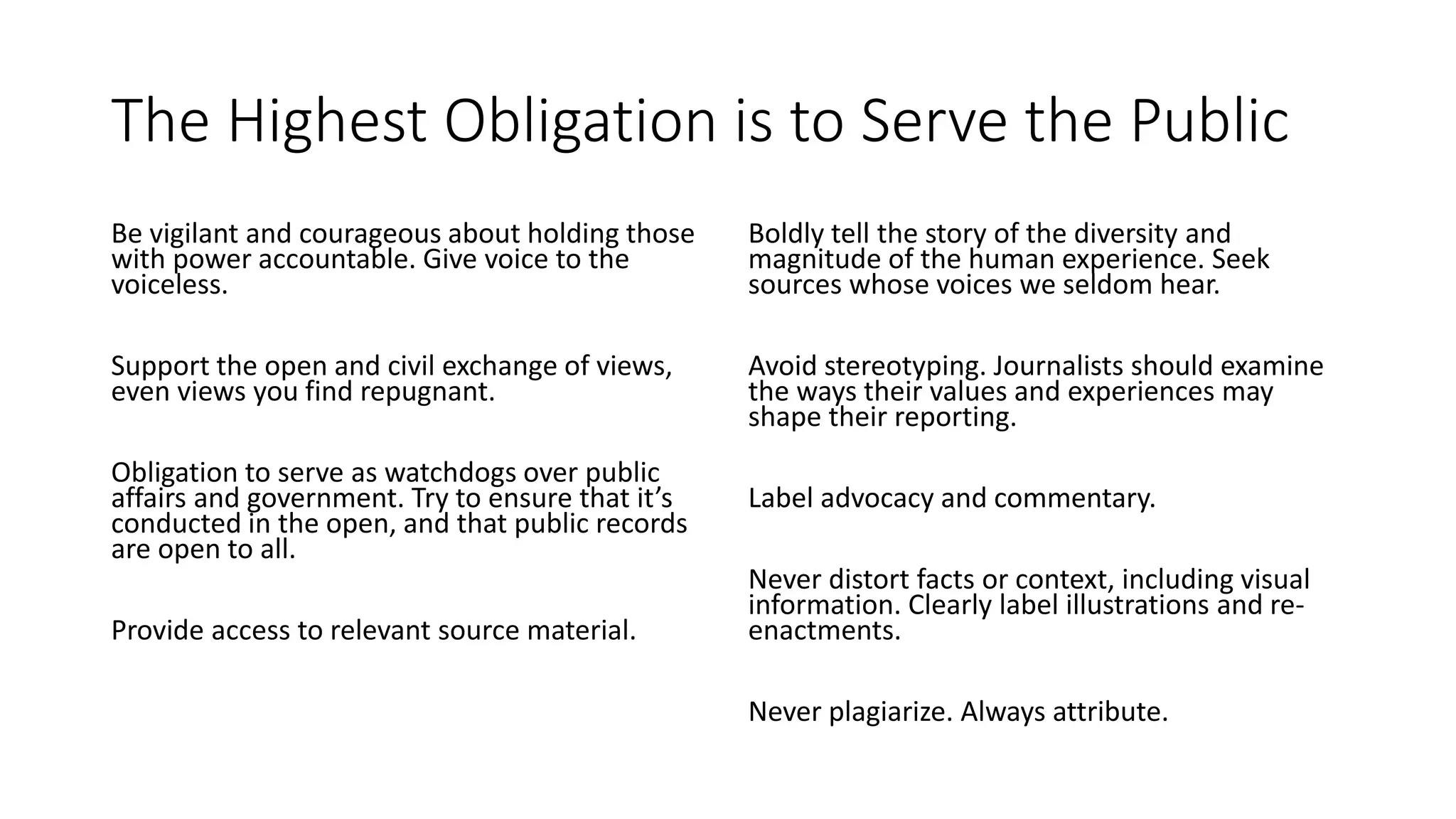
The Highest Obligation is to Serve the Public
Be vigilant and courageous about holding those
with power accountable. Give voice to the
voiceless.
Support the open and civil exchange of views,
even views you find repugnant.
Obligation to serve as watchdogs over public
affairs and government. Try to ensure that it’s
conducted in the open, and that public records
are open to all.
Provide access to relevant source material.
Boldly tell the story of the diversity and
magnitude of the human experience. Seek
sources whose voices we seldom hear.
Avoid stereotyping. Journalists should examine
the ways their values and experiences may
shape their reporting.
Label advocacy and commentary.
Never distort facts or context, including visual
information. Clearly label illustrations and re-
enactments.
Never plagiarize. Always attribute.
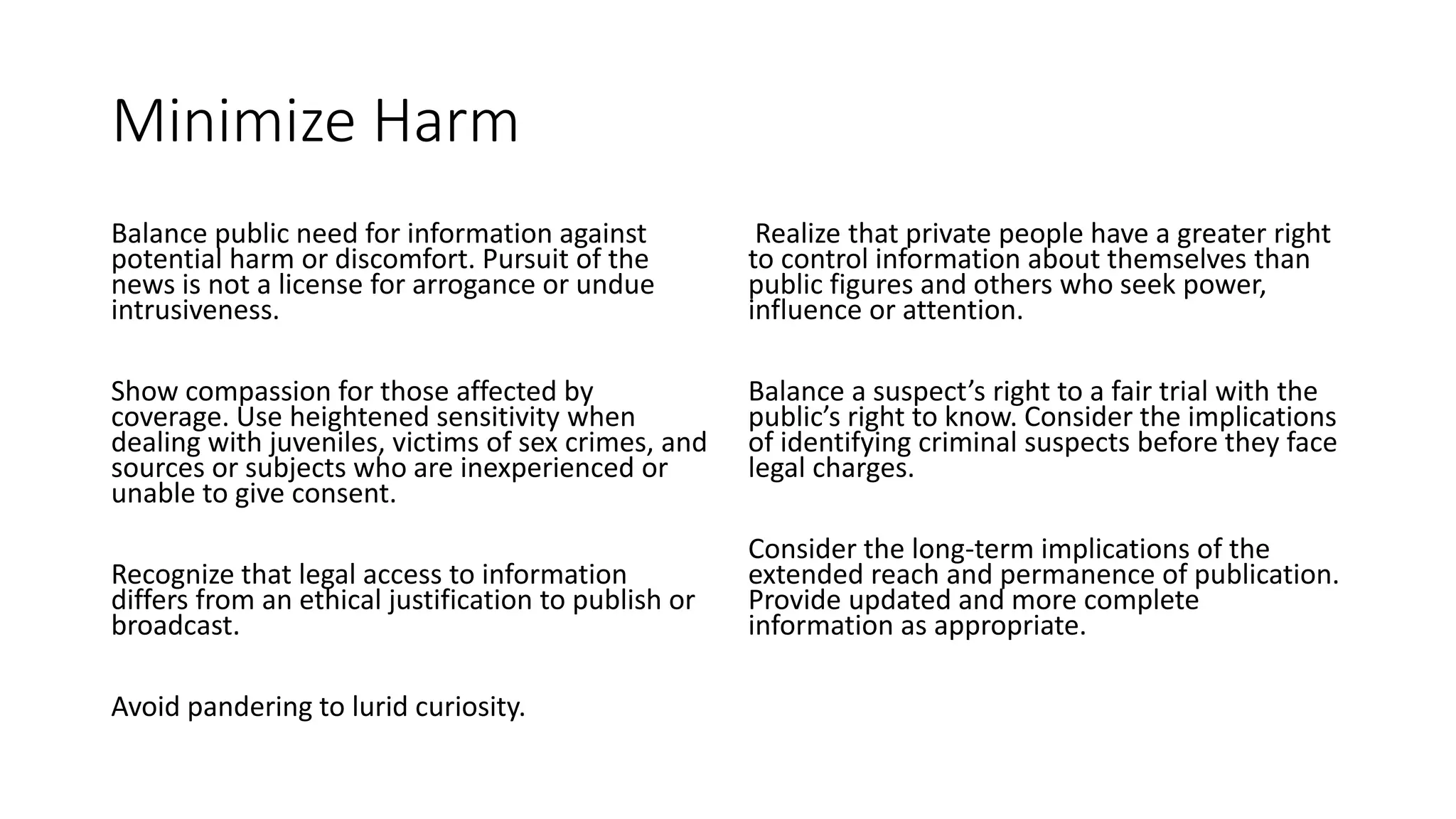
Minimize Harm
Balance public need for information against
potential harm or discomfort. Pursuit of the
news is not a license for arrogance or undue
intrusiveness.
Show compassion for those affected by
coverage. Use heightened sensitivity when
dealing with juveniles, victims of sex crimes, and
sources or subjects who are inexperienced or
unable to give consent.
Recognize that legal access to information
differs from an ethical justification to publish or
broadcast.
Avoid pandering to lurid curiosity.
Realize that private people have a greater right
to control information about themselves than
public figures and others who seek power,
influence or attention.
Balance a suspect’s right to a fair trial with the
public’s right to know. Consider the implications
of identifying criminal suspects before they face
legal charges.
Consider the long-term implications of the
extended reach and permanence of publication.
Provide updated and more complete
information as appropriate.
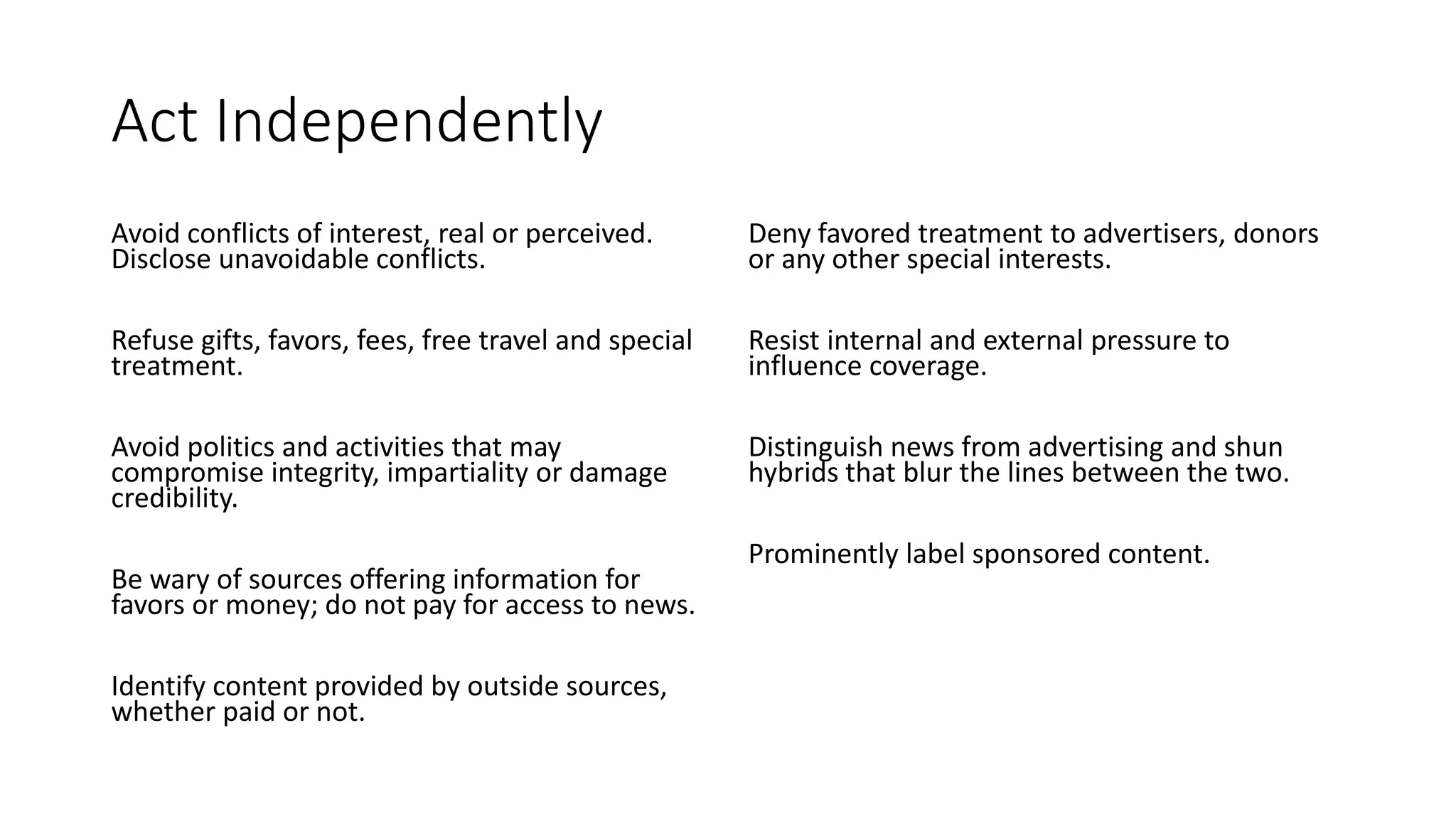
Act Independently
Avoid conflicts of interest, real or perceived.
Disclose unavoidable conflicts.
Refuse gifts, favors, fees, free travel and special
treatment.
Avoid politics and activities that may
compromise integrity, impartiality or damage
credibility.
Be wary of sources offering information for
favors or money; do not pay for access to news.
Identify content provided by outside sources,
whether paid or not.
Deny favored treatment to advertisers, donors
or any other special interests.
Resist internal and external pressure to
influence coverage.
Distinguish news from advertising and shun
hybrids that blur the lines between the two.
Prominently label sponsored content.
Be Accountable and Transparent
Explain ethical choices and processes to audiences.
Encourage a civil dialogue with the public about
journalistic practices, coverage and news content.
Respond quickly to questions about accuracy, clarity
and fairness.
Acknowledge mistakes and correct them promptly
and prominently. Clearly explain corrections and
clarifications.
Expose unethical conduct in journalism.
Abide by the same high standards they expect of
others.
Cui Bono?
Who Benefits from
Dismissing Journalism
as Fake News?
Documentary Filmmaking
To film or not to film? How
close to a subject is too close?
How far is too far?
These are questions that
documentary filmmakers
should be asking themselves
when they set out to record a
true story.
When you spend so much time
with a subject:
Sometimes lines are crossed,
and sometimes boundaries are
set beforehand.
Sometimes the filmmaker and
the audience disagree on where
the line is, and a divide is
created between them.
Famous People Have Agency, Plain Folks Don’t
“We want to get the facts right
of course, and if it’s really
something that bothers you or
that you’re not happy with,
you’re going to be listened to,”
said Gordon Quinn, co-
producer of Hoop Dreams.
“But at the end of the day it has
to be my decision.”
Code of Ethics for Public Relations
Commitment is to Client, not Public:
“We serve the public interest by acting as responsible advocates for those
we represent. We provide a voice in the marketplace of ideas, facts, and
viewpoints to aid informed public debate.”
Can go up to the line of truth, but not cross:
“We adhere to the highest standards of accuracy and truth in advancing the
interests of those we represent.”
Emphasis on enforcement of the Code has been eliminated
Integrity Guidelines
Be honest and accurate in all communications.
Act promptly to correct erroneous communications for which the
practitioner is responsible.
Investigate the truthfulness and accuracy of information released
on behalf of those represented.
Reveal the sponsors for causes and interests represented.
Disclose financial interest (such as stock ownership) in a client’s
organization.
Avoid deceptive practices.
Examples of Improper Information Disclosure
Front groups: A member implements “grass roots” campaigns or letter-
writing campaigns to legislators on behalf of undisclosed interest
groups.
Lying by omission: A practitioner for a corporation knowingly fails to
release financial information, giving a misleading impression of the
corporation’s performance.
A member discovers inaccurate information disseminated via a
website or media kit and does not correct the information.
A member deceives the public by employing people to pose as
volunteers to speak at public hearings and participate in “grass roots”
campaigns.
Financial Influence – Where’s the Line?
Preserve the free flow of unprejudiced information when giving or
receiving gifts by ensuring that gifts are nominal, legal, and
infrequent.
Examples of Improper Conduct Under this Provision:
• A member representing a ski manufacturer gives an expensive
pair of racing skis to a sports columnist, to influence them to
write favorable articles about the product.
• A member entertains a government official beyond legal limits
and/or in violation of government reporting requirements.
Ethics in Advertising -- Where’s the Line?
Fair, Honest and Forthright
Credibility Essential for Business
Does it Combat Erosion of Trust?
Must Distinguish Ads from News
“Paid post”
“Presented by”
“Sponsored by”
“Partnered with”
“Promoted”
“Affiliated with”
“Powered by”
Sponsored Content works!
Sponsored Content
Make your brand feel credible and
trustworthy by placing it
alongside other things that the
viewer enjoys
Adds to the user experience
instead of disrupting it
Mutually beneficial – a content
creator gets funding and a
product creator gets an audience
Articles
Listicles
Videos
Photos
Infographics
Sponsored Tweets
Sponsored Pins
Carousel Ads
Instagram TV Episodes
Snapchat stories
Facebook stories
YouTube videos
Podcast episodes or series
And more!
Treat Customers Fairly -- Vulnerable Ones
The Children’s Food and Beverage Advertising Initiative is an
outstanding illustration of how the food industry modified its
advertising directed to children under 12 to encourage healthier
dietary choices and healthy lifestyles.
Begun in 2006 with 10 participating companies, today 17 food and
beverage marketers have agreed voluntarily to advertise to children 12
and under only “better-for-you” products.
Monitored by the Council of Better Business Bureaus.
Talk to Your Kids About Not Smoking
https://www.lung.org/research/sotc/by-the-numbers/10-bad-things-
to-entice-kids

COM 140 - Media Ethics

  • 1.
    Media Ethics COM 140 ForJournalism, PR, Documentaries, Advertising
  • 2.
    Take responsibility foraccuracy. Verify information before releasing it. Use original sources when possible. Neither speed nor format excuses inaccuracy. Provide context. Don’t misrepresent or oversimplify in promoting, previewing or summarizing a story. Gather, update and correct information throughout the life of a news story. Be cautious when making promises and keep the promises you make. – Identify sources clearly. Let the public judge the reliability and motivations of sources. Reserve anonymity for sources who may face danger, retribution or other harm, and have information that cannot be obtained elsewhere. Explain why anonymity was granted. Track down subjects of news coverage to allow them to respond to criticism or allegations of wrongdoing. Avoid undercover or other surreptitious reporting unless traditional, open methods will not yield information vital to the public. Society of Professional Journalists Code of Ethics: Seek Truth and Report It
  • 3.
    The Highest Obligationis to Serve the Public Be vigilant and courageous about holding those with power accountable. Give voice to the voiceless. Support the open and civil exchange of views, even views you find repugnant. Obligation to serve as watchdogs over public affairs and government. Try to ensure that it’s conducted in the open, and that public records are open to all. Provide access to relevant source material. Boldly tell the story of the diversity and magnitude of the human experience. Seek sources whose voices we seldom hear. Avoid stereotyping. Journalists should examine the ways their values and experiences may shape their reporting. Label advocacy and commentary. Never distort facts or context, including visual information. Clearly label illustrations and re- enactments. Never plagiarize. Always attribute.
  • 4.
    Minimize Harm Balance publicneed for information against potential harm or discomfort. Pursuit of the news is not a license for arrogance or undue intrusiveness. Show compassion for those affected by coverage. Use heightened sensitivity when dealing with juveniles, victims of sex crimes, and sources or subjects who are inexperienced or unable to give consent. Recognize that legal access to information differs from an ethical justification to publish or broadcast. Avoid pandering to lurid curiosity. Realize that private people have a greater right to control information about themselves than public figures and others who seek power, influence or attention. Balance a suspect’s right to a fair trial with the public’s right to know. Consider the implications of identifying criminal suspects before they face legal charges. Consider the long-term implications of the extended reach and permanence of publication. Provide updated and more complete information as appropriate.
  • 5.
    Act Independently Avoid conflictsof interest, real or perceived. Disclose unavoidable conflicts. Refuse gifts, favors, fees, free travel and special treatment. Avoid politics and activities that may compromise integrity, impartiality or damage credibility. Be wary of sources offering information for favors or money; do not pay for access to news. Identify content provided by outside sources, whether paid or not. Deny favored treatment to advertisers, donors or any other special interests. Resist internal and external pressure to influence coverage. Distinguish news from advertising and shun hybrids that blur the lines between the two. Prominently label sponsored content.
  • 6.
    Be Accountable andTransparent Explain ethical choices and processes to audiences. Encourage a civil dialogue with the public about journalistic practices, coverage and news content. Respond quickly to questions about accuracy, clarity and fairness. Acknowledge mistakes and correct them promptly and prominently. Clearly explain corrections and clarifications. Expose unethical conduct in journalism. Abide by the same high standards they expect of others. Cui Bono? Who Benefits from Dismissing Journalism as Fake News?
  • 7.
    Documentary Filmmaking To filmor not to film? How close to a subject is too close? How far is too far? These are questions that documentary filmmakers should be asking themselves when they set out to record a true story. When you spend so much time with a subject: Sometimes lines are crossed, and sometimes boundaries are set beforehand. Sometimes the filmmaker and the audience disagree on where the line is, and a divide is created between them.
  • 8.
    Famous People HaveAgency, Plain Folks Don’t “We want to get the facts right of course, and if it’s really something that bothers you or that you’re not happy with, you’re going to be listened to,” said Gordon Quinn, co- producer of Hoop Dreams. “But at the end of the day it has to be my decision.”
  • 9.
    Code of Ethicsfor Public Relations Commitment is to Client, not Public: “We serve the public interest by acting as responsible advocates for those we represent. We provide a voice in the marketplace of ideas, facts, and viewpoints to aid informed public debate.” Can go up to the line of truth, but not cross: “We adhere to the highest standards of accuracy and truth in advancing the interests of those we represent.” Emphasis on enforcement of the Code has been eliminated
  • 10.
    Integrity Guidelines Be honestand accurate in all communications. Act promptly to correct erroneous communications for which the practitioner is responsible. Investigate the truthfulness and accuracy of information released on behalf of those represented. Reveal the sponsors for causes and interests represented. Disclose financial interest (such as stock ownership) in a client’s organization. Avoid deceptive practices.
  • 11.
    Examples of ImproperInformation Disclosure Front groups: A member implements “grass roots” campaigns or letter- writing campaigns to legislators on behalf of undisclosed interest groups. Lying by omission: A practitioner for a corporation knowingly fails to release financial information, giving a misleading impression of the corporation’s performance. A member discovers inaccurate information disseminated via a website or media kit and does not correct the information. A member deceives the public by employing people to pose as volunteers to speak at public hearings and participate in “grass roots” campaigns.
  • 12.
    Financial Influence –Where’s the Line? Preserve the free flow of unprejudiced information when giving or receiving gifts by ensuring that gifts are nominal, legal, and infrequent. Examples of Improper Conduct Under this Provision: • A member representing a ski manufacturer gives an expensive pair of racing skis to a sports columnist, to influence them to write favorable articles about the product. • A member entertains a government official beyond legal limits and/or in violation of government reporting requirements.
  • 13.
    Ethics in Advertising-- Where’s the Line? Fair, Honest and Forthright Credibility Essential for Business Does it Combat Erosion of Trust?
  • 14.
    Must Distinguish Adsfrom News “Paid post” “Presented by” “Sponsored by” “Partnered with” “Promoted” “Affiliated with” “Powered by” Sponsored Content works!
  • 15.
    Sponsored Content Make yourbrand feel credible and trustworthy by placing it alongside other things that the viewer enjoys Adds to the user experience instead of disrupting it Mutually beneficial – a content creator gets funding and a product creator gets an audience Articles Listicles Videos Photos Infographics Sponsored Tweets Sponsored Pins Carousel Ads Instagram TV Episodes Snapchat stories Facebook stories YouTube videos Podcast episodes or series And more!
  • 16.
    Treat Customers Fairly-- Vulnerable Ones The Children’s Food and Beverage Advertising Initiative is an outstanding illustration of how the food industry modified its advertising directed to children under 12 to encourage healthier dietary choices and healthy lifestyles. Begun in 2006 with 10 participating companies, today 17 food and beverage marketers have agreed voluntarily to advertise to children 12 and under only “better-for-you” products. Monitored by the Council of Better Business Bureaus.
  • 17.
    Talk to YourKids About Not Smoking
  • 18.

Editor's Notes

  • #10 https://www.prsa.org/about/prsa-code-of-ethics
  • #14 Institute for Advertising Ethics, “PRINCIPLES and PRACTICES forADVERTISING ETHICS”
  • #15 https://www.activecampaign.com/blog/sponsored-content