PUBLIC SPEAKING &
PRESENTATION SKILLS
FOR MARKETING
Case Studies, Concepts, and Ideas


Kenny Ong
Takaful IKHLAS Sdn Bhd


                                    1
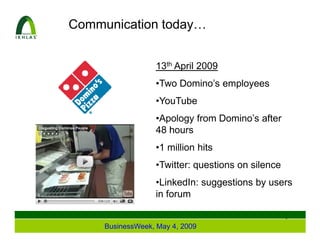
Communication today…


                  13th April 2009
                  •Two Domino’s employees
                  •YouTube
                  •Apology from Domino’s after
                  48 hours
                  •1 million hits
                  •Twitter: questions on silence
                  •LinkedIn: suggestions by users
                  in forum

                                                   2
     BusinessWeek, May 4, 2009
3
4
5
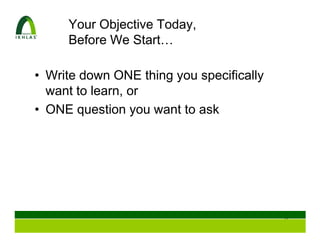
Your Objective Today,
     Before We Start…

• Write down ONE thing you specifically
  want to learn, or
• ONE question you want to ask


                                          6
Part A
Public Speaking
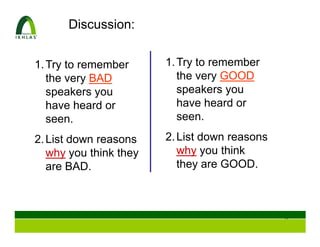
Discussion:


1. Try to remember      1. Try to remember
   the very BAD            the very GOOD
   speakers you            speakers you
   have heard or           have heard or
   seen.                   seen.

2. List down reasons    2. List down reasons
   why you think they      why you think
   are BAD.                they are GOOD.


                                               8
Different types of Public Speaking

•   Speech              •   Training
•   Debate              •   Facilitation
•   Presentation        •   Forum
•   Persuasion          •   Q&A


                                           9
Part A-1
BASICS

           10
The Two Major Focus


1. Confidence
2. Technique


                           11
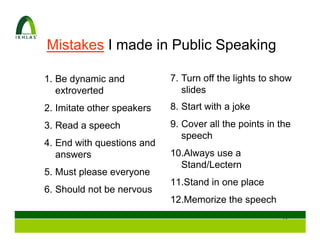
Mistakes I made in Public Speaking

1. Be dynamic and           7. Turn off the lights to show
   extroverted                 slides
2. Imitate other speakers   8. Start with a joke
3. Read a speech            9. Cover all the points in the
                               speech
4. End with questions and
   answers                  10.Always use a
                              Stand/Lectern
5. Must please everyone
                            11.Stand in one place
6. Should not be nervous
                            12.Memorize the speech
                                                       12
“Why should I
listen to you?”

 “So what?”
                  13
Confidence Secret #1:


 “It’s not about you,
   it’s about Them”
                        Dr John C. Maxwell


                                             14
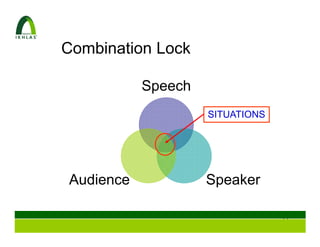
Combination Lock

           Speech
                    SITUATIONS


Audience            Speaker

                                 15
• The Blue Marble


                    16
Speech


         17
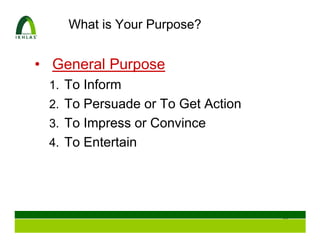
What is Your Purpose?


• General Purpose
 1. To Inform
 2. To Persuade or To Get Action
 3. To Impress or Convince
 4. To Entertain


                                   18
“People don’t care how
       much you know,
until they know how much
          you care.”
                   Unknown


                             19
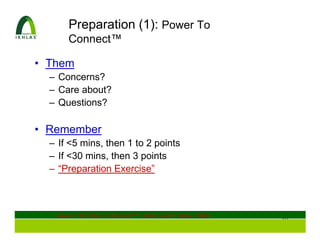
Preparation (1): Power To
       Connect™

• Them
  – Concerns?
  – Care about?
  – Questions?

• Remember
  – If <5 mins, then 1 to 2 points
  – If <30 mins, then 3 points
  – “Preparation Exercise”


   Source: The Power To Connect®, T. Easler and C. Easler; 2003
                                                                  20
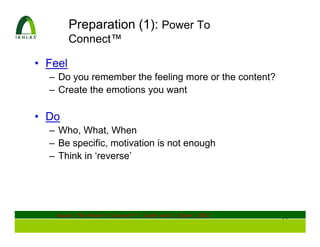
Preparation (1): Power To
         Connect™

• Feel
  – Do you remember the feeling more or the content?
  – Create the emotions you want

• Do
  – Who, What, When
  – Be specific, motivation is not enough
  – Think in ‘reverse’


   Source: The Power To Connect®, T. Easler and C. Easler; 2003
                                                                  21
Confidence Secret #2:


     OVER PREPARE


                        22
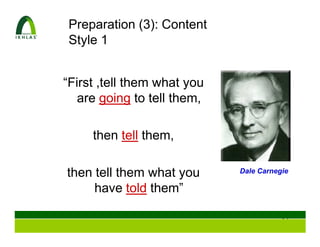
Preparation (3): Content
Style 1


“First ,tell them what you
   are going to tell them,

     then tell them,

then tell them what you      Dale Carnegie

     have told them”

                                        23
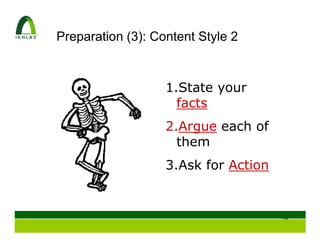
Preparation (3): Content Style 2


                   1.State your
                     facts
                   2.Argue each of
                     them
                   3.Ask for Action


                                      24
Preparation (3): Content
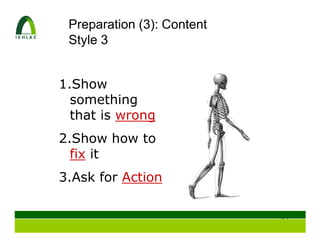
 Style 3


1.Show
  something
  that is wrong
2.Show how to
  fix it
3.Ask for Action

                            25
Preparation (3): Content
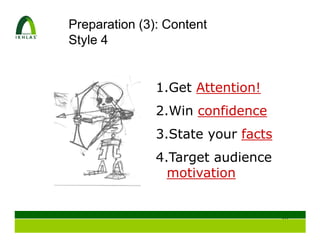
Style 4


               1.Get Attention!
               2.Win confidence
               3.State your facts
               4.Target audience
                 motivation


                                    26
Types of Openings


•   Ask a question
•   Tell a story
•   Present a quotation
•   Refer to the audience/leader
•   Refer to the occasion
•   Use an exhibit
•   Facts and Statistics


                                   27
Congratulations.
You are going to die.


                        28
Why are Questions
 Mysterious?

“All Leaders share one key ability”
“What one key ability do all Leaders share?”

“You should eat healthy food”
“Do you want to die young?”

“Begin with a question”
“Why begin with a question?”


                                               29
Do you know these
     facts?

1. Workers younger than 25 have the highest
   rate of death from electrical shock.
2. Over 500,000 trees are used to supply
   Americans with their Sunday newspaper
   every week.
3. More people die from sudden heart attack
   than from breast cancer, prostate cancer,
   AIDS, house fires, handguns, and traffic
   accidents combined.
4. Many workers at or near retirement age,
   would require more than RM1 million to pay
   medical costs until they die.

                                                30
Planning the Conclusion


• Appeal for Action
• Quick, sincere compliment
• Poetry
• Famous Quote
• Emotional or Dramatic


                                31
Confidence Secret #3:


  Practice, Practice, Practice


                                 32
Speaker


          33
Developing Self Confidence
        (1)
• Know what you are talking about
  –   Prepare in a proper way
  –   Never memorize
  –   Arrange your ideas beforehand
  –   Use personal experiences
  –   Rehearse your talk with your friends


                                             34
Developing Self Confidence
        (2)
• Think Positive and Think Success
  –   Believe in your own topic
  –   Think positive and good things
  –   Imagine a fantastic presentation
  –   Focus on others
  –   Talk positively to yourself


                                         35
Developing Self Confidence
 (3)

• Use your Body
  – Exercise
     • Pressure
     • Active
  – Relaxation techniques
  – Music
     • Calm
     • Energy
  – Talking to yourself
  – Movement and hand signals
  – Pause

                                36
Physical Appearance


  What most people do not realize:


  Your image and reputation is
   evaluated before you get on
         stage, not after.


                                     37
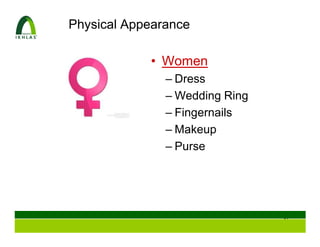
Physical Appearance

            • Women
               – Dress
               – Wedding Ring
               – Fingernails
               – Makeup
               – Purse


                                38
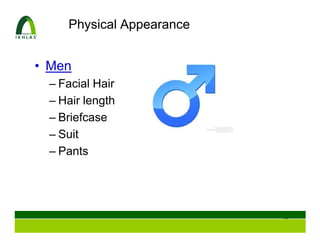
Physical Appearance


• Men
 – Facial Hair
 – Hair length
 – Briefcase
 – Suit
 – Pants


                          39
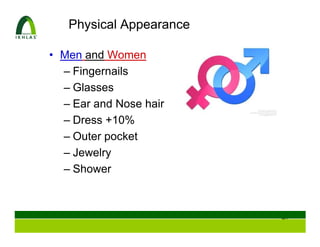
Physical Appearance

• Men and Women
  – Fingernails
  – Glasses
  – Ear and Nose hair
  – Dress +10%
  – Outer pocket
  – Jewelry
  – Shower


                         40
Strategic Movement


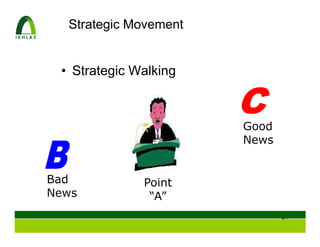
 • Strategic Walking


                       Good
                       News


Bad           Point
News           “A”
                              41
Strategic Movement


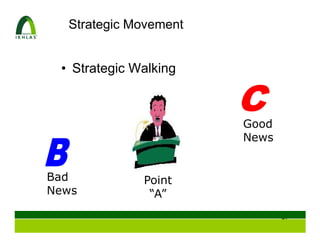
 • Strategic Walking


                       Good
                       News


Bad           Point
News           “A”
                              42
Strategic Movement


• Strategic Anchor
  1. Create a “positive” experience or
     thought
  2. Anchor your movement
  3. “Fire” your anchor!


                                     43
Voice (1)


  Talk with audience, not
        to audience


                            44
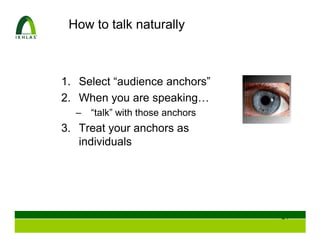
How to talk naturally


1. Select “audience anchors”
2. When you are speaking…
  –   “talk” with those anchors
3. Treat your anchors as
   individuals


                                  45
Confidence Secret #4:


  Do not follow other people’s
              style.

    Talk natural, but louder.


                                 46
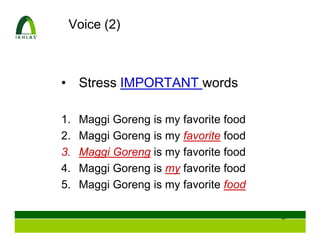
Voice (2)


• Stress IMPORTANT words

1.   Maggi Goreng is my favorite food
2.   Maggi Goreng is my favorite food
3.   Maggi Goreng is my favorite food
4.   Maggi Goreng is my favorite food
5.   Maggi Goreng is my favorite food

                                        47
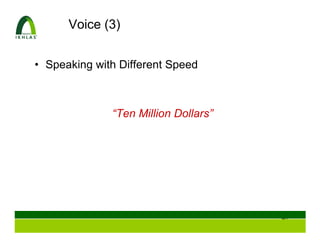
Voice (3)


• Speaking with Different Speed


              “Ten Million Dollars”


                                      48
Voice (4)


• Emphasize

  – IF I WISH TO EMPHASIZE
    SOMETHING, I… speak softly

  – When I want to get attention… I pause


                                            49
Hand Movements


• A person’s hand movements are personal things
• Do not copy another person
• All great speakers have their own hand
  movements
• Force yourself only when practicing


                                             50
Hand Movements: My
        Personal
•   Finger (one hand, two hands)
•   Fists (one hand, two hands)
•   Chop (one hand, two hands)
•   Circle (one hand, two hands)
•   Sweep (left, right, up)
•   Palm (up, down)
•   “Strategic Anchors” – on purpose


                                       51
Confidence Secret #5:


Select “audience anchors” as eye
   contacts that make you more
               relax


                                   52
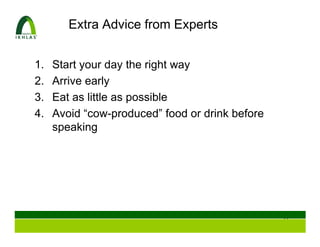
Extra Advice from Experts


1.   Start your day the right way
2.   Arrive early
3.   Eat as little as possible
4.   Avoid “cow-produced” food or drink before
     speaking


                                                 53
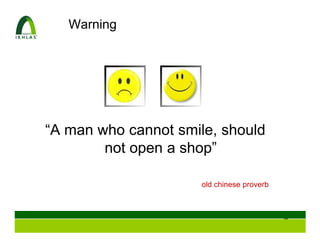
Warning


“A man who cannot smile, should
        not open a shop”

                      old chinese proverb


                                            54
Audience


           55
Audience


 “Marketing is a transfer
       of feelings”


                            56
57
58
59
60
61
62
Platform Rules


1. Crowd your audience together
  –   Best if standing on eye level
2. Air circulation
3. Let there be light on your Face
4. Clear the Platform
  –   Do not hide
  –   As empty as possible
  –   No guests


                                      63
1st Important Question


      Why is your audience there?

          Willingly or unwillingly?


Ask for                        Persuade
Action


                                          64
Part A-2
ADVANCED

           65
Part B
Visual Aids and
 Power Points
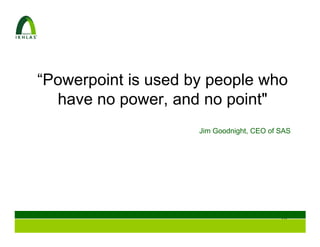
“Powerpoint is used by people who
  have no power, and no point"
                     Jim Goodnight, CEO of SAS


                                           67
• Do’s and Don’ts of PowerPoint


                                  68
69
70
71
72
73
74
75
76
77
78
79
80
81
82
83
84
85
86
87
88
89
90
91
92
Visual aid rules
• Be sure you have a reason for
      using a visual aid
 Keep the visual aid simple
 Use numbered and/or bulleted lists
 Use as little words as possible
 Use large Fonts (18, 22)
 Use the 3¼ Rule (if visual is eye level)
Master your LCD Skills
 Slides vs. Handouts

                                            93
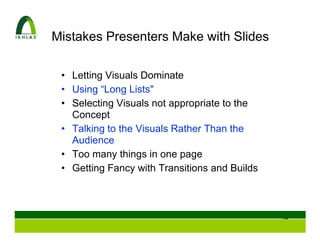
Mistakes Presenters Make with Slides

 • Letting Visuals Dominate
 • Using “Long Lists"
 • Selecting Visuals not appropriate to the
   Concept
 • Talking to the Visuals Rather Than the
   Audience
 • Too many things in one page
 • Getting Fancy with Transitions and Builds


                                               94
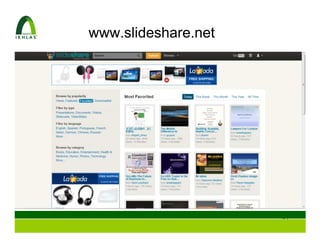
www.slideshare.net


                     95
Part B-2
ADVANCED

           96
Part C
Marketing, Persuasion and
       Influencing
The real goal of Marketing and
           Branding
  Understanding our role in the whole
          scheme of things


                                        98
What is the purpose of
    Marketing & Branding?
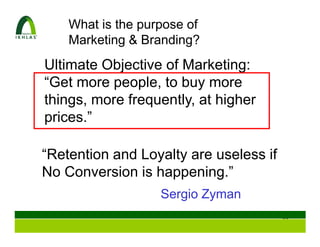
Ultimate Objective of Marketing:
“Get more people, to buy more
things, more frequently, at higher
prices.”

“Retention and Loyalty are useless if
No Conversion is happening.”
                   Sergio Zyman
                                        99
What is the purpose of
    Marketing & Branding?

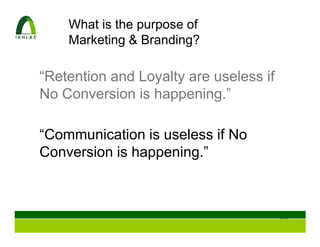
“Retention and Loyalty are useless if
No Conversion is happening.”

“Communication is useless if No
Conversion is happening.”


                                        100
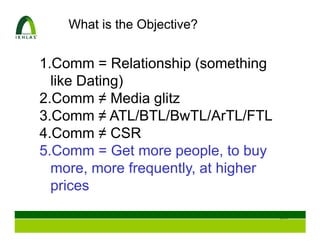
What is the Objective?


1.Comm = Relationship (something
  like Dating)
2.Comm ≠ Media glitz
3.Comm ≠ ATL/BTL/BwTL/ArTL/FTL
4.Comm ≠ CSR
5.Comm = Get more people, to buy
  more, more frequently, at higher
  prices

                                     101
Universal Law

Law of the Ping-Pong Ball
  a.k.a. Law of Cause and Effect


                                   102
Law of Buy-in


1. People will always buy ‘You’ first, before they
   buy the product
2. Respect, Credibility, Trust, Love/Hate


                                                 103
Law of Annoyance

1.    Things our prospects and customers wish we wouldn’t
      do that really annoys them:
     – pushy.
     – call too much.
     – disrespectful of their time.
     – keep calling if they say they’re not interested.
     – appear not to understand them,
     – don’t listen.
     – don’t know about our own products/ services.
     – rude, arrogant, or inattentive.
     – vague or unclear.
     – won’t take no for an answer.


                                                       104
Law of Q&A


1. No one likes to listen to ‘sales talk’
2. The more QUESTIONS you ask, the more
   sales you get


                                            105
Law of the Panadol


1. Creative solutions for customers will always
   come from the ‘problems’
2. Sales is about ‘solving the problem’ not selling
   the solution
3. Example: We do not sell Panadol. We sell
   quick headache relief in 30 seconds.


                                                 106
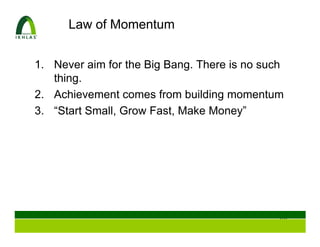
Law of Momentum


1. Never aim for the Big Bang. There is no such
   thing.
2. Achievement comes from building momentum
3. “Start Small, Grow Fast, Make Money”


                                              107
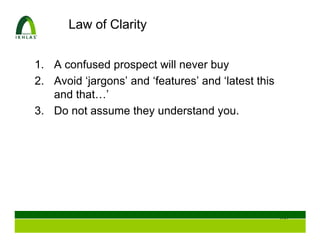
Law of Clarity


1. A confused prospect will never buy
2. Avoid ‘jargons’ and ‘features’ and ‘latest this
   and that…’
3. Do not assume they understand you.


                                                     108
How not to talk to
       Retail External Parties
“The holder [of a CAB certificate] may continue to
  serve regularly any point named herein through the
  airport last regularly used by the holder to serve
  such point prior to the effective date of the
  certificate. Upon compliance with such procedures
  relating thereto as may be prescribed by the Board,
  the holder may, in addition to the services
  hereinabove expressly prescribed, regularly serve a
  point named herein through any airport convenient
  thereto.”


                                                   109
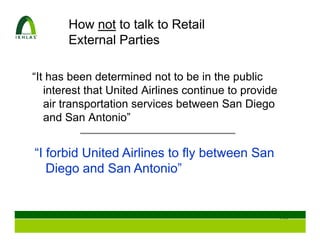
How not to talk to Retail
       External Parties

“It has been determined not to be in the public
   interest that United Airlines continue to provide
   air transportation services between San Diego
   and San Antonio”


“I forbid United Airlines to fly between San
   Diego and San Antonio”


                                                       110
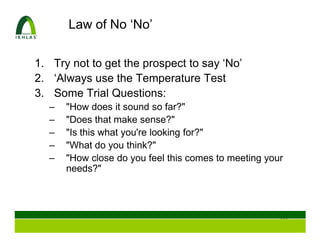
Law of No ‘No’

1. Try not to get the prospect to say ‘No’
2. ‘Always use the Temperature Test
3. Some Trial Questions:
  –   "How does it sound so far?"
  –   "Does that make sense?"
  –   "Is this what you're looking for?"
  –   "What do you think?"
  –   "How close do you feel this comes to meeting your
      needs?"


                                                      111
Law of Belief


1.   Never assume they believe you
2.   Tell them only as much as they’ll believe
3.   Point out the disadvantages
4.   Use precise numbers
5.   If you have something to gain, let them know
6.   Use the power of the printed word
7.   Let them know who else says so


                                                    112
Law of Comparison


• Comparison. When Others Are Doing It, You
  Should, Too.
• We view a behavior as correct in a given
  situation to the degree we see others performing
  it


                                                113
Law of Authority


• Authority. When the Source Is An Authority,
  You Can Believe It.
• Humans by nature have a deep-seated sense of
  duty to authority.


                                            114
Law of Reciprocity


• Reciprocity. When Someone Gives You
  Something, You Should Give Something Back.
• We should try to repay, in kind, what another
  person has provided for us


                                              115
Law of Consistency


• Commitment/Consistency. When You Take A
  Stand, You Should Be Consistent.
• Once we make a choice or take a stand
  (commitment), we will encounter personal and
  interpersonal pressures to behave consistently
  with that commitment (consistency).
• Involvement and Buy-in


                                               116
Law of Scarcity


• Scarcity. When It Is Rare, It Is Good
• Opportunities seem more valuable to us when
  they are less available.
• Things that can be scare: time, money,
  opportunity, physical


                                                117
Law of Self Perception


• Self perception. We learn about ourselves by
  observing our own behavior.
• If we observe ourselves doing some thing then
  we reason that we must like the thing.


                                              118
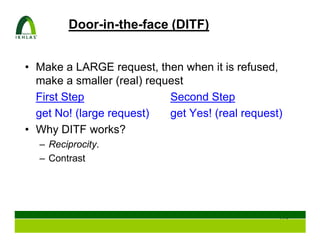
Door-in-the-face (DITF)


• Make a LARGE request, then when it is refused,
  make a smaller (real) request
  First Step                Second Step
  get No! (large request)   get Yes! (real request)
• Why DITF works?
  – Reciprocity.
  – Contrast


                                                  119
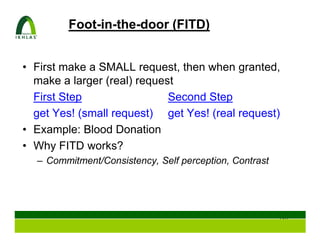
Foot-in-the-door (FITD)


• First make a SMALL request, then when granted,
  make a larger (real) request
  First Step                 Second Step
  get Yes! (small request) get Yes! (real request)
• Example: Blood Donation
• Why FITD works?
  – Commitment/Consistency, Self perception, Contrast


                                                        120
Final Notes


              121
Confidence Secret #3:


  Practice, Practice, Practice


                                 122
The End
     If you are interested in the topic, the
          audience will be interested.

     If you are interested in them, they will
              be interested in you.


                                                123
Thank You.

              soft copy of slides:
http://totallyunrelatedrandomanddebatable.
                blogspot.com/

Takaful IKHLAS Public Speaking & Presentation Skills for Marketing

  • 1.
    PUBLIC SPEAKING & PRESENTATIONSKILLS FOR MARKETING Case Studies, Concepts, and Ideas Kenny Ong Takaful IKHLAS Sdn Bhd 1
  • 2.
    Communication today… 13th April 2009 •Two Domino’s employees •YouTube •Apology from Domino’s after 48 hours •1 million hits •Twitter: questions on silence •LinkedIn: suggestions by users in forum 2 BusinessWeek, May 4, 2009
  • 3.
  • 4.
  • 5.
  • 6.
    Your Objective Today, Before We Start… • Write down ONE thing you specifically want to learn, or • ONE question you want to ask 6
  • 7.
  • 8.
    Discussion: 1. Try toremember 1. Try to remember the very BAD the very GOOD speakers you speakers you have heard or have heard or seen. seen. 2. List down reasons 2. List down reasons why you think they why you think are BAD. they are GOOD. 8
  • 9.
    Different types ofPublic Speaking • Speech • Training • Debate • Facilitation • Presentation • Forum • Persuasion • Q&A 9
  • 10.
  • 11.
    The Two MajorFocus 1. Confidence 2. Technique 11
  • 12.
    Mistakes I madein Public Speaking 1. Be dynamic and 7. Turn off the lights to show extroverted slides 2. Imitate other speakers 8. Start with a joke 3. Read a speech 9. Cover all the points in the speech 4. End with questions and answers 10.Always use a Stand/Lectern 5. Must please everyone 11.Stand in one place 6. Should not be nervous 12.Memorize the speech 12
  • 13.
    “Why should I listento you?” “So what?” 13
  • 14.
    Confidence Secret #1: “It’s not about you, it’s about Them” Dr John C. Maxwell 14
  • 15.
    Combination Lock Speech SITUATIONS Audience Speaker 15
  • 16.
    • The BlueMarble 16
  • 17.
  • 18.
    What is YourPurpose? • General Purpose 1. To Inform 2. To Persuade or To Get Action 3. To Impress or Convince 4. To Entertain 18
  • 19.
    “People don’t carehow much you know, until they know how much you care.” Unknown 19
  • 20.
    Preparation (1): PowerTo Connect™ • Them – Concerns? – Care about? – Questions? • Remember – If <5 mins, then 1 to 2 points – If <30 mins, then 3 points – “Preparation Exercise” Source: The Power To Connect®, T. Easler and C. Easler; 2003 20
  • 21.
    Preparation (1): PowerTo Connect™ • Feel – Do you remember the feeling more or the content? – Create the emotions you want • Do – Who, What, When – Be specific, motivation is not enough – Think in ‘reverse’ Source: The Power To Connect®, T. Easler and C. Easler; 2003 21
  • 22.
    Confidence Secret #2: OVER PREPARE 22
  • 23.
    Preparation (3): Content Style1 “First ,tell them what you are going to tell them, then tell them, then tell them what you Dale Carnegie have told them” 23
  • 24.
    Preparation (3): ContentStyle 2 1.State your facts 2.Argue each of them 3.Ask for Action 24
  • 25.
    Preparation (3): Content Style 3 1.Show something that is wrong 2.Show how to fix it 3.Ask for Action 25
  • 26.
    Preparation (3): Content Style4 1.Get Attention! 2.Win confidence 3.State your facts 4.Target audience motivation 26
  • 27.
    Types of Openings • Ask a question • Tell a story • Present a quotation • Refer to the audience/leader • Refer to the occasion • Use an exhibit • Facts and Statistics 27
  • 28.
  • 29.
    Why are Questions Mysterious? “All Leaders share one key ability” “What one key ability do all Leaders share?” “You should eat healthy food” “Do you want to die young?” “Begin with a question” “Why begin with a question?” 29
  • 30.
    Do you knowthese facts? 1. Workers younger than 25 have the highest rate of death from electrical shock. 2. Over 500,000 trees are used to supply Americans with their Sunday newspaper every week. 3. More people die from sudden heart attack than from breast cancer, prostate cancer, AIDS, house fires, handguns, and traffic accidents combined. 4. Many workers at or near retirement age, would require more than RM1 million to pay medical costs until they die. 30
  • 31.
    Planning the Conclusion •Appeal for Action • Quick, sincere compliment • Poetry • Famous Quote • Emotional or Dramatic 31
  • 32.
    Confidence Secret #3: Practice, Practice, Practice 32
  • 33.
  • 34.
    Developing Self Confidence (1) • Know what you are talking about – Prepare in a proper way – Never memorize – Arrange your ideas beforehand – Use personal experiences – Rehearse your talk with your friends 34
  • 35.
    Developing Self Confidence (2) • Think Positive and Think Success – Believe in your own topic – Think positive and good things – Imagine a fantastic presentation – Focus on others – Talk positively to yourself 35
  • 36.
    Developing Self Confidence (3) • Use your Body – Exercise • Pressure • Active – Relaxation techniques – Music • Calm • Energy – Talking to yourself – Movement and hand signals – Pause 36
  • 37.
    Physical Appearance What most people do not realize: Your image and reputation is evaluated before you get on stage, not after. 37
  • 38.
    Physical Appearance • Women – Dress – Wedding Ring – Fingernails – Makeup – Purse 38
  • 39.
    Physical Appearance • Men – Facial Hair – Hair length – Briefcase – Suit – Pants 39
  • 40.
    Physical Appearance • Menand Women – Fingernails – Glasses – Ear and Nose hair – Dress +10% – Outer pocket – Jewelry – Shower 40
  • 41.
    Strategic Movement •Strategic Walking Good News Bad Point News “A” 41
  • 42.
    Strategic Movement •Strategic Walking Good News Bad Point News “A” 42
  • 43.
    Strategic Movement • StrategicAnchor 1. Create a “positive” experience or thought 2. Anchor your movement 3. “Fire” your anchor! 43
  • 44.
    Voice (1) Talk with audience, not to audience 44
  • 45.
    How to talknaturally 1. Select “audience anchors” 2. When you are speaking… – “talk” with those anchors 3. Treat your anchors as individuals 45
  • 46.
    Confidence Secret #4: Do not follow other people’s style. Talk natural, but louder. 46
  • 47.
    Voice (2) • StressIMPORTANT words 1. Maggi Goreng is my favorite food 2. Maggi Goreng is my favorite food 3. Maggi Goreng is my favorite food 4. Maggi Goreng is my favorite food 5. Maggi Goreng is my favorite food 47
  • 48.
    Voice (3) • Speakingwith Different Speed “Ten Million Dollars” 48
  • 49.
    Voice (4) • Emphasize – IF I WISH TO EMPHASIZE SOMETHING, I… speak softly – When I want to get attention… I pause 49
  • 50.
    Hand Movements • Aperson’s hand movements are personal things • Do not copy another person • All great speakers have their own hand movements • Force yourself only when practicing 50
  • 51.
    Hand Movements: My Personal • Finger (one hand, two hands) • Fists (one hand, two hands) • Chop (one hand, two hands) • Circle (one hand, two hands) • Sweep (left, right, up) • Palm (up, down) • “Strategic Anchors” – on purpose 51
  • 52.
    Confidence Secret #5: Select“audience anchors” as eye contacts that make you more relax 52
  • 53.
    Extra Advice fromExperts 1. Start your day the right way 2. Arrive early 3. Eat as little as possible 4. Avoid “cow-produced” food or drink before speaking 53
  • 54.
    Warning “A man whocannot smile, should not open a shop” old chinese proverb 54
  • 55.
  • 56.
    Audience “Marketing isa transfer of feelings” 56
  • 57.
  • 58.
  • 59.
  • 60.
  • 61.
  • 62.
  • 63.
    Platform Rules 1. Crowdyour audience together – Best if standing on eye level 2. Air circulation 3. Let there be light on your Face 4. Clear the Platform – Do not hide – As empty as possible – No guests 63
  • 64.
    1st Important Question Why is your audience there? Willingly or unwillingly? Ask for Persuade Action 64
  • 65.
  • 66.
    Part B Visual Aidsand Power Points
  • 67.
    “Powerpoint is usedby people who have no power, and no point" Jim Goodnight, CEO of SAS 67
  • 68.
    • Do’s andDon’ts of PowerPoint 68
  • 69.
  • 70.
  • 71.
  • 72.
  • 73.
  • 74.
  • 75.
  • 76.
  • 77.
  • 78.
  • 79.
  • 80.
  • 81.
  • 82.
  • 83.
  • 84.
  • 85.
  • 86.
  • 87.
  • 88.
  • 89.
  • 90.
  • 91.
  • 92.
  • 93.
    Visual aid rules •Be sure you have a reason for using a visual aid Keep the visual aid simple Use numbered and/or bulleted lists Use as little words as possible Use large Fonts (18, 22) Use the 3¼ Rule (if visual is eye level) Master your LCD Skills Slides vs. Handouts 93
  • 94.
    Mistakes Presenters Makewith Slides • Letting Visuals Dominate • Using “Long Lists" • Selecting Visuals not appropriate to the Concept • Talking to the Visuals Rather Than the Audience • Too many things in one page • Getting Fancy with Transitions and Builds 94
  • 95.
  • 96.
  • 97.
  • 98.
    The real goalof Marketing and Branding Understanding our role in the whole scheme of things 98
  • 99.
    What is thepurpose of Marketing & Branding? Ultimate Objective of Marketing: “Get more people, to buy more things, more frequently, at higher prices.” “Retention and Loyalty are useless if No Conversion is happening.” Sergio Zyman 99
  • 100.
    What is thepurpose of Marketing & Branding? “Retention and Loyalty are useless if No Conversion is happening.” “Communication is useless if No Conversion is happening.” 100
  • 101.
    What is theObjective? 1.Comm = Relationship (something like Dating) 2.Comm ≠ Media glitz 3.Comm ≠ ATL/BTL/BwTL/ArTL/FTL 4.Comm ≠ CSR 5.Comm = Get more people, to buy more, more frequently, at higher prices 101
  • 102.
    Universal Law Law ofthe Ping-Pong Ball a.k.a. Law of Cause and Effect 102
  • 103.
    Law of Buy-in 1.People will always buy ‘You’ first, before they buy the product 2. Respect, Credibility, Trust, Love/Hate 103
  • 104.
    Law of Annoyance 1. Things our prospects and customers wish we wouldn’t do that really annoys them: – pushy. – call too much. – disrespectful of their time. – keep calling if they say they’re not interested. – appear not to understand them, – don’t listen. – don’t know about our own products/ services. – rude, arrogant, or inattentive. – vague or unclear. – won’t take no for an answer. 104
  • 105.
    Law of Q&A 1.No one likes to listen to ‘sales talk’ 2. The more QUESTIONS you ask, the more sales you get 105
  • 106.
    Law of thePanadol 1. Creative solutions for customers will always come from the ‘problems’ 2. Sales is about ‘solving the problem’ not selling the solution 3. Example: We do not sell Panadol. We sell quick headache relief in 30 seconds. 106
  • 107.
    Law of Momentum 1.Never aim for the Big Bang. There is no such thing. 2. Achievement comes from building momentum 3. “Start Small, Grow Fast, Make Money” 107
  • 108.
    Law of Clarity 1.A confused prospect will never buy 2. Avoid ‘jargons’ and ‘features’ and ‘latest this and that…’ 3. Do not assume they understand you. 108
  • 109.
    How not totalk to Retail External Parties “The holder [of a CAB certificate] may continue to serve regularly any point named herein through the airport last regularly used by the holder to serve such point prior to the effective date of the certificate. Upon compliance with such procedures relating thereto as may be prescribed by the Board, the holder may, in addition to the services hereinabove expressly prescribed, regularly serve a point named herein through any airport convenient thereto.” 109
  • 110.
    How not totalk to Retail External Parties “It has been determined not to be in the public interest that United Airlines continue to provide air transportation services between San Diego and San Antonio” “I forbid United Airlines to fly between San Diego and San Antonio” 110
  • 111.
    Law of No‘No’ 1. Try not to get the prospect to say ‘No’ 2. ‘Always use the Temperature Test 3. Some Trial Questions: – "How does it sound so far?" – "Does that make sense?" – "Is this what you're looking for?" – "What do you think?" – "How close do you feel this comes to meeting your needs?" 111
  • 112.
    Law of Belief 1. Never assume they believe you 2. Tell them only as much as they’ll believe 3. Point out the disadvantages 4. Use precise numbers 5. If you have something to gain, let them know 6. Use the power of the printed word 7. Let them know who else says so 112
  • 113.
    Law of Comparison •Comparison. When Others Are Doing It, You Should, Too. • We view a behavior as correct in a given situation to the degree we see others performing it 113
  • 114.
    Law of Authority •Authority. When the Source Is An Authority, You Can Believe It. • Humans by nature have a deep-seated sense of duty to authority. 114
  • 115.
    Law of Reciprocity •Reciprocity. When Someone Gives You Something, You Should Give Something Back. • We should try to repay, in kind, what another person has provided for us 115
  • 116.
    Law of Consistency •Commitment/Consistency. When You Take A Stand, You Should Be Consistent. • Once we make a choice or take a stand (commitment), we will encounter personal and interpersonal pressures to behave consistently with that commitment (consistency). • Involvement and Buy-in 116
  • 117.
    Law of Scarcity •Scarcity. When It Is Rare, It Is Good • Opportunities seem more valuable to us when they are less available. • Things that can be scare: time, money, opportunity, physical 117
  • 118.
    Law of SelfPerception • Self perception. We learn about ourselves by observing our own behavior. • If we observe ourselves doing some thing then we reason that we must like the thing. 118
  • 119.
    Door-in-the-face (DITF) • Makea LARGE request, then when it is refused, make a smaller (real) request First Step Second Step get No! (large request) get Yes! (real request) • Why DITF works? – Reciprocity. – Contrast 119
  • 120.
    Foot-in-the-door (FITD) • Firstmake a SMALL request, then when granted, make a larger (real) request First Step Second Step get Yes! (small request) get Yes! (real request) • Example: Blood Donation • Why FITD works? – Commitment/Consistency, Self perception, Contrast 120
  • 121.
  • 122.
    Confidence Secret #3: Practice, Practice, Practice 122
  • 123.
    The End If you are interested in the topic, the audience will be interested. If you are interested in them, they will be interested in you. 123
  • 124.
    Thank You. soft copy of slides: http://totallyunrelatedrandomanddebatable. blogspot.com/