CASE STUDY
BIRSA AGRICULTURAL UNIVERSITY, KANKE,
RANCHI
• BUILDING:
Birsa Agricultural University
• LOCATION:
Kanke, 10kms away from Ranchi
• CONSTRUCTED BY:
Bihar Government(PWD)
• STYLE OF ARCHITECTURE:
Modern
• TYPE OF BUILDING:
Educational Building and
Residential buildings
• CONSTRUCTION MATERIALS:
Concrete, bricks
• STRUCTURAL SYSTEM:
Framed structure
INTRODUCTION
HISTORY
• Ranchi Agricultural College was established in 1955.
• Ranchi Veterinary College, College of Forestry and College of Bio-Technology were
established in 1961,1980 and 1980 respectively.
• Birsa Agricultural University was established
on 26th June, 1981 after its formal
inauguration by the then Prime Minister of
India, Late Smt. Indira Gandhi.
• Its primary objective is to develop area
specific technologies and manpower in the
field of agriculture, animal husbandry and
forestry for the agricultural development of
the plateau region of Bihar and economic
upliftment of tribal and other backward class
population of the region.
• Being a completely residential
university, hostels for boys and
girls, and residential facilities for
Teachers/Scientists and
supporting staff have
been provided in the campus.
LOCATION &
NEARBY PLACES
1
3
2
13kms from Ranchi
Railway Station
LOCATED :
Kanke, Ranchi
20 kms from Ranchi Airport
6 kms from Kantatoli
Bus Stand
1. National University of
Study and Research
2. DAV Nirja Sahay
Public School, Kanke
3. Indian Institute of
Coal Management
CLIMATOLOGICAL DATA
MAX. TEMP : MAY (36.6°C)
MIN. TEMP :JAN (8.2°C)
AVERAGE TEMP. : 29.3°C
PRECIPITATION : 1462
mm
MAX.- JUL &AUG(341
mm)
WIND FROM SOUTH –WEST
DIRECTION
Kanke, Ranchi is situated at
23* 19’ latitude
85*31’ longitude
Altitude: 625 m
STRUCTURED SPACE
ORGANIZATION
Entry gates Private The yellow line demarcates the
site boundary
Semi- Public
Public
• 4 Entry gates for the site
• Campus has been surrounded from
one side and three sides open
•Circulation within the site:
Road of min. 3.5m width runs all
along the site
• Buildings specific:
i. Headquarters
ii.The educational building
can be divided into 4 sections:-
-- College of Agricultural
-- College of Forestry
-- College of Veterinary Sciences
& Animal Husbandry
-- College of Bio-Technology
iii. Hostels
iv. Building for Home Sciences
v. Staff Quarters
vi. V.C. House
vii. Sheep & Goat shed
PLANNING, CIRCULATION
& FUNCTIONS
Hostels
Staff Quarters
Headquarters
College of Agriculture
College of Bio-Technology
SPACES IDENTIFIED
College of
Veterinary Sciences
& Animal Husbandry
College of Forestry
V.C. House
Central Library
Sheep &
Goat Shed
Central Library
Dept. of Home Sciences
Guest Houses
HEADQUARTERS
• Established in 1981
• G+2 structure
• Divided into 3 wings
at each level
• Each wing has its
own Senate Hall
having a capacity
of 350 persons
• Wings are connected
via a central triangular
core
• Beautiful landscape in front
• Parking Facility for staff
INTRODUCTION
LOCATION OF COLLEGE
OF AGRICULTURE
COLLEGE OF AGRICULTURE
INTRODUCTION
• Established in 1956
• Promote science based
agricultural education
• G+2 structure
• Has a separate library and
an auditorium
• Has conference rooms and
laboratory
• Beautiful landscape in front
• Parking Facility only for staff
• Has 4 boys hostel and 3 girls
hostel accommodating both
the UGs & PGs
FOYER
• Has got a V- shaped entrance
• Helps in better ventilation by diverting the air current
GLIMPSES
HOSTELS
GIRL’S BOY’S
COMMON SPACE
GUEST HOUSE
•There are 3 guest houses:-
i. Damodar International
Guest house
ii. Paravarik Antarashtriya
Guest house
iii. Guest house
PARKING
• Unstructured parking
• Shed has been
provided for
2-wheelers
• No special provision
for 4-wheelers
• Cars are generally
parked in an
open ground
• Corridors are used as
a parking space in
hostels
SERVICES
• No provision for
centralised air-
conditioning
• Split ACs have been
used in the offices
• No proper sewerage
system
• Waste is disposed
manually
•Type of securities:-
 Security Guards
 CCTV Cameras
These cameras are
controlled from the
Headquarters.
• Size of security guard
room:- 2X1.8 sq.m
• Location of CCTV:-
Lecture halls,
Entry gates
• Provision for Fire
Safety has also
been considered
• Fire extinguishers
have been kept
at each corridor
LITERATURE STUDY
CHANDIGARH COLLEGE OF ARCHITECTURE, CHANDIGARH
INTRODUCTION
• PROJECT: CCA, Chandigarh
• ARCHITECT: Le Corbusier
• SITE AREA : 5 acre
• BUILT UP AREA:
• LOCATION:Sector-12,
Chandigarh
• STYLE OF ARCHITECTURE:
Contemporary
• TYPE OF BUILDING:
Educational
• MATERIALS OF CONSTRUCTION:
Brick, concrete
• TYPE OF STRUCTURAL SYSTEM
EMPLOYED:
Load- bearing structure
•Established on 7 August 1961
•College imparts education and
research in the field of architecture
•Covers the north-western region of India
• Has an enrolment of 200 UG
•Situated on Vidhya path ,
Chandigarh
• Campus is housed at the Punjab
Engineering College Campus,
Chandigarh
LOCATIO
N
15.2km
11.4km
5.4km
1
2
•The planning is introvert in nature.
The studio and classrooms have
been grouped together around a
rectangular courtyard
• There are two doubly loaded
corridors originating on the two
ends of the building which lead from
the entrance to the studios and
classrooms. These corridors are
poorly connected to the courtyard
through four small openings
PLANNING & LAYOUT
•The design studios are on the northern side of the building. Entrance hall
is rectangular in shape. The courtyard has not been well linked with the
rest of the building.
SITE PLAN
FLOOR PLAN
SECTION AND
ELEVATIONS
SECTION
EAST SIDE ELEVATION
ELEVATIONS
WEST SIDE ELEVATION
NORTH SIDE ELEVATION
SOUTH SIDE ELEVATION
LIBRARY
•Centrally air-conditioned library
with approx 15,000 titles in
architecture and related files
• Teaching aids like audio and video
cassettes are also available
• Training reports are also available
• Books by famous architect, 63
journels, books about the heritage
of Chandigarh is also present • Ceiling is 3.2 m high
• Maximum height of shelf is 1.8m
•Natural lighting and ventilation
have been provided
• CCTV cameras and fire alarms
have been provided
• Display of items
• Room Dimension= 24X12 sq.m
• Display of furnitures designed by
students
• Reputed firms send their models
for display
• Models are mostly made in
workshop
MODEL
ROOM
PHOTOGRAPH
Y LAB
• In photography lab, there is a dark
room
• College has its own photographer
who accompany the students on
their site visits
•The classrooms, studios are other
spaces depend on north lights for
their lighting.
• Courtyard has not contributed
much for natural lighting
• Ventilation is from small window.
The north side windows are large
and near the ceilings
LIGHT &
VENTILATION
Effect of day lighting from the Northern
facade
ROOF OPENINGS
WORK SHOP
• The college workshop caters to the need
of ‘hands on’ experience in handling of
building Construction tools and model
making.
• It has facilities including machines and
trained personnel in the fields of
carpentry ,metal work and model making.
• 15 students can work at 1 time.
LECTURE ROOM
• Sitting arrangement is done in the form
of steps of width 1 m and riser of 0.2m.
• The lecture hall is designed for 30
students.
• Use of north lighting.
STUDIO
• The studios are of dimension 18m x 11m.
• They have low height partition walls.
• Doubly loaded corridors are dull spaces.
• Drafting space for 30 students.
• Natural ventilation and lightings.
• Classrooms have chairs and have
• space for 30 students
•
• Grassy lawn .
• There is good usage of open spaces.
• Internal courtyard has been design
with a stage .
• Open spaces in front of the canteen
used as sitting place.
• Recreational spaces for students like
football ground , Cricket pitch and
basketball court.
•
Open space
PROS
• Courtyard is the only open
space in the college, which is
well linked to the rest of the
college. It is a grassy lawn,
used by the students to relax
during their spare time.
• The classrooms, studios are
other spaces deeper on north
lights for their lighting. The
lighting is good during the day
time.
• It is from small window, which
are present on the outside
walls. The north side windows
are large and near the ceilings.
• Recently, partitions have been put in
the studios to divide them into sub-
places.
• The studios are quite spacious and
they are separated by low height
walls.
• Bend pipes are used for fresh
oxygen from ceiling.
Solar panels are provided
Fire extinguishers &
alarms have been used
CONS
• There is a small room for faculty’s interaction.
• Courtyard is not linked well with rest of the building.
• Building is made up of concrete, therefore it absorbs heat.
• Architect has failed to link the courtyard in an active
manner with rest of the building. As a result, it is passive
and dead space.
• Green belt surrounding the building is not well maintained.
• No medical room in the college.
• Girl’s hostels are situated in another sector.
MATERIALS USED
• BRICK has been used as primary building material for the
entire complex walls and columns.
• Brick arches have been used for wide spans.
• Use of concrete has been restricted to foundations, floor
slabs and ties for arched openings.
SPACE STANDARDS CASE STUDY LITERATURE STUDY
CLASSROOM 50-60 sq. m 30 sq. m 288 sq. m
LECTURE HALL 100-200 sq. m - 35.5 sq. m
ANCILLARY ROOM 15 sq. m - -
SEMINAR ROOM 100 sq. m 45 sq. m 100 sq. m
LABS - 50 sq. M 94 sq. m
CORRIDOOR WIDTH 1.8 m 2 m 1.6 m
CAFETERIA FOR 100
PERSONS
116 sq. m 20 sq. m 63.4 sq. m
AUDITORIUM FOR 350
PERSONS
200 sq. m 200 sq. m -
DISTANCE BETWEEN
BOOKCASES IN LIBRARY
1.5 - 1.6 m 1.2 m -
HOSTEL FACILITIES
DOUBLE BED ROOM 20.4 sq. m 14 sq. m -
OFFICES FOR ACADEMIC STAFF
PROFESSOR 20-24 sq. m 7.5 sq. m 22 sq. m
LECTURER 15 sq. m - -
ASSISTANTS 20 sq. m - -
MEETING ROOM 111 sq. m 45sq. m 35 sq. m
COMPARATIVE ANALYSIS
THANK YOU…
•Akanksha Ruchi Horo Barch/10013/2013
• Harshita Kachchhap Barch/10017/2013
• Mukul Sidhartha Barch/10020/2013
• Mohit Bansal Barch/10041/2013
• Aditi Thakur Barch/10043/2013
Birla Institute of technology Lalpur
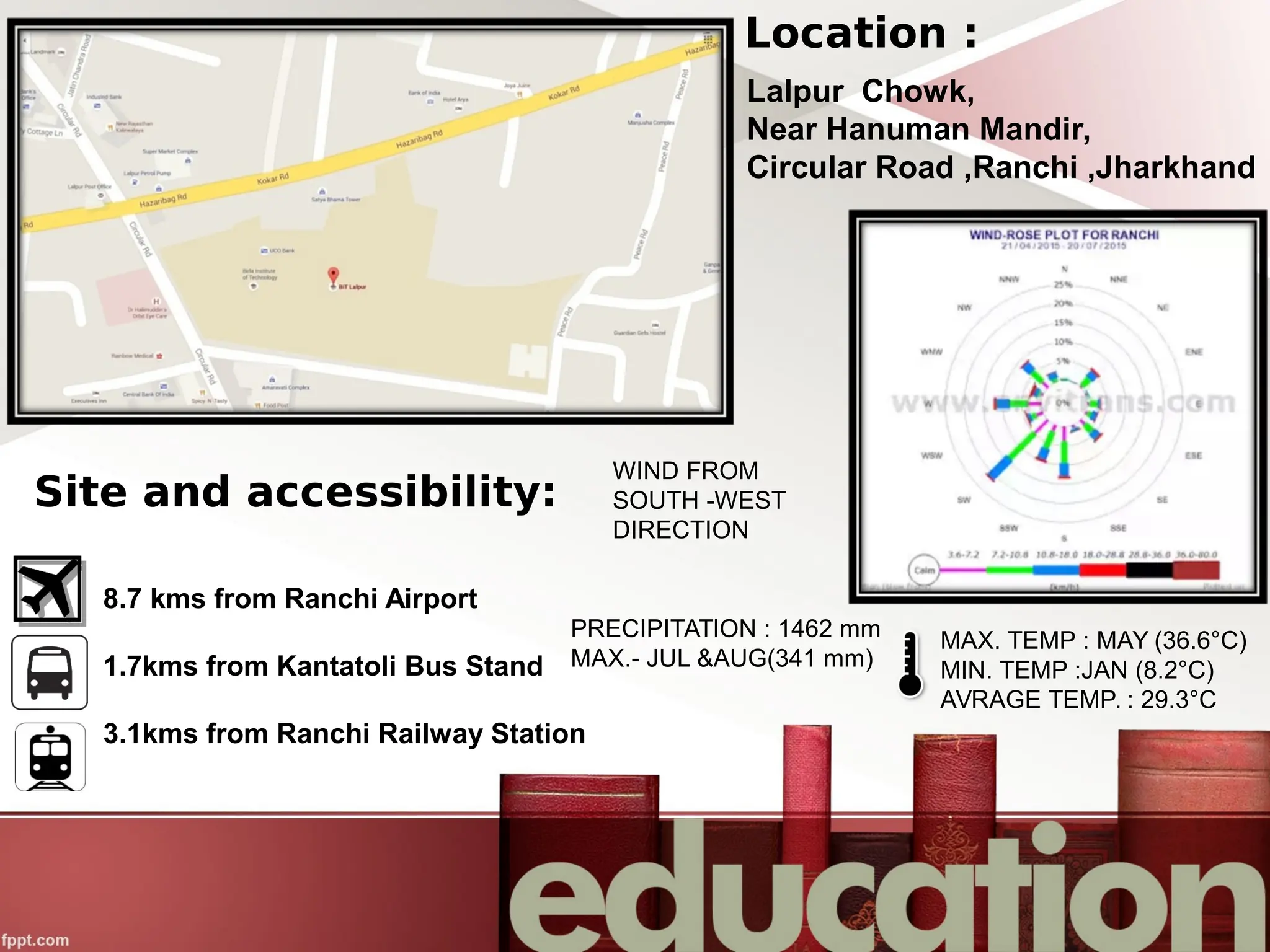
8.7 kms from Ranchi Airport
1.7kms from Kantatoli Bus Stand
3.1kms from Ranchi Railway Station
Site and accessibility:
Lalpur Chowk,
Near Hanuman Mandir,
Circular Road ,Ranchi ,Jharkhand
MAX. TEMP : MAY (36.6°C)
MIN. TEMP :JAN (8.2°C)
AVRAGE TEMP. : 29.3°C
PRECIPITATION : 1462 mm
MAX.- JUL &AUG(341 mm)
WIND FROM
SOUTH -WEST
DIRECTION
Location :
Surrounding LAND USE PATTERN
RESIDENTIAL COMPLEX
RESIDENTIAL COMPLEX
COMMERCIAL COMPLEX
RESIDENTIAL COMPLEX
The site is surrounded by
Commercial buildings – in front
and 2 sides
AMARAVATI PLAZA
Residential buildings – back
and side
Site has Roads on 2 sides.
RES –COM COMPLEX
COMMERCIAL COMPLEX
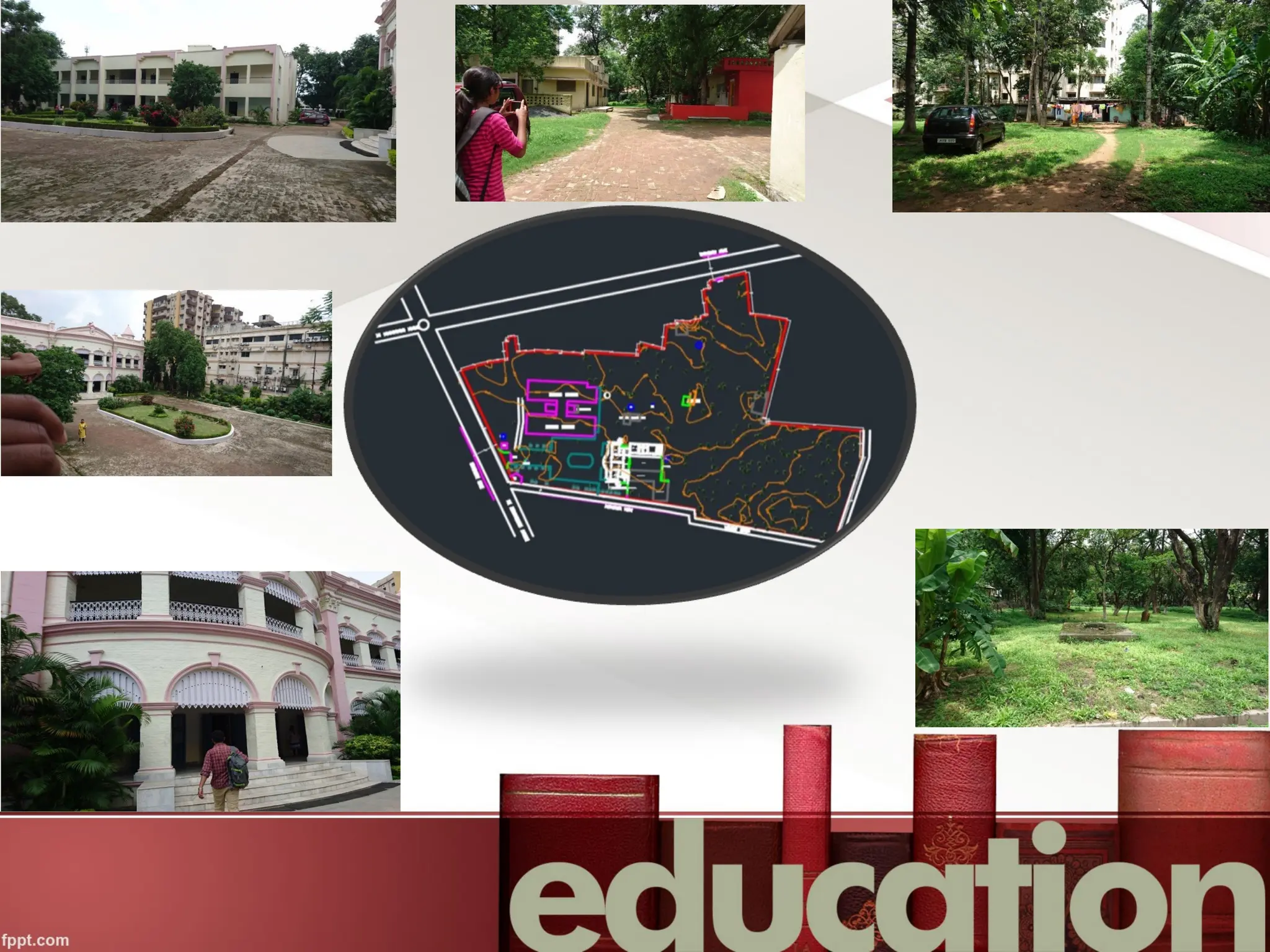
•Space organization: Structured
Each space has got its defined area
• Buildings specific:
i.Admin building.
ii.The institute building
iii.Staff Quarter
•Circulation within the site:
•1-1.5 M Wide Road.
•2 entry gates
•Unpaved roads
•Parking along
Headquarter
The institute building
Staff quarter
Materials of construction
Spiral staircase
of Iron
Railing of Iron (0.9 m hieght)
Exposed brick on stairs
Brick wall
Wooden carved
Fireplace
Stone tiled flooring
1mX1 m
Earthen tiles on
roof of verandah
Wooden
Wooden
staircase
institute block G +1 Structure
Modern style building
H- shaped building footprint.
Approx.1280 sq m Area
Class room
Library
Framed Structure.
material of construction :-
Brick , concrete.
Landscape features
Unpaved roads
Front garden
Garden in front of institute building
Courtyard of heritag
building
The mean daily maximum and minimum temperature
45’c and 25’c in summer
The mean daily maximum and minimum temperature
25’c and 1.8’c
The wind is light and blow from northwest to southeast direction
Hot summer
Cold dry winter
Sub tropical monsoon
The average rainfall is 1100.7mm

center line plan for commercial building

  • 1.
    CASE STUDY BIRSA AGRICULTURALUNIVERSITY, KANKE, RANCHI
  • 2.
    • BUILDING: Birsa AgriculturalUniversity • LOCATION: Kanke, 10kms away from Ranchi • CONSTRUCTED BY: Bihar Government(PWD) • STYLE OF ARCHITECTURE: Modern • TYPE OF BUILDING: Educational Building and Residential buildings • CONSTRUCTION MATERIALS: Concrete, bricks • STRUCTURAL SYSTEM: Framed structure INTRODUCTION
  • 3.
    HISTORY • Ranchi AgriculturalCollege was established in 1955. • Ranchi Veterinary College, College of Forestry and College of Bio-Technology were established in 1961,1980 and 1980 respectively. • Birsa Agricultural University was established on 26th June, 1981 after its formal inauguration by the then Prime Minister of India, Late Smt. Indira Gandhi. • Its primary objective is to develop area specific technologies and manpower in the field of agriculture, animal husbandry and forestry for the agricultural development of the plateau region of Bihar and economic upliftment of tribal and other backward class population of the region. • Being a completely residential university, hostels for boys and girls, and residential facilities for Teachers/Scientists and supporting staff have been provided in the campus.
  • 4.
    LOCATION & NEARBY PLACES 1 3 2 13kmsfrom Ranchi Railway Station LOCATED : Kanke, Ranchi 20 kms from Ranchi Airport 6 kms from Kantatoli Bus Stand 1. National University of Study and Research 2. DAV Nirja Sahay Public School, Kanke 3. Indian Institute of Coal Management
  • 5.
    CLIMATOLOGICAL DATA MAX. TEMP: MAY (36.6°C) MIN. TEMP :JAN (8.2°C) AVERAGE TEMP. : 29.3°C PRECIPITATION : 1462 mm MAX.- JUL &AUG(341 mm) WIND FROM SOUTH –WEST DIRECTION Kanke, Ranchi is situated at 23* 19’ latitude 85*31’ longitude Altitude: 625 m
  • 6.
    STRUCTURED SPACE ORGANIZATION Entry gatesPrivate The yellow line demarcates the site boundary Semi- Public Public
  • 7.
    • 4 Entrygates for the site • Campus has been surrounded from one side and three sides open •Circulation within the site: Road of min. 3.5m width runs all along the site • Buildings specific: i. Headquarters ii.The educational building can be divided into 4 sections:- -- College of Agricultural -- College of Forestry -- College of Veterinary Sciences & Animal Husbandry -- College of Bio-Technology iii. Hostels iv. Building for Home Sciences v. Staff Quarters vi. V.C. House vii. Sheep & Goat shed PLANNING, CIRCULATION & FUNCTIONS
  • 8.
    Hostels Staff Quarters Headquarters College ofAgriculture College of Bio-Technology SPACES IDENTIFIED College of Veterinary Sciences & Animal Husbandry College of Forestry V.C. House Central Library Sheep & Goat Shed Central Library Dept. of Home Sciences Guest Houses
  • 9.
    HEADQUARTERS • Established in1981 • G+2 structure • Divided into 3 wings at each level • Each wing has its own Senate Hall having a capacity of 350 persons • Wings are connected via a central triangular core • Beautiful landscape in front • Parking Facility for staff INTRODUCTION
  • 10.
  • 11.
    COLLEGE OF AGRICULTURE INTRODUCTION •Established in 1956 • Promote science based agricultural education • G+2 structure • Has a separate library and an auditorium • Has conference rooms and laboratory • Beautiful landscape in front • Parking Facility only for staff • Has 4 boys hostel and 3 girls hostel accommodating both the UGs & PGs
  • 12.
    FOYER • Has gota V- shaped entrance • Helps in better ventilation by diverting the air current
  • 13.
  • 14.
  • 15.
    GUEST HOUSE •There are3 guest houses:- i. Damodar International Guest house ii. Paravarik Antarashtriya Guest house iii. Guest house
  • 16.
    PARKING • Unstructured parking •Shed has been provided for 2-wheelers • No special provision for 4-wheelers • Cars are generally parked in an open ground • Corridors are used as a parking space in hostels
  • 17.
    SERVICES • No provisionfor centralised air- conditioning • Split ACs have been used in the offices • No proper sewerage system • Waste is disposed manually •Type of securities:-  Security Guards  CCTV Cameras These cameras are controlled from the Headquarters. • Size of security guard room:- 2X1.8 sq.m • Location of CCTV:- Lecture halls, Entry gates • Provision for Fire Safety has also been considered • Fire extinguishers have been kept at each corridor
  • 18.
    LITERATURE STUDY CHANDIGARH COLLEGEOF ARCHITECTURE, CHANDIGARH
  • 19.
    INTRODUCTION • PROJECT: CCA,Chandigarh • ARCHITECT: Le Corbusier • SITE AREA : 5 acre • BUILT UP AREA: • LOCATION:Sector-12, Chandigarh • STYLE OF ARCHITECTURE: Contemporary • TYPE OF BUILDING: Educational • MATERIALS OF CONSTRUCTION: Brick, concrete • TYPE OF STRUCTURAL SYSTEM EMPLOYED: Load- bearing structure •Established on 7 August 1961 •College imparts education and research in the field of architecture •Covers the north-western region of India • Has an enrolment of 200 UG
  • 20.
    •Situated on Vidhyapath , Chandigarh • Campus is housed at the Punjab Engineering College Campus, Chandigarh LOCATIO N 15.2km 11.4km 5.4km 1 2
  • 21.
    •The planning isintrovert in nature. The studio and classrooms have been grouped together around a rectangular courtyard • There are two doubly loaded corridors originating on the two ends of the building which lead from the entrance to the studios and classrooms. These corridors are poorly connected to the courtyard through four small openings PLANNING & LAYOUT •The design studios are on the northern side of the building. Entrance hall is rectangular in shape. The courtyard has not been well linked with the rest of the building.
  • 22.
  • 23.
  • 24.
  • 25.
    ELEVATIONS WEST SIDE ELEVATION NORTHSIDE ELEVATION SOUTH SIDE ELEVATION
  • 26.
    LIBRARY •Centrally air-conditioned library withapprox 15,000 titles in architecture and related files • Teaching aids like audio and video cassettes are also available • Training reports are also available • Books by famous architect, 63 journels, books about the heritage of Chandigarh is also present • Ceiling is 3.2 m high • Maximum height of shelf is 1.8m •Natural lighting and ventilation have been provided • CCTV cameras and fire alarms have been provided
  • 27.
    • Display ofitems • Room Dimension= 24X12 sq.m • Display of furnitures designed by students • Reputed firms send their models for display • Models are mostly made in workshop MODEL ROOM PHOTOGRAPH Y LAB • In photography lab, there is a dark room • College has its own photographer who accompany the students on their site visits
  • 28.
    •The classrooms, studiosare other spaces depend on north lights for their lighting. • Courtyard has not contributed much for natural lighting • Ventilation is from small window. The north side windows are large and near the ceilings LIGHT & VENTILATION Effect of day lighting from the Northern facade ROOF OPENINGS
  • 29.
    WORK SHOP • Thecollege workshop caters to the need of ‘hands on’ experience in handling of building Construction tools and model making. • It has facilities including machines and trained personnel in the fields of carpentry ,metal work and model making. • 15 students can work at 1 time. LECTURE ROOM • Sitting arrangement is done in the form of steps of width 1 m and riser of 0.2m. • The lecture hall is designed for 30 students. • Use of north lighting.
  • 30.
    STUDIO • The studiosare of dimension 18m x 11m. • They have low height partition walls. • Doubly loaded corridors are dull spaces. • Drafting space for 30 students. • Natural ventilation and lightings. • Classrooms have chairs and have • space for 30 students • • Grassy lawn . • There is good usage of open spaces. • Internal courtyard has been design with a stage . • Open spaces in front of the canteen used as sitting place. • Recreational spaces for students like football ground , Cricket pitch and basketball court. • Open space
  • 31.
    PROS • Courtyard isthe only open space in the college, which is well linked to the rest of the college. It is a grassy lawn, used by the students to relax during their spare time. • The classrooms, studios are other spaces deeper on north lights for their lighting. The lighting is good during the day time. • It is from small window, which are present on the outside walls. The north side windows are large and near the ceilings. • Recently, partitions have been put in the studios to divide them into sub- places. • The studios are quite spacious and they are separated by low height walls. • Bend pipes are used for fresh oxygen from ceiling. Solar panels are provided Fire extinguishers & alarms have been used
  • 32.
    CONS • There isa small room for faculty’s interaction. • Courtyard is not linked well with rest of the building. • Building is made up of concrete, therefore it absorbs heat. • Architect has failed to link the courtyard in an active manner with rest of the building. As a result, it is passive and dead space. • Green belt surrounding the building is not well maintained. • No medical room in the college. • Girl’s hostels are situated in another sector.
  • 33.
    MATERIALS USED • BRICKhas been used as primary building material for the entire complex walls and columns. • Brick arches have been used for wide spans. • Use of concrete has been restricted to foundations, floor slabs and ties for arched openings.
  • 34.
    SPACE STANDARDS CASESTUDY LITERATURE STUDY CLASSROOM 50-60 sq. m 30 sq. m 288 sq. m LECTURE HALL 100-200 sq. m - 35.5 sq. m ANCILLARY ROOM 15 sq. m - - SEMINAR ROOM 100 sq. m 45 sq. m 100 sq. m LABS - 50 sq. M 94 sq. m CORRIDOOR WIDTH 1.8 m 2 m 1.6 m CAFETERIA FOR 100 PERSONS 116 sq. m 20 sq. m 63.4 sq. m AUDITORIUM FOR 350 PERSONS 200 sq. m 200 sq. m - DISTANCE BETWEEN BOOKCASES IN LIBRARY 1.5 - 1.6 m 1.2 m - HOSTEL FACILITIES DOUBLE BED ROOM 20.4 sq. m 14 sq. m - OFFICES FOR ACADEMIC STAFF PROFESSOR 20-24 sq. m 7.5 sq. m 22 sq. m LECTURER 15 sq. m - - ASSISTANTS 20 sq. m - - MEETING ROOM 111 sq. m 45sq. m 35 sq. m COMPARATIVE ANALYSIS
  • 35.
    THANK YOU… •Akanksha RuchiHoro Barch/10013/2013 • Harshita Kachchhap Barch/10017/2013 • Mukul Sidhartha Barch/10020/2013 • Mohit Bansal Barch/10041/2013 • Aditi Thakur Barch/10043/2013
  • 36.
    Birla Institute oftechnology Lalpur
  • 37.
    8.7 kms fromRanchi Airport 1.7kms from Kantatoli Bus Stand 3.1kms from Ranchi Railway Station Site and accessibility: Lalpur Chowk, Near Hanuman Mandir, Circular Road ,Ranchi ,Jharkhand MAX. TEMP : MAY (36.6°C) MIN. TEMP :JAN (8.2°C) AVRAGE TEMP. : 29.3°C PRECIPITATION : 1462 mm MAX.- JUL &AUG(341 mm) WIND FROM SOUTH -WEST DIRECTION Location :
  • 38.
    Surrounding LAND USEPATTERN RESIDENTIAL COMPLEX RESIDENTIAL COMPLEX COMMERCIAL COMPLEX RESIDENTIAL COMPLEX The site is surrounded by Commercial buildings – in front and 2 sides AMARAVATI PLAZA Residential buildings – back and side Site has Roads on 2 sides. RES –COM COMPLEX COMMERCIAL COMPLEX
  • 40.
    •Space organization: Structured Eachspace has got its defined area • Buildings specific: i.Admin building. ii.The institute building iii.Staff Quarter •Circulation within the site: •1-1.5 M Wide Road. •2 entry gates •Unpaved roads •Parking along Headquarter The institute building Staff quarter
  • 42.
    Materials of construction Spiralstaircase of Iron Railing of Iron (0.9 m hieght) Exposed brick on stairs Brick wall Wooden carved Fireplace Stone tiled flooring 1mX1 m Earthen tiles on roof of verandah Wooden Wooden staircase
  • 43.
    institute block G+1 Structure Modern style building H- shaped building footprint. Approx.1280 sq m Area Class room Library Framed Structure. material of construction :- Brick , concrete.
  • 44.
    Landscape features Unpaved roads Frontgarden Garden in front of institute building Courtyard of heritag building
  • 45.
    The mean dailymaximum and minimum temperature 45’c and 25’c in summer The mean daily maximum and minimum temperature 25’c and 1.8’c The wind is light and blow from northwest to southeast direction Hot summer Cold dry winter Sub tropical monsoon The average rainfall is 1100.7mm