Agenda
• What is Brick and Mortar model?
• When and where brick and mortar model is used?
• Pros and Cons of offline/traditional store
• E-commerce & E-Business
• When and Where online model is used?
• Pros and Cons of online store.
• Online Model Vs. Brick Mortar
• Facts and figures
• Case Study
• Conclusion
What is Brick and Mortar Model?
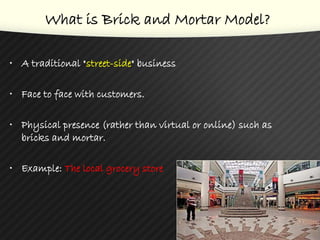
• A traditional "street-side" business
• Face to face with customers.
• Physical presence (rather than virtual or online) such as
bricks and mortar.
• Example: The local grocery store
3
When and where brick and mortar model is
used?
• Where online retail services are not available
– e.g. small cities.
• People are not in touch with technology
• When products are of lesser amount Consumer does not want to
pay delivery charges.
• Needs the product on urgent basis
• Customer wants to check the product before buying and does not
trust online retailers.
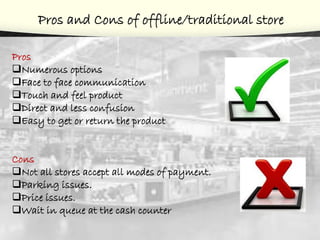
Pros and Cons of offline/traditional store
Pros
Numerous options
Face to face communication
Touch and feel product
Direct and less confusion
Easy to get or return the product
Cons
Not all stores accept all modes of payment.
Parking issues.
Price issues.
Wait in queue at the cash counter
When and Where online model is used?
• Short of time
• Discounts for branded products
• Ready to wait for the product to get delivered
• Quick decision of buying
– compare the prices, quality of variety of
products
Pros and Cons of online store
Pros
 Convenience.
 Better prices.
 Variety of products.
 Discounts.
 Send gifts
 Fewer expenses
 Comparison of prices
 Compulsive shopping
 Buy old or unused items at
low prices
Cons
 Physical feel of items missing
 Out of stock problem.
 Delivery risk.
 Mishandling while shipping.
 Shipping charges.
 Online IS issue.
 Online fraud.
 Dull shopping experience.
 Spyware on your PCs
 Online connectivity issues.
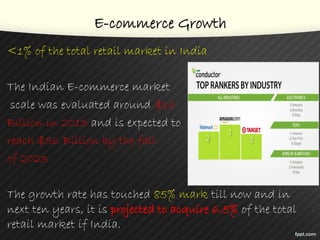
E-commerce Growth
<1% of the total retail market in India
The Indian E-commerce market
scale was evaluated around $16
Billion in 2013 and is expected to
reach $56 Billion by the fall
of 2023
The growth rate has touched 85% mark till now and in
next ten years, it is projected to acquire 6.5% of the total
retail market if India.
Clicks v/s Bricks
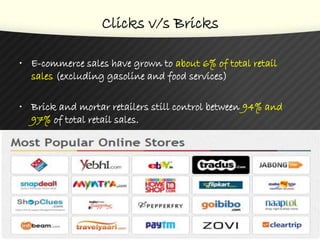
• E-commerce sales have grown to about 6% of total retail
sales (excluding gasoline and food services)
• Brick and mortar retailers still control between 94% and
97% of total retail sales.
Clicks v/s Bricks
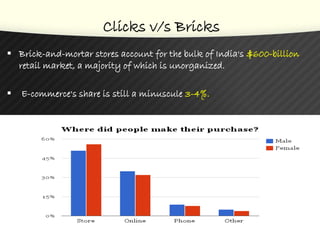
 Brick-and-mortar stores account for the bulk of India's $600-billion
retail market, a majority of which is unorganized.
 E-commerce's share is still a minuscule 3-4%.
Clicks v/s Bricks
11
Clicks v/s Bricks
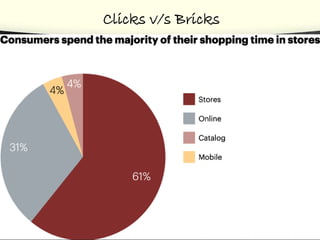
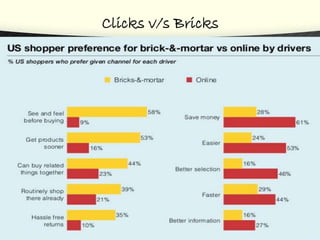
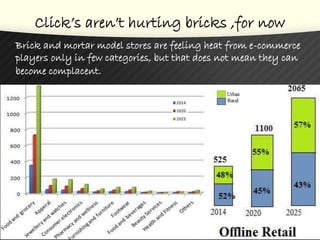
Click’s aren’t hurting bricks ,for now
Brick and mortar model stores are feeling heat from e-commerce
players only in few categories, but that does not mean they can
become complacent.
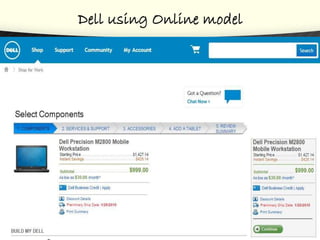
Dell using Online model
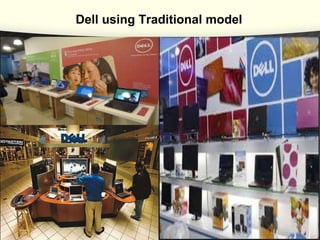
Dell using Traditional model
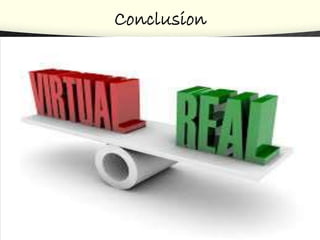
Conclusion
Thank you for your patience…

Brick and mortar vs ecom

  • 2.
    Agenda • What isBrick and Mortar model? • When and where brick and mortar model is used? • Pros and Cons of offline/traditional store • E-commerce & E-Business • When and Where online model is used? • Pros and Cons of online store. • Online Model Vs. Brick Mortar • Facts and figures • Case Study • Conclusion
  • 3.
    What is Brickand Mortar Model? • A traditional "street-side" business • Face to face with customers. • Physical presence (rather than virtual or online) such as bricks and mortar. • Example: The local grocery store 3
  • 4.
    When and wherebrick and mortar model is used? • Where online retail services are not available – e.g. small cities. • People are not in touch with technology • When products are of lesser amount Consumer does not want to pay delivery charges. • Needs the product on urgent basis • Customer wants to check the product before buying and does not trust online retailers.
  • 5.
    Pros and Consof offline/traditional store Pros Numerous options Face to face communication Touch and feel product Direct and less confusion Easy to get or return the product Cons Not all stores accept all modes of payment. Parking issues. Price issues. Wait in queue at the cash counter
  • 6.
    When and Whereonline model is used? • Short of time • Discounts for branded products • Ready to wait for the product to get delivered • Quick decision of buying – compare the prices, quality of variety of products
  • 7.
    Pros and Consof online store Pros  Convenience.  Better prices.  Variety of products.  Discounts.  Send gifts  Fewer expenses  Comparison of prices  Compulsive shopping  Buy old or unused items at low prices Cons  Physical feel of items missing  Out of stock problem.  Delivery risk.  Mishandling while shipping.  Shipping charges.  Online IS issue.  Online fraud.  Dull shopping experience.  Spyware on your PCs  Online connectivity issues.
  • 8.
    E-commerce Growth <1% ofthe total retail market in India The Indian E-commerce market scale was evaluated around $16 Billion in 2013 and is expected to reach $56 Billion by the fall of 2023 The growth rate has touched 85% mark till now and in next ten years, it is projected to acquire 6.5% of the total retail market if India.
  • 9.
    Clicks v/s Bricks •E-commerce sales have grown to about 6% of total retail sales (excluding gasoline and food services) • Brick and mortar retailers still control between 94% and 97% of total retail sales.
  • 10.
    Clicks v/s Bricks Brick-and-mortar stores account for the bulk of India's $600-billion retail market, a majority of which is unorganized.  E-commerce's share is still a minuscule 3-4%.
  • 11.
  • 12.
  • 13.
    Click’s aren’t hurtingbricks ,for now Brick and mortar model stores are feeling heat from e-commerce players only in few categories, but that does not mean they can become complacent.
  • 14.
  • 15.
  • 16.
  • 18.
    Thank you foryour patience…