SWINE
PRODUCTION IN
INTEDRATED
FARMING SYSTEMBY:
B.SUBHASH
2018042069
INTEGRATED FARMING SYSTEM
 Production of agricultural crops, vary in response to changes of the seasons.
 In the recent period stable income of agricultural crops has become unstable.
 Redressing these by integrating crops with agro-based industries like livestock
farming is essential.
 In today's environment, increasing demand for meat in rural and urban areas
can help small and part-time farmers earn good profits by trading with the goat
and sheep farming.
 Because of less investment and maintenance costs for shed, it can be done in
coordination with agriculture crops.
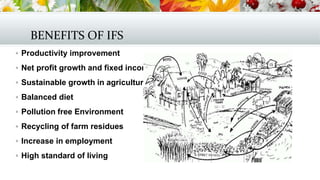
BENEFITS OF IFS
 Productivity improvement
 Net profit growth and fixed income
 Sustainable growth in agriculture
 Balanced diet
 Pollution free Environment
 Recycling of farm residues
 Increase in employment
 High standard of living
SWINE PRODUCTION IN INTEGRATED
FARMING SYSTEN (IFS)
 Piggery is a highly profitable enterprise because of among the domesticated
animals; pigs are the most prolific one.
 Feed conversion ratio is 3.0 to 3.5 KG feed per Kg live weight gain.
 In India pig farming and pork production are in the hands of traditional pig
farmers belonging to lower income group people.
 The food habits of Indians are changing and there is a great demand for pig
meat. Integrated pig farming with fish is a demanding venture of enhanced
income in the family of lower strata people.
MANAGEMENT OF SWINE IN (IFS)
 Housing management
 The pigs are very sensitive to adverse climatic conditions hence, well protected
housing is necessary for pig farming.
 It should be well protected from direct sunlight, rain and wind.
 The walls and floors should be strong enough to withstand the rooting habits of
pigs.
 To provide thermal comfort in hot summer days a wallowing tank may be
provided in pig house.
 Pigs are kept under two housing systems VIZ. indoor system and open air
system.
 A combination of these two systems is very advantageous and can be adopted in
SPACE REQUIREMENT
 For furrowing sows an individual furrowing pen with 10 to 16 sq
ft/sow having feed and water through including guard rails &
creep areas should be provided.
 A concrete yard with feed and water trough is sufficient for
fatteners.
 A sow with her litter requires 80 sq ftcovered and 70 sq ft open
area.
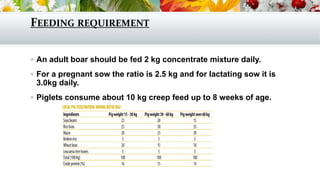
FEEDING REQUIREMENT
 An adult boar should be fed 2 kg concentrate mixture daily.
 For a pregnant sow the ratio is 2.5 kg and for lactating sow it is
3.0kg daily.
 Piglets consume about 10 kg creep feed up to 8 weeks of age.
BREEDING MANAGEMENT
 Pigs can be breed at the age of 8 to 9 months or 80 to 90 kg body
weight and the boar-sow ratio should be 1:20.
 Oester cycle in pig is 21 days.
 After 24 hours of onset of heat is right time for mating, followed by
a second mating after 8 to 12 hours.
 Gestation period in pig is 114 days.
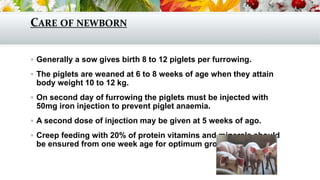
CARE OF NEWBORN
 Generally a sow gives birth 8 to 12 piglets per furrowing.
 The piglets are weaned at 6 to 8 weeks of age when they attain
body weight 10 to 12 kg.
 On second day of furrowing the piglets must be injected with
50mg iron injection to prevent piglet anaemia.
 A second dose of injection may be given at 5 weeks of ago.
 Creep feeding with 20% of protein vitamins and minerals should
be ensured from one week age for optimum growth of piglets.
HEALTH MANAGEMENT
 Pigs are susceptible to heat stroke.
 Provision of wallowing or water sprinkling is very important
during summer months.
 Vaccination for swine fever and food and mouth diseases must be
done periodically.
 Regular deworming is advised for a pig farm.
Swine production in intedrated farming system(2018042069)