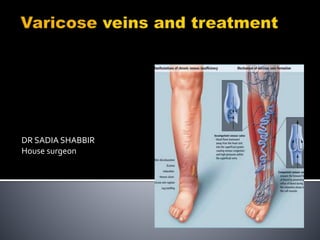
DR SADIA SHABBIR
House surgeon
 The venous drainage system of the lower
extremity consists of three sets of veins:
 Deep veins,
 Superficial veins
 Perforating veins.
 All veins contain delicate one-way valves
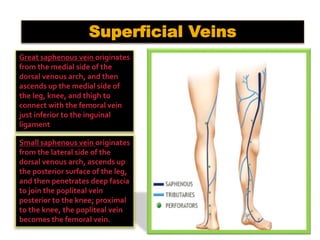
Great saphenous vein originates
from the medial side of the
dorsal venous arch, and then
ascends up the medial side of
the leg, knee, and thigh to
connect with the femoral vein
just inferior to the inguinal
ligament
Small saphenous vein originates
from the lateral side of the
dorsal venous arch, ascends up
the posterior surface of the leg,
and then penetrates deep fascia
to join the popliteal vein
posterior to the knee; proximal
to the knee, the popliteal vein
becomes the femoral vein.
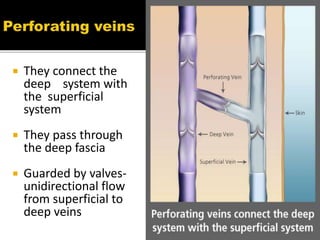
 They connect the
deep system with
the superficial
system
 They pass through
the deep fascia
 Guarded by valves-
unidirectional flow
from superficial to
deep veins
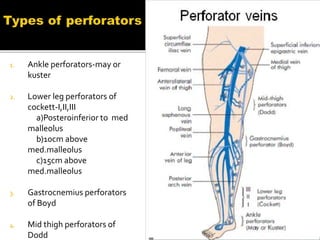
1. Ankle perforators-may or
kuster
2. Lower leg perforators of
cockett-I,II,III
a)Posteroinferior to med
malleolus
b)10cm above
med.malleolus
c)15cm above
med.malleolus
3. Gastrocnemius perforators
of Boyd
4. Mid thigh perforators of
Dodd
Venous return from leg is governed by
 Arterial pressure
 Calf musculovenous pump
 Gravity
 Thoracic pump
 Valves in veins
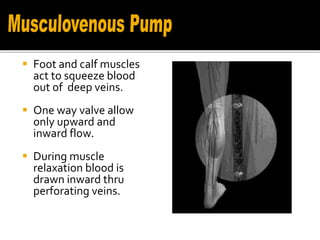
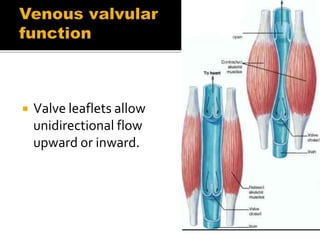
 Foot and calf muscles
act to squeeze blood
out of deep veins.
 One way valve allow
only upward and
inward flow.
 During muscle
relaxation blood is
drawn inward thru
perforating veins.
 Valve leaflets allow
unidirectional flow
upward or inward.
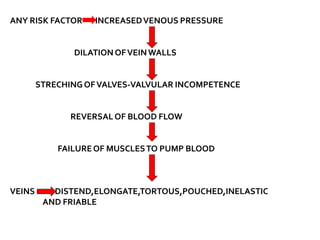
ANY RISK FACTOR INCREASEDVENOUS PRESSURE
DILATION OFVEINWALLS
STRECHINGOFVALVES-VALVULAR INCOMPETENCE
REVERSALOF BLOOD FLOW
FAILUREOF MUSCLESTO PUMP BLOOD
VEINS DISTEND,ELONGATE,TORTOUS,POUCHED,INELASTIC
AND FRIABLE
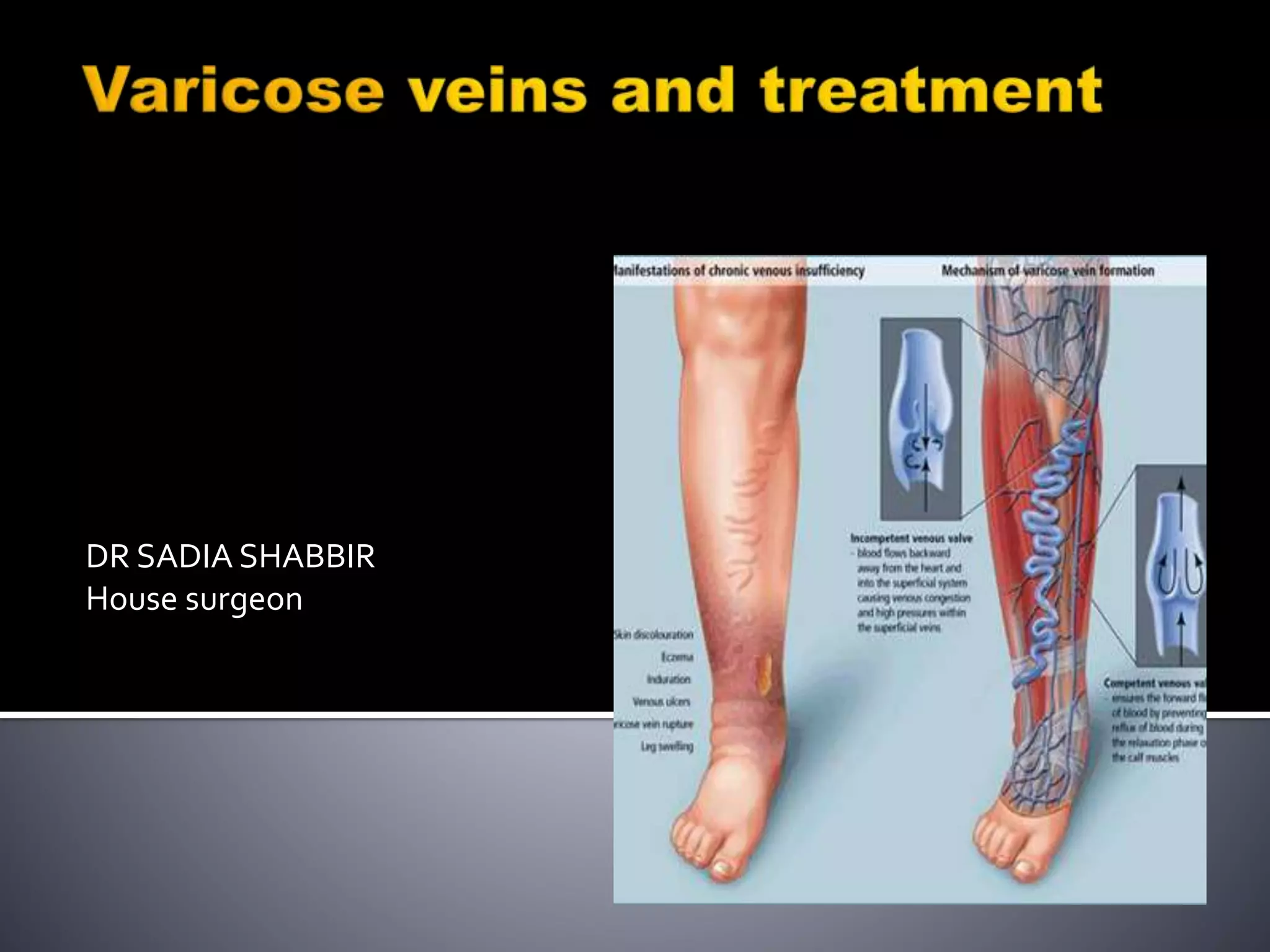
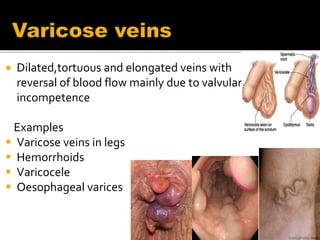
 Dilated,tortuous and elongated veins with
reversal of blood flow mainly due to valvular
incompetence
Examples
 Varicose veins in legs
 Hemorrhoids
 Varicocele
 Oesophageal varices
 Age
 Gender
 Height
 Heredity
 Pregnancy
 Obesity and overweight
 Posture
Primary varicosities
 Congenital incompetence/absence of valves
 Weakness or wasting of muscles
 Stretching of deep fascia
 Inheritance with FOXC2 gene
 Klippel-trenaunay syndrome
Secondary Varicositiesecond varicosities
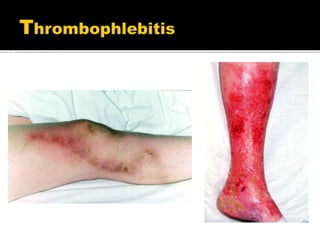
 Recurrent thrombophlebitis
 Occupational
 Oral contraceptive pills
 Pregnancy and pelvic tumors
 Iatrogenic-in AV fistula
 Deep vein thrombosis
 Dilated tortuous veins
 Dragging pain worsening on prolonged standing/sitting
 Night cramps
 Aching pain is relieved at night on taking rest or elevation
of limbs
 Ithcing,oedema,thickening and eczema of feet
 Appearance of spider veins in affected leg.
 Discoloration/ulceration
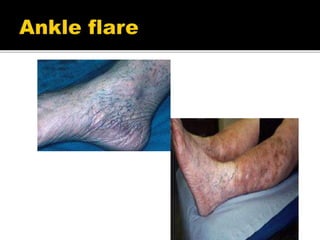
 Skin above ankle may shrink (lipodermatosclerosis) b/c fat
underneath skin becomes hard.
Symptoms
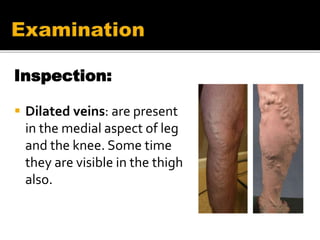
Inspection:
 Dilated veins: are present
in the medial aspect of leg
and the knee. Some time
they are visible in the thigh
also.
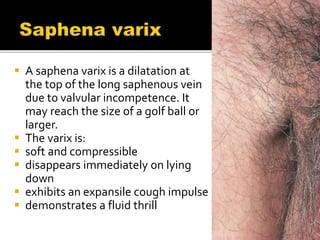
 A saphena varix is a dilatation at
the top of the long saphenous vein
due to valvular incompetence. It
may reach the size of a golf ball or
larger.
 The varix is:
 soft and compressible
 disappears immediately on lying
down
 exhibits an expansile cough impulse
 demonstrates a fluid thrill
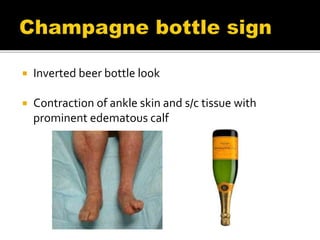
 Inverted beer bottle look
 Contraction of ankle skin and s/c tissue with
prominent edematous calf
lipodermatosclerosis
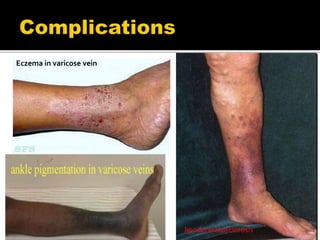
Eczema in varicose vein
id for treatment
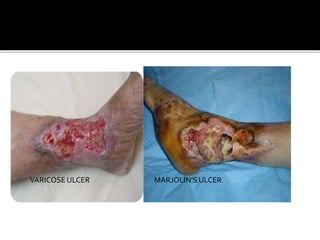
VARICOSE ULCER MARJOLIN’S ULCER
1. Cough impulse test:
This test should be done in standing position.The
examiner keeps the finger at SF junction and ask the
patient to cough. Fluid thrill, an impulse felt by fingers,
is indicative of “saphenofemoral incompetence”
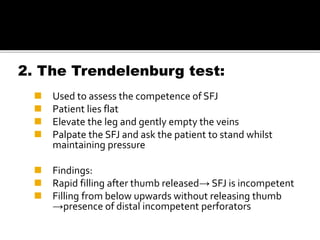
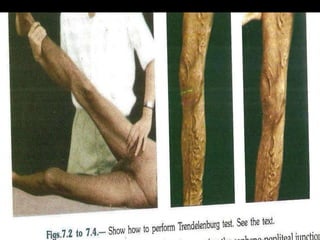
2. The Trendelenburg test:
 Used to assess the competence of SFJ
 Patient lies flat
 Elevate the leg and gently empty the veins
 Palpate the SFJ and ask the patient to stand whilst
maintaining pressure
 Findings:
 Rapid filling after thumb released→ SFJ is incompetent
 Filling from below upwards without releasing thumb
→presence of distal incompetent perforators
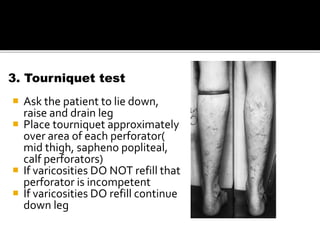
3. Tourniquet test
 Ask the patient to lie down,
raise and drain leg
 Place tourniquet approximately
over area of each perforator(
mid thigh, sapheno popliteal,
calf perforators)
 If varicosities DO NOT refill that
perforator is incompetent
 If varicosities DO refill continue
down leg
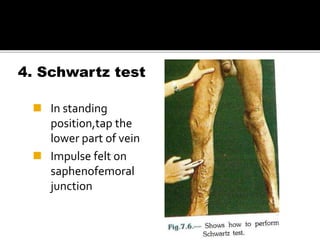
4. Schwartz test
 In standing
position,tap the
lower part of vein
 Impulse felt on
saphenofemoral
junction
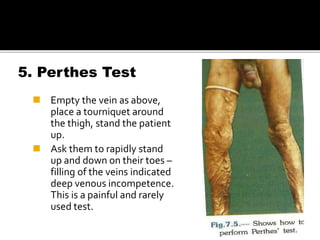
5. Perthes Test
 Empty the vein as above,
place a tourniquet around
the thigh, stand the patient
up.
 Ask them to rapidly stand
up and down on their toes –
filling of the veins indicated
deep venous incompetence.
This is a painful and rarely
used test.
6.Fegan’s test
 Line of varicosities marked
 Site where perforators pierce deep fascia-bulges
on standing circular depressions on lying
 Doppler ultrsound
 Duplex ultrsound imaging
 Venography
 Varicography
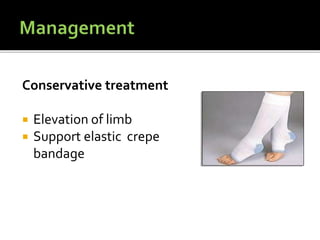
Conservative treatment
 Elevation of limb
 Support elastic crepe
bandage
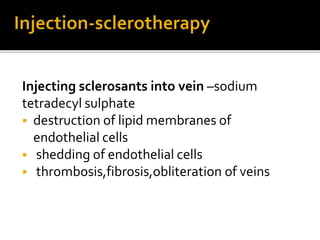
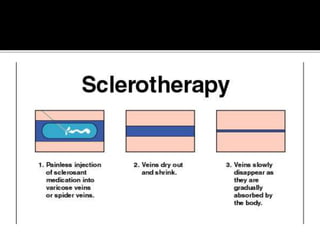
Injecting sclerosants into vein –sodium
tetradecyl sulphate
 destruction of lipid membranes of
endothelial cells
 shedding of endothelial cells
 thrombosis,fibrosis,obliteration of veins
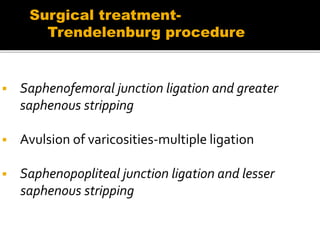
 Saphenofemoral junction ligation and greater
saphenous stripping
 Avulsion of varicosities-multiple ligation
 Saphenopopliteal junction ligation and lesser
saphenous stripping
Surgical treatment-
Trendelenburg procedure
Picture clipping

vericose veins

  • 1.
  • 2.
     The venousdrainage system of the lower extremity consists of three sets of veins:  Deep veins,  Superficial veins  Perforating veins.  All veins contain delicate one-way valves
  • 3.
    Great saphenous veinoriginates from the medial side of the dorsal venous arch, and then ascends up the medial side of the leg, knee, and thigh to connect with the femoral vein just inferior to the inguinal ligament Small saphenous vein originates from the lateral side of the dorsal venous arch, ascends up the posterior surface of the leg, and then penetrates deep fascia to join the popliteal vein posterior to the knee; proximal to the knee, the popliteal vein becomes the femoral vein.
  • 4.
     They connectthe deep system with the superficial system  They pass through the deep fascia  Guarded by valves- unidirectional flow from superficial to deep veins
  • 5.
    1. Ankle perforators-mayor kuster 2. Lower leg perforators of cockett-I,II,III a)Posteroinferior to med malleolus b)10cm above med.malleolus c)15cm above med.malleolus 3. Gastrocnemius perforators of Boyd 4. Mid thigh perforators of Dodd
  • 6.
    Venous return fromleg is governed by  Arterial pressure  Calf musculovenous pump  Gravity  Thoracic pump  Valves in veins
  • 7.
     Foot andcalf muscles act to squeeze blood out of deep veins.  One way valve allow only upward and inward flow.  During muscle relaxation blood is drawn inward thru perforating veins.
  • 8.
     Valve leafletsallow unidirectional flow upward or inward.
  • 10.
    ANY RISK FACTORINCREASEDVENOUS PRESSURE DILATION OFVEINWALLS STRECHINGOFVALVES-VALVULAR INCOMPETENCE REVERSALOF BLOOD FLOW FAILUREOF MUSCLESTO PUMP BLOOD VEINS DISTEND,ELONGATE,TORTOUS,POUCHED,INELASTIC AND FRIABLE
  • 11.
     Dilated,tortuous andelongated veins with reversal of blood flow mainly due to valvular incompetence Examples  Varicose veins in legs  Hemorrhoids  Varicocele  Oesophageal varices
  • 12.
     Age  Gender Height  Heredity  Pregnancy  Obesity and overweight  Posture
  • 13.
    Primary varicosities  Congenitalincompetence/absence of valves  Weakness or wasting of muscles  Stretching of deep fascia  Inheritance with FOXC2 gene  Klippel-trenaunay syndrome
  • 14.
    Secondary Varicositiesecond varicosities Recurrent thrombophlebitis  Occupational  Oral contraceptive pills  Pregnancy and pelvic tumors  Iatrogenic-in AV fistula  Deep vein thrombosis
  • 15.
     Dilated tortuousveins  Dragging pain worsening on prolonged standing/sitting  Night cramps  Aching pain is relieved at night on taking rest or elevation of limbs  Ithcing,oedema,thickening and eczema of feet  Appearance of spider veins in affected leg.  Discoloration/ulceration  Skin above ankle may shrink (lipodermatosclerosis) b/c fat underneath skin becomes hard. Symptoms
  • 16.
    Inspection:  Dilated veins:are present in the medial aspect of leg and the knee. Some time they are visible in the thigh also.
  • 17.
     A saphenavarix is a dilatation at the top of the long saphenous vein due to valvular incompetence. It may reach the size of a golf ball or larger.  The varix is:  soft and compressible  disappears immediately on lying down  exhibits an expansile cough impulse  demonstrates a fluid thrill
  • 19.
     Inverted beerbottle look  Contraction of ankle skin and s/c tissue with prominent edematous calf
  • 20.
  • 21.
  • 22.
  • 23.
    1. Cough impulsetest: This test should be done in standing position.The examiner keeps the finger at SF junction and ask the patient to cough. Fluid thrill, an impulse felt by fingers, is indicative of “saphenofemoral incompetence”
  • 24.
    2. The Trendelenburgtest:  Used to assess the competence of SFJ  Patient lies flat  Elevate the leg and gently empty the veins  Palpate the SFJ and ask the patient to stand whilst maintaining pressure  Findings:  Rapid filling after thumb released→ SFJ is incompetent  Filling from below upwards without releasing thumb →presence of distal incompetent perforators
  • 26.
    3. Tourniquet test Ask the patient to lie down, raise and drain leg  Place tourniquet approximately over area of each perforator( mid thigh, sapheno popliteal, calf perforators)  If varicosities DO NOT refill that perforator is incompetent  If varicosities DO refill continue down leg
  • 27.
    4. Schwartz test In standing position,tap the lower part of vein  Impulse felt on saphenofemoral junction
  • 28.
    5. Perthes Test Empty the vein as above, place a tourniquet around the thigh, stand the patient up.  Ask them to rapidly stand up and down on their toes – filling of the veins indicated deep venous incompetence. This is a painful and rarely used test.
  • 29.
    6.Fegan’s test  Lineof varicosities marked  Site where perforators pierce deep fascia-bulges on standing circular depressions on lying
  • 30.
     Doppler ultrsound Duplex ultrsound imaging  Venography  Varicography
  • 31.
    Conservative treatment  Elevationof limb  Support elastic crepe bandage
  • 32.
    Injecting sclerosants intovein –sodium tetradecyl sulphate  destruction of lipid membranes of endothelial cells  shedding of endothelial cells  thrombosis,fibrosis,obliteration of veins
  • 34.
     Saphenofemoral junctionligation and greater saphenous stripping  Avulsion of varicosities-multiple ligation  Saphenopopliteal junction ligation and lesser saphenous stripping Surgical treatment- Trendelenburg procedure
  • 35.