presents
Back to Basics: Financial
Fundamentals For Startups
Financial Fundamentals: Money 101
March 17th 2014
Smith Anderson
Silicon Valley Bank
(617) 796-6958
Smanderson@svb.com
Twitter: @SmithTown561
Glen Mello
Silicon Valley Bank
(617) 630-4188
gmello@svb.com
!
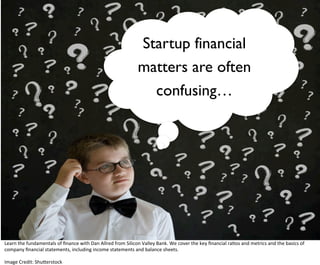
Startup financial
matters are often
confusing…
It’s a lot like 

learning a language
You need to learn
key phrases
yourself...
…and rely on translators for the rest.
AGENDA
• Key financial metrics	

• Financial statements	

• When & how to leverage CFOs & others	

• Q & A
TOP LINE REV / SALES
• Gross Sales or Revenue regardless of cost, liabilities etc..	

– Used to discuss growth of the business over time. 	

– Important, however there is more to the story.
Revenue – COGS – expenses	

!
• Net Profit (or Net Loss)	

– interest,	

– taxes,	

– Depreciation	

– Amortization expenses	

!
• EBITDA: Earnings Before Interest,Taxes, Depreciation &
Amortization
BOTTOM LINE
BOOKINGS
• The financial value of business that you have under contract	

!
• i.e.“we booked a deal with Amazon for $240k over 2 years”	

!
• Not a financial statement item—“dashboard” item.	

!
• Total ContractValue (TCV) vs. Annual ContractValue (ACV)
REVENUE
• The accounting value of a sale during a specific time period	

• a.k.a: “rev rec”,“recognized revenue”,“scored revenue”	

!
• Sale à revenue when the product has been delivered and
payment terms are defined and agreed to.	

• Cash upfront – Deferred Revenue (Liability)	

• Bookings > Delivery > Revenue > Collection > A/R
COGs
• Cost of good sold	

!
• Production costs: direct product costs, hosting, etc.	

!
• Execution costs: commissions, revenue share, etc.
• Revenue - COGS = Gross Profit (a hard dollar number)	

!
!
• Gross Profit / Revenue = Gross Margin (a percentage)
GROSS MARGIN
Costs to run your business	

• Sales & Marketing expenses	

• Research & Development expenses	

• General & Administrative expenses
EXPENSES
Sources	

• Trade Receivables (A/R)	

• Deferred Revenue (D/R)	

• Debt	

• Equity
Uses	

• Trade Payables (A/P)	

• Salaries/Wages Payable	

• Debt
SOURCES & USES OF CASH
• Cash divided by cash burn	

!
• Cash burn does not necessarily equal EBITDA – depends on
timing of cash receipts vs. bookings vs. revenue
RUNWAY
Events that drive value in the company:	

!
• Commercial milestones: distribution agreements, customers,
bookings, revenue, etc.	

!
• Market milestones: users, working business model, etc.	

!
• Technical milestones: proof of concept, working prototype, etc.
MILESTONES
• One Page: Communicate progress to key stakeholders
(investors, employees, etc.)	

!
• Time-based representation of how company is tracking against
key financial goals (perhaps other time-bound goals as well)	

!
• Not a financial statement
DASHBOARDS
• Questions to ask yourself:	

– What drives value in the business (bookings, gross margin,
technical progress, distribution deals)?	

– What resources do you need to drive this value (people,
time, money, etc.)?	

!
• Your dashboard will:	

– Track the value you are building in the business.	

– Track the resources you are consuming 	

as you build value.
BUILDYOUR DASHBOARD
• Income Statement	

– A movie	

– Tells the financial story of a company over a
span of time	

!
• Balance Sheet	

– A picture	

– Indicates the financial health of a 	

company at a point in time
FINANCIAL STATEMENTS
Over a period of time:	

• Revenue (“top line”)	

• Minus COGS	

• Equals Gross Profit	

• Minus Expenses	

• Equals EBITDA (“bottom line”)
INCOME STATEMENT
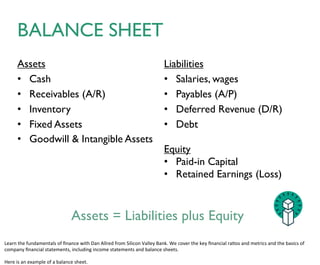
Assets	

• Cash	

• Receivables (A/R)	

• Inventory	

• Fixed Assets	

• Goodwill & Intangible Assets
Liabilities	

• Salaries, wages 	

• Payables (A/P)	

• Deferred Revenue (D/R)	

• Debt
Assets = Liabilities plus Equity
BALANCE SHEET
Equity
• Paid-in Capital
• Retained Earnings (Loss)
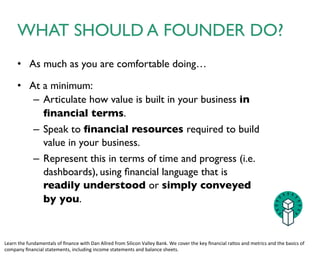
• As much as you are comfortable doing…	

!
• At a minimum:	

– Articulate how value is built in your business in
financial terms. 	

– Speak to financial resources required to build
value in your business.	

– Represent this in terms of time and progress (i.e.
dashboards), using financial language that is
readily understood or simply conveyed
by you.
WHAT SHOULD A FOUNDER DO?
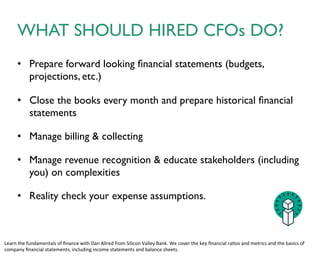
• Prepare forward looking financial statements (budgets,
projections, etc.)	

!
• Close the books every month and prepare historical financial
statements	

!
• Manage billing & collecting	

!
• Manage revenue recognition & educate stakeholders (including
you) on complexities	

!
• Reality check your expense assumptions.
WHAT SHOULD HIRED CFOs DO?
Q & A
• Don’t be SHY
WANT TO LEARN HOW TO FILL
YOUR PIGGY BANK?
SVB BOSTON—FREE 1:1 SESSION
http://learn.intelligent.ly/svb-office-hours
Financial Fundamentals: Money 101
March 17th 2014
Smith Anderson
Silicon Valley Bank
(617) 796-6958
Smanderson@svb.com
Twitter: @SmithTown561
Glen Mello
Silicon Valley Bank
(617) 630-4188
gmello@svb.com
!
presents
INSTRUCTOR
Course Name
Learn the skills
you need to win,
from people who’ve
done it before
visit

Back to Basics: Financial Fundamentals for Startups

  • 1.
    presents Back to Basics:Financial Fundamentals For Startups
  • 2.
    Financial Fundamentals: Money101 March 17th 2014 Smith Anderson Silicon Valley Bank (617) 796-6958 Smanderson@svb.com Twitter: @SmithTown561 Glen Mello Silicon Valley Bank (617) 630-4188 gmello@svb.com !
  • 3.
  • 4.
    It’s a lotlike 
 learning a language
  • 5.
    You need tolearn key phrases yourself...
  • 6.
    …and rely ontranslators for the rest.
  • 7.
    AGENDA • Key financialmetrics • Financial statements • When & how to leverage CFOs & others • Q & A
  • 8.
    TOP LINE REV/ SALES • Gross Sales or Revenue regardless of cost, liabilities etc.. – Used to discuss growth of the business over time. – Important, however there is more to the story.
  • 9.
    Revenue – COGS– expenses ! • Net Profit (or Net Loss) – interest, – taxes, – Depreciation – Amortization expenses ! • EBITDA: Earnings Before Interest,Taxes, Depreciation & Amortization BOTTOM LINE
  • 10.
    BOOKINGS • The financialvalue of business that you have under contract ! • i.e.“we booked a deal with Amazon for $240k over 2 years” ! • Not a financial statement item—“dashboard” item. ! • Total ContractValue (TCV) vs. Annual ContractValue (ACV)
  • 11.
    REVENUE • The accountingvalue of a sale during a specific time period • a.k.a: “rev rec”,“recognized revenue”,“scored revenue” ! • Sale à revenue when the product has been delivered and payment terms are defined and agreed to. • Cash upfront – Deferred Revenue (Liability) • Bookings > Delivery > Revenue > Collection > A/R
  • 12.
    COGs • Cost ofgood sold ! • Production costs: direct product costs, hosting, etc. ! • Execution costs: commissions, revenue share, etc.
  • 13.
    • Revenue -COGS = Gross Profit (a hard dollar number) ! ! • Gross Profit / Revenue = Gross Margin (a percentage) GROSS MARGIN
  • 14.
    Costs to runyour business • Sales & Marketing expenses • Research & Development expenses • General & Administrative expenses EXPENSES
  • 15.
    Sources • Trade Receivables(A/R) • Deferred Revenue (D/R) • Debt • Equity Uses • Trade Payables (A/P) • Salaries/Wages Payable • Debt SOURCES & USES OF CASH
  • 16.
    • Cash dividedby cash burn ! • Cash burn does not necessarily equal EBITDA – depends on timing of cash receipts vs. bookings vs. revenue RUNWAY
  • 17.
    Events that drivevalue in the company: ! • Commercial milestones: distribution agreements, customers, bookings, revenue, etc. ! • Market milestones: users, working business model, etc. ! • Technical milestones: proof of concept, working prototype, etc. MILESTONES
  • 18.
    • One Page:Communicate progress to key stakeholders (investors, employees, etc.) ! • Time-based representation of how company is tracking against key financial goals (perhaps other time-bound goals as well) ! • Not a financial statement DASHBOARDS
  • 19.
    • Questions toask yourself: – What drives value in the business (bookings, gross margin, technical progress, distribution deals)? – What resources do you need to drive this value (people, time, money, etc.)? ! • Your dashboard will: – Track the value you are building in the business. – Track the resources you are consuming as you build value. BUILDYOUR DASHBOARD
  • 20.
    • Income Statement –A movie – Tells the financial story of a company over a span of time ! • Balance Sheet – A picture – Indicates the financial health of a company at a point in time FINANCIAL STATEMENTS
  • 21.
    Over a periodof time: • Revenue (“top line”) • Minus COGS • Equals Gross Profit • Minus Expenses • Equals EBITDA (“bottom line”) INCOME STATEMENT
  • 22.
    Assets • Cash • Receivables(A/R) • Inventory • Fixed Assets • Goodwill & Intangible Assets Liabilities • Salaries, wages • Payables (A/P) • Deferred Revenue (D/R) • Debt Assets = Liabilities plus Equity BALANCE SHEET Equity • Paid-in Capital • Retained Earnings (Loss)
  • 23.
    • As muchas you are comfortable doing… ! • At a minimum: – Articulate how value is built in your business in financial terms. – Speak to financial resources required to build value in your business. – Represent this in terms of time and progress (i.e. dashboards), using financial language that is readily understood or simply conveyed by you. WHAT SHOULD A FOUNDER DO?
  • 24.
    • Prepare forwardlooking financial statements (budgets, projections, etc.) ! • Close the books every month and prepare historical financial statements ! • Manage billing & collecting ! • Manage revenue recognition & educate stakeholders (including you) on complexities ! • Reality check your expense assumptions. WHAT SHOULD HIRED CFOs DO?
  • 25.
    Q & A •Don’t be SHY
  • 26.
    WANT TO LEARNHOW TO FILL YOUR PIGGY BANK? SVB BOSTON—FREE 1:1 SESSION http://learn.intelligent.ly/svb-office-hours
  • 27.
    Financial Fundamentals: Money101 March 17th 2014 Smith Anderson Silicon Valley Bank (617) 796-6958 Smanderson@svb.com Twitter: @SmithTown561 Glen Mello Silicon Valley Bank (617) 630-4188 gmello@svb.com !
  • 28.
    presents INSTRUCTOR Course Name Learn theskills you need to win, from people who’ve done it before visit

Editor's Notes

  • #3 Image Credit: Shutterstock
  • #4 Image Credit: Shutterstock
  • #5 Photo Credit: Shutterstock