BRANDING
SUBMITTED TO PRESENTED BY
SUPRIYA SINGH VISHAL KUMAR
Assistant professor Roll - 01
Dr. R.P.C.A.U , Pusa 1st SEMESTER
CONTENTS
 INTRODUCTION
 BRAND EQUITY
 BRAND LOYALITY
 BRAND STRATEGY
CO-BRANDING
NATIONAL BRAND
PRIVATE BRAND
GENERIC BRANDS
 THE ROLE OF BRANDS
 CONCLUSION
 REFERENCES
BRANDING
A brand is the idea or image of a specific product or service that
consumers connect with, by identifying the name, logo, slogan, or
design of the company who owns the idea or image.
 Branding is one of the most important aspects of any business, large or small, retail
or business to business.
 Branding creates a unique name and image for a product in consumer mind.
 An effective brand gives you a major edge in increasingly competitive markets.
INTRODUCTION
BRAND EQUITY
 Brand equity is the added value endowed on products and
services, which may be reflected in the way consumers,
think, feel and act with respect to the brand.
BRAND LOYALTY
 Brand loyalty is the tendency of consumers to continuously purchase one brand’s products
over another.
COCA-COLA APPLE NESTLE
LEVIS
1. Co-Branding.
2.. National Brand.
3. Private Brand.
4. Generic Brand.
BRAND STRATEGY
CO-BRANDING
 The practice of using the established brand names of two different
companies on the same product.
 IDEA & HDFC
 BMW & Louis Vuitton
 Products that carry the name of the
manufacturer.
i.e. Amul & Haldiram
NATIONAL BRAND
 Products that carry the name of the seller, not the
manufacturer.
PRIVATE BRAND
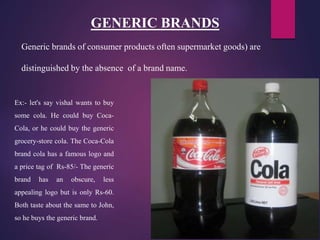
Generic brands of consumer products often supermarket goods) are
distinguished by the absence of a brand name.
GENERIC BRANDS
Ex:- let's say vishal wants to buy
some cola. He could buy Coca-
Cola, or he could buy the generic
grocery-store cola. The Coca-Cola
brand cola has a famous logo and
a price tag of Rs-85/- The generic
brand has an obscure, less
appealing logo but is only Rs-60.
Both taste about the same to John,
so he buys the generic brand.
THE ROLE OF BRANDS
 Simplify product handling.
 Represent business professionally.
 Signify quality.
 Inspire customer confidence.
 Serve as a competitive advantage.
BRANDS
AGRICULTURAL BRANDS
 Branding is essential for all company to be in market.
 Now a days huge customers wants branded product, so brand is very
essential.
CONCLUSION
REFERENCES
• HTTPS://WWW.WIKIPEDIA.ORG/
• WWW.GOOGLE.COM/BRANDING/
• BOOK-MARKETING MANAGEMENT (PHILIP
KOTLER)
Branding ppt

Branding ppt

  • 1.
    BRANDING SUBMITTED TO PRESENTEDBY SUPRIYA SINGH VISHAL KUMAR Assistant professor Roll - 01 Dr. R.P.C.A.U , Pusa 1st SEMESTER
  • 2.
    CONTENTS  INTRODUCTION  BRANDEQUITY  BRAND LOYALITY  BRAND STRATEGY CO-BRANDING NATIONAL BRAND PRIVATE BRAND GENERIC BRANDS  THE ROLE OF BRANDS  CONCLUSION  REFERENCES
  • 3.
    BRANDING A brand isthe idea or image of a specific product or service that consumers connect with, by identifying the name, logo, slogan, or design of the company who owns the idea or image.  Branding is one of the most important aspects of any business, large or small, retail or business to business.  Branding creates a unique name and image for a product in consumer mind.  An effective brand gives you a major edge in increasingly competitive markets. INTRODUCTION
  • 4.
    BRAND EQUITY  Brandequity is the added value endowed on products and services, which may be reflected in the way consumers, think, feel and act with respect to the brand.
  • 5.
    BRAND LOYALTY  Brandloyalty is the tendency of consumers to continuously purchase one brand’s products over another. COCA-COLA APPLE NESTLE LEVIS
  • 6.
    1. Co-Branding. 2.. NationalBrand. 3. Private Brand. 4. Generic Brand. BRAND STRATEGY
  • 7.
    CO-BRANDING  The practiceof using the established brand names of two different companies on the same product.  IDEA & HDFC  BMW & Louis Vuitton
  • 8.
     Products thatcarry the name of the manufacturer. i.e. Amul & Haldiram NATIONAL BRAND
  • 9.
     Products thatcarry the name of the seller, not the manufacturer. PRIVATE BRAND
  • 10.
    Generic brands ofconsumer products often supermarket goods) are distinguished by the absence of a brand name. GENERIC BRANDS Ex:- let's say vishal wants to buy some cola. He could buy Coca- Cola, or he could buy the generic grocery-store cola. The Coca-Cola brand cola has a famous logo and a price tag of Rs-85/- The generic brand has an obscure, less appealing logo but is only Rs-60. Both taste about the same to John, so he buys the generic brand.
  • 11.
    THE ROLE OFBRANDS  Simplify product handling.  Represent business professionally.  Signify quality.  Inspire customer confidence.  Serve as a competitive advantage.
  • 12.
  • 13.
  • 17.
     Branding isessential for all company to be in market.  Now a days huge customers wants branded product, so brand is very essential. CONCLUSION
  • 18.