Presented by
VISHAL KUMAR
 The term 'marketing mix' was first used in 1953 when Neil Borden, in his
American Marketing Association presidential address, took the recipe idea
one step further and coined the term "marketing-mix". A prominent
marketer, E. Jerome McCarthy, proposed a 4 P’s classification in 1960,
which has seen wide use.
MARKETING MIX
 Marketing Mix is a combination of marketing tools that a company uses to
satisfy their target customers, and achieving organizational goals. McCarthy
classified all these marketing tools under four broad categories:
 Product
 Price
 Place
 Promotion
 These four elements are the basic components of a marketing plan and are
collectively called 4 P’s of marketing.
 All marketing decision-making can be classified into four strategy
elements, sometimes referred to as the marketing mix or the four P’s.
 Product: What are the benefits of this product and service to its
customers?
 Price: Should a price be charged to cover costs only? Should the price
allow for a profit?
 Place: What can be done to make this product and service more accessible
and available?
 Promotion: What can be done to increase the visibility of this product and
service? What can be done to increase its usage or exposure?
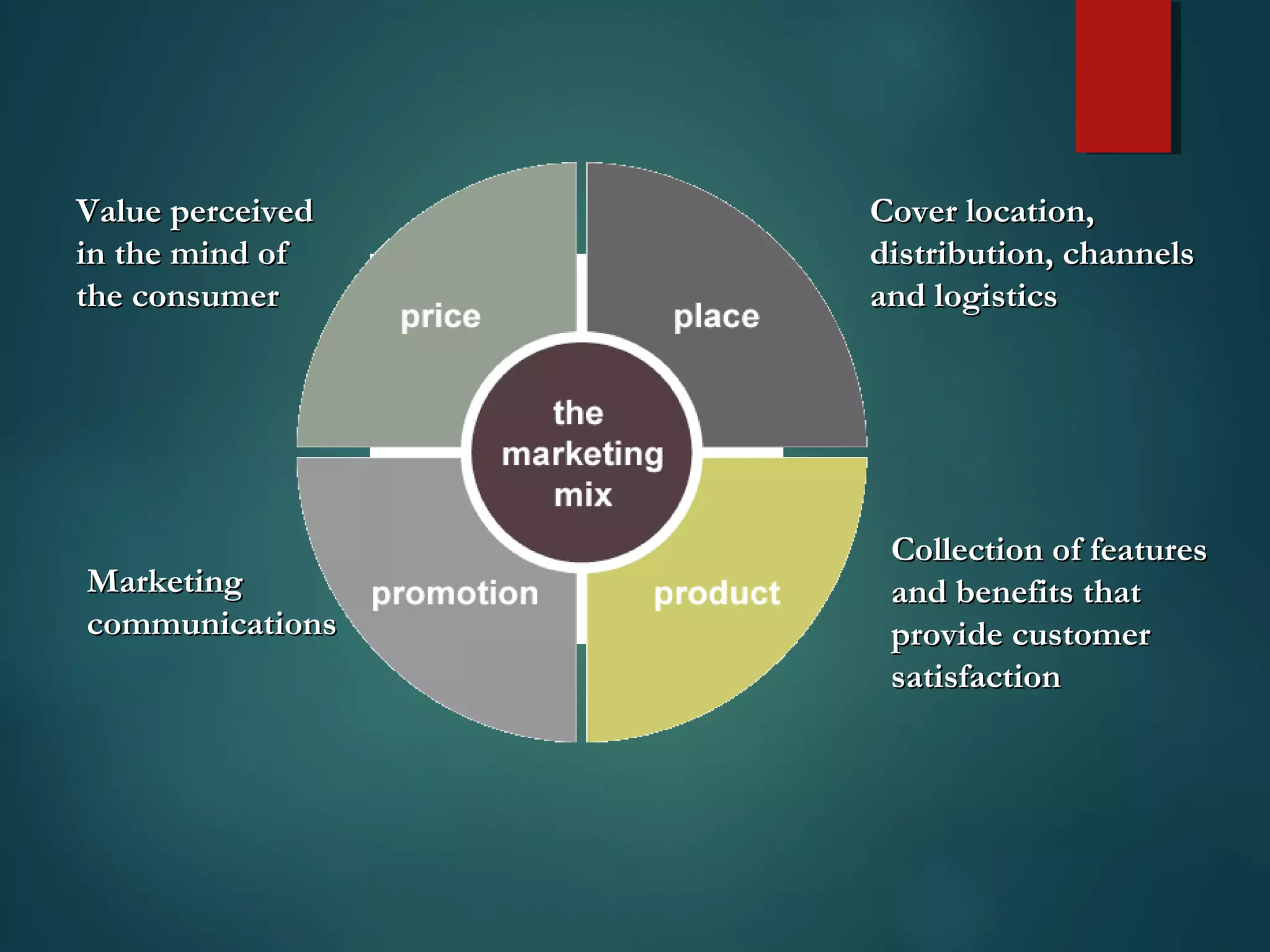
Value perceivedValue perceived
in the mind ofin the mind of
the consumerthe consumer
Cover location,Cover location,
distribution, channelsdistribution, channels
and logisticsand logistics
MarketingMarketing
communicationscommunications
Collection of featuresCollection of features
and benefits thatand benefits that
provide customerprovide customer
satisfactionsatisfaction
 Product is the actually offering by the company to its targeted customers
which also includes value added stuff. Product may be tangible (goods) or
intangible (services).
 For many a product is simply the tangible, physical entity that they may be
buying or selling.
 While formulating the marketing strategy, product decisions include:
 What to offer?
 Brand name
 Packaging
 Quality
 Appearance
 Functionality
 Accessories
 Installation
 After sale services
 Warranty
 Price includes the pricing strategy of the company for its products. How much
customer should pay for a product? Pricing strategy is not only related to the profit
margins but also helps in finding target customers. Pricing decision also influence
the choice of marketing channels.
 Price decisions include:
 Pricing Strategy (Penetration, Skim, etc)
 List Price
 Payment period
 Discounts
 Financing
 Credit terms
 Using price as a weapon for rivals is as old as mankind, but it’s risky too.
Consumers are often sensitive for price, discounts and additional offers. Another
aspect of pricing is that expensive products are considered of good quality.
 It not only includes the place where the product is placed,  all those
activities performed by the company to ensure the availability of the
product tot he targeted customers. Availability of the product at the
right place, at the right time and in the right quantity is crucial in
placement decisions.
 Placement decisions include:
 Placement
 Distribution channels
 Logistics
 Inventory
 Order processing
 Market coverage
 selection of channel members
 There are many types of intermediaries such as wholesalers, agents,
retailers, the Internet, overseas distributors, direct marketing (from
manufacturer to user without an intermediary), and many others.
 Promotion includes all communication and selling activities to persuade future
prospects to buy the product. Promotion decisions include:
 Advertising
 Media Types
 Message
 Budgets
 Sales promotion
 Personal selling
 Public relations/publicity
 Direct marketing
 Sponsorship
 The elements of the promotions mix are integrated to form a coherent campaign. As
with all forms of communication.
 As these costs are huge as compared to product price, So it’s good to perform a
break-even analysis before allocating the budget. It helps in determining whether the
new customers are worth of promotion cost or not.
Marketing mix

Marketing mix

  • 1.
  • 2.
     The term'marketing mix' was first used in 1953 when Neil Borden, in his American Marketing Association presidential address, took the recipe idea one step further and coined the term "marketing-mix". A prominent marketer, E. Jerome McCarthy, proposed a 4 P’s classification in 1960, which has seen wide use. MARKETING MIX
  • 3.
     Marketing Mixis a combination of marketing tools that a company uses to satisfy their target customers, and achieving organizational goals. McCarthy classified all these marketing tools under four broad categories:  Product  Price  Place  Promotion  These four elements are the basic components of a marketing plan and are collectively called 4 P’s of marketing.
  • 4.
     All marketingdecision-making can be classified into four strategy elements, sometimes referred to as the marketing mix or the four P’s.  Product: What are the benefits of this product and service to its customers?  Price: Should a price be charged to cover costs only? Should the price allow for a profit?  Place: What can be done to make this product and service more accessible and available?  Promotion: What can be done to increase the visibility of this product and service? What can be done to increase its usage or exposure?
  • 5.
    Value perceivedValue perceived inthe mind ofin the mind of the consumerthe consumer Cover location,Cover location, distribution, channelsdistribution, channels and logisticsand logistics MarketingMarketing communicationscommunications Collection of featuresCollection of features and benefits thatand benefits that provide customerprovide customer satisfactionsatisfaction
  • 6.
     Product isthe actually offering by the company to its targeted customers which also includes value added stuff. Product may be tangible (goods) or intangible (services).  For many a product is simply the tangible, physical entity that they may be buying or selling.  While formulating the marketing strategy, product decisions include:  What to offer?  Brand name  Packaging  Quality  Appearance  Functionality  Accessories  Installation  After sale services  Warranty
  • 7.
     Price includesthe pricing strategy of the company for its products. How much customer should pay for a product? Pricing strategy is not only related to the profit margins but also helps in finding target customers. Pricing decision also influence the choice of marketing channels.  Price decisions include:  Pricing Strategy (Penetration, Skim, etc)  List Price  Payment period  Discounts  Financing  Credit terms  Using price as a weapon for rivals is as old as mankind, but it’s risky too. Consumers are often sensitive for price, discounts and additional offers. Another aspect of pricing is that expensive products are considered of good quality.
  • 8.
     It notonly includes the place where the product is placed,  all those activities performed by the company to ensure the availability of the product tot he targeted customers. Availability of the product at the right place, at the right time and in the right quantity is crucial in placement decisions.  Placement decisions include:  Placement  Distribution channels  Logistics  Inventory  Order processing  Market coverage  selection of channel members  There are many types of intermediaries such as wholesalers, agents, retailers, the Internet, overseas distributors, direct marketing (from manufacturer to user without an intermediary), and many others.
  • 9.
     Promotion includesall communication and selling activities to persuade future prospects to buy the product. Promotion decisions include:  Advertising  Media Types  Message  Budgets  Sales promotion  Personal selling  Public relations/publicity  Direct marketing  Sponsorship  The elements of the promotions mix are integrated to form a coherent campaign. As with all forms of communication.  As these costs are huge as compared to product price, So it’s good to perform a break-even analysis before allocating the budget. It helps in determining whether the new customers are worth of promotion cost or not.