



Brand
Management
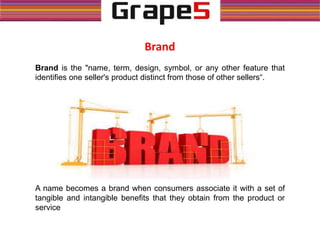
A name becomes a brand when consumers associate it with a set of
tangible and intangible benefits that they obtain from the product or
service
Brand
Brand is the "name, term, design, symbol, or any other feature that
identifies one seller's product distinct from those of other sellers“.
The process of maintaining, improving, and upholding a brand so that
the name is associated with positive results. Brand management
involves a number of important aspects such as cost, customer
satisfaction, in-store presentation, and competition. Brand
management is built on a marketing foundation, but focuses directly
on the brand and how that brand can remain favourable to customers.
Proper brand management can result in higher sales of not only one
product, but on other products associated with that brand.
Brand Management
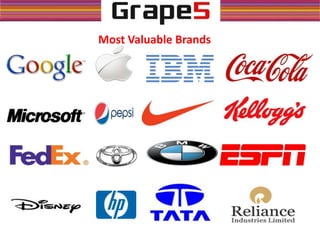
Most Valuable Brands
What Makes Them Leading Brands?
They invest heavily in brand promotion.
Strength of the brand goes back to basic marketing
strategy.
All efforts are directed to supporting the strategy
that flows from basic marketing decisions.
An Effective Brand Name
 Is Easy to Pronounce.
 Is Easy to Recognize & Remember.
 Is short, distinctive & Unique.
 Describes the product use & benefits.
 Has a Positive Connotation.
 Reinforces the Product Image.
 Is legally Protectable.
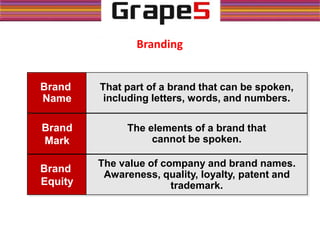
Branding
Brand
Name
Brand
Mark
Brand
Equity
That part of a brand that can be spoken,
including letters, words, and numbers.
The elements of a brand that
cannot be spoken.
The value of company and brand names.
Awareness, quality, loyalty, patent and
trademark.
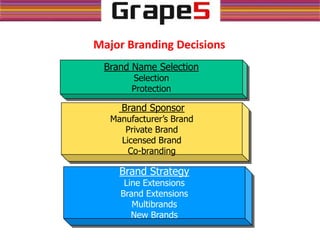
Major Branding Decisions
Brand Strategy
Line Extensions
Brand Extensions
Multibrands
New Brands
Brand Sponsor
Manufacturer’s Brand
Private Brand
Licensed Brand
Co-branding
Brand Name Selection
Selection
Protection
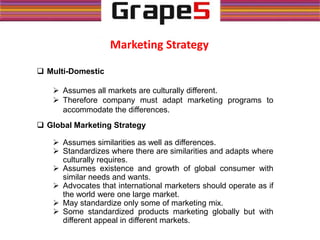
Marketing Strategy
 Multi-Domestic
 Assumes all markets are culturally different.
 Therefore company must adapt marketing programs to
accommodate the differences.
 Global Marketing Strategy
 Assumes similarities as well as differences.
 Standardizes where there are similarities and adapts where
culturally requires.
 Assumes existence and growth of global consumer with
similar needs and wants.
 Advocates that international marketers should operate as if
the world were one large market.
 May standardize only some of marketing mix.
 Some standardized products marketing globally but with
different appeal in different markets.
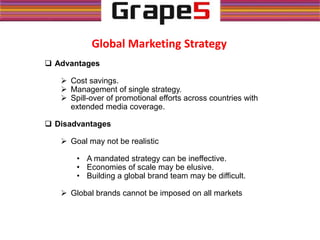
Global Marketing Strategy
 Advantages
 Cost savings.
 Management of single strategy.
 Spill-over of promotional efforts across countries with
extended media coverage.
 Disadvantages
 Goal may not be realistic
• A mandated strategy can be ineffective.
• Economies of scale may be elusive.
• Building a global brand team may be difficult.
 Global brands cannot be imposed on all markets
Think Globally, Act Locally
 Smart international marketers know decisions for standardization
or modification depend more on motivation patterns than
geography.
Global Perspective
 Calls for products and advertising toward a worldwide
market rather than national markets.
 Possible to balance strategy and not make global brand
the priority.
 Possible to create strong brands through Global Brand
Leadership.
 Organizational structures, processes and cultures
 Allocate brand-building resources globally, to create global
synergies
 Develop global brand strategy that coordinates country
brand strategies
Most multinational companies use Global Brand Leadership
Creating a Unique Brand Identity
 Find a unique benefit.
 Exploit that benefit to create a
differentiation in the mind of
the consumer.
 Convince the consumer that
your brand is Different, Better,
Special.
Packaging
 Contain and Protect
 Promote
 Facilitate Storage, Use, and
Convenience
 Facilitate Recycling
CONNECT
WITH US
Pinterest
Facebook
TwitterYouTube
LinkedIn
Bangalore office
#576, 30th Main Road,
Banashankari 3rd Stage,
Bangalore-560070
Navi Mumbai
Gangasagar, Plot no.E-47,
Near MSEB, Sector-12,
Kharghar,
Navi Mumbai-410210
……………………………….............

Brand management

  • 1.
  • 2.
    A name becomesa brand when consumers associate it with a set of tangible and intangible benefits that they obtain from the product or service Brand Brand is the "name, term, design, symbol, or any other feature that identifies one seller's product distinct from those of other sellers“.
  • 3.
    The process ofmaintaining, improving, and upholding a brand so that the name is associated with positive results. Brand management involves a number of important aspects such as cost, customer satisfaction, in-store presentation, and competition. Brand management is built on a marketing foundation, but focuses directly on the brand and how that brand can remain favourable to customers. Proper brand management can result in higher sales of not only one product, but on other products associated with that brand. Brand Management
  • 4.
  • 5.
    What Makes ThemLeading Brands? They invest heavily in brand promotion. Strength of the brand goes back to basic marketing strategy. All efforts are directed to supporting the strategy that flows from basic marketing decisions.
  • 6.
    An Effective BrandName  Is Easy to Pronounce.  Is Easy to Recognize & Remember.  Is short, distinctive & Unique.  Describes the product use & benefits.  Has a Positive Connotation.  Reinforces the Product Image.  Is legally Protectable.
  • 7.
    Branding Brand Name Brand Mark Brand Equity That part ofa brand that can be spoken, including letters, words, and numbers. The elements of a brand that cannot be spoken. The value of company and brand names. Awareness, quality, loyalty, patent and trademark.
  • 8.
    Major Branding Decisions BrandStrategy Line Extensions Brand Extensions Multibrands New Brands Brand Sponsor Manufacturer’s Brand Private Brand Licensed Brand Co-branding Brand Name Selection Selection Protection
  • 9.
    Marketing Strategy  Multi-Domestic Assumes all markets are culturally different.  Therefore company must adapt marketing programs to accommodate the differences.  Global Marketing Strategy  Assumes similarities as well as differences.  Standardizes where there are similarities and adapts where culturally requires.  Assumes existence and growth of global consumer with similar needs and wants.  Advocates that international marketers should operate as if the world were one large market.  May standardize only some of marketing mix.  Some standardized products marketing globally but with different appeal in different markets.
  • 10.
    Global Marketing Strategy Advantages  Cost savings.  Management of single strategy.  Spill-over of promotional efforts across countries with extended media coverage.  Disadvantages  Goal may not be realistic • A mandated strategy can be ineffective. • Economies of scale may be elusive. • Building a global brand team may be difficult.  Global brands cannot be imposed on all markets
  • 11.
    Think Globally, ActLocally  Smart international marketers know decisions for standardization or modification depend more on motivation patterns than geography. Global Perspective  Calls for products and advertising toward a worldwide market rather than national markets.  Possible to balance strategy and not make global brand the priority.  Possible to create strong brands through Global Brand Leadership.  Organizational structures, processes and cultures  Allocate brand-building resources globally, to create global synergies  Develop global brand strategy that coordinates country brand strategies Most multinational companies use Global Brand Leadership
  • 12.
    Creating a UniqueBrand Identity  Find a unique benefit.  Exploit that benefit to create a differentiation in the mind of the consumer.  Convince the consumer that your brand is Different, Better, Special. Packaging  Contain and Protect  Promote  Facilitate Storage, Use, and Convenience  Facilitate Recycling
  • 13.
    CONNECT WITH US Pinterest Facebook TwitterYouTube LinkedIn Bangalore office #576,30th Main Road, Banashankari 3rd Stage, Bangalore-560070 Navi Mumbai Gangasagar, Plot no.E-47, Near MSEB, Sector-12, Kharghar, Navi Mumbai-410210 ……………………………….............