1
Brand Associations
BRAND
MANAGEMENT
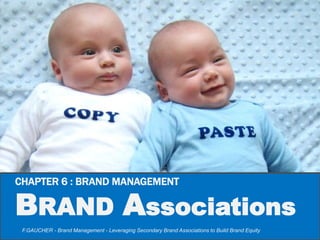
CHAPTER 6 : BRAND MANAGEMENT
BRAND Associations
F.GAUCHER - Brand Management - Leveraging Secondary Brand Associations to Build Brand Equity
Learning Objectives
Objectives
 Explain the process by which a brand can leverage
secondary associations
2
Introduction
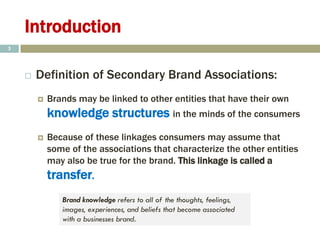
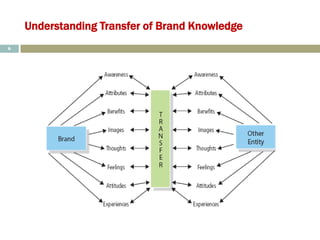
 Definition of Secondary Brand Associations:
 Brands may be linked to other entities that have their own
knowledge structures in the minds of the consumers
 Because of these linkages consumers may assume that
some of the associations that characterize the other entities
may also be true for the brand. This linkage is called a
transfer.
3
Brand knowledge refers to all of the thoughts, feelings,
images, experiences, and beliefs that become associated
with a businesses brand.
Introduction
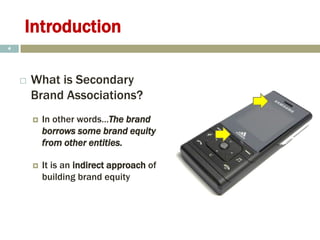
 What is Secondary
Brand Associations?
 In other words…The brand
borrows some brand equity
from other entities.
 It is an indirect approach of
building brand equity
4
Introduction
 Brand leveraging may be important if…
 If the existing brand associations are deficient in any
way
 Brand leveraging helps create strong, favorable and unique
associations and positive responses that are not present.
 Brand leveraging may help new brands to grow under the
umbrella of other most renowned brands.
 To reinforce existing associations in a fresh and
unique way
5
Understanding Transfer of Brand Knowledge
6
Introduction
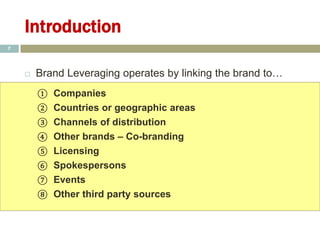
 Brand Leveraging operates by linking the brand to…
① Companies
② Countries or geographic areas
③ Channels of distribution
④ Other brands – Co-branding
⑤ Licensing
⑥ Spokespersons
⑦ Events
⑧ Other third party sources
7
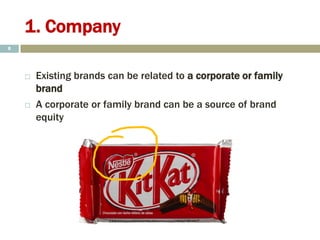
1. Company
 Existing brands can be related to a corporate or family
brand
 A corporate or family brand can be a source of brand
equity
8
2. Country of Origin or Geographic
Location
 A place of origin can be linked to the brand to generate
secondary associations
 Consumers choose brands originating in different
countries based on:
 Their beliefs about the quality of brands or products from these
countries
 The image that these brands or products communicate
9
2. Country of Origin or Geographic
Location
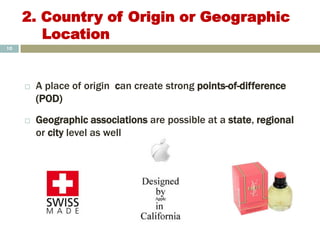
 A place of origin can create strong points-of-difference
(POD)
 Geographic associations are possible at a state, regional
or city level as well
10
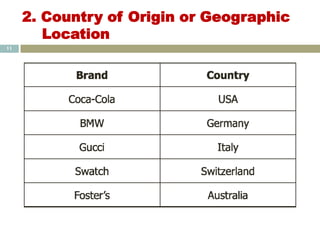
2. Country of Origin or Geographic
Location
11
3. Channels of Distribution
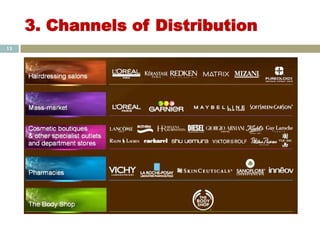
 Retail stores can indirectly affect brand equity
through an “image transfer” process
 Retailers have their own brand images in consumers’
minds due to the following associations
 Product assortment or category
 Pricing
 Quality of service
 Credit policy
 Location & store layout
 etc.
12
3. Channels of Distribution
13
4. Co-branding
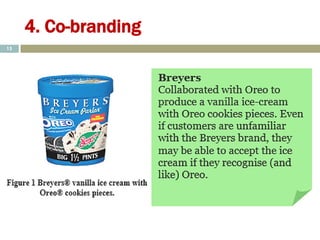
Co-Branding
When two or more existing brands are combined into a joint
product or are marketed together in some fashion
14
4. Co-branding
15
4. Co-branding
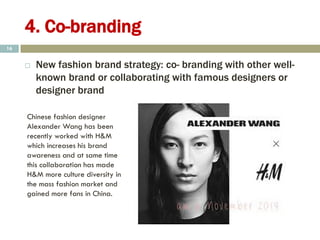
 New fashion brand strategy: co- branding with other well-
known brand or collaborating with famous designers or
designer brand
16
Chinese fashion designer
Alexander Wang has been
recently worked with H&M
which increases his brand
awareness and at same time
this collaboration has made
H&M more culture diversity in
the mass fashion market and
gained more fans in China.
4. Co-branding
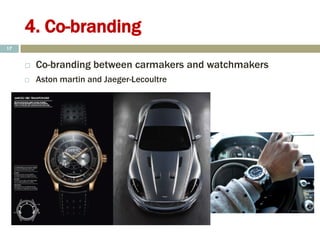
 Co-branding between carmakers and watchmakers
 Aston martin and Jaeger-Lecoultre
17
4. Co-branding
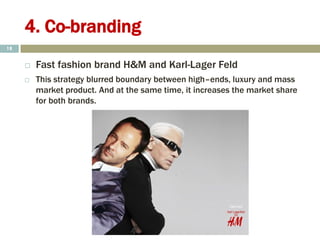
 Fast fashion brand H&M and Karl-Lager Feld
 This strategy blurred boundary between high–ends, luxury and mass
market product. And at the same time, it increases the market share
for both brands.
18
4. Co-branding
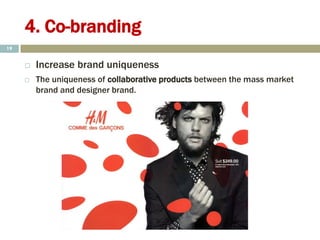
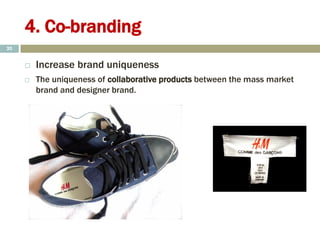
 Increase brand uniqueness
 The uniqueness of collaborative products between the mass market
brand and designer brand.
19
4. Co-branding
 Increase brand uniqueness
 The uniqueness of collaborative products between the mass market
brand and designer brand.
20
5. Licensing
 Contractual arrangements whereby firms can use:
 Names, logos, and characters of other brands to market
their own brands for some fixed fees (Royalties)
21
5. Licensing
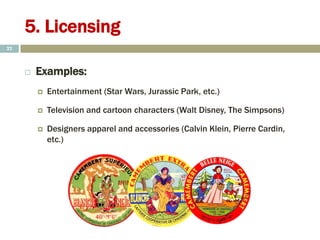
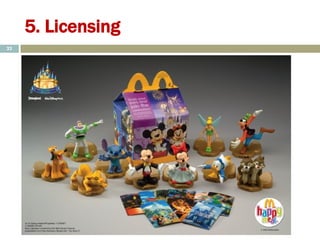
 Examples:
 Entertainment (Star Wars, Jurassic Park, etc.)
 Television and cartoon characters (Walt Disney, The Simpsons)
 Designers apparel and accessories (Calvin Klein, Pierre Cardin,
etc.)
22
5. Licensing
23
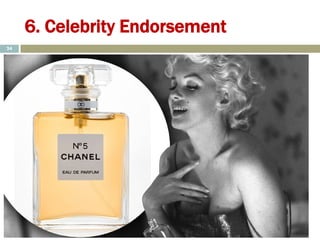
6. Celebrity Endorsement
24
6. Celebrity Endorsement
 Draws attention to the brand
 Shapes the perceptions of the brand
 Celebrity should have a high level of visibility and a rich set
of useful associations, judgments, and feelings
 Q-Score (Quotient-Score) to evaluate celebrities
 Revert to document provided during class
25
6. Celebrity Endorsement
 Potential Problems
 Celebrity endorsers can be overused by endorsing many
products that are too varied.
 There must be a reasonable match between the celebrity and
the product.
 Celebrity endorsers can get in trouble or lose popularity.
 Many consumers feel that celebrities are doing the endorsement
for money and do not necessarily believe in the endorsed brand.
 Celebrities may distract attention from the brand.
26
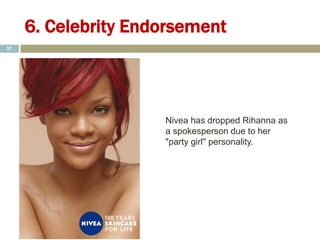
6. Celebrity Endorsement
Nivea has dropped Rihanna as
a spokesperson due to her
"party girl" personality.
27
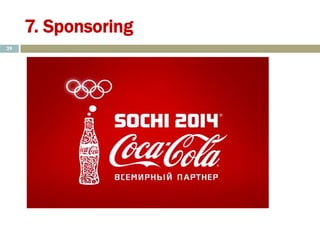
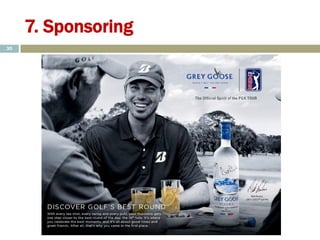
7. Sponsoring
 Sponsored events can contribute to brand equity by
becoming associated to the brand
 Sponsored events may improve
 brand awareness,
 adding new associations,
 the strength, favorability, and uniqueness of existing
associations.
 The main means by which an event can transfer
associations is credibility.
28
7. Sponsoring
29
7. Sponsoring
30
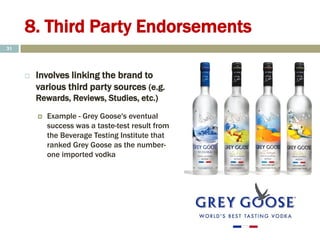
8. Third Party Endorsements
 Involves linking the brand to
various third party sources (e.g.
Rewards, Reviews, Studies, etc.)
 Example - Grey Goose's eventual
success was a taste-test result from
the Beverage Testing Institute that
ranked Grey Goose as the number-
one imported vodka
31
8. Third Party Endorsements
 Marketers can create secondary associations in a number
of different ways by linking the brand to various third-party
sources.
 Third-party sources can be especially credible sources.
 Marketers often feature them in advertising campaigns
and selling efforts.
 Example: J.D. Power and Associates’ well-publicized Customer
Satisfaction Index
32
To Sum Up...
 The extent to which an entity can be leveraged as a source
of equity depends on:
 Consumer knowledge of the entity
 How easily the appropriate associations or responses to the entity
transfer to the brand
33
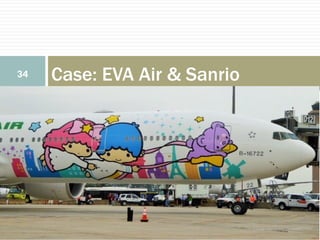
Case: EVA Air & Sanrio34
EVA Air & Sanrio
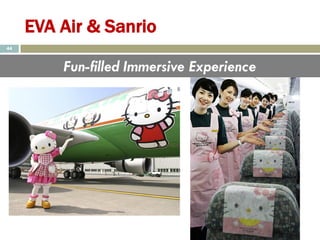
A successful example of long term brands collaboration
between the Taiwanese airline company EVA Air and Sanrio,
the official home of Hello Kitty.
35
EVA Air & Sanrio
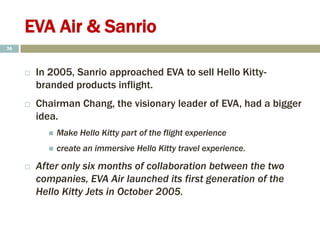
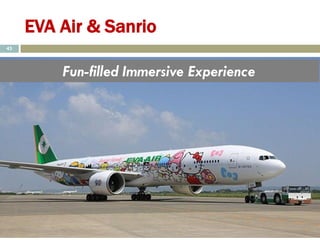
 In 2005, Sanrio approached EVA to sell Hello Kitty-
branded products inflight.
 Chairman Chang, the visionary leader of EVA, had a bigger
idea.
 Make Hello Kitty part of the flight experience
 create an immersive Hello Kitty travel experience.
 After only six months of collaboration between the two
companies, EVA Air launched its first generation of the
Hello Kitty Jets in October 2005.
36
EVA Air & Sanrio
 How did these two companies successfully work
together?
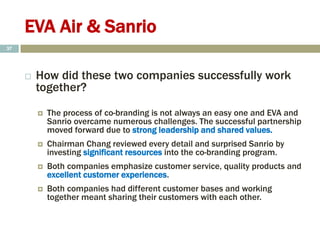
 The process of co-branding is not always an easy one and EVA and
Sanrio overcame numerous challenges. The successful partnership
moved forward due to strong leadership and shared values.
 Chairman Chang reviewed every detail and surprised Sanrio by
investing significant resources into the co-branding program.
 Both companies emphasize customer service, quality products and
excellent customer experiences.
 Both companies had different customer bases and working
together meant sharing their customers with each other.
37
EVA Air & Sanrio
 Successful results
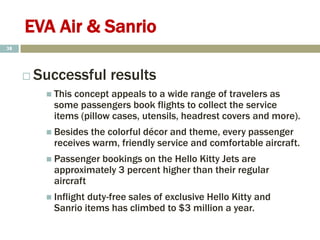
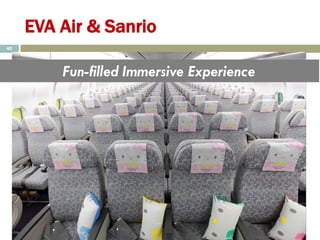
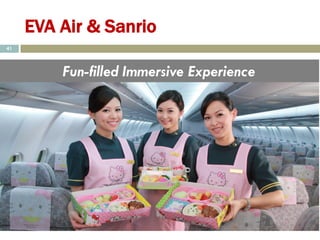
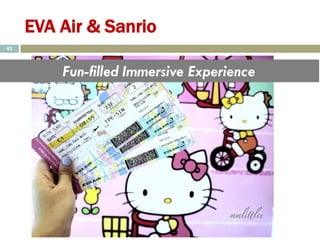
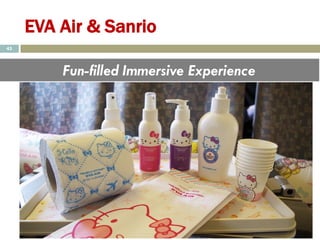
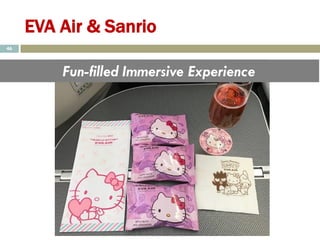
 This concept appeals to a wide range of travelers as
some passengers book flights to collect the service
items (pillow cases, utensils, headrest covers and more).
 Besides the colorful décor and theme, every passenger
receives warm, friendly service and comfortable aircraft.
 Passenger bookings on the Hello Kitty Jets are
approximately 3 percent higher than their regular
aircraft
 Inflight duty-free sales of exclusive Hello Kitty and
Sanrio items has climbed to $3 million a year.
38
EVA Air & Hello Kitty
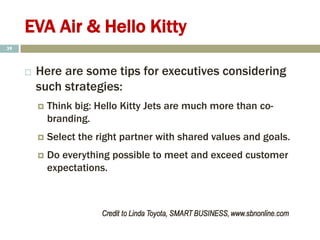
 Here are some tips for executives considering
such strategies:
 Think big: Hello Kitty Jets are much more than co-
branding.
 Select the right partner with shared values and goals.
 Do everything possible to meet and exceed customer
expectations.
39
EVA Air & Sanrio
40
Fun-filled Immersive Experience
EVA Air & Sanrio
41
Fun-filled Immersive Experience
EVA Air & Sanrio
42
Immersive Experience
Fun-filled Immersive Experience
EVA Air & Sanrio
43
Immersive Experience
Fun-filled Immersive Experience
EVA Air & Sanrio
44
Fun-filled Immersive Experience
EVA Air & Sanrio
45
Fun-filled Immersive Experience
EVA Air & Sanrio
46
Fun-filled Immersive Experience

Brand Associations

  • 1.
    1 Brand Associations BRAND MANAGEMENT CHAPTER 6: BRAND MANAGEMENT BRAND Associations F.GAUCHER - Brand Management - Leveraging Secondary Brand Associations to Build Brand Equity
  • 2.
    Learning Objectives Objectives  Explainthe process by which a brand can leverage secondary associations 2
  • 3.
    Introduction  Definition ofSecondary Brand Associations:  Brands may be linked to other entities that have their own knowledge structures in the minds of the consumers  Because of these linkages consumers may assume that some of the associations that characterize the other entities may also be true for the brand. This linkage is called a transfer. 3 Brand knowledge refers to all of the thoughts, feelings, images, experiences, and beliefs that become associated with a businesses brand.
  • 4.
    Introduction  What isSecondary Brand Associations?  In other words…The brand borrows some brand equity from other entities.  It is an indirect approach of building brand equity 4
  • 5.
    Introduction  Brand leveragingmay be important if…  If the existing brand associations are deficient in any way  Brand leveraging helps create strong, favorable and unique associations and positive responses that are not present.  Brand leveraging may help new brands to grow under the umbrella of other most renowned brands.  To reinforce existing associations in a fresh and unique way 5
  • 6.
    Understanding Transfer ofBrand Knowledge 6
  • 7.
    Introduction  Brand Leveragingoperates by linking the brand to… ① Companies ② Countries or geographic areas ③ Channels of distribution ④ Other brands – Co-branding ⑤ Licensing ⑥ Spokespersons ⑦ Events ⑧ Other third party sources 7
  • 8.
    1. Company  Existingbrands can be related to a corporate or family brand  A corporate or family brand can be a source of brand equity 8
  • 9.
    2. Country ofOrigin or Geographic Location  A place of origin can be linked to the brand to generate secondary associations  Consumers choose brands originating in different countries based on:  Their beliefs about the quality of brands or products from these countries  The image that these brands or products communicate 9
  • 10.
    2. Country ofOrigin or Geographic Location  A place of origin can create strong points-of-difference (POD)  Geographic associations are possible at a state, regional or city level as well 10
  • 11.
    2. Country ofOrigin or Geographic Location 11
  • 12.
    3. Channels ofDistribution  Retail stores can indirectly affect brand equity through an “image transfer” process  Retailers have their own brand images in consumers’ minds due to the following associations  Product assortment or category  Pricing  Quality of service  Credit policy  Location & store layout  etc. 12
  • 13.
    3. Channels ofDistribution 13
  • 14.
    4. Co-branding Co-Branding When twoor more existing brands are combined into a joint product or are marketed together in some fashion 14
  • 15.
  • 16.
    4. Co-branding  Newfashion brand strategy: co- branding with other well- known brand or collaborating with famous designers or designer brand 16 Chinese fashion designer Alexander Wang has been recently worked with H&M which increases his brand awareness and at same time this collaboration has made H&M more culture diversity in the mass fashion market and gained more fans in China.
  • 17.
    4. Co-branding  Co-brandingbetween carmakers and watchmakers  Aston martin and Jaeger-Lecoultre 17
  • 18.
    4. Co-branding  Fastfashion brand H&M and Karl-Lager Feld  This strategy blurred boundary between high–ends, luxury and mass market product. And at the same time, it increases the market share for both brands. 18
  • 19.
    4. Co-branding  Increasebrand uniqueness  The uniqueness of collaborative products between the mass market brand and designer brand. 19
  • 20.
    4. Co-branding  Increasebrand uniqueness  The uniqueness of collaborative products between the mass market brand and designer brand. 20
  • 21.
    5. Licensing  Contractualarrangements whereby firms can use:  Names, logos, and characters of other brands to market their own brands for some fixed fees (Royalties) 21
  • 22.
    5. Licensing  Examples: Entertainment (Star Wars, Jurassic Park, etc.)  Television and cartoon characters (Walt Disney, The Simpsons)  Designers apparel and accessories (Calvin Klein, Pierre Cardin, etc.) 22
  • 23.
  • 24.
  • 25.
    6. Celebrity Endorsement Draws attention to the brand  Shapes the perceptions of the brand  Celebrity should have a high level of visibility and a rich set of useful associations, judgments, and feelings  Q-Score (Quotient-Score) to evaluate celebrities  Revert to document provided during class 25
  • 26.
    6. Celebrity Endorsement Potential Problems  Celebrity endorsers can be overused by endorsing many products that are too varied.  There must be a reasonable match between the celebrity and the product.  Celebrity endorsers can get in trouble or lose popularity.  Many consumers feel that celebrities are doing the endorsement for money and do not necessarily believe in the endorsed brand.  Celebrities may distract attention from the brand. 26
  • 27.
    6. Celebrity Endorsement Niveahas dropped Rihanna as a spokesperson due to her "party girl" personality. 27
  • 28.
    7. Sponsoring  Sponsoredevents can contribute to brand equity by becoming associated to the brand  Sponsored events may improve  brand awareness,  adding new associations,  the strength, favorability, and uniqueness of existing associations.  The main means by which an event can transfer associations is credibility. 28
  • 29.
  • 30.
  • 31.
    8. Third PartyEndorsements  Involves linking the brand to various third party sources (e.g. Rewards, Reviews, Studies, etc.)  Example - Grey Goose's eventual success was a taste-test result from the Beverage Testing Institute that ranked Grey Goose as the number- one imported vodka 31
  • 32.
    8. Third PartyEndorsements  Marketers can create secondary associations in a number of different ways by linking the brand to various third-party sources.  Third-party sources can be especially credible sources.  Marketers often feature them in advertising campaigns and selling efforts.  Example: J.D. Power and Associates’ well-publicized Customer Satisfaction Index 32
  • 33.
    To Sum Up... The extent to which an entity can be leveraged as a source of equity depends on:  Consumer knowledge of the entity  How easily the appropriate associations or responses to the entity transfer to the brand 33
  • 34.
    Case: EVA Air& Sanrio34
  • 35.
    EVA Air &Sanrio A successful example of long term brands collaboration between the Taiwanese airline company EVA Air and Sanrio, the official home of Hello Kitty. 35
  • 36.
    EVA Air &Sanrio  In 2005, Sanrio approached EVA to sell Hello Kitty- branded products inflight.  Chairman Chang, the visionary leader of EVA, had a bigger idea.  Make Hello Kitty part of the flight experience  create an immersive Hello Kitty travel experience.  After only six months of collaboration between the two companies, EVA Air launched its first generation of the Hello Kitty Jets in October 2005. 36
  • 37.
    EVA Air &Sanrio  How did these two companies successfully work together?  The process of co-branding is not always an easy one and EVA and Sanrio overcame numerous challenges. The successful partnership moved forward due to strong leadership and shared values.  Chairman Chang reviewed every detail and surprised Sanrio by investing significant resources into the co-branding program.  Both companies emphasize customer service, quality products and excellent customer experiences.  Both companies had different customer bases and working together meant sharing their customers with each other. 37
  • 38.
    EVA Air &Sanrio  Successful results  This concept appeals to a wide range of travelers as some passengers book flights to collect the service items (pillow cases, utensils, headrest covers and more).  Besides the colorful décor and theme, every passenger receives warm, friendly service and comfortable aircraft.  Passenger bookings on the Hello Kitty Jets are approximately 3 percent higher than their regular aircraft  Inflight duty-free sales of exclusive Hello Kitty and Sanrio items has climbed to $3 million a year. 38
  • 39.
    EVA Air &Hello Kitty  Here are some tips for executives considering such strategies:  Think big: Hello Kitty Jets are much more than co- branding.  Select the right partner with shared values and goals.  Do everything possible to meet and exceed customer expectations. 39
  • 40.
    EVA Air &Sanrio 40 Fun-filled Immersive Experience
  • 41.
    EVA Air &Sanrio 41 Fun-filled Immersive Experience
  • 42.
    EVA Air &Sanrio 42 Immersive Experience Fun-filled Immersive Experience
  • 43.
    EVA Air &Sanrio 43 Immersive Experience Fun-filled Immersive Experience
  • 44.
    EVA Air &Sanrio 44 Fun-filled Immersive Experience
  • 45.
    EVA Air &Sanrio 45 Fun-filled Immersive Experience
  • 46.
    EVA Air &Sanrio 46 Fun-filled Immersive Experience