Charles Laffiteau
Nature of Consumer Demand 
Who & When What Where Why & How 
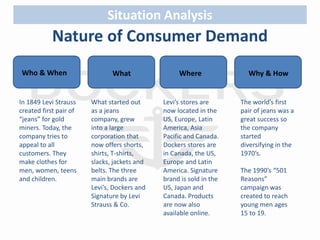
In 1849 Levi Strauss 
created first pair of 
“jeans” for gold 
miners. Today, the 
company tries to 
appeal to all 
customers. They 
make clothes for 
men, women, teens 
and children. 
What started out 
as a jeans 
company, grew 
into a large 
corporation that 
now offers shorts, 
shirts, T-shirts, 
slacks, jackets and 
belts. The three 
main brands are 
Levi’s, Dockers and 
Signature by Levi 
Strauss & Co. 
Levi’s stores are 
now located in the 
US, Europe, Latin 
America, Asia 
Pacific and Canada. 
Dockers stores are 
in Canada, the US, 
Europe and Latin 
America. Signature 
brand is sold in the 
US, Japan and 
Canada. Products 
are now also 
available online. 
The world’s first 
pair of jeans was a 
great success so 
the company 
started 
diversifying in the 
1970’s. 
The 1990’s “501 
Reasons” 
campaign was 
created to reach 
young men ages 
15 to 19. 
Situation Analysis
Situation Analysis 
Extent of Demand 
Size of Market and Growth Potential 
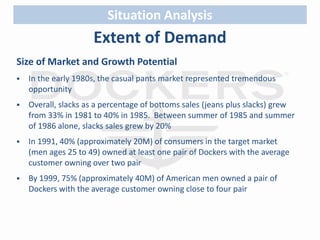
 In the early 1980s, the casual pants market represented tremendous 
opportunity 
 Overall, slacks as a percentage of bottoms sales (jeans plus slacks) grew 
from 33% in 1981 to 40% in 1985. Between summer of 1985 and summer 
of 1986 alone, slacks sales grew by 20% 
 In 1991, 40% (approximately 20M) of consumers in the target market 
(men ages 25 to 49) owned at least one pair of Dockers with the average 
customer owning over two pair 
 By 1999, 75% (approximately 40M) of American men owned a pair of 
Dockers with the average customer owning close to four pair
Situation Analysis 
Extent of Demand (cont’d) 
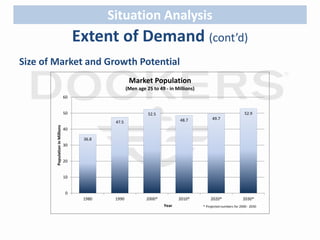
Size of Market and Growth Potential 
36.8 
47.5 
Market Population 
(Men age 25 to 49 - in Millions) 
52.5 
48.7 49.7 
52.9 
60 
50 
40 
30 
20 
10 
0 
1980 1990 2000* 2010* 2020* 2030* 
Population in Millions 
Year 
* Projected numbers for 2000 - 2030
Situation Analysis 
II. Extent of Demand (cont’d) 
Market Analysis 
 Baby Boomers, in general, see themselves as different from their parents. 
They have a driving need to be active, involved, fashionable and 
comfortable. 
 In 1999, Levi’s observed that this segment wanted their clothes to be a 
break from tradition; and fashion was more important for them compared 
to previous generations. 
 In the late 1990s, many companies were relaxing the office dress code 
allowing for more casual attire. The male Baby Boomer needed a pant 
that combined versatility and comfort appropriate for work and leisure. 
 Pants available to consumers at that time were on the main floor in 
department stores in “Better Sportswear” and priced at $60 to $80 per 
pair. Dockers were merchandised to be more accessible to the target 
market with a moderate price range averaging $32 per pair.
Situation Analysis 
II. Extent of Demand (cont’d) 
Dockers 
Dockers were designed to appeal to the fashion demands of Baby Boomers 
 Casual and comfortable, yet stylish 
 Positioned as more formal than jeans but less casual than dress slacks 
 Preference for more natural fibers (impetus for move to 100% cotton) 
 Right pant for a variety of occasions
Situation Analysis 
Nature of Competition 
Competition 
 Haggar, Farah, Bugle Boy—target Baby Boomers 
 Gap, Polo, Tommy Hilfiger, Abercrombie and Fitch, American Eagle—target 
younger generations 
Which brands are successful and why? Haggar and Farah 
 In 1980s, introduced wrinkle-free pants that looked like Dockers but did not have 
to be ironed due to a new wrinkle-eliminating treatment in the fabric 
 The concept allowed these companies to gain a significant competitive advantage 
over Levi’s. Haggar in particular held 73% of the market share 
 Levi’s was losing customers and failing to attract new ones. They had to change 
strategy and adopt the new wrinkle-free trend to stay competitive 
Is competitive retaliation anticipated? 
 Innovation and a forward looking strategy are indispensable for staying 
competitive in this market 
 As Levi’s added new products through innovation, the competition retaliated with 
similar innovations of their own, which is also expected going forward
Situation Analysis 
Environmental & Social Climate 
 The business casual trend which first appeared in the 1980s has 
since grown to encompass 70% or more of the workforce. 
 The trend also evolved and changed when the Baby Boomer 
generation began to give way to later generations (X and Y). 
 Gen X and Y workers regard business casual as outdated and prefer 
an even more casual dress approach such as wearing jeans to work. 
 But ‘new’ male role models and expectations of behavior have also 
emerged, thus providing Dockers an opportunity to reposition khaki 
pants as an essential element of the ‘new’ male’s wardrobe.
Situation Analysis 
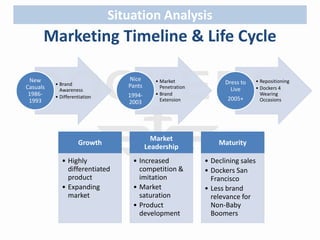
Marketing Timeline & Life Cycle 
• Brand 
Awareness 
• Differentiation 
New 
Casuals 
1986- 
1993 
• Market 
Penetration 
• Brand 
Extension 
Nice 
Pants 
1994- 
2003 
• Repositioning 
• Dockers 4 
Wearing 
Occasions 
Dress to 
Live 
2005+ 
Growth 
• Highly 
differentiated 
product 
• Expanding 
market 
Market 
Leadership 
• Increased 
competition & 
imitation 
• Market 
saturation 
• Product 
development 
Maturity 
• Declining sales 
• Dockers San 
Francisco 
• Less brand 
relevance for 
Non-Baby 
Boomers
Situation Analysis 
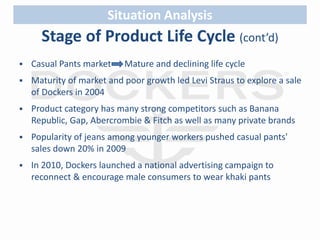
Stage of Product Life Cycle (cont’d) 
 Casual Pants market Mature and declining life cycle 
 Maturity of market and poor growth led Levi Straus to explore a sale 
of Dockers in 2004 
 Product category has many strong competitors such as Banana 
Republic, Gap, Abercrombie & Fitch as well as many private brands 
 Popularity of jeans among younger workers pushed casual pants' 
sales down 20% in 2009 
 In 2010, Dockers launched a national advertising campaign to 
reconnect & encourage male consumers to wear khaki pants
Situation Analysis 
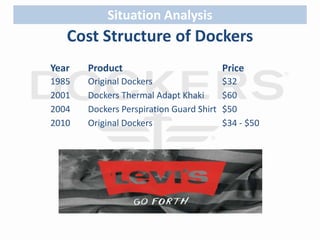
Cost Structure of Dockers 
Year Product Price 
1985 Original Dockers $32 
2001 Dockers Thermal Adapt Khaki $60 
2004 Dockers Perspiration Guard Shirt $50 
2010 Original Dockers $34 - $50
Situation Analysis 
Skills of the Firm 
Marketing Skills 
 “Hip” image in the 1970s to reflect new focus on diversification and 
acquisition 
 Initial Dockers TV campaign was “reality-based advertising” using 
emotional appeal 
 Spot TV ads in target markets aired during prime time, sports, and late 
night programs supplemented by subway signs and mobile billboards in 
NYC 
 Dockers moved into European markets and launched the brand with pan- 
European advertising 
 Continuously modified marketing approach by adding new brands and 
slogans in attempting to expand, compete, and meet changing consumer 
demands.
Skills of the Firm (cont’d) 
Additional Marketing Activities 
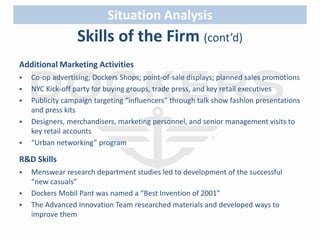
 Co-op advertising; Dockers Shops; point-of-sale displays; planned sales promotions 
 NYC Kick-off party for buying groups, trade press, and key retail executives 
 Publicity campaign targeting “influencers” through talk show fashion presentations 
and press kits 
 Designers, merchandisers, marketing personnel, and senior management visits to 
key retail accounts 
 “Urban networking” program 
R&D Skills 
 Menswear research department studies led to development of the successful 
“new casuals” 
 Dockers Mobil Pant was named a “Best Invention of 2001” 
 The Advanced Innovation Team researched materials and developed ways to 
improve them 
Situation Analysis
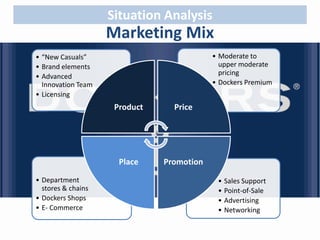
• Sales Support 
• Point-of-Sale 
• Advertising 
• Networking 
• Department 
stores & chains 
• Dockers Shops 
• E- Commerce 
Situation Analysis 
Marketing Mix 
• Moderate to 
upper moderate 
pricing 
• Dockers Premium 
• “New Casuals” 
• Brand elements 
• Advanced 
Innovation Team 
• Licensing 
Product Price 
Place Promotion
Case Study Questions
Case Study Questions 
Characterize Levi’s branding strategy? 
 General Brand Strategy: Throughout all of Levi’s products, the 
main idea expressed is that the products are casual, comfortable 
and good for any occasion, while at the same time still very 
stylish. 
 Positive Aspect: A major positive aspect of Levi’s branding 
strategy is that they open themselves up to a very large target 
audience. 
 Negative Aspect: The negative aspect to Levi’s branding strategy 
is that with such a large target audience, it is easy to lose sight of 
your core strategy and products. Sometimes you just need to 
stick to what you know best.
Case Study Questions 
Analyze Dockers’ communication strategy 
 At the time of the 1980s launch of Dockers, the company employed 
new creative methods to promote the product 
 Dockers shops were installed in the middle of the men’s department in major 
department stores 
 Fixtures and tables were set up displaying Dockers pants similar to the way 
only jeans had been displayed in past 
 Goal of advertising was to educate the audience and create an 
image for the new product reflecting the high quality of the 
established Levi’s jeans while also having its own autonomy 
 Target audience was professional men ages 24 to 49 
 Focus groups were used to test creative for TV ads, which used an 
emotional appeal
Case Study Questions 
How did the communication strategy fit with past 
advertising efforts and contribute to brand equity? 
 The communication strategy fit with the previous advertising efforts 
in a sense that it emphasized high quality and comfort 
 The launch of Dockers immediately created a strong brand. It 
showed consumers that LS&Co was investing money in innovation 
and created a new product that appealed to the target market. The 
creative ways that were used to launch the product allowed the 
company to capture over $1Billion in sales 
 Consumers had high levels of brand awareness and image. The 
brand awareness in the target market for males between ages 25 
and 44 was 90%. About 40% of these males bought at least one pair 
of Dockers annually 
 Branding is about creating differences, and LS&Co was able to do 
that with the “New Casuals”
Case Study Questions 
Characterize the Dockers brand image 
 Overall, the Levi’s brand was known for quality. Although moving 
into the pants market was different, it was a natural move for the 
company to meet changing consumer trends and needs 
 Baby Boomers had grown up with Levi’s brand and had tremendous 
loyalty towards it but now sought a different kind of pant 
 To the target market of male Baby Boomers, Dockers were known 
to be the alternative to jeans. They were unpretentious with a 
moderate price point when compared to Men’s “Better 
Sportswear” slacks 
 Younger consumers had less interest in Dockers, with many saying 
they were something “their fathers wore”
Case Study Questions 
What makes up Dockers’ brand equity? 
 The image that the Levi’s brand earned from the jeans business was 
contributed to its slacks image. They were considered to be more 
contemporary, less conservative and more casual than other slacks 
 To start, Dockers was slower moving into natural fabrics but then 
became the leader in fabric trends 
 By 1991, Dockers was a $500 Million business and enjoyed 90% 
awareness in the target market
Case Study Questions 
Evaluate the move to expand into other markets 
 Levi’s is a brand that has been associated with clothing for over one 
hundred years. The Dockers brand was developed to respond to 
changing consumer trends and needs. 
 It makes sense that in order to grow, Levi’s wanted to expand into 
other segments. However, bedding, bath and luggage are not logical 
extensions for the Dockers brand. After building the brand to be 
associated with pants, these new extensions do not resonate the 
same needs for the Dockers consumer. 
 Exploring various fabric technology and expanding into women’s and 
kid’s clothing is a more logical and understandable move for 
Dockers. These extensions relate better to the already established 
brand identity attached to Dockers for Ready-to-Wear apparel.
Case Study Questions 
Changes in strategy 
 In the first decade of Dockers, the marketing strategy centered on 
achieving brand awareness, establishing PODs, and obtaining 
retailer buy-in for the “New Casuals” category. 
 The mid 1990s to early 2000s found Dockers using more youthful 
and “sexier” ad messaging, licensing outside of menswear, and 
research to enhance product features in order to cope with 
declining sales in the wake of new competition in the “Business 
Casual” segment. 
 With the election of John Goodman as brand president in 2005, 
Dockers rebranded itself as Dockers San Francisco and re-segmented 
their offerings according to Dockers’ four usage 
occasions: work, weekend, dress and golf.
Case Study Questions 
Changes in strategy (cont’d) 
 After 20 years on the market, the marketing objectives changed from 
educating consumers about the product to updating its image and 
stabilizing flagging sales. 
 With the casual pant market in a state of maturity and decline, 
Dockers is not in a strong position to recapture market leadership. 
The brand is strategically encircled by competitors such as The Gap, 
Express, Banana Republic, retailer private labels, and producers like 
Haggar and Polo. 
 Furthermore, the “New Casuals” concept and Dockers product are 
not sufficiently differentiated or exciting to the next generation of 
urban male professionals ages 25 to 44. 
 The Dockers brand must find a way to carve out a new identity 
through its revised “occasion of use” segmentation strategy or 
relegate itself to the discount market.
Case Study Questions 
Adoption of new technologies 
 After initially missing out on the “wrinkle-free” trend, embracing 
new technologies in its products, such as the Thermal Adapt Khaki 
and Perspiration Guard Shirt, years later was the right move for 
Dockers. 
 The success of “wrinkle-free” pants proved that consumers cared 
about the added benefits from new technologies. 
 The new technologies added to products were relevant to 
consumers’ needs. 
 Dockers was able to use its new technologically advanced products 
to garner publicity.
Case Study Questions 
Analyze decision to stop selling Dockers directly 
 Levis and Dockers abandoned online retailing because the profits from 
e-commerce didn’t cover their costs of operating their websites. 
 In September 2005, Levis partnered with GSI Commerce, to launch 
www.levisstore.com for the Levi’s® brand and in June 2006 for 
Dockers. 
 By contracting with an experienced e-commerce firm with more than 
50 other partners, Dockers online retailing business stopped losing 
money.
Case Study Questions 
Recommendations for EVP John Goodman 
 Brand extensions—revitalize the brand by making it 
multidimensional: 
 Transform Dockers into a lifestyle brand 
 Focus on Dockers Four Wearing Occasions campaign 
 Benefit from success in women’s brands 
 Focus on continued quality and maintaining the Dockers brand - 
fashionable, stylish and relevant 
 Build on brand identity and speed to market 
 Continue to lower product sourcing costs and inventory markdowns 
 Capitalize on the momentum from the Asia Pacific success, and 
develop this market 
 Open Dockers stores to better display Dockers products, 
improvements to the brand, and changes adopted by the company
References 
 Day, Jennifer Cheeseman, Population Projections of the United 
States by Age, Sex, Race, and Hispanic Origin: 1995 to 2050, U.S. 
Bureau of the Census, Current Population Reports, P25-1130, U.S. 
Government Printing Office, Washington, DC, 1996 
 Hobbs, Frank and Nicole Stoops, U.S. Census Bureau, Census 2000 
Special Reports, Series CENSR-4, Demographic Trends in the 20th 
Century, U.S. Government Printing Office, Washington, DC, 2002 
 Wong, Elaine.“Dockers Brings Back Khakis” Brand Week (December 
9, 2009) retrieved at 
http://www.adweek.com/aw/content_display/news/agency/e3i632 
8aaffeb014c13a17b6f2ca4fb5cec
Charles Laffiteau

Dockers mba case study

  • 1.
  • 2.
    Nature of ConsumerDemand Who & When What Where Why & How In 1849 Levi Strauss created first pair of “jeans” for gold miners. Today, the company tries to appeal to all customers. They make clothes for men, women, teens and children. What started out as a jeans company, grew into a large corporation that now offers shorts, shirts, T-shirts, slacks, jackets and belts. The three main brands are Levi’s, Dockers and Signature by Levi Strauss & Co. Levi’s stores are now located in the US, Europe, Latin America, Asia Pacific and Canada. Dockers stores are in Canada, the US, Europe and Latin America. Signature brand is sold in the US, Japan and Canada. Products are now also available online. The world’s first pair of jeans was a great success so the company started diversifying in the 1970’s. The 1990’s “501 Reasons” campaign was created to reach young men ages 15 to 19. Situation Analysis
  • 3.
    Situation Analysis Extentof Demand Size of Market and Growth Potential  In the early 1980s, the casual pants market represented tremendous opportunity  Overall, slacks as a percentage of bottoms sales (jeans plus slacks) grew from 33% in 1981 to 40% in 1985. Between summer of 1985 and summer of 1986 alone, slacks sales grew by 20%  In 1991, 40% (approximately 20M) of consumers in the target market (men ages 25 to 49) owned at least one pair of Dockers with the average customer owning over two pair  By 1999, 75% (approximately 40M) of American men owned a pair of Dockers with the average customer owning close to four pair
  • 4.
    Situation Analysis Extentof Demand (cont’d) Size of Market and Growth Potential 36.8 47.5 Market Population (Men age 25 to 49 - in Millions) 52.5 48.7 49.7 52.9 60 50 40 30 20 10 0 1980 1990 2000* 2010* 2020* 2030* Population in Millions Year * Projected numbers for 2000 - 2030
  • 5.
    Situation Analysis II.Extent of Demand (cont’d) Market Analysis  Baby Boomers, in general, see themselves as different from their parents. They have a driving need to be active, involved, fashionable and comfortable.  In 1999, Levi’s observed that this segment wanted their clothes to be a break from tradition; and fashion was more important for them compared to previous generations.  In the late 1990s, many companies were relaxing the office dress code allowing for more casual attire. The male Baby Boomer needed a pant that combined versatility and comfort appropriate for work and leisure.  Pants available to consumers at that time were on the main floor in department stores in “Better Sportswear” and priced at $60 to $80 per pair. Dockers were merchandised to be more accessible to the target market with a moderate price range averaging $32 per pair.
  • 6.
    Situation Analysis II.Extent of Demand (cont’d) Dockers Dockers were designed to appeal to the fashion demands of Baby Boomers  Casual and comfortable, yet stylish  Positioned as more formal than jeans but less casual than dress slacks  Preference for more natural fibers (impetus for move to 100% cotton)  Right pant for a variety of occasions
  • 7.
    Situation Analysis Natureof Competition Competition  Haggar, Farah, Bugle Boy—target Baby Boomers  Gap, Polo, Tommy Hilfiger, Abercrombie and Fitch, American Eagle—target younger generations Which brands are successful and why? Haggar and Farah  In 1980s, introduced wrinkle-free pants that looked like Dockers but did not have to be ironed due to a new wrinkle-eliminating treatment in the fabric  The concept allowed these companies to gain a significant competitive advantage over Levi’s. Haggar in particular held 73% of the market share  Levi’s was losing customers and failing to attract new ones. They had to change strategy and adopt the new wrinkle-free trend to stay competitive Is competitive retaliation anticipated?  Innovation and a forward looking strategy are indispensable for staying competitive in this market  As Levi’s added new products through innovation, the competition retaliated with similar innovations of their own, which is also expected going forward
  • 8.
    Situation Analysis Environmental& Social Climate  The business casual trend which first appeared in the 1980s has since grown to encompass 70% or more of the workforce.  The trend also evolved and changed when the Baby Boomer generation began to give way to later generations (X and Y).  Gen X and Y workers regard business casual as outdated and prefer an even more casual dress approach such as wearing jeans to work.  But ‘new’ male role models and expectations of behavior have also emerged, thus providing Dockers an opportunity to reposition khaki pants as an essential element of the ‘new’ male’s wardrobe.
  • 9.
    Situation Analysis MarketingTimeline & Life Cycle • Brand Awareness • Differentiation New Casuals 1986- 1993 • Market Penetration • Brand Extension Nice Pants 1994- 2003 • Repositioning • Dockers 4 Wearing Occasions Dress to Live 2005+ Growth • Highly differentiated product • Expanding market Market Leadership • Increased competition & imitation • Market saturation • Product development Maturity • Declining sales • Dockers San Francisco • Less brand relevance for Non-Baby Boomers
  • 10.
    Situation Analysis Stageof Product Life Cycle (cont’d)  Casual Pants market Mature and declining life cycle  Maturity of market and poor growth led Levi Straus to explore a sale of Dockers in 2004  Product category has many strong competitors such as Banana Republic, Gap, Abercrombie & Fitch as well as many private brands  Popularity of jeans among younger workers pushed casual pants' sales down 20% in 2009  In 2010, Dockers launched a national advertising campaign to reconnect & encourage male consumers to wear khaki pants
  • 11.
    Situation Analysis CostStructure of Dockers Year Product Price 1985 Original Dockers $32 2001 Dockers Thermal Adapt Khaki $60 2004 Dockers Perspiration Guard Shirt $50 2010 Original Dockers $34 - $50
  • 12.
    Situation Analysis Skillsof the Firm Marketing Skills  “Hip” image in the 1970s to reflect new focus on diversification and acquisition  Initial Dockers TV campaign was “reality-based advertising” using emotional appeal  Spot TV ads in target markets aired during prime time, sports, and late night programs supplemented by subway signs and mobile billboards in NYC  Dockers moved into European markets and launched the brand with pan- European advertising  Continuously modified marketing approach by adding new brands and slogans in attempting to expand, compete, and meet changing consumer demands.
  • 13.
    Skills of theFirm (cont’d) Additional Marketing Activities  Co-op advertising; Dockers Shops; point-of-sale displays; planned sales promotions  NYC Kick-off party for buying groups, trade press, and key retail executives  Publicity campaign targeting “influencers” through talk show fashion presentations and press kits  Designers, merchandisers, marketing personnel, and senior management visits to key retail accounts  “Urban networking” program R&D Skills  Menswear research department studies led to development of the successful “new casuals”  Dockers Mobil Pant was named a “Best Invention of 2001”  The Advanced Innovation Team researched materials and developed ways to improve them Situation Analysis
  • 14.
    • Sales Support • Point-of-Sale • Advertising • Networking • Department stores & chains • Dockers Shops • E- Commerce Situation Analysis Marketing Mix • Moderate to upper moderate pricing • Dockers Premium • “New Casuals” • Brand elements • Advanced Innovation Team • Licensing Product Price Place Promotion
  • 15.
  • 16.
    Case Study Questions Characterize Levi’s branding strategy?  General Brand Strategy: Throughout all of Levi’s products, the main idea expressed is that the products are casual, comfortable and good for any occasion, while at the same time still very stylish.  Positive Aspect: A major positive aspect of Levi’s branding strategy is that they open themselves up to a very large target audience.  Negative Aspect: The negative aspect to Levi’s branding strategy is that with such a large target audience, it is easy to lose sight of your core strategy and products. Sometimes you just need to stick to what you know best.
  • 17.
    Case Study Questions Analyze Dockers’ communication strategy  At the time of the 1980s launch of Dockers, the company employed new creative methods to promote the product  Dockers shops were installed in the middle of the men’s department in major department stores  Fixtures and tables were set up displaying Dockers pants similar to the way only jeans had been displayed in past  Goal of advertising was to educate the audience and create an image for the new product reflecting the high quality of the established Levi’s jeans while also having its own autonomy  Target audience was professional men ages 24 to 49  Focus groups were used to test creative for TV ads, which used an emotional appeal
  • 18.
    Case Study Questions How did the communication strategy fit with past advertising efforts and contribute to brand equity?  The communication strategy fit with the previous advertising efforts in a sense that it emphasized high quality and comfort  The launch of Dockers immediately created a strong brand. It showed consumers that LS&Co was investing money in innovation and created a new product that appealed to the target market. The creative ways that were used to launch the product allowed the company to capture over $1Billion in sales  Consumers had high levels of brand awareness and image. The brand awareness in the target market for males between ages 25 and 44 was 90%. About 40% of these males bought at least one pair of Dockers annually  Branding is about creating differences, and LS&Co was able to do that with the “New Casuals”
  • 19.
    Case Study Questions Characterize the Dockers brand image  Overall, the Levi’s brand was known for quality. Although moving into the pants market was different, it was a natural move for the company to meet changing consumer trends and needs  Baby Boomers had grown up with Levi’s brand and had tremendous loyalty towards it but now sought a different kind of pant  To the target market of male Baby Boomers, Dockers were known to be the alternative to jeans. They were unpretentious with a moderate price point when compared to Men’s “Better Sportswear” slacks  Younger consumers had less interest in Dockers, with many saying they were something “their fathers wore”
  • 20.
    Case Study Questions What makes up Dockers’ brand equity?  The image that the Levi’s brand earned from the jeans business was contributed to its slacks image. They were considered to be more contemporary, less conservative and more casual than other slacks  To start, Dockers was slower moving into natural fabrics but then became the leader in fabric trends  By 1991, Dockers was a $500 Million business and enjoyed 90% awareness in the target market
  • 21.
    Case Study Questions Evaluate the move to expand into other markets  Levi’s is a brand that has been associated with clothing for over one hundred years. The Dockers brand was developed to respond to changing consumer trends and needs.  It makes sense that in order to grow, Levi’s wanted to expand into other segments. However, bedding, bath and luggage are not logical extensions for the Dockers brand. After building the brand to be associated with pants, these new extensions do not resonate the same needs for the Dockers consumer.  Exploring various fabric technology and expanding into women’s and kid’s clothing is a more logical and understandable move for Dockers. These extensions relate better to the already established brand identity attached to Dockers for Ready-to-Wear apparel.
  • 22.
    Case Study Questions Changes in strategy  In the first decade of Dockers, the marketing strategy centered on achieving brand awareness, establishing PODs, and obtaining retailer buy-in for the “New Casuals” category.  The mid 1990s to early 2000s found Dockers using more youthful and “sexier” ad messaging, licensing outside of menswear, and research to enhance product features in order to cope with declining sales in the wake of new competition in the “Business Casual” segment.  With the election of John Goodman as brand president in 2005, Dockers rebranded itself as Dockers San Francisco and re-segmented their offerings according to Dockers’ four usage occasions: work, weekend, dress and golf.
  • 23.
    Case Study Questions Changes in strategy (cont’d)  After 20 years on the market, the marketing objectives changed from educating consumers about the product to updating its image and stabilizing flagging sales.  With the casual pant market in a state of maturity and decline, Dockers is not in a strong position to recapture market leadership. The brand is strategically encircled by competitors such as The Gap, Express, Banana Republic, retailer private labels, and producers like Haggar and Polo.  Furthermore, the “New Casuals” concept and Dockers product are not sufficiently differentiated or exciting to the next generation of urban male professionals ages 25 to 44.  The Dockers brand must find a way to carve out a new identity through its revised “occasion of use” segmentation strategy or relegate itself to the discount market.
  • 24.
    Case Study Questions Adoption of new technologies  After initially missing out on the “wrinkle-free” trend, embracing new technologies in its products, such as the Thermal Adapt Khaki and Perspiration Guard Shirt, years later was the right move for Dockers.  The success of “wrinkle-free” pants proved that consumers cared about the added benefits from new technologies.  The new technologies added to products were relevant to consumers’ needs.  Dockers was able to use its new technologically advanced products to garner publicity.
  • 25.
    Case Study Questions Analyze decision to stop selling Dockers directly  Levis and Dockers abandoned online retailing because the profits from e-commerce didn’t cover their costs of operating their websites.  In September 2005, Levis partnered with GSI Commerce, to launch www.levisstore.com for the Levi’s® brand and in June 2006 for Dockers.  By contracting with an experienced e-commerce firm with more than 50 other partners, Dockers online retailing business stopped losing money.
  • 26.
    Case Study Questions Recommendations for EVP John Goodman  Brand extensions—revitalize the brand by making it multidimensional:  Transform Dockers into a lifestyle brand  Focus on Dockers Four Wearing Occasions campaign  Benefit from success in women’s brands  Focus on continued quality and maintaining the Dockers brand - fashionable, stylish and relevant  Build on brand identity and speed to market  Continue to lower product sourcing costs and inventory markdowns  Capitalize on the momentum from the Asia Pacific success, and develop this market  Open Dockers stores to better display Dockers products, improvements to the brand, and changes adopted by the company
  • 27.
    References  Day,Jennifer Cheeseman, Population Projections of the United States by Age, Sex, Race, and Hispanic Origin: 1995 to 2050, U.S. Bureau of the Census, Current Population Reports, P25-1130, U.S. Government Printing Office, Washington, DC, 1996  Hobbs, Frank and Nicole Stoops, U.S. Census Bureau, Census 2000 Special Reports, Series CENSR-4, Demographic Trends in the 20th Century, U.S. Government Printing Office, Washington, DC, 2002  Wong, Elaine.“Dockers Brings Back Khakis” Brand Week (December 9, 2009) retrieved at http://www.adweek.com/aw/content_display/news/agency/e3i632 8aaffeb014c13a17b6f2ca4fb5cec
  • 28.

Editor's Notes

  • #12 After much research, we have found that Dockers does not release individual variable or fixed costs of their products. On the Levi’s 10K financial statement, the company groups all sub-brands together under the Levi’s Strauss Brand when stating financial information. As you can see on the slide above, the price point of Dockers has remained around the same since introduced into the market. The only time the price was raised was when Dockers started using high-tech fabrics for their clothing (ex: Thermal Adapt Khaki). At this point in time, using economies of scale, Dockers probably makes a higher margin on their Original Dockers pants because they have found the most efficient way to produce them.
  • #13 Marketing Skills Historically focused on the quality, durability, & timelessness of Levi’s men’s jeans through print and TV ads. Early ads contained Western gold miner themes but tried to create a more “hip” image in the 1970s to reflect a new focus on diversification and acquisition. After corporate reorganization in the 1980s, each division led its own advertising strategy to target specific groups, and by 1982, the advertising budget jumped to $100 Million, mainly due to increased TV spending. The initial Dockers TV campaign used “reality-based advertising” style ads with an emotional appeal. The ads featured men ages 20 to 40 informally conversing about life in various settings to build product and brand awareness and be viewed as a casual or informal alternative to traditional dressing for almost every occasion, including weekend and work. The tagline was, “Levi’s 100% Cotton Dockers. If You’re Not Wearing Dockers, You’re Just Wearing Pants.” The media strategy involved TV ads in target markets, aired during select “showcase” prime time, sports, and late night programs. They ran multiple ads per program, and supplemented with subway signs and mobile billboards in New York. Dockers moved into European markets and launched the brand with pan-European advertising. LS&Co. continuously modified the marketing approach for Dockers by adding new brands and taglines in attempting to expand, compete, and meet changing consumer demands. Following are some examples: “Nobody Does Colors Like Dockers” campaign was meant to broaden the image beyond khakis. “Don’t just get dressed. Get Dockers” campaign launched Dockers Wrinkle-Free. The sexed-up “Nice Pants” campaign was a distinct departure from the earlier male bonding adds and contributed to the reversal of Dockers’ sales decline. “Dress to Live” tagline replaced the long-standing “Nice Pants” and was designed to expand positioning beyond casual slacks to include a wider range of products. At the same time, Dockers launched Dockers San Francisco, which was a new brand identity and logo intended to update Dockers’ image from the “guys-club” theme to a more inclusive brand image playing on “San Francisco’s stylish-but-not-stiff way of dressing.”
  • #14 Additional Marketing activities To establish Dockers, LS&Co. concentrated distribution in department stores and chains and provided sales support including the following: Sales kits providing a “road-map” for retail-based marketing Cooperative advertising Sales promotion programs (i.e. gift- with-purchase programs) Supplemental financial support for promotional activities to high image department stores LS&Co. established Dockers shops within main floor men’s areas of major department stores. In-store shops: Created a friendly and accessible environment; Gained in-store visibility by prominently displaying sporty Dockers logo; and Linked consumer advertising with point-of-sale signs and posters Planned sales promotions during kick-off & key seasons Organized an advertising kick-off party in New York City for buying groups, trade press, and key retail executives Publicity campaign targeted major market influencers with talk show fashion presentations and press kits Conducted a series of visits to key retail accounts by designers, merchandisers, marketing personnel, and senior management “Urban networking” program was a cultural outreach, where Dockers sponsored parties, dinners, film festivals, concert series, and khaki giveaways in urban centers across the country R&D Skills Menswear research department studies led to development of the successful “new casuals” Dockers Mobil Pant was named a “Best Invention of 2001” The Advanced Innovation Team researched materials and developed ways to improve them Stain Defender technology Color Bond technology Refresh Action technology Dockers Thermal Adapt Khaki Perspiration Guard Shirts
  • #15 Product Dockers created a “New Casuals” market niche by satisfying the unmet need for a pant positioned between jeans and dress pants among its target audience of white-collar males between the ages of 25 and 44. The brand’s comfortable, stylish, and versatile image as well as its differentiated 100% cotton materials enabled it to capture over $1B in sales and over 50% of the casual pant sales volume at the peak of Dockers’ popularity in 1993. To broaden its market penetration, Dockers extended its brand into multiple products: Dockers Authentics, Mobile Pant, etc. The brand was also licensed extensively to producers in the home furnishings, bedding, and linens markets. Price Dockers cultivated its market with accessible, moderate pricing to attract buyers in its target audience. Additional price was justified through product innovations such as Stain Defender, Color Bond, Refresh Action, and Perspiration Guard fabrics. Promotion The success of the initial product launch was a product of a carefully tailored Integrated Marketing Campaign that reached the brand’s target market as well as the trade and retail channels where the pants were to be sold. LS&Co achieved brand resonance between its market and Dockers with emotionally appealing, humorous, at times sexy, and aspiration-driven TV and print media ads. Trade/sales support promotional activities included retailer co-op advertising, point of sale displays, product launch parties, and an “urban networking” program targeting opinion leaders within the brand’s target market. Since Dockers created a new category of pants, initial advertising goals were to educate consumers on the brand, raise brand awareness, and leverage positive associations with Levi’s while establishing key PODs. Place Geographic markets were limited to 11 regional urban areas with a high concentration of urban male professionals: New York, Columbus, Cincinnati, Minneapolis, Houston, D.C., Los Angeles, Miami, Dallas, Charlotte, and Denver. The pants were predominantly sold through department stores and retail chains where most of the brand’s target audience did their shopping, as well as Dockers Shops where the brand’s full breadth and depth of product assortment could be showcased. Dockers and LS&Co. only met with limited success as a late entrant to the e-retailing apparel market. After 15 months without turning a profit, the e-commerce branch of the Levis site was eliminated in January 2000.
  • #17 Levi’s has changed its strategy several times over the past couple of decades. When Levi’s came into the textile industry, they manufactured jeans that were made to appeal to men working in the gold mines. When that market matured in the 1980s , Levi’s had to catch up to the khakis trend. Dockers were positioned towards white collar working men between the ages of 25 and 49 who lived in major metropolitan areas in the United States. Levi’s wanted people to believe that Dockers were more formal than jeans but less casual than dress slacks. In 1993, Levi’s realized that they were losing the younger market and created Dockers Authentics to reach out to the younger and more self-conscious customer. Levi’s tried to break away from being seen as a men’s only brand when they introduced Dockers for Her in 1998. In 1999, Levi’s once again tried to get the attention of the younger market by using slick and sexy TV advertisements with men “being themselves.” Levi’s was having an issue with the younger crowd seeing Levi’s as something their fathers would wear. In 2000, the company decided to take a step back from the crowded khaki market and focus on the “fashion forward” customer. This new line was called Dockers Recode and offered business-casual tops, bottoms and outerwear. Over the next five years Levi’s diversified their product categories on a large scale, ranging from infant apparel to home décor. Throughout all of Levi’s products, the main idea expressed is that the products are casual, comfortable and good for any occasion, while at the same time still very stylish. A positive aspect of Levi’s branding strategy is that they open themselves up to a very large target audience. It is easier to target the average person than a very specific market. The negative aspect to Levi’s branding strategy is that with such a large target audience it is easy to lose sight of your core strategy and products. Sometimes you need to stick to what you know best.
  • #20 In the mid-1980s, Levi’s wanted to capitalize on changing demographics and consumer tastes with a new line of casual slacks that appealed to the traditional, older men’s customer as well as to the new younger crossovers (men that grew up with Levi’s jeans but were now part of an office environment)