Biology is divided into many specialized branches for better understanding. Some key branches include:
- Morphology, which studies the form and structure of organisms.
- Anatomy, which is the study of internal structures through dissection.
- Physiology, which examines the functions and mechanisms in living systems.
- Immunology, which deals with the immune responses that defend the body against foreign challenges.
Biology encompasses various branches such as Morphology, Anatomy, Histology, and others, focusing on the structure, function, and classification of living organisms.
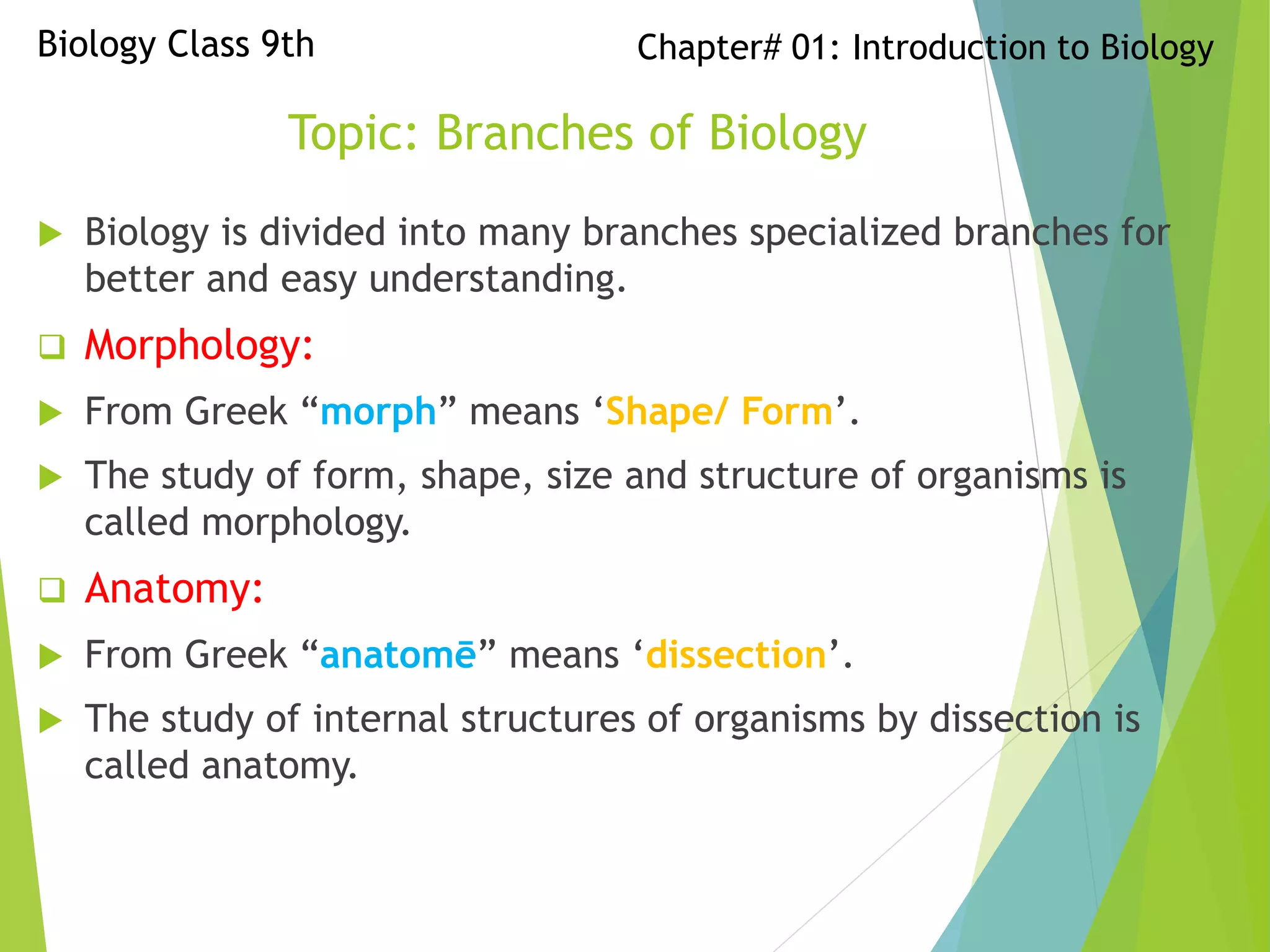
Topic: Branches ofBiology
Biology is divided into many branches specialized branches for
better and easy understanding.
Morphology:
From Greek “morph” means ‘Shape/ Form’.
The study of form, shape, size and structure of organisms is
called morphology.
Anatomy:
From Greek “anatomē” means ‘dissection’.
The study of internal structures of organisms by dissection is
called anatomy.
Biology Class 9th Chapter# 01: Introduction to Biology
2.
Histology:
FromGreek "histos" meaning ‘tissue’.
The study of composition, structure and functions of plants
and animal tissues is called histology.
Physiology:
From Greek “physis” meaning 'nature/origin'.
The scientific study of functions and mechanisms in a living
system is called Physiology.
Embryology:
From Greek “embryon” means ‘unborn/embryo/featus’.
Embryology deals with the study of embryo and phenomena
involved in its formation and its development into a new
organism.
Biology Class 9th Chapter# 01: Introduction to Biology
3.
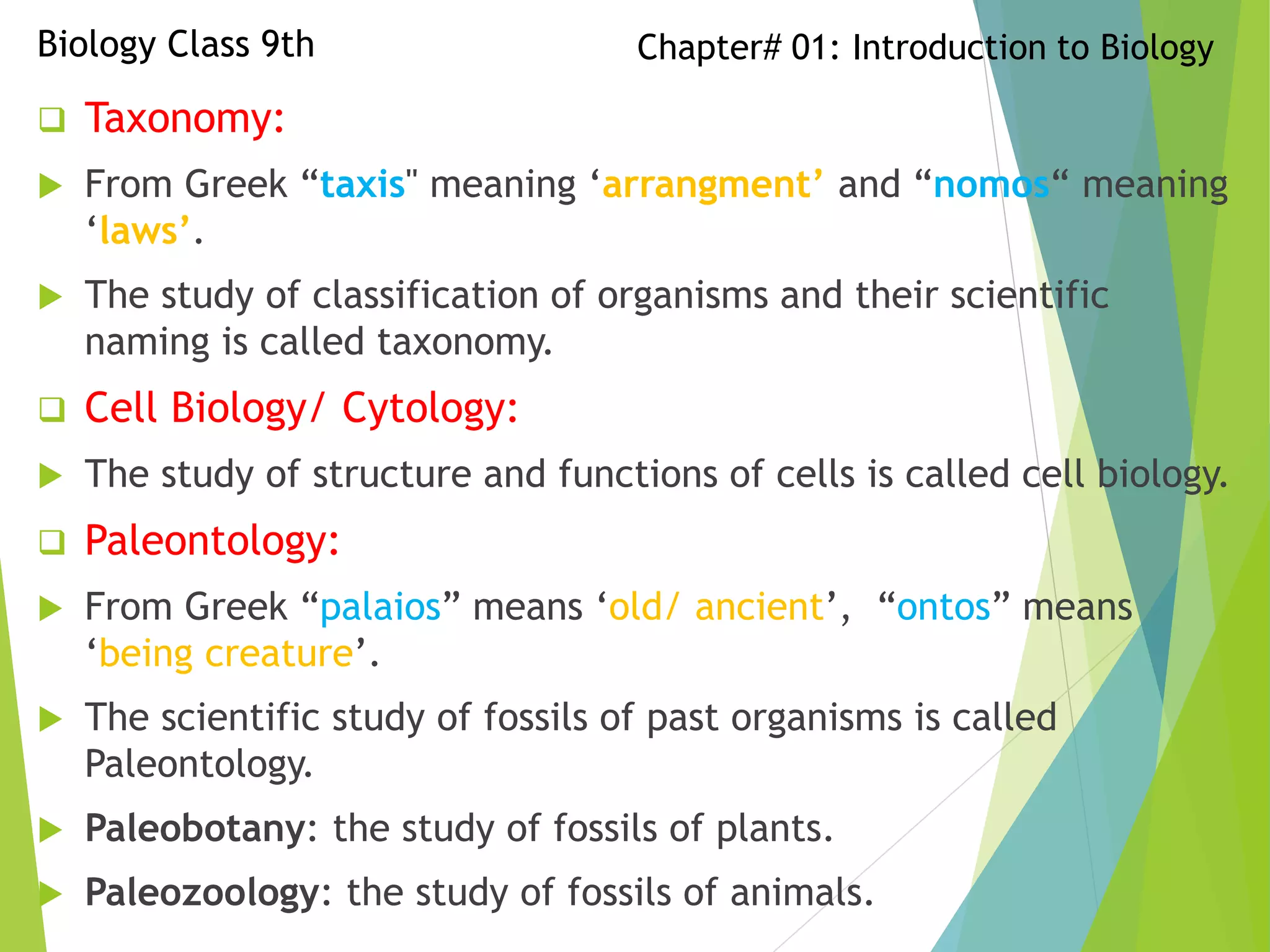
Taxonomy:
FromGreek “taxis" meaning ‘arrangment’ and “nomos“ meaning
‘laws’.
The study of classification of organisms and their scientific
naming is called taxonomy.
Cell Biology/ Cytology:
The study of structure and functions of cells is called cell biology.
Paleontology:
From Greek “palaios” means ‘old/ ancient’, “ontos” means
‘being creature’.
The scientific study of fossils of past organisms is called
Paleontology.
Paleobotany: the study of fossils of plants.
Paleozoology: the study of fossils of animals.
Biology Class 9th Chapter# 01: Introduction to Biology
4.
Immunology
Itis from Latin word “immunis” meaning ‘resistance/ to
exempt’.
The branch of biology which deals with the immune responses of
the body to foreign challenge in order to defend itself is called
immunology.
Entomology:
From Greek “entomon” means ‘notched refer to segmented
body of insect’.
The scientific study of insects is called entomology.
Genetics:
The study of genes and their role in inheritance is called
genetics.
Inheritance is the transmission of characters from parents to
offspring.
Biology Class 9th Chapter# 01: Introduction to Biology
5.
Socio-biology/ behavioralecology:
From Latin word “socius” means ‘companion’.
The systematic study of the biological basis of social behavior in
both humans and animals is called Socio-biology.
For example: social behavior and beneficial relationship among
the animals living in the same area such as humans, bees, ants
etc.
Pharmacology:
From Greek “pharmakon” means ‘drug/ poison’.
The branch of biology deals with the properties, uses, effects,
and mode of action of drugs on biological system is called
pharmacology.
Biology Class 9th Chapter# 01: Introduction to Biology
6.
Biotechnology:
Thestudy of practical application/use of organisms for the
benefit and welfare of humanity is called biotechnology.
Environmental biology/ Ecology:
Environmental biology is the branch of biology which study that
how the organisms interact with their environment.
Parasitology:
The branch of biology which deals with the study of parasites and
all aspects of parasitism.
Biology Class 9th Chapter# 01: Introduction to Biology
Assignment:
Q: How can you describe your own body under different branches of
biology?