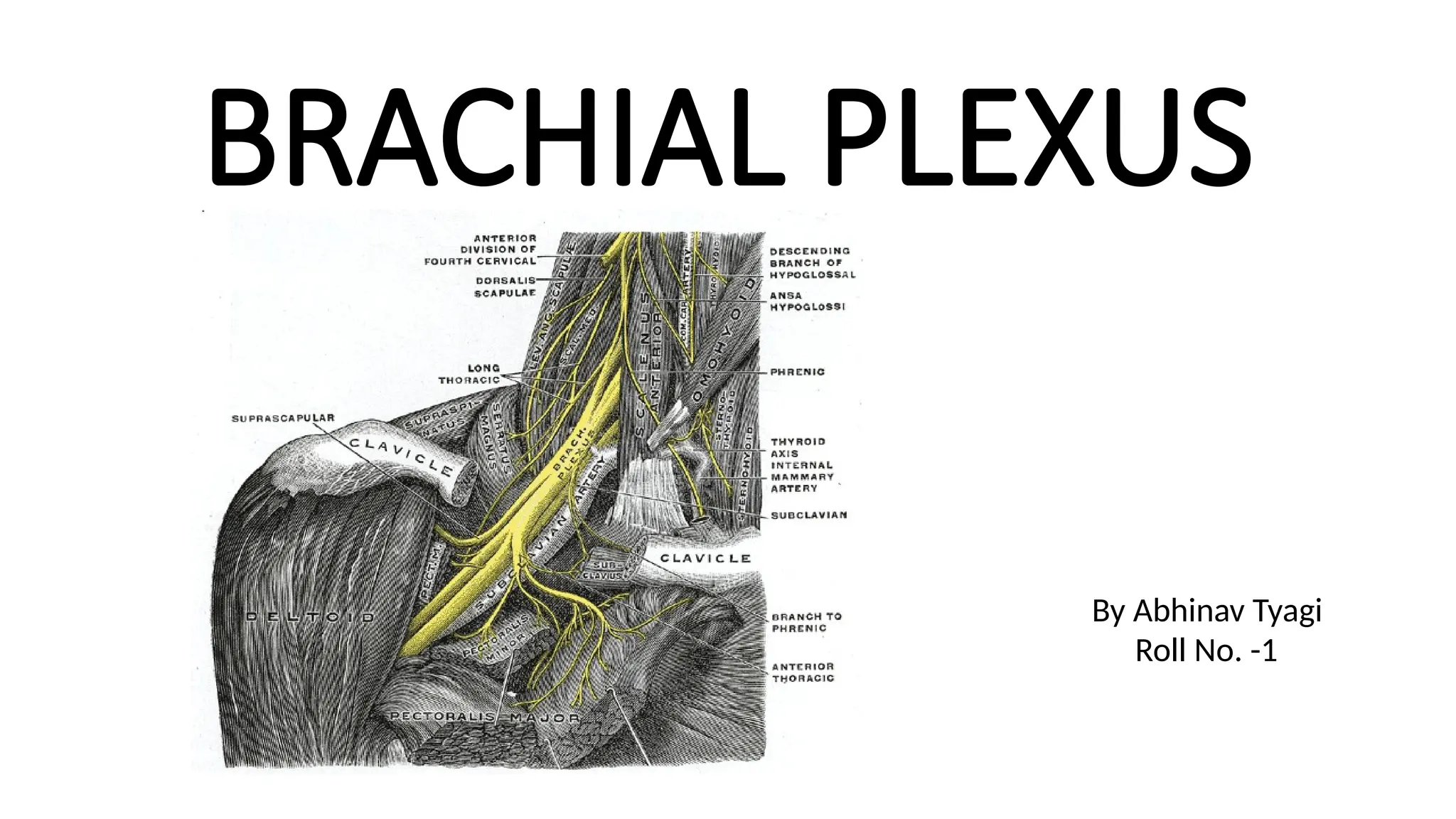
BRACHIAL PLEXUS
By Abhinav Tyagi
Roll No. -1
CONTENTS
• What is brachial plexus?
• Diagram
• Origin
• Roots
• Trunks
• Divisions
• Cords
• Branches
• Blood supply of brachial plexus
What is Brachial Plexus?
The brachial plexus is a major network of nerves
transmitting signals responsible for motor and sensory
innervation of the upper extremities, including the
shoulder, arm, and hands.
The Plexus consists of roots, trunks, divisions, cords and
branches
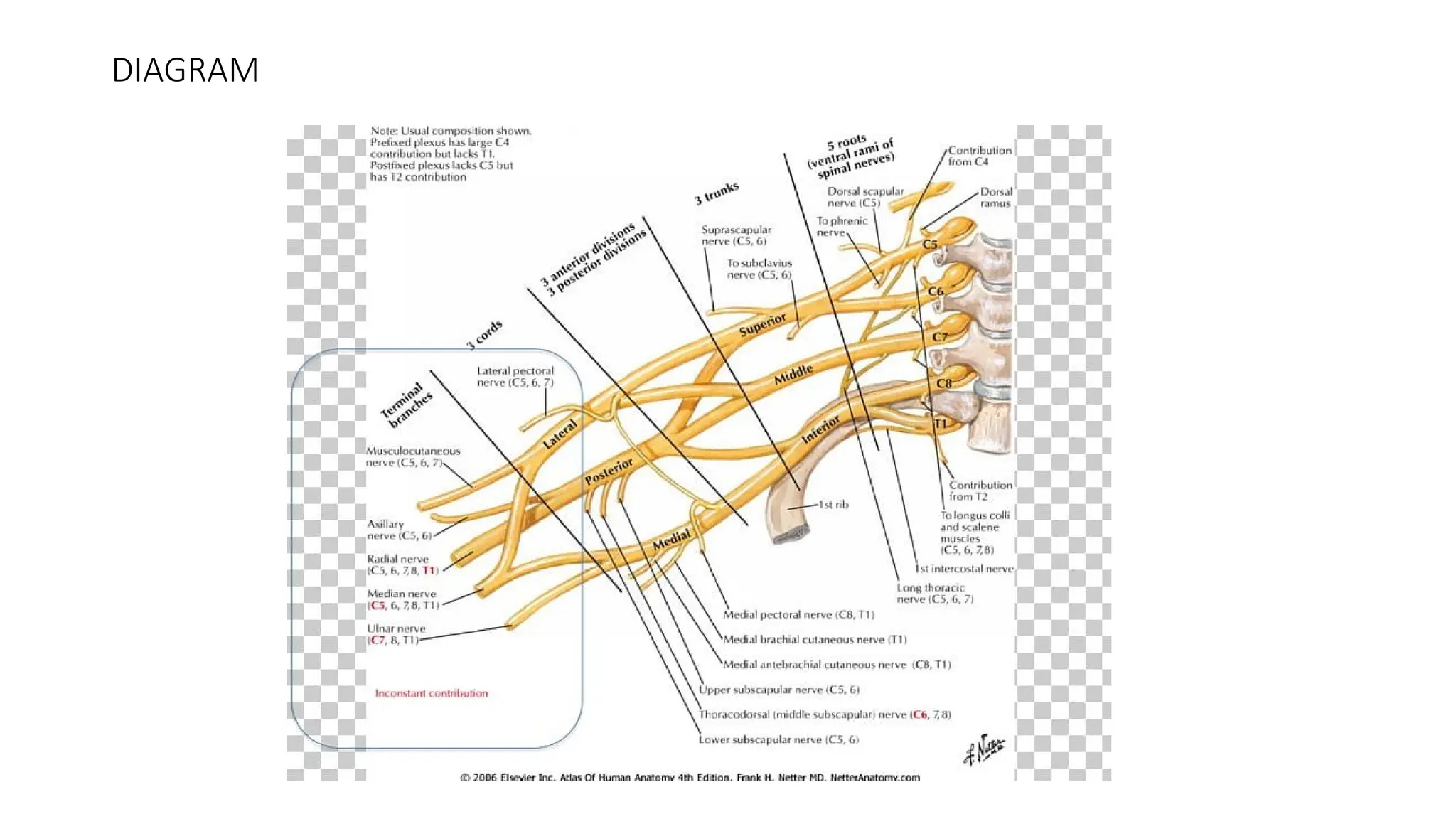
DIAGRAM
ORIGIN
• It originates from the ventral primary rami of C5-C8 and
T1 segments of spinal cord.
• The origin of the plexus may shift by one segment either
upward or downward resulting in a prefixed or postfixed
plexus.
• In prefixed plexus, the contributions by C4 is large and C5
is present, T1 is small and T2 is absent.
• In postfixed plexus, the contribution by T1 is large, T2 is
always present, C4 is absent and C5 is reduced in size.
ROOTS
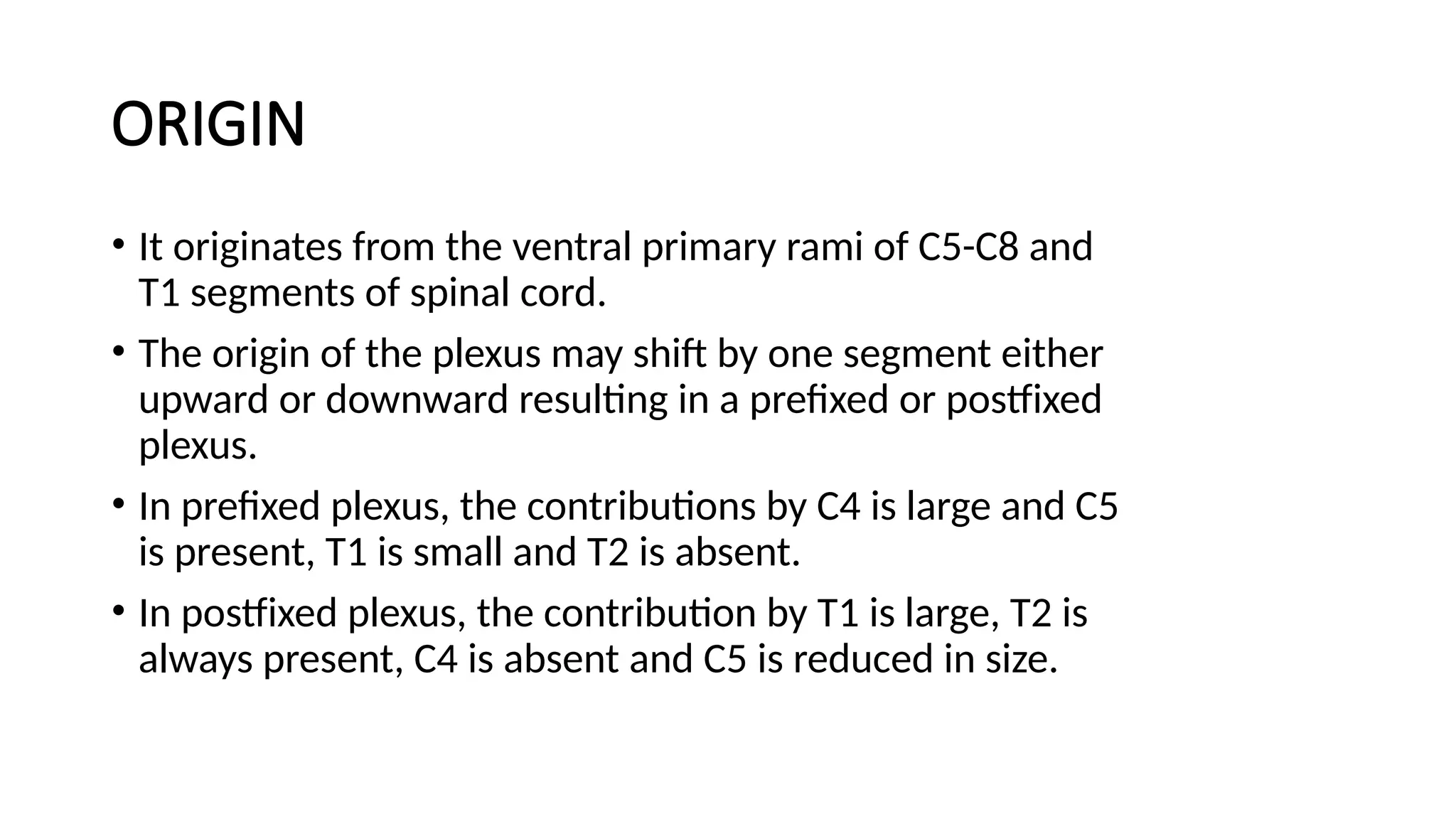
• Roots are formed between the scalenus anterior
and scalenus medius muscles by the anterior
rami of C5-C8 and T1 nerve roots.
• Three branches arise from the roots directly :
• dorsal scapular nerve: arises from the posterior
aspect of the C5 root and supplies the
rhomboids.
• subclavian nerve: arises from the C5 and C6 roots
anteriorly to supply subclavius.
• long thoracic nerve: arises from the posterior
aspects of C5-C7 and supplies serratus anterior.
TRUNKS
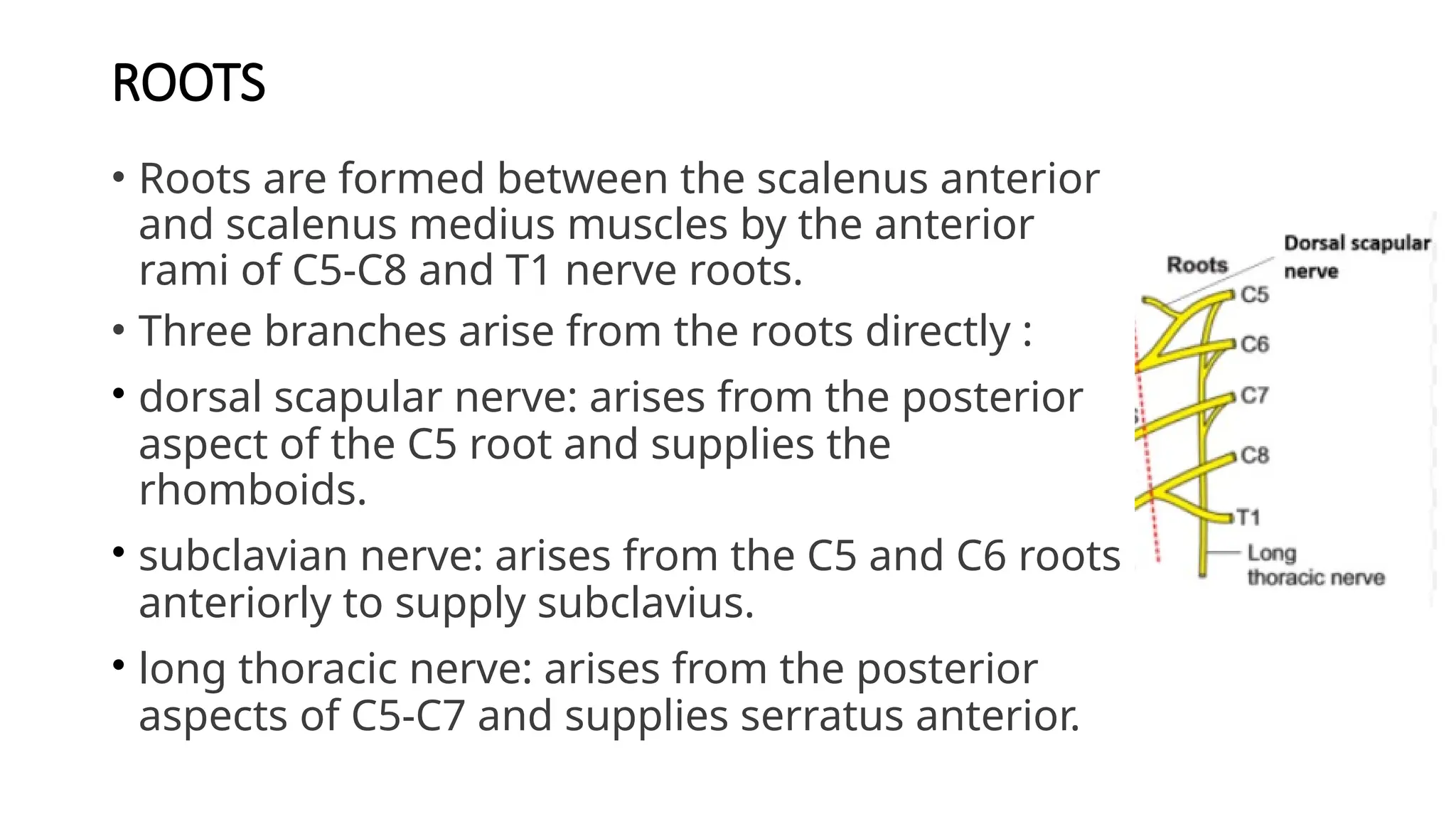
• Trunks form from the roots as they pass between
scalenus anterior and medius muscles, then go on to
traverse the posterior triangle
• C5 and C6 roots combine to form the upper trunk
• C7 root makes up the middle trunk
• C8 and T1 roots combine to form the lower trunk
• Two branches arises from the trunks:
suprascapular nerve: arises from the upper trunk and
supplies the supraspinatus and infraspinatus muscles
• Nerve to Subclavius: It arises from upper trunk and supplies
the subclavius muscle
DIVISIONS
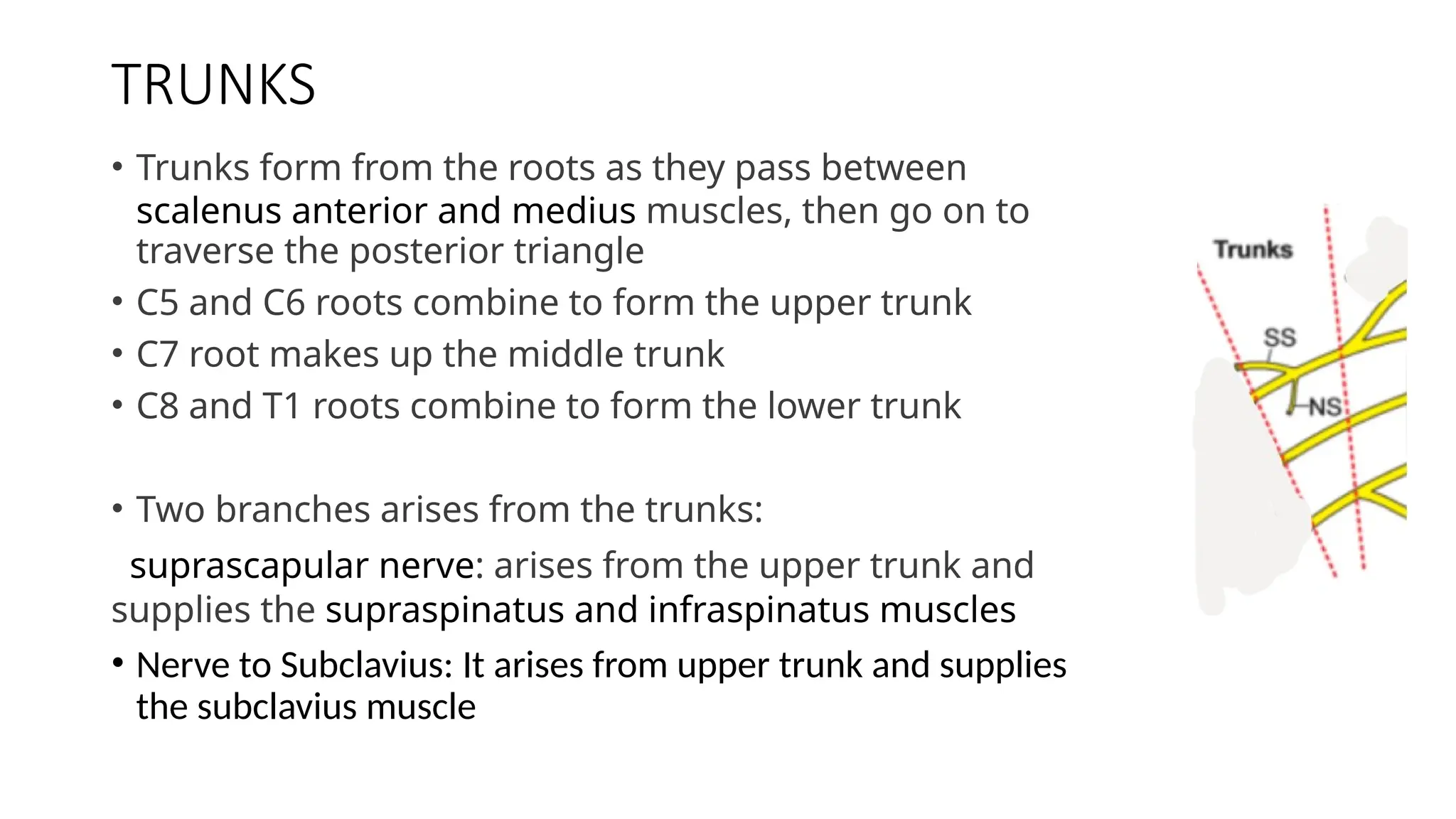
• Each trunk divides to form an anterior
and posterior division posterior to the
mid clavicle.
• In general anterior divisions supply
muscles of the anterior compartments
(flexors) whereas the posterior divisions
supply muscles of the posterior
compartments (extensors)
• No branches arise from the divisions.
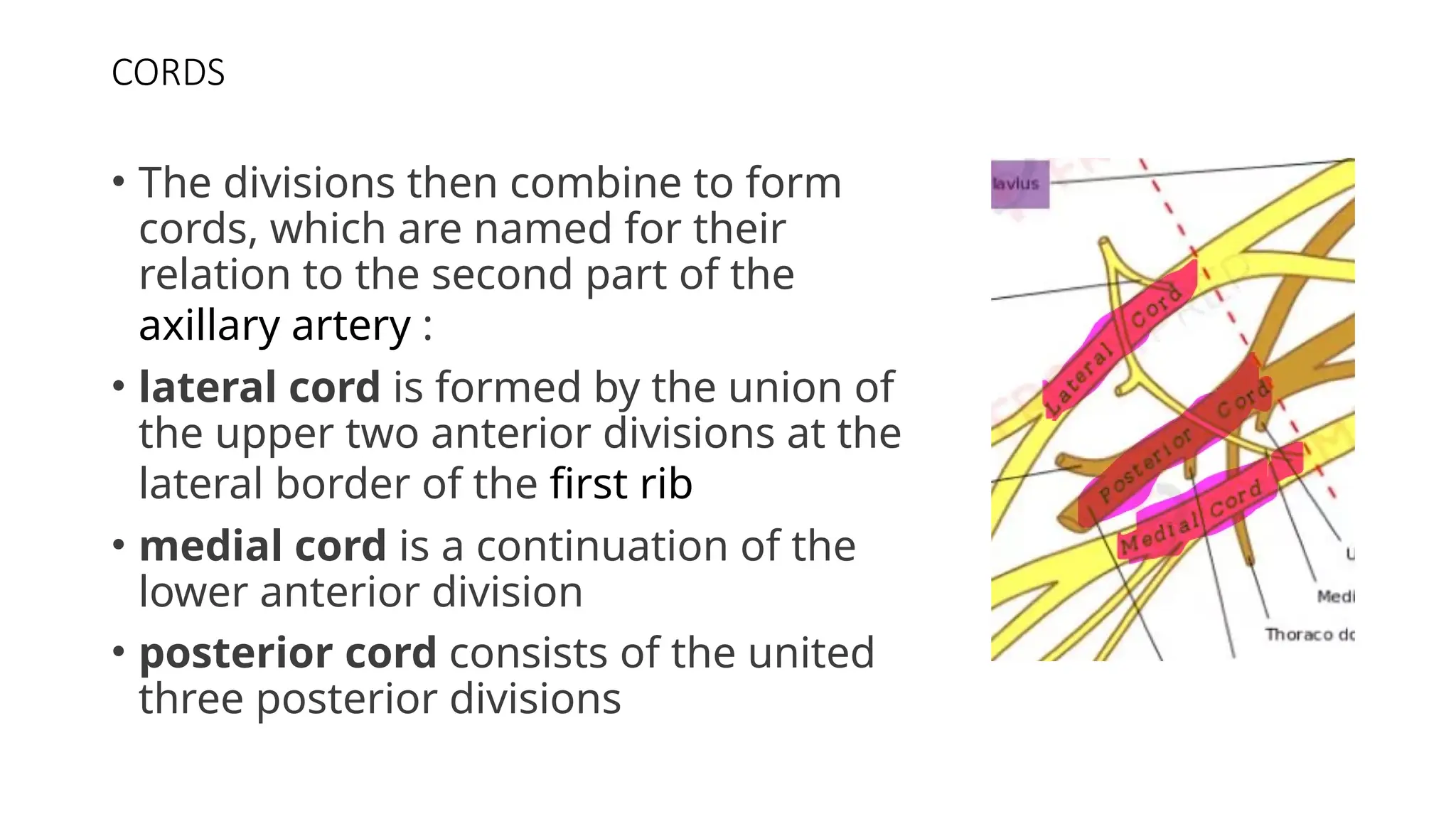
CORDS
• The divisions then combine to form
cords, which are named for their
relation to the second part of the
axillary artery :
• lateral cord is formed by the union of
the upper two anterior divisions at the
lateral border of the first rib
• medial cord is a continuation of the
lower anterior division
• posterior cord consists of the united
three posterior divisions
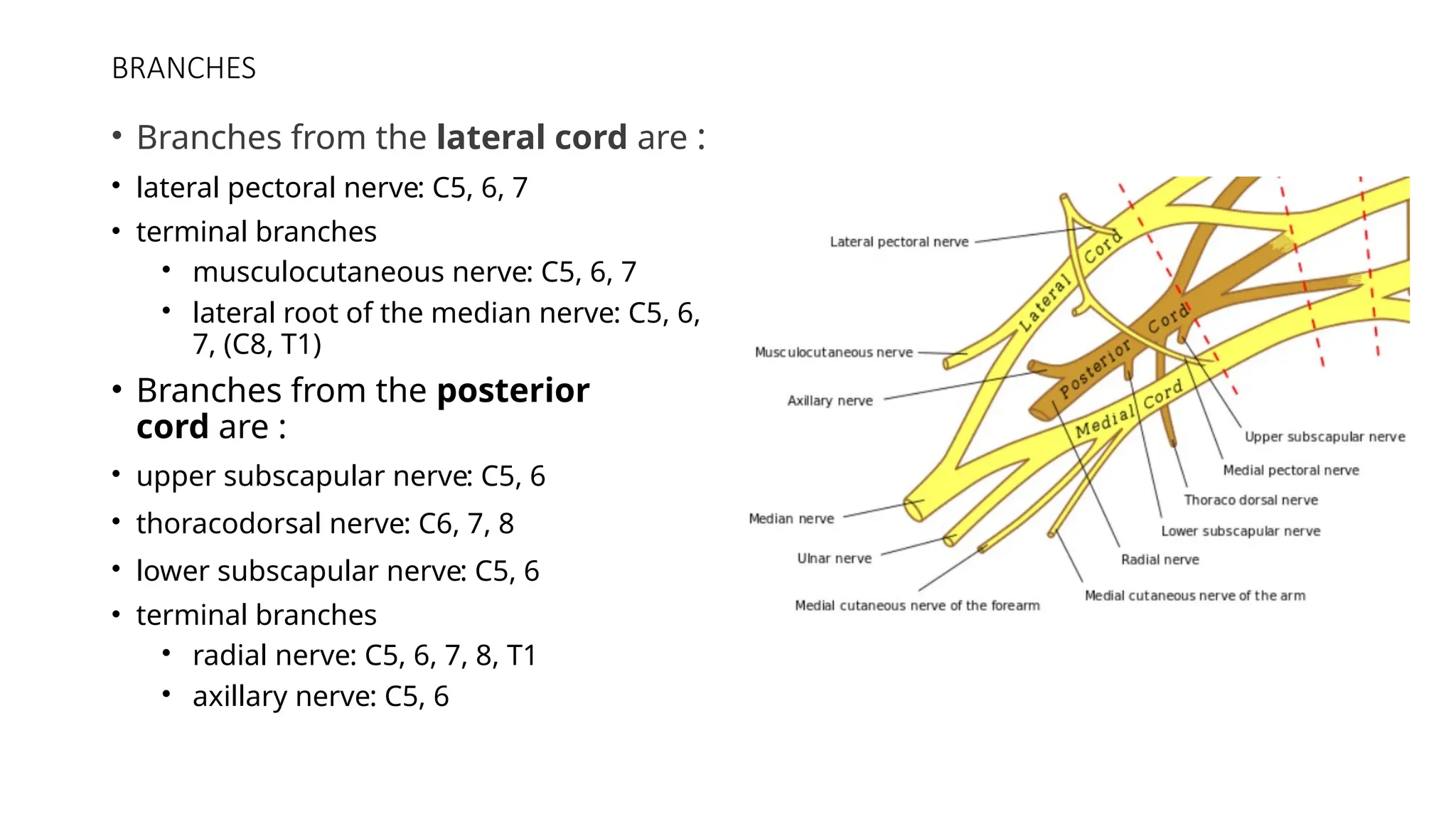
BRANCHES
• Branches from the lateral cord are :
• lateral pectoral nerve: C5, 6, 7
• terminal branches
• musculocutaneous nerve: C5, 6, 7
• lateral root of the median nerve: C5, 6,
7, (C8, T1)
• Branches from the posterior
cord are :
• upper subscapular nerve: C5, 6
• thoracodorsal nerve: C6, 7, 8
• lower subscapular nerve: C5, 6
• terminal branches
• radial nerve: C5, 6, 7, 8, T1
• axillary nerve: C5, 6
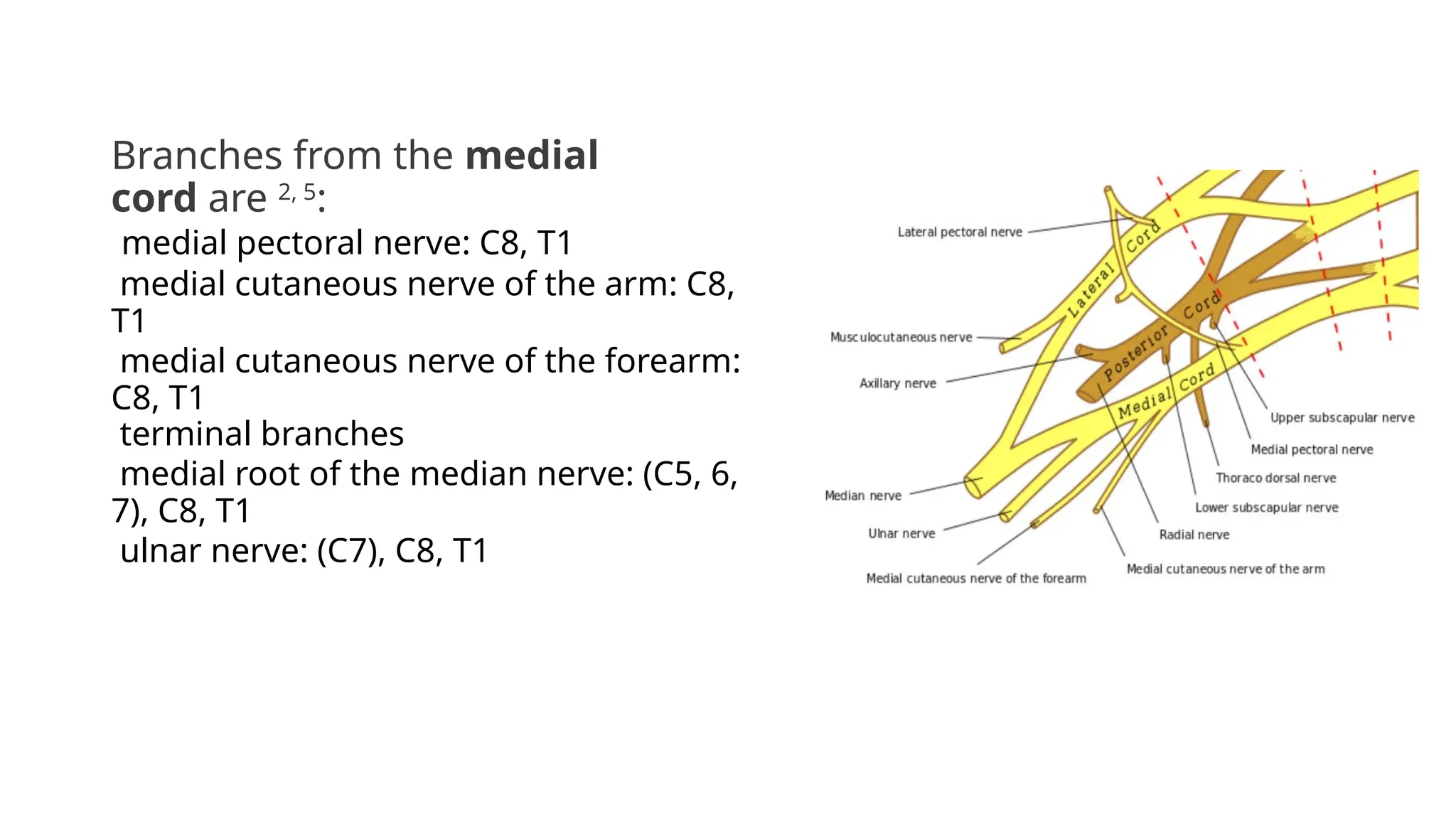
Branches from the medial
cord are 2, 5
:
medial pectoral nerve: C8, T1
medial cutaneous nerve of the arm: C8,
T1
medial cutaneous nerve of the forearm:
C8, T1
terminal branches
medial root of the median nerve: (C5, 6,
7), C8, T1
ulnar nerve: (C7), C8, T1
BLOOD SUPPLY OF BRACHIAL PLEXUS
• Vertebral artery and thyrocervical trunk with its branches, the
suprascapular and transverse cervical arteries, supply blood to the
brachial plexus
THANK
YOU

BRACHIAL PLEXUS - By Abhinav Tyagi.pptx anatomy

  • 1.
    BRACHIAL PLEXUS By AbhinavTyagi Roll No. -1
  • 2.
    CONTENTS • What isbrachial plexus? • Diagram • Origin • Roots • Trunks • Divisions • Cords • Branches • Blood supply of brachial plexus
  • 3.
    What is BrachialPlexus? The brachial plexus is a major network of nerves transmitting signals responsible for motor and sensory innervation of the upper extremities, including the shoulder, arm, and hands. The Plexus consists of roots, trunks, divisions, cords and branches
  • 4.
  • 5.
    ORIGIN • It originatesfrom the ventral primary rami of C5-C8 and T1 segments of spinal cord. • The origin of the plexus may shift by one segment either upward or downward resulting in a prefixed or postfixed plexus. • In prefixed plexus, the contributions by C4 is large and C5 is present, T1 is small and T2 is absent. • In postfixed plexus, the contribution by T1 is large, T2 is always present, C4 is absent and C5 is reduced in size.
  • 6.
    ROOTS • Roots areformed between the scalenus anterior and scalenus medius muscles by the anterior rami of C5-C8 and T1 nerve roots. • Three branches arise from the roots directly : • dorsal scapular nerve: arises from the posterior aspect of the C5 root and supplies the rhomboids. • subclavian nerve: arises from the C5 and C6 roots anteriorly to supply subclavius. • long thoracic nerve: arises from the posterior aspects of C5-C7 and supplies serratus anterior.
  • 7.
    TRUNKS • Trunks formfrom the roots as they pass between scalenus anterior and medius muscles, then go on to traverse the posterior triangle • C5 and C6 roots combine to form the upper trunk • C7 root makes up the middle trunk • C8 and T1 roots combine to form the lower trunk • Two branches arises from the trunks: suprascapular nerve: arises from the upper trunk and supplies the supraspinatus and infraspinatus muscles • Nerve to Subclavius: It arises from upper trunk and supplies the subclavius muscle
  • 8.
    DIVISIONS • Each trunkdivides to form an anterior and posterior division posterior to the mid clavicle. • In general anterior divisions supply muscles of the anterior compartments (flexors) whereas the posterior divisions supply muscles of the posterior compartments (extensors) • No branches arise from the divisions.
  • 9.
    CORDS • The divisionsthen combine to form cords, which are named for their relation to the second part of the axillary artery : • lateral cord is formed by the union of the upper two anterior divisions at the lateral border of the first rib • medial cord is a continuation of the lower anterior division • posterior cord consists of the united three posterior divisions
  • 10.
    BRANCHES • Branches fromthe lateral cord are : • lateral pectoral nerve: C5, 6, 7 • terminal branches • musculocutaneous nerve: C5, 6, 7 • lateral root of the median nerve: C5, 6, 7, (C8, T1) • Branches from the posterior cord are : • upper subscapular nerve: C5, 6 • thoracodorsal nerve: C6, 7, 8 • lower subscapular nerve: C5, 6 • terminal branches • radial nerve: C5, 6, 7, 8, T1 • axillary nerve: C5, 6
  • 11.
    Branches from themedial cord are 2, 5 : medial pectoral nerve: C8, T1 medial cutaneous nerve of the arm: C8, T1 medial cutaneous nerve of the forearm: C8, T1 terminal branches medial root of the median nerve: (C5, 6, 7), C8, T1 ulnar nerve: (C7), C8, T1
  • 12.
    BLOOD SUPPLY OFBRACHIAL PLEXUS • Vertebral artery and thyrocervical trunk with its branches, the suprascapular and transverse cervical arteries, supply blood to the brachial plexus
  • 13.