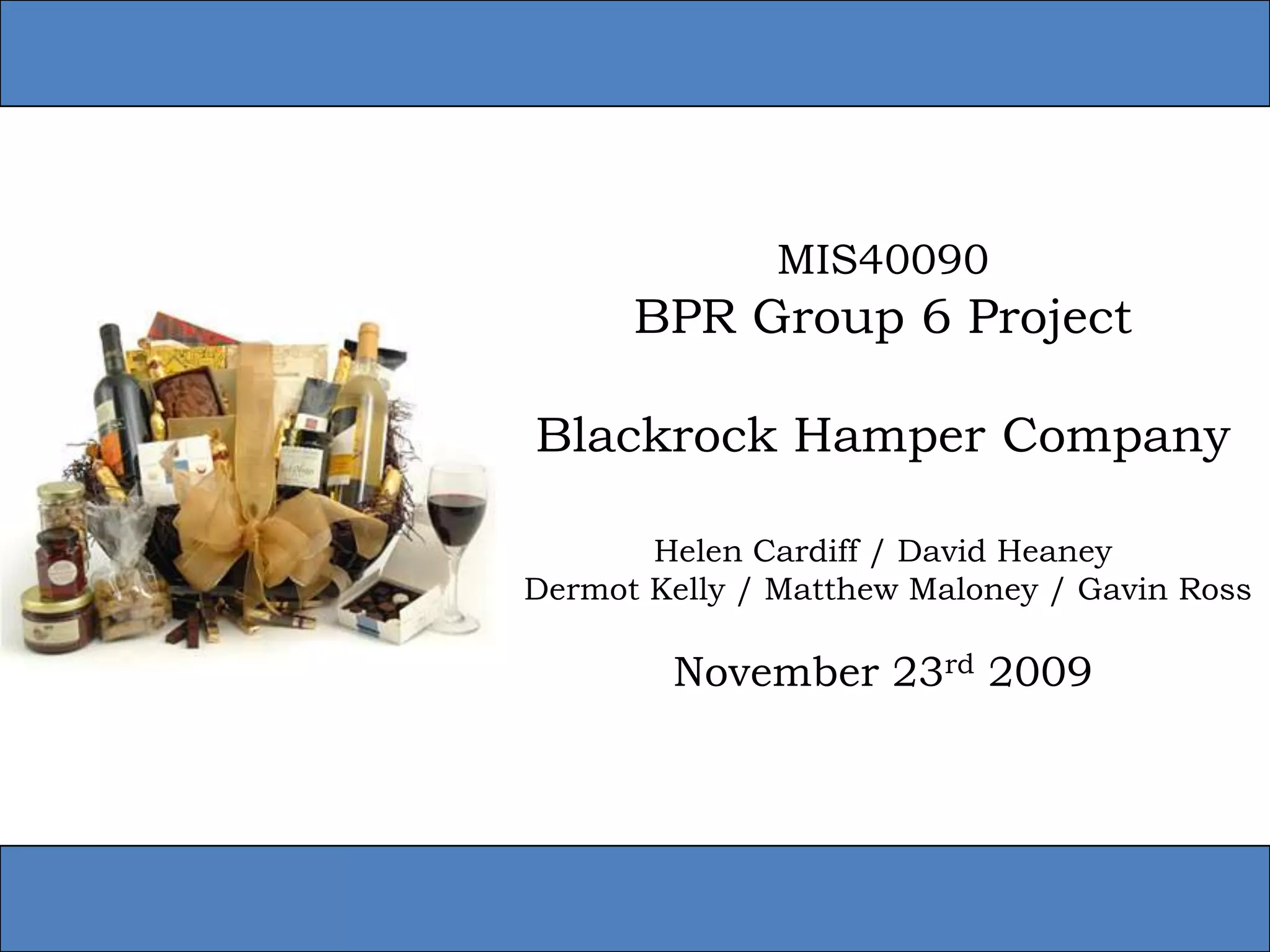
MIS40090BPR Group 6 Project Blackrock Hamper CompanyHelen Cardiff / David Heaney Dermot Kelly / Matthew Maloney / Gavin Ross November 23rd 2009
IntroductionProject Overview(a) Client Profile(b) Drivers of BPR Project. Why Now?(c) Project Aims(d) Specific TargetsProject Scope & StakeholdersMethodologyProcess - Order Taking – As-Is & To-BeProcess - Order Fulfilment – As-Is & To-BeTechnology RequirementsImpact on PeopleBPR Project RisksImplementation PlanBusiness Case SavingQuestions & Answers
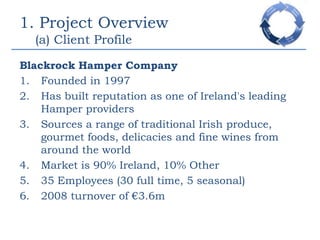
1. Project Overview    (a) Client ProfileBlackrock Hamper CompanyFounded in 1997Has built reputation as one of Ireland's leading Hamper providersSources a range of traditional Irish produce, gourmet foods, delicacies and fine wines from around the worldMarket is 90% Ireland, 10% Other35 Employees (30 full time, 5 seasonal)2008 turnover of €3.6m
1. Project Overview     (b) Drivers of BPR project. Why now?Founded as a small “mom and pop” operationRapid growth has left it with a lot of legacy systems and manual processes which evolved on an ad hoc basis over the years. As sales and staff numbers have grown, the inefficiencies produced by the current processes become ever more apparentManagement finally convinced that a radical redesign of the firms processes was required in order to support its future expansion strategy which allows customers to create their own personalised hampers by choosing from a range of quality wines, spirits, chocolates and food
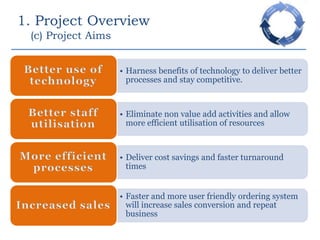
1. Project Overview     (c) Project Aims
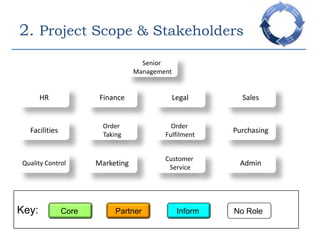
2. Project Scope & StakeholdersSenior ManagementHRFinanceSalesLegalFacilitiesOrder FulfilmentPurchasingOrder TakingAdminCustomer ServiceQuality ControlMarketingKey:Core PartnerInform No Role
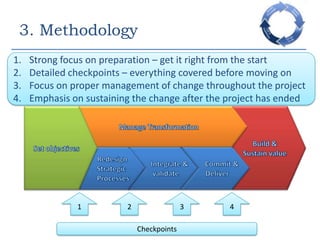
Three-stage process: Preparation, Transformation, ConsolidationBuild &Sustain value3. MethodologyStrong focus on preparation – get it right from the startDetailed checkpoints – everything covered before moving onFocus on proper management of change throughout the projectEmphasis on sustaining the change after the project has ended   Manage Transformation  Set objectivesIntegrate &   validateCommit &  DeliverRedesign   Strategic     Processes1234Checkpoints
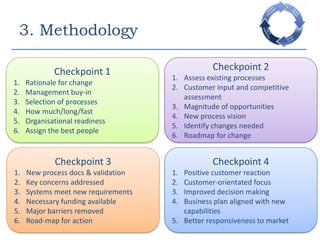
3. MethodologyCheckpoint 1Rationale for changeManagement buy-inSelection of processesHow much/long/fastOrganisational readinessAssign the best peopleCheckpoint 2Assess existing processesCustomer input and competitive assessmentMagnitude of opportunitiesNew process visionIdentify changes neededRoadmap for change Checkpoint 3New process docs & validationKey concerns addressedSystems meet new requirementsNecessary funding availableMajor barriers removedRoad-map for actionCheckpoint 4Positive customer reactionCustomer-orientated focusImproved decision makingBusiness plan aligned with new capabilitiesBetter responsiveness to market
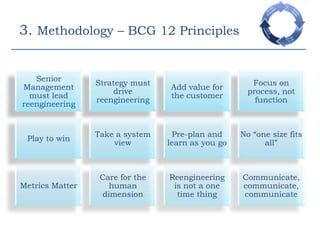
3. Methodology – BCG 12 Principles
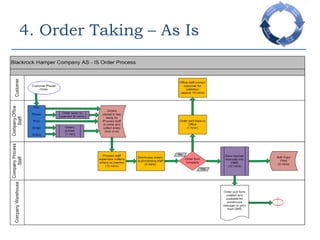
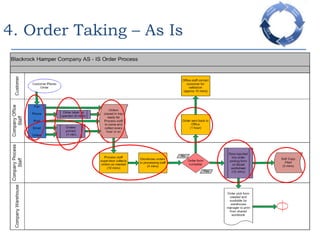
4. Order Taking – As IsTechniques Used– Observed & recorded staff’s daily routines & procedures	– Interviewed supervisors, managers, selected staff	 – Benchmarking	– Staff focus groups	– Resulted in the development of the ‘As-Is’ Process Map
4. Order Taking – As Is
4. Order Taking – As IsResults FoundProcesses	No specific order taking process, very messy. OMS only being used for online paymentOrders not validated and checked in officeNon value adding proceduresToo much time spent on manual tasksCurrent OMS not being used to full potential Inefficient process overallPeopleLack of communication and coordinationNot customer focusedStaff stuck in old established routinesTechnologyLimited use of technologyCurrent OMS not being used to full potential
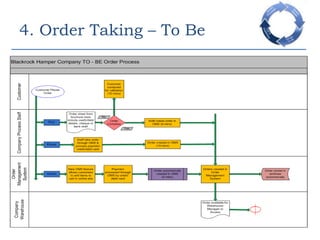
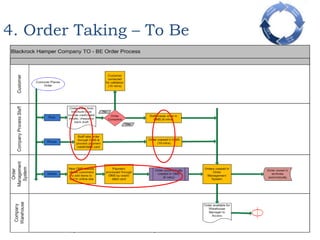
4. Order Taking – To Be
4. Order Taking – To BeResults FoundProcesses	Office staff no longer involved in the processProcess staff validate, process payment and create orders in new Orderwise OMS software, which has been integrated with old OMSOnline validation ensures orders are correct and they are created in OMS instantlyOrder taking process time reduced by up to 1 hour and 20 minutesAutomated system has reduced manual tasks PeopleOffice staff return to focus on core tasks and also deployed in value adding activities elsewhereNew clearer job roles Customer focusedVery coordinatedTechnologyOrderwise Order Management System implementedOnly manual task is inputting data into OMS to create orders from postal & phone ordersNew system has eliminated many of the old manual tasks
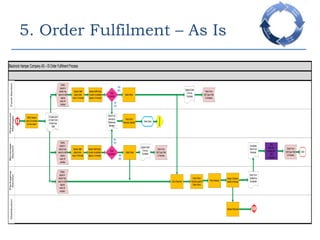
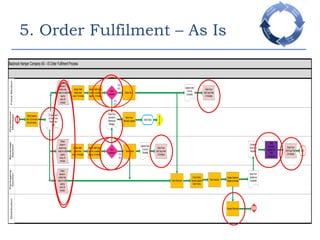
5. Order Fulfilment – As IsTechniques Used– Observed & Recorded Staff’s Daily Routines & Procedures	– Interview’s		- Warehouse Manager 		- Selected Staff	– Group Workshops		- Initial 		- Development of the ‘As-Is’ Process Map		- 2nd Round		- Signed Off
5. Order Fulfilment – As Is
5. Order Fulfilment – As IsResults FoundProcess	• Identified Potential Bottlenecks	• Identified Excessive Handoffs	• Identified Process Delays by using Process Metrics	• Identified Lack of Single Control & Audit Point 	• Identified Non-Value and Value Adding StepsPeople		•No Staff Empowerment		•Not Customer Focused		•Each Section Worked in IsolationTechnology		•Insufficient use of Technology
5. Order Fulfilment – To Be
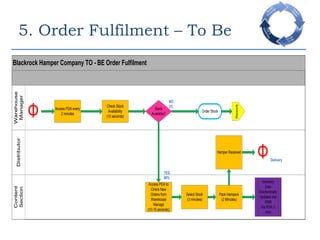
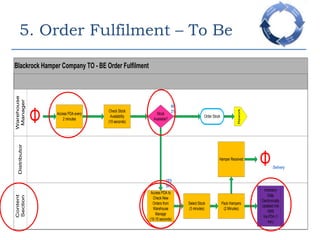
5. Order Fulfilment – To BeResults Found- ProcessAmalgamated 3 Sections into 1.
Automated System has Eliminated Bottlenecks and Manual Tasks.
Reduced Process Delays.
More Efficient Process with a 30 minute saving.- PeopleMore Responsibility.
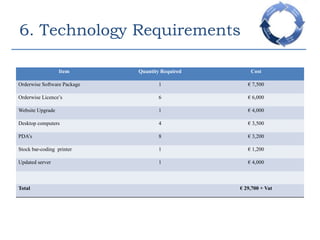
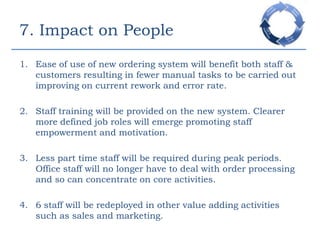
More Involved in Value Adding Procedures.- TechnologyEnabled Better Communication & Inventory Replenishment.6. Technology RequirementsCreate a more efficient customer focused ordering, payment and product fulfilment process. Improve warehouse performance. Provide an efficient end to end automated and accountable stock management system.Provide internal company visibility by integrating the new system with existing technology where possible. Capture of customer details for future marketing campaigns.Provide a supplier compatible system.
6. Technology Requirements
7. Impact on PeopleEase of use of new ordering system will benefit both staff & customers resulting in fewer manual tasks to be carried out improving on current rework and error rate. Staff training will be provided on the new system. Clearer more defined job roles will emerge promoting staff empowerment and motivation. Less part time staff will be required during peak periods. Office staff will no longer have to deal with order processing and so can concentrate on core activities.6 staff will be redeployed in other value adding activities such as sales and marketing.
8. BPR Project RisksPeople

Bpr Presentation 21 Nov

  • 1.
    MIS40090BPR Group 6Project Blackrock Hamper CompanyHelen Cardiff / David Heaney Dermot Kelly / Matthew Maloney / Gavin Ross November 23rd 2009
  • 2.
    IntroductionProject Overview(a) ClientProfile(b) Drivers of BPR Project. Why Now?(c) Project Aims(d) Specific TargetsProject Scope & StakeholdersMethodologyProcess - Order Taking – As-Is & To-BeProcess - Order Fulfilment – As-Is & To-BeTechnology RequirementsImpact on PeopleBPR Project RisksImplementation PlanBusiness Case SavingQuestions & Answers
  • 3.
    1. Project Overview (a) Client ProfileBlackrock Hamper CompanyFounded in 1997Has built reputation as one of Ireland's leading Hamper providersSources a range of traditional Irish produce, gourmet foods, delicacies and fine wines from around the worldMarket is 90% Ireland, 10% Other35 Employees (30 full time, 5 seasonal)2008 turnover of €3.6m
  • 4.
    1. Project Overview (b) Drivers of BPR project. Why now?Founded as a small “mom and pop” operationRapid growth has left it with a lot of legacy systems and manual processes which evolved on an ad hoc basis over the years. As sales and staff numbers have grown, the inefficiencies produced by the current processes become ever more apparentManagement finally convinced that a radical redesign of the firms processes was required in order to support its future expansion strategy which allows customers to create their own personalised hampers by choosing from a range of quality wines, spirits, chocolates and food
  • 5.
    1. Project Overview (c) Project Aims
  • 6.
    2. Project Scope& StakeholdersSenior ManagementHRFinanceSalesLegalFacilitiesOrder FulfilmentPurchasingOrder TakingAdminCustomer ServiceQuality ControlMarketingKey:Core PartnerInform No Role
  • 7.
    Three-stage process: Preparation,Transformation, ConsolidationBuild &Sustain value3. MethodologyStrong focus on preparation – get it right from the startDetailed checkpoints – everything covered before moving onFocus on proper management of change throughout the projectEmphasis on sustaining the change after the project has ended Manage Transformation Set objectivesIntegrate & validateCommit & DeliverRedesign Strategic Processes1234Checkpoints
  • 8.
    3. MethodologyCheckpoint 1Rationalefor changeManagement buy-inSelection of processesHow much/long/fastOrganisational readinessAssign the best peopleCheckpoint 2Assess existing processesCustomer input and competitive assessmentMagnitude of opportunitiesNew process visionIdentify changes neededRoadmap for change Checkpoint 3New process docs & validationKey concerns addressedSystems meet new requirementsNecessary funding availableMajor barriers removedRoad-map for actionCheckpoint 4Positive customer reactionCustomer-orientated focusImproved decision makingBusiness plan aligned with new capabilitiesBetter responsiveness to market
  • 9.
    3. Methodology –BCG 12 Principles
  • 10.
    4. Order Taking– As IsTechniques Used– Observed & recorded staff’s daily routines & procedures – Interviewed supervisors, managers, selected staff – Benchmarking – Staff focus groups – Resulted in the development of the ‘As-Is’ Process Map
  • 11.
  • 12.
    4. Order Taking– As IsResults FoundProcesses No specific order taking process, very messy. OMS only being used for online paymentOrders not validated and checked in officeNon value adding proceduresToo much time spent on manual tasksCurrent OMS not being used to full potential Inefficient process overallPeopleLack of communication and coordinationNot customer focusedStaff stuck in old established routinesTechnologyLimited use of technologyCurrent OMS not being used to full potential
  • 13.
  • 14.
    4. Order Taking– To BeResults FoundProcesses Office staff no longer involved in the processProcess staff validate, process payment and create orders in new Orderwise OMS software, which has been integrated with old OMSOnline validation ensures orders are correct and they are created in OMS instantlyOrder taking process time reduced by up to 1 hour and 20 minutesAutomated system has reduced manual tasks PeopleOffice staff return to focus on core tasks and also deployed in value adding activities elsewhereNew clearer job roles Customer focusedVery coordinatedTechnologyOrderwise Order Management System implementedOnly manual task is inputting data into OMS to create orders from postal & phone ordersNew system has eliminated many of the old manual tasks
  • 15.
    5. Order Fulfilment– As IsTechniques Used– Observed & Recorded Staff’s Daily Routines & Procedures – Interview’s - Warehouse Manager - Selected Staff – Group Workshops - Initial - Development of the ‘As-Is’ Process Map - 2nd Round - Signed Off
  • 16.
  • 17.
    5. Order Fulfilment– As IsResults FoundProcess • Identified Potential Bottlenecks • Identified Excessive Handoffs • Identified Process Delays by using Process Metrics • Identified Lack of Single Control & Audit Point • Identified Non-Value and Value Adding StepsPeople •No Staff Empowerment •Not Customer Focused •Each Section Worked in IsolationTechnology •Insufficient use of Technology
  • 18.
  • 19.
    5. Order Fulfilment– To BeResults Found- ProcessAmalgamated 3 Sections into 1.
  • 20.
    Automated System hasEliminated Bottlenecks and Manual Tasks.
  • 21.
  • 22.
    More Efficient Processwith a 30 minute saving.- PeopleMore Responsibility.
  • 23.
    More Involved inValue Adding Procedures.- TechnologyEnabled Better Communication & Inventory Replenishment.6. Technology RequirementsCreate a more efficient customer focused ordering, payment and product fulfilment process. Improve warehouse performance. Provide an efficient end to end automated and accountable stock management system.Provide internal company visibility by integrating the new system with existing technology where possible. Capture of customer details for future marketing campaigns.Provide a supplier compatible system.
  • 24.
  • 25.
  • 26.
    7. Impact onPeopleEase of use of new ordering system will benefit both staff & customers resulting in fewer manual tasks to be carried out improving on current rework and error rate. Staff training will be provided on the new system. Clearer more defined job roles will emerge promoting staff empowerment and motivation. Less part time staff will be required during peak periods. Office staff will no longer have to deal with order processing and so can concentrate on core activities.6 staff will be redeployed in other value adding activities such as sales and marketing.
  • 27.
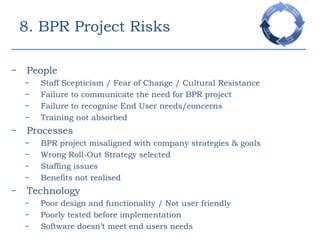
    8. BPR ProjectRisksPeople

Editor's Notes

  • #8 The integrate and validate section is basically checking that what has been developed in the redesign phase is achievable, that is meets all the needs of the client, is realistic, is possible within the budget, does not face any big barriers and that that the plan for implementation is in place and agreed.
  • #26 show checkpoints, show how we will sustain change after implementation