Site Contribution and Value Analysis
August 2016
1
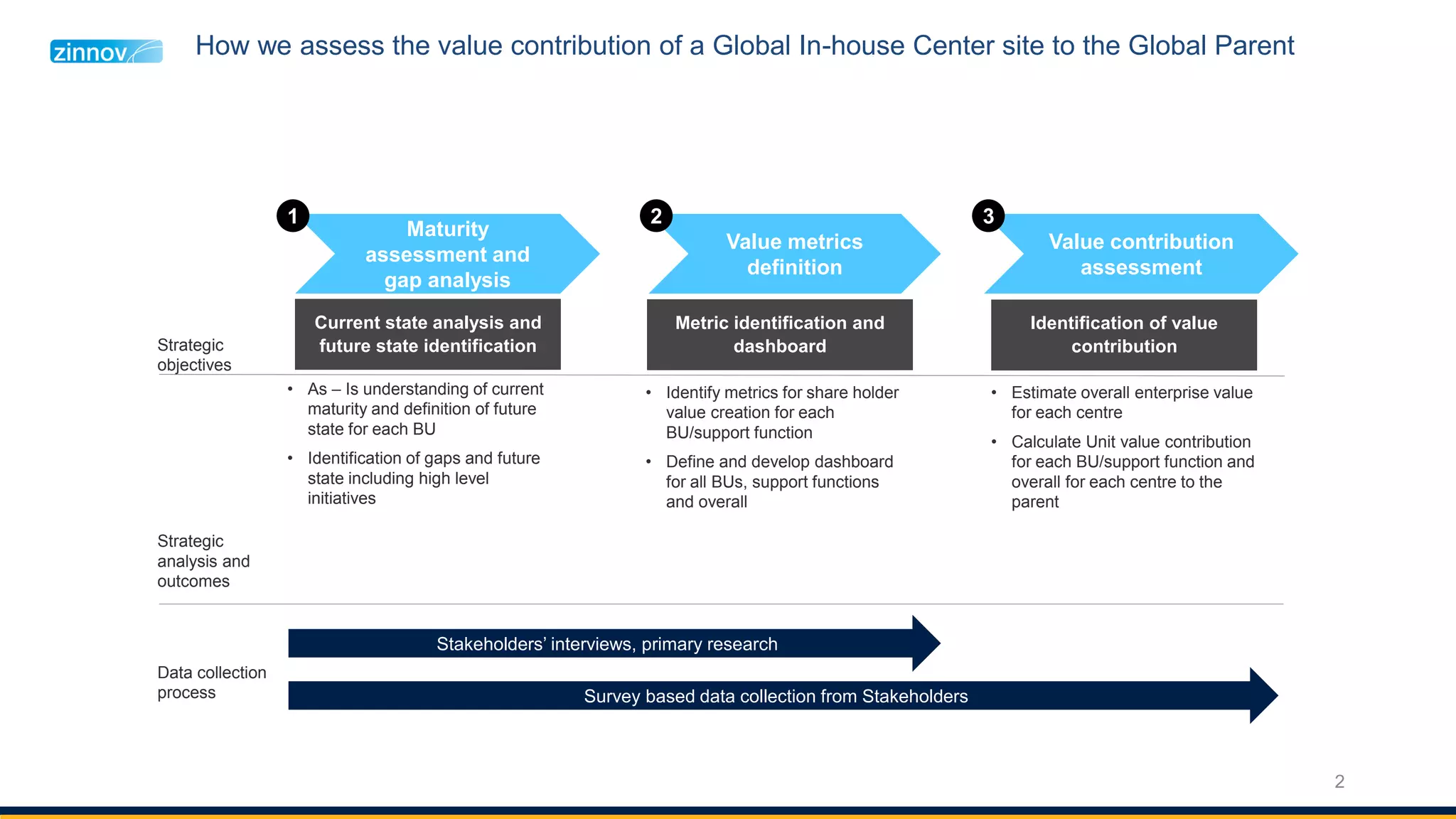
2
Maturity
assessment and
gap analysis
Value metrics
definition
Value contribution
assessment
Strategic
analysis and
outcomes
Data collection
process
Strategic
objectives
Current state analysis and
future state identification
• As – Is understanding of current
maturity and definition of future
state for each BU
• Identification of gaps and future
state including high level
initiatives
Stakeholders’ interviews, primary research
Survey based data collection from Stakeholders
Metric identification and
dashboard
• Identify metrics for share holder
value creation for each
BU/support function
• Define and develop dashboard
for all BUs, support functions
and overall
Identification of value
contribution
• Estimate overall enterprise value
for each centre
• Calculate Unit value contribution
for each BU/support function and
overall for each centre to the
parent
1 2 3
How we assess the value contribution of a Global In-house Center site to the Global Parent
3
Maturity Assessment
4
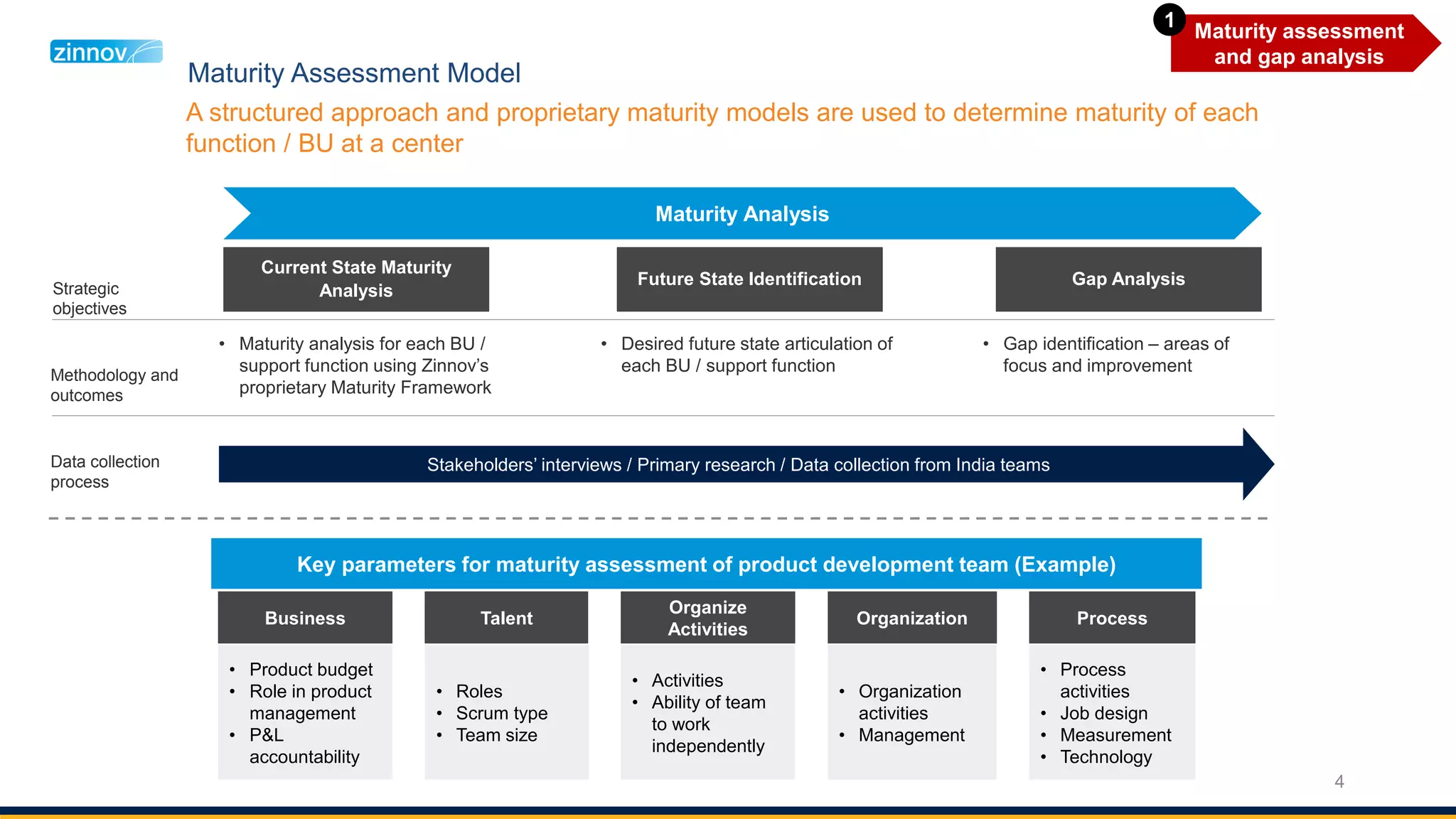
Maturity Assessment Model
A structured approach and proprietary maturity models are used to determine maturity of each
function / BU at a center
Methodology and
outcomes
Data collection
process
Stakeholders’ interviews / Primary research / Data collection from India teams
Maturity Analysis
Strategic
objectives
• Maturity analysis for each BU /
support function using Zinnov’s
proprietary Maturity Framework
Current State Maturity
Analysis
• Desired future state articulation of
each BU / support function
Future State Identification
• Gap identification – areas of
focus and improvement
Gap Analysis
Maturity assessment
and gap analysis
1
Key parameters for maturity assessment of product development team (Example)
Business Talent Organization Process
• Product budget
• Role in product
management
• P&L
accountability
• Roles
• Scrum type
• Team size
• Activities
• Ability of team
to work
independently
• Organization
activities
• Management
• Process
activities
• Job design
• Measurement
• Technology
Organize
Activities
Maturity assessment
4321 5
Organization
Talent
Organize activities
Process
Business
Current maturity level Desired maturity level within 2-3 years Current state same as desired state
Desired StateCurrent state
• Assists in creating product roadmap
BUSINESS
TALENT
• Significantly influence the product road map, strategy, budget
ORGANIZE ACTIVITIES
ORGANIZATION
• Development, QA, release managers, product managers • Executive leadership from India
• Activities include conceptualization, design, development, testing
and release.
• User experience for the product.
• Activities include conceptualization, design, development, testing
and release.
• User experience for the product
• Structure for assessing ideas
• Product managers defined
• Common portal for submitting of ideas. Unbiased evaluation by
top management
• Project managers responsible for P&L
• Resource allocation is coordinated
• Some repetitive tasks have been automated
• Prioritized resource allocation
• All repetitive tasks automated
PROCESS
5
Maturity assessment
and gap analysis
1
Maturity Assessment
6
Value Metric Definition
7
Value Metrics
definition
2
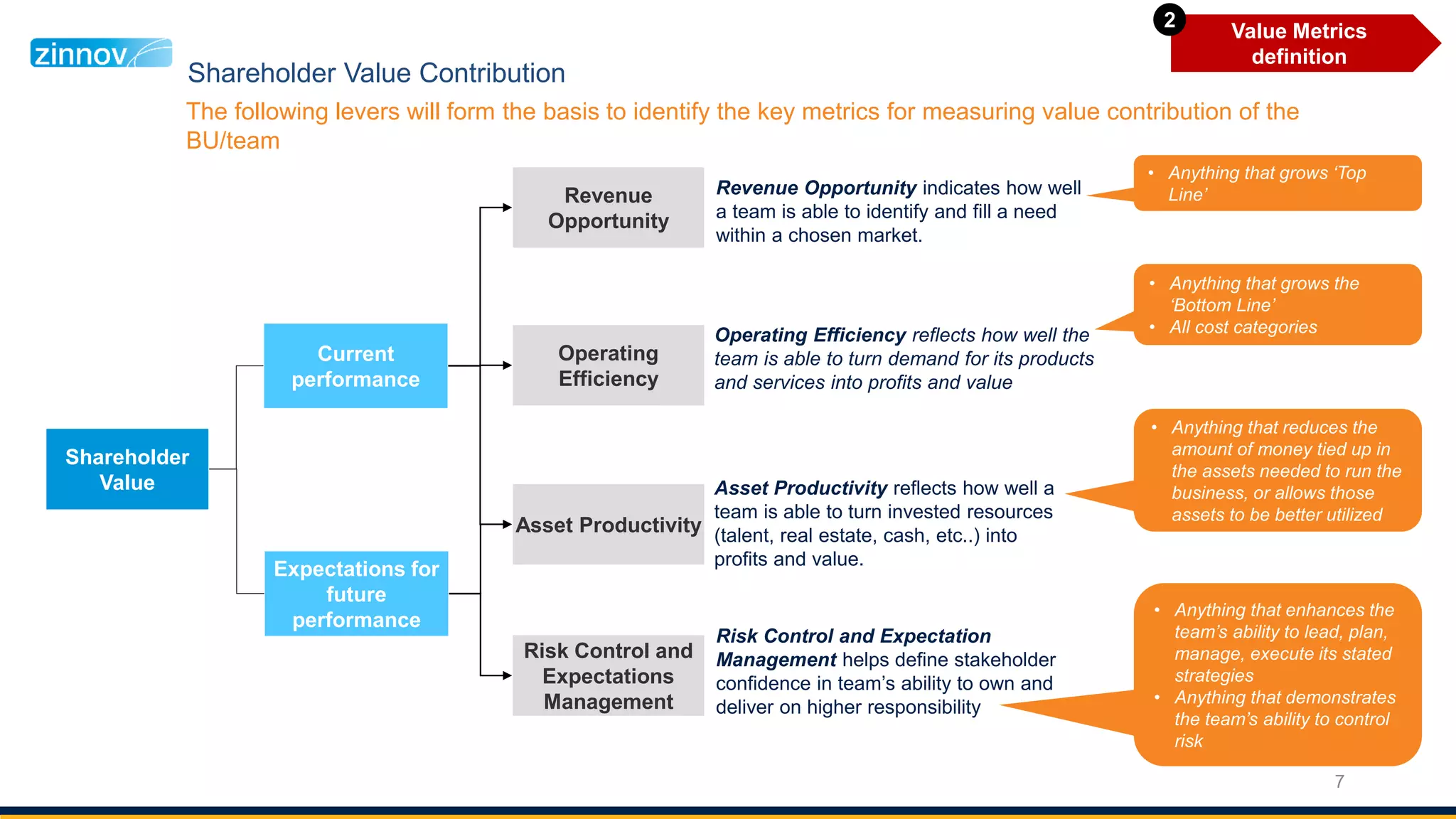
Revenue Opportunity indicates how well
a team is able to identify and fill a need
within a chosen market.
Operating Efficiency reflects how well the
team is able to turn demand for its products
and services into profits and value
Risk Control and Expectation
Management helps define stakeholder
confidence in team’s ability to own and
deliver on higher responsibility
Shareholder
Value
Revenue
Opportunity
Operating
Efficiency
Asset Productivity
Risk Control and
Expectations
Management
• Anything that grows ‘Top
Line’
• Anything that grows the
‘Bottom Line’
• All cost categories
• Anything that reduces the
amount of money tied up in
the assets needed to run the
business, or allows those
assets to be better utilized
• Anything that enhances the
team’s ability to lead, plan,
manage, execute its stated
strategies
• Anything that demonstrates
the team’s ability to control
risk
Asset Productivity reflects how well a
team is able to turn invested resources
(talent, real estate, cash, etc..) into
profits and value.
Current
performance
Expectations for
future
performance
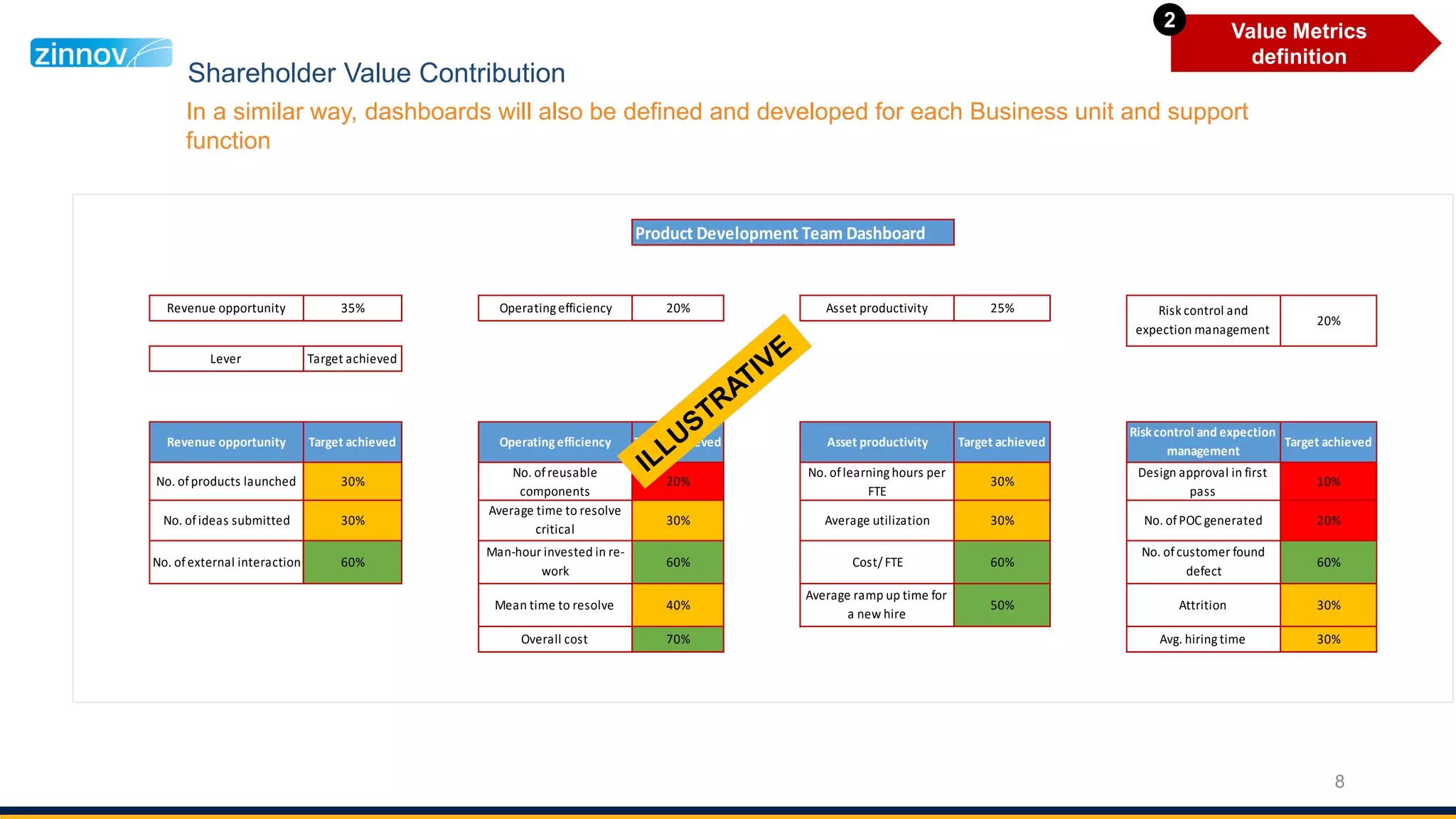
Shareholder Value Contribution
The following levers will form the basis to identify the key metrics for measuring value contribution of the
BU/team
Product Development Team Dashboard
35% 20% 25%
Target achieved
Target achieved Target achieved Target achieved Target achieved
30% 20% 30% 10%
30% 30% 30% 20%
60% 60% 60% 60%
40% 50% 30%
70% 30%
Mean time to resolve
Overall cost
Average ramp up time for
a new hire
Attrition
Avg. hiring time
Asset productivity
No. oflearning hours per
FTE
Average utilization
Cost/ FTE
Riskcontrol and expection
management
Design approval in first
pass
No. ofPOC generated
No. ofcustomer found
defect
Lever
Revenue opportunity
No. ofproducts launched
No. ofideas submitted
No. ofexternal interaction
Operating efficiency
No. ofreusable
components
Average time to resolve
critical
Man-hour invested in re-
work
Revenue opportunity Operating efficiency Asset productivity Risk control and
expection management
20%
8
Value Metrics
definition
2
Shareholder Value Contribution
In a similar way, dashboards will also be defined and developed for each Business unit and support
function
9
Shareholder Value Creation - Metrics
10
Individual Centre’s Value Contribution Analysis
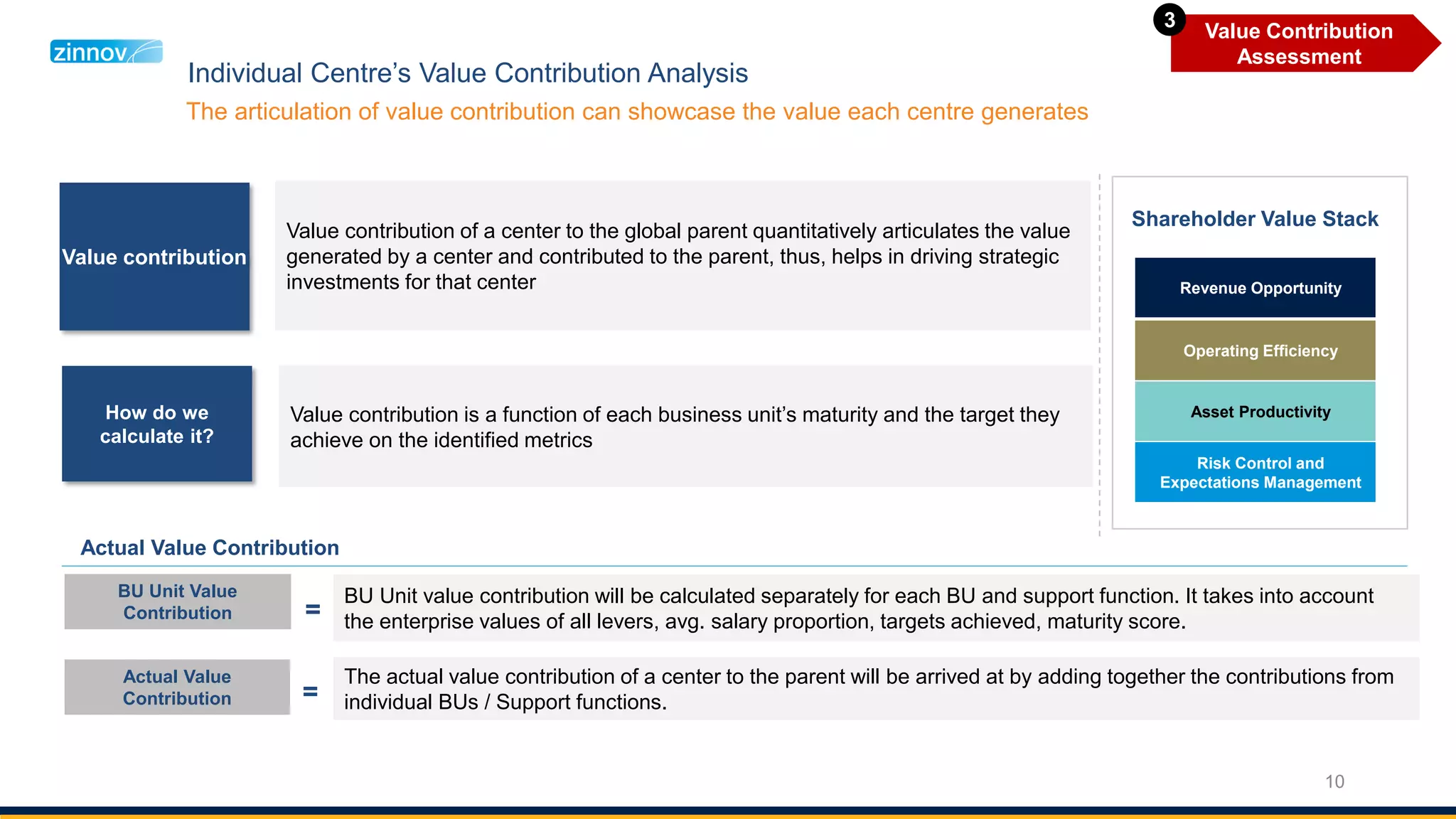
The articulation of value contribution can showcase the value each centre generates
Value Contribution
Assessment
3
How do we
calculate it?
Revenue Opportunity
Operating Efficiency
Asset Productivity
Risk Control and
Expectations Management
Shareholder Value Stack
Actual Value
Contribution
The actual value contribution of a center to the parent will be arrived at by adding together the contributions from
individual BUs / Support functions.=
Actual Value Contribution
Value contribution is a function of each business unit’s maturity and the target they
achieve on the identified metrics
BU Unit Value
Contribution =
BU Unit value contribution will be calculated separately for each BU and support function. It takes into account
the enterprise values of all levers, avg. salary proportion, targets achieved, maturity score.
Value contribution
Value contribution of a center to the global parent quantitatively articulates the value
generated by a center and contributed to the parent, thus, helps in driving strategic
investments for that center
11
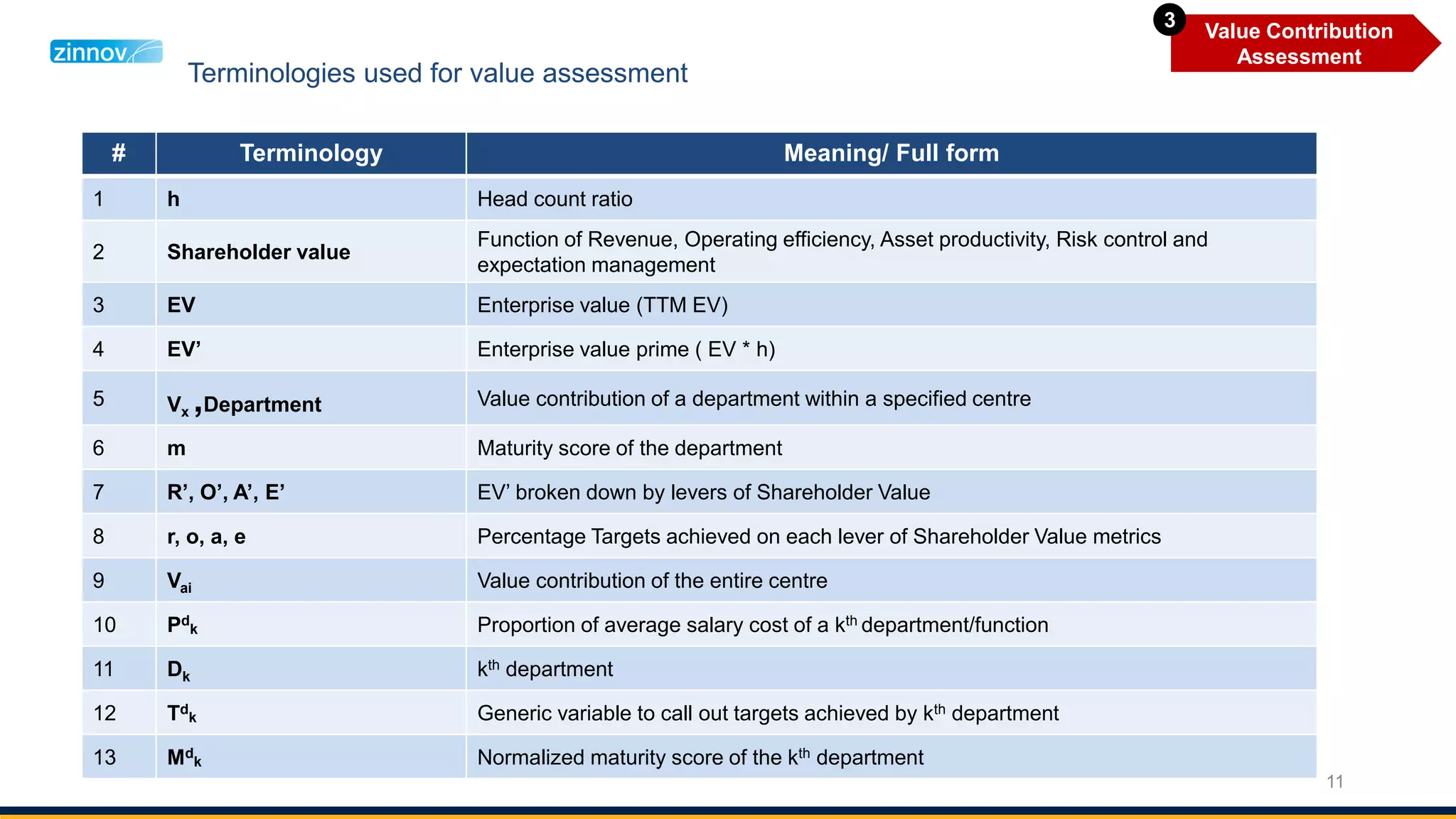
Terminologies used for value assessment
Value Contribution
Assessment
3
# Terminology Meaning/ Full form
1 h Head count ratio
2 Shareholder value
Function of Revenue, Operating efficiency, Asset productivity, Risk control and
expectation management
3 EV Enterprise value (TTM EV)
4 EV’ Enterprise value prime ( EV * h)
5 Vx ,Department Value contribution of a department within a specified centre
6 m Maturity score of the department
7 R’, O’, A’, E’ EV’ broken down by levers of Shareholder Value
8 r, o, a, e Percentage Targets achieved on each lever of Shareholder Value metrics
9 Vai Value contribution of the entire centre
10 Pd
k Proportion of average salary cost of a kth department/function
11 Dk kth department
12 Td
k Generic variable to call out targets achieved by kth department
13 Md
k Normalized maturity score of the kth department
12
Key Facts
• The Shareholder Value = f(Revenue, Operating Efficiency, Asset Productivity, Risk
Control and Expectation Management)
Key ratios
• Headcount ratio (h) = Total number of people in centre ‘X’ / Total number of
employees
Centre ‘X’ Potential Value Contribution
*Note: Potential contribution on each of the lever is arrived at by distributing equally the remainder of potential enterprise value less potential revenue contribution across Operating
Efficiency, Asset Efficiency, Expectations
Centre ‘X’ Value
Contribution
(Vx)
Sum of value contribution of all Centre ‘X’
departments
(∑ Vx,Department)
=
Centre ‘X’ - Potential Enterprise Value
broken by levers of Shareholder Value
(EV’)
Global Average TTM
Enterprise Value (EV)= Headcount Ratio (h)x
Centre ‘X’ Actual Value Contribution
*
• Centre ‘X’ Value Contributions = f(average TTM enterprise value, headcount ratio,
proportion of avg. salary cost, maturity level, and target achieved on metrics)
Centre ‘X’ Dept. Value
Contribution
(Vx,Department)
=
Value Analysis
The value that a centre contributes is a function of average TTM enterprise value, headcount ratio,
maturity level, and the target achieved on metrics
Revenue Opportunity
Operating Efficiency
Asset Productivity
Risk Control and
Expectations Management
Shareholder Value Stack
Value Contribution
Assessment
3
f (EV’, Pd
k , Td
k, Md
k )
13
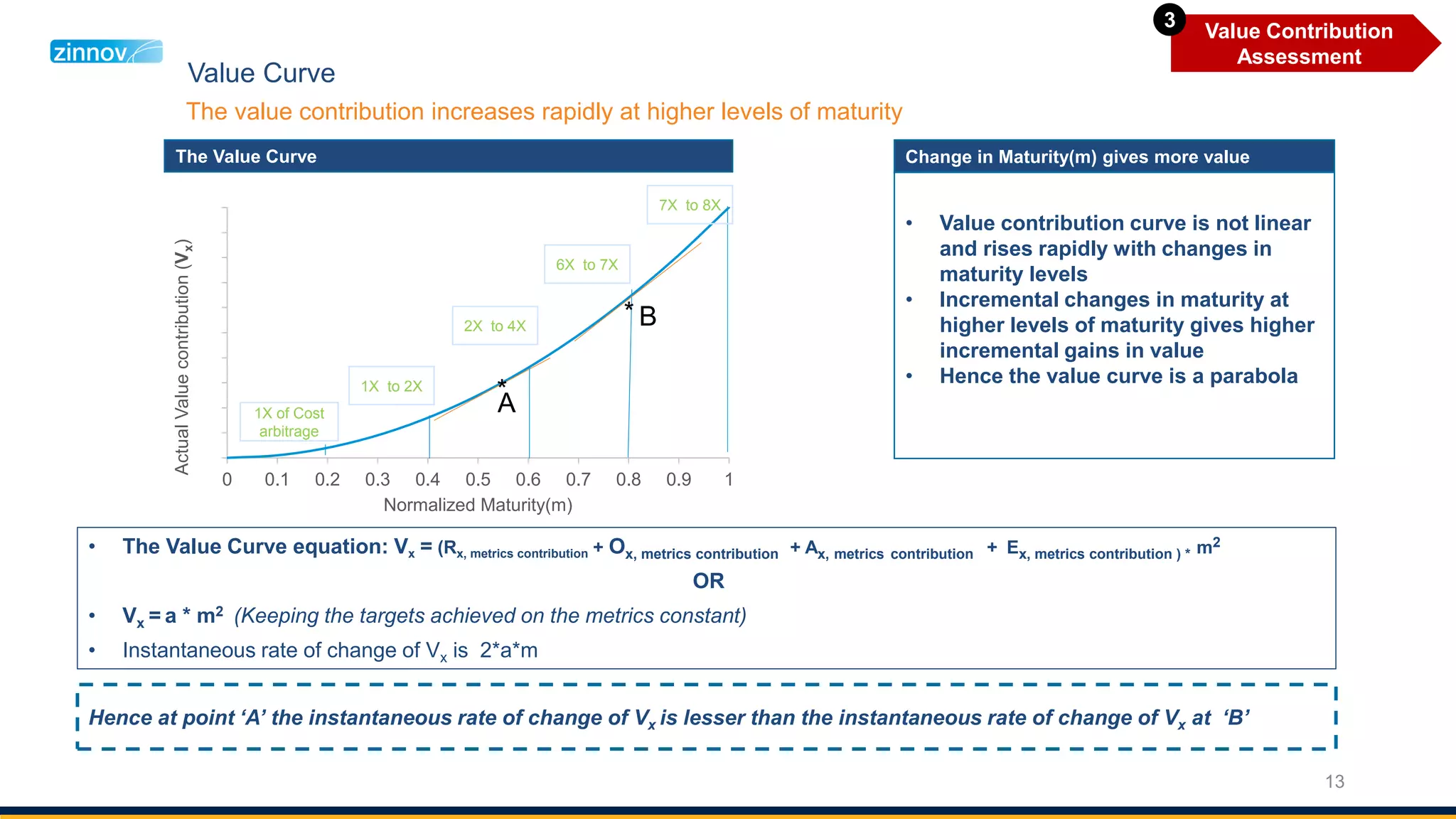
Change in Maturity(m) gives more value
• The Value Curve equation: Vx = (Rx, metrics contribution + Ox, metrics contribution + Ax, metrics contribution + Ex, metrics contribution ) * m2
OR
• Vx = a * m2 (Keeping the targets achieved on the metrics constant)
• Instantaneous rate of change of Vx is 2*a*m
0 0.1 0.2 0.3 0.4 0.5 0.6 0.7 0.8 0.9 1
ActualValuecontribution(Vx)
Normalized Maturity(m)
A
B
*
*
The Value Curve
Hence at point ‘A’ the instantaneous rate of change of Vx is lesser than the instantaneous rate of change of Vx at ‘B’
1X of Cost
arbitrage
1X to 2X
2X to 4X
6X to 7X
7X to 8X
• Value contribution curve is not linear
and rises rapidly with changes in
maturity levels
• Incremental changes in maturity at
higher levels of maturity gives higher
incremental gains in value
• Hence the value curve is a parabola
Value Curve
The value contribution increases rapidly at higher levels of maturity
Value Contribution
Assessment
3
14
Case Study
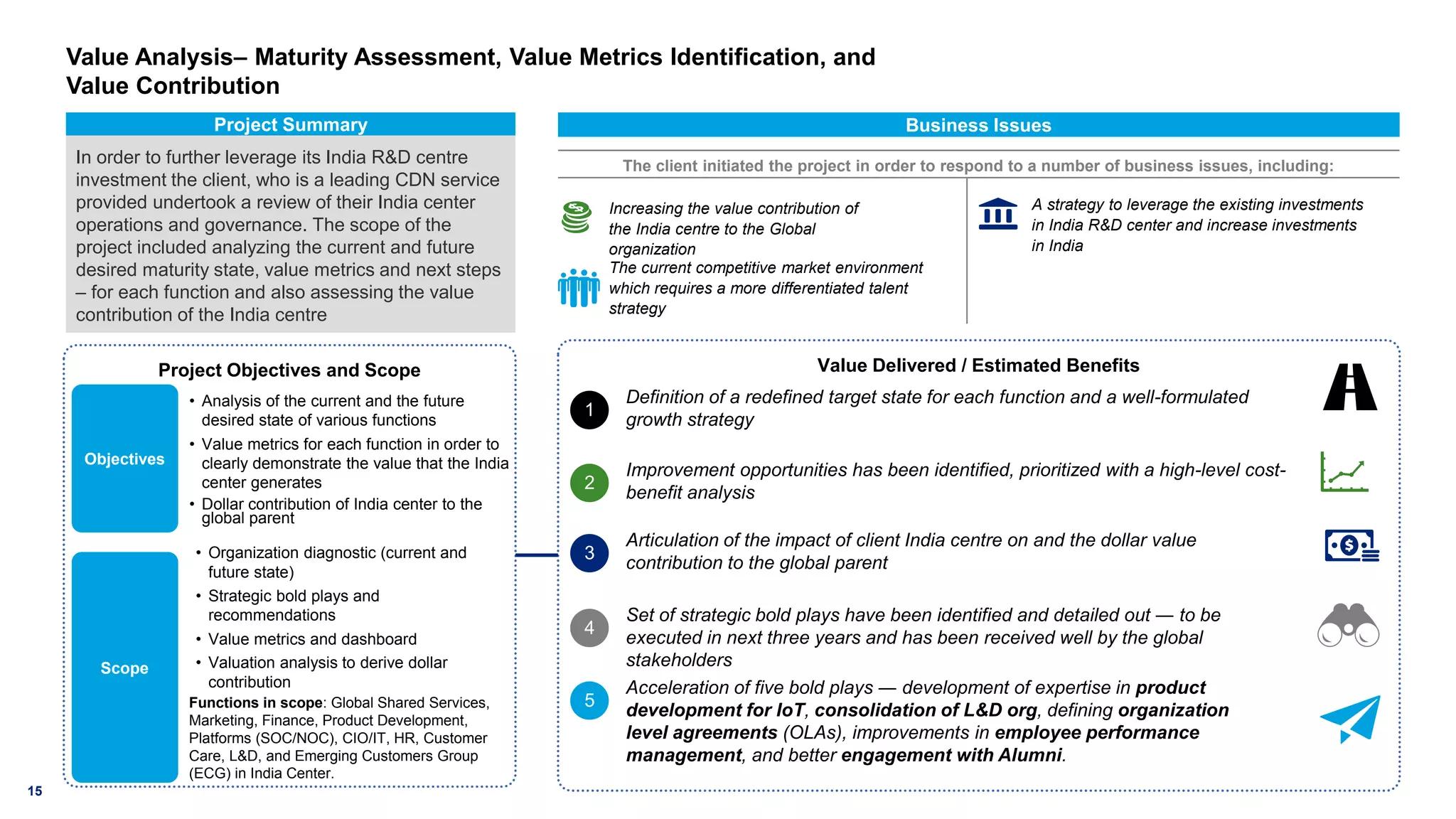
Value Analysis– Maturity Assessment, Value Metrics Identification, and
Value Contribution
15
Project Summary
In order to further leverage its India R&D centre
investment the client, who is a leading CDN service
provided undertook a review of their India center
operations and governance. The scope of the
project included analyzing the current and future
desired maturity state, value metrics and next steps
– for each function and also assessing the value
contribution of the India centre
Business Issues
The client initiated the project in order to respond to a number of business issues, including:
Increasing the value contribution of
the India centre to the Global
organization
A strategy to leverage the existing investments
in India R&D center and increase investments
in India
The current competitive market environment
which requires a more differentiated talent
strategy
Objectives
Project Objectives and Scope
• Analysis of the current and the future
desired state of various functions
• Value metrics for each function in order to
clearly demonstrate the value that the India
center generates
• Dollar contribution of India center to the
global parent
Scope
• Organization diagnostic (current and
future state)
• Strategic bold plays and
recommendations
• Value metrics and dashboard
• Valuation analysis to derive dollar
contribution
Functions in scope: Global Shared Services,
Marketing, Finance, Product Development,
Platforms (SOC/NOC), CIO/IT, HR, Customer
Care, L&D, and Emerging Customers Group
(ECG) in India Center.
Value Delivered / Estimated Benefits
1
Definition of a redefined target state for each function and a well-formulated
growth strategy
2
Improvement opportunities has been identified, prioritized with a high-level cost-
benefit analysis
3
Articulation of the impact of client India centre on and the dollar value
contribution to the global parent
4
Set of strategic bold plays have been identified and detailed out ― to be
executed in next three years and has been received well by the global
stakeholders
5
Acceleration of five bold plays ― development of expertise in product
development for IoT, consolidation of L&D org, defining organization
level agreements (OLAs), improvements in employee performance
management, and better engagement with Alumni.
Bangalore
69 "Prathiba Complex",
4th 'A' Cross,
Koramangala 5th Block,
Bangalore-560 095.
Phone: +91-80-41127925/6
Singapore
Level 42, Suntec Tower Three
8 Temasek Boulevard
Singapore 038988
Phone:+65 6829 2123
Texas
21, Waterway Ave
Suite 300
The Woodlands
TX-77380 USA
Phone:+1-281-362-2773
Beijing
Meilifang Tower 4, Entrance 4, 10/F #1003,
11 Beiyuan Shuangying Road,
Chaoyang District, Beijing
China 100012
Thank You
Gurgaon Office:
First Floor,
Plot no. 131, Sector 44,
Gurgaon-122002,
Phone: +91 124 4420100
California Office
3080 Olcott Street
Suite A125,
Santa Clara, CA 95054
Phone: +408-716-8432

Global In-house Site contribution and value analysis

  • 1.
    Site Contribution andValue Analysis August 2016 1
  • 2.
    2 Maturity assessment and gap analysis Valuemetrics definition Value contribution assessment Strategic analysis and outcomes Data collection process Strategic objectives Current state analysis and future state identification • As – Is understanding of current maturity and definition of future state for each BU • Identification of gaps and future state including high level initiatives Stakeholders’ interviews, primary research Survey based data collection from Stakeholders Metric identification and dashboard • Identify metrics for share holder value creation for each BU/support function • Define and develop dashboard for all BUs, support functions and overall Identification of value contribution • Estimate overall enterprise value for each centre • Calculate Unit value contribution for each BU/support function and overall for each centre to the parent 1 2 3 How we assess the value contribution of a Global In-house Center site to the Global Parent
  • 3.
  • 4.
    4 Maturity Assessment Model Astructured approach and proprietary maturity models are used to determine maturity of each function / BU at a center Methodology and outcomes Data collection process Stakeholders’ interviews / Primary research / Data collection from India teams Maturity Analysis Strategic objectives • Maturity analysis for each BU / support function using Zinnov’s proprietary Maturity Framework Current State Maturity Analysis • Desired future state articulation of each BU / support function Future State Identification • Gap identification – areas of focus and improvement Gap Analysis Maturity assessment and gap analysis 1 Key parameters for maturity assessment of product development team (Example) Business Talent Organization Process • Product budget • Role in product management • P&L accountability • Roles • Scrum type • Team size • Activities • Ability of team to work independently • Organization activities • Management • Process activities • Job design • Measurement • Technology Organize Activities
  • 5.
    Maturity assessment 4321 5 Organization Talent Organizeactivities Process Business Current maturity level Desired maturity level within 2-3 years Current state same as desired state Desired StateCurrent state • Assists in creating product roadmap BUSINESS TALENT • Significantly influence the product road map, strategy, budget ORGANIZE ACTIVITIES ORGANIZATION • Development, QA, release managers, product managers • Executive leadership from India • Activities include conceptualization, design, development, testing and release. • User experience for the product. • Activities include conceptualization, design, development, testing and release. • User experience for the product • Structure for assessing ideas • Product managers defined • Common portal for submitting of ideas. Unbiased evaluation by top management • Project managers responsible for P&L • Resource allocation is coordinated • Some repetitive tasks have been automated • Prioritized resource allocation • All repetitive tasks automated PROCESS 5 Maturity assessment and gap analysis 1 Maturity Assessment
  • 6.
  • 7.
    7 Value Metrics definition 2 Revenue Opportunityindicates how well a team is able to identify and fill a need within a chosen market. Operating Efficiency reflects how well the team is able to turn demand for its products and services into profits and value Risk Control and Expectation Management helps define stakeholder confidence in team’s ability to own and deliver on higher responsibility Shareholder Value Revenue Opportunity Operating Efficiency Asset Productivity Risk Control and Expectations Management • Anything that grows ‘Top Line’ • Anything that grows the ‘Bottom Line’ • All cost categories • Anything that reduces the amount of money tied up in the assets needed to run the business, or allows those assets to be better utilized • Anything that enhances the team’s ability to lead, plan, manage, execute its stated strategies • Anything that demonstrates the team’s ability to control risk Asset Productivity reflects how well a team is able to turn invested resources (talent, real estate, cash, etc..) into profits and value. Current performance Expectations for future performance Shareholder Value Contribution The following levers will form the basis to identify the key metrics for measuring value contribution of the BU/team
  • 8.
    Product Development TeamDashboard 35% 20% 25% Target achieved Target achieved Target achieved Target achieved Target achieved 30% 20% 30% 10% 30% 30% 30% 20% 60% 60% 60% 60% 40% 50% 30% 70% 30% Mean time to resolve Overall cost Average ramp up time for a new hire Attrition Avg. hiring time Asset productivity No. oflearning hours per FTE Average utilization Cost/ FTE Riskcontrol and expection management Design approval in first pass No. ofPOC generated No. ofcustomer found defect Lever Revenue opportunity No. ofproducts launched No. ofideas submitted No. ofexternal interaction Operating efficiency No. ofreusable components Average time to resolve critical Man-hour invested in re- work Revenue opportunity Operating efficiency Asset productivity Risk control and expection management 20% 8 Value Metrics definition 2 Shareholder Value Contribution In a similar way, dashboards will also be defined and developed for each Business unit and support function
  • 9.
  • 10.
    10 Individual Centre’s ValueContribution Analysis The articulation of value contribution can showcase the value each centre generates Value Contribution Assessment 3 How do we calculate it? Revenue Opportunity Operating Efficiency Asset Productivity Risk Control and Expectations Management Shareholder Value Stack Actual Value Contribution The actual value contribution of a center to the parent will be arrived at by adding together the contributions from individual BUs / Support functions.= Actual Value Contribution Value contribution is a function of each business unit’s maturity and the target they achieve on the identified metrics BU Unit Value Contribution = BU Unit value contribution will be calculated separately for each BU and support function. It takes into account the enterprise values of all levers, avg. salary proportion, targets achieved, maturity score. Value contribution Value contribution of a center to the global parent quantitatively articulates the value generated by a center and contributed to the parent, thus, helps in driving strategic investments for that center
  • 11.
    11 Terminologies used forvalue assessment Value Contribution Assessment 3 # Terminology Meaning/ Full form 1 h Head count ratio 2 Shareholder value Function of Revenue, Operating efficiency, Asset productivity, Risk control and expectation management 3 EV Enterprise value (TTM EV) 4 EV’ Enterprise value prime ( EV * h) 5 Vx ,Department Value contribution of a department within a specified centre 6 m Maturity score of the department 7 R’, O’, A’, E’ EV’ broken down by levers of Shareholder Value 8 r, o, a, e Percentage Targets achieved on each lever of Shareholder Value metrics 9 Vai Value contribution of the entire centre 10 Pd k Proportion of average salary cost of a kth department/function 11 Dk kth department 12 Td k Generic variable to call out targets achieved by kth department 13 Md k Normalized maturity score of the kth department
  • 12.
    12 Key Facts • TheShareholder Value = f(Revenue, Operating Efficiency, Asset Productivity, Risk Control and Expectation Management) Key ratios • Headcount ratio (h) = Total number of people in centre ‘X’ / Total number of employees Centre ‘X’ Potential Value Contribution *Note: Potential contribution on each of the lever is arrived at by distributing equally the remainder of potential enterprise value less potential revenue contribution across Operating Efficiency, Asset Efficiency, Expectations Centre ‘X’ Value Contribution (Vx) Sum of value contribution of all Centre ‘X’ departments (∑ Vx,Department) = Centre ‘X’ - Potential Enterprise Value broken by levers of Shareholder Value (EV’) Global Average TTM Enterprise Value (EV)= Headcount Ratio (h)x Centre ‘X’ Actual Value Contribution * • Centre ‘X’ Value Contributions = f(average TTM enterprise value, headcount ratio, proportion of avg. salary cost, maturity level, and target achieved on metrics) Centre ‘X’ Dept. Value Contribution (Vx,Department) = Value Analysis The value that a centre contributes is a function of average TTM enterprise value, headcount ratio, maturity level, and the target achieved on metrics Revenue Opportunity Operating Efficiency Asset Productivity Risk Control and Expectations Management Shareholder Value Stack Value Contribution Assessment 3 f (EV’, Pd k , Td k, Md k )
  • 13.
    13 Change in Maturity(m)gives more value • The Value Curve equation: Vx = (Rx, metrics contribution + Ox, metrics contribution + Ax, metrics contribution + Ex, metrics contribution ) * m2 OR • Vx = a * m2 (Keeping the targets achieved on the metrics constant) • Instantaneous rate of change of Vx is 2*a*m 0 0.1 0.2 0.3 0.4 0.5 0.6 0.7 0.8 0.9 1 ActualValuecontribution(Vx) Normalized Maturity(m) A B * * The Value Curve Hence at point ‘A’ the instantaneous rate of change of Vx is lesser than the instantaneous rate of change of Vx at ‘B’ 1X of Cost arbitrage 1X to 2X 2X to 4X 6X to 7X 7X to 8X • Value contribution curve is not linear and rises rapidly with changes in maturity levels • Incremental changes in maturity at higher levels of maturity gives higher incremental gains in value • Hence the value curve is a parabola Value Curve The value contribution increases rapidly at higher levels of maturity Value Contribution Assessment 3
  • 14.
  • 15.
    Value Analysis– MaturityAssessment, Value Metrics Identification, and Value Contribution 15 Project Summary In order to further leverage its India R&D centre investment the client, who is a leading CDN service provided undertook a review of their India center operations and governance. The scope of the project included analyzing the current and future desired maturity state, value metrics and next steps – for each function and also assessing the value contribution of the India centre Business Issues The client initiated the project in order to respond to a number of business issues, including: Increasing the value contribution of the India centre to the Global organization A strategy to leverage the existing investments in India R&D center and increase investments in India The current competitive market environment which requires a more differentiated talent strategy Objectives Project Objectives and Scope • Analysis of the current and the future desired state of various functions • Value metrics for each function in order to clearly demonstrate the value that the India center generates • Dollar contribution of India center to the global parent Scope • Organization diagnostic (current and future state) • Strategic bold plays and recommendations • Value metrics and dashboard • Valuation analysis to derive dollar contribution Functions in scope: Global Shared Services, Marketing, Finance, Product Development, Platforms (SOC/NOC), CIO/IT, HR, Customer Care, L&D, and Emerging Customers Group (ECG) in India Center. Value Delivered / Estimated Benefits 1 Definition of a redefined target state for each function and a well-formulated growth strategy 2 Improvement opportunities has been identified, prioritized with a high-level cost- benefit analysis 3 Articulation of the impact of client India centre on and the dollar value contribution to the global parent 4 Set of strategic bold plays have been identified and detailed out ― to be executed in next three years and has been received well by the global stakeholders 5 Acceleration of five bold plays ― development of expertise in product development for IoT, consolidation of L&D org, defining organization level agreements (OLAs), improvements in employee performance management, and better engagement with Alumni.
  • 16.
    Bangalore 69 "Prathiba Complex", 4th'A' Cross, Koramangala 5th Block, Bangalore-560 095. Phone: +91-80-41127925/6 Singapore Level 42, Suntec Tower Three 8 Temasek Boulevard Singapore 038988 Phone:+65 6829 2123 Texas 21, Waterway Ave Suite 300 The Woodlands TX-77380 USA Phone:+1-281-362-2773 Beijing Meilifang Tower 4, Entrance 4, 10/F #1003, 11 Beiyuan Shuangying Road, Chaoyang District, Beijing China 100012 Thank You Gurgaon Office: First Floor, Plot no. 131, Sector 44, Gurgaon-122002, Phone: +91 124 4420100 California Office 3080 Olcott Street Suite A125, Santa Clara, CA 95054 Phone: +408-716-8432