Identifying and Analyzing the Risks of Business Process Reengineering Projects Kristin M. Howlett Director of Process Improvement DeKalb County, Georgia October 29, 2008
Are you gambling with your project?
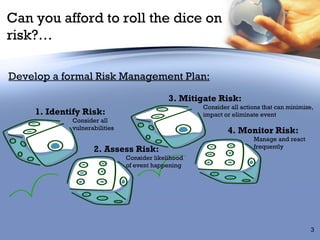
Can you afford to roll the dice on risk?… Develop a formal Risk Management Plan: Consider all  vulnerabilities Consider likelihood of event happening Manage and react  frequently  Consider all actions that can minimize,  impact or eliminate event 1. Identify Risk: 2. Assess Risk: 3. Mitigate Risk: 4. Monitor Risk:
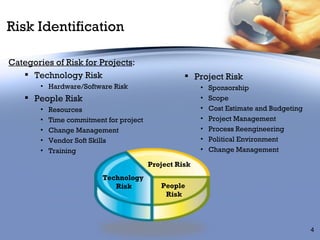
Risk Identification Categories of Risk for Projects : Technology Risk Hardware/Software Risk People Risk Resources Time commitment for project Change Management Vendor Soft Skills Training Project Risk Sponsorship Scope Cost Estimate and Budgeting Project Management Process Reengineering Political Environment Change Management Technology  Risk People  Risk Project Risk
Technology Risk Hardware Risk New purchase vs. existing hardware Maintenance – costs for upgrades Technology redundancy (across different systems), or interoperability (interfaces between systems) Software Risk Custom solution vs. package solution Interfaces User-friendly technology Enhancements to software Software functionality On-going support (when project is complete)
People Risk Resources Subject Matter Experts Technical resources Contractors End user management Time Commitment for Project Concurrent projects Other work responsibilities Change Management Acceptance of new process from project team and the rest of the organization Plan in place and owners assigned Training Training on new procedures  On-going availability for new training (or retraining if needed) Vendor Soft Skills
Project Risk Sponsorship  Who is leading the project? How engaged is he or she? Scope Have clearly defined goals and objectives in advance Avoid “scope creep” Cost Estimate & Budgeting Know budget limitations Contingency Fund (add 25% to budget for unanticipated events) Project Management Process Reengineering Is it being performed? Who is responsible for it? Political Environment Change Management Clearly defined process on how requirement changes will be implemented How will changes be institutionalized?
Case Study: DeKalb County 311 DeKalb County is located in Metropolitan Atlanta Third most populated county in Georgia Population: 737,000 Over 100 languages spoken DeKalb is home to… The state’s second largest airport (PDK) Center for Disease Control (CDC) GBI Headquarters, FBI and IRS Regional Headquarters 9 major medical facilities, including  Emory University Hospital and Atlanta VA  Medical Center
Case Study: DeKalb County 311 What is 311? An easy to remember three digit phone number to call when contacting your local government for any “non-public safety emergency” matter. Centralized, consolidated call center to relieve the non-emergency call burden from 911 and to provide excellence in customer service “ One-stop Shop” for customer service delivery System-wide technology implementation that provided an opportunity for Dekalb to revisit the way the county does business  Streamlined business processes  Eliminated redundant activities Improved customer-facing business practices Increased revenue streams
Case Study: DeKalb County 311(continued) Some of the benefits of 311 include… Relieving front-end, customer service work load from individual departments across the county, allowing individual departments to better focus on core business functions Assessing county performance Tracks the quantity and status of service requests to improve accountability and service delivery Classify and analyze service requests to locate problem areas Improving service quality and quantity Improves how county services are requested, scheduled, and performed (standardization of practices) Central point of intake and retention of customer information Ability to handle many calls simultaneously with a “live” person Ability to identify service needs in high call volume areas  Increases the efficiency of administrative activities by eliminating  tasks that add no value
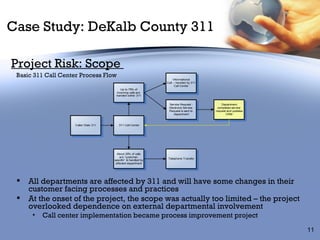
Case Study: DeKalb County 311 All departments are affected by 311 and will have some changes in their customer facing processes and practices At the onset of the project, the scope was actually too limited – the project overlooked dependence on external departmental involvement  Call center implementation became process improvement project Project Risk: Scope  Basic 311 Call Center Process Flow
Managing Risk There are 3 types of risk:  Controllable  - Risk can be identified and a contingency plan to minimize or eliminate risk is established Plan for alternatives or options from most optimal to least optimal  Uncontrollable  – Occurs when risk can be identified, but the specific event and/or the timeline for occurrence is unknown  Plan for contingencies Unknown  – A risk that has not been identified and it occurs Hiring freeze in DeKalb County that threatened 311 “Go Live” date Acquiring the “311” number designation
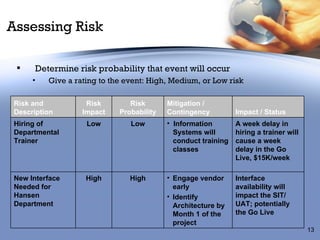
Assessing Risk Determine risk probability that event will occur Give a rating to the event: High, Medium, or Low risk Interface availability will impact the SIT/ UAT; potentially the Go Live A week delay in hiring a trainer will cause a week delay in the Go Live, $15K/week  Impact / Status Engage vendor early Identify Architecture by Month 1 of the project High High New Interface Needed for Hansen Department Information  Systems will  conduct training classes Low Low Hiring of Departmental Trainer Mitigation / Contingency Risk Probability Risk Impact Risk and Description
Mitigating Risk Develop a Contingency Plan Determine a back-up plan for an event happening Determine  who owns  the event if it happens Risk Avoidance: Can you prevent a risk from occurring? Who will be responsible for preventing the risk from happening and when will it be done? Assess severity of impact Whenever possible, relate risk impact in terms of money and time:  A 4 week delay in a hardware delivery date would cost $40K per week (or $160K for a month). Budget for Impacts Add 25% to your budget to fund mitigation and contingency plans
Monitoring Risk Develop and implement a methodology to manage the risk process Use software tools and risk mitigation techniques to manage risks Develop a formal process for issues management Reassess and add risk items throughout implementation
Key Take-Aways Risk cannot be avoided, so don’t take a chance! Follow a Risk Management Plan: Identify risks early in project implementation Assess the potential impact to project (preferably in dollars) Mitigate risk by developing a  contingency plan for each risk Monitor risk continuously
Questions?

Bpm Risk Analysis 10 27 10 30

  • 1.
    Identifying and Analyzingthe Risks of Business Process Reengineering Projects Kristin M. Howlett Director of Process Improvement DeKalb County, Georgia October 29, 2008
  • 2.
    Are you gamblingwith your project?
  • 3.
    Can you affordto roll the dice on risk?… Develop a formal Risk Management Plan: Consider all vulnerabilities Consider likelihood of event happening Manage and react frequently Consider all actions that can minimize, impact or eliminate event 1. Identify Risk: 2. Assess Risk: 3. Mitigate Risk: 4. Monitor Risk:
  • 4.
    Risk Identification Categoriesof Risk for Projects : Technology Risk Hardware/Software Risk People Risk Resources Time commitment for project Change Management Vendor Soft Skills Training Project Risk Sponsorship Scope Cost Estimate and Budgeting Project Management Process Reengineering Political Environment Change Management Technology Risk People Risk Project Risk
  • 5.
    Technology Risk HardwareRisk New purchase vs. existing hardware Maintenance – costs for upgrades Technology redundancy (across different systems), or interoperability (interfaces between systems) Software Risk Custom solution vs. package solution Interfaces User-friendly technology Enhancements to software Software functionality On-going support (when project is complete)
  • 6.
    People Risk ResourcesSubject Matter Experts Technical resources Contractors End user management Time Commitment for Project Concurrent projects Other work responsibilities Change Management Acceptance of new process from project team and the rest of the organization Plan in place and owners assigned Training Training on new procedures On-going availability for new training (or retraining if needed) Vendor Soft Skills
  • 7.
    Project Risk Sponsorship Who is leading the project? How engaged is he or she? Scope Have clearly defined goals and objectives in advance Avoid “scope creep” Cost Estimate & Budgeting Know budget limitations Contingency Fund (add 25% to budget for unanticipated events) Project Management Process Reengineering Is it being performed? Who is responsible for it? Political Environment Change Management Clearly defined process on how requirement changes will be implemented How will changes be institutionalized?
  • 8.
    Case Study: DeKalbCounty 311 DeKalb County is located in Metropolitan Atlanta Third most populated county in Georgia Population: 737,000 Over 100 languages spoken DeKalb is home to… The state’s second largest airport (PDK) Center for Disease Control (CDC) GBI Headquarters, FBI and IRS Regional Headquarters 9 major medical facilities, including Emory University Hospital and Atlanta VA Medical Center
  • 9.
    Case Study: DeKalbCounty 311 What is 311? An easy to remember three digit phone number to call when contacting your local government for any “non-public safety emergency” matter. Centralized, consolidated call center to relieve the non-emergency call burden from 911 and to provide excellence in customer service “ One-stop Shop” for customer service delivery System-wide technology implementation that provided an opportunity for Dekalb to revisit the way the county does business Streamlined business processes Eliminated redundant activities Improved customer-facing business practices Increased revenue streams
  • 10.
    Case Study: DeKalbCounty 311(continued) Some of the benefits of 311 include… Relieving front-end, customer service work load from individual departments across the county, allowing individual departments to better focus on core business functions Assessing county performance Tracks the quantity and status of service requests to improve accountability and service delivery Classify and analyze service requests to locate problem areas Improving service quality and quantity Improves how county services are requested, scheduled, and performed (standardization of practices) Central point of intake and retention of customer information Ability to handle many calls simultaneously with a “live” person Ability to identify service needs in high call volume areas Increases the efficiency of administrative activities by eliminating tasks that add no value
  • 11.
    Case Study: DeKalbCounty 311 All departments are affected by 311 and will have some changes in their customer facing processes and practices At the onset of the project, the scope was actually too limited – the project overlooked dependence on external departmental involvement Call center implementation became process improvement project Project Risk: Scope Basic 311 Call Center Process Flow
  • 12.
    Managing Risk Thereare 3 types of risk: Controllable - Risk can be identified and a contingency plan to minimize or eliminate risk is established Plan for alternatives or options from most optimal to least optimal Uncontrollable – Occurs when risk can be identified, but the specific event and/or the timeline for occurrence is unknown Plan for contingencies Unknown – A risk that has not been identified and it occurs Hiring freeze in DeKalb County that threatened 311 “Go Live” date Acquiring the “311” number designation
  • 13.
    Assessing Risk Determinerisk probability that event will occur Give a rating to the event: High, Medium, or Low risk Interface availability will impact the SIT/ UAT; potentially the Go Live A week delay in hiring a trainer will cause a week delay in the Go Live, $15K/week Impact / Status Engage vendor early Identify Architecture by Month 1 of the project High High New Interface Needed for Hansen Department Information Systems will conduct training classes Low Low Hiring of Departmental Trainer Mitigation / Contingency Risk Probability Risk Impact Risk and Description
  • 14.
    Mitigating Risk Developa Contingency Plan Determine a back-up plan for an event happening Determine who owns the event if it happens Risk Avoidance: Can you prevent a risk from occurring? Who will be responsible for preventing the risk from happening and when will it be done? Assess severity of impact Whenever possible, relate risk impact in terms of money and time: A 4 week delay in a hardware delivery date would cost $40K per week (or $160K for a month). Budget for Impacts Add 25% to your budget to fund mitigation and contingency plans
  • 15.
    Monitoring Risk Developand implement a methodology to manage the risk process Use software tools and risk mitigation techniques to manage risks Develop a formal process for issues management Reassess and add risk items throughout implementation
  • 16.
    Key Take-Aways Riskcannot be avoided, so don’t take a chance! Follow a Risk Management Plan: Identify risks early in project implementation Assess the potential impact to project (preferably in dollars) Mitigate risk by developing a contingency plan for each risk Monitor risk continuously
  • 17.