Software risk, Configuration
Management and QA
Chapter No. 5
Risk management
What is it?
Risk analysis and management are a series of steps that help a software team to
understand and manage uncertainty. Many problems can plague a software project. A
risk is a potential problem—it might happen, it might not.But, regardless of the outcome,
it’s a really good idea to identify it, assess its probability of occurrence, estimate its
impact, and establish a contingency plan should the problem actually occur.
Who does it?
Everyone involved in the software process—managers, software engineers, and
customers— participate in risk analysis and management.
Why is it important?
Think about the Boy Scout motto: “Be prepared.” Software is a difficult
undertaking.Lots of things can go wrong, and frankly, many often do. It’s for this
reason that being prepared— understanding the risks and taking proactive measures
to avoid or manage them—is a key element of good software project management.
What are the steps?
Recognizing what can go wrong is the first step, called “risk identification.” Next,
each risk is analyzed to determine the likelihood that it will occur and the damage
that it will do if it does occur. Once this information is established, risks are ranked,
by probability and impact. Finally, a plan is developed to manage those risks with
high probability and high impact.
Proactive Risk strategy
A considerably more intelligent strategy for risk management is to be proactive.
A proactive strategy begins long before technical work is initiated. Potential
risks are identified, their probability and impact are assessed, and they are
ranked by importance.Then, the software team establishes a plan for managing
risk.
The primary objective is to avoid risk, but because not all risks can be avoided,
the team works to develop a contingency plan that will enable it to respond in a
controlled and effective manner. Throughout the remainder of this chapter, we
discuss a proactive strategy for risk management.
Software Risk
General agreement that risk always involves two characteristics
● Uncertainty—the risk may or may not happen; that is, there are no 100% probable
risks.
● Loss—if the risk becomes a reality, unwanted consequences or losses will occur.
When risks are analyzed, it is important to quantify the level of uncertainty and the
degree of loss associated with each risk. To accomplish this, different categories of risks
are considered.
Project risks threaten the project plan. That is, if project risks become real, it is likely that
project schedule will slip and that costs will increase. Project risks identify potential
budgetary, schedule, personnel (staffing and organization), resource, customer, and
requirements problems and their impact on a software project.
Software Risk
Technical risks threaten the quality and timeliness of the software to be produced. If a technical
risk becomes a reality, implementation may become difficult or impossible. Technical risks identify
potential design, implementation, interface, verification, and maintenance problems. In addition,
specification ambiguity, technical uncertainty, technical obsolescence, and "leading-edge"
technology are also risk factors. Technical risks occur because the problem is harder to solve than
we thought it would be.
Business risks threaten the viability of the software to be built. Business risks often jeopardize the
project or the product. Candidates for the top five business risks are
(1) building a excellent product or system that no one really wants (market risk), (2) building a
product that no longer fits into the overall business strategy for the company (strategic risk), (3)
building a product that the sales force doesn't understand how to sell, (4) losing the support of
senior management due to a change in focus or a change in people (management risk), and (5)
losing budgetary or personnel commitment (budget risks).
Software Risk
Another general categorization of risks has been proposed by Charette [CHA89].
Known risks are those that can be uncovered after careful evaluation of the project
plan, the business and technical environment in which the project is being developed,
and other reliable information sources (e.g., unrealistic delivery date, lack of
documented requirements or software scope, poor development environment).
Predictable risks are extrapolated from past project experience (e.g., staff turnover,
poor communication with the customer, dilution of staff effort as ongoing maintenance
requests are serviced). Unpredictable risks are the joker in the deck. They can and do
occur, but they are extremely difficult to identify in advance.
Risk Identification
Risk identification is a systematic attempt to specify threats to the project plan (estimates,
schedule, resource loading, etc.). By identifying known and predictable risks, the project
manager takes a first step toward avoiding them when possible and controlling them
when necessary.
There are two distinct types of risks for each of the categories : generic risks and product-
specific risks. Generic risks are a potential threat to every software project.
Product-specific risks can be identified only by those with a clear understanding of the
technology, the people, and the environment that is specific to the project at hand.
To identify product-specific risks, the project plan and the software statement of scope
are examined and an answer to the following question is developed: "What special
characteristics of this product may threaten our project plan?" One method for identifying
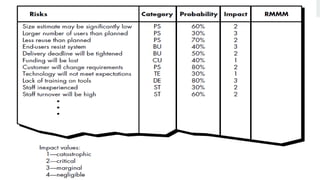
risks is to create a risk item checklist
Risk Projection
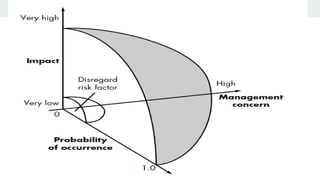
Risk projection, also called risk estimation, attempts to rate each risk in two ways
—the likelihood or probability that the risk is real and the consequences of the
problems associated with the risk, should it occur. The project planner, along
with other managers and technical staff, performs four risk projection activities:
(1) establish a scale that reflects the perceived likelihood of a risk,
(2) delineate the consequences of the risk,
(3) estimate the impact of the risk on the project and the product, and
(4) note the overall accuracy of the risk projection so that there will be no
misunderstandings
Risk Projection
Risk identification
Risk Probability
Risk Impact
Risk exposure
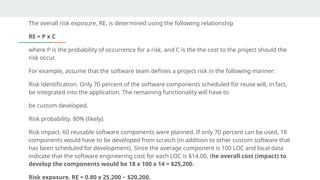
The overall risk exposure, RE, is determined using the following relationship
RE = P x C
where P is the probability of occurrence for a risk, and C is the the cost to the project should the
risk occur.
For example, assume that the software team defines a project risk in the following manner:
Risk identification. Only 70 percent of the software components scheduled for reuse will, in fact,
be integrated into the application. The remaining functionality will have to
be custom developed.
Risk probability. 80% (likely).
Risk impact. 60 reusable software components were planned. If only 70 percent can be used, 18
components would have to be developed from scratch (in addition to other custom software that
has been scheduled for development). Since the average component is 100 LOC and local data
indicate that the software engineering cost for each LOC is $14.00, the overall cost (impact) to
develop the components would be 18 x 100 x 14 = $25,200.
Risk exposure. RE = 0.80 x 25,200 ~ $20,200.
RMMM
All of the risk analysis activities presented to this point have a single goal—to
assist the project team in developing a strategy for dealing with risk. An
effective strategy must consider three issues:
• risk avoidance
• risk monitoring
• risk management and contingency planning
RMMM
If a software team adopts a proactive approach to risk, avoidance is always the
best strategy. This is achieved by developing a plan for risk mitigation. For
example, assume that high staff turnover is noted as a project risk, r1. Based
on past history and man-agement intuition, the likelihood, l1, of high turnover
is estimated to be 0.70 (70 percent, rather high) and the impact, x1, is
projected at level 2. That is, high turnover will have a critical impact on project
cost and schedule.
Risk mitigation
To mitigate this risk, project management must develop a strategy for reducing turnover. Among
the possible steps to be taken are
• Meet with current staff to determine causes for turnover (e.g., poor working conditions, low pay,
competitive job market). Mitigate those causes that are under our control before the project starts.
• Once the project commences, assume turnover will occur and develop techniques to ensure
continuity when people leave.
• Organize project teams so that information about each development activity is widely dispersed.
• Define documentation standards and establish mechanisms to be sure that documents are
developed in a timely manner.
• Conduct peer reviews of all work (so that more than one person is "up to speed”).
• Assign a backup staff member for every critical technologist.
Risk Monitoring
As the project proceeds, risk monitoring activities commence. The project
manager monitors factors that may provide an indication of whether the risk is
becoming more or less likely. In the case of high staff turnover, the following
factors can be monitored:
• General attitude of team members based on project pressures.
• The degree to which the team has jelled.
• Interpersonal relationships among team members.
• Potential problems with compensation and benefits.
• The availability of jobs within the company and outside it.
Risk management
Risk management and contingency planning assumes that mitigation efforts have
failed and that the risk has become a reality. Continuing the example, the project iswell
underway and a number of people announce that they will be leaving. If the mitigation
strategy has been followed, backup is available, information is documented, and
knowledge has been dispersed across the team.
In addition, the project manager may temporarily refocus resources (and readjust the
project schedule) to those functions that are fully staffed, enabling newcomers who
must be added to the team to “get up to speed.” Those individuals who are leaving are
asked to stop all work and spend their last weeks in “knowledge transfer mode.” This
might include video-based knowledge capture, the development of “commentary
documents,” and/or meeting with other team members who will remain on the project.

Software risk, Configuration Management and QA (1).pptx

  • 1.
  • 2.
    Risk management What isit? Risk analysis and management are a series of steps that help a software team to understand and manage uncertainty. Many problems can plague a software project. A risk is a potential problem—it might happen, it might not.But, regardless of the outcome, it’s a really good idea to identify it, assess its probability of occurrence, estimate its impact, and establish a contingency plan should the problem actually occur. Who does it? Everyone involved in the software process—managers, software engineers, and customers— participate in risk analysis and management.
  • 3.
    Why is itimportant? Think about the Boy Scout motto: “Be prepared.” Software is a difficult undertaking.Lots of things can go wrong, and frankly, many often do. It’s for this reason that being prepared— understanding the risks and taking proactive measures to avoid or manage them—is a key element of good software project management. What are the steps? Recognizing what can go wrong is the first step, called “risk identification.” Next, each risk is analyzed to determine the likelihood that it will occur and the damage that it will do if it does occur. Once this information is established, risks are ranked, by probability and impact. Finally, a plan is developed to manage those risks with high probability and high impact.
  • 4.
    Proactive Risk strategy Aconsiderably more intelligent strategy for risk management is to be proactive. A proactive strategy begins long before technical work is initiated. Potential risks are identified, their probability and impact are assessed, and they are ranked by importance.Then, the software team establishes a plan for managing risk. The primary objective is to avoid risk, but because not all risks can be avoided, the team works to develop a contingency plan that will enable it to respond in a controlled and effective manner. Throughout the remainder of this chapter, we discuss a proactive strategy for risk management.
  • 5.
    Software Risk General agreementthat risk always involves two characteristics ● Uncertainty—the risk may or may not happen; that is, there are no 100% probable risks. ● Loss—if the risk becomes a reality, unwanted consequences or losses will occur. When risks are analyzed, it is important to quantify the level of uncertainty and the degree of loss associated with each risk. To accomplish this, different categories of risks are considered. Project risks threaten the project plan. That is, if project risks become real, it is likely that project schedule will slip and that costs will increase. Project risks identify potential budgetary, schedule, personnel (staffing and organization), resource, customer, and requirements problems and their impact on a software project.
  • 6.
    Software Risk Technical risksthreaten the quality and timeliness of the software to be produced. If a technical risk becomes a reality, implementation may become difficult or impossible. Technical risks identify potential design, implementation, interface, verification, and maintenance problems. In addition, specification ambiguity, technical uncertainty, technical obsolescence, and "leading-edge" technology are also risk factors. Technical risks occur because the problem is harder to solve than we thought it would be. Business risks threaten the viability of the software to be built. Business risks often jeopardize the project or the product. Candidates for the top five business risks are (1) building a excellent product or system that no one really wants (market risk), (2) building a product that no longer fits into the overall business strategy for the company (strategic risk), (3) building a product that the sales force doesn't understand how to sell, (4) losing the support of senior management due to a change in focus or a change in people (management risk), and (5) losing budgetary or personnel commitment (budget risks).
  • 7.
    Software Risk Another generalcategorization of risks has been proposed by Charette [CHA89]. Known risks are those that can be uncovered after careful evaluation of the project plan, the business and technical environment in which the project is being developed, and other reliable information sources (e.g., unrealistic delivery date, lack of documented requirements or software scope, poor development environment). Predictable risks are extrapolated from past project experience (e.g., staff turnover, poor communication with the customer, dilution of staff effort as ongoing maintenance requests are serviced). Unpredictable risks are the joker in the deck. They can and do occur, but they are extremely difficult to identify in advance.
  • 8.
    Risk Identification Risk identificationis a systematic attempt to specify threats to the project plan (estimates, schedule, resource loading, etc.). By identifying known and predictable risks, the project manager takes a first step toward avoiding them when possible and controlling them when necessary. There are two distinct types of risks for each of the categories : generic risks and product- specific risks. Generic risks are a potential threat to every software project. Product-specific risks can be identified only by those with a clear understanding of the technology, the people, and the environment that is specific to the project at hand. To identify product-specific risks, the project plan and the software statement of scope are examined and an answer to the following question is developed: "What special characteristics of this product may threaten our project plan?" One method for identifying risks is to create a risk item checklist
  • 9.
    Risk Projection Risk projection,also called risk estimation, attempts to rate each risk in two ways —the likelihood or probability that the risk is real and the consequences of the problems associated with the risk, should it occur. The project planner, along with other managers and technical staff, performs four risk projection activities: (1) establish a scale that reflects the perceived likelihood of a risk, (2) delineate the consequences of the risk, (3) estimate the impact of the risk on the project and the product, and (4) note the overall accuracy of the risk projection so that there will be no misunderstandings
  • 12.
    Risk Projection Risk identification RiskProbability Risk Impact Risk exposure
  • 13.
    The overall riskexposure, RE, is determined using the following relationship RE = P x C where P is the probability of occurrence for a risk, and C is the the cost to the project should the risk occur. For example, assume that the software team defines a project risk in the following manner: Risk identification. Only 70 percent of the software components scheduled for reuse will, in fact, be integrated into the application. The remaining functionality will have to be custom developed. Risk probability. 80% (likely). Risk impact. 60 reusable software components were planned. If only 70 percent can be used, 18 components would have to be developed from scratch (in addition to other custom software that has been scheduled for development). Since the average component is 100 LOC and local data indicate that the software engineering cost for each LOC is $14.00, the overall cost (impact) to develop the components would be 18 x 100 x 14 = $25,200. Risk exposure. RE = 0.80 x 25,200 ~ $20,200.
  • 14.
    RMMM All of therisk analysis activities presented to this point have a single goal—to assist the project team in developing a strategy for dealing with risk. An effective strategy must consider three issues: • risk avoidance • risk monitoring • risk management and contingency planning
  • 15.
    RMMM If a softwareteam adopts a proactive approach to risk, avoidance is always the best strategy. This is achieved by developing a plan for risk mitigation. For example, assume that high staff turnover is noted as a project risk, r1. Based on past history and man-agement intuition, the likelihood, l1, of high turnover is estimated to be 0.70 (70 percent, rather high) and the impact, x1, is projected at level 2. That is, high turnover will have a critical impact on project cost and schedule.
  • 16.
    Risk mitigation To mitigatethis risk, project management must develop a strategy for reducing turnover. Among the possible steps to be taken are • Meet with current staff to determine causes for turnover (e.g., poor working conditions, low pay, competitive job market). Mitigate those causes that are under our control before the project starts. • Once the project commences, assume turnover will occur and develop techniques to ensure continuity when people leave. • Organize project teams so that information about each development activity is widely dispersed. • Define documentation standards and establish mechanisms to be sure that documents are developed in a timely manner. • Conduct peer reviews of all work (so that more than one person is "up to speed”). • Assign a backup staff member for every critical technologist.
  • 17.
    Risk Monitoring As theproject proceeds, risk monitoring activities commence. The project manager monitors factors that may provide an indication of whether the risk is becoming more or less likely. In the case of high staff turnover, the following factors can be monitored: • General attitude of team members based on project pressures. • The degree to which the team has jelled. • Interpersonal relationships among team members. • Potential problems with compensation and benefits. • The availability of jobs within the company and outside it.
  • 18.
    Risk management Risk managementand contingency planning assumes that mitigation efforts have failed and that the risk has become a reality. Continuing the example, the project iswell underway and a number of people announce that they will be leaving. If the mitigation strategy has been followed, backup is available, information is documented, and knowledge has been dispersed across the team. In addition, the project manager may temporarily refocus resources (and readjust the project schedule) to those functions that are fully staffed, enabling newcomers who must be added to the team to “get up to speed.” Those individuals who are leaving are asked to stop all work and spend their last weeks in “knowledge transfer mode.” This might include video-based knowledge capture, the development of “commentary documents,” and/or meeting with other team members who will remain on the project.