Dogfight over Europe: Ryanair
ROKAS DIEDONIS
IEVA NAUJOKAITĖ
KAROLIS VAIŠNYS
EDVINAS VYŠNIAUSKAS
Introduction
 Analysis of Ryanair company in 1986, new Dublin-London route
 Competitors analysis
 Ryanair‘s profitability of the new route
 How Aer Lingus should respond?
 How British Airways should respond?
 Which competitor should Ryanair be more afraid of?
 Our assessment of Ryanair‘s strategy
What‘s going on?
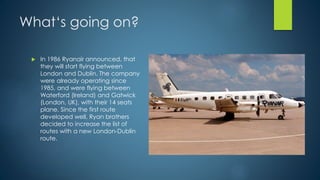
 In 1986 Ryanair announced, that
they will start flying between
London and Dublin. The company
were already operating since
1985, and were flying between
Waterford (Ireland) and Gatwick
(London, UK), with their 14 seats
plane. Since the first route
developed well, Ryan brothers
decided to increase the list of
routes with a new London-Dublin
route.
British Airways
 145 destinations in 68 countries
 Fleet of 163 aircraft
 Own passenger and ground services
 171 retail shops
 49,000 independent travel agents
 Full range of classes of service
Aer Lingus
 Partnership with BA until development of trans-Atlantic routes
 Losses in the 1970s prompted to diversification
 Maintenance service, engineer training, computer consulting, hotel
business
Ryanair
 1985, Ryan brothers
 Dublin-London (secondary airports)
 4 round trips per day with a 44-seat
 Single fare for a ticket with no restrictions
Revenues of Ryanair
 Ryanair managers assume, that plane will be always full
 44 seats in the jet
 4 trips a day
 365 days in a year
 98 Irish pounds per ticket
 Number of passengers in a year = 365*4*44 = 64240
 Revenue = 64240 * 98 = 6 295 520 Irish pounds per year
Costs of Ryanair
 The case do not provide possible
costs of Ryanair. However, there is
given average revenues and
average costs of competitor
(British Airways) for the same
Dublin-London route
 British Airways average price of
ticket: 166,5 Irish pound
 Profit of 11,4 Irish pound
British Airways costs (prices in Irish pounds):
Staff 35,7
Depreciation and amortization 8,6
Fuel and oil 31,8
Engineering and other aircraft costs 9,8
Selling 18,0
Aircraft operating leases 3,4
Landing fees and en route charges 11,7
Handling charges, catering and other 16,6
Accomodation, ground equipment and other 19,5
TOTAL 155,1
Costs of Ryanair
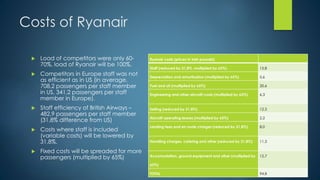
 Load of competitors were only 60-
70%, load of Ryanair will be 100%.
 Competitors in Europe staff was not
as efficient as in US (in average,
708,2 passengers per staff member
in US, 341,2 passengers per staff
member in Europe).
 Staff efficiency of British Airways –
482,9 passengers per staff member
(31,8% difference from US)
 Costs where staff is included
(variable costs) will be lowered by
31,8%.
 Fixed costs will be spreaded for more
passengers (multiplied by 65%)
Ryanair costs (prices in Irish pounds):
Staff (reduced by 31,8%, multiplied by 65%) 15,8
Depreciation and amortization (multiplied by 65%) 5,6
Fuel and oil (multiplied by 65%) 20,6
Engineering and other aircraft costs (multiplied by 65%) 6,3
Selling (reduced by 31,8%) 12,3
Aircraft operating leases (multiplied by 65%) 2,2
Landing fees and en route charges (reduced by 31,8%) 8,0
Handling charges, catering and other (reduced by 31,8%) 11,3
Accomodation, ground equipment and other (multiplied by
65%)
12,7
TOTAL 94,8
Profit of Ryanair
 Total revenue per ticket = 98 Irish pounds
 Total costs per ticket = 94,8 Irish pounds
 Profit per ticket = 3,2 Irish pound
 Yearly profit = 3,2 *64240 (number of passengers) = 205 568 Irish
pounds
Aer Lingus scenarios
Lowering prices
 Aer Lingus sustains short term losses
 155-98=57 Irish pounds lost per person
 64240*57 = 3.6 million Irish pounds lost
 If Ryanair retreats, old prices may prevail again
Leaving the market
 Losses in trans-Atlantic flights
 Low operating profit: 0.5 million Irish pounds
 High operating profit in other activities
 Maintenance services - 12.7 million profit
 Non-airline services – 17.1 million profit
British Airways scenarios
Expanding in other routes
 The best time to expand in other routes and countries
 Try to continue reach as many customers as it can
 Leave Ryanair in “local” market
Push Ryanair out from the market
 Lowering prices
 Try to push out Ryanair from the market
 Attract as many customers as it can
Which competitor Ryanair should
afraid more?
 British Airways
 Government support
 Not afraid of losses
 May compete with Ryanair for flight prices
Findings
 The new route was profitable (profit of 3,2 Irish pound per ticket)
 Very low price (significantly lower than competitors)
 With such low price, Ryanair have an ability to attract travelers by
ferries (price difference is 48 Irish pounds, time difference is 8 hours)
 However, Ryanair had nothing more to offer, besides lower price.
 Three possible strategies of Aer Lingus
 Most likely, they will let Ryanair come to the market, and will focus on
other kinds of businessess, in which they do perform
 Two possible strategies of British Airways
 They will compete with Ryanair, because they can loose profit, while
they‘re government funded company
Thank you for your attention!

Ryanair ppt final

  • 1.
    Dogfight over Europe:Ryanair ROKAS DIEDONIS IEVA NAUJOKAITĖ KAROLIS VAIŠNYS EDVINAS VYŠNIAUSKAS
  • 2.
    Introduction  Analysis ofRyanair company in 1986, new Dublin-London route  Competitors analysis  Ryanair‘s profitability of the new route  How Aer Lingus should respond?  How British Airways should respond?  Which competitor should Ryanair be more afraid of?  Our assessment of Ryanair‘s strategy
  • 3.
    What‘s going on? In 1986 Ryanair announced, that they will start flying between London and Dublin. The company were already operating since 1985, and were flying between Waterford (Ireland) and Gatwick (London, UK), with their 14 seats plane. Since the first route developed well, Ryan brothers decided to increase the list of routes with a new London-Dublin route.
  • 4.
    British Airways  145destinations in 68 countries  Fleet of 163 aircraft  Own passenger and ground services  171 retail shops  49,000 independent travel agents  Full range of classes of service
  • 5.
    Aer Lingus  Partnershipwith BA until development of trans-Atlantic routes  Losses in the 1970s prompted to diversification  Maintenance service, engineer training, computer consulting, hotel business
  • 6.
    Ryanair  1985, Ryanbrothers  Dublin-London (secondary airports)  4 round trips per day with a 44-seat  Single fare for a ticket with no restrictions
  • 7.
    Revenues of Ryanair Ryanair managers assume, that plane will be always full  44 seats in the jet  4 trips a day  365 days in a year  98 Irish pounds per ticket  Number of passengers in a year = 365*4*44 = 64240  Revenue = 64240 * 98 = 6 295 520 Irish pounds per year
  • 8.
    Costs of Ryanair The case do not provide possible costs of Ryanair. However, there is given average revenues and average costs of competitor (British Airways) for the same Dublin-London route  British Airways average price of ticket: 166,5 Irish pound  Profit of 11,4 Irish pound British Airways costs (prices in Irish pounds): Staff 35,7 Depreciation and amortization 8,6 Fuel and oil 31,8 Engineering and other aircraft costs 9,8 Selling 18,0 Aircraft operating leases 3,4 Landing fees and en route charges 11,7 Handling charges, catering and other 16,6 Accomodation, ground equipment and other 19,5 TOTAL 155,1
  • 9.
    Costs of Ryanair Load of competitors were only 60- 70%, load of Ryanair will be 100%.  Competitors in Europe staff was not as efficient as in US (in average, 708,2 passengers per staff member in US, 341,2 passengers per staff member in Europe).  Staff efficiency of British Airways – 482,9 passengers per staff member (31,8% difference from US)  Costs where staff is included (variable costs) will be lowered by 31,8%.  Fixed costs will be spreaded for more passengers (multiplied by 65%) Ryanair costs (prices in Irish pounds): Staff (reduced by 31,8%, multiplied by 65%) 15,8 Depreciation and amortization (multiplied by 65%) 5,6 Fuel and oil (multiplied by 65%) 20,6 Engineering and other aircraft costs (multiplied by 65%) 6,3 Selling (reduced by 31,8%) 12,3 Aircraft operating leases (multiplied by 65%) 2,2 Landing fees and en route charges (reduced by 31,8%) 8,0 Handling charges, catering and other (reduced by 31,8%) 11,3 Accomodation, ground equipment and other (multiplied by 65%) 12,7 TOTAL 94,8
  • 10.
    Profit of Ryanair Total revenue per ticket = 98 Irish pounds  Total costs per ticket = 94,8 Irish pounds  Profit per ticket = 3,2 Irish pound  Yearly profit = 3,2 *64240 (number of passengers) = 205 568 Irish pounds
  • 11.
  • 12.
    Lowering prices  AerLingus sustains short term losses  155-98=57 Irish pounds lost per person  64240*57 = 3.6 million Irish pounds lost  If Ryanair retreats, old prices may prevail again
  • 13.
    Leaving the market Losses in trans-Atlantic flights  Low operating profit: 0.5 million Irish pounds  High operating profit in other activities  Maintenance services - 12.7 million profit  Non-airline services – 17.1 million profit
  • 14.
  • 15.
    Expanding in otherroutes  The best time to expand in other routes and countries  Try to continue reach as many customers as it can  Leave Ryanair in “local” market
  • 16.
    Push Ryanair outfrom the market  Lowering prices  Try to push out Ryanair from the market  Attract as many customers as it can
  • 17.
    Which competitor Ryanairshould afraid more?  British Airways  Government support  Not afraid of losses  May compete with Ryanair for flight prices
  • 18.
    Findings  The newroute was profitable (profit of 3,2 Irish pound per ticket)  Very low price (significantly lower than competitors)  With such low price, Ryanair have an ability to attract travelers by ferries (price difference is 48 Irish pounds, time difference is 8 hours)  However, Ryanair had nothing more to offer, besides lower price.  Three possible strategies of Aer Lingus  Most likely, they will let Ryanair come to the market, and will focus on other kinds of businessess, in which they do perform  Two possible strategies of British Airways  They will compete with Ryanair, because they can loose profit, while they‘re government funded company
  • 19.
    Thank you foryour attention!