
Enterprise Document Management
in SharePoint 2010
as You’ve Never Seen
Ágnes Molnár
SharePoint Server MVP
Budapest, Hungary
About the Speaker...
 Ágnes Molnár (Ághy)
 SharePoint Server MVP, MCITP, MCTS,
MCT
 Budapest, Hungary
 http://aghy.dotneteers.net
 E-mail: aghy@aghy.hu
 Twitter: @molnaragnes
 Facebook: http://facebook.com/molnaragnes
About the Speaker...
Sessions
Title Day / Time / Venue
16 - Enterprise Document
Management in SharePoint 2010
as You’ve Never Seen
Tuesday 3:00 pm / Reston B
52 - Best Practices for Organizing
Documents in SharePoint 2010
Wednesday 11:00 am / Reston B
119 - Best Practices for
SharePoint 2010 Search
Thursday 3:00 pm / Lake Thoreau
Ask the Experts: Information
Architecture
Thursday 1:30 pm / Reston A
Agenda
 Introduction:
 SharePoint 2010 Capabilities for supporting
Document Management
 Best Practices:
 Online and Offline Access to Documents
 Metadata Management and Document
Management
 Organizing Documents
 Deploying a good Document Search
Infrastructure
Agenda
 Introduction:Introduction:
 SharePoint 2010 Capabilities forSharePoint 2010 Capabilities for
supporting Document Managementsupporting Document Management
 Best Practices:
 Online and Offline Access to Documents
 Metadata Management and Document
Management
 Organizing Documents
 Deploying a good Document Search
Infrastructure
Document Management
„A document management system (DMS)
is a computer system (or set of computer
programs) used to track and store
electronic documents and/or images of
paper documents.”
(Wikipedia)
Document Management
General Requirements
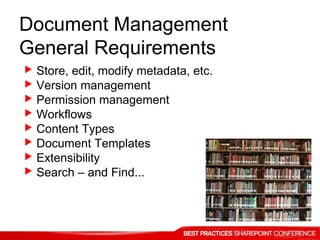
 Store, edit, modify metadata, etc.
 Version management
 Permission management
 Workflows
 Content Types
 Document Templates
 Extensibility
 Search – and Find...
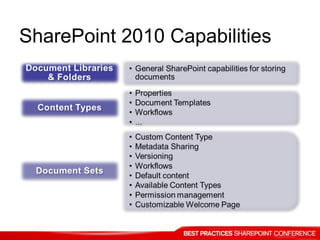
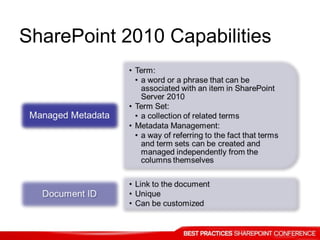
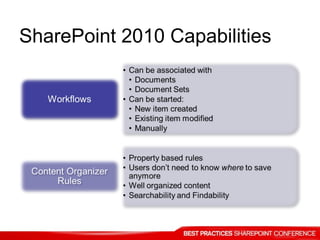
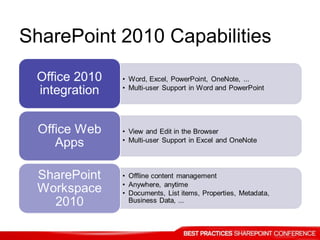
SharePoint 2010 Capabilities
Agenda
 Introduction::
 SharePoint 2010 Capabilities for supporting
Document Management
 Best Practices:Best Practices:
 Online and Offline Access to DocumentsOnline and Offline Access to Documents
 Metadata Management and Document
Management
 Organizing Documents
 Deploying a good Document Search
Infrastructure
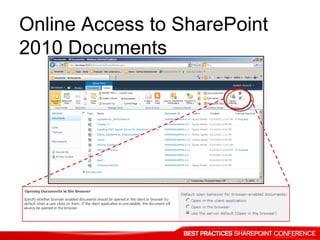
Online Access to SharePoint
2010 Documents
SharePoint in Browser
 Enforce users visiting SharePoint in the
browser, when:
 Internet/Extranet solutions
 but it depends...
 Unified User Interface for all content is important
 No SharePoint Workspace at all
 for example: branch offices
 Custom User Interface
 for example: custom forms, touch screen
Office Web Applications
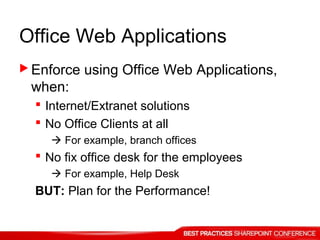
 Enforce using Office Web Applications,
when:
 Internet/Extranet solutions
 No Office Clients at all
 For example, branch offices
 No fix office desk for the employees
 For example, Help Desk
BUT: Plan for the Performance!
Office Web Applications
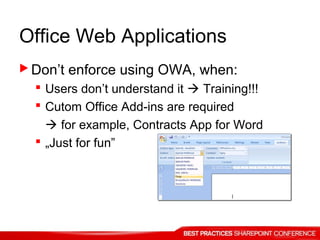
 Don’t enforce using OWA, when:
 Users don’t understand it  Training!!!
 Cutom Office Add-ins are required
 for example, Contracts App for Word
 „Just for fun”
SharePoint Workspace 2010
 Enforce using SharePoint Workspace
when:
 Offline access is needed
for example, sales people or agents
 Would like to access content from different
sources
BUT: Be careful and set the permissions
properly!
Accessing Content in SP2010 –
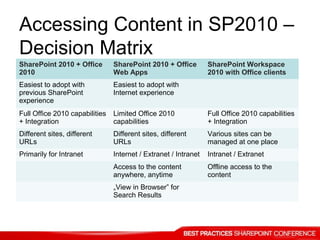
Decision Matrix
SharePoint 2010 + Office
2010
SharePoint 2010 + Office
Web Apps
SharePoint Workspace
2010 with Office clients
Easiest to adopt with
previous SharePoint
experience
Easiest to adopt with
Internet experience
Full Office 2010 capabilities
+ Integration
Limited Office 2010
capabilities
Full Office 2010 capabilities
+ Integration
Different sites, different
URLs
Different sites, different
URLs
Various sites can be
managed at one place
Primarily for Intranet Internet / Extranet / Intranet Intranet / Extranet
Access to the content
anywhere, anytime
Offline access to the
content
„View in Browser” for
Search Results
Agenda
 Introduction::
 SharePoint 2010 Capabilities for supporting
Document Management
 Best Practices:Best Practices:
 Online and Offline Access to Documents
 Metadata Management and DocumentMetadata Management and Document
ManagementManagement
 Organizing Documents
 Deploying a good Document Search
Infrastructure
Metadata Management in
SharePoint 2010
 Managed Metadata is much more than
Properties:
 Metadata-based navigation
 Filter on search results
 Independent, centralized management
 Metadata Hierarchy
 Synonyms
 Multi-language support
 Metadata owners
Metadata Management
 BUT: Not necessarily use managed
metadata, if:
 No need to reuse the term set
 No need to independent/centralized
management of properties
 No need the multi-language support
 No need the magamement of synonyms
Agenda
 Introduction::
 SharePoint 2010 Capabilities for supporting
Document Management
 Best Practices:Best Practices:
 Online and Offline Access to Documents
 Metadata Management and Document
Management
 Organizing DocumentsOrganizing Documents
 Deploying a good Document Search
Infrastructure
Organizing Documents in
SharePoint 2010
 SharePoint 2010 capabilities:
 Site Collections and Sites
 Document Libraries
 Document Sets
 Folders
 Content Types and document templates
 Content Organizer Rules
 ...
Organizing Documents in
SharePoint 2010
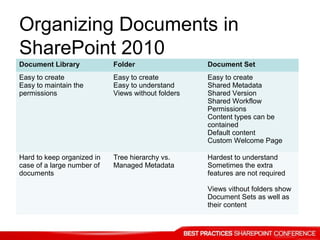
Document Library Folder Document Set
Easy to create
Easy to maintain the
permissions
Easy to create
Easy to understand
Views without folders
Easy to create
Shared Metadata
Shared Version
Shared Workflow
Permissions
Content types can be
contained
Default content
Custom Welcome Page
Hard to keep organized in
case of a large number of
documents
Tree hierarchy vs.
Managed Metadata
Hardest to understand
Sometimes the extra
features are not required
Views vithout folders show
Document Sets as well as
their content
Organizing Documents in
SharePoint 2010
 Content Types
Reusable collection of settings:
– metadata (columns)
– document templates
– workflows
– custom Document Information Panel
– information management settings
Planning Content Types
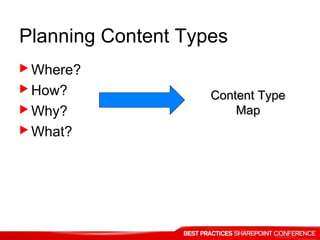
 Where?
 How?
 Why?
 What?
Content TypeContent Type
MapMap
Planning Content Types
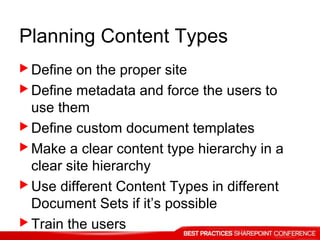
 Define on the proper site
 Define metadata and force the users to
use them
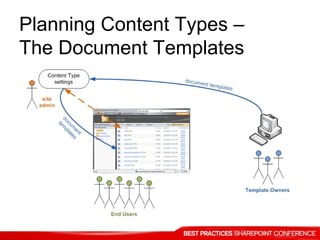
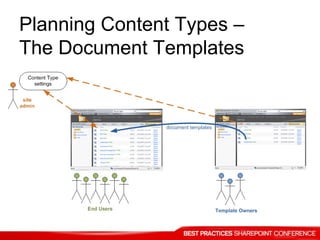
 Define custom document templates
 Make a clear content type hierarchy in a
clear site hierarchy
 Use different Content Types in different
Document Sets if it’s possible
 Train the users
Planning Content Types –
The Document Templates
Planning Content Types –
The Document Templates
Organizing Documents
Please visit my session tomorrow 
Agenda
 Introduction::
 SharePoint 2010 Capabilities for supporting
Document Management
 Best Practices:Best Practices:
 Online and Offline Access to Documents
 Metadata Management and Document
Management
 Organizing Documents
 Deploying a good Document SearchDeploying a good Document Search
InfrastructureInfrastructure
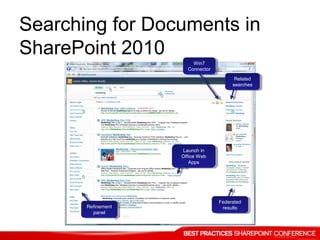
Searching for Documents in
SharePoint 2010
Refinement
panel
Refinement
panel
Related
searches
Related
searches
Federated
results
Federated
results
Win7
Connector
Win7
Connector
Launch in
Office Web
Apps
Launch in
Office Web
Apps
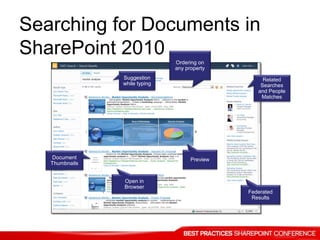
Searching for Documents in
SharePoint 2010
Suggestion
while typing
Document
Thumbnails
Preview
Open in
Browser
Related
Searches
and People
Matches
Federated
Results
Ordering on
any property
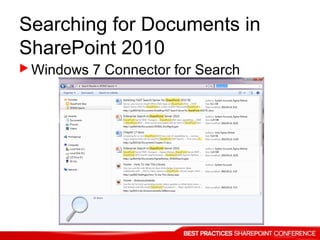
Searching for Documents in
SharePoint 2010
 Windows 7 Connector for Search
Deploying a good Document
Search Infrastructure
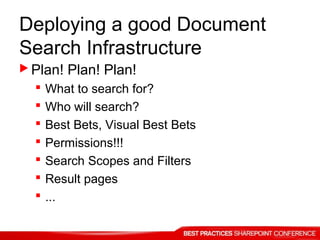
 Plan! Plan! Plan!
 What to search for?
 Who will search?
 Best Bets, Visual Best Bets
 Permissions!!!
 Search Scopes and Filters
 Result pages
 ...
Deploying a good Document
Search Infrastructure
 Test! Test! Test!
With REAL End-users!
 Learn! Learn! Learn!
Search in SharePoint 2010
 Visit my Search sessions on Thursday
Thank you!
Please be sure to fill out your
session evaluation!

Bpc10 16 agnes-molnar_enterprisedocmgmt

  • 1.
    Enterprise Document Management inSharePoint 2010 as You’ve Never Seen Ágnes Molnár SharePoint Server MVP Budapest, Hungary
  • 2.
    About the Speaker... Ágnes Molnár (Ághy)  SharePoint Server MVP, MCITP, MCTS, MCT  Budapest, Hungary  http://aghy.dotneteers.net  E-mail: aghy@aghy.hu  Twitter: @molnaragnes  Facebook: http://facebook.com/molnaragnes
  • 3.
  • 4.
    Sessions Title Day /Time / Venue 16 - Enterprise Document Management in SharePoint 2010 as You’ve Never Seen Tuesday 3:00 pm / Reston B 52 - Best Practices for Organizing Documents in SharePoint 2010 Wednesday 11:00 am / Reston B 119 - Best Practices for SharePoint 2010 Search Thursday 3:00 pm / Lake Thoreau Ask the Experts: Information Architecture Thursday 1:30 pm / Reston A
  • 5.
    Agenda  Introduction:  SharePoint2010 Capabilities for supporting Document Management  Best Practices:  Online and Offline Access to Documents  Metadata Management and Document Management  Organizing Documents  Deploying a good Document Search Infrastructure
  • 6.
    Agenda  Introduction:Introduction:  SharePoint2010 Capabilities forSharePoint 2010 Capabilities for supporting Document Managementsupporting Document Management  Best Practices:  Online and Offline Access to Documents  Metadata Management and Document Management  Organizing Documents  Deploying a good Document Search Infrastructure
  • 7.
    Document Management „A documentmanagement system (DMS) is a computer system (or set of computer programs) used to track and store electronic documents and/or images of paper documents.” (Wikipedia)
  • 8.
    Document Management General Requirements Store, edit, modify metadata, etc.  Version management  Permission management  Workflows  Content Types  Document Templates  Extensibility  Search – and Find...
  • 9.
  • 10.
  • 11.
  • 12.
  • 13.
    Agenda  Introduction::  SharePoint2010 Capabilities for supporting Document Management  Best Practices:Best Practices:  Online and Offline Access to DocumentsOnline and Offline Access to Documents  Metadata Management and Document Management  Organizing Documents  Deploying a good Document Search Infrastructure
  • 14.
    Online Access toSharePoint 2010 Documents
  • 16.
    SharePoint in Browser Enforce users visiting SharePoint in the browser, when:  Internet/Extranet solutions  but it depends...  Unified User Interface for all content is important  No SharePoint Workspace at all  for example: branch offices  Custom User Interface  for example: custom forms, touch screen
  • 17.
    Office Web Applications Enforce using Office Web Applications, when:  Internet/Extranet solutions  No Office Clients at all  For example, branch offices  No fix office desk for the employees  For example, Help Desk BUT: Plan for the Performance!
  • 18.
    Office Web Applications Don’t enforce using OWA, when:  Users don’t understand it  Training!!!  Cutom Office Add-ins are required  for example, Contracts App for Word  „Just for fun”
  • 19.
    SharePoint Workspace 2010 Enforce using SharePoint Workspace when:  Offline access is needed for example, sales people or agents  Would like to access content from different sources BUT: Be careful and set the permissions properly!
  • 20.
    Accessing Content inSP2010 – Decision Matrix SharePoint 2010 + Office 2010 SharePoint 2010 + Office Web Apps SharePoint Workspace 2010 with Office clients Easiest to adopt with previous SharePoint experience Easiest to adopt with Internet experience Full Office 2010 capabilities + Integration Limited Office 2010 capabilities Full Office 2010 capabilities + Integration Different sites, different URLs Different sites, different URLs Various sites can be managed at one place Primarily for Intranet Internet / Extranet / Intranet Intranet / Extranet Access to the content anywhere, anytime Offline access to the content „View in Browser” for Search Results
  • 21.
    Agenda  Introduction::  SharePoint2010 Capabilities for supporting Document Management  Best Practices:Best Practices:  Online and Offline Access to Documents  Metadata Management and DocumentMetadata Management and Document ManagementManagement  Organizing Documents  Deploying a good Document Search Infrastructure
  • 22.
    Metadata Management in SharePoint2010  Managed Metadata is much more than Properties:  Metadata-based navigation  Filter on search results  Independent, centralized management  Metadata Hierarchy  Synonyms  Multi-language support  Metadata owners
  • 23.
    Metadata Management  BUT:Not necessarily use managed metadata, if:  No need to reuse the term set  No need to independent/centralized management of properties  No need the multi-language support  No need the magamement of synonyms
  • 24.
    Agenda  Introduction::  SharePoint2010 Capabilities for supporting Document Management  Best Practices:Best Practices:  Online and Offline Access to Documents  Metadata Management and Document Management  Organizing DocumentsOrganizing Documents  Deploying a good Document Search Infrastructure
  • 25.
    Organizing Documents in SharePoint2010  SharePoint 2010 capabilities:  Site Collections and Sites  Document Libraries  Document Sets  Folders  Content Types and document templates  Content Organizer Rules  ...
  • 26.
    Organizing Documents in SharePoint2010 Document Library Folder Document Set Easy to create Easy to maintain the permissions Easy to create Easy to understand Views without folders Easy to create Shared Metadata Shared Version Shared Workflow Permissions Content types can be contained Default content Custom Welcome Page Hard to keep organized in case of a large number of documents Tree hierarchy vs. Managed Metadata Hardest to understand Sometimes the extra features are not required Views vithout folders show Document Sets as well as their content
  • 27.
    Organizing Documents in SharePoint2010  Content Types Reusable collection of settings: – metadata (columns) – document templates – workflows – custom Document Information Panel – information management settings
  • 28.
    Planning Content Types Where?  How?  Why?  What? Content TypeContent Type MapMap
  • 29.
    Planning Content Types Define on the proper site  Define metadata and force the users to use them  Define custom document templates  Make a clear content type hierarchy in a clear site hierarchy  Use different Content Types in different Document Sets if it’s possible  Train the users
  • 30.
    Planning Content Types– The Document Templates
  • 31.
    Planning Content Types– The Document Templates
  • 32.
    Organizing Documents Please visitmy session tomorrow 
  • 33.
    Agenda  Introduction::  SharePoint2010 Capabilities for supporting Document Management  Best Practices:Best Practices:  Online and Offline Access to Documents  Metadata Management and Document Management  Organizing Documents  Deploying a good Document SearchDeploying a good Document Search InfrastructureInfrastructure
  • 34.
    Searching for Documentsin SharePoint 2010 Refinement panel Refinement panel Related searches Related searches Federated results Federated results Win7 Connector Win7 Connector Launch in Office Web Apps Launch in Office Web Apps
  • 35.
    Searching for Documentsin SharePoint 2010 Suggestion while typing Document Thumbnails Preview Open in Browser Related Searches and People Matches Federated Results Ordering on any property
  • 36.
    Searching for Documentsin SharePoint 2010  Windows 7 Connector for Search
  • 37.
    Deploying a goodDocument Search Infrastructure  Plan! Plan! Plan!  What to search for?  Who will search?  Best Bets, Visual Best Bets  Permissions!!!  Search Scopes and Filters  Result pages  ...
  • 38.
    Deploying a goodDocument Search Infrastructure  Test! Test! Test! With REAL End-users!  Learn! Learn! Learn!
  • 39.
    Search in SharePoint2010  Visit my Search sessions on Thursday
  • 40.
    Thank you! Please besure to fill out your session evaluation!

Editor's Notes

  • #3 The SharePoint Server has gained a lot of popularity with the release of Microsoft Office SharePoint Server 2007. With the inclusion of document management and enterprise search capabilities, as well as Records Center and Excel Services modules, more and more companies are turning toward SharePoint in search of solutions to their business problems. With this growth comes big opening for business opportunities, but those who don’t have the right training approach stand to lose out on a customer’s or internal business units satisfaction. Some of the SharePoint environment roles are often defined as IT related, and information workers are often overlooked. Lack of training is the number one