Understanding Life Span
Human Development
An Introduction
Learning Objectives
Overview of Chapter
How should we think about development?
What is the science of lifespan
Development?
What are influences on development?
How is development Studied?
What special challenges do developmental
scientists face?
Goals for the study of human
development
Seeks to:
Describe
Explain
Predict
Modify development
• Scientists observe behavior and record
characteristics – Descriptive research
• Understanding the cause of behavior –
Experimental research
• Make predictions about when and how
behavior will occur – Correlational research
• Study negative behaviors and help
individuals change those behaviors and
help people make that their lives better
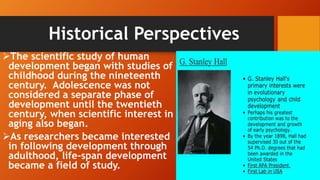
Historical Perspectives
The scientific study of human
development began with studies of
childhood during the nineteenth
century. Adolescence was not
considered a separate phase of
development until the twentieth
century, when scientific interest in
aging also began.
As researchers became interested
in following development through
adulthood, life-span development
became a field of study.
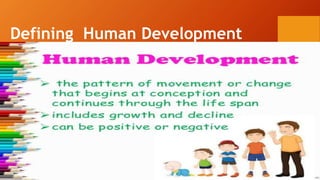
Defining Human Development
Human Development
Development is always evolving
Developmental scientists study
developmental change, both quantitative
and qualitative, as well as with stability of
personality and behavior.
Three Major Domains of Development
Physical development -
growth of body,
physiological change
Cognitive development –
Changes in perception,
language, learning, and
memory
Psychosocial development –
Changes in personality,
emotions
Developmental Scientists
also study:
Moral Development
Social Development
Each of these aspects
affects the other
Human Development
There are individual differences in
development.
Things that can influence development:
Heredity
Environment
This involves the Nurture-Nature Debate
Many typical changes during childhood are
related to maturation. Individual differences
increase with age.
Eight Periods of Development
The Prenatal Period – conception to birth
Infancy and Toddlerhood –birth-3 years
Early childhood 3-6 years
Middle childhood 6-12 years
Adolescence 12-20
Young adulthood – 30-40
Middle adulthood
Late adulthood- 65 and up
In each period, people have characteristic developmental
needs and tasks
Influences on Development
Ethnicity
Heredity
Environment
Culture
Historical context
Influences may be normative (age-graded
or history-graded) or non-normative
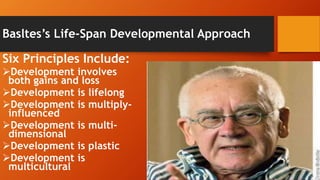
Basltes’s Life-Span Developmental Approach
Six Principles Include:
Development involves
both gains and loss
Development is lifelong
Development is multiply-
influenced
Development is multi-
dimensional
Development is plastic
Development is
multicultural
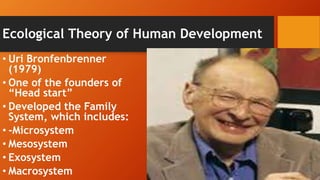
Ecological Theory of Human Development
• Uri Bronfenbrenner
(1979)
• One of the founders of
“Head start”
• Developed the Family
System, which includes:
• -Microsystem
• Mesosystem
• Exosystem
• Macrosystem
How Development is Studied
•Scientists use various methods in studying
development:
• Qualitative or Quantitative Research
•Scientists use Random selection to ensure
generalizability
• Three forms of data collection:
• Self-Reports (Interviews, questionnaires, diaries)
• Behavioral and performance measures
• Observation
Research Designs
Research designs used in studying
development include:
Case Studies and ethnographic
study (Qualitative design)
designs used to study age-related
development are:
 longitudinal – describe
continuity or change in the same
participants
There are advantages and
disadvantages to each design
Correlational Studies and
Experiments (Quantitative
design)
cross-sectional –compare age
groups
Only the experiment can
establish a causal relationship
Sequential – intended to
overcome the weaknesses of
the other two designs
Ethical Issues in Research
• Ethical Issues in research
include:
•Informed Consent
•Avoidance of deception
•Protection from harm
•Debriefing after
completion of study
•Confidentiality

An Introduction to Understanding Life Span Human Development

  • 1.
    Understanding Life Span HumanDevelopment An Introduction
  • 2.
    Learning Objectives Overview ofChapter How should we think about development? What is the science of lifespan Development? What are influences on development? How is development Studied? What special challenges do developmental scientists face?
  • 3.
    Goals for thestudy of human development Seeks to: Describe Explain Predict Modify development • Scientists observe behavior and record characteristics – Descriptive research • Understanding the cause of behavior – Experimental research • Make predictions about when and how behavior will occur – Correlational research • Study negative behaviors and help individuals change those behaviors and help people make that their lives better
  • 4.
    Historical Perspectives The scientificstudy of human development began with studies of childhood during the nineteenth century. Adolescence was not considered a separate phase of development until the twentieth century, when scientific interest in aging also began. As researchers became interested in following development through adulthood, life-span development became a field of study.
  • 5.
  • 6.
    Human Development Development isalways evolving Developmental scientists study developmental change, both quantitative and qualitative, as well as with stability of personality and behavior.
  • 7.
    Three Major Domainsof Development Physical development - growth of body, physiological change Cognitive development – Changes in perception, language, learning, and memory Psychosocial development – Changes in personality, emotions Developmental Scientists also study: Moral Development Social Development Each of these aspects affects the other
  • 8.
    Human Development There areindividual differences in development. Things that can influence development: Heredity Environment This involves the Nurture-Nature Debate Many typical changes during childhood are related to maturation. Individual differences increase with age.
  • 9.
    Eight Periods ofDevelopment The Prenatal Period – conception to birth Infancy and Toddlerhood –birth-3 years Early childhood 3-6 years Middle childhood 6-12 years Adolescence 12-20 Young adulthood – 30-40 Middle adulthood Late adulthood- 65 and up In each period, people have characteristic developmental needs and tasks
  • 10.
    Influences on Development Ethnicity Heredity Environment Culture Historicalcontext Influences may be normative (age-graded or history-graded) or non-normative
  • 11.
    Basltes’s Life-Span DevelopmentalApproach Six Principles Include: Development involves both gains and loss Development is lifelong Development is multiply- influenced Development is multi- dimensional Development is plastic Development is multicultural
  • 12.
    Ecological Theory ofHuman Development • Uri Bronfenbrenner (1979) • One of the founders of “Head start” • Developed the Family System, which includes: • -Microsystem • Mesosystem • Exosystem • Macrosystem
  • 13.
    How Development isStudied •Scientists use various methods in studying development: • Qualitative or Quantitative Research •Scientists use Random selection to ensure generalizability • Three forms of data collection: • Self-Reports (Interviews, questionnaires, diaries) • Behavioral and performance measures • Observation
  • 14.
    Research Designs Research designsused in studying development include: Case Studies and ethnographic study (Qualitative design) designs used to study age-related development are:  longitudinal – describe continuity or change in the same participants There are advantages and disadvantages to each design Correlational Studies and Experiments (Quantitative design) cross-sectional –compare age groups Only the experiment can establish a causal relationship Sequential – intended to overcome the weaknesses of the other two designs
  • 15.
    Ethical Issues inResearch • Ethical Issues in research include: •Informed Consent •Avoidance of deception •Protection from harm •Debriefing after completion of study •Confidentiality