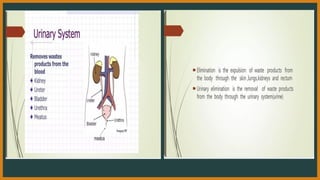
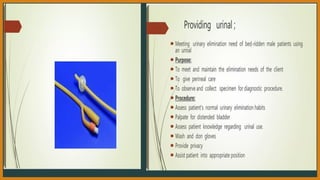
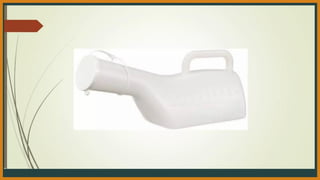
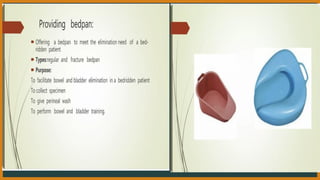
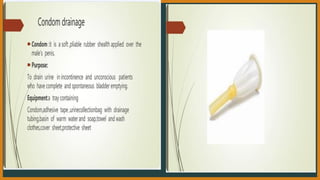
URINARY
ELIMINATION
BOWEL ELIMINATION
DEFECATION
- is the expulsion of faces from the rectum.
-it may be facilitated voluntarily by contracting the
abdominal muscles and by forceful expiration with glottis
closed increase abdominal pressure(valsalva maneuver).
• The fecal matter may take24 to 48 hours to pass through
the entire large intestine
• Between150-300 grams of feces is produced daily.
• The faces consist of 75% water and 25% solid
• If the feces Are moved rapidly through the large intestine, less water is
absorbed and the stool is liquid.
• If the movement of the faces and elimination are delayed, an excessive
amount of water is absorbed and the stool becomes hard and dry.
NORMAL CHARACTERISTICS OF THE STOOL
1. COLOR: yellow or golden brown( due to bile pigment derivative known as stercobilin
or fecal urobilinogen)
2. ODOR: aromatic upon defecation( due to indole and scatole, which are products of
fermentation and putrefraction in the large intestine).
3. AMOUNT: Depends on the bulk of the food intake.
4. CONSISTENCY: soft, formed
5. SHAPE: Cylindrical
6. FREQUENCY: variable; usually range1-2 per day to 1 every2-3 days
ALTERATION ON THE CHARACTERISTICS OF
STOOL
1. ACHOLIC STOOL- gray, pale or clay-colored stool due to absence of stercobilin
caused by biliary obstruction.
2. HEMATOCHEZIA- passage of stool with bright red blood. It is due to lower
gastrointestinal bleeding.
3. MELENA- passage of black harry stool due to upper GI bleeding.
4. STEATORRHEA- greasy, bulky, foul-smelling stool. It is due to presence of
undigested fats like in hepatobiliary-pancreatic obstructions/ disorders.
COMMON FECAL ELIMINATION PROBLEMS
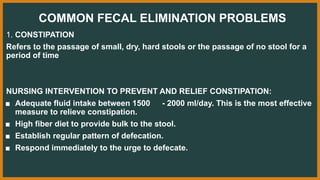
1. CONSTIPATION
Refers to the passage of small, dry, hard stools or the passage of no stool for a
period of time
NURSING INTERVENTION TO PREVENT AND RELIEF CONSTIPATION:
■ Adequate fluid intake between 1500 - 2000 ml/day. This is the most effective
measure to relieve constipation.
■ High fiber diet to provide bulk to the stool.
■ Establish regular pattern of defecation.
■ Respond immediately to the urge to defecate.
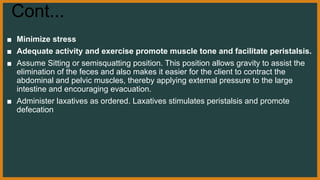
Cont...
■ Minimize stress
■ Adequate activity and exercise promote muscle tone and facilitate peristalsis.
■ Assume Sitting or semisquatting position. This position allows gravity to assist the
elimination of the feces and also makes it easier for the client to contract the
abdominal and pelvic muscles, thereby applying external pressure to the large
intestine and encouraging evacuation.
■ Administer laxatives as ordered. Laxatives stimulates peristalsis and promote
defecation
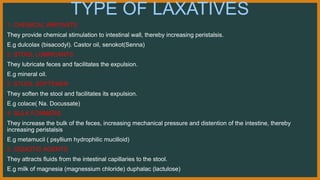
TYPE OF LAXATIVES
1. CHEMICAL IRRITANTS
They provide chemical stimulation to intestinal wall, thereby increasing peristalsis.
E.g dulcolax (bisacodyl). Castor oil, senokot(Senna)
2. STOOL LUBRICANTS
They lubricate feces and facilitates the expulsion.
E.g mineral oil.
3. STOOL SOFTENER
They soften the stool and facilitates its expulsion.
E.g colace( Na. Docussate)
4. BULK FORMERS
They increase the bulk of the feces, increasing mechanical pressure and distention of the intestine, thereby
increasing peristalsis
E.g metamucil ( psyllium hydrophilic mucilloid)
5. OSMOTIC AGENTS
They attracts fluids from the intestinal capillaries to the stool.
E.g milk of magnesia (magnessium chloride) duphalac (lactulose)
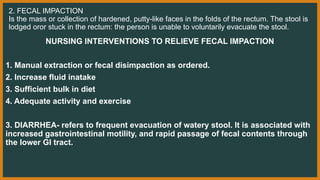
2. FECAL IMPACTION
Is the mass or collection of hardened, putty-like faces in the folds of the rectum. The stool is
lodged oror stuck in the rectum: the person is unable to voluntarily evacuate the stool.
NURSING INTERVENTIONS TO RELIEVE FECAL IMPACTION
1. Manual extraction or fecal disimpaction as ordered.
2. Increase fluid inatake
3. Sufficient bulk in diet
4. Adequate activity and exercise
3. DIARRHEA- refers to frequent evacuation of watery stool. It is associated with
increased gastrointestinal motility, and rapid passage of fecal contents through
the lower GI tract.
NURSING INTERVENTIONS
1. Replace fluid and electrolyte losses.
2. Provide good perineal care. Diarreheal stool is often times highly acidic. This causes
anal soreness and irritation in the perineal area.
3. Promote rest. To reduce peristalsis.
4. Diet: small amount of bland foods, low fiber diet, brat diet( banana, rice am, apple,
toast), avoid excessively hot and cold fluids, potassium-rich food (banana, gatorade)
5. Antidiarrheal medications as ordered
- DEMULCENTS- mechanically coat the irritated bowel and act as protectives.
-ABSORBENTS- absorbs gas or toxic substances from the bowel
-ASTRIGENTS- shrinks swollen or inflamed tissues in the bowel.
CAUTION: do not administer antidiarrheal at the start of diarrhea. Diarrhea is the body's
protective mechanism to rid itself of bacteria and toxins.
4. Flatulence
-Is the presence of excessive gas in the intestines, (also tympanites). This may be
due to swallowed air, bacterial action in the large intestine and diffusion from stool.
COMMON CAUSES OF FLATULENCE
✔ Constipation
✔ Codeine, barbiturates and other medication that decrease intestinal motility
✔ Anxiety
✔ Eating gas-forming foods( cabbage, onions, rootcrops,legumes)
✔ Rapid food or fluid ingestion
✔ Improper use of drinking straw
✔ Excessive drinking of carbonated beverages
✔ Gum chewing, candy sucking, smoking
✔ Abdominal surgery
NURSING INTERVENTIONS
1. Avoid gas-forming foods
2. Provide warm fluids to drink
3. Early ambulation among postoperative clients.
4. Adequate activity and exercise
5. Limit carbonated beverages, use of drinking straws and chewing gum
6. Rectal tube insertion as ordered.
7. Carminative enema as ordered.
8. Administer cholinergics as ordered.
5. FECAL INCONTINENCE
◆ Is the involuntary elimination of bowel contents; it is often associated with
neurologic, mental, or emotional impairness.
◆ Clients with cerebral corrected injury may be unable to perceive distended rectum,
or are unable to initiate the motor response required to inhibit defecation
voluntarily.
◆ People who have sustained sacral spinal cord injury experience impaired nerve
supply to the rectum and anal sphincters. They are unable to inhibit voluntary anal
sphincters to postpone defecation.
◆ Clients who are disoriented or confused may have lost the social inhibition that
prevents immediate fecal evacuation.
◆ Diarrhea predisposes a person to fecal incontinence. Sometimes, the volume of
feces is so large and the defecation urge so intense that the person cannot
maintain sphincter contraction long enough to access toilet facilities and remove
the necessary clothing.
Purposes of administering enemas:
1. To relieve constipation and fecal impaction
2. To relieve flatulence
3. To administer medication
4. To evaluate feces in preparation for diagnostic procedure or surgery.
TYPES OF ENEMAS
1. CLEANSING ENEMA- stimulates peristalsis by irritating the colon and rectum and
or by distending the intestine with the volume of fluid introduced.
A. High enema- to clean as much of the colon as possible; 1000ml of solution is
introduced to an adult
B. Low enema- to clean the rectum and the sigmoid colon only; 500ml of solution is
introduced to an adult
2. CARMINATIVE ENEMA- to expel flatus. 60-180ml of fluid is introduced
3. RETENTION ENEMA- introduces oil into the rectum and sigmoid colon; oil
retained in1 to3 hors. Acts to soften the feces and to lubricate the rectum and the
anal canal, facilitatingfacilit passage of feces.
4. Return flow enema/harris flush/colonic irrigation- done to expel flatus.
THANK YOU FOR YOUR
ATTENTION

URINARY-ELIMINATION (funda)-PPT.pptx.pdf

  • 1.
  • 40.
    BOWEL ELIMINATION DEFECATION - isthe expulsion of faces from the rectum. -it may be facilitated voluntarily by contracting the abdominal muscles and by forceful expiration with glottis closed increase abdominal pressure(valsalva maneuver). • The fecal matter may take24 to 48 hours to pass through the entire large intestine • Between150-300 grams of feces is produced daily. • The faces consist of 75% water and 25% solid
  • 41.
    • If thefeces Are moved rapidly through the large intestine, less water is absorbed and the stool is liquid. • If the movement of the faces and elimination are delayed, an excessive amount of water is absorbed and the stool becomes hard and dry. NORMAL CHARACTERISTICS OF THE STOOL 1. COLOR: yellow or golden brown( due to bile pigment derivative known as stercobilin or fecal urobilinogen) 2. ODOR: aromatic upon defecation( due to indole and scatole, which are products of fermentation and putrefraction in the large intestine). 3. AMOUNT: Depends on the bulk of the food intake. 4. CONSISTENCY: soft, formed 5. SHAPE: Cylindrical 6. FREQUENCY: variable; usually range1-2 per day to 1 every2-3 days
  • 42.
    ALTERATION ON THECHARACTERISTICS OF STOOL 1. ACHOLIC STOOL- gray, pale or clay-colored stool due to absence of stercobilin caused by biliary obstruction. 2. HEMATOCHEZIA- passage of stool with bright red blood. It is due to lower gastrointestinal bleeding. 3. MELENA- passage of black harry stool due to upper GI bleeding. 4. STEATORRHEA- greasy, bulky, foul-smelling stool. It is due to presence of undigested fats like in hepatobiliary-pancreatic obstructions/ disorders.
  • 43.
    COMMON FECAL ELIMINATIONPROBLEMS 1. CONSTIPATION Refers to the passage of small, dry, hard stools or the passage of no stool for a period of time NURSING INTERVENTION TO PREVENT AND RELIEF CONSTIPATION: ■ Adequate fluid intake between 1500 - 2000 ml/day. This is the most effective measure to relieve constipation. ■ High fiber diet to provide bulk to the stool. ■ Establish regular pattern of defecation. ■ Respond immediately to the urge to defecate.
  • 44.
    Cont... ■ Minimize stress ■Adequate activity and exercise promote muscle tone and facilitate peristalsis. ■ Assume Sitting or semisquatting position. This position allows gravity to assist the elimination of the feces and also makes it easier for the client to contract the abdominal and pelvic muscles, thereby applying external pressure to the large intestine and encouraging evacuation. ■ Administer laxatives as ordered. Laxatives stimulates peristalsis and promote defecation
  • 45.
    TYPE OF LAXATIVES 1.CHEMICAL IRRITANTS They provide chemical stimulation to intestinal wall, thereby increasing peristalsis. E.g dulcolax (bisacodyl). Castor oil, senokot(Senna) 2. STOOL LUBRICANTS They lubricate feces and facilitates the expulsion. E.g mineral oil. 3. STOOL SOFTENER They soften the stool and facilitates its expulsion. E.g colace( Na. Docussate) 4. BULK FORMERS They increase the bulk of the feces, increasing mechanical pressure and distention of the intestine, thereby increasing peristalsis E.g metamucil ( psyllium hydrophilic mucilloid) 5. OSMOTIC AGENTS They attracts fluids from the intestinal capillaries to the stool. E.g milk of magnesia (magnessium chloride) duphalac (lactulose)
  • 46.
    2. FECAL IMPACTION Isthe mass or collection of hardened, putty-like faces in the folds of the rectum. The stool is lodged oror stuck in the rectum: the person is unable to voluntarily evacuate the stool. NURSING INTERVENTIONS TO RELIEVE FECAL IMPACTION 1. Manual extraction or fecal disimpaction as ordered. 2. Increase fluid inatake 3. Sufficient bulk in diet 4. Adequate activity and exercise 3. DIARRHEA- refers to frequent evacuation of watery stool. It is associated with increased gastrointestinal motility, and rapid passage of fecal contents through the lower GI tract.
  • 47.
    NURSING INTERVENTIONS 1. Replacefluid and electrolyte losses. 2. Provide good perineal care. Diarreheal stool is often times highly acidic. This causes anal soreness and irritation in the perineal area. 3. Promote rest. To reduce peristalsis. 4. Diet: small amount of bland foods, low fiber diet, brat diet( banana, rice am, apple, toast), avoid excessively hot and cold fluids, potassium-rich food (banana, gatorade) 5. Antidiarrheal medications as ordered - DEMULCENTS- mechanically coat the irritated bowel and act as protectives. -ABSORBENTS- absorbs gas or toxic substances from the bowel -ASTRIGENTS- shrinks swollen or inflamed tissues in the bowel. CAUTION: do not administer antidiarrheal at the start of diarrhea. Diarrhea is the body's protective mechanism to rid itself of bacteria and toxins.
  • 48.
    4. Flatulence -Is thepresence of excessive gas in the intestines, (also tympanites). This may be due to swallowed air, bacterial action in the large intestine and diffusion from stool. COMMON CAUSES OF FLATULENCE ✔ Constipation ✔ Codeine, barbiturates and other medication that decrease intestinal motility ✔ Anxiety ✔ Eating gas-forming foods( cabbage, onions, rootcrops,legumes) ✔ Rapid food or fluid ingestion ✔ Improper use of drinking straw ✔ Excessive drinking of carbonated beverages ✔ Gum chewing, candy sucking, smoking ✔ Abdominal surgery
  • 49.
    NURSING INTERVENTIONS 1. Avoidgas-forming foods 2. Provide warm fluids to drink 3. Early ambulation among postoperative clients. 4. Adequate activity and exercise 5. Limit carbonated beverages, use of drinking straws and chewing gum 6. Rectal tube insertion as ordered. 7. Carminative enema as ordered. 8. Administer cholinergics as ordered.
  • 50.
    5. FECAL INCONTINENCE ◆Is the involuntary elimination of bowel contents; it is often associated with neurologic, mental, or emotional impairness. ◆ Clients with cerebral corrected injury may be unable to perceive distended rectum, or are unable to initiate the motor response required to inhibit defecation voluntarily. ◆ People who have sustained sacral spinal cord injury experience impaired nerve supply to the rectum and anal sphincters. They are unable to inhibit voluntary anal sphincters to postpone defecation. ◆ Clients who are disoriented or confused may have lost the social inhibition that prevents immediate fecal evacuation. ◆ Diarrhea predisposes a person to fecal incontinence. Sometimes, the volume of feces is so large and the defecation urge so intense that the person cannot maintain sphincter contraction long enough to access toilet facilities and remove the necessary clothing.
  • 51.
    Purposes of administeringenemas: 1. To relieve constipation and fecal impaction 2. To relieve flatulence 3. To administer medication 4. To evaluate feces in preparation for diagnostic procedure or surgery. TYPES OF ENEMAS 1. CLEANSING ENEMA- stimulates peristalsis by irritating the colon and rectum and or by distending the intestine with the volume of fluid introduced. A. High enema- to clean as much of the colon as possible; 1000ml of solution is introduced to an adult B. Low enema- to clean the rectum and the sigmoid colon only; 500ml of solution is introduced to an adult
  • 52.
    2. CARMINATIVE ENEMA-to expel flatus. 60-180ml of fluid is introduced 3. RETENTION ENEMA- introduces oil into the rectum and sigmoid colon; oil retained in1 to3 hors. Acts to soften the feces and to lubricate the rectum and the anal canal, facilitatingfacilit passage of feces. 4. Return flow enema/harris flush/colonic irrigation- done to expel flatus.
  • 53.
    THANK YOU FORYOUR ATTENTION