Bovine Spongiform
Encephalopathy
RAFAT FOIZE CHOWDHURY
ID # 172-016-061
MS in Microbiology
PRIMEASIA UNIVERSITY
1
BOVINE SPONGIFORM
ENCEPHALOPATHY (BSE)
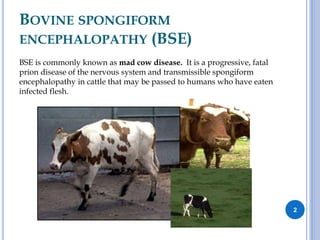
BSE is commonly known as mad cow disease. It is a progressive, fatal
prion disease of the nervous system and transmissible spongiform
encephalopathy in cattle that may be passed to humans who have eaten
infected flesh.
2
HISTORY OF DISEASE
 BSE was first recognized and defined in UK in November
1986.
 From 1987 to 2007, UK has reported more than 180,000 cases
of BSE accounting for 97% of all cases reported throughout
the world.
3
CAUSES OF DISEASE
 The infectious agent in bovine spongiform encephalopathy is
a specific type of misfolded protein called a prion.
 Prions can be transmitted to humans by eating food
contaminated with them.
 Prions are not destroyed even if the beef or material
containing them is cooked or heat-treated.
 Prion proteins carry the disease between individuals and
cause deterioration of the brain.
4
TRANSMISSION
 BSE is a transmissible disease that primarily affects the central
nervous system (brain & spinal tissue); it is a form of
transmissible spongiform encephalopathy, like
 Creutzfeldt–Jakob disease in humans
 Scrapie in sheep
 Chronic wasting disease in corvids
 The spread of this disease in cattle is caused by feeding
rendered material from infected cattle back to other cattle.
5
SIGNS & SYMPTOMS
 BSE has a long incubation period : 2-8 years.
 Clinical signs of BSE are found in adult animals. Symptoms
may last for a period of two to six months before the animal
dies.
 Animals with BSE may demonstrate some of the following
symptoms:
 nervous or aggressive behaviour
 Depression
 hypersensitive to sound and touch, twitching, tremors
 abnormal posture
 lack of co-ordination and difficulty in rising from a lying position
 weight loss
 decreased milk production
6
DIAGNOSIS
 The BSE testing protocol calls for an initial rapid test called an
Enzyme-Linked Immunosorbent Assay (ELISA)
 If the ELISA test is inconclusive, samples are sent for
confirmatory testing to the National Veterinary Services
Laboratories (NVSL)
 An immunohistochemistry test Western Blot is conducted at
National Animal Disease Center (NADC)
 The tests are designed to detect the presence of BSE-specific
abnormal prion protein in the brain tissue.
7
VACCINATION/PREVENTION
 No effective vaccine
 A ban on feeding meat and bone meal to cattle from countries
where the disease was present
 Surveillance measures
 Blood/plasma donation restrictions
8
TREATMENT
 There is no treatment for BSE
 Some of the symptoms can be managed
 Treatment is palliative care
9
Thank You
10

Bovine spongiform encephalopathy

  • 1.
    Bovine Spongiform Encephalopathy RAFAT FOIZECHOWDHURY ID # 172-016-061 MS in Microbiology PRIMEASIA UNIVERSITY 1
  • 2.
    BOVINE SPONGIFORM ENCEPHALOPATHY (BSE) BSEis commonly known as mad cow disease. It is a progressive, fatal prion disease of the nervous system and transmissible spongiform encephalopathy in cattle that may be passed to humans who have eaten infected flesh. 2
  • 3.
    HISTORY OF DISEASE BSE was first recognized and defined in UK in November 1986.  From 1987 to 2007, UK has reported more than 180,000 cases of BSE accounting for 97% of all cases reported throughout the world. 3
  • 4.
    CAUSES OF DISEASE The infectious agent in bovine spongiform encephalopathy is a specific type of misfolded protein called a prion.  Prions can be transmitted to humans by eating food contaminated with them.  Prions are not destroyed even if the beef or material containing them is cooked or heat-treated.  Prion proteins carry the disease between individuals and cause deterioration of the brain. 4
  • 5.
    TRANSMISSION  BSE isa transmissible disease that primarily affects the central nervous system (brain & spinal tissue); it is a form of transmissible spongiform encephalopathy, like  Creutzfeldt–Jakob disease in humans  Scrapie in sheep  Chronic wasting disease in corvids  The spread of this disease in cattle is caused by feeding rendered material from infected cattle back to other cattle. 5
  • 6.
    SIGNS & SYMPTOMS BSE has a long incubation period : 2-8 years.  Clinical signs of BSE are found in adult animals. Symptoms may last for a period of two to six months before the animal dies.  Animals with BSE may demonstrate some of the following symptoms:  nervous or aggressive behaviour  Depression  hypersensitive to sound and touch, twitching, tremors  abnormal posture  lack of co-ordination and difficulty in rising from a lying position  weight loss  decreased milk production 6
  • 7.
    DIAGNOSIS  The BSEtesting protocol calls for an initial rapid test called an Enzyme-Linked Immunosorbent Assay (ELISA)  If the ELISA test is inconclusive, samples are sent for confirmatory testing to the National Veterinary Services Laboratories (NVSL)  An immunohistochemistry test Western Blot is conducted at National Animal Disease Center (NADC)  The tests are designed to detect the presence of BSE-specific abnormal prion protein in the brain tissue. 7
  • 8.
    VACCINATION/PREVENTION  No effectivevaccine  A ban on feeding meat and bone meal to cattle from countries where the disease was present  Surveillance measures  Blood/plasma donation restrictions 8
  • 9.
    TREATMENT  There isno treatment for BSE  Some of the symptoms can be managed  Treatment is palliative care 9
  • 10.