1
Boundary Lubrication
Definition: Campbell [1]
"Boundary lubrication is lubrication by a liquid under
conditions where the solid surfaces are so close together that
appreciable contact between opposing asperities is possible. The
friction and wear in boundary lubrication are determined
predominantly by interaction between the solids and between
the solids and the liquid. The bulk flow properties of the liquid
play little or no part in the friction and wear behavior. "
Stribeck Curve
2
Characteristics
• Liquid-solid interactions
• Contact between asperities
− Increased friction
− Wear
• Friction & wear determined by properties of solid
surfaces as well as properties of lubricant
• Shear of thin surface films
− Lubricant films < 100 nm thick
− Several to hundreds of molecules thick
− Solid or liquid
− “Lubricant starved” contact
• Load sharing
− Asperity-asperity contacts
− Lubricant pressures generated by
 Squeeze films
 Sliding
• "Oiliness" of surfaces determines friction
− Lubricant film thickness < 100 nm thick
3
Examples
 Engines: Piston rings & liner @ TDC & BDC
 Biological
o Synovial joints, e.g., knee with synovial fluid
o Teeth/saliva during chewing
 Oiled gun barrel & bullet
 Start up & shut down of equipment:
o Engines
o Bearings
o Cams
 Lubricated metal cutting or machining
4
Protective Films
• Chemical interactions form (protective) films
− Surface absorption
− Surface reactions
• Diamond like (protective) films
− Very low (dry) friction µ ≈ 0.001
− Chemically inert, very hard
− Ali Erdemir: "Near-Frictionless Carbon…….ultra-
hard coating many times slicker than Teflon."
− Hydrogenated carbon bonded to surface, unreactive.
• Design of protective boundary films (hydrocarbons)
− Film absorbs to surface
− Bodies don't touch
− Class of oil additives for bonding to surfaces
(surfactants)
5
GREASES
MOLECULAR DYNAMICS OF FILMS
FLOW THROUGH ROUGH SURFACES
ADHESION OF LUBRICANT
GOOD BOUNDARY LUBRICANTS
6
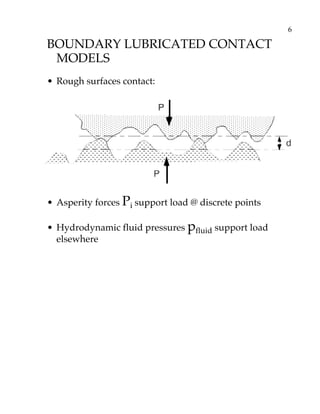
BOUNDARY LUBRICATED CONTACT
MODELS
• Rough surfaces contact:
• Asperity forces Pi support load @ discrete points
• Hydrodynamic fluid pressures pfluid support load
elsewhere
7
• Total load support
P = Σasperities Pi + ∫area pfluid dA
≈ N ⌡
⌠
d
∞
  Pi(z) F(z) dz
+ ∫A pfluid dA
Notes:
• Real contact area Areal << A, apparent contact area.
Thus
∫(A - Areal) pfluid dA ≈ ∫A pfluid dA
• Many asperities of many heights, thus
Σasperities Pi ≈ N ⌡
⌠
d
∞
  Pi(z) F(z) dz
8
• References
1. W.E. Campbell, Boundary Lubrication, Boundary Lubrication, an Appraisal of
World Literature, ASME, 1969, pp. 87-117..
2. N.K Myshkin, Chung Kyun Kim, Mark I Petrokovets, Introduction to Tribology,
Cheong Moon Gak, 1997.

Boundary Lubrication

  • 1.
    1 Boundary Lubrication Definition: Campbell[1] "Boundary lubrication is lubrication by a liquid under conditions where the solid surfaces are so close together that appreciable contact between opposing asperities is possible. The friction and wear in boundary lubrication are determined predominantly by interaction between the solids and between the solids and the liquid. The bulk flow properties of the liquid play little or no part in the friction and wear behavior. " Stribeck Curve
  • 2.
    2 Characteristics • Liquid-solid interactions •Contact between asperities − Increased friction − Wear • Friction & wear determined by properties of solid surfaces as well as properties of lubricant • Shear of thin surface films − Lubricant films < 100 nm thick − Several to hundreds of molecules thick − Solid or liquid − “Lubricant starved” contact • Load sharing − Asperity-asperity contacts − Lubricant pressures generated by  Squeeze films  Sliding • "Oiliness" of surfaces determines friction − Lubricant film thickness < 100 nm thick
  • 3.
    3 Examples  Engines: Pistonrings & liner @ TDC & BDC  Biological o Synovial joints, e.g., knee with synovial fluid o Teeth/saliva during chewing  Oiled gun barrel & bullet  Start up & shut down of equipment: o Engines o Bearings o Cams  Lubricated metal cutting or machining
  • 4.
    4 Protective Films • Chemicalinteractions form (protective) films − Surface absorption − Surface reactions • Diamond like (protective) films − Very low (dry) friction µ ≈ 0.001 − Chemically inert, very hard − Ali Erdemir: "Near-Frictionless Carbon…….ultra- hard coating many times slicker than Teflon." − Hydrogenated carbon bonded to surface, unreactive. • Design of protective boundary films (hydrocarbons) − Film absorbs to surface − Bodies don't touch − Class of oil additives for bonding to surfaces (surfactants)
  • 5.
    5 GREASES MOLECULAR DYNAMICS OFFILMS FLOW THROUGH ROUGH SURFACES ADHESION OF LUBRICANT GOOD BOUNDARY LUBRICANTS
  • 6.
    6 BOUNDARY LUBRICATED CONTACT MODELS •Rough surfaces contact: • Asperity forces Pi support load @ discrete points • Hydrodynamic fluid pressures pfluid support load elsewhere
  • 7.
    7 • Total loadsupport P = Σasperities Pi + ∫area pfluid dA ≈ N ⌡ ⌠ d ∞   Pi(z) F(z) dz + ∫A pfluid dA Notes: • Real contact area Areal << A, apparent contact area. Thus ∫(A - Areal) pfluid dA ≈ ∫A pfluid dA • Many asperities of many heights, thus Σasperities Pi ≈ N ⌡ ⌠ d ∞   Pi(z) F(z) dz
  • 8.
    8 • References 1. W.E.Campbell, Boundary Lubrication, Boundary Lubrication, an Appraisal of World Literature, ASME, 1969, pp. 87-117.. 2. N.K Myshkin, Chung Kyun Kim, Mark I Petrokovets, Introduction to Tribology, Cheong Moon Gak, 1997.