
BOTOX-MITIGATING RISKS AND MANAGING
COMPLICATIONS
DR.MOHNISH SEKAR
CONSULTANT DERMATOLOGIST
INTRODUCTION
 Cosmetic surgery and Aesthetic procedures Billion dollar industry owing to the ever-growing
demand of the population to stay young.
 Treatment modalities Relatively safe Side effects.
Fillers
and
Botox
Quick
Results
Rejuvenation
Facial
wrinkles
Highly
Popular
MITIGATING RISKS
 Patient selection Crucial step toward prevention of patient dissatisfaction.
 Every patient needs an extensive informative consultation that covers not only the BTX option but
also all alternative methods and procedures.
 Made aware that facial asymmetry is common,
 Use of BTX cannot guarantee facial symmetry; Asymmetry hyperactive muscles can be smoothened.
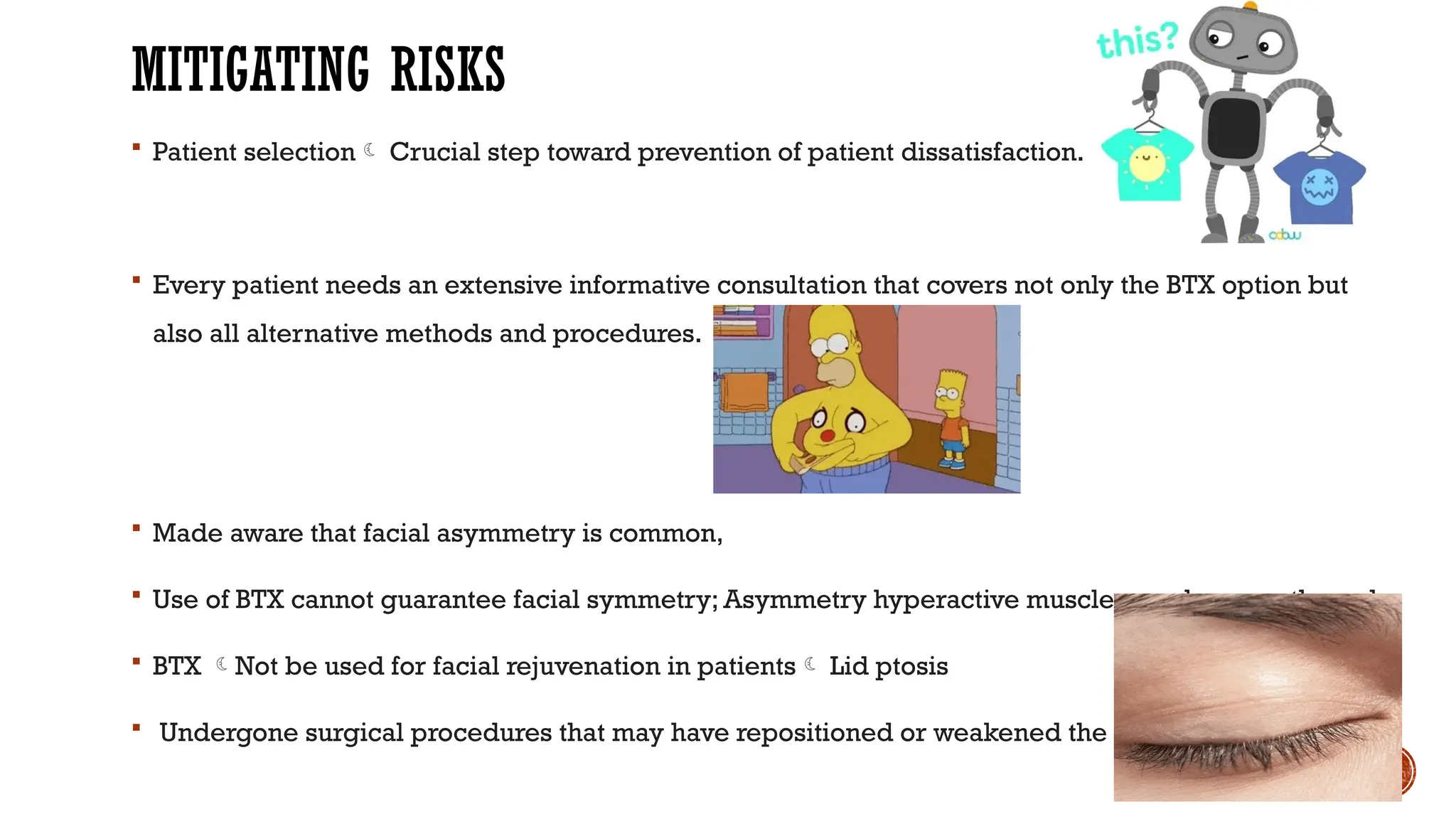
 BTX Not be used for facial rejuvenation in patients Lid ptosis
 Undergone surgical procedures that may have repositioned or weakened the muscles.
SELECTION OF CANDIDATES
Poor
Candidates
Evaluate Vigilantly
Politicians and
Actors
Mask like face
FILLERS
Good Alternative
Psychiatric and
Unrealistic
expectation
Systemic Botulism
CONTRAINDICATIONS
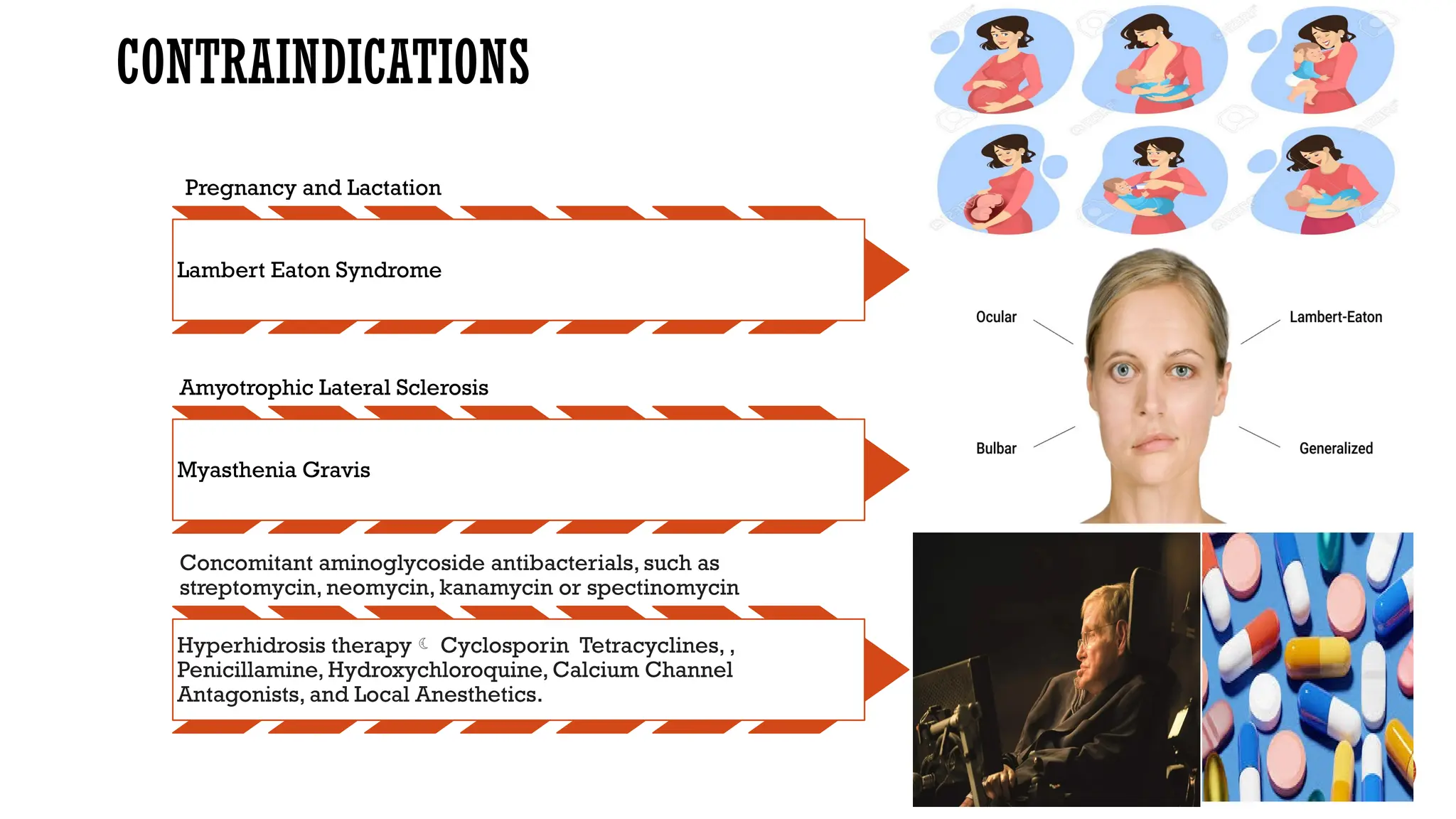
Pregnancy and Lactation
Lambert Eaton Syndrome
Amyotrophic Lateral Sclerosis
Myasthenia Gravis
Concomitant aminoglycoside antibacterials, such as
streptomycin, neomycin, kanamycin or spectinomycin
Hyperhidrosis therapy Cyclosporin Tetracyclines, ,
Penicillamine, Hydroxychloroquine, Calcium Channel
Antagonists, and Local Anesthetics.
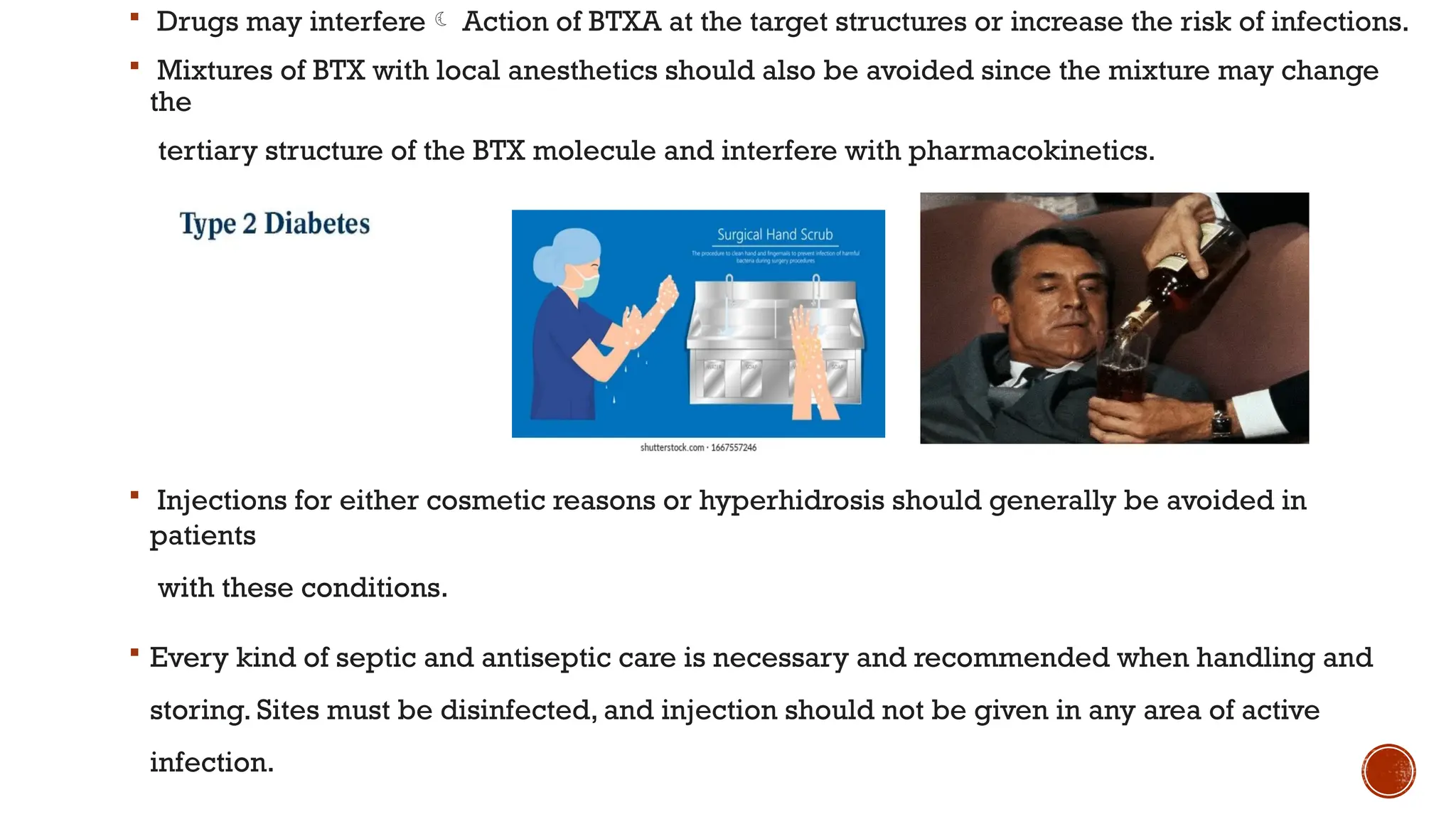
 Drugs may interfere Action of BTXA at the target structures or increase the risk of infections.
 Mixtures of BTX with local anesthetics should also be avoided since the mixture may change
the
tertiary structure of the BTX molecule and interfere with pharmacokinetics.
 Injections for either cosmetic reasons or hyperhidrosis should generally be avoided in
patients
with these conditions.
 Every kind of septic and antiseptic care is necessary and recommended when handling and
storing. Sites must be disinfected, and injection should not be given in any area of active
infection.
COMPLICATIONS
 BTX  Inhibiting the release of acetylcholine at the motor end plate leading to muscle paralysis.
 Selective paralysis of certain muscles Basis of botulinum toxin treatment but paralysis of adjacent
or other muscles can lead to the complications.
Brow ptosis Lip ptosis and asymmetry
Dysphagia, hoarseness, and neck
weakness
Injection site complications
Allergy and hypersensitivity
reactions
Infections
Inappropriate injection technique Vascular adverse effects
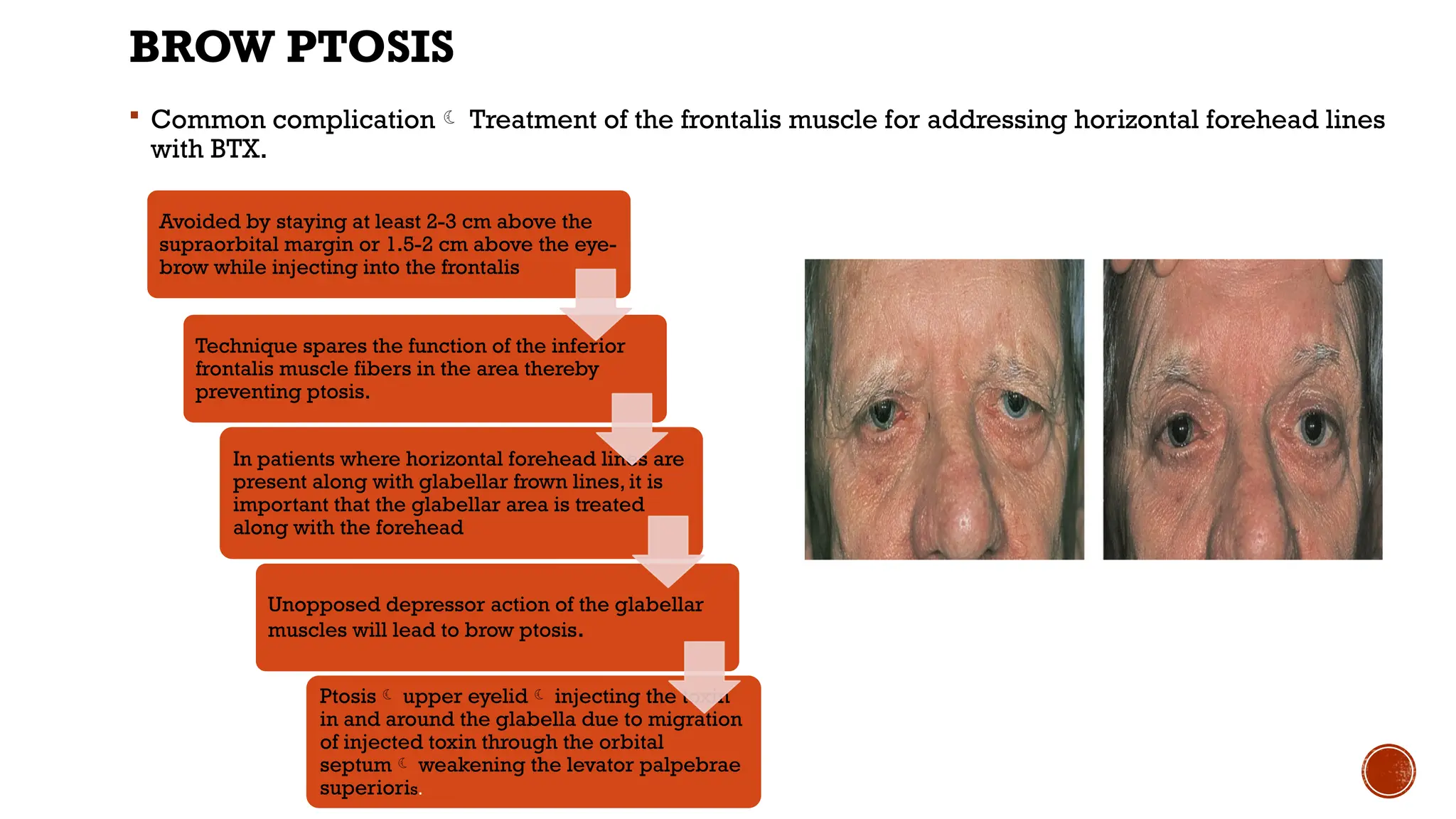
BROW PTOSIS
 Common complication Treatment of the frontalis muscle for addressing horizontal forehead lines
with BTX.
Avoided by staying at least 2-3 cm above the
supraorbital margin or 1.5-2 cm above the eye-
brow while injecting into the frontalis
Technique spares the function of the inferior
frontalis muscle fibers in the area thereby
preventing ptosis.
In patients where horizontal forehead lines are
present along with glabellar frown lines, it is
important that the glabellar area is treated
along with the forehead
Unopposed depressor action of the glabellar
muscles will lead to brow ptosis.
Ptosis upper eyelid injecting the toxin
in and around the glabella due to migration
of injected toxin through the orbital
septum weakening the levator palpebrae
superioris.
Commonly BTX is injected close to the bony
supraorbital margin at the mid-pupillary line and when
large volumes of diluted toxin are injected in the area.
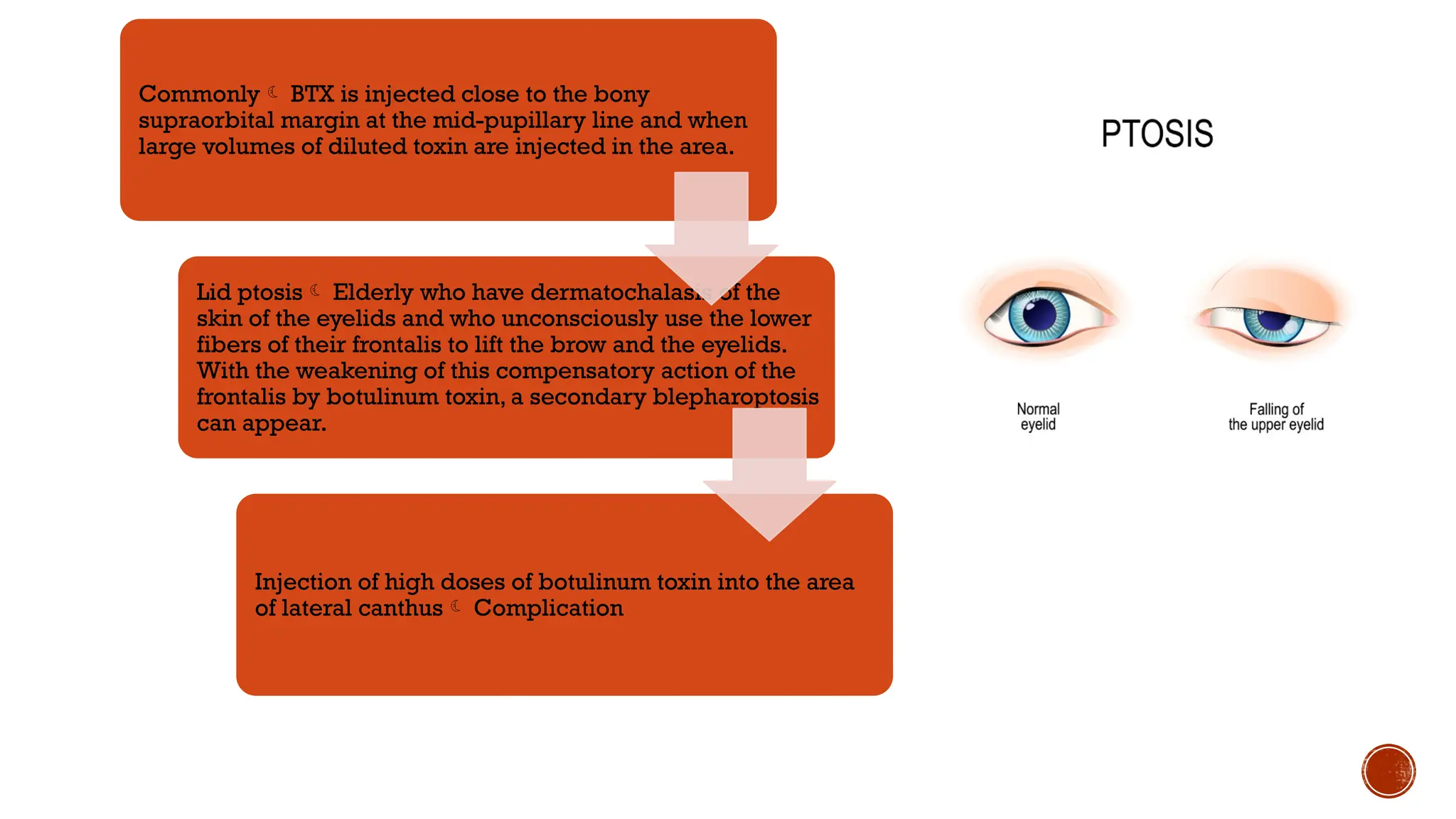
Lid ptosis Elderly who have dermatochalasis of the
skin of the eyelids and who unconsciously use the lower
fibers of their frontalis to lift the brow and the eyelids.
With the weakening of this compensatory action of the
frontalis by botulinum toxin, a secondary blepharoptosis
can appear.
Injection of high doses of botulinum toxin into the area
of lateral canthus Complication
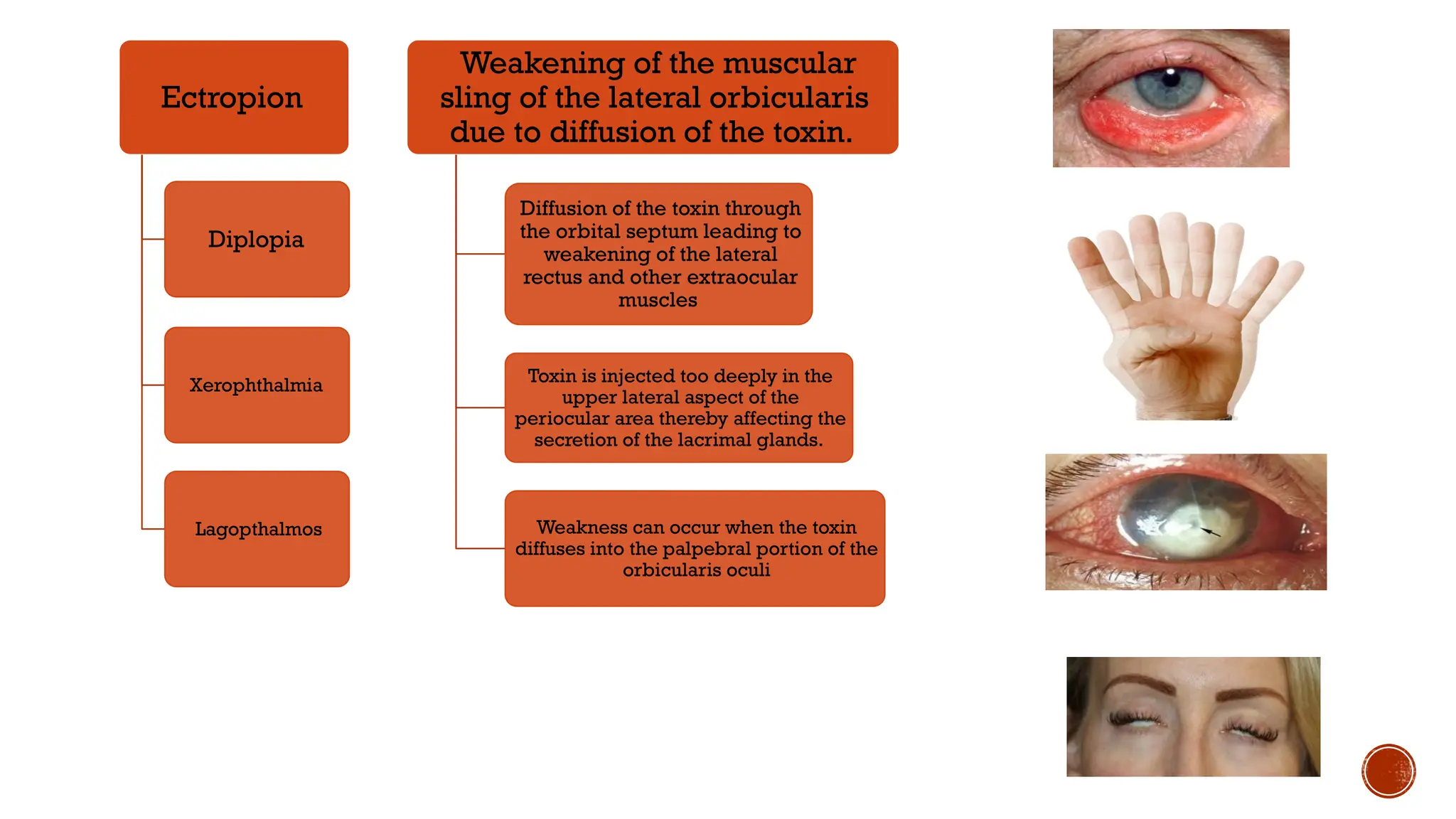
Ectropion
Diplopia
Xerophthalmia
Lagopthalmos
Weakening of the muscular
sling of the lateral orbicularis
due to diffusion of the toxin.
Diffusion of the toxin through
the orbital septum leading to
weakening of the lateral
rectus and other extraocular
muscles
Toxin is injected too deeply in the
upper lateral aspect of the
periocular area thereby affecting the
secretion of the lacrimal glands.
Weakness can occur when the toxin
diffuses into the palpebral portion of the
orbicularis oculi
Reduced by injecting the toxin subdermally
and lateral to an imaginary vertical line that
passes through the lateral canthus.
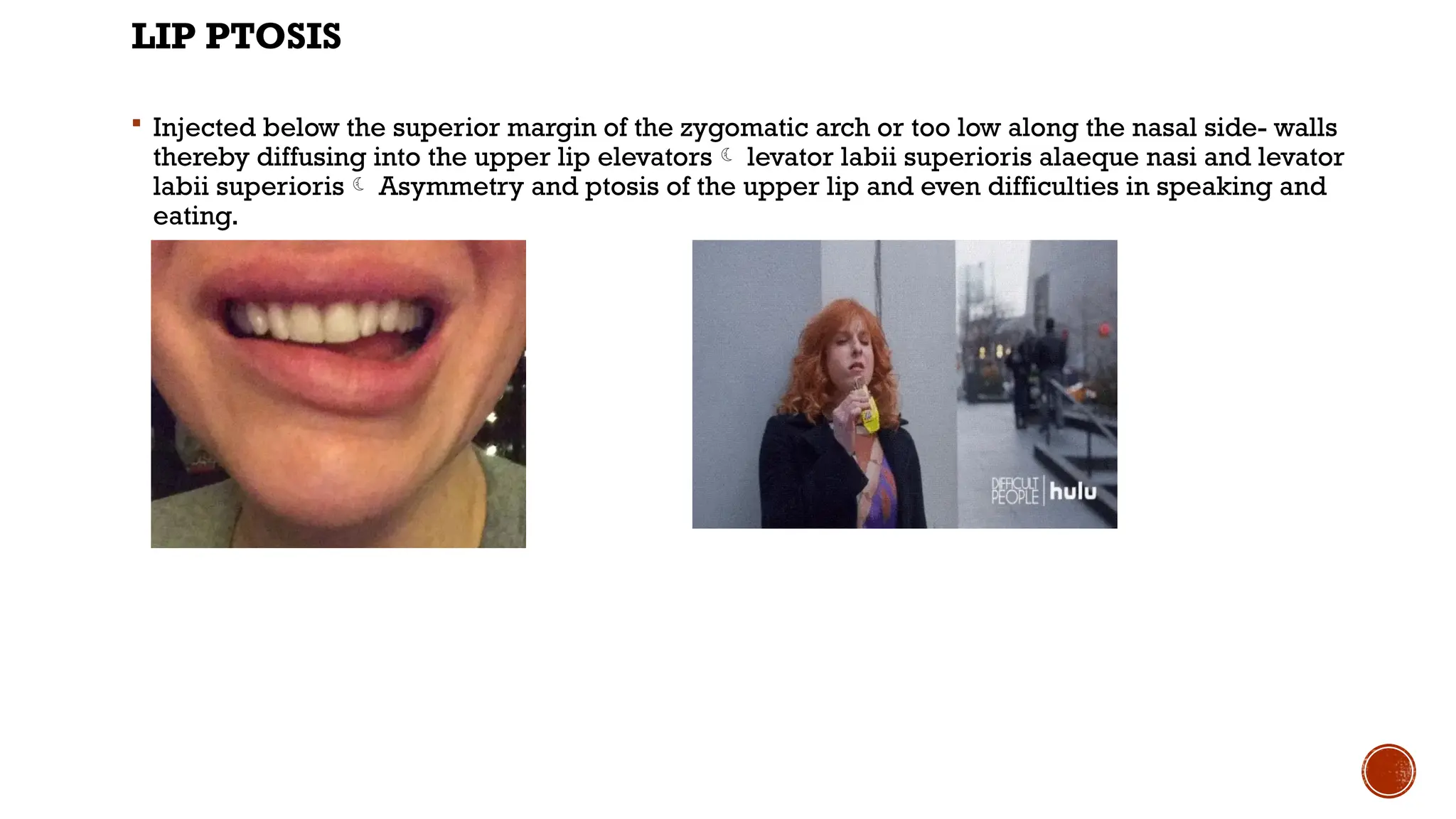
LIP PTOSIS
 Injected below the superior margin of the zygomatic arch or too low along the nasal side- walls
thereby diffusing into the upper lip elevators levator labii superioris alaeque nasi and levator
labii superioris Asymmetry and ptosis of the upper lip and even difficulties in speaking and
eating.
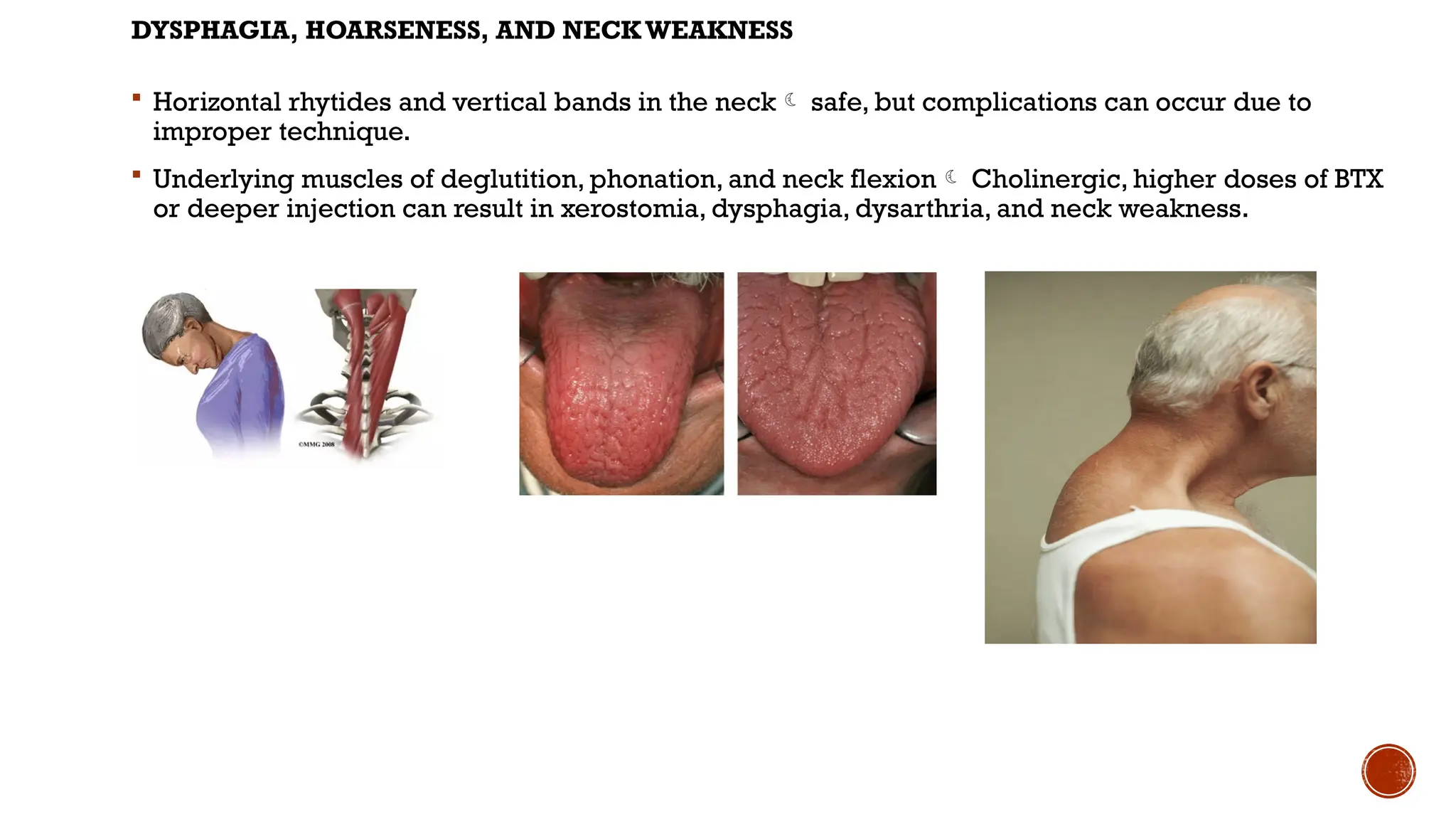
DYSPHAGIA, HOARSENESS, AND NECKWEAKNESS
 Horizontal rhytides and vertical bands in the neck safe, but complications can occur due to
improper technique.
 Underlying muscles of deglutition, phonation, and neck flexion Cholinergic, higher doses of BTX
or deeper injection can result in xerostomia, dysphagia, dysarthria, and neck weakness.
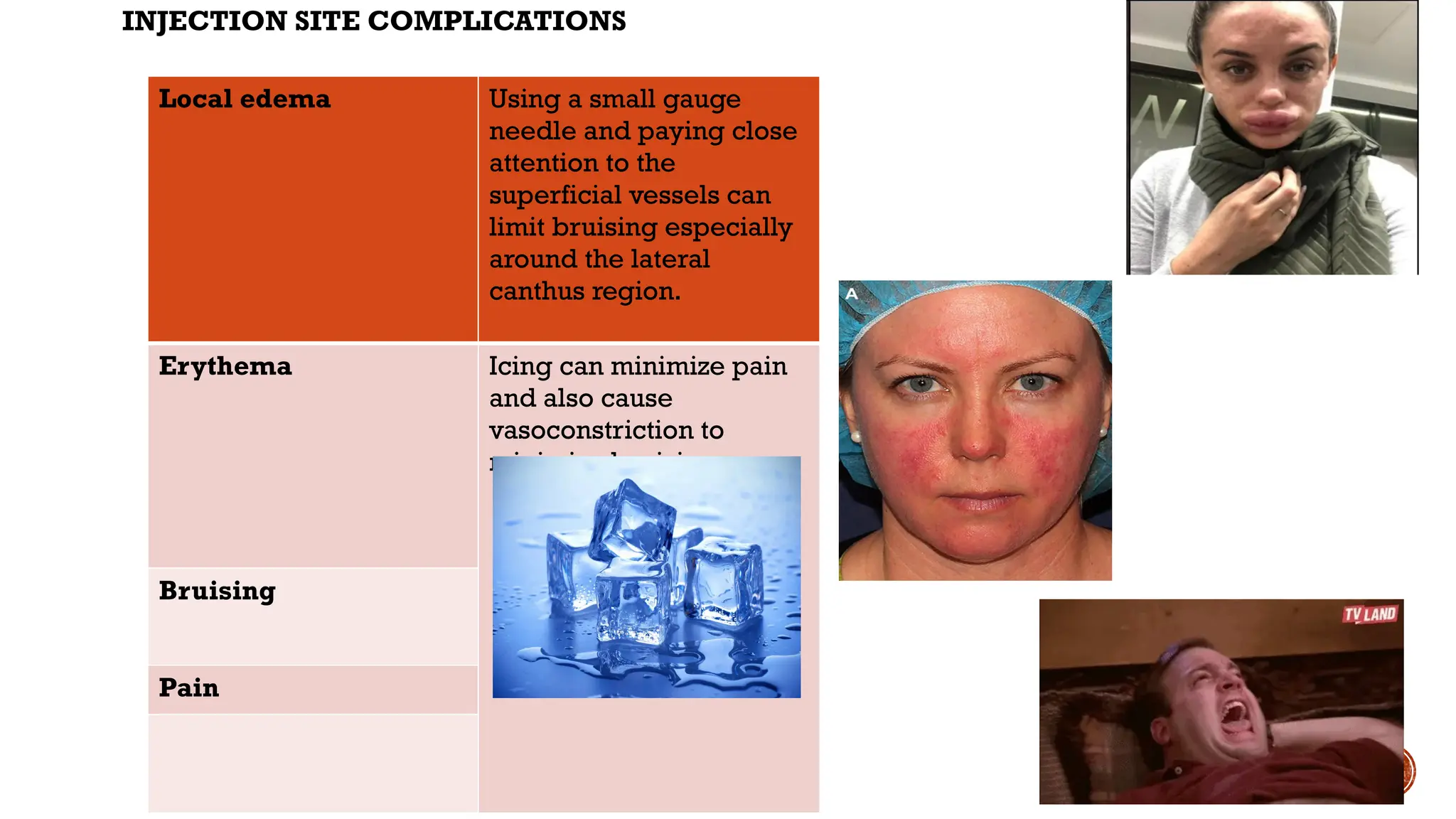
INJECTION SITE COMPLICATIONS
Local edema Using a small gauge
needle and paying close
attention to the
superficial vessels can
limit bruising especially
around the lateral
canthus region.
Erythema Icing can minimize pain
and also cause
vasoconstriction to
minimize bruising
Bruising
Pain
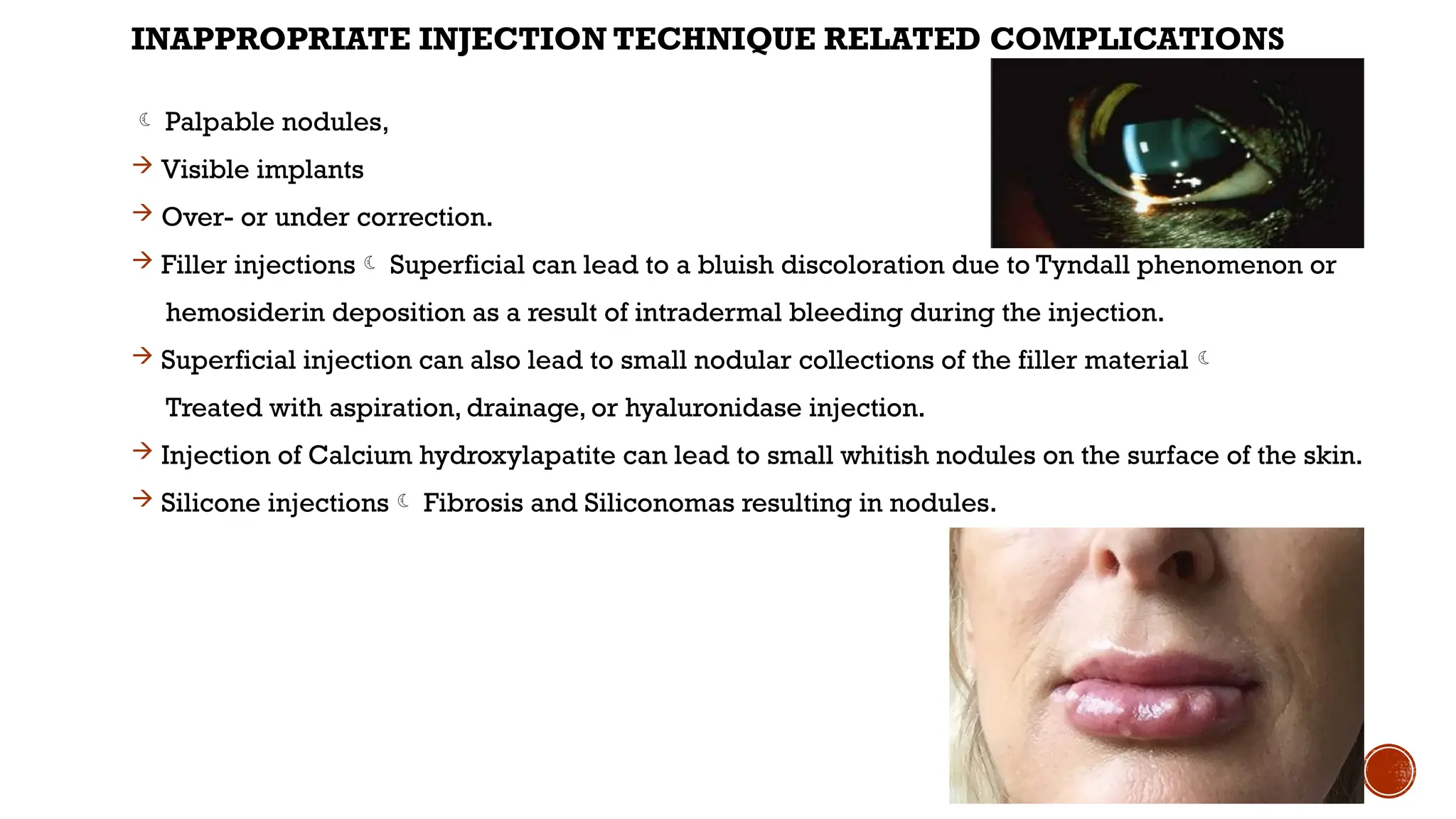
INAPPROPRIATE INJECTION TECHNIQUE RELATED COMPLICATIONS
 Palpable nodules,
 Visible implants
 Over- or under correction.
 Filler injections Superficial can lead to a bluish discoloration due to Tyndall phenomenon or
hemosiderin deposition as a result of intradermal bleeding during the injection.
 Superficial injection can also lead to small nodular collections of the filler material
Treated with aspiration, drainage, or hyaluronidase injection.
 Injection of Calcium hydroxylapatite can lead to small whitish nodules on the surface of the skin.
 Silicone injections Fibrosis and Siliconomas resulting in nodules.
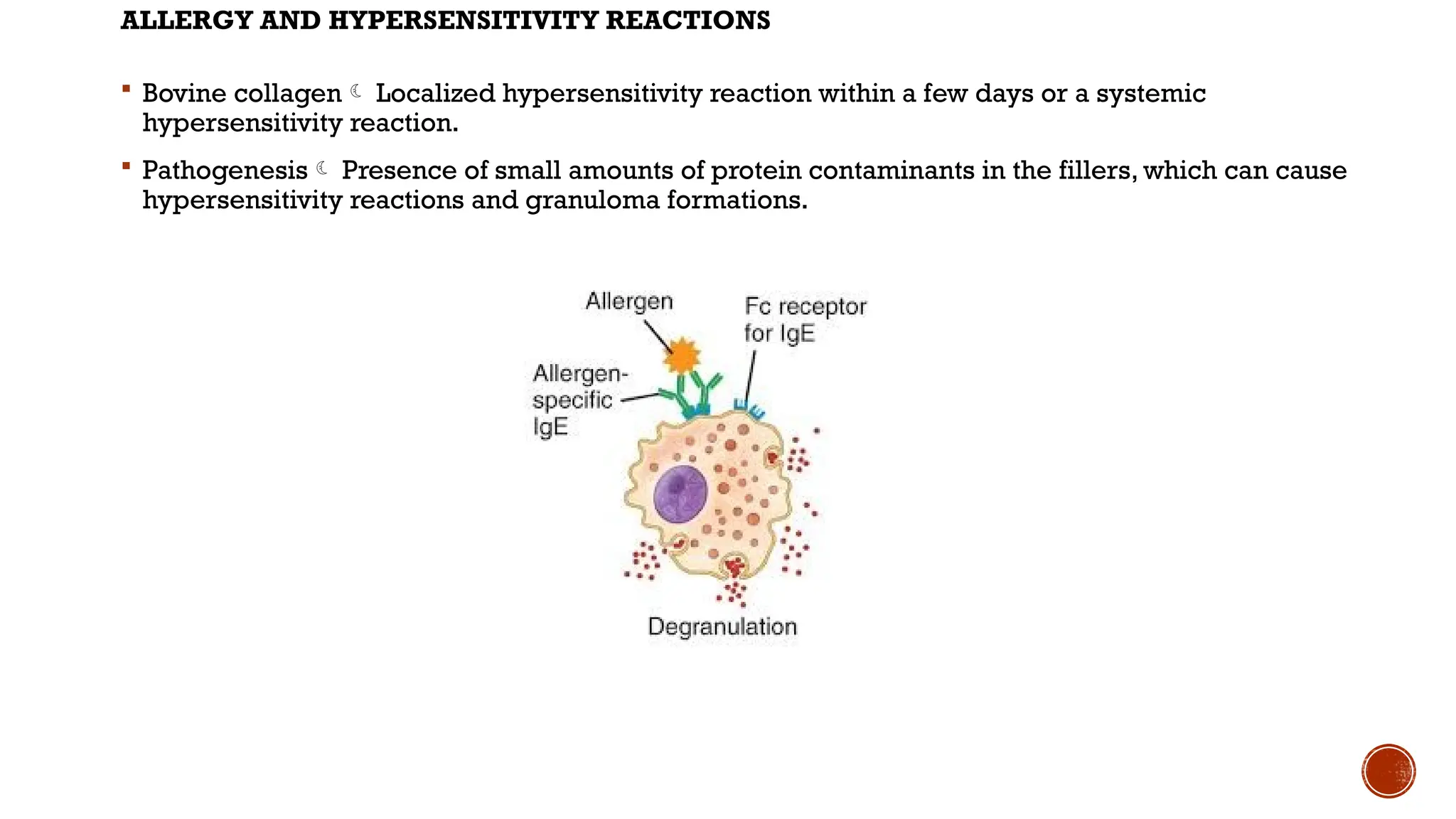
ALLERGY AND HYPERSENSITIVITY REACTIONS
 Bovine collagen Localized hypersensitivity reaction within a few days or a systemic
hypersensitivity reaction.
 Pathogenesis Presence of small amounts of protein contaminants in the fillers, which can cause
hypersensitivity reactions and granuloma formations.
VASCULAR ADVERSE EFFECTS
Retinal embolism due to the intravascular
injection into the supra- trochlear artery,
supraorbital, angular, and dorsal . nasal arteries is
also a rare complication..
Filler induced skin necrosis due to inadvertent
intravascular injection of filler Glabellar region
due to injection into the supratrochlear artery
Powerful presynaptic neuromuscular blocking
agent which interferes with cholinergic
parasympathetic terminals
VASCULAR EFFECTS CONTD
If any features of tissue necrosis appear, injection must be
stopped immediately, and an immediate injection of
hyaluronidase enzyme is important to minimize the tissue
necrosis.
Mitigated by aspirating the needle before injecting, keeping
the needle moving while injecting, using a less dense filler and
by injecting low volumes over two or three sessions rather
than injecting a high volume in a single session.
Cerebral ischemic events due to the retro-grade flow of filler
emboli in the internal carotid artery rare but a life-
threatening complication
INFECTIONS
Reactivation of herpes simplex infection Lip augmentation
Bacterial infections Cellulitis and abscesses
Staphylococcal and Streptococcal infections, which may
require broad-spectrum oral antibiotic therapy.
Mycobacterium abscesses and mycobacterium chelonae
infection Use of contaminated fillers
Biofilm formation over the dermal fillers Variety of complications
including cellulitis, abscesses, nodules, or granulomatous
inflammation, which can manifest even years after dermal filler
injections
BOTOX MITIGATING RISKS AND MANAGING COMPLICATIONS

BOTOX MITIGATING RISKS AND MANAGING COMPLICATIONS

  • 1.
    BOTOX-MITIGATING RISKS ANDMANAGING COMPLICATIONS DR.MOHNISH SEKAR CONSULTANT DERMATOLOGIST
  • 2.
    INTRODUCTION  Cosmetic surgeryand Aesthetic procedures Billion dollar industry owing to the ever-growing demand of the population to stay young.  Treatment modalities Relatively safe Side effects. Fillers and Botox Quick Results Rejuvenation Facial wrinkles Highly Popular
  • 3.
    MITIGATING RISKS  Patientselection Crucial step toward prevention of patient dissatisfaction.  Every patient needs an extensive informative consultation that covers not only the BTX option but also all alternative methods and procedures.  Made aware that facial asymmetry is common,  Use of BTX cannot guarantee facial symmetry; Asymmetry hyperactive muscles can be smoothened.  BTX Not be used for facial rejuvenation in patients Lid ptosis  Undergone surgical procedures that may have repositioned or weakened the muscles.
  • 4.
    SELECTION OF CANDIDATES Poor Candidates EvaluateVigilantly Politicians and Actors Mask like face FILLERS Good Alternative Psychiatric and Unrealistic expectation Systemic Botulism
  • 5.
    CONTRAINDICATIONS Pregnancy and Lactation LambertEaton Syndrome Amyotrophic Lateral Sclerosis Myasthenia Gravis Concomitant aminoglycoside antibacterials, such as streptomycin, neomycin, kanamycin or spectinomycin Hyperhidrosis therapy Cyclosporin Tetracyclines, , Penicillamine, Hydroxychloroquine, Calcium Channel Antagonists, and Local Anesthetics.
  • 6.
     Drugs mayinterfere Action of BTXA at the target structures or increase the risk of infections.  Mixtures of BTX with local anesthetics should also be avoided since the mixture may change the tertiary structure of the BTX molecule and interfere with pharmacokinetics.  Injections for either cosmetic reasons or hyperhidrosis should generally be avoided in patients with these conditions.  Every kind of septic and antiseptic care is necessary and recommended when handling and storing. Sites must be disinfected, and injection should not be given in any area of active infection.
  • 7.
    COMPLICATIONS  BTX Inhibiting the release of acetylcholine at the motor end plate leading to muscle paralysis.  Selective paralysis of certain muscles Basis of botulinum toxin treatment but paralysis of adjacent or other muscles can lead to the complications. Brow ptosis Lip ptosis and asymmetry Dysphagia, hoarseness, and neck weakness Injection site complications Allergy and hypersensitivity reactions Infections Inappropriate injection technique Vascular adverse effects
  • 8.
    BROW PTOSIS  Commoncomplication Treatment of the frontalis muscle for addressing horizontal forehead lines with BTX. Avoided by staying at least 2-3 cm above the supraorbital margin or 1.5-2 cm above the eye- brow while injecting into the frontalis Technique spares the function of the inferior frontalis muscle fibers in the area thereby preventing ptosis. In patients where horizontal forehead lines are present along with glabellar frown lines, it is important that the glabellar area is treated along with the forehead Unopposed depressor action of the glabellar muscles will lead to brow ptosis. Ptosis upper eyelid injecting the toxin in and around the glabella due to migration of injected toxin through the orbital septum weakening the levator palpebrae superioris.
  • 9.
    Commonly BTX isinjected close to the bony supraorbital margin at the mid-pupillary line and when large volumes of diluted toxin are injected in the area. Lid ptosis Elderly who have dermatochalasis of the skin of the eyelids and who unconsciously use the lower fibers of their frontalis to lift the brow and the eyelids. With the weakening of this compensatory action of the frontalis by botulinum toxin, a secondary blepharoptosis can appear. Injection of high doses of botulinum toxin into the area of lateral canthus Complication
  • 10.
    Ectropion Diplopia Xerophthalmia Lagopthalmos Weakening of themuscular sling of the lateral orbicularis due to diffusion of the toxin. Diffusion of the toxin through the orbital septum leading to weakening of the lateral rectus and other extraocular muscles Toxin is injected too deeply in the upper lateral aspect of the periocular area thereby affecting the secretion of the lacrimal glands. Weakness can occur when the toxin diffuses into the palpebral portion of the orbicularis oculi
  • 11.
    Reduced by injectingthe toxin subdermally and lateral to an imaginary vertical line that passes through the lateral canthus.
  • 12.
    LIP PTOSIS  Injectedbelow the superior margin of the zygomatic arch or too low along the nasal side- walls thereby diffusing into the upper lip elevators levator labii superioris alaeque nasi and levator labii superioris Asymmetry and ptosis of the upper lip and even difficulties in speaking and eating.
  • 13.
    DYSPHAGIA, HOARSENESS, ANDNECKWEAKNESS  Horizontal rhytides and vertical bands in the neck safe, but complications can occur due to improper technique.  Underlying muscles of deglutition, phonation, and neck flexion Cholinergic, higher doses of BTX or deeper injection can result in xerostomia, dysphagia, dysarthria, and neck weakness.
  • 14.
    INJECTION SITE COMPLICATIONS Localedema Using a small gauge needle and paying close attention to the superficial vessels can limit bruising especially around the lateral canthus region. Erythema Icing can minimize pain and also cause vasoconstriction to minimize bruising Bruising Pain
  • 15.
    INAPPROPRIATE INJECTION TECHNIQUERELATED COMPLICATIONS  Palpable nodules,  Visible implants  Over- or under correction.  Filler injections Superficial can lead to a bluish discoloration due to Tyndall phenomenon or hemosiderin deposition as a result of intradermal bleeding during the injection.  Superficial injection can also lead to small nodular collections of the filler material Treated with aspiration, drainage, or hyaluronidase injection.  Injection of Calcium hydroxylapatite can lead to small whitish nodules on the surface of the skin.  Silicone injections Fibrosis and Siliconomas resulting in nodules.
  • 16.
    ALLERGY AND HYPERSENSITIVITYREACTIONS  Bovine collagen Localized hypersensitivity reaction within a few days or a systemic hypersensitivity reaction.  Pathogenesis Presence of small amounts of protein contaminants in the fillers, which can cause hypersensitivity reactions and granuloma formations.
  • 17.
    VASCULAR ADVERSE EFFECTS Retinalembolism due to the intravascular injection into the supra- trochlear artery, supraorbital, angular, and dorsal . nasal arteries is also a rare complication.. Filler induced skin necrosis due to inadvertent intravascular injection of filler Glabellar region due to injection into the supratrochlear artery Powerful presynaptic neuromuscular blocking agent which interferes with cholinergic parasympathetic terminals
  • 18.
    VASCULAR EFFECTS CONTD Ifany features of tissue necrosis appear, injection must be stopped immediately, and an immediate injection of hyaluronidase enzyme is important to minimize the tissue necrosis. Mitigated by aspirating the needle before injecting, keeping the needle moving while injecting, using a less dense filler and by injecting low volumes over two or three sessions rather than injecting a high volume in a single session. Cerebral ischemic events due to the retro-grade flow of filler emboli in the internal carotid artery rare but a life- threatening complication
  • 19.
    INFECTIONS Reactivation of herpessimplex infection Lip augmentation Bacterial infections Cellulitis and abscesses Staphylococcal and Streptococcal infections, which may require broad-spectrum oral antibiotic therapy. Mycobacterium abscesses and mycobacterium chelonae infection Use of contaminated fillers Biofilm formation over the dermal fillers Variety of complications including cellulitis, abscesses, nodules, or granulomatous inflammation, which can manifest even years after dermal filler injections