Botulinum Toxin in
Aesthesis
Dr. S.Satish Kumar
HISTORICAL ASPECT
• A German poet, doctor and scientist , Dr. Justinus Kerner of
Wurttemberg, first explained the disease called botulism (1817 to
1822) caused by ‘sausage poison’.
• Dr Emile Pierre van Ermengem (belgium) in 1895 successfully
isolated this bacterium, named it Bacillus botulinus.
• Botulinum toxin was first used to treat human disease(1980) by Drs
Alan Scott (opthalmologist) and Edward Schantz, in treating
strabismus.
• In 1987, ophthalmologist Jean Carruthers observed that frown lines
disappeared after the use of botulinum toxin A for blepharospasm.
• In 1996, they published the first paper on the use of Botox for
cosmetic purposes.
HISTORICAL ASPECT
• In 2002, the FDA announced the approval of BOTOX® Cosmetic to
temporarily improve the appearance of moderate-to-severe frown lines
between the eyebrows (glabellar lines).
• In July 2004, the FDA approved BOTOX® to treat severe underarm
sweating, known as primary axillary hyperhidrosis, that cannot be
managed by topical agents.
BOTULINUM TOXIN (BTX OR BoNT)
• Produced by Clostridium botulinum, a gram-positive anaerobic, spore
forming bacillus.
• BoNT is broken into 7 neurotoxins (labeled as types A, B, C [C1, C2],
D, E, F, and G), which are antigenically and serologically distinct but
structurally similar.
• Type A is the most potent toxin, followed by types B and F toxin.
• Human botulism is caused mainly by types A, B, E, and (rarely) F.
Types C and D cause toxicity only in animals.
MICROBIOLOGY
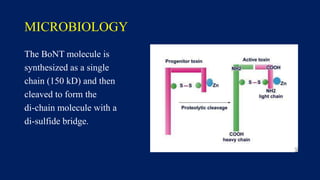
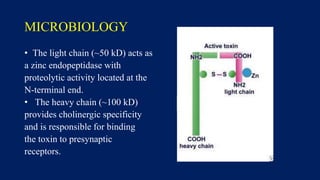
The BoNT molecule is
synthesized as a single
chain (150 kD) and then
cleaved to form the
di-chain molecule with a
di-sulfide bridge.
MICROBIOLOGY
• The light chain (~50 kD) acts as
a zinc endopeptidase with
proteolytic activity located at the
N-terminal end.
• The heavy chain (~100 kD)
provides cholinergic specificity
and is responsible for binding
the toxin to presynaptic
receptors.
MECHANISM OF ACTION
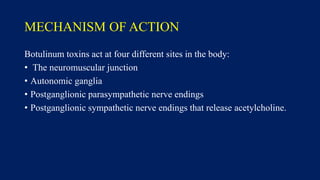
Botulinum toxins act at four different sites in the body:
• The neuromuscular junction
• Autonomic ganglia
• Postganglionic parasympathetic nerve endings
• Postganglionic sympathetic nerve endings that release acetylcholine.
MECHANISM OF ACTION
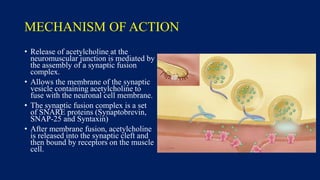
• Release of acetylcholine at the
neuromuscular junction is mediated by
the assembly of a synaptic fusion
complex.
• Allows the membrane of the synaptic
vesicle containing acetylcholine to
fuse with the neuronal cell membrane.
• The synaptic fusion complex is a set
of SNARE proteins (Synaptobrevin,
SNAP-25 and Syntaxin)
• After membrane fusion, acetylcholine
is released into the synaptic cleft and
then bound by receptors on the muscle
cell.
MECHANISM OF ACTION
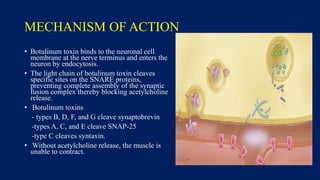
• Botulinum toxin binds to the neuronal cell
membrane at the nerve terminus and enters the
neuron by endocytosis.
• The light chain of botulinum toxin cleaves
specific sites on the SNARE proteins,
preventing complete assembly of the synaptic
fusion complex thereby blocking acetylcholine
release.
• Botulinum toxins
- types B, D, F, and G cleave synaptobrevin
-types A, C, and E cleave SNAP-25
-type C cleaves syntaxin.
• Without acetylcholine release, the muscle is
unable to contract.
MECHANISM OF ACTION
• Induces weakness of striated muscles by inhibiting alpha motor
neurones at the neuromuscular junction.
• Used in conditions with muscular overactivity, such as dystonia.
• Transmission is also inhibited at gamma neurones in muscle spindles,
which may alter reflex overactivity.
• Also inhibits release of acetylcholine in all parasympathetic and
cholinergic postganglionic sympathetic neurons.
• Used as a treatment for overactive smooth muscles (for eg, achalasia)
or abnormal activity of glands (for eg, hyperhidrosis).
MECHANISM OF ACTION
• The toxin requires 24-72 hours to take effect
(the time necessary to disrupt the synaptosomal process.)
• In very rare circumstances, some individuals may require as many as
five days for the full effect to be observed.
• Peaking at about 10 days, the effect of toxin lasts nearly 8-12 weeks.
AESTHETIC USES
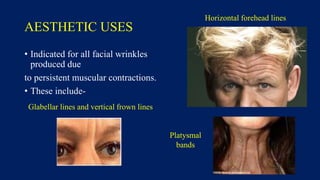
• Indicated for all facial wrinkles
produced due
to persistent muscular contractions.
• These include-
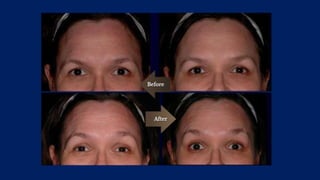
Horizontal forehead lines
Glabellar lines and vertical frown lines
Platysmal
bands
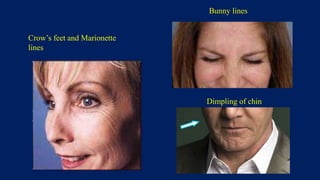
Crow’s feet and Marionette
lines
Bunny lines
Dimpling of chin
THERAPEUTIC USES
Sweating, salivary, and allergy
disorders
• Axillary and palmar hyperhidrosis
• Frey syndrome
• Drooling in cerebral palsy and other
neurological disorders
• Nasal allergy
Strabismus and nystagmus
Smooth muscle hyperactive disorders
• Neurogenic bladder – Detrusor
hyperreflexia, BPH
• Achalasia cardia
• Hemorrhoids, Chronic anal fissures
Focal dystonias
• Cervical dystonia (spasmodic
torticollis)
• Blepharospasm (eyelid closure)
• Laryngeal, Limb,
Oromandibular,
Orolingual, Truncal dystonia
Spasticity
Nondystonic disorders of
involuntary
muscle activity
• Hemifacial spasm, trismus
• Tremors, tics, myoclonus
THERAPEUTIC USES
Chronic pain and disorders of localized muscle spasms
• Chronic low back pain
• Tension headache
• Chronic migraine headache
• Medication overuse headache
• Lateral epicondylitis
• Knee, Shoulder neuropathic pain
CONTRAINDICATIONS
• Patients afflicted with a preexisting motor neuron disease, myasthenia
gravis, Eaton-Lambert syndrome, neuropathies, psychological instability.
• History of reaction to toxin or albumin.
• Pregnancy and lactating females.
• Infection at the injection site.
DRUG INTERACTIONS
• Aminoglycosides (may increase effect of botulinum toxin)
• Penicillamine, Quinine, Chloroquine and Hydroxychloroquine (may reduce
effect)
PREPARATION
• Serotype A is the only commercially available form of botulinum toxin
for clinical use.
• The potency of BoNT-A is measured in mouse units (MU).
• One MU of BoNT-A is equivalent to the amount of toxin that kills
50% of a group of 20 g Swiss-Webster mice within 3 days of
intraperitoneal injection.
• According to one report, 1 nanogram of toxin contains approximately
20 U of BOTOX® (ie, 1 U of BOTOX® is equal to approximately
0.05 nanogram of the toxin).
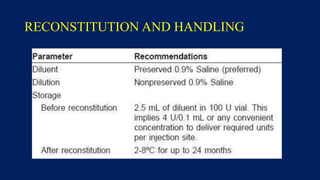
RECONSTITUTION AND HANDLING
• Follow all usual precautions of sterility and skin preparation before
injection.
• Seat the patient with chin down and head slightly lower than the
physician's.
• Plastic single use insulin syringes with 30-32 gauge needles are
recommended, and toxin is injected into affected muscles
• Topical anesthetics are generally reserved for the very sensitive. Ice
could be used as a numbing agent.
• Injections can also be administered under the guidance of
electromyograph (EMG) monitoring for better accuracy.
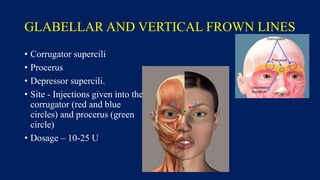
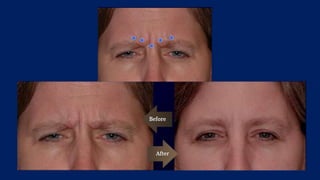
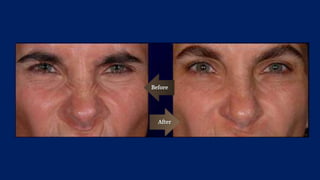
GLABELLAR AND VERTICAL FROWN LINES
• Corrugator supercili
• Procerus
• Depressor supercili.
• Site - Injections given into the
corrugator (red and blue
circles) and procerus (green
circle)
• Dosage – 10-25 U
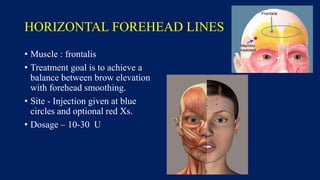
HORIZONTAL FOREHEAD LINES
• Muscle : frontalis
• Treatment goal is to achieve a
balance between brow elevation
with forehead smoothing.
• Site - Injection given at blue
circles and optional red Xs.
• Dosage – 10-30 U
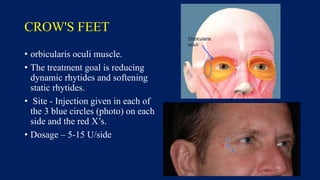
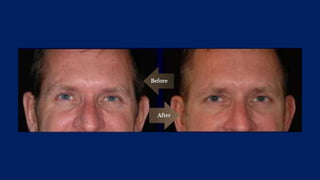
CROW'S FEET
• orbicularis oculi muscle.
• The treatment goal is reducing
dynamic rhytides and softening
static rhytides.
• Site - Injection given in each of
the 3 blue circles (photo) on each
side and the red X’s.
• Dosage – 5-15 U/side
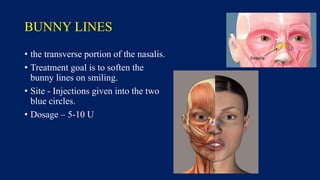
BUNNY LINES
• the transverse portion of the nasalis.
• Treatment goal is to soften the
bunny lines on smiling.
• Site - Injections given into the two
blue circles.
• Dosage – 5-10 U
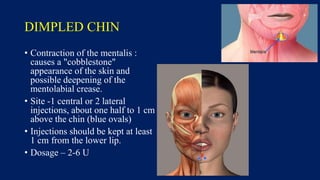
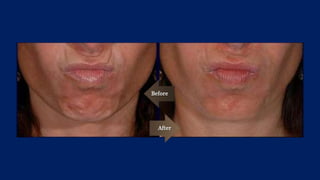
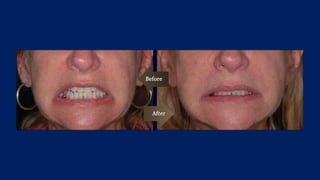
DIMPLED CHIN
• Contraction of the mentalis :
causes a "cobblestone"
appearance of the skin and
possible deepening of the
mentolabial crease.
• Site -1 central or 2 lateral
injections, about one half to 1 cm
above the chin (blue ovals)
• Injections should be kept at least
1 cm from the lower lip.
• Dosage – 2-6 U
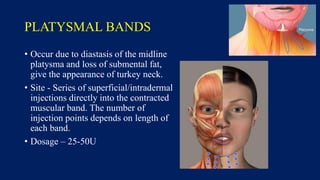
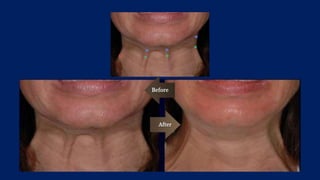
PLATYSMAL BANDS
• Occur due to diastasis of the midline
platysma and loss of submental fat,
give the appearance of turkey neck.
• Site - Series of superficial/intradermal
injections directly into the contracted
muscular band. The number of
injection points depends on length of
each band.
• Dosage – 25-50U
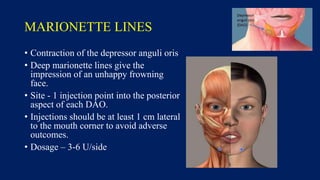
MARIONETTE LINES
• Contraction of the depressor anguli oris
• Deep marionette lines give the
impression of an unhappy frowning
face.
• Site - 1 injection point into the posterior
aspect of each DAO.
• Injections should be at least 1 cm lateral
to the mouth corner to avoid adverse
outcomes.
• Dosage – 3-6 U/side
COMPLICATIONS
Local site
• Pain
• Edema
• Erythema
• Ecchymosis
• Short-term hyperesthesia.
Generalised reactions
• Nausea
• Malaise
• Flu-like symptoms
• Cutaneous eruptions
Diffusion of neurotoxin
into the systemic
circulation
SPECIFIC COMPL.
• Glabellar region - ptosis of the upper eyelid
• Forehead – Brow ptosis
• Crow’s feet – bruising
diplopia
ectropion
asymmetric smile -caused by injection of the
zygomaticus major.
• Lower face - asymmetric smile and lip ptosis
• Neck - weakness of the neck flexors and dysphagia
TOPICAL BTX
• BoNTA cream based on commercially viable ionic nanoparticle
technology.
Advantages over conventional injections
• Eliminates the need for multiple traumatic injections for better comfort
• Self administration
• Cause only a mild weakening. Potentially safer for use in the areas
where muscles are highly sensitive to smaller doses of the toxin.
THANK YOU

BOTOX - Botulinum toxin in aesthesis

  • 1.
  • 2.
    HISTORICAL ASPECT • AGerman poet, doctor and scientist , Dr. Justinus Kerner of Wurttemberg, first explained the disease called botulism (1817 to 1822) caused by ‘sausage poison’. • Dr Emile Pierre van Ermengem (belgium) in 1895 successfully isolated this bacterium, named it Bacillus botulinus. • Botulinum toxin was first used to treat human disease(1980) by Drs Alan Scott (opthalmologist) and Edward Schantz, in treating strabismus. • In 1987, ophthalmologist Jean Carruthers observed that frown lines disappeared after the use of botulinum toxin A for blepharospasm. • In 1996, they published the first paper on the use of Botox for cosmetic purposes.
  • 3.
    HISTORICAL ASPECT • In2002, the FDA announced the approval of BOTOX® Cosmetic to temporarily improve the appearance of moderate-to-severe frown lines between the eyebrows (glabellar lines). • In July 2004, the FDA approved BOTOX® to treat severe underarm sweating, known as primary axillary hyperhidrosis, that cannot be managed by topical agents.
  • 4.
    BOTULINUM TOXIN (BTXOR BoNT) • Produced by Clostridium botulinum, a gram-positive anaerobic, spore forming bacillus. • BoNT is broken into 7 neurotoxins (labeled as types A, B, C [C1, C2], D, E, F, and G), which are antigenically and serologically distinct but structurally similar. • Type A is the most potent toxin, followed by types B and F toxin. • Human botulism is caused mainly by types A, B, E, and (rarely) F. Types C and D cause toxicity only in animals.
  • 5.
    MICROBIOLOGY The BoNT moleculeis synthesized as a single chain (150 kD) and then cleaved to form the di-chain molecule with a di-sulfide bridge.
  • 6.
    MICROBIOLOGY • The lightchain (~50 kD) acts as a zinc endopeptidase with proteolytic activity located at the N-terminal end. • The heavy chain (~100 kD) provides cholinergic specificity and is responsible for binding the toxin to presynaptic receptors.
  • 7.
    MECHANISM OF ACTION Botulinumtoxins act at four different sites in the body: • The neuromuscular junction • Autonomic ganglia • Postganglionic parasympathetic nerve endings • Postganglionic sympathetic nerve endings that release acetylcholine.
  • 8.
    MECHANISM OF ACTION •Release of acetylcholine at the neuromuscular junction is mediated by the assembly of a synaptic fusion complex. • Allows the membrane of the synaptic vesicle containing acetylcholine to fuse with the neuronal cell membrane. • The synaptic fusion complex is a set of SNARE proteins (Synaptobrevin, SNAP-25 and Syntaxin) • After membrane fusion, acetylcholine is released into the synaptic cleft and then bound by receptors on the muscle cell.
  • 9.
    MECHANISM OF ACTION •Botulinum toxin binds to the neuronal cell membrane at the nerve terminus and enters the neuron by endocytosis. • The light chain of botulinum toxin cleaves specific sites on the SNARE proteins, preventing complete assembly of the synaptic fusion complex thereby blocking acetylcholine release. • Botulinum toxins - types B, D, F, and G cleave synaptobrevin -types A, C, and E cleave SNAP-25 -type C cleaves syntaxin. • Without acetylcholine release, the muscle is unable to contract.
  • 10.
    MECHANISM OF ACTION •Induces weakness of striated muscles by inhibiting alpha motor neurones at the neuromuscular junction. • Used in conditions with muscular overactivity, such as dystonia. • Transmission is also inhibited at gamma neurones in muscle spindles, which may alter reflex overactivity. • Also inhibits release of acetylcholine in all parasympathetic and cholinergic postganglionic sympathetic neurons. • Used as a treatment for overactive smooth muscles (for eg, achalasia) or abnormal activity of glands (for eg, hyperhidrosis).
  • 11.
    MECHANISM OF ACTION •The toxin requires 24-72 hours to take effect (the time necessary to disrupt the synaptosomal process.) • In very rare circumstances, some individuals may require as many as five days for the full effect to be observed. • Peaking at about 10 days, the effect of toxin lasts nearly 8-12 weeks.
  • 12.
    AESTHETIC USES • Indicatedfor all facial wrinkles produced due to persistent muscular contractions. • These include- Horizontal forehead lines Glabellar lines and vertical frown lines Platysmal bands
  • 13.
    Crow’s feet andMarionette lines Bunny lines Dimpling of chin
  • 14.
    THERAPEUTIC USES Sweating, salivary,and allergy disorders • Axillary and palmar hyperhidrosis • Frey syndrome • Drooling in cerebral palsy and other neurological disorders • Nasal allergy Strabismus and nystagmus Smooth muscle hyperactive disorders • Neurogenic bladder – Detrusor hyperreflexia, BPH • Achalasia cardia • Hemorrhoids, Chronic anal fissures Focal dystonias • Cervical dystonia (spasmodic torticollis) • Blepharospasm (eyelid closure) • Laryngeal, Limb, Oromandibular, Orolingual, Truncal dystonia Spasticity Nondystonic disorders of involuntary muscle activity • Hemifacial spasm, trismus • Tremors, tics, myoclonus
  • 15.
    THERAPEUTIC USES Chronic painand disorders of localized muscle spasms • Chronic low back pain • Tension headache • Chronic migraine headache • Medication overuse headache • Lateral epicondylitis • Knee, Shoulder neuropathic pain
  • 16.
    CONTRAINDICATIONS • Patients afflictedwith a preexisting motor neuron disease, myasthenia gravis, Eaton-Lambert syndrome, neuropathies, psychological instability. • History of reaction to toxin or albumin. • Pregnancy and lactating females. • Infection at the injection site. DRUG INTERACTIONS • Aminoglycosides (may increase effect of botulinum toxin) • Penicillamine, Quinine, Chloroquine and Hydroxychloroquine (may reduce effect)
  • 17.
    PREPARATION • Serotype Ais the only commercially available form of botulinum toxin for clinical use. • The potency of BoNT-A is measured in mouse units (MU). • One MU of BoNT-A is equivalent to the amount of toxin that kills 50% of a group of 20 g Swiss-Webster mice within 3 days of intraperitoneal injection. • According to one report, 1 nanogram of toxin contains approximately 20 U of BOTOX® (ie, 1 U of BOTOX® is equal to approximately 0.05 nanogram of the toxin).
  • 18.
  • 19.
    RECONSTITUTION AND HANDLING •Follow all usual precautions of sterility and skin preparation before injection. • Seat the patient with chin down and head slightly lower than the physician's. • Plastic single use insulin syringes with 30-32 gauge needles are recommended, and toxin is injected into affected muscles • Topical anesthetics are generally reserved for the very sensitive. Ice could be used as a numbing agent. • Injections can also be administered under the guidance of electromyograph (EMG) monitoring for better accuracy.
  • 20.
    GLABELLAR AND VERTICALFROWN LINES • Corrugator supercili • Procerus • Depressor supercili. • Site - Injections given into the corrugator (red and blue circles) and procerus (green circle) • Dosage – 10-25 U
  • 22.
    HORIZONTAL FOREHEAD LINES •Muscle : frontalis • Treatment goal is to achieve a balance between brow elevation with forehead smoothing. • Site - Injection given at blue circles and optional red Xs. • Dosage – 10-30 U
  • 24.
    CROW'S FEET • orbicularisoculi muscle. • The treatment goal is reducing dynamic rhytides and softening static rhytides. • Site - Injection given in each of the 3 blue circles (photo) on each side and the red X’s. • Dosage – 5-15 U/side
  • 26.
    BUNNY LINES • thetransverse portion of the nasalis. • Treatment goal is to soften the bunny lines on smiling. • Site - Injections given into the two blue circles. • Dosage – 5-10 U
  • 28.
    DIMPLED CHIN • Contractionof the mentalis : causes a "cobblestone" appearance of the skin and possible deepening of the mentolabial crease. • Site -1 central or 2 lateral injections, about one half to 1 cm above the chin (blue ovals) • Injections should be kept at least 1 cm from the lower lip. • Dosage – 2-6 U
  • 30.
    PLATYSMAL BANDS • Occurdue to diastasis of the midline platysma and loss of submental fat, give the appearance of turkey neck. • Site - Series of superficial/intradermal injections directly into the contracted muscular band. The number of injection points depends on length of each band. • Dosage – 25-50U
  • 32.
    MARIONETTE LINES • Contractionof the depressor anguli oris • Deep marionette lines give the impression of an unhappy frowning face. • Site - 1 injection point into the posterior aspect of each DAO. • Injections should be at least 1 cm lateral to the mouth corner to avoid adverse outcomes. • Dosage – 3-6 U/side
  • 34.
    COMPLICATIONS Local site • Pain •Edema • Erythema • Ecchymosis • Short-term hyperesthesia. Generalised reactions • Nausea • Malaise • Flu-like symptoms • Cutaneous eruptions Diffusion of neurotoxin into the systemic circulation
  • 35.
    SPECIFIC COMPL. • Glabellarregion - ptosis of the upper eyelid • Forehead – Brow ptosis • Crow’s feet – bruising diplopia ectropion asymmetric smile -caused by injection of the zygomaticus major. • Lower face - asymmetric smile and lip ptosis • Neck - weakness of the neck flexors and dysphagia
  • 36.
    TOPICAL BTX • BoNTAcream based on commercially viable ionic nanoparticle technology. Advantages over conventional injections • Eliminates the need for multiple traumatic injections for better comfort • Self administration • Cause only a mild weakening. Potentially safer for use in the areas where muscles are highly sensitive to smaller doses of the toxin.
  • 38.