



Botulinum toxin
American board of Aesthetic medicine.
History
Discovered in 1895.
Neurotoxin, clostridium botulinum.
One of the most toxic substances known.
Causes food poisoning, ingestion of food
contaminated with spores. Perforated can,
anaerobic environment, spore germination.
Botulinum toxin typeA
Isolated in 1920.
Clinical use for >30 years.
1989, FDA for treatment of strabismus and
blepharospasm.
Introduction
Cosmetic effect initially described in 80’s.
Jean and Alastair Carruthers
Ophthalmologist/dermatologist husband and wife
team from Canada.
Wrinkles in glabellar region decrease after
treatment for eyelids spasm with Btx A.
Experimented on themselves and staff.
Introduction
2002 FDA approved BtX glabellar lines.
Also approved for axillary hyperhiderosis.
Increased use for dystopia and spastic disorders.
Limb dystonia.
Lingual dystonia.
Facial spasm
Migraine.
Introduction
Purified proteins complex.
7 serotypes, A ,B, C, D, E, F, G
A and B serotypes Clinical use.
Type B, myobloc/elan, cervical dystonia.
Type A most potent and most established for cosmetic use.
Botox, Allergen
Dysport, Galderma.
Xeomin, Mertz.
Mechanism
Inhibition of acetylcholine release at NMJ.
Ach induced transmissions blocked.
Muscular flaccid paralysis.
Mechanism
Botox, light and heavy chains.
Heavy chain bound to nerve irreversible.
Receptor toxin complex internalized. Endocytosis.
Light chain cleave peptide bonds requires for Ach
formation.
Botulinum toxin A
3 types in current cosmetic use.
Botox, onabotulinumtoxin A.
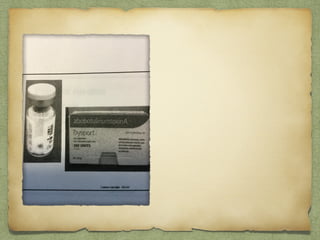
Dysport, abobotulinumtoxin A
Xeomin, incobotulinumtoxin A.
Onabotulinumtoxin A Botox.
Allergan
Bacterial strain Hall
Mol weight 900 KD
100 u btx A , 0.5 mg HSA, 0.9 mg NaCl.
Complexing proteins 5 Nd/100U
Abotulinumtoxin A
IPSec UK, medicis US.
IPSec strain.
300-500 KD.
300-500 U btx A, 0.125 mg HSA, 2.5 mg lactose
Complexing protein 2.5 ng/100 U
Incobotulinum A Xeomin.
Merz pharmaceutical Germany.
Hall strain.
150 KD.
100 U btx A, 1 mg HSA 5 m sucrose.
Complexing protein none.
Possible less allergic potential.
Botulinum toxin A
Unit potency, mouse intraperitoneal injection assay.
1 U activity, dose which causes death in 72 hrs in
50% of mice assessed. Ld 50
Assay protocols varies among manufacturers.
1 unit Botox, 2 units of Dysport.
Lethal dose 2500-3000 units or 30 bottles 70 kg
person.
Anatomy
Complications due to inappropriate placement.
Diffusion
Diffusion differs due to proteins clustered around
active molecule.
Botox, 900 KD.
Dysport, 300-500 KD.
Xeomin, 150 KD.
Spread Botox < Dysport < Xeomin.
Anatomy
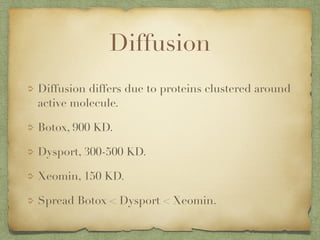
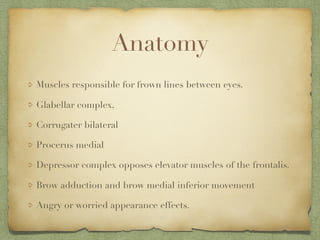
Muscles responsible for frown lines to forehead.
Frontalis
Not continuous but separate bands.
Opposes depressor muscles of glabellar complex
and brows.
Anatomy
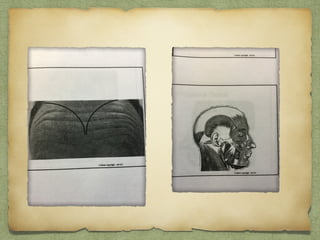
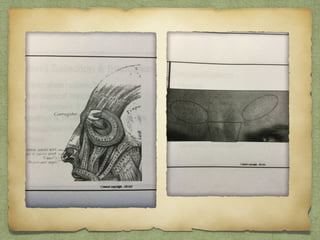
Muscles responsible for frown lines between eyes.
Glabellar complex,
Corrugater bilateral
Procerus medial
Depressor complex opposes elevator muscles of the frontalis.
Brow adduction and brow medial inferior movement
Angry or worried appearance effects.
Anatomy
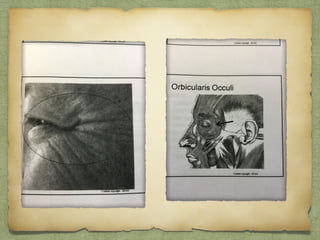
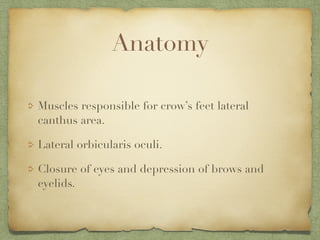
Muscles responsible for crow’s feet lateral
canthus area.
Lateral orbicularis oculi.
Closure of eyes and depression of brows and
eyelids.
Cosmetic usage of
botulinum toxin A
Glabellar frowns lines.
Forehead lines.
Crow’s feet
Excessive sweating, hyperhydrosis.
Lines and bands in the neck.
Lines on chest,
Perioral wrinkles.
Facial contouring.
Patient selection and
evaluation
Expectation realistic .
Past medical history.
Past treatment and outcomes.
Location and severity of treatment sites.
Pretreatment asymmetries.
Ptosis, lid laxity.
Contraindications
Absolute
Preexisting neuromuscular disease.
AML amyotrophic lateral sclerosis. AML.
Myasthenia Gravis
Pregnancy
Breast feeding
Infection at injection site.
Unrealistic expectation.
Contraindications
Relative
Facial palsy.
Marked preexisting asymmetry.
Moderate to severe ptosis.
Preparation
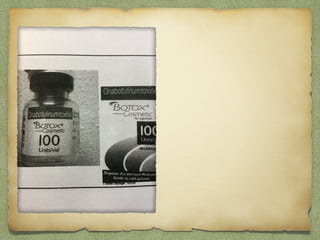
Botox
Labile
Lyophilized vials
Vacuum should be prepared.
Inject saline slowly to minimize bubbles.
Gentle swirl vial. No vigorously shaking.
Dilution range 1 to 4 ml
Recommended dilution 2.5 ml or 4 units/0.1ml.
Preparation
Dysport
Lyophilized vials. 300 units/ vial.
Same preparation as Botox.
Vacuum should be presented.
Recommended dilution.
3 ml or 10 units / 0.1 ml
Inject the sam3 vol as for Botox, or Dysport if mix this way.
Xeomin
Lyophilized vials 100 units/vial.
Same preparation as Botox.
Vacuum should be presented upon dilution.
Recommended dilution 2.5 ml or 4 units/ 0.1 ml.
Preparation techniques
Storage
Botox and Dysport shipped frozen on dry ice, placed in
freezer or refrigerator upon delivery.
Xeomin shipped at room temperature.
Once reconstituted refrigerated.
2 to 8degreeCelsius. Not frozen.
Allergan and Galderma, recommend discarding of Botox or
Dysport after 4 hrs for sterility reason.
Glabellar injections
Pt asked to frown.
Corrugator and procerus identified.
5 to 6 sites. 2 injection sites per corrugator.
1 to 2 injection sites to procerus.
Injection vol 0.05cc to 0.10 cc (2-4 units), per site
depending on severity.
Total dose 15 -25 units.
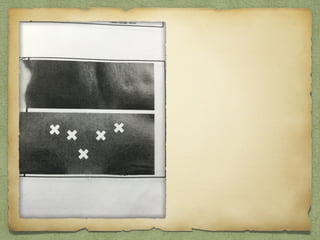
Frontalis injection.
Injection distribution adjacent to furrow. In the
mountains not the valleys.
Patient asked to furrow their forehead for
placement.
Stay 1.5 c,from eyebrows to prevent ptosis.
Not always possible to target lowest rhytids.
Frontalis injection.
Injection site, 4-8 sites or more depending on
severity of wrinkles.
Injection vol, 0.05 cc, 2 units per site.
Dosage 8-16 units.
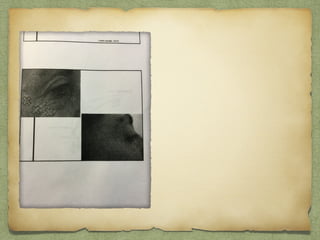
Crow’s feet/Lateral
canthus
Injection sites, 2-4 sites per lateral canthus.
Usually 3 sites.
Intradermal is effective.
Injection volume, 0.05 cc, 2 units per site.
Dosage 4-8 units per site.
Crow’s feet/lateral
canthus.
Pt asked to smile maximum.
Stay 1 cm lateral to orbital rim, avoid diffusion to rectus
muscle.
Don’t go below zygoma, lip ptosis.
Be aware of vessels near lateral canthus.
Crow’s feet can be, evenly below or bone lateral canthus.
Primarily below lateral canthus. Primarily above lateral
canthus.
Post procedure care
Don’t lie flat for 4 to 8 hrs.
Don’t bend over and pick heavy objects, for 4 hrs.
Don’t massage in the area,
Work the muscles infected.
Topical vitA or arnica for bruising.
Ice for any swelling.
Complications and side
effects
Bruising
Pain redness to injected site
Headache
Nausea and flu like symptoms
Face pain
Anaphylaxis
Uneven result.
Unwanted muscle paralysis.
Complications and side
effects
Eyelids ptosis.
Eyebrow ptosis
Diplopia
Lip ptosis
Ectropion
Antibody resistance.
Treatment of ptosis.
Avoid ptosis by not injection closer than 1.5 cm to eye
browns. Injection or diffusion into frontalis muscle.
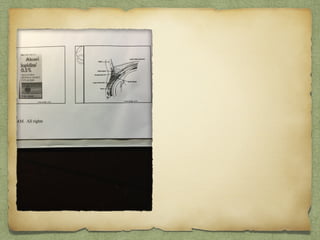
Diffusion into lavator palpebral muscle of eyelid.
Treat with apraclonidine, lopidine eye drops.
Allow Mueller’s muscle elevation up to 3 mm, 2 drops
TID.
Mueller’s muscle smooth muscle and depends on
adrenergic activity.
Advices
Single treatment may nor eliminate all lines and
wrinkles.
Onset in 3 days, max effects may take upto 2 weeks.
Complete paralysis may not provide greatest
cosmetic effects
Relaxation not paralysis more natural look.
Deep furrow and lines may need filler augmentation.
Advices
Recovery generally begins at 3 to 4 months after injection.
PTE receiving regular treatment ay have duration of 4-6
months.
Bruising usually resolves in 2 weeks.
Ptosis if from diffusion into levator palpebral May resolve
2-3 weeks.
Ptosis from frontalis effects last entire duration of 3 to 4
months.

Presentation

  • 1.
    Botulinum toxin American boardof Aesthetic medicine.
  • 2.
    History Discovered in 1895. Neurotoxin,clostridium botulinum. One of the most toxic substances known. Causes food poisoning, ingestion of food contaminated with spores. Perforated can, anaerobic environment, spore germination.
  • 3.
    Botulinum toxin typeA Isolatedin 1920. Clinical use for >30 years. 1989, FDA for treatment of strabismus and blepharospasm.
  • 4.
    Introduction Cosmetic effect initiallydescribed in 80’s. Jean and Alastair Carruthers Ophthalmologist/dermatologist husband and wife team from Canada. Wrinkles in glabellar region decrease after treatment for eyelids spasm with Btx A. Experimented on themselves and staff.
  • 5.
    Introduction 2002 FDA approvedBtX glabellar lines. Also approved for axillary hyperhiderosis. Increased use for dystopia and spastic disorders. Limb dystonia. Lingual dystonia. Facial spasm Migraine.
  • 6.
    Introduction Purified proteins complex. 7serotypes, A ,B, C, D, E, F, G A and B serotypes Clinical use. Type B, myobloc/elan, cervical dystonia. Type A most potent and most established for cosmetic use. Botox, Allergen Dysport, Galderma. Xeomin, Mertz.
  • 7.
    Mechanism Inhibition of acetylcholinerelease at NMJ. Ach induced transmissions blocked. Muscular flaccid paralysis.
  • 8.
    Mechanism Botox, light andheavy chains. Heavy chain bound to nerve irreversible. Receptor toxin complex internalized. Endocytosis. Light chain cleave peptide bonds requires for Ach formation.
  • 9.
    Botulinum toxin A 3types in current cosmetic use. Botox, onabotulinumtoxin A. Dysport, abobotulinumtoxin A Xeomin, incobotulinumtoxin A.
  • 10.
    Onabotulinumtoxin A Botox. Allergan Bacterialstrain Hall Mol weight 900 KD 100 u btx A , 0.5 mg HSA, 0.9 mg NaCl. Complexing proteins 5 Nd/100U
  • 11.
    Abotulinumtoxin A IPSec UK,medicis US. IPSec strain. 300-500 KD. 300-500 U btx A, 0.125 mg HSA, 2.5 mg lactose Complexing protein 2.5 ng/100 U
  • 12.
    Incobotulinum A Xeomin. Merzpharmaceutical Germany. Hall strain. 150 KD. 100 U btx A, 1 mg HSA 5 m sucrose. Complexing protein none. Possible less allergic potential.
  • 13.
    Botulinum toxin A Unitpotency, mouse intraperitoneal injection assay. 1 U activity, dose which causes death in 72 hrs in 50% of mice assessed. Ld 50 Assay protocols varies among manufacturers. 1 unit Botox, 2 units of Dysport. Lethal dose 2500-3000 units or 30 bottles 70 kg person.
  • 14.
    Anatomy Complications due toinappropriate placement.
  • 15.
    Diffusion Diffusion differs dueto proteins clustered around active molecule. Botox, 900 KD. Dysport, 300-500 KD. Xeomin, 150 KD. Spread Botox < Dysport < Xeomin.
  • 16.
    Anatomy Muscles responsible forfrown lines to forehead. Frontalis Not continuous but separate bands. Opposes depressor muscles of glabellar complex and brows.
  • 17.
    Anatomy Muscles responsible forfrown lines between eyes. Glabellar complex, Corrugater bilateral Procerus medial Depressor complex opposes elevator muscles of the frontalis. Brow adduction and brow medial inferior movement Angry or worried appearance effects.
  • 21.
    Anatomy Muscles responsible forcrow’s feet lateral canthus area. Lateral orbicularis oculi. Closure of eyes and depression of brows and eyelids.
  • 22.
    Cosmetic usage of botulinumtoxin A Glabellar frowns lines. Forehead lines. Crow’s feet Excessive sweating, hyperhydrosis. Lines and bands in the neck. Lines on chest, Perioral wrinkles. Facial contouring.
  • 23.
    Patient selection and evaluation Expectationrealistic . Past medical history. Past treatment and outcomes. Location and severity of treatment sites. Pretreatment asymmetries. Ptosis, lid laxity.
  • 24.
    Contraindications Absolute Preexisting neuromuscular disease. AMLamyotrophic lateral sclerosis. AML. Myasthenia Gravis Pregnancy Breast feeding Infection at injection site. Unrealistic expectation.
  • 25.
  • 26.
    Preparation Botox Labile Lyophilized vials Vacuum shouldbe prepared. Inject saline slowly to minimize bubbles. Gentle swirl vial. No vigorously shaking. Dilution range 1 to 4 ml Recommended dilution 2.5 ml or 4 units/0.1ml.
  • 28.
    Preparation Dysport Lyophilized vials. 300units/ vial. Same preparation as Botox. Vacuum should be presented. Recommended dilution. 3 ml or 10 units / 0.1 ml Inject the sam3 vol as for Botox, or Dysport if mix this way.
  • 30.
    Xeomin Lyophilized vials 100units/vial. Same preparation as Botox. Vacuum should be presented upon dilution. Recommended dilution 2.5 ml or 4 units/ 0.1 ml.
  • 31.
    Preparation techniques Storage Botox andDysport shipped frozen on dry ice, placed in freezer or refrigerator upon delivery. Xeomin shipped at room temperature. Once reconstituted refrigerated. 2 to 8degreeCelsius. Not frozen. Allergan and Galderma, recommend discarding of Botox or Dysport after 4 hrs for sterility reason.
  • 32.
    Glabellar injections Pt askedto frown. Corrugator and procerus identified. 5 to 6 sites. 2 injection sites per corrugator. 1 to 2 injection sites to procerus. Injection vol 0.05cc to 0.10 cc (2-4 units), per site depending on severity. Total dose 15 -25 units.
  • 34.
    Frontalis injection. Injection distributionadjacent to furrow. In the mountains not the valleys. Patient asked to furrow their forehead for placement. Stay 1.5 c,from eyebrows to prevent ptosis. Not always possible to target lowest rhytids.
  • 35.
    Frontalis injection. Injection site,4-8 sites or more depending on severity of wrinkles. Injection vol, 0.05 cc, 2 units per site. Dosage 8-16 units.
  • 36.
    Crow’s feet/Lateral canthus Injection sites,2-4 sites per lateral canthus. Usually 3 sites. Intradermal is effective. Injection volume, 0.05 cc, 2 units per site. Dosage 4-8 units per site.
  • 37.
    Crow’s feet/lateral canthus. Pt askedto smile maximum. Stay 1 cm lateral to orbital rim, avoid diffusion to rectus muscle. Don’t go below zygoma, lip ptosis. Be aware of vessels near lateral canthus. Crow’s feet can be, evenly below or bone lateral canthus. Primarily below lateral canthus. Primarily above lateral canthus.
  • 39.
    Post procedure care Don’tlie flat for 4 to 8 hrs. Don’t bend over and pick heavy objects, for 4 hrs. Don’t massage in the area, Work the muscles infected. Topical vitA or arnica for bruising. Ice for any swelling.
  • 40.
    Complications and side effects Bruising Painredness to injected site Headache Nausea and flu like symptoms Face pain Anaphylaxis Uneven result. Unwanted muscle paralysis.
  • 41.
    Complications and side effects Eyelidsptosis. Eyebrow ptosis Diplopia Lip ptosis Ectropion Antibody resistance.
  • 42.
    Treatment of ptosis. Avoidptosis by not injection closer than 1.5 cm to eye browns. Injection or diffusion into frontalis muscle. Diffusion into lavator palpebral muscle of eyelid. Treat with apraclonidine, lopidine eye drops. Allow Mueller’s muscle elevation up to 3 mm, 2 drops TID. Mueller’s muscle smooth muscle and depends on adrenergic activity.
  • 44.
    Advices Single treatment maynor eliminate all lines and wrinkles. Onset in 3 days, max effects may take upto 2 weeks. Complete paralysis may not provide greatest cosmetic effects Relaxation not paralysis more natural look. Deep furrow and lines may need filler augmentation.
  • 45.
    Advices Recovery generally beginsat 3 to 4 months after injection. PTE receiving regular treatment ay have duration of 4-6 months. Bruising usually resolves in 2 weeks. Ptosis if from diffusion into levator palpebral May resolve 2-3 weeks. Ptosis from frontalis effects last entire duration of 3 to 4 months.