SOA Practitioners’ Guide:
Best Practices for Enterprise
Transformation and Modernization
Burc Oral, PhD, CellExchange, Inc.,
Peter Bostrom, BEA Systems
Painting by Surekha Durvasula ©
Third Service Oriented Architecture for E-Government Conference,
May 1-2, 2007, at MITRE: Responsibility to Provide Best Practices for
An Information Sharing Environment - Bringing Together the Global
Information Grid, W3C, SOA Consortium, and Shared Services
Third Service Oriented Architecture for E-Government Conference, May 1-2, 2007SOA Practitioners’ Guide
Surekha Durvasula, Enterprise Architect, Kohls
Martin Guttmann, Principal Architect, Customer Solutions Group, Intel Corp
Ashok Kumar, Manager, Director – Services Architecture, Avis/Budget
Jeffrey Lamb, Enterprise Architect, Wells Fargo
Tom Mitchell, Lead Technical Architect, Wells Fargo Private Client Services
Dr. Burc Oral, Sr. Architect, CellExchange, Inc.
Yogish Pai, Chief Architect AquaLogic Composer, BEA Systems, Inc.
Tom Sedlack, Enterprise Architecture and Engineering, SunTrust Banks, Inc.
Dr. Harsh Sharma, Senior Information Architect, MetLife
Sankar Ram-Sundaresan, Chief Architect e-Business, HP-IT
SOA Practitioners
Authors are also the founding members of the SOA Consortium
Third Service Oriented Architecture for E-Government Conference, May 1-2, 2007SOA Practitioners’ Guide
The Practitioner’s Guide: A Collective BoK
Collaborative work of dedicated expert SOA practitioners,
brought together by BEA and Intel in 2005
Authors are also the founding members of the SOA Consortium
A series of living documents
Collective body of knowledge about SOA
Develops a shared language
Describes and documents best practices and key learnings
Helps fellow practitioners address the challenges of SOA
A reference encyclopedia for all SOA stakeholders
Guide to Enterprise Transformation and Modernization
Third Service Oriented Architecture for E-Government Conference, May 1-2, 2007SOA Practitioners’ Guide
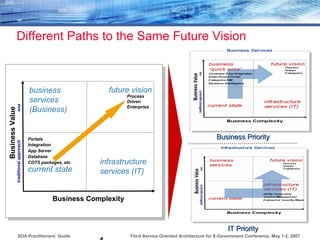
Different Paths to the Same Future Vision
Business Complexity
BusinessValue
traditionalapproachsoa
current state
infrastructure
services (IT)
business
services
(Business)
future vision
Portals
Integration
App Server
Database
COTS packages, etc.
Process
Driven
Enterprise
Business PriorityBusiness Priority
IT PriorityIT Priority
Third Service Oriented Architecture for E-Government Conference, May 1-2, 2007SOA Practitioners’ Guide
Impetus for the Practitioners’ Guide
•Relieve Business and IT Pain Points
•Expand Current Enterprise Architectures
Business Solutions through Applications
•Create Future Vision
Business Solutions through Infrastructure
•Align IT and Business Paths
Third Service Oriented Architecture for E-Government Conference, May 1-2, 2007SOA Practitioners’ Guide
Best Practices for Alignment
Understand Business Services
Define Key Performance Metrics
Build out the Infrastructure While Meeting Immediate
Business Needs
Identify “quick wins” Using SOA
Design and Build Infrastructure Services as Required
Develop SOA Blueprint and
Follow SOA Practitioners’ Guide
Third Service Oriented Architecture for E-Government Conference, May 1-2, 2007SOA Practitioners’ Guide
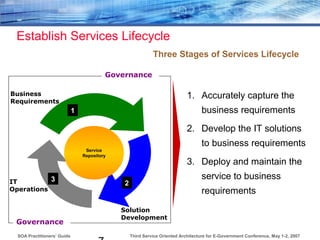
Business
Requirements
Solution
Development
IT
Operations
Service
Repository
1
2
3
1. Accurately capture the
business requirements
2. Develop the IT solutions
to business requirements
3. Deploy and maintain the
service to business
requirements
Establish Services Lifecycle
Governance
Governance
Three Stages of Services Lifecycle
Third Service Oriented Architecture for E-Government Conference, May 1-2, 2007SOA Practitioners’ Guide
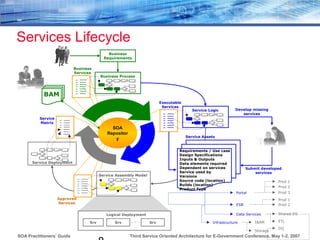
SOA
Repositor
y
Business
Requirements
Business Process
Business
Services
Service Logic
Executable
Services
Service Assets
Requirements / Use case
Design Specifications
Inputs & Outputs
Data elements required
Dependent on services
Service used by
Versions
Source code (location)
Builds (location)
Product Type
Develop missing
services
Submit developed
services
Approved
Services
Service Assembly Model
Logical Deployment
Srv Srv Srv
Portal
ESB
Data Services
Infrastructure
Prod 1
Prod 2
Prod 3
Prod 1
Prod 2
Shared DS
ETL
DQ
I&AM
Storage
Service Deployment
Service
Matrix
BAM
Services Lifecycle
Third Service Oriented Architecture for E-Government Conference, May 1-2, 2007SOA Practitioners’ Guide
Elements of a Lifecycle Stage
Actors
Tools
Artifacts/Deliverables
Service Lifecycle Key Considerations
Stage Recommended Process
Best Practices and Requirements
Download SOA Practitioners’ Guide for Details
Third Service Oriented Architecture for E-Government Conference, May 1-2, 2007SOA Practitioners’ Guide
Services Lifecycle
Selected Best Practices
Requirements Stage Best Practice
 Capture all business requirements in the form of business processes such as activities,
rules, and policies
Application Design Stage Best Practice
 Have business analysts focus on business process modeling and architects focus on
service orchestration modeling
Application Design & Development Stage Best Practice
 Architects define the service, implementation, properties, interfaces, and bindings.
The development team then leverages this service model for developing and
modifying the service.
SOA Governance and Organizations Best Practice
 Spur organizational agility by creating teams based on technical capabilities not on
projects
Third Service Oriented Architecture for E-Government Conference, May 1-2, 2007SOA Practitioners’ Guide
Getting There with SOA Lifecycle
Portfolio Management
Project
Management
Application
Infrastructure
Data
Testing
Publish
Discover
Project Objectives
Develop SOA Roadmap
Team Members
FTE & PT
Timeline & Deliverables
6-12 weeks
Initiate SOA
Initiate
Business Principles
Application Principles
Technology Principles
Data Principles
Business Architecture
BPM, COTS, etc.
Infrastructure Arch
Portal, SO, ES, etc.
Information Arch
MDM, ODS, DW, etc.
SOA Principles
Reference
Architecture
Develop Roadmap
Based on Biz Priorities
Develop SOA Roadmap
Execute SOA Roadmap
Execute Plan
Governance Organization Skills Mapping
Review and Update Roadmap
Third Service Oriented Architecture for E-Government Conference, May 1-2, 2007SOA Practitioners’ Guide
SOA Lifecycle
1. Initiate SOA
 Establish the process for getting started
 Establish objectives, project teams, timelines, deliverables, etc.
1. Develop Roadmap
 Establish SOA Principles
 Develop Reference Architecture
 Develop SOA roadmap based on business priority
1. Execute SOA Roadmap
 Initiate Enterprise Transformation in Business and IT
by establishing SOA Governance
 Manage Services Portfolio and execute roadmap
 Revise and update roadmap on a periodic basis, based on internal
and external environmental changes
Third Service Oriented Architecture for E-Government Conference, May 1-2, 2007SOA Practitioners’ Guide
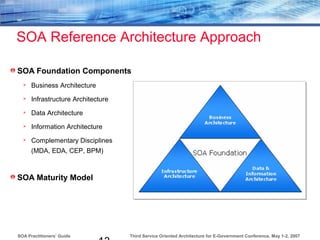
SOA Reference Architecture Approach
SOA Foundation Components
 Business Architecture
 Infrastructure Architecture
 Data Architecture
 Information Architecture
 Complementary Disciplines
(MDA, EDA, CEP, BPM)
SOA Maturity Model
Third Service Oriented Architecture for E-Government Conference, May 1-2, 2007SOA Practitioners’ Guide
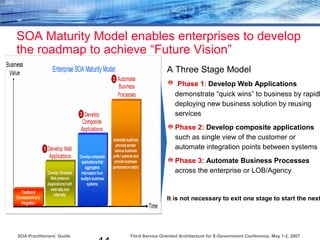
SOA Maturity Model enables enterprises to develop
the roadmap to achieve “Future Vision”
A Three Stage Model
Phase 1: Develop Web Applications
demonstrate “quick wins” to business by rapidl
deploying new business solution by reusing
services
Phase 2: Develop composite applications
such as single view of the customer or
automate integration points between systems
Phase 3: Automate Business Processes
across the enterprise or LOB/Agency
It is not necessary to exit one stage to start the next
Third Service Oriented Architecture for E-Government Conference, May 1-2, 2007SOA Practitioners’ Guide
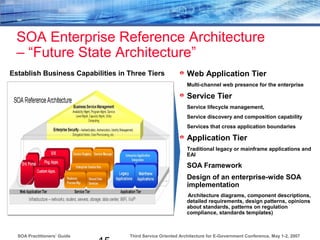
SOA Enterprise Reference Architecture
– “Future State Architecture”
Web Application Tier
Multi-channel web presence for the enterprise
Service Tier
Service lifecycle management,
Service discovery and composition capability
Services that cross application boundaries
Application Tier
Traditional legacy or mainframe applications and
EAI
SOA Framework
Design of an enterprise-wide SOA
implementation
Architecture diagrams, component descriptions,
detailed requirements, design patterns, opinions
about standards, patterns on regulation
compliance, standards templates)
Establish Business Capabilities in Three Tiers
Third Service Oriented Architecture for E-Government Conference, May 1-2, 2007SOA Practitioners’ Guide
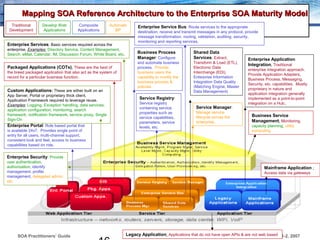
Enterprise Portal: Role based portal that
is available 24x7. Provides single point of
entry for all users, multi-channel support,
consistent look and feel, access to business
capabilities based on role.
Custom Applications: These are either built on an
App Server, Portal or proprietary thick client.
Application Framework required to leverage reuse.
Examples: Logging, Exception handling, data services,
application configuration, monitoring, search
framework, notification framework, service proxy, Single
Sign-On
Packaged Applications (COTs): These are the best of
the breed packaged application that also act as the system of
record for a particular business function.
Enterprise Services: Basic services required across the
enterprise. Examples: Directory Service, Content Management,
Search, eMail, Calendar, IM, Discussion Forum, White Board, etc. Business Process
Manager: Configure
and automate business
process. Provide
business users the
capability to modify the
business process &
policies.
Enterprise Service Bus: Route services to the appropriate
destination; receive and transmit messages in any protocol, provide
message transformation, routing, validation, auditing, security,
monitoring and reporting services.
Service Registry:
Service registry
containing service
properties such as
service capabilities,
parameters, service
levels, etc.
Shared Data
Services: Extract,
Transform & Load (ETL),
Electronic Data
Interchange (EDI),
Enterprise Information
Integration Data Quality
(Matching Engine, Master
Data Management)
Service Manager:
Manage service
lifecycle across the
enterprise.
Enterprise Application
Integration: Traditional
enterprise integration approach.
Provide Application Adapters,
Business Process, Messaging,
Security, etc. capabilities. Mostly
proprietary in nature and
application integration generally
implemented as a point-to-point
integration on a Hub..
Legacy Application: Applications that do not have open APIs & are not web based
Mainframe Application :
Access data via gateways
Enterprise Security: Provide
user authentication,
authorization, identify
management, profile
management, delegated admin,
etc.
Business Service
Management: Monitoring,
capacity planning, utility
computing
Mapping SOA Reference Architecture to the Enterprise SOA Maturity ModelMapping SOA Reference Architecture to the Enterprise SOA Maturity Model
Traditional
Development
Develop Web
Applications
Composite
Applications
Automate
BP
Third Service Oriented Architecture for E-Government Conference, May 1-2, 2007SOA Practitioners’ Guide
Where to find SOA Practitioners’ Guide
SOA Reference Architecture published at the Global
Integration Summit held at Boston in May 2006
Three part SOA Practitioners Guide published at the BEA
World held at San Francisco in September 2006
http://dev2dev.bea.com/pub/a/2006/09/soa-practitioners-guide.html
)
Living Document at
http://soaalliance.jot.com/MemberPublications
which shall be constantly updated based on the SOA
Practitioners experience
Download at
http://www.cellexchange.com/soa
Third Service Oriented Architecture for E-Government Conference, May 1-2, 2007SOA Practitioners’ Guide
Thanks
Ready for Q/A about how to
Burc Oral, PhD, CellExchange, Inc.
boral@cellexchange.com
http://www.cellexchange.com
Transform and Modernize
your Enterprise
with SOA Practitioners’ Guide

BOral205012007.290213247

  • 1.
    SOA Practitioners’ Guide: BestPractices for Enterprise Transformation and Modernization Burc Oral, PhD, CellExchange, Inc., Peter Bostrom, BEA Systems Painting by Surekha Durvasula © Third Service Oriented Architecture for E-Government Conference, May 1-2, 2007, at MITRE: Responsibility to Provide Best Practices for An Information Sharing Environment - Bringing Together the Global Information Grid, W3C, SOA Consortium, and Shared Services
  • 2.
    Third Service OrientedArchitecture for E-Government Conference, May 1-2, 2007SOA Practitioners’ Guide Surekha Durvasula, Enterprise Architect, Kohls Martin Guttmann, Principal Architect, Customer Solutions Group, Intel Corp Ashok Kumar, Manager, Director – Services Architecture, Avis/Budget Jeffrey Lamb, Enterprise Architect, Wells Fargo Tom Mitchell, Lead Technical Architect, Wells Fargo Private Client Services Dr. Burc Oral, Sr. Architect, CellExchange, Inc. Yogish Pai, Chief Architect AquaLogic Composer, BEA Systems, Inc. Tom Sedlack, Enterprise Architecture and Engineering, SunTrust Banks, Inc. Dr. Harsh Sharma, Senior Information Architect, MetLife Sankar Ram-Sundaresan, Chief Architect e-Business, HP-IT SOA Practitioners Authors are also the founding members of the SOA Consortium
  • 3.
    Third Service OrientedArchitecture for E-Government Conference, May 1-2, 2007SOA Practitioners’ Guide The Practitioner’s Guide: A Collective BoK Collaborative work of dedicated expert SOA practitioners, brought together by BEA and Intel in 2005 Authors are also the founding members of the SOA Consortium A series of living documents Collective body of knowledge about SOA Develops a shared language Describes and documents best practices and key learnings Helps fellow practitioners address the challenges of SOA A reference encyclopedia for all SOA stakeholders Guide to Enterprise Transformation and Modernization
  • 4.
    Third Service OrientedArchitecture for E-Government Conference, May 1-2, 2007SOA Practitioners’ Guide Different Paths to the Same Future Vision Business Complexity BusinessValue traditionalapproachsoa current state infrastructure services (IT) business services (Business) future vision Portals Integration App Server Database COTS packages, etc. Process Driven Enterprise Business PriorityBusiness Priority IT PriorityIT Priority
  • 5.
    Third Service OrientedArchitecture for E-Government Conference, May 1-2, 2007SOA Practitioners’ Guide Impetus for the Practitioners’ Guide •Relieve Business and IT Pain Points •Expand Current Enterprise Architectures Business Solutions through Applications •Create Future Vision Business Solutions through Infrastructure •Align IT and Business Paths
  • 6.
    Third Service OrientedArchitecture for E-Government Conference, May 1-2, 2007SOA Practitioners’ Guide Best Practices for Alignment Understand Business Services Define Key Performance Metrics Build out the Infrastructure While Meeting Immediate Business Needs Identify “quick wins” Using SOA Design and Build Infrastructure Services as Required Develop SOA Blueprint and Follow SOA Practitioners’ Guide
  • 7.
    Third Service OrientedArchitecture for E-Government Conference, May 1-2, 2007SOA Practitioners’ Guide Business Requirements Solution Development IT Operations Service Repository 1 2 3 1. Accurately capture the business requirements 2. Develop the IT solutions to business requirements 3. Deploy and maintain the service to business requirements Establish Services Lifecycle Governance Governance Three Stages of Services Lifecycle
  • 8.
    Third Service OrientedArchitecture for E-Government Conference, May 1-2, 2007SOA Practitioners’ Guide SOA Repositor y Business Requirements Business Process Business Services Service Logic Executable Services Service Assets Requirements / Use case Design Specifications Inputs & Outputs Data elements required Dependent on services Service used by Versions Source code (location) Builds (location) Product Type Develop missing services Submit developed services Approved Services Service Assembly Model Logical Deployment Srv Srv Srv Portal ESB Data Services Infrastructure Prod 1 Prod 2 Prod 3 Prod 1 Prod 2 Shared DS ETL DQ I&AM Storage Service Deployment Service Matrix BAM Services Lifecycle
  • 9.
    Third Service OrientedArchitecture for E-Government Conference, May 1-2, 2007SOA Practitioners’ Guide Elements of a Lifecycle Stage Actors Tools Artifacts/Deliverables Service Lifecycle Key Considerations Stage Recommended Process Best Practices and Requirements Download SOA Practitioners’ Guide for Details
  • 10.
    Third Service OrientedArchitecture for E-Government Conference, May 1-2, 2007SOA Practitioners’ Guide Services Lifecycle Selected Best Practices Requirements Stage Best Practice  Capture all business requirements in the form of business processes such as activities, rules, and policies Application Design Stage Best Practice  Have business analysts focus on business process modeling and architects focus on service orchestration modeling Application Design & Development Stage Best Practice  Architects define the service, implementation, properties, interfaces, and bindings. The development team then leverages this service model for developing and modifying the service. SOA Governance and Organizations Best Practice  Spur organizational agility by creating teams based on technical capabilities not on projects
  • 11.
    Third Service OrientedArchitecture for E-Government Conference, May 1-2, 2007SOA Practitioners’ Guide Getting There with SOA Lifecycle Portfolio Management Project Management Application Infrastructure Data Testing Publish Discover Project Objectives Develop SOA Roadmap Team Members FTE & PT Timeline & Deliverables 6-12 weeks Initiate SOA Initiate Business Principles Application Principles Technology Principles Data Principles Business Architecture BPM, COTS, etc. Infrastructure Arch Portal, SO, ES, etc. Information Arch MDM, ODS, DW, etc. SOA Principles Reference Architecture Develop Roadmap Based on Biz Priorities Develop SOA Roadmap Execute SOA Roadmap Execute Plan Governance Organization Skills Mapping Review and Update Roadmap
  • 12.
    Third Service OrientedArchitecture for E-Government Conference, May 1-2, 2007SOA Practitioners’ Guide SOA Lifecycle 1. Initiate SOA  Establish the process for getting started  Establish objectives, project teams, timelines, deliverables, etc. 1. Develop Roadmap  Establish SOA Principles  Develop Reference Architecture  Develop SOA roadmap based on business priority 1. Execute SOA Roadmap  Initiate Enterprise Transformation in Business and IT by establishing SOA Governance  Manage Services Portfolio and execute roadmap  Revise and update roadmap on a periodic basis, based on internal and external environmental changes
  • 13.
    Third Service OrientedArchitecture for E-Government Conference, May 1-2, 2007SOA Practitioners’ Guide SOA Reference Architecture Approach SOA Foundation Components  Business Architecture  Infrastructure Architecture  Data Architecture  Information Architecture  Complementary Disciplines (MDA, EDA, CEP, BPM) SOA Maturity Model
  • 14.
    Third Service OrientedArchitecture for E-Government Conference, May 1-2, 2007SOA Practitioners’ Guide SOA Maturity Model enables enterprises to develop the roadmap to achieve “Future Vision” A Three Stage Model Phase 1: Develop Web Applications demonstrate “quick wins” to business by rapidl deploying new business solution by reusing services Phase 2: Develop composite applications such as single view of the customer or automate integration points between systems Phase 3: Automate Business Processes across the enterprise or LOB/Agency It is not necessary to exit one stage to start the next
  • 15.
    Third Service OrientedArchitecture for E-Government Conference, May 1-2, 2007SOA Practitioners’ Guide SOA Enterprise Reference Architecture – “Future State Architecture” Web Application Tier Multi-channel web presence for the enterprise Service Tier Service lifecycle management, Service discovery and composition capability Services that cross application boundaries Application Tier Traditional legacy or mainframe applications and EAI SOA Framework Design of an enterprise-wide SOA implementation Architecture diagrams, component descriptions, detailed requirements, design patterns, opinions about standards, patterns on regulation compliance, standards templates) Establish Business Capabilities in Three Tiers
  • 16.
    Third Service OrientedArchitecture for E-Government Conference, May 1-2, 2007SOA Practitioners’ Guide Enterprise Portal: Role based portal that is available 24x7. Provides single point of entry for all users, multi-channel support, consistent look and feel, access to business capabilities based on role. Custom Applications: These are either built on an App Server, Portal or proprietary thick client. Application Framework required to leverage reuse. Examples: Logging, Exception handling, data services, application configuration, monitoring, search framework, notification framework, service proxy, Single Sign-On Packaged Applications (COTs): These are the best of the breed packaged application that also act as the system of record for a particular business function. Enterprise Services: Basic services required across the enterprise. Examples: Directory Service, Content Management, Search, eMail, Calendar, IM, Discussion Forum, White Board, etc. Business Process Manager: Configure and automate business process. Provide business users the capability to modify the business process & policies. Enterprise Service Bus: Route services to the appropriate destination; receive and transmit messages in any protocol, provide message transformation, routing, validation, auditing, security, monitoring and reporting services. Service Registry: Service registry containing service properties such as service capabilities, parameters, service levels, etc. Shared Data Services: Extract, Transform & Load (ETL), Electronic Data Interchange (EDI), Enterprise Information Integration Data Quality (Matching Engine, Master Data Management) Service Manager: Manage service lifecycle across the enterprise. Enterprise Application Integration: Traditional enterprise integration approach. Provide Application Adapters, Business Process, Messaging, Security, etc. capabilities. Mostly proprietary in nature and application integration generally implemented as a point-to-point integration on a Hub.. Legacy Application: Applications that do not have open APIs & are not web based Mainframe Application : Access data via gateways Enterprise Security: Provide user authentication, authorization, identify management, profile management, delegated admin, etc. Business Service Management: Monitoring, capacity planning, utility computing Mapping SOA Reference Architecture to the Enterprise SOA Maturity ModelMapping SOA Reference Architecture to the Enterprise SOA Maturity Model Traditional Development Develop Web Applications Composite Applications Automate BP
  • 17.
    Third Service OrientedArchitecture for E-Government Conference, May 1-2, 2007SOA Practitioners’ Guide Where to find SOA Practitioners’ Guide SOA Reference Architecture published at the Global Integration Summit held at Boston in May 2006 Three part SOA Practitioners Guide published at the BEA World held at San Francisco in September 2006 http://dev2dev.bea.com/pub/a/2006/09/soa-practitioners-guide.html ) Living Document at http://soaalliance.jot.com/MemberPublications which shall be constantly updated based on the SOA Practitioners experience Download at http://www.cellexchange.com/soa
  • 18.
    Third Service OrientedArchitecture for E-Government Conference, May 1-2, 2007SOA Practitioners’ Guide Thanks Ready for Q/A about how to Burc Oral, PhD, CellExchange, Inc. boral@cellexchange.com http://www.cellexchange.com Transform and Modernize your Enterprise with SOA Practitioners’ Guide