BEA implemented an end-to-end architecture utilizing a set of Enterprise
Infrastructure Services (EIS) built on BEA WebLogic Platform™
8.1. The EIS archi-
tecture is designed to support applications that will make BEA’s sales force more
effective and productive, and enable timelier, more proactive customer support.
OVERVIEW
At a certain point, linear expansion of an IT
infrastructure begins to deliver diminishing
returns. BEA had reached that point by 2003
and realized that radical change was necessary.
To reduce IT costs, ensure data consistency
across applications, improve customer support,
and increase the productivity of BEA sales
people, BEA challenged its IT staff to imple-
ment a new enterprise architecture.
The new architecture would be service-ori-
ented, meaning data and business logic
would be centralized and exposed to sales
and support applications in the form of stan-
dards-based Web services. BEA turned to its
own platform suite to implement the new
infrastructure. BEA WebLogic Workshop™
8.1 was used as the integrated development
environment (IDE).
BEA refers to this project as the Future State
Architecture (FSA) initiative.This new archi-
tecture transforms applications from their
traditional roles as fat, isolated containers of
data into new roles as facilitators of integrated
business activities. All the data and business
logic required for a task can be exposed via
Web services to a single application.There is
no need to bounce between screens to com-
plete a job. Applications essentially become
customized dashboards that are tailored based
on a user’s defined role.
The first two phases of the FSA initiative
were built in only six months.The develop-
ment team was comprised of eight people,
none of whom had previous experience
developing with BEA WebLogic Workshop.
BEA estimates that its service-oriented archi-
tecture will cut more than 50 percent off the
CUSTOMER CASE STUDY
BEA SYSTEMS, INC.
Enterprise Infrastructure Services
manpower and cost needed to build, integrate, extend
and manage its infrastructure. BEA anticipates that its
cumulative cost savings and productivity improvements
will top $75 million over three years.
COMPANY BRIEF
BEA is the world’s leading application infrastructure
software company. In eight years, the company has
grown from a small startup into a global organization.
Today, BEA and its WebLogic®
brand are among the
most trusted names in business.The company earned
nearly $1 billion in revenue during its last fiscal year
and has more than 15,000 customers and 3,000
employees in 31 countries.
BUSINESS PROCESS CHALLENGE
As the company grew, its information technology (IT)
infrastructure expanded in size and complexity to meet
the needs of the business. For several years, this IT phi-
losophy was successful, enabling the company to oper-
ate smartly and efficiently. However, at a certain point,
linear expansion of an IT infrastructure begins to deliv-
er diminishing returns. BEA had reached that point by
2003 and realized that radical change was necessary.
Simply adding more disparate enterprise applications
and data stores would not provide the payback that
BEA seeks from its IT investments.The costs of deploy-
ing, integrating and managing more silos was becoming
prohibitive.The infrastructure was unwieldy; it was
impractical to build custom connections between every
combination of systems that could conceivably exchange
data. It was equally impractical to build applications
with global reach from scratch every time a new busi-
ness requirement was identified.
The impact of a sprawling IT environment was particu-
larly acute for the customer-facing portions of the
organization. Sales people and customer service repre-
sentatives had to bounce between 12 points of entry
into 30 enterprise systems that contained customer
data. For example, viewing all open service cases for a
client was extremely difficult, as was understanding the
details of a client’s license agreement(s).
The result was that sales and support personnel were
spending a large percentage of their time on non-
value-add tasks just to stay current on client account
activity.This cut into time that sales people could spend
selling and generating revenue, and hampered the ability
of support staff to be proactive and close cases rapidly
and efficiently.
To reduce IT costs, ensure data consistency across appli-
cations, improve customer support, and increase the
productivity of BEA sales people, BEA challenged its
IT staff to implement a new enterprise architecture.
The new architecture would be service-oriented,
meaning data and business logic would be centralized
and exposed to sales and support in the form of stan-
dards-based Web services.The goal was to provide a
unified customer view that would allow account teams
to better understand a customer’s situation, support cus-
tomers in a timelier and more cost-effective manner,
and enrich BEA’s customer interaction to build more
lucrative and mutually beneficial long-term relationships.
Rhonda Hocker, BEA’s chief information officer, artic-
ulated the business case.“We wanted to decouple the
presentation layer from the business logic. This would
enable us to manage, expose, and secure data more
effectively, and rapidly deploy applications and func-
tionality for distinct audiences, such as customers, sales
reps, and customer service reps. The desired results are
substantially lower IT costs, superior customer service,
increased revenue (made possible by getting information
into the hands of inside and outside sales reps when
they need it), and greater company-wide productivity
facilitated by streamlined workflows.”
Although the project was focused on customer-centric
applications, the new architecture would provide benefits
that extend to every corner of the organization.The
architecture that BEA was envisioning would employ
fully reusable software code that could be leveraged
repeatedly to improve workflows for accounting, human
resources, marketing, operations, and other groups.As
the new architecture becomes more mature, and the
library of reusable software grows, future projects could
be completed faster and cheaper than would be possible
using traditional development strategies.
SOLUTION
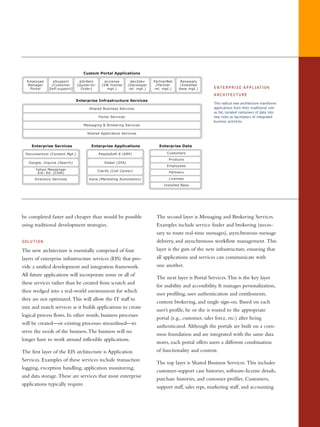
The new architecture is essentially comprised of four
layers of enterprise infrastructure services (EIS) that pro-
vide a unified development and integration framework.
All future applications will incorporate some or all of
these services rather than be created from scratch and
then wedged into a real-world environment for which
they are not optimized. This will allow the IT staff to
mix and match services as it builds applications to create
logical process flows. In other words, business processes
will be created—or existing processes streamlined—to
serve the needs of the business.The business will no
longer have to work around inflexible applications.
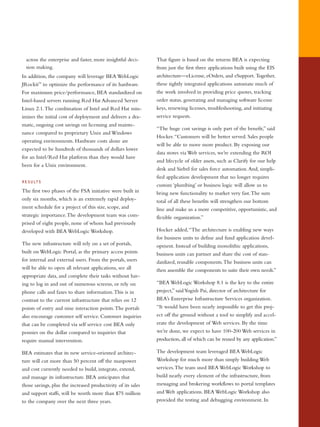
The first layer of the EIS architecture is Application
Services. Examples of these services include transaction
logging, exception handling, application monitoring,
and data storage. These are services that most enterprise
applications typically require.
The second layer is Messaging and Brokering Services.
Examples include service finder and brokering (neces-
sary to route real-time messages), asynchronous message
delivery, and asynchronous workflow management. This
layer is the guts of the new infrastructure, ensuring that
all applications and services can communicate with
one another.
The next layer is Portal Services.This is the key layer
for usability and accessibility. It manages personalization,
user profiling, user authentication and entitlements,
content brokering, and single sign-on. Based on each
user’s profile, he or she is routed to the appropriate
portal (e.g., customer, sales force, etc.) after being
authenticated. Although the portals are built on a com-
mon foundation and are integrated with the same data
stores, each portal offers users a different combination
of functionality and content.
The top layer is Shared Business Services. This includes
customer-support case histories, software-license details,
purchase histories, and customer profiles. Customers,
support staff, sales reps, marketing staff, and accounting
ENTERPRISE APPLIATION
ARCHITECTURE
This radical new architecture transforms
applications from their traditional role
as fat, isolated containers of data into
new roles as facilitators of integrated
business activities.
Custom Portal Applications
Enterprise Infrastructure Services
Enterprise Services Enterprise Applications Enterprise Data
Shared Business Services
Portal Services
Messaging & Brokering Services
Shared Application Services
Documentum (Content Mgt.)
Google, Inquira (Search)
Yahoo Messenger
Ent. Ed. (Chat)
Directory Services
PeopleSoft 8 (ERP) Customers
Products
Employees
Partners
Licenses
Installed Base
Siebel (SFA)
Clarify (Call Center)
Kana (Marketing Automation)
Employee
Manager
Portal
eSupport
(Customer
Self-support)
eOrders
(Quote-to-
Order)
eLicense
(SW license
mgt.)
dev2dev
(Developer
rel. mgt.)
PartnerNet
(Partner
rel. mgt.)
Renewals
(Installed
base mgt.)
could all potentially consume these services. By making
these shared services, BEA ensures that everyone who
views the data is looking at consistent, up-to-date
information regardless of their point of entry.
This radical new architecture transforms applications
from their traditional roles as fat, isolated containers of
data into new roles as facilitators of integrated business
activities.All the data and business logic required for a
task can be exposed via Web services to a single appli-
cation. Because the data is centralized there is no risk
of inconsistent information.Applications essentially
become customized dashboards that are tailored based
on a user’s defined role.
“We can build smart applications that are more appro-
priate for our business,” said Hocker. “This architecture
allows us to bring data in real time to decision makers.
For example, sales people are able to see a wide range
of relevant information about their customers in a sin-
gle location rather than having to dig for it in multiple
functional silos. That will allow sales personnel to make
better decisions, use their time more productively, capi-
talize on more opportunities and build more valuable
relationships with customers.”
BEA turned to its own award-winning application
platform suite for the tools needed to build the new
infrastructure. BEA refers to this project as the Future
State Architecture (FSA) initiative.The new infrastruc-
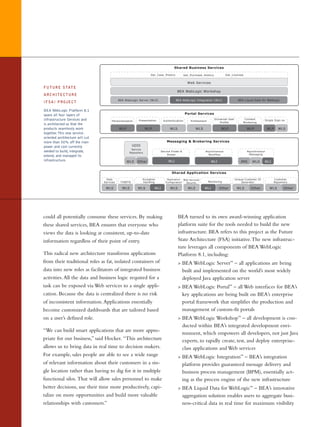
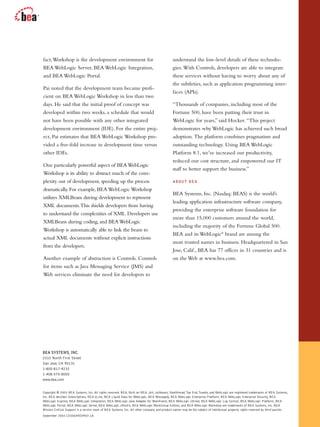
ture leverages all components of BEA WebLogic
Platform 8.1, including:
> BEA WebLogic Server™
– all applications are being
built and implemented on the world’s most widely
deployed Java application server
> BEA WebLogic Portal™
– all Web interfaces for BEA’s
key applications are being built on BEA’s enterprise
portal framework that simplifies the production and
management of custom-fit portals
> BEA WebLogic Workshop™
– all development is con-
ducted within BEA’s integrated development envi-
ronment, which empowers all developers, not just Java
experts, to rapidly create, test, and deploy enterprise-
class applications and Web services
> BEA WebLogic Integration™
– BEA’s integration
platform provides guaranteed message delivery and
business process management (BPM), essentially act-
ing as the process engine of the new infrastructure
> BEA Liquid Data for WebLogic™
– BEA’s innovative
aggregation solution enables users to aggregate busi-
ness-critical data in real time for maximum visibility
FUTURE STATE
ARCHITECTURE
(FSA) PROJECT
BEA WebLogic Platform 8.1
spans all four layers of
Infrastructure Services and
is architected so that the
products seamlessly work
together.This new service-
oriented architecture will cut
more than 50% off the man-
power and cost currently
needed to build, integrate,
extend, and managed its
infrastructure.
Shared Business Services
Web Services
BEA WebLogic Server (WLS) BEA WebLogic Integration (WLI)
BEA WebLogic Workshop
BEA Liquid Data for Weblogic
Get_Case_History Get_Purchase_History Get_Licenses
Shared Application Services
UDDI
Service
Repository
WLI WLIWLS Other
Messaging & Brokering Services
JMS WLS WLI
Asynchronous
Messaging
Service Finder &
Broker
Asynchronous
Workflow
Portal Services
WLP WLP WLS WLS WLP WLP WLP WLS
Personalization Presentation Authentication Entitlement
Universal User
Profile
Content
Brokering
Single Sign-on
WLS
Data
Services
WLS WLS WLI
Logging
WLS
Application
Configuration
WLS
Web Services
Security
Exception
Handling
WLI Other
Monitoring
WLS Other
Unique Customer ID
Generator
WLS Other
Customer
Repository
across the enterprise and faster, more insightful deci-
sion making.
In addition, the company will leverage BEA WebLogic
JRockit™
to optimize the performance of its hardware.
For maximum price/performance, BEA standardized on
Intel-based servers running Red Hat Advanced Server
Linux 2.1.The combination of Intel and Red Hat min-
imizes the initial cost of deployment and delivers a dra-
matic, ongoing cost savings on licensing and mainte-
nance compared to proprietary Unix and Windows
operating environments. Hardware costs alone are
expected to be hundreds of thousands of dollars lower
for an Intel/Red Hat platform than they would have
been for a Unix environment.
RESULTS
The first two phases of the FSA initiative were built in
only six months, which is an extremely rapid deploy-
ment schedule for a project of this size, scope, and
strategic importance.The development team was com-
prised of eight people, none of whom had previously
developed with BEA WebLogic Workshop.
The new infrastructure will rely on a set of portals,
built on WebLogic Portal, as the primary access points
for internal and external users. From the portals, users
will be able to open all relevant applications, see all
appropriate data, and complete their tasks without hav-
ing to log in and out of numerous screens, or rely on
phone calls and faxes to share information.This is in
contrast to the current infrastructure that relies on 12
points of entry and nine interaction points.The portals
also encourage customer self service. Customer inquiries
that can be completed via self service cost BEA only
pennies on the dollar compared to inquiries that
require manual intervention.
BEA estimates that its new service-oriented architec-
ture will cut more than 50 percent off the manpower
and cost currently needed to build, integrate, extend,
and manage its infrastructure. BEA anticipates that
those savings, plus the increased productivity of its sales
and support staffs, will be worth more than $75 million
to the company over the next three years.
That figure is based on the returns BEA is expecting
from just the first three applications built using the EIS
architecture—eLicense, eOrders, and eSupport. Together,
these tightly integrated applications automate much of
the work involved in providing price quotes, tracking
order status, generating and managing software license
keys, renewing licenses, troubleshooting, and initiating
service requests.
“The huge cost savings is only part of the benefit,” said
Hocker.“Customers will be better served. Sales people
will be able to move more product. By exposing our
data stores via Web services, we’re extending the ROI
and lifecycle of older assets, such as Clarify for our help
desk and Siebel for sales force automation.And, simpli-
fied application development that no longer requires
custom ‘plumbing’ or business logic will allow us to
bring new functionality to market very fast.The sum
total of all these benefits will strengthen our bottom
line and make us a more competitive, opportunistic, and
flexible organization.”
Hocker added,“The architecture is enabling new ways
for business units to define and fund application devel-
opment. Instead of building monolithic applications,
business units can partner and share the cost of stan-
dardized, reusable components.The business units can
then assemble the components to suite their own needs.”
“BEA WebLogic Workshop 8.1 is the key to the entire
project,” saidYogish Pai, director of architecture for
BEA’s Enterprise Infrastructure Services organization.
“It would have been nearly impossible to get this proj-
ect off the ground without a tool to simplify and accel-
erate the development of Web services. By the time
we’re done, we expect to have 100-200 Web services in
production, all of which can be reused by any application.”
The development team leveraged BEA WebLogic
Workshop for much more than simply building Web
services.The team used BEA WebLogic Workshop to
build nearly every element of the infrastructure, from
messaging and brokering workflows to portal templates
and Web applications. BEA WebLogic Workshop also
provided the testing and debugging environment. In
fact,Workshop is the development environment for
BEA WebLogic Server, BEA WebLogic Integration,
and BEA WebLogic Portal.
Pai noted that the development team became profi-
cient on BEA WebLogic Workshop in less than two
days. He said that the initial proof of concept was
developed within two weeks, a schedule that would
not have been possible with any other integrated
development environment (IDE). For the entire proj-
ect, Pai estimates that BEA WebLogic Workshop pro-
vided a five-fold increase in development time versus
other IDEs.
One particularly powerful aspect of BEAWebLogic
Workshop is its ability to abstract much of the com-
plexity out of development, speeding up the process
dramatically. For example, BEA WebLogic Workshop
utilizes XMLBeans during development to represent
XML documents.This shields developers from having
to understand the complexities of XML. Developers use
XMLBeans during coding, and BEAWebLogic
Workshop is automatically able to link the beans to
actual XML documents without explicit instructions
from the developers.
Another example of abstraction is Controls. Controls
for items such as Java Messaging Service (JMS) and
Web services eliminate the need for developers to
understand the low-level details of these technolo-
gies. With Controls, developers are able to integrate
these services without having to worry about any of
the subtleties, such as application programming inter-
faces (APIs).
“Thousands of companies, including most of the
Fortune 500, have been putting their trust in
WebLogic for years,” said Hocker. “This project
demonstrates why WebLogic has achieved such broad
adoption. The platform combines pragmatism and
outstanding technology. Using BEA WebLogic
Platform 8.1, we’ve increased our productivity,
reduced our cost structure, and empowered our IT
staff to better support the business.”
ABOUT BEA
BEA Systems, Inc. (Nasdaq: BEAS) is the world’s
leading application infrastructure software company,
providing the enterprise software foundation for
more than 15,000 customers around the world,
including the majority of the Fortune Global 500.
BEA and its WebLogic®
brand are among the
most trusted names in business. Headquartered in San
Jose, Calif., BEA has 77 offices in 31 countries and is
on the Web at www.bea.com.
Copyright © 2003 BEA Systems, Inc. All rights reserved. BEA, Built on BEA, Jolt, Joltbeans, Steelthread,Top End,Tuxedo, and WebLogic are registered trademarks of BEA Systems,
Inc. BEA dev2dev Subscriptions, BEA eLink, BEA Liquid Data for WebLogic, BEA MessageQ, BEA WebLogic Enterprise Platform, BEA WebLogic Enterprise Security, BEA
WebLogic Express, BEA WebLogic Integration, BEA WebLogic Java Adapter for Mainframe, BEA WebLogic JDriver, BEA WebLogic Log Central, BEA WebLogic Platform, BEA
WebLogic Portal, BEA WebLogic Server, BEA WebLogic JRockit, BEA WebLogic WorkGroup Edition, and BEA WebLogic Workshop are trademarks of BEA Systems, Inc. BEA
Mission Critical Support is a service mark of BEA Systems, Inc. All other company and product names may be the subject of intellectual property rights reserved by third parties.
September 2003 CSS0644E0903-1A
BEA SYSTEMS, INC.
2315 North First Street
San Jose, CA 95131
1-800-817-4232
1-408-570-8000
www.bea.com

BEA_IT_cs1.290214856

  • 1.
    BEA implemented anend-to-end architecture utilizing a set of Enterprise Infrastructure Services (EIS) built on BEA WebLogic Platform™ 8.1. The EIS archi- tecture is designed to support applications that will make BEA’s sales force more effective and productive, and enable timelier, more proactive customer support. OVERVIEW At a certain point, linear expansion of an IT infrastructure begins to deliver diminishing returns. BEA had reached that point by 2003 and realized that radical change was necessary. To reduce IT costs, ensure data consistency across applications, improve customer support, and increase the productivity of BEA sales people, BEA challenged its IT staff to imple- ment a new enterprise architecture. The new architecture would be service-ori- ented, meaning data and business logic would be centralized and exposed to sales and support applications in the form of stan- dards-based Web services. BEA turned to its own platform suite to implement the new infrastructure. BEA WebLogic Workshop™ 8.1 was used as the integrated development environment (IDE). BEA refers to this project as the Future State Architecture (FSA) initiative.This new archi- tecture transforms applications from their traditional roles as fat, isolated containers of data into new roles as facilitators of integrated business activities. All the data and business logic required for a task can be exposed via Web services to a single application.There is no need to bounce between screens to com- plete a job. Applications essentially become customized dashboards that are tailored based on a user’s defined role. The first two phases of the FSA initiative were built in only six months.The develop- ment team was comprised of eight people, none of whom had previous experience developing with BEA WebLogic Workshop. BEA estimates that its service-oriented archi- tecture will cut more than 50 percent off the CUSTOMER CASE STUDY BEA SYSTEMS, INC. Enterprise Infrastructure Services
  • 2.
    manpower and costneeded to build, integrate, extend and manage its infrastructure. BEA anticipates that its cumulative cost savings and productivity improvements will top $75 million over three years. COMPANY BRIEF BEA is the world’s leading application infrastructure software company. In eight years, the company has grown from a small startup into a global organization. Today, BEA and its WebLogic® brand are among the most trusted names in business.The company earned nearly $1 billion in revenue during its last fiscal year and has more than 15,000 customers and 3,000 employees in 31 countries. BUSINESS PROCESS CHALLENGE As the company grew, its information technology (IT) infrastructure expanded in size and complexity to meet the needs of the business. For several years, this IT phi- losophy was successful, enabling the company to oper- ate smartly and efficiently. However, at a certain point, linear expansion of an IT infrastructure begins to deliv- er diminishing returns. BEA had reached that point by 2003 and realized that radical change was necessary. Simply adding more disparate enterprise applications and data stores would not provide the payback that BEA seeks from its IT investments.The costs of deploy- ing, integrating and managing more silos was becoming prohibitive.The infrastructure was unwieldy; it was impractical to build custom connections between every combination of systems that could conceivably exchange data. It was equally impractical to build applications with global reach from scratch every time a new busi- ness requirement was identified. The impact of a sprawling IT environment was particu- larly acute for the customer-facing portions of the organization. Sales people and customer service repre- sentatives had to bounce between 12 points of entry into 30 enterprise systems that contained customer data. For example, viewing all open service cases for a client was extremely difficult, as was understanding the details of a client’s license agreement(s). The result was that sales and support personnel were spending a large percentage of their time on non- value-add tasks just to stay current on client account activity.This cut into time that sales people could spend selling and generating revenue, and hampered the ability of support staff to be proactive and close cases rapidly and efficiently. To reduce IT costs, ensure data consistency across appli- cations, improve customer support, and increase the productivity of BEA sales people, BEA challenged its IT staff to implement a new enterprise architecture. The new architecture would be service-oriented, meaning data and business logic would be centralized and exposed to sales and support in the form of stan- dards-based Web services.The goal was to provide a unified customer view that would allow account teams to better understand a customer’s situation, support cus- tomers in a timelier and more cost-effective manner, and enrich BEA’s customer interaction to build more lucrative and mutually beneficial long-term relationships. Rhonda Hocker, BEA’s chief information officer, artic- ulated the business case.“We wanted to decouple the presentation layer from the business logic. This would enable us to manage, expose, and secure data more effectively, and rapidly deploy applications and func- tionality for distinct audiences, such as customers, sales reps, and customer service reps. The desired results are substantially lower IT costs, superior customer service, increased revenue (made possible by getting information into the hands of inside and outside sales reps when they need it), and greater company-wide productivity facilitated by streamlined workflows.” Although the project was focused on customer-centric applications, the new architecture would provide benefits that extend to every corner of the organization.The architecture that BEA was envisioning would employ fully reusable software code that could be leveraged repeatedly to improve workflows for accounting, human resources, marketing, operations, and other groups.As the new architecture becomes more mature, and the library of reusable software grows, future projects could
  • 3.
    be completed fasterand cheaper than would be possible using traditional development strategies. SOLUTION The new architecture is essentially comprised of four layers of enterprise infrastructure services (EIS) that pro- vide a unified development and integration framework. All future applications will incorporate some or all of these services rather than be created from scratch and then wedged into a real-world environment for which they are not optimized. This will allow the IT staff to mix and match services as it builds applications to create logical process flows. In other words, business processes will be created—or existing processes streamlined—to serve the needs of the business.The business will no longer have to work around inflexible applications. The first layer of the EIS architecture is Application Services. Examples of these services include transaction logging, exception handling, application monitoring, and data storage. These are services that most enterprise applications typically require. The second layer is Messaging and Brokering Services. Examples include service finder and brokering (neces- sary to route real-time messages), asynchronous message delivery, and asynchronous workflow management. This layer is the guts of the new infrastructure, ensuring that all applications and services can communicate with one another. The next layer is Portal Services.This is the key layer for usability and accessibility. It manages personalization, user profiling, user authentication and entitlements, content brokering, and single sign-on. Based on each user’s profile, he or she is routed to the appropriate portal (e.g., customer, sales force, etc.) after being authenticated. Although the portals are built on a com- mon foundation and are integrated with the same data stores, each portal offers users a different combination of functionality and content. The top layer is Shared Business Services. This includes customer-support case histories, software-license details, purchase histories, and customer profiles. Customers, support staff, sales reps, marketing staff, and accounting ENTERPRISE APPLIATION ARCHITECTURE This radical new architecture transforms applications from their traditional role as fat, isolated containers of data into new roles as facilitators of integrated business activities. Custom Portal Applications Enterprise Infrastructure Services Enterprise Services Enterprise Applications Enterprise Data Shared Business Services Portal Services Messaging & Brokering Services Shared Application Services Documentum (Content Mgt.) Google, Inquira (Search) Yahoo Messenger Ent. Ed. (Chat) Directory Services PeopleSoft 8 (ERP) Customers Products Employees Partners Licenses Installed Base Siebel (SFA) Clarify (Call Center) Kana (Marketing Automation) Employee Manager Portal eSupport (Customer Self-support) eOrders (Quote-to- Order) eLicense (SW license mgt.) dev2dev (Developer rel. mgt.) PartnerNet (Partner rel. mgt.) Renewals (Installed base mgt.)
  • 4.
    could all potentiallyconsume these services. By making these shared services, BEA ensures that everyone who views the data is looking at consistent, up-to-date information regardless of their point of entry. This radical new architecture transforms applications from their traditional roles as fat, isolated containers of data into new roles as facilitators of integrated business activities.All the data and business logic required for a task can be exposed via Web services to a single appli- cation. Because the data is centralized there is no risk of inconsistent information.Applications essentially become customized dashboards that are tailored based on a user’s defined role. “We can build smart applications that are more appro- priate for our business,” said Hocker. “This architecture allows us to bring data in real time to decision makers. For example, sales people are able to see a wide range of relevant information about their customers in a sin- gle location rather than having to dig for it in multiple functional silos. That will allow sales personnel to make better decisions, use their time more productively, capi- talize on more opportunities and build more valuable relationships with customers.” BEA turned to its own award-winning application platform suite for the tools needed to build the new infrastructure. BEA refers to this project as the Future State Architecture (FSA) initiative.The new infrastruc- ture leverages all components of BEA WebLogic Platform 8.1, including: > BEA WebLogic Server™ – all applications are being built and implemented on the world’s most widely deployed Java application server > BEA WebLogic Portal™ – all Web interfaces for BEA’s key applications are being built on BEA’s enterprise portal framework that simplifies the production and management of custom-fit portals > BEA WebLogic Workshop™ – all development is con- ducted within BEA’s integrated development envi- ronment, which empowers all developers, not just Java experts, to rapidly create, test, and deploy enterprise- class applications and Web services > BEA WebLogic Integration™ – BEA’s integration platform provides guaranteed message delivery and business process management (BPM), essentially act- ing as the process engine of the new infrastructure > BEA Liquid Data for WebLogic™ – BEA’s innovative aggregation solution enables users to aggregate busi- ness-critical data in real time for maximum visibility FUTURE STATE ARCHITECTURE (FSA) PROJECT BEA WebLogic Platform 8.1 spans all four layers of Infrastructure Services and is architected so that the products seamlessly work together.This new service- oriented architecture will cut more than 50% off the man- power and cost currently needed to build, integrate, extend, and managed its infrastructure. Shared Business Services Web Services BEA WebLogic Server (WLS) BEA WebLogic Integration (WLI) BEA WebLogic Workshop BEA Liquid Data for Weblogic Get_Case_History Get_Purchase_History Get_Licenses Shared Application Services UDDI Service Repository WLI WLIWLS Other Messaging & Brokering Services JMS WLS WLI Asynchronous Messaging Service Finder & Broker Asynchronous Workflow Portal Services WLP WLP WLS WLS WLP WLP WLP WLS Personalization Presentation Authentication Entitlement Universal User Profile Content Brokering Single Sign-on WLS Data Services WLS WLS WLI Logging WLS Application Configuration WLS Web Services Security Exception Handling WLI Other Monitoring WLS Other Unique Customer ID Generator WLS Other Customer Repository
  • 5.
    across the enterpriseand faster, more insightful deci- sion making. In addition, the company will leverage BEA WebLogic JRockit™ to optimize the performance of its hardware. For maximum price/performance, BEA standardized on Intel-based servers running Red Hat Advanced Server Linux 2.1.The combination of Intel and Red Hat min- imizes the initial cost of deployment and delivers a dra- matic, ongoing cost savings on licensing and mainte- nance compared to proprietary Unix and Windows operating environments. Hardware costs alone are expected to be hundreds of thousands of dollars lower for an Intel/Red Hat platform than they would have been for a Unix environment. RESULTS The first two phases of the FSA initiative were built in only six months, which is an extremely rapid deploy- ment schedule for a project of this size, scope, and strategic importance.The development team was com- prised of eight people, none of whom had previously developed with BEA WebLogic Workshop. The new infrastructure will rely on a set of portals, built on WebLogic Portal, as the primary access points for internal and external users. From the portals, users will be able to open all relevant applications, see all appropriate data, and complete their tasks without hav- ing to log in and out of numerous screens, or rely on phone calls and faxes to share information.This is in contrast to the current infrastructure that relies on 12 points of entry and nine interaction points.The portals also encourage customer self service. Customer inquiries that can be completed via self service cost BEA only pennies on the dollar compared to inquiries that require manual intervention. BEA estimates that its new service-oriented architec- ture will cut more than 50 percent off the manpower and cost currently needed to build, integrate, extend, and manage its infrastructure. BEA anticipates that those savings, plus the increased productivity of its sales and support staffs, will be worth more than $75 million to the company over the next three years. That figure is based on the returns BEA is expecting from just the first three applications built using the EIS architecture—eLicense, eOrders, and eSupport. Together, these tightly integrated applications automate much of the work involved in providing price quotes, tracking order status, generating and managing software license keys, renewing licenses, troubleshooting, and initiating service requests. “The huge cost savings is only part of the benefit,” said Hocker.“Customers will be better served. Sales people will be able to move more product. By exposing our data stores via Web services, we’re extending the ROI and lifecycle of older assets, such as Clarify for our help desk and Siebel for sales force automation.And, simpli- fied application development that no longer requires custom ‘plumbing’ or business logic will allow us to bring new functionality to market very fast.The sum total of all these benefits will strengthen our bottom line and make us a more competitive, opportunistic, and flexible organization.” Hocker added,“The architecture is enabling new ways for business units to define and fund application devel- opment. Instead of building monolithic applications, business units can partner and share the cost of stan- dardized, reusable components.The business units can then assemble the components to suite their own needs.” “BEA WebLogic Workshop 8.1 is the key to the entire project,” saidYogish Pai, director of architecture for BEA’s Enterprise Infrastructure Services organization. “It would have been nearly impossible to get this proj- ect off the ground without a tool to simplify and accel- erate the development of Web services. By the time we’re done, we expect to have 100-200 Web services in production, all of which can be reused by any application.” The development team leveraged BEA WebLogic Workshop for much more than simply building Web services.The team used BEA WebLogic Workshop to build nearly every element of the infrastructure, from messaging and brokering workflows to portal templates and Web applications. BEA WebLogic Workshop also provided the testing and debugging environment. In
  • 6.
    fact,Workshop is thedevelopment environment for BEA WebLogic Server, BEA WebLogic Integration, and BEA WebLogic Portal. Pai noted that the development team became profi- cient on BEA WebLogic Workshop in less than two days. He said that the initial proof of concept was developed within two weeks, a schedule that would not have been possible with any other integrated development environment (IDE). For the entire proj- ect, Pai estimates that BEA WebLogic Workshop pro- vided a five-fold increase in development time versus other IDEs. One particularly powerful aspect of BEAWebLogic Workshop is its ability to abstract much of the com- plexity out of development, speeding up the process dramatically. For example, BEA WebLogic Workshop utilizes XMLBeans during development to represent XML documents.This shields developers from having to understand the complexities of XML. Developers use XMLBeans during coding, and BEAWebLogic Workshop is automatically able to link the beans to actual XML documents without explicit instructions from the developers. Another example of abstraction is Controls. Controls for items such as Java Messaging Service (JMS) and Web services eliminate the need for developers to understand the low-level details of these technolo- gies. With Controls, developers are able to integrate these services without having to worry about any of the subtleties, such as application programming inter- faces (APIs). “Thousands of companies, including most of the Fortune 500, have been putting their trust in WebLogic for years,” said Hocker. “This project demonstrates why WebLogic has achieved such broad adoption. The platform combines pragmatism and outstanding technology. Using BEA WebLogic Platform 8.1, we’ve increased our productivity, reduced our cost structure, and empowered our IT staff to better support the business.” ABOUT BEA BEA Systems, Inc. (Nasdaq: BEAS) is the world’s leading application infrastructure software company, providing the enterprise software foundation for more than 15,000 customers around the world, including the majority of the Fortune Global 500. BEA and its WebLogic® brand are among the most trusted names in business. Headquartered in San Jose, Calif., BEA has 77 offices in 31 countries and is on the Web at www.bea.com. Copyright © 2003 BEA Systems, Inc. All rights reserved. BEA, Built on BEA, Jolt, Joltbeans, Steelthread,Top End,Tuxedo, and WebLogic are registered trademarks of BEA Systems, Inc. BEA dev2dev Subscriptions, BEA eLink, BEA Liquid Data for WebLogic, BEA MessageQ, BEA WebLogic Enterprise Platform, BEA WebLogic Enterprise Security, BEA WebLogic Express, BEA WebLogic Integration, BEA WebLogic Java Adapter for Mainframe, BEA WebLogic JDriver, BEA WebLogic Log Central, BEA WebLogic Platform, BEA WebLogic Portal, BEA WebLogic Server, BEA WebLogic JRockit, BEA WebLogic WorkGroup Edition, and BEA WebLogic Workshop are trademarks of BEA Systems, Inc. BEA Mission Critical Support is a service mark of BEA Systems, Inc. All other company and product names may be the subject of intellectual property rights reserved by third parties. September 2003 CSS0644E0903-1A BEA SYSTEMS, INC. 2315 North First Street San Jose, CA 95131 1-800-817-4232 1-408-570-8000 www.bea.com