Date: 2/10/2008 SOA Practitioners’ Guide, Part 4: Integration Yesterday, Today and Tomorrow Page 1 of 26
SOA Practitioners’ Guide
Part 4
Integration: Yesterday, Today and
Tomorrow
 
Painting by: Surekha Durvasula
Date: 2/10/2008 SOA Practitioners’ Guide, Part 4: Integration Yesterday, Today and Tomorrow Page 2 of 26
Contributing SOA Practitioners
Ashok Kumar, Director - Services, Avis/Budget
Burc Oral, CellExchange Inc.
Surekha Durvasula, Enterprise Architect, Kohls
Yogish Pai, CEO, Pai Systems, LLC
This work is licensed under the Creative Commons Attribution 3.0 United States License. To view a copy
of this license, visit http://creativecommons.org/licenses/by/3.0/us/ or send a letter to Creative Commons,
171 Second Street, Suite 300, San Francisco, California, 94105, USA.
SOA Practitioners Blog: http://entarch.blogspot.com
.
Date: 2/10/2008 SOA Practitioners’ Guide, Part 4: Integration Yesterday, Today and Tomorrow Page 3 of 26
TABLE OF CONTENTS 
TABLE OF CONTENTS ...........................................................................................................................3 
ABOUT THIS DOCUMENT.....................................................................................................................5 
ABSTRACT ....................................................................................................................................................5 
INTENDED AUDIENCE ..................................................................................................................................5 
BENEFITS OF THE SOA PRACTITIONERS’ GUIDE......................................................................................5 
SOA PRACTITIONERS’ GUIDE: PARTS .......................................................................................................6 
INTRODUCTION.......................................................................................................................................7 
INTEGRATION YESTERDAY................................................................................................................8 
INTEGRATION YESTERDAY: TRADITIONAL PATTERN .............................................................................8 
ADAPTER.......................................................................................................................................................8 
MESSAGING LAYER.......................................................................................................................................9 
INTEGRATION YESTERDAY: CASE STUDIES.............................................................................................11 
CASE STUDY 1.............................................................................................................................................11 
CASE STUDY 2.............................................................................................................................................12 
INTEGRATION TODAY ........................................................................................................................13 
INTEGRATION APPROACH.........................................................................................................................15 
PRESENTATION SERVICES ...........................................................................................................................16 
BUSINESS PROCESS MANAGEMENT ............................................................................................................16 
SHARED DATA SERVICES............................................................................................................................17 
SERVICE INTEGRATION ...............................................................................................................................18 
BUSINESS INTEGRATION............................................................................................................................19 
INTEGRATION TODAY: CASE STUDIES.....................................................................................................19 
CASE STUDY 1.............................................................................................................................................20 
CASE STUDY 2:............................................................................................................................................21 
CASE STUDY 3.............................................................................................................................................22 
INTEGRATION: TOMORROW............................................................................................................23 
FUTURE OF IT ............................................................................................................................................23 
SOA GOVERNANCE ...................................................................................................................................23 
FACTORS IMPACTING BUSINESS INTEGRATION .....................................................................................24 
Date: 2/10/2008 SOA Practitioners’ Guide, Part 4: Integration Yesterday, Today and Tomorrow Page 4 of 26
EXPONENTIAL EXPLOSIONS OF EVENTS .....................................................................................................24 
COMMODITIZATION OF TECHNOLOGY ........................................................................................................25 
SOFTWARE AS A SERVICE (SAAS) ...............................................................................................................25 
MAPPING DEPENDENCIES ............................................................................................................................25 
CONCLUSION...............................................................................................................................................26 
 
Date: 2/10/2008 SOA Practitioners’ Guide, Part 4: Integration Yesterday, Today and Tomorrow Page 5 of 26
ABOUT THIS DOCUMENT 
ABSTRACT 
SOA is relatively new, so companies seeking to implement it cannot tap into a wealth of practical
expertise. Without a common language and industry vocabulary based on shared experience, SOA may
end up adding more custom logic and increased complexity to IT infrastructure, instead of delivering on its
promise of intra and inter-enterprise services reuse and process interoperability. To help develop a shared
language and collective body of knowledge about SOA, a group of SOA practitioners created this SOA
Practitioners’ Guide series of documents. In it, these SOA experts describe and document best practices
and key learnings relating to SOA, to help other companies address the challenges of SOA. The SOA
Practitioners’ Guide is envisioned as a multi-part collection of publications that can act as a standard
reference encyclopaedia for all SOA stakeholders.
INTENDED AUDIENCE 
This document is intended for the following audience:
• Business and IT leaders, who need to start and manage an SOA strategy across the
enterprise/LOB
• Enterprise Architects who need to drive the vision and roadmap of the SOA program and the
architecture of each implementation that falls under it
• Program Managers who need to manage a portfolio of sub-projects within an overall SOA
business strategy
• Project Team Members, who need to map dependencies and develop a timeline that meets the
business expectations
• Vendors who provide solutions and tools for new business capabilities to the business and IT
• Standards bodies which need a better understanding of use cases of how business and IT plan to
leverage technology to meet their objectives.
BENEFITS OF THE SOA PRACTITIONERS’ GUIDE  
This document helps readers to:
• Learn from others: Early adopters of SOA share their best practices, insights, and views on the
state of SOA adoption across the industry
• Compare alternatives: Identify and define the key technology components of SOA to establish a
baseline reference for comparison of options
• Improve collaboration: A common language clarifies the nature of SOA components defined in
this document
Date: 2/10/2008 SOA Practitioners’ Guide, Part 4: Integration Yesterday, Today and Tomorrow Page 6 of 26
• Accelerate implementations: This guide defines the services lifecycle along with the
requirements, recommended tools, and best practices for each of the stages.
• Understand the value of standards: This document recommends standards for aspects of SOA
• Avoid potential risks: The guide identifies some problem areas not yet addressed by the vendor
community. 
 
SOA PRACTITIONERS’ GUIDE: PARTS  
There are three separate parts that make up the SOA Practitioners’ Guide.
This document is Part 1, Why Services-Oriented Architecture? It provides a high-level summary of SOA.
Part 2: SOA Reference Architecture provides a worked design of an enterprise-wide SOA
implementation, with detailed architecture diagrams, component descriptions, detailed requirements,
design patterns, opinions about standards, patterns on regulation compliance, standards templates, and
potential code assets from members.
Part 3: Introduction to Services Lifecycle provides a detailed process for services management though
the service lifecycle, from inception through to retirement or repurposing of the services. It also contains
an appendix that includes organization and governance best practices, templates, comments on key SOA
standards, and recommended links for more information.
Part 4: Integration: Yesterday, Today and Tomorrow details the integration reference architecture, how
SOA enables integration and what the industry is expected to deal with Integration by 2010
Date: 2/10/2008 SOA Practitioners’ Guide, Part 4: Integration Yesterday, Today and Tomorrow Page 7 of 26
INTRODUCTION 
Integration of business systems is one of the key capabilities that should be provided by IT to enable
business agility. This has been the primary objective of all integration effort to-date, however, due to
various factors most of the integration efforts have not achieved the expected business benefit. Of course
projects with the right executive backing have been quite successful but have never reached their full
potential. The objective of this article is to demonstrate how adopting SOA enables achieving business
agility and flexibility.
Date: 2/10/2
INTEGRA
Following
majority o
two or mo
Integratio
the Opera
top of the
moving an
of the cu
proportion
such as C
the decisi
resorting
enterprise
Business
of the bus
and later
the lack
componen
In short,
working o
INTEGRA
Following
the traditi
the high-l
Hub or Int
ADAPTER
The conne
the EAI or
views (cod
2008 SOA
ATION YEST
is a brief ove
of the integrat
ore business
n (EAI) or an
ational Data S
ese database
nd aggregatin
urrent state o
nal to quality
Customers, P
ion makers a
to custom de
es.
does also pla
siness silos, IT
expected to s
of available
nts such as E
IT organizatio
on enabling bu
ATION YESTE
is the traditi
onal CRM/ER
evel architec
tegration Serv
R 
ectivity adapt
r the Applicat
de) of the targ
A Practitioners’ G
ERDAY 
erview of the
tion efforts fol
applications.
Extract Tran
Stores (ODS)
s using a Bu
ng the data, it
of their busin
of data and w
roducts, and
are getting an
evelopment of
ay an importa
T organizatio
stitch them to
infrastructure
EAI, ETL, BI, D
ons were spe
usiness agility
ERDAY:  TRA
onal integrati
RP vendors fo
cture of the tr
ver style.
ter between th
ion vendor. A
get applicatio
Guide, Part 4: Int
traditional int
llow the hub a
. In addition
sform Load (
and/or Data
siness Intellig
t is next to im
ness. As th
with most of th
Orders are ty
n accurate vi
f all of the bu
ant role in dri
n are directed
ogether. An a
e - IT organi
Data Quality t
ending most
y.
ADITIONAL 
ion pattern im
or providing i
raditional inte
he messaging
As these adap
ons – they use
tegration Yesterd
tegration bes
and spoke pa
, this approa
ETL) tools to
Warehouses
gence (BI) to
mpossible for
he accuracy
he business s
ypically entere
ew. One co
usiness syste
ving IT in this
d to invest he
additional draw
zations were
tools separate
of their effor
PATTERN 
mplemented a
integration so
egration patte
g layer and th
ptors are gen
e the generic
day, Today and T
t practices ad
attern; with th
ch relies eith
move data fr
s. The Execu
ools. Due to t
the decision
of all major
systems still b
ed in multiple
uld potentiall
ems. This ma
s direction. A
eavily on imple
wback of the
e forced to p
ely and custo
rt in developin
at most of the
olutions to the
ern – general
he application
neric in nature
user id and p
Tomorrow
dopted by the
e hub bridgin
her on an Ent
rom the trans
tive Dashboa
the processin
makers to ge
business de
being siloed (
e systems) it
y resolve this
ay not, howev
As time-to-mar
ementing pac
traditional ap
procure each
om develop th
ng the infrast
e integration
eir end-custo
ly referred to
is typically p
e and invoke t
password to c
Page
e industry. Ty
ng the gap be
terprise Appli
actional syste
ard is develop
ng time requir
et real-time an
ecisions is d
(the enterpris
is very unlike
s architectura
ver, be practi
rket is key fo
ckaged applic
pproach was
of the techn
he infrastructu
tructure, inste
solution as w
mers. Follow
o as the Integ
rovided by eit
the applicatio
connect to the
8 of 26
ypically
etween
ication
ems to
ped on
red for
nalysis
directly
e data
ely that
ally by
cal for
r each
cations
due to
nology
ure.
ead of
well as
wing is
gration
ther
n
e
Date: 2/10/2008 SOA Practitioners’ Guide, Part 4: Integration Yesterday, Today and Tomorrow Page 9 of 26
applications. This creates a security loophole and to overcome this, IT organizations need to develop
code to pass and manage the user credentials across all the systems.
MESSAGING LAYER 
This is the backbone of the traditional reliable and scalable EAI tools which needs to integrate with
disparate technologies (CORBA, JMS, RMI, MQ, etc.) and applications. (ERP, CRM, Mainframes, etc.).
As the integration pattern for EAI based solution is the hub and spoke model – all messages from the end-
point (applications) are transformed into a common business object model (such as customers, orders,
products, etc.) on which the integration business logic is applied. Examples of such business logic are:
scoring leads from campaign data prior to populating the Sale Force Automation Software, validation of
order prior to sending it to Shipping. Etc. Once the business logic is applied the message is again
transformed prior to sending it to the destination applications.
Following are some of the best practices/key learnings of leveraging this integration pattern.
• These patterns have been widely adopted and extensively used, especially for manufacturing,
B2B supply chain, banking, etc.
• Requires standardization of the message format – header and payload section
• Source and target applications need to develop code (using their own proprietary code and
interface) to integrate with the Adapter
• Business process adopted using proprietary workflow solutions - not necessarily standards based.
However, the latest versions allow for BPEL, XPDL, JPD import/export, etc.
• Generally result in implementing point-to-point solution on the hub and vendor lock-in (due to the
proprietary nature of the EAI tool)
• Reliable and scalable to support mission critical applications
• Modification of the canonical model may require redeployment of the entire application resulting in
complex regression and integration testing which can make it difficult to deploy the refactored
solution without shutting down the system
• IT organizations spend a lot of effort in integrating the technologies instead of focusing on
delivering new business behaviour that enables business agility
As the EAI tool typically gets implemented as a point-to-point solution on a centralized server, it is not
convenient to leverage this approach to provide the decision makers with real-time information. One of
the best practices of leveraging the EAI tool is to pass all the relevant data over the messaging layer to
populate the Operational Data Store and/or the data warehouse. However, due to the high development
costs, it rarely ever happens. Instead the data team implements a parallel integration effort using ETL tool
to copy all the data to an ODS/DW for aggregation and reporting purpose.
Date: 2/10/2
This resul
increased
reports fo
the so ca
However,
enterprise
not, when
Majority o
been suc
applicatio
implemen
the data a
 
2008 SOA
lts in the sam
d Total Cost o
r the decision
alled master
there is st
e. It at least
n compared to
of the enterpr
ccessful, esp
ns to the CR
ntations of larg
after all the da
A Practitioners’ G
me business lo
of Ownership
n makers are
data stores
ill a potentia
provides a v
o not having a
rises that hav
ecially in the
RM and/or ER
ge ODS/DW
ata is copied f
Guide, Part 4: Int
ogic impleme
p. In addition
provided with
where the d
ally large bu
view into the s
any view ente
ve implement
e area of su
RP systems, e
solutions, es
from the trans
tegration Yesterd
ented in multip
n to this redu
h information
data is not e
siness bene
state of the e
erprise data at
ted an EAI so
upply-chain,
etc. However
pecially as th
saction system
day, Today and T
ple applicatio
undancy, as
based on the
entirely accu
fit for implem
enterprise wh
t hand at all.
olution with th
B2B, manufa
r, there have
his effort attem
ms.
Tomorrow
ons and techn
the Executiv
e data from th
rate and nor
menting this
hether accura
he right exec
acturing, inte
been many c
mpts to stand
Page 1
nologies resul
ve Dashboard
he ODS/DW o
r is it in rea
approach fo
ate and real-ti
cutive backing
egrating eBus
cases of disa
ardize and cl
0 of 26
lting in
ds and
or from
al-time.
or the
ime or
g have
siness
astrous
leanse
Date: 2/10/2
INTEGRA
Following
to provide
CASE STU
• C
re
tr
• P
E
• P
in
• A
sy
po
The follow
• A
• B
• W
• W
2008 SOA
ATION YESTE
are two distin
e integration f
UDY 1 
Customer ente
ecord. In this
ansaction is s
rovide custom
DI integration
eriodic (night
nformation into
A change notif
ystem of reco
ortal.
wing function
Adaptors to co
2B connector
Workflow engin
Worklist featur
A Practitioners’ G
ERDAY: CAS
nct case stud
lexibility.
ers order on th
case, the EA
submitted to t
mer the ability
n with third pa
tly) scheduled
o the package
fication listene
ord (packaged
/ features we
onnect to pack
rs for EDI and
nes are utilize
res are emplo
Guide, Part 4: Int
SE STUDIES
ies where IT
he eBusiness
AI tool respon
the packaged
y to review the
arty for logistic
d batch proce
ed product re
er on the EAI
d application)
re leveraged
kaged applica
d ebXML
ed for service
oyed for mana
tegration Yesterd
organizations
s site which is
sible for orde
d applications
e product stat
cs and Web S
sses, powere
epository, ope
is leveraged
to populate t
from the EAI
ations
e orchestration
aging human
day, Today and T
s have levera
s validated an
er validation a
.
tus as well as
Service to trac
ed by ETL to p
erations data s
to capture an
the local prod
tool:
n with partner
interaction pr
Tomorrow
ged their exis
nd submitted t
nd for ensurin
s track the sh
ck packaged
populate mas
stores and da
ny product ch
uct details for
r applications
rocess
Page 1
sting investme
to the system
ng that the
ipped packag
ster data
ata warehous
anges in the
r the eBusine
s
1 of 26
ents
of
ges.
e.
ess
Date: 2/10/2
• Jo
CASE STU
• B
• M
th
• Le
ap
th
se
• La
in
un
The follow
• JM
• W
se
• W
• Lo
2008 SOA
ob Scheduler
UDY 2 
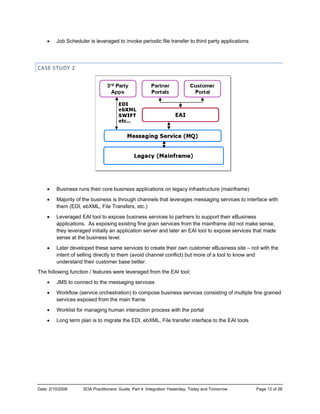
usiness runs
Majority of the
hem (EDI, ebX
everaged EA
pplications. A
hey leveraged
ense at the bu
ater develope
ntent of selling
nderstand the
wing function
MS to connec
Workflow (serv
ervices expos
Worklist for ma
ong term plan
A Practitioners’ G
r is leveraged
their core bu
business is t
XML, File Tra
I tool to expo
As exposing e
d initially an a
usiness level
ed these sam
g directly to th
eir customer b
/ features we
ct to the mess
vice orchestra
sed from the m
anaging huma
n is to migrate
Guide, Part 4: Int
to invoke pe
siness applic
hrough chann
ansfers, etc.)
se business s
existing fine g
pplication ser
.
e services to
hem (avoid ch
base better.
re leveraged
saging service
ation) to comp
main frame.
an interaction
e the EDI, ebX
tegration Yesterd
riodic file tran
cations on leg
nels that leve
services to pa
grain services
rver and later
create their o
hannel conflic
from the EAI
es
pose business
n process with
XML, File tran
day, Today and T
nsfer to third p
acy infrastruc
rages messa
artners to sup
s from the ma
r an EAI tool t
own customer
ct) but more o
tool:
s services co
h the portal
nsfer interface
Tomorrow
party applicat
cture (mainfra
ging services
pport their eBu
inframe did n
to expose ser
r eBusiness s
of a tool to kno
nsisting of mu
e to the EAI to
Page 1
ions
ame)
s to interface w
usiness
ot make sens
rvices that ma
site – not with
ow and
ultiple fine gra
ools
2 of 26
with
se,
ade
h the
ained
Date: 2/10/2
INTEGRA
One of th
solution; r
SOA defin
SOA is the
overall rev
In order
Reference
the SOA
map back
are not ye
map the b
business
2008 SOA
ATION TODA
he reasons w
rather it is a
nition in the S
e business ope
venue, increasi
to ensure th
e Architecture
Practitioners
k to business
et on linked to
business proc
process.
A Practitioners’ G
AY 
why SOA is g
way of aligni
SOA Practition
erations strate
ing customer s
hat there is
e (illustrated a
Guide Part 2
requirements
o the business
cess and late
Guide, Part 4: Int
gaining such
ng IT closer
ners Guide Pa
egy for leverag
satisfaction, im
a common v
above) which
2. The prima
s, i.e. IT shou
s requiremen
er drill down
tegration Yesterd
a momentu
to the busine
art 1 which is
ging informati
mproving prod
vocabulary, t
is well under
ary principle o
ld be not be d
t. The right w
to understan
day, Today and T
m is becaus
ess and vice
as follows:
ion to meet th
duct quality, et
the SOA Pra
rstood by the
of SOA is tha
developing an
ways to captur
d the busines
Tomorrow
e it is clearly
versa. The
heir objectives,
tc.  
actitioners de
contributors
at all services
ny infrastruct
re these requ
ss services r
Page 1
y not a techn
SOA publishe
s, such as incre
eveloped the
and documen
s developed s
ure or service
irements are
required to fu
3 of 26
nology
ed the
easing 
e SOA
nted in
should
es that
to first
ulfil the
Date: 2/10/2
The abov
integration
is a fact th
very hard
businesse
of discrete
On the IT
have evol
data as s
quite mat
developm
business
integration
One way
disparate
fragmente
account s
applicatio
system is
example,
inventory
implemen
implemen
ways too.
2008 SOA
ve diagram ill
n. On the bu
hat many ente
d to make im
es are looking
e business ac
side, analog
lved and grow
services. But
tch what the
ment to try an
activities tha
n and SOA ad
to create a
data from
ed across diff
service that
ns. Another
s orchestratin
there is an
it initiates
nted by a pr
nted with proc
For example
A Practitioners’ G
lustrated how
usiness side m
erprises do n
provements,
g to achieve f
ctivities, and t
ous to the bu
wn over time.
the issue on
e business pr
nd achieve th
at support bu
ddresses.
business se
multiple app
ferent accoun
aggregates
way to crea
g across a s
order fulfilme
shipment, ot
rocess servic
cess technolo
e, a customer
Guide, Part 4: Int
w business a
most business
ot precisely u
gain operatio
flexibility by b
this flow or pr
usiness side, m
Early SOA e
the IT side
rocess needs
is alignment.
usiness proce
ervices is usi
plications. F
nts that the cu
fragments o
ate a busines
et of finer gr
ent business
therwise noti
ce within an
ogy and can b
may write a c
tegration Yesterd
lignment and
s processes h
understand th
onal efficienc
being able to
rocess can be
most of IT is
efforts have e
is that these
s, and a lot
. What is nee
esses. It is th
ng a data in
or example,
ustomer holds
of account in
ss services is
ained service
service, whi
ifies the cus
EAI tool. A
be augmente
custom applic
day, Today and T
d flexibility in
have just grow
heir processes
cy, and react
describe the
e optimized an
a set of appli
ven exposed
applications,
of time and
eded is a ser
he provisioni
ntegration pat
customer’s
s with the en
nformation fro
s the service
es or applicat
ch does an
stomer when
A process se
d by busines
cation on an A
Tomorrow
achieved by
wn and evolv
s and bottlene
quickly to th
eir business p
nd changed.
cations, interf
some of thes
, interfaces a
d effort is sp
rvices layer t
ng of this la
ttern, where
account inf
terprise. So,
om multiple
orchestration
tion interface
inventory che
n delivery is
ervice in an
ss logic in Jav
Application Se
Page 1
y adopting SO
ved over time
ecks. This ma
he marketplac
processes as
faces and da
se application
and services d
pent in codin
that is aligne
yer that ente
in one aggre
formation ma
one might ne
data source
n pattern. He
s. In the illus
eck – if there
possible. T
EAI tool ca
va. There are
erver.
4 of 26
OA for
and it
akes it
ce. So
a flow
ta that
ns and
do not
g and
ed with
erprise
egates
ay be
eed an
s and
ere the
strated
e’s an
This is
an be
e other
Date: 2/10/2
In the illus
notion of
different c
The final
across dif
an enterp
consumab
Service B
INTEGRA
This secti
BPM and
the appro
their busin
could leve
Based on
both BPM
level how
Note: Even
primarily on
The follow
problem b
2008 SOA
strated exam
a process is
contexts and t
component f
fferent types o
prise may hav
ble by any ot
Bus (ESB).
ATION APPR
ion describes
SOA. Both
aches. For ex
ness process
erage SOA at
n our experie
M and SOA to
they would w
though this is a
the integration a
wing diagram
being solves a
A Practitioners’ G
ple the overa
present in bo
the two techn
for achieving
of services, w
ve in its syste
ther service in
OACH 
s the best pra
these approa
xample: busin
ses and imple
t the infrastruc
nce and key
o achieve Bus
work together.
also defined in th
aspects.
illustrates the
and in the foll
Guide, Part 4: Int
all order mana
oth BPM and
nologies are o
flexibility is th
whether busin
em landscape
n the enterpr
actices for int
aches are com
ness may dec
ement the ent
cture or platfo
learnings, th
siness agility
.
he SOA Practitio
e SOA Integra
owing section
tegration Yesterd
agement proc
d EAI, but as
optimized for d
he service in
ess services
e and expose
rise. This lay
tegrating the
mplementary
cide to adopt
tire process u
orm level for i
he SOA Prac
and flexibility
oners Guide Par
ation pattern,
n we shall add
day, Today and T
cess is imple
you can see
different use c
tegration laye
or application
es them via p
yer is typically
various silos
and one cou
BPM for mod
using a packa
ntegration wit
ctitioners reco
y. The follow
rt 3: Introduction
, independent
dress each of
Tomorrow
emented in a
the use of th
cases.
er. Service in
ns or other typ
proxy services
y implemente
s within an en
uld choose to
deling, simula
aged applicati
thout busines
ommends tha
wing section d
n to the Services
t of the produ
f the compon
Page 1
BPM tool. No
his technolog
ntegration me
pes of service
s in a format
ed by an Ente
nterprise base
adopt one or
ating and revie
on. Alternate
ss adopting B
at enterprise
describes at a
s Lifecycle this fo
ucts of the bu
ents.
5 of 26
ow the
gy is in
ediates
es that
t that’s
erprise
ed on
r both
ewing
ely, IT
PM.
adopt
a high
focuses
siness
Date: 2/10/2
PRESENT
Traditiona
Most have
SOA Refe
the ability
possible u
types of p
course bu
terms wh
based on
whenever
In case o
judgment
Complian
Business
BUSINES
The diagr
Business
execution
develop a
2008 SOA
TATION SER
ally the IT or
e been based
erence Archit
y to access al
until recently,
products enab
usiness will n
at they do to
n SOAP and
r it is possible
of IT develop
call on whe
ce service co
Service.
SS PROCESS 
ram represent
can focus o
and measur
aircrafts, auto
A Practitioners’ G
VICES 
rganizations a
d on portal te
tecture). For
l the relevant
, especially w
ble business u
need to acce
o be able to
lately (and
e.
ing the prese
ere the servic
ould be direct
MANAGEM
ts a sample b
on managing
ement of pro
omobiles, etc.
Guide, Part 4: Int
are responsib
chnology (ad
a long time
t data, on-dem
with Web 2.0
users to comp
ss the catalo
utilize them.
preferable) o
entation serv
ce should res
tly invoked fo
ENT 
business proc
and improvi
cesses. Whe
it is time for
tegration Yesterd
ble for develo
dition details
business has
mand, withou
products now
pose presenta
og (Service R
Typically th
on REST. S
ices, the Ent
side. For ex
rm the prese
cess
ing the perfo
en large ente
r business to
day, Today and T
oping or imp
available in S
s been reque
t IT involvem
w available f
ations that lev
Registry/Repo
ese services
SOA Practitio
terprise Arch
xample; third
ntation tier, S
ormance of th
rprise leverag
leverage rea
Tomorrow
plementing eB
SOA Practitio
sting/demand
ent. Unfortun
for the Enterp
verage one o
ository), unde
are exposed
ners recomm
itecture team
party servic
Service media
he business
ge modeling t
adily available
Page 1
Business solu
oners Guide P
ding that they
nately, this w
prises. Thes
r more servic
erstand in bus
d as Web Se
mends using
m needs to m
es such as E
ation layer (ES
through mod
tools to desig
e tools to the
6 of 26
utions.
Part 2:
y need
was not
e new
ces. Of
siness
ervices
REST
make a
Export
SB) or
deling,
gn and
same
Date: 2/10/2
for their b
resulting i
IT needs
Integrate
measurem
• Le
• Le
• Le
• Le
or
• Le
The Enter
the recom
implemen
In short: B
SHARED 
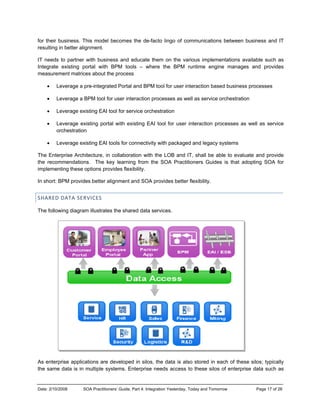
The follow
As enterp
the same
2008 SOA
business. Thi
n better align
to partner w
existing por
ment matrices
everage a pre
everage a BP
everage exist
everage exis
rchestration
everage exist
rprise Archite
mmendations.
nting these op
BPM provides
DATA SERV
wing diagram
prise applicati
data is in m
A Practitioners’ G
s model beco
nment.
with business
rtal with BPM
s about the pr
e-integrated P
PM tool for us
ting EAI tool f
ting portal w
ting EAI tools
ecture, in coll
. The key le
ptions provide
s better alignm
VICES 
illustrates the
ions are deve
ultiple system
Guide, Part 4: Int
omes the de-
and educate
M tools – w
rocess
Portal and BP
ser interaction
for service orc
ith existing E
s for connectiv
aboration wit
earning from
es flexibility.
ment and SOA
e shared data
eloped in silo
ms. Enterprise
tegration Yesterd
-facto lingo o
e them on the
here the BP
PM tool for use
n processes a
chestration
EAI tool for us
vity with pack
th the LOB a
the SOA Pr
A provides be
a services.
os, the data is
e needs acce
day, Today and T
of communica
e various imp
PM runtime e
er interaction
as well as serv
ser interactio
aged and leg
nd IT, shall b
actitioners G
etter flexibility
s also stored
ess to these
Tomorrow
ations betwee
plementations
engine mana
based busin
vice orchestra
on processes
gacy systems
be able to ev
uides is that
y.
in each of th
silos of enter
Page 1
en business a
s available su
ages and pro
ess processe
ation
as well as s
valuate and p
t adopting SO
hese silos; ty
rprise data su
7 of 26
and IT
uch as
ovides
es
service
provide
OA for
pically
uch as
Date: 2/10/2
customers
layer. Th
(part of th
services.
These da
One of th
clients sh
Supportin
traditional
time is a a
SERVICE 
The follow
The Ente
SOA Prac
for decou
through th
2008 SOA
s, products, o
is layer could
he Enterprise
ta services co
he key criteria
hould be abl
g SQL interfa
l ODS/DW, e
additional ben
INTEGRATI
wing diagram
rprise Service
ctitioners wou
pling services
he service bus
A Practitioners’ G
orders, and th
d be implemen
e Architecture
ould be acce
a is that thes
e to access
ace shall enab
nabling them
nefit of such t
ON 
illustrates the
e Bus pattern
uld like to poin
s. Sometime
s.
Guide, Part 4: Int
he best way to
nted using on
e team) nee
ssed by any
se tools supp
these share
ble business t
to get real-ti
tools.
e service med
n is already w
nt is that it is n
s it is ok for e
tegration Yesterd
o provide suc
ne or more tec
d to partner
client such a
port multiple
ed data serv
to point their
me informatio
diation layer (
well understo
not always ne
enterprise app
day, Today and T
h capability to
chnologies an
with busines
s portals, par
protocols to
vices as Web
BI tools to the
on. Ability to
ESB).
ood and docu
ecessary that
plications to g
Tomorrow
o develop a u
nd the enterp
ss to define
rtners, BPM,
access the d
b Services, X
ese data serv
cache the da
umented and
t one needs to
go from point-
Page 1
uniform data a
prise data arch
and expose
EAI/ESB, BI
data services
XQuery, SQL
vices, instead
ata over a pe
the only po
o use a servic
-to-point, inst
8 of 26
access
hitects
these
tools,.
. The
L, etc.
of the
riod of
int the
ce bus
ead of
Date: 2/10/2
BUSINES
In conclus
This patte
explained
or BI tool
infrastruct
INTEGRA
Following
to provide
studies lis
2008 SOA
SS INTEGRAT
sion, Busines
ern is indepen
to the busine
) to review th
ture but NOW
ATION TODA
are two disti
e business alig
sted in “Integr
A Practitioners’ G
TION 
s Agility = Ali
ndent of the p
ess. In additi
heir business
W it means bu
AY: CASE ST
nct case stud
gnment and f
ration Yesterd
Guide, Part 4: Int
gnment + Fle
products or th
on, this also
s real-time. O
siness integra
UDIES 
dies where IT
flexibility. The
day” and the t
tegration Yesterd
exibility = BPM
e tools used
enables the d
One final com
ation at all lev
T organization
e first two cas
third case is a
day, Today and T
M + SOA.
to integrate t
decision make
mment, integr
vels.
ns have lever
se studies are
a new one.
Tomorrow
he enterprise
ers (by levera
ration now no
raged their ex
e transformati
Page 1
e and can eas
aging any rep
o longer mea
xisting investm
ion of the two
9 of 26
sily be
porting
ans IT
ments
o case
Date: 2/10/2
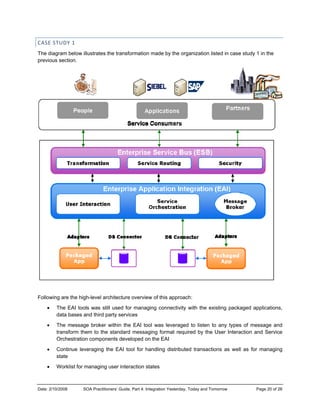
CASE STU
The diagr
previous s
Following
• T
da
• T
tr
O
• C
st
• W
2008 SOA
UDY 1 
ram below illu
section.
are the high-
he EAI tools
ata bases and
he message
ansform them
Orchestration c
Continue lever
tate
Worklist for ma
A Practitioners’ G
strates the tra
-level architec
was still use
d third party s
broker within
m to the stan
components d
raging the EA
anaging user
Guide, Part 4: Int
ansformation
cture overview
ed for manag
services
n the EAI too
dard messag
developed on
AI tool for ha
interaction st
tegration Yesterd
made by the
w of this appr
ing connectiv
ol was levera
ging format re
n the EAI
andling distrib
tates
day, Today and T
organization
roach:
vity with the e
aged to listen
equired by th
buted transac
Tomorrow
listed in case
existing pack
n to any types
he User Intera
ctions as wel
Page 2
e study 1 in th
kaged applica
s of message
action and Se
ll as for man
20 of 26
he
ations,
e and
ervice
naging
Date: 2/10/2
• T
E
• T
an
This appro
focusing o
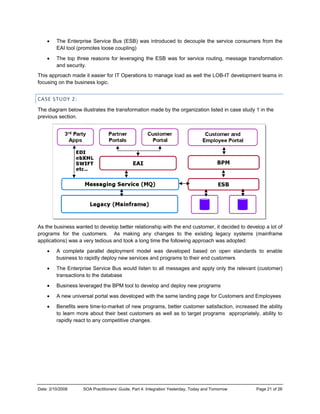
CASE STU
The diagr
previous s
As the bu
programs
applicatio
• A
bu
• T
tr
• B
• A
• B
to
ra
 
2008 SOA
he Enterprise
AI tool (prom
he top three
nd security.
oach made it
on the busine
UDY 2: 
ram below illu
section.
siness wante
for the cus
ns) was a ver
A complete p
usiness to rap
he Enterprise
ansactions to
usiness lever
A new universa
enefits were
o learn more
apidly react to
A Practitioners’ G
e Service Bus
otes loose co
reasons for
t easier for IT
ess logic.
strates the tra
ed to develop
stomers. As
ry tedious and
parallel deplo
pidly deploy n
e Service Bus
o the database
raged the BP
al portal was
time-to-mark
about their b
o any compet
Guide, Part 4: Int
s (ESB) was
oupling)
leveraging th
Operations t
ansformation
better relation
s making any
d took a long
yment mode
new services
s would listen
e
M tool to deve
developed w
et of new pro
best customer
itive changes
tegration Yesterd
introduced to
he ESB was f
to manage loa
made by the
nship with the
y changes to
time the follo
el was develo
and program
n to all messa
elop and dep
ith the same
ograms, bette
rs as well as
s.
day, Today and T
o decouple th
for service ro
ad as well the
organization
e end custom
o the existin
owing approac
oped based
s to their end
ages and app
loy new prog
landing page
er customer sa
to target pro
Tomorrow
he service co
outing, messa
e LOB-IT dev
listed in case
er, it decided
ng legacy sys
ch was adopt
on open sta
d customers
ply only the re
rams
for Custome
atisfaction, in
ograms appr
Page 2
onsumers from
age transform
velopment tea
e study 1 in th
to develop a
stems (mainf
ted:
andards to e
elevant (custo
rs and Emplo
ncreased the
ropriately, abi
21 of 26
m the
mation
ams in
he
a lot of
frame
enable
omer)
oyees
ability
ility to
Date: 2/10/2
CASE STU
This is a r
Poland w
This instit
interested
improve c
different c
The finan
infrastruct
The abov
institution
as well as
2008 SOA
UDY 3 
real-life case
with 10+ millio
tution grew
d in creating
cross-sell rate
countries.
cial institution
ture which en
ve diagram i
in Europe to
s drive new an
A Practitioners’ G
study where
on customers
by mergers
new opportu
es, streamline
n adopted SO
nables them to
llustrates the
rreduce prod
nnual net reve
Guide, Part 4: Int
one of the lar
s has succes
and acquisiti
unities by lau
e front-end p
OA to integrat
o build and la
e high-level
duction cost im
enue counted
tegration Yesterd
rge financial i
sfully adopte
ions of multi
unching e-se
processes, et
te their entire
aunch new se
integration a
mmediately b
d in millions o
day, Today and T
nstitutions sp
ed such as a
ple compani
ervices to pro
c. and mask
business bas
rvices and pr
approach whi
y 55% in the
f € by effectiv
Tomorrow
panning the N
pproach acro
es over last
ovide a 24x7
complexity o
sed on an op
ocesses rapid
ch enabled
first country t
ve channel uti
Page 2
Nordics, Baltic
oss the enter
10 years. It
7 servicing m
of core syste
pen, service-c
dly.
the large fin
they impleme
ilization.
22 of 26
cs and
rprise.
t was
model,
ms in
centric
nancial
ented it
Date: 2/10/2
 INTEGRA
FUTURE 
The IT or
shall be u
organizati
outsource
Following
• E
in
co
pu
• M
th
ap
on
be
cu
SOA GOV
There are
managem
architects
funded. T
executive
2008 SOA
ATION: TOM
OF IT  
rganization of
used as a ch
ions that are
ed.
are the two i
ven though
nterdependen
ould be very
ut in place a r
Most of the IT
heir effort on
pplications in
ne of the soft
e to impleme
ustomers, pr
VERNANCE 
e two aspect
ment/operation
s, to focus on
This includes
s. Following
A Practitioners’ G
MORROW 
f the future sh
hange agent
able to trans
mportant fact
BPM + SOA
cies between
brittle leading
robust and re
T organization
the integratio
n house, inste
tware as a se
ent business
roducts, ord
ts associated
ns model. It
developing a
s putting toge
is one of the
Guide, Part 4: Int
hall be substa
by business
sform themse
tors that shall
A enable busi
n systems, se
g to disaster.
eliable SOA go
ns, especially
on. Ideally, th
ead they wou
rvice (SaaS)
processes a
ers, and so
with SOA G
is very imp
and demonst
ether an easy
successful ap
tegration Yesterd
antially differe
s executives
elves shall su
l impact the IT
ness alignme
ervices, etc. a
It is for this
overnance pr
the small an
hese organiz
uld recommen
providers. Th
across these
o on; basica
Governance;
portant for I
rating the pot
y, simple to
pproaches lev
day, Today and T
ent than wha
to transform
rvive and the
T organization
ent and flexib
nd if not prop
reason it is im
rocess right fr
nd medium e
zations would
nd business t
he primary tas
solutions, ma
ally focus o
one is the fu
T organizatio
tential busine
understand f
veraged by IT
Tomorrow
t it is today. A
their busine
e other shall e
ns:
bility, they al
perly manage
mportant for I
rom the begin
nterprises, sh
d no longer h
to leverage a
sk of the IT o
anage enterp
on integratin
unding mode
ons, especia
ess value of S
funding mode
T organization
Page 2
An IT organiz
ess. Only tho
either perish
lso create a
d this environ
IT organizatio
nning.
hall primarily
host any pack
an application
rganizations w
prise data su
g the enter
el and other
ally the ente
SOA prior to
el for the bus
ns.
23 of 26
zation
ose IT
or be
lot of
nment
ons to
focus
kaged
n from
would
ch as
rprise.
is the
rprise
being
siness
Date: 2/10/2008 SOA Practitioners’ Guide, Part 4: Integration Yesterday, Today and Tomorrow Page 24 of 26
This is basically a three layered model, where the lowest level is the most universal and generic
infrastructure which is funded as tax or charge-back across all the business units (similar to the networks,
email, etc.). The second level is the shared set of business services that is funded jointly by one or more
organizations. The important thing to remember is that even though one of the business units may not
use the shared business services right up-front, it has been observed that the second business unit would
be willing to fund it, provided they know that one of their business applications shall require that service
(recommend that this horizon be less than one year). The top most level is the least universal or a set of
services that specific only to one of the business units and shall also be funded by that business unit.
Evangelizing such as model during the annual budget planning cycle shall increase the success of getting
the SOA projects funded.
Once the funding is approved, it is important that the organizations focus on managing the SOA program.
This shall require organizations to adopt SOA Governance tools that include both the BPM and
Repository capability. This is to enable organizations to fine tune their governance processes as well as
reduce/eliminate deployment of redundant services. Most of the major software vendors already have
SOA Governance tools and have also published their best practices and common patterns. The
recommendation for IT organizations would be to leverage these patterns as a base and customize it to
meet their specific requirements.
Following are some of the high-level requirements for an SOA Governance tool:
• Ability to customize the governance process, preferably using a browser
• Governance process engine should be independent of the repository
• Federation is key, as large enterprises shall potentially have multiple instances
• Meta data repository, especially one based on Meta-Object Facility (OMG Standard)
• Ability to map dependencies between the various metadata schemas and artifacts
• Ability to manage multiple versions of the metadata and artifacts
• Ability to create and manage assets
• Integration with financial applications, application portfolio management systems and CMDB
FACTORS IMPACTING BUSINESS INTEGRATION 
Following are the list of factors that shall impact the business integration in the future:
EXPONENTIAL EXPLOSIONS OF EVENTS 
As enterprises start adopting SOA and new technologies such as RFID, location based services, Web 2.0
and multimedia; these systems shall continuously generate a lot of events. In today’s integration efforts
most of the business rules could be captured and automated. However, this approach shall not be
sufficient in the future, especially as business would want to interact to any environmental change rapidly.
Enterprises need to start looking at adopting Event Servers to handle some existing events and as the
number of events increase, the Event Server should be able to detect various patterns and proactively
recommend action without the business having to spell out every scenario possible to IT (which would be
next to impossible to do). Multiple standards groups are currently working on the standards for the Event
Date: 2/10/2008 SOA Practitioners’ Guide, Part 4: Integration Yesterday, Today and Tomorrow Page 25 of 26
Driven Architecture but are still a year or two away from defining them. In short, pick a vendor/product
that meets your specific needs expecting the vendor to support the standard in a few years.
COMMODITIZATION OF TECHNOLOGY 
Today large eBusiness and Search engine sites develop specialized software to handle large volumes
and run on high-end hardware. Over the period of time the software vendors are expected to develop
software that shall run on low-end commodity servers (x86 based server); basically a grid of commodity
servers. It would be important to watch the progress made by The Open Grid Forum and potentially
adopt some of their recommendations.
SOFTWARE AS A SERVICE (SAAS) 
Enterprises shall not only leverage SaaS for business application but shall do so, on a periodic basis, for
processor power, disk spaces, etc. Business Applications such as ERP, CRM and eBusiness suites have
been provided by the SaaS vendors for quite a while and integrating with them is straight forward.
Enterprises have to be watchful of how these business application oriented SaaS providers incorporate
the changing privacy rules and regulatory policies in times of globalization. On the other hand enterprises
would have to exercise caution before leveraging on-demand infrastructure providers, especially due to
lack of standardization. Some concerns could include metering for usage of these infrastructure services.
MAPPING DEPENDENCIES 
As IT organizations shall be leveraging SaaS for infrastructure too, it becomes very important for them to
map the dependencies right from the business process to the set of services all the way down to the
servers and disks used that support these business capabilities. This basically makes it necessary for IT
organizations to adopt a metadata repository to map the entire grid such as the ones provided by Asset
Management Tools. Once again, monitoring The Open Grid Forum would be beneficial.
An analysis effort has to be undertaken by IT to help with the mapping exercise and to keep this up to
date. In addition, it is imperative that the business services (components) are built modular in nature and
limit their dependencies to each other. This not only involves work in the analysis of the core business
functions and business process but also an understanding of how these would be deployed and utilized
within the various business units. Parameters such as availability, variability, regulatory influences upon
the operations of each business unit have an impact on the modularity and reusability of these services.
Date: 2/10/2008 SOA Practitioners’ Guide, Part 4: Integration Yesterday, Today and Tomorrow Page 26 of 26
CONCLUSION 
Business integration is a difficult problem when the business environment and business operating models
are changing. The best way to deal with this is to identify the most granular reusable business functions
that can be effectively assembled by the business users and the knowledge workers. This requires that
IT not only engages with the business in strategic discussions but is also involved with identifying the
core business activities that remain stable and unchanged across the life of an enterprise. These core
business activities are encapsulated into reusable business functions. IT will also need to evaluate and
provide tools to the business user to offer the ability to assemble new business capabilities and also tools
that allow the business user to simulate novel business scenarios. These types of tools that enable the
business user to become self-reliant also reduce the “lost in translation” syndrome for the business
capabilities in the deployment of these solutions. Finally, a word on governance. The business user and
IT have to be participants in the governance and oversight models for governance successful integration
of enterprise information into knowledge.

SOAPGPart4.40203134

  • 1.
    Date: 2/10/2008 SOAPractitioners’ Guide, Part 4: Integration Yesterday, Today and Tomorrow Page 1 of 26 SOA Practitioners’ Guide Part 4 Integration: Yesterday, Today and Tomorrow   Painting by: Surekha Durvasula
  • 2.
    Date: 2/10/2008 SOAPractitioners’ Guide, Part 4: Integration Yesterday, Today and Tomorrow Page 2 of 26 Contributing SOA Practitioners Ashok Kumar, Director - Services, Avis/Budget Burc Oral, CellExchange Inc. Surekha Durvasula, Enterprise Architect, Kohls Yogish Pai, CEO, Pai Systems, LLC This work is licensed under the Creative Commons Attribution 3.0 United States License. To view a copy of this license, visit http://creativecommons.org/licenses/by/3.0/us/ or send a letter to Creative Commons, 171 Second Street, Suite 300, San Francisco, California, 94105, USA. SOA Practitioners Blog: http://entarch.blogspot.com .
  • 3.
    Date: 2/10/2008 SOAPractitioners’ Guide, Part 4: Integration Yesterday, Today and Tomorrow Page 3 of 26 TABLE OF CONTENTS  TABLE OF CONTENTS ...........................................................................................................................3  ABOUT THIS DOCUMENT.....................................................................................................................5  ABSTRACT ....................................................................................................................................................5  INTENDED AUDIENCE ..................................................................................................................................5  BENEFITS OF THE SOA PRACTITIONERS’ GUIDE......................................................................................5  SOA PRACTITIONERS’ GUIDE: PARTS .......................................................................................................6  INTRODUCTION.......................................................................................................................................7  INTEGRATION YESTERDAY................................................................................................................8  INTEGRATION YESTERDAY: TRADITIONAL PATTERN .............................................................................8  ADAPTER.......................................................................................................................................................8  MESSAGING LAYER.......................................................................................................................................9  INTEGRATION YESTERDAY: CASE STUDIES.............................................................................................11  CASE STUDY 1.............................................................................................................................................11  CASE STUDY 2.............................................................................................................................................12  INTEGRATION TODAY ........................................................................................................................13  INTEGRATION APPROACH.........................................................................................................................15  PRESENTATION SERVICES ...........................................................................................................................16  BUSINESS PROCESS MANAGEMENT ............................................................................................................16  SHARED DATA SERVICES............................................................................................................................17  SERVICE INTEGRATION ...............................................................................................................................18  BUSINESS INTEGRATION............................................................................................................................19  INTEGRATION TODAY: CASE STUDIES.....................................................................................................19  CASE STUDY 1.............................................................................................................................................20  CASE STUDY 2:............................................................................................................................................21  CASE STUDY 3.............................................................................................................................................22  INTEGRATION: TOMORROW............................................................................................................23  FUTURE OF IT ............................................................................................................................................23  SOA GOVERNANCE ...................................................................................................................................23  FACTORS IMPACTING BUSINESS INTEGRATION .....................................................................................24 
  • 4.
    Date: 2/10/2008 SOAPractitioners’ Guide, Part 4: Integration Yesterday, Today and Tomorrow Page 4 of 26 EXPONENTIAL EXPLOSIONS OF EVENTS .....................................................................................................24  COMMODITIZATION OF TECHNOLOGY ........................................................................................................25  SOFTWARE AS A SERVICE (SAAS) ...............................................................................................................25  MAPPING DEPENDENCIES ............................................................................................................................25  CONCLUSION...............................................................................................................................................26   
  • 5.
    Date: 2/10/2008 SOAPractitioners’ Guide, Part 4: Integration Yesterday, Today and Tomorrow Page 5 of 26 ABOUT THIS DOCUMENT  ABSTRACT  SOA is relatively new, so companies seeking to implement it cannot tap into a wealth of practical expertise. Without a common language and industry vocabulary based on shared experience, SOA may end up adding more custom logic and increased complexity to IT infrastructure, instead of delivering on its promise of intra and inter-enterprise services reuse and process interoperability. To help develop a shared language and collective body of knowledge about SOA, a group of SOA practitioners created this SOA Practitioners’ Guide series of documents. In it, these SOA experts describe and document best practices and key learnings relating to SOA, to help other companies address the challenges of SOA. The SOA Practitioners’ Guide is envisioned as a multi-part collection of publications that can act as a standard reference encyclopaedia for all SOA stakeholders. INTENDED AUDIENCE  This document is intended for the following audience: • Business and IT leaders, who need to start and manage an SOA strategy across the enterprise/LOB • Enterprise Architects who need to drive the vision and roadmap of the SOA program and the architecture of each implementation that falls under it • Program Managers who need to manage a portfolio of sub-projects within an overall SOA business strategy • Project Team Members, who need to map dependencies and develop a timeline that meets the business expectations • Vendors who provide solutions and tools for new business capabilities to the business and IT • Standards bodies which need a better understanding of use cases of how business and IT plan to leverage technology to meet their objectives. BENEFITS OF THE SOA PRACTITIONERS’ GUIDE   This document helps readers to: • Learn from others: Early adopters of SOA share their best practices, insights, and views on the state of SOA adoption across the industry • Compare alternatives: Identify and define the key technology components of SOA to establish a baseline reference for comparison of options • Improve collaboration: A common language clarifies the nature of SOA components defined in this document
  • 6.
    Date: 2/10/2008 SOAPractitioners’ Guide, Part 4: Integration Yesterday, Today and Tomorrow Page 6 of 26 • Accelerate implementations: This guide defines the services lifecycle along with the requirements, recommended tools, and best practices for each of the stages. • Understand the value of standards: This document recommends standards for aspects of SOA • Avoid potential risks: The guide identifies some problem areas not yet addressed by the vendor community.    SOA PRACTITIONERS’ GUIDE: PARTS   There are three separate parts that make up the SOA Practitioners’ Guide. This document is Part 1, Why Services-Oriented Architecture? It provides a high-level summary of SOA. Part 2: SOA Reference Architecture provides a worked design of an enterprise-wide SOA implementation, with detailed architecture diagrams, component descriptions, detailed requirements, design patterns, opinions about standards, patterns on regulation compliance, standards templates, and potential code assets from members. Part 3: Introduction to Services Lifecycle provides a detailed process for services management though the service lifecycle, from inception through to retirement or repurposing of the services. It also contains an appendix that includes organization and governance best practices, templates, comments on key SOA standards, and recommended links for more information. Part 4: Integration: Yesterday, Today and Tomorrow details the integration reference architecture, how SOA enables integration and what the industry is expected to deal with Integration by 2010
  • 7.
    Date: 2/10/2008 SOAPractitioners’ Guide, Part 4: Integration Yesterday, Today and Tomorrow Page 7 of 26 INTRODUCTION  Integration of business systems is one of the key capabilities that should be provided by IT to enable business agility. This has been the primary objective of all integration effort to-date, however, due to various factors most of the integration efforts have not achieved the expected business benefit. Of course projects with the right executive backing have been quite successful but have never reached their full potential. The objective of this article is to demonstrate how adopting SOA enables achieving business agility and flexibility.
  • 8.
    Date: 2/10/2 INTEGRA Following majority o twoor mo Integratio the Opera top of the moving an of the cu proportion such as C the decisi resorting enterprise Business of the bus and later the lack componen In short, working o INTEGRA Following the traditi the high-l Hub or Int ADAPTER The conne the EAI or views (cod 2008 SOA ATION YEST is a brief ove of the integrat ore business n (EAI) or an ational Data S ese database nd aggregatin urrent state o nal to quality Customers, P ion makers a to custom de es. does also pla siness silos, IT expected to s of available nts such as E IT organizatio on enabling bu ATION YESTE is the traditi onal CRM/ER evel architec tegration Serv R  ectivity adapt r the Applicat de) of the targ A Practitioners’ G ERDAY  erview of the tion efforts fol applications. Extract Tran Stores (ODS) s using a Bu ng the data, it of their busin of data and w roducts, and are getting an evelopment of ay an importa T organizatio stitch them to infrastructure EAI, ETL, BI, D ons were spe usiness agility ERDAY:  TRA onal integrati RP vendors fo cture of the tr ver style. ter between th ion vendor. A get applicatio Guide, Part 4: Int traditional int llow the hub a . In addition sform Load ( and/or Data siness Intellig t is next to im ness. As th with most of th Orders are ty n accurate vi f all of the bu ant role in dri n are directed ogether. An a e - IT organi Data Quality t ending most y. ADITIONAL  ion pattern im or providing i raditional inte he messaging As these adap ons – they use tegration Yesterd tegration bes and spoke pa , this approa ETL) tools to Warehouses gence (BI) to mpossible for he accuracy he business s ypically entere ew. One co usiness syste ving IT in this d to invest he additional draw zations were tools separate of their effor PATTERN  mplemented a integration so egration patte g layer and th ptors are gen e the generic day, Today and T t practices ad attern; with th ch relies eith move data fr s. The Execu ools. Due to t the decision of all major systems still b ed in multiple uld potentiall ems. This ma s direction. A eavily on imple wback of the e forced to p ely and custo rt in developin at most of the olutions to the ern – general he application neric in nature user id and p Tomorrow dopted by the e hub bridgin her on an Ent rom the trans tive Dashboa the processin makers to ge business de being siloed ( e systems) it y resolve this ay not, howev As time-to-mar ementing pac traditional ap procure each om develop th ng the infrast e integration eir end-custo ly referred to is typically p e and invoke t password to c Page e industry. Ty ng the gap be terprise Appli actional syste ard is develop ng time requir et real-time an ecisions is d (the enterpris is very unlike s architectura ver, be practi rket is key fo ckaged applic pproach was of the techn he infrastructu tructure, inste solution as w mers. Follow o as the Integ rovided by eit the applicatio connect to the 8 of 26 ypically etween ication ems to ped on red for nalysis directly e data ely that ally by cal for r each cations due to nology ure. ead of well as wing is gration ther n e
  • 9.
    Date: 2/10/2008 SOAPractitioners’ Guide, Part 4: Integration Yesterday, Today and Tomorrow Page 9 of 26 applications. This creates a security loophole and to overcome this, IT organizations need to develop code to pass and manage the user credentials across all the systems. MESSAGING LAYER  This is the backbone of the traditional reliable and scalable EAI tools which needs to integrate with disparate technologies (CORBA, JMS, RMI, MQ, etc.) and applications. (ERP, CRM, Mainframes, etc.). As the integration pattern for EAI based solution is the hub and spoke model – all messages from the end- point (applications) are transformed into a common business object model (such as customers, orders, products, etc.) on which the integration business logic is applied. Examples of such business logic are: scoring leads from campaign data prior to populating the Sale Force Automation Software, validation of order prior to sending it to Shipping. Etc. Once the business logic is applied the message is again transformed prior to sending it to the destination applications. Following are some of the best practices/key learnings of leveraging this integration pattern. • These patterns have been widely adopted and extensively used, especially for manufacturing, B2B supply chain, banking, etc. • Requires standardization of the message format – header and payload section • Source and target applications need to develop code (using their own proprietary code and interface) to integrate with the Adapter • Business process adopted using proprietary workflow solutions - not necessarily standards based. However, the latest versions allow for BPEL, XPDL, JPD import/export, etc. • Generally result in implementing point-to-point solution on the hub and vendor lock-in (due to the proprietary nature of the EAI tool) • Reliable and scalable to support mission critical applications • Modification of the canonical model may require redeployment of the entire application resulting in complex regression and integration testing which can make it difficult to deploy the refactored solution without shutting down the system • IT organizations spend a lot of effort in integrating the technologies instead of focusing on delivering new business behaviour that enables business agility As the EAI tool typically gets implemented as a point-to-point solution on a centralized server, it is not convenient to leverage this approach to provide the decision makers with real-time information. One of the best practices of leveraging the EAI tool is to pass all the relevant data over the messaging layer to populate the Operational Data Store and/or the data warehouse. However, due to the high development costs, it rarely ever happens. Instead the data team implements a parallel integration effort using ETL tool to copy all the data to an ODS/DW for aggregation and reporting purpose.
  • 10.
    Date: 2/10/2 This resul increased reportsfo the so ca However, enterprise not, when Majority o been suc applicatio implemen the data a   2008 SOA lts in the sam d Total Cost o r the decision alled master there is st e. It at least n compared to of the enterpr ccessful, esp ns to the CR ntations of larg after all the da A Practitioners’ G me business lo of Ownership n makers are data stores ill a potentia provides a v o not having a rises that hav ecially in the RM and/or ER ge ODS/DW ata is copied f Guide, Part 4: Int ogic impleme p. In addition provided with where the d ally large bu view into the s any view ente ve implement e area of su RP systems, e solutions, es from the trans tegration Yesterd ented in multip n to this redu h information data is not e siness bene state of the e erprise data at ted an EAI so upply-chain, etc. However pecially as th saction system day, Today and T ple applicatio undancy, as based on the entirely accu fit for implem enterprise wh t hand at all. olution with th B2B, manufa r, there have his effort attem ms. Tomorrow ons and techn the Executiv e data from th rate and nor menting this hether accura he right exec acturing, inte been many c mpts to stand Page 1 nologies resul ve Dashboard he ODS/DW o r is it in rea approach fo ate and real-ti cutive backing egrating eBus cases of disa ardize and cl 0 of 26 lting in ds and or from al-time. or the ime or g have siness astrous leanse
  • 11.
    Date: 2/10/2 INTEGRA Following to provide CASE STU •C re tr • P E • P in • A sy po The follow • A • B • W • W 2008 SOA ATION YESTE are two distin e integration f UDY 1  Customer ente ecord. In this ansaction is s rovide custom DI integration eriodic (night nformation into A change notif ystem of reco ortal. wing function Adaptors to co 2B connector Workflow engin Worklist featur A Practitioners’ G ERDAY: CAS nct case stud lexibility. ers order on th case, the EA submitted to t mer the ability n with third pa tly) scheduled o the package fication listene ord (packaged / features we onnect to pack rs for EDI and nes are utilize res are emplo Guide, Part 4: Int SE STUDIES ies where IT he eBusiness AI tool respon the packaged y to review the arty for logistic d batch proce ed product re er on the EAI d application) re leveraged kaged applica d ebXML ed for service oyed for mana tegration Yesterd organizations s site which is sible for orde d applications e product stat cs and Web S sses, powere epository, ope is leveraged to populate t from the EAI ations e orchestration aging human day, Today and T s have levera s validated an er validation a . tus as well as Service to trac ed by ETL to p erations data s to capture an the local prod tool: n with partner interaction pr Tomorrow ged their exis nd submitted t nd for ensurin s track the sh ck packaged populate mas stores and da ny product ch uct details for r applications rocess Page 1 sting investme to the system ng that the ipped packag ster data ata warehous anges in the r the eBusine s 1 of 26 ents of ges. e. ess
  • 12.
    Date: 2/10/2 • Jo CASE STU •B • M th • Le ap th se • La in un The follow • JM • W se • W • Lo 2008 SOA ob Scheduler UDY 2  usiness runs Majority of the hem (EDI, ebX everaged EA pplications. A hey leveraged ense at the bu ater develope ntent of selling nderstand the wing function MS to connec Workflow (serv ervices expos Worklist for ma ong term plan A Practitioners’ G r is leveraged their core bu business is t XML, File Tra I tool to expo As exposing e d initially an a usiness level ed these sam g directly to th eir customer b / features we ct to the mess vice orchestra sed from the m anaging huma n is to migrate Guide, Part 4: Int to invoke pe siness applic hrough chann ansfers, etc.) se business s existing fine g pplication ser . e services to hem (avoid ch base better. re leveraged saging service ation) to comp main frame. an interaction e the EDI, ebX tegration Yesterd riodic file tran cations on leg nels that leve services to pa grain services rver and later create their o hannel conflic from the EAI es pose business n process with XML, File tran day, Today and T nsfer to third p acy infrastruc rages messa artners to sup s from the ma r an EAI tool t own customer ct) but more o tool: s services co h the portal nsfer interface Tomorrow party applicat cture (mainfra ging services pport their eBu inframe did n to expose ser r eBusiness s of a tool to kno nsisting of mu e to the EAI to Page 1 ions ame) s to interface w usiness ot make sens rvices that ma site – not with ow and ultiple fine gra ools 2 of 26 with se, ade h the ained
  • 13.
    Date: 2/10/2 INTEGRA One ofth solution; r SOA defin SOA is the overall rev In order Reference the SOA map back are not ye map the b business 2008 SOA ATION TODA he reasons w rather it is a nition in the S e business ope venue, increasi to ensure th e Architecture Practitioners k to business et on linked to business proc process. A Practitioners’ G AY  why SOA is g way of aligni SOA Practition erations strate ing customer s hat there is e (illustrated a Guide Part 2 requirements o the business cess and late Guide, Part 4: Int gaining such ng IT closer ners Guide Pa egy for leverag satisfaction, im a common v above) which 2. The prima s, i.e. IT shou s requiremen er drill down tegration Yesterd a momentu to the busine art 1 which is ging informati mproving prod vocabulary, t is well under ary principle o ld be not be d t. The right w to understan day, Today and T m is becaus ess and vice as follows: ion to meet th duct quality, et the SOA Pra rstood by the of SOA is tha developing an ways to captur d the busines Tomorrow e it is clearly versa. The heir objectives, tc.   actitioners de contributors at all services ny infrastruct re these requ ss services r Page 1 y not a techn SOA publishe s, such as incre eveloped the and documen s developed s ure or service irements are required to fu 3 of 26 nology ed the easing  e SOA nted in should es that to first ulfil the
  • 14.
    Date: 2/10/2 The abov integration isa fact th very hard businesse of discrete On the IT have evol data as s quite mat developm business integration One way disparate fragmente account s applicatio system is example, inventory implemen implemen ways too. 2008 SOA ve diagram ill n. On the bu hat many ente d to make im es are looking e business ac side, analog lved and grow services. But tch what the ment to try an activities tha n and SOA ad to create a data from ed across diff service that ns. Another s orchestratin there is an it initiates nted by a pr nted with proc For example A Practitioners’ G lustrated how usiness side m erprises do n provements, g to achieve f ctivities, and t ous to the bu wn over time. the issue on e business pr nd achieve th at support bu ddresses. business se multiple app ferent accoun aggregates way to crea g across a s order fulfilme shipment, ot rocess servic cess technolo e, a customer Guide, Part 4: Int w business a most business ot precisely u gain operatio flexibility by b this flow or pr usiness side, m Early SOA e the IT side rocess needs is alignment. usiness proce ervices is usi plications. F nts that the cu fragments o ate a busines et of finer gr ent business therwise noti ce within an ogy and can b may write a c tegration Yesterd lignment and s processes h understand th onal efficienc being able to rocess can be most of IT is efforts have e is that these s, and a lot . What is nee esses. It is th ng a data in or example, ustomer holds of account in ss services is ained service service, whi ifies the cus EAI tool. A be augmente custom applic day, Today and T d flexibility in have just grow heir processes cy, and react describe the e optimized an a set of appli ven exposed applications, of time and eded is a ser he provisioni ntegration pat customer’s s with the en nformation fro s the service es or applicat ch does an stomer when A process se d by busines cation on an A Tomorrow achieved by wn and evolv s and bottlene quickly to th eir business p nd changed. cations, interf some of thes , interfaces a d effort is sp rvices layer t ng of this la ttern, where account inf terprise. So, om multiple orchestration tion interface inventory che n delivery is ervice in an ss logic in Jav Application Se Page 1 y adopting SO ved over time ecks. This ma he marketplac processes as faces and da se application and services d pent in codin that is aligne yer that ente in one aggre formation ma one might ne data source n pattern. He s. In the illus eck – if there possible. T EAI tool ca va. There are erver. 4 of 26 OA for and it akes it ce. So a flow ta that ns and do not g and ed with erprise egates ay be eed an s and ere the strated e’s an This is an be e other
  • 15.
    Date: 2/10/2 In theillus notion of different c The final across dif an enterp consumab Service B INTEGRA This secti BPM and the appro their busin could leve Based on both BPM level how Note: Even primarily on The follow problem b 2008 SOA strated exam a process is contexts and t component f fferent types o prise may hav ble by any ot Bus (ESB). ATION APPR ion describes SOA. Both aches. For ex ness process erage SOA at n our experie M and SOA to they would w though this is a the integration a wing diagram being solves a A Practitioners’ G ple the overa present in bo the two techn for achieving of services, w ve in its syste ther service in OACH  s the best pra these approa xample: busin ses and imple t the infrastruc nce and key o achieve Bus work together. also defined in th aspects. illustrates the and in the foll Guide, Part 4: Int all order mana oth BPM and nologies are o flexibility is th whether busin em landscape n the enterpr actices for int aches are com ness may dec ement the ent cture or platfo learnings, th siness agility . he SOA Practitio e SOA Integra owing section tegration Yesterd agement proc d EAI, but as optimized for d he service in ess services e and expose rise. This lay tegrating the mplementary cide to adopt tire process u orm level for i he SOA Prac and flexibility oners Guide Par ation pattern, n we shall add day, Today and T cess is imple you can see different use c tegration laye or application es them via p yer is typically various silos and one cou BPM for mod using a packa ntegration wit ctitioners reco y. The follow rt 3: Introduction , independent dress each of Tomorrow emented in a the use of th cases. er. Service in ns or other typ proxy services y implemente s within an en uld choose to deling, simula aged applicati thout busines ommends tha wing section d n to the Services t of the produ f the compon Page 1 BPM tool. No his technolog ntegration me pes of service s in a format ed by an Ente nterprise base adopt one or ating and revie on. Alternate ss adopting B at enterprise describes at a s Lifecycle this fo ucts of the bu ents. 5 of 26 ow the gy is in ediates es that t that’s erprise ed on r both ewing ely, IT PM. adopt a high focuses siness
  • 16.
    Date: 2/10/2 PRESENT Traditiona Most have SOARefe the ability possible u types of p course bu terms wh based on whenever In case o judgment Complian Business BUSINES The diagr Business execution develop a 2008 SOA TATION SER ally the IT or e been based erence Archit y to access al until recently, products enab usiness will n at they do to n SOAP and r it is possible of IT develop call on whe ce service co Service. SS PROCESS  ram represent can focus o and measur aircrafts, auto A Practitioners’ G VICES  rganizations a d on portal te tecture). For l the relevant , especially w ble business u need to acce o be able to lately (and e. ing the prese ere the servic ould be direct MANAGEM ts a sample b on managing ement of pro omobiles, etc. Guide, Part 4: Int are responsib chnology (ad a long time t data, on-dem with Web 2.0 users to comp ss the catalo utilize them. preferable) o entation serv ce should res tly invoked fo ENT  business proc and improvi cesses. Whe it is time for tegration Yesterd ble for develo dition details business has mand, withou products now pose presenta og (Service R Typically th on REST. S ices, the Ent side. For ex rm the prese cess ing the perfo en large ente r business to day, Today and T oping or imp available in S s been reque t IT involvem w available f ations that lev Registry/Repo ese services SOA Practitio terprise Arch xample; third ntation tier, S ormance of th rprise leverag leverage rea Tomorrow plementing eB SOA Practitio sting/demand ent. Unfortun for the Enterp verage one o ository), unde are exposed ners recomm itecture team party servic Service media he business ge modeling t adily available Page 1 Business solu oners Guide P ding that they nately, this w prises. Thes r more servic erstand in bus d as Web Se mends using m needs to m es such as E ation layer (ES through mod tools to desig e tools to the 6 of 26 utions. Part 2: y need was not e new ces. Of siness ervices REST make a Export SB) or deling, gn and same
  • 17.
    Date: 2/10/2 for theirb resulting i IT needs Integrate measurem • Le • Le • Le • Le or • Le The Enter the recom implemen In short: B SHARED  The follow As enterp the same 2008 SOA business. Thi n better align to partner w existing por ment matrices everage a pre everage a BP everage exist everage exis rchestration everage exist rprise Archite mmendations. nting these op BPM provides DATA SERV wing diagram prise applicati data is in m A Practitioners’ G s model beco nment. with business rtal with BPM s about the pr e-integrated P PM tool for us ting EAI tool f ting portal w ting EAI tools ecture, in coll . The key le ptions provide s better alignm VICES  illustrates the ions are deve ultiple system Guide, Part 4: Int omes the de- and educate M tools – w rocess Portal and BP ser interaction for service orc ith existing E s for connectiv aboration wit earning from es flexibility. ment and SOA e shared data eloped in silo ms. Enterprise tegration Yesterd -facto lingo o e them on the here the BP PM tool for use n processes a chestration EAI tool for us vity with pack th the LOB a the SOA Pr A provides be a services. os, the data is e needs acce day, Today and T of communica e various imp PM runtime e er interaction as well as serv ser interactio aged and leg nd IT, shall b actitioners G etter flexibility s also stored ess to these Tomorrow ations betwee plementations engine mana based busin vice orchestra on processes gacy systems be able to ev uides is that y. in each of th silos of enter Page 1 en business a s available su ages and pro ess processe ation as well as s valuate and p t adopting SO hese silos; ty rprise data su 7 of 26 and IT uch as ovides es service provide OA for pically uch as
  • 18.
    Date: 2/10/2 customers layer. Th (partof th services. These da One of th clients sh Supportin traditional time is a a SERVICE  The follow The Ente SOA Prac for decou through th 2008 SOA s, products, o is layer could he Enterprise ta services co he key criteria hould be abl g SQL interfa l ODS/DW, e additional ben INTEGRATI wing diagram rprise Service ctitioners wou pling services he service bus A Practitioners’ G orders, and th d be implemen e Architecture ould be acce a is that thes e to access ace shall enab nabling them nefit of such t ON  illustrates the e Bus pattern uld like to poin s. Sometime s. Guide, Part 4: Int he best way to nted using on e team) nee ssed by any se tools supp these share ble business t to get real-ti tools. e service med n is already w nt is that it is n s it is ok for e tegration Yesterd o provide suc ne or more tec d to partner client such a port multiple ed data serv to point their me informatio diation layer ( well understo not always ne enterprise app day, Today and T h capability to chnologies an with busines s portals, par protocols to vices as Web BI tools to the on. Ability to ESB). ood and docu ecessary that plications to g Tomorrow o develop a u nd the enterp ss to define rtners, BPM, access the d b Services, X ese data serv cache the da umented and t one needs to go from point- Page 1 uniform data a prise data arch and expose EAI/ESB, BI data services XQuery, SQL vices, instead ata over a pe the only po o use a servic -to-point, inst 8 of 26 access hitects these tools,. . The L, etc. of the riod of int the ce bus ead of
  • 19.
    Date: 2/10/2 BUSINES In conclus Thispatte explained or BI tool infrastruct INTEGRA Following to provide studies lis 2008 SOA SS INTEGRAT sion, Busines ern is indepen to the busine ) to review th ture but NOW ATION TODA are two disti e business alig sted in “Integr A Practitioners’ G TION  s Agility = Ali ndent of the p ess. In additi heir business W it means bu AY: CASE ST nct case stud gnment and f ration Yesterd Guide, Part 4: Int gnment + Fle products or th on, this also s real-time. O siness integra UDIES  dies where IT flexibility. The day” and the t tegration Yesterd exibility = BPM e tools used enables the d One final com ation at all lev T organization e first two cas third case is a day, Today and T M + SOA. to integrate t decision make mment, integr vels. ns have lever se studies are a new one. Tomorrow he enterprise ers (by levera ration now no raged their ex e transformati Page 1 e and can eas aging any rep o longer mea xisting investm ion of the two 9 of 26 sily be porting ans IT ments o case
  • 20.
    Date: 2/10/2 CASE STU The diagr previouss Following • T da • T tr O • C st • W 2008 SOA UDY 1  ram below illu section. are the high- he EAI tools ata bases and he message ansform them Orchestration c Continue lever tate Worklist for ma A Practitioners’ G strates the tra -level architec was still use d third party s broker within m to the stan components d raging the EA anaging user Guide, Part 4: Int ansformation cture overview ed for manag services n the EAI too dard messag developed on AI tool for ha interaction st tegration Yesterd made by the w of this appr ing connectiv ol was levera ging format re n the EAI andling distrib tates day, Today and T organization roach: vity with the e aged to listen equired by th buted transac Tomorrow listed in case existing pack n to any types he User Intera ctions as wel Page 2 e study 1 in th kaged applica s of message action and Se ll as for man 20 of 26 he ations, e and ervice naging
  • 21.
    Date: 2/10/2 • T E •T an This appro focusing o CASE STU The diagr previous s As the bu programs applicatio • A bu • T tr • B • A • B to ra   2008 SOA he Enterprise AI tool (prom he top three nd security. oach made it on the busine UDY 2:  ram below illu section. siness wante for the cus ns) was a ver A complete p usiness to rap he Enterprise ansactions to usiness lever A new universa enefits were o learn more apidly react to A Practitioners’ G e Service Bus otes loose co reasons for t easier for IT ess logic. strates the tra ed to develop stomers. As ry tedious and parallel deplo pidly deploy n e Service Bus o the database raged the BP al portal was time-to-mark about their b o any compet Guide, Part 4: Int s (ESB) was oupling) leveraging th Operations t ansformation better relation s making any d took a long yment mode new services s would listen e M tool to deve developed w et of new pro best customer itive changes tegration Yesterd introduced to he ESB was f to manage loa made by the nship with the y changes to time the follo el was develo and program n to all messa elop and dep ith the same ograms, bette rs as well as s. day, Today and T o decouple th for service ro ad as well the organization e end custom o the existin owing approac oped based s to their end ages and app loy new prog landing page er customer sa to target pro Tomorrow he service co outing, messa e LOB-IT dev listed in case er, it decided ng legacy sys ch was adopt on open sta d customers ply only the re rams for Custome atisfaction, in ograms appr Page 2 onsumers from age transform velopment tea e study 1 in th to develop a stems (mainf ted: andards to e elevant (custo rs and Emplo ncreased the ropriately, abi 21 of 26 m the mation ams in he a lot of frame enable omer) oyees ability ility to
  • 22.
    Date: 2/10/2 CASE STU This isa r Poland w This instit interested improve c different c The finan infrastruct The abov institution as well as 2008 SOA UDY 3  real-life case with 10+ millio tution grew d in creating cross-sell rate countries. cial institution ture which en ve diagram i in Europe to s drive new an A Practitioners’ G study where on customers by mergers new opportu es, streamline n adopted SO nables them to llustrates the rreduce prod nnual net reve Guide, Part 4: Int one of the lar s has succes and acquisiti unities by lau e front-end p OA to integrat o build and la e high-level duction cost im enue counted tegration Yesterd rge financial i sfully adopte ions of multi unching e-se processes, et te their entire aunch new se integration a mmediately b d in millions o day, Today and T nstitutions sp ed such as a ple compani ervices to pro c. and mask business bas rvices and pr approach whi y 55% in the f € by effectiv Tomorrow panning the N pproach acro es over last ovide a 24x7 complexity o sed on an op ocesses rapid ch enabled first country t ve channel uti Page 2 Nordics, Baltic oss the enter 10 years. It 7 servicing m of core syste pen, service-c dly. the large fin they impleme ilization. 22 of 26 cs and rprise. t was model, ms in centric nancial ented it
  • 23.
    Date: 2/10/2  INTEGRA FUTURE  The ITor shall be u organizati outsource Following • E in co pu • M th ap on be cu SOA GOV There are managem architects funded. T executive 2008 SOA ATION: TOM OF IT   rganization of used as a ch ions that are ed. are the two i ven though nterdependen ould be very ut in place a r Most of the IT heir effort on pplications in ne of the soft e to impleme ustomers, pr VERNANCE  e two aspect ment/operation s, to focus on This includes s. Following A Practitioners’ G MORROW  f the future sh hange agent able to trans mportant fact BPM + SOA cies between brittle leading robust and re T organization the integratio n house, inste tware as a se ent business roducts, ord ts associated ns model. It developing a s putting toge is one of the Guide, Part 4: Int hall be substa by business sform themse tors that shall A enable busi n systems, se g to disaster. eliable SOA go ns, especially on. Ideally, th ead they wou rvice (SaaS) processes a ers, and so with SOA G is very imp and demonst ether an easy successful ap tegration Yesterd antially differe s executives elves shall su l impact the IT ness alignme ervices, etc. a It is for this overnance pr the small an hese organiz uld recommen providers. Th across these o on; basica Governance; portant for I rating the pot y, simple to pproaches lev day, Today and T ent than wha to transform rvive and the T organization ent and flexib nd if not prop reason it is im rocess right fr nd medium e zations would nd business t he primary tas solutions, ma ally focus o one is the fu T organizatio tential busine understand f veraged by IT Tomorrow t it is today. A their busine e other shall e ns: bility, they al perly manage mportant for I rom the begin nterprises, sh d no longer h to leverage a sk of the IT o anage enterp on integratin unding mode ons, especia ess value of S funding mode T organization Page 2 An IT organiz ess. Only tho either perish lso create a d this environ IT organizatio nning. hall primarily host any pack an application rganizations w prise data su g the enter el and other ally the ente SOA prior to el for the bus ns. 23 of 26 zation ose IT or be lot of nment ons to focus kaged n from would ch as rprise. is the rprise being siness
  • 24.
    Date: 2/10/2008 SOAPractitioners’ Guide, Part 4: Integration Yesterday, Today and Tomorrow Page 24 of 26 This is basically a three layered model, where the lowest level is the most universal and generic infrastructure which is funded as tax or charge-back across all the business units (similar to the networks, email, etc.). The second level is the shared set of business services that is funded jointly by one or more organizations. The important thing to remember is that even though one of the business units may not use the shared business services right up-front, it has been observed that the second business unit would be willing to fund it, provided they know that one of their business applications shall require that service (recommend that this horizon be less than one year). The top most level is the least universal or a set of services that specific only to one of the business units and shall also be funded by that business unit. Evangelizing such as model during the annual budget planning cycle shall increase the success of getting the SOA projects funded. Once the funding is approved, it is important that the organizations focus on managing the SOA program. This shall require organizations to adopt SOA Governance tools that include both the BPM and Repository capability. This is to enable organizations to fine tune their governance processes as well as reduce/eliminate deployment of redundant services. Most of the major software vendors already have SOA Governance tools and have also published their best practices and common patterns. The recommendation for IT organizations would be to leverage these patterns as a base and customize it to meet their specific requirements. Following are some of the high-level requirements for an SOA Governance tool: • Ability to customize the governance process, preferably using a browser • Governance process engine should be independent of the repository • Federation is key, as large enterprises shall potentially have multiple instances • Meta data repository, especially one based on Meta-Object Facility (OMG Standard) • Ability to map dependencies between the various metadata schemas and artifacts • Ability to manage multiple versions of the metadata and artifacts • Ability to create and manage assets • Integration with financial applications, application portfolio management systems and CMDB FACTORS IMPACTING BUSINESS INTEGRATION  Following are the list of factors that shall impact the business integration in the future: EXPONENTIAL EXPLOSIONS OF EVENTS  As enterprises start adopting SOA and new technologies such as RFID, location based services, Web 2.0 and multimedia; these systems shall continuously generate a lot of events. In today’s integration efforts most of the business rules could be captured and automated. However, this approach shall not be sufficient in the future, especially as business would want to interact to any environmental change rapidly. Enterprises need to start looking at adopting Event Servers to handle some existing events and as the number of events increase, the Event Server should be able to detect various patterns and proactively recommend action without the business having to spell out every scenario possible to IT (which would be next to impossible to do). Multiple standards groups are currently working on the standards for the Event
  • 25.
    Date: 2/10/2008 SOAPractitioners’ Guide, Part 4: Integration Yesterday, Today and Tomorrow Page 25 of 26 Driven Architecture but are still a year or two away from defining them. In short, pick a vendor/product that meets your specific needs expecting the vendor to support the standard in a few years. COMMODITIZATION OF TECHNOLOGY  Today large eBusiness and Search engine sites develop specialized software to handle large volumes and run on high-end hardware. Over the period of time the software vendors are expected to develop software that shall run on low-end commodity servers (x86 based server); basically a grid of commodity servers. It would be important to watch the progress made by The Open Grid Forum and potentially adopt some of their recommendations. SOFTWARE AS A SERVICE (SAAS)  Enterprises shall not only leverage SaaS for business application but shall do so, on a periodic basis, for processor power, disk spaces, etc. Business Applications such as ERP, CRM and eBusiness suites have been provided by the SaaS vendors for quite a while and integrating with them is straight forward. Enterprises have to be watchful of how these business application oriented SaaS providers incorporate the changing privacy rules and regulatory policies in times of globalization. On the other hand enterprises would have to exercise caution before leveraging on-demand infrastructure providers, especially due to lack of standardization. Some concerns could include metering for usage of these infrastructure services. MAPPING DEPENDENCIES  As IT organizations shall be leveraging SaaS for infrastructure too, it becomes very important for them to map the dependencies right from the business process to the set of services all the way down to the servers and disks used that support these business capabilities. This basically makes it necessary for IT organizations to adopt a metadata repository to map the entire grid such as the ones provided by Asset Management Tools. Once again, monitoring The Open Grid Forum would be beneficial. An analysis effort has to be undertaken by IT to help with the mapping exercise and to keep this up to date. In addition, it is imperative that the business services (components) are built modular in nature and limit their dependencies to each other. This not only involves work in the analysis of the core business functions and business process but also an understanding of how these would be deployed and utilized within the various business units. Parameters such as availability, variability, regulatory influences upon the operations of each business unit have an impact on the modularity and reusability of these services.
  • 26.
    Date: 2/10/2008 SOAPractitioners’ Guide, Part 4: Integration Yesterday, Today and Tomorrow Page 26 of 26 CONCLUSION  Business integration is a difficult problem when the business environment and business operating models are changing. The best way to deal with this is to identify the most granular reusable business functions that can be effectively assembled by the business users and the knowledge workers. This requires that IT not only engages with the business in strategic discussions but is also involved with identifying the core business activities that remain stable and unchanged across the life of an enterprise. These core business activities are encapsulated into reusable business functions. IT will also need to evaluate and provide tools to the business user to offer the ability to assemble new business capabilities and also tools that allow the business user to simulate novel business scenarios. These types of tools that enable the business user to become self-reliant also reduce the “lost in translation” syndrome for the business capabilities in the deployment of these solutions. Finally, a word on governance. The business user and IT have to be participants in the governance and oversight models for governance successful integration of enterprise information into knowledge.