Diversity & Inclusion
An Overview
Diversity: the art of thinking
independently together.
- Malcolm Forbes
In corporate America, a common mission, vision, and purpose in
thought and action across all levels of an organization is of the utmost
importance to bottom line success, but at the same time, so is the
celebration, validation, and respect of each individual and the unique
attributes he or she brings to the table. Effectively combining these
two fundamental areas requires diligence, understanding, and trust
from all parties, and one way organizations are attempting to bridge
the gap is through diversity and inclusion initiatives. But before an
organization can make true progress in this regard, people across all
levels of the organization must understand and believe in the
company’s definitions of diversity and inclusion.
Diversity and inclusion is not a buzz word but a business imperative
tied directly to the business case of the best companies in America and
around the globe. In best practice companies, diversity and inclusion is
not only viewed as an asset to the organization and employees, it is a
necessity. As corporations look to build their bottom lines through
increased employee engagement, robust recruitment and retention
initiatives, and insightful marketing plans, diversity and inclusion will
continue to rise to the fore as essential for growth and achievement.
Diversity & Inclusion Structure
 The diversity and inclusion (D&I) field has experienced
exponential growth over the past decade. Fueled by
tremendous demographic, economic, political and social
realities, and marketplace demand, more and more
organizations are recognizing that their future success is
inextricably tied to their ability to tap into this new workforce
and customer base.
 While most companies today recognize the critical importance
of diversity and inclusion to their competitiveness, there are
various stages of evolution to diversity and inclusion work.
Therefore, it is important to understand the history of D&I work
in the United States, in order to articulate what D&I and
cultural competence mean in the present day and in the future
for organizational success.
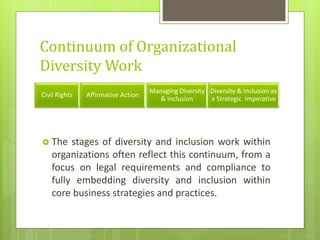
Continuum of Organizational
Diversity Work
Civil Rights Affirmative Action
Managing Diversity
& Inclusion
Diversity & Inclusion as
a Strategic Imperative
 The stages of diversity and inclusion work within
organizations often reflect this continuum, from a
focus on legal requirements and compliance to
fully embedding diversity and inclusion within
core business strategies and practices.
Civil Rights
 The Civil Rights era focused on formally addressing the
historic discrimination that had legally denied minorities full
rights of citizenship. Laws were designed to ensure equal
treatment to women and racial minorities by protecting
people from discrimination in education, employment,
housing, and other opportunities based on race, color,
national origin, religion, or gender. The laws, primarily Title
VII of the Civil Rights Act of 1964, the Equal Pay Act of 1963,
and the Age Discrimination in Employment Act of 1967,
were created to level the playing field for all. Additional laws
were enacted in subsequent years to expand civil rights
protections—Sections 501 and 505 of the Rehabilitation Act
of 1973, Title I and Title V of the American Disabilities Act of
1990, and the Civil Rights Act of 1991.
Affirmative Action
 Affirmative Action began in the 1970s as a strategy to recruit
and hire a more diverse workforce. Focused primarily on
representation, Affirmative Action policies were intended to
address past discrimination by giving preferential treatment to
specified underrepresented groups in the workplace. The
objective was to make the employer’s workforce more
representative of the general population in its geographic area.
There are strong opinions both for and against Affirmative
Action. Those against Affirmative Action often argue that such
policies result in reverse discrimination and in hiring
unqualified and under qualified candidates. Proponents, on the
other hand, often argue diverse candidates will not have equal
access to opportunities unless organizations mandate their
recruitment.
The Four Stages of Diversity &
Inclusion
 The first step in growing your company’s commitment
to diversity & inclusion (D&I) is to assess where it now
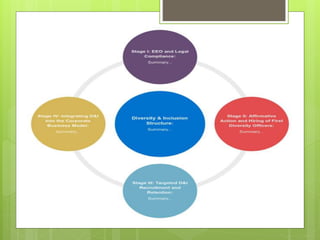
stands. Most diversity & inclusion strategies in
corporate America reside in one of four common
stages of evolution, from working to meet EEO and
legal requirements to integrating diversity philosophy
into the business mission of the company.
 What stage best defines your organization?
Stage I: EEO and Legal Compliance
 Diversity & inclusion initiatives, once unheard of in
corporate America, have come a long way to become a
central part of the critical business function. The early
corporate emphasis was on equal employment, legal
mandates, and reporting to the Equal Employment
Opportunity Commission (EEOC).
 Original diversity initiatives were reactive because they
aimed to prevent discrimination and litigation. Today’s
diversity & inclusion initiatives must be proactive and
viewed as a business imperative by company
leadership—a core function that fuels a company’s
competitive edge.
Stage II: Affirmative Action and
Hiring of First Diversity Officers
 In this stage, Affirmative Action becomes a serious
goal. Companies begin to name diversity officers
and spend money on scholarships and community
activities to support a growing minority workforce.
For these companies, such diversity & inclusion
initiatives follow closely with community relations
and corporate philanthropy, yet only under Stage
IV do we witness a sophisticated approach to
community and philanthropy.
Stage III: Targeted D&I
Recruitment and Retention
 In stage three, diversity & inclusion becomes a
recruitment and retention tool, helping human
resources seek out the best and brightest
employees from all backgrounds. Companies tout
diversity and inclusion as a workforce imperative,
building their companies as microcosms of an
ever-diversifying world. For many, this emphasis
proves vital to match the workforce changes with
those of the marketplace.
Stage IV: Integrating D&I Into the
Corporate Business Model
 Functional integration with recruitment, retention, and work/life, along
with the other key functions—such as customer and marketplace,
community outreach, corporate philanthropy, government relations,
marketing, and supplier diversity—allow companies and organizations
to make diversity & inclusion central to their brand, business practices,
and culture. Diversity and inclusion is managed in a far more strategic
way, typically including the measurement of the entire process and of
specific D&I components. In this stage, the CEO and Board of Directors
lend support and endorsement, of which the most important is the
recognition that diversity and inclusion increases revenue while
decreasing costs and is a competitive advantage. Diversity and
inclusion is a management imperative of company leadership and well-
articulated in every aspect of the organization and companies establish
employee resource groups to unite different groups of employees and
diversity councils to help guide the company’s diversity and inclusion
efforts.
Managing Diversity and Inclusion
 Due in part to the gains of Affirmative Action, organizations increased the diversity of
their workforce; however, this success revealed the natural tension and challenges
that often accompany such change. Two phenomena often accompanied the more
representative workplace environment: The “revolving door” syndrome, with newly
recruited underrepresented employees not staying with their employers very long;
and second, people neither working well together, nor trusting each other across
cultural lines.
 To address the problems that accompanied the new workplace, organizations began
to offer D&I training with the expectation that if employees could better understand,
become more aware, and more sensitive to others, they could get along better. Such
training yielded limited success but led to the concept of Managing Diversity, a main
goal of which is to enable and tap into the potential of all employees. Organizations
began to develop and implement strategies for organizational change—change that
would produce a more inclusive culture. This concept was a multifaceted approach
that addressed both individual and organizational responsibilities for building inclusive
environments. New systems, procedures, and training to enhance, support, and
encourage opportunities for previously underrepresented groups were recognized as
essential to organizational success. It is also in this stage that the Chief Diversity
Officer role began to be recognized as a major value-add for organizational success.
Diversity and Inclusion as Strategic
Imperative
 Organizations that recognize that diversity and inclusion is
critical to their long-term business success have begun to
adopt strategic initiatives that are aligned with and central
to overall organizational goals. Chief Diversity Officers often
have a seat at the strategy table, holding individual
managers and senior leaders accountable for achieving
diversity and inclusion objectives. These organizations are at
the forefront of developing best practices and are using a
growing body of research on topics, ranging from the
efficacy of diversity and inclusion training to implicit bias to
micro-messaging, to inform their business practices.
 Questions for Reflection:
1. How deep is your knowledge/involvement in the
evolution of diversity and inclusion work?
2. How has your organization historically addressed
diversity and inclusion throughout the decades?
3. Where do you want the organization to be in 2020,
2050, and beyond?
4. What policies/practices currently exist at your
organization to support diversity and inclusion?
5. What steps can you take to help your organization
move forward on the diversity and inclusion
continuum?
Corporate Examples: Diversity
Website Statements
 Abbott Laboratories
Simply defined, diversity recognizes similarities and
differences. Inclusion builds a foundation where employees
can reach their full potential by embracing concepts such as
awareness, acceptance, respect and understanding. Our goal is
to create an inclusive culture at Abbott that enables all
employees to contribute to our company’s success and to
develop their talents, strengths, and careers. Diversity and
Inclusion are more than just beliefs; they are priorities. With
approximately 70,000 employees in more than 130 countries,
we place a premium on having a high–performing employee
population that reflects the customers and markets we serve.
 Dell
At Dell we characterize Global Diversity by similarities and
differences, defining it more broadly than just race, gender and
ethnicity. It’s about diversity of thinking, leadership, skill set
and style. And by harnessing our differences in pursuit of
common business goals, our teams can bring about innovation
and new ways of achieving objectives. Diversity represents a
way of doing business that is barrier-free and all-inclusive,
allowing the unique ideas, experiences, cultures and
backgrounds of all our people to come together for creating
the most innovative products and best customer experience.
Our diversity is global in its inclusion and respect for the many
different people and cultures we encounter everyday
throughout the many countries in which we do business
worldwide.
 Eastman Kodak Company
Diversity at Eastman Kodak Company refers to the
degree and depth of richness represented by the
population of people supporting Kodak, along the
dimensions of civilization orientation, national
identification, organizational factors, societal
formation, individual identification, and
personality/style. Inclusion is the search for value
and full, effective utilization of the richness of
Kodak’s human capital. Human capital includes
Kodak’s board of directors, customers, employees,
and external business alliances.
 Exelon Corporation
Diversity at Exelon is the many distinct characteristics
that employees, suppliers and customers bring to our
organization. These include race/ethnicity/national
origin, gender, age, sexual orientation, socio-economic
background, physical abilities, religion, and other
differences that create an inclusive environment. And
with these distinct characteristics come variations of
thinking, communications styles, skill and behaviors—all
of which enable us to achieve our business goals, gain
competitive advantage and support our business values.
 Hewlett-Packard
Diversity is the existence of many unique individuals in
the workplace, marketplace and community. This
includes men and women from different nations,
cultures, ethnic groups, generations, backgrounds, skills,
abilities and all the other unique differences that make
each of us who we are.
Inclusion means a work environment where everyone
has an opportunity to fully participate in creating
business success and where each person is valued for his
or her distinctive skills, experiences and perspectives.
Inclusion is also about creating a global community
where HP connects everyone and everything through our
products, services and our winning workforce.
 Johnson & Johnson
Across the Johnson & Johnson Family of Companies,
global diversity is defined as a variety of similar and
different characteristics among people including
age, gender, race, religion, national origin, physical
ability, sexual orientation, thinking style, background
and all other attributes that make each person
unique.
 Target Corporation
At Target, diversity is defined inclusively as
individuality. This individuality may include a wide
spectrum of attributes such as personal style, age,
race, gender, ethnicity, sexual orientation, gender
identity or expression, language, physical ability,
religion, family, citizenship status, socioeconomic
circumstances, education and life experiences. To us,
diversity is any attribute that makes an individual
unique that does not interfere with effective job
performance.
 The Coca-Cola Company
The Coca-Cola Company strives for an inclusive culture that is
defined by our seven core values: leadership, passion, integrity,
collaboration, innovation, quality, and accountability. Each day
we work to bring these values to life through our diversity
workplace strategy. This strategy includes programs to attract,
retain, and develop diverse talent; provide support systems for
groups with diverse backgrounds; and educate all associates so
that we master the skills to achieve sustainable growth.
Coca-Cola defines diversity as: respecting individuals, valuing
differences, and representing our consumers and the markets
where we do business. Our diversity strategy is centered on
the 4Cs: a focus on driving consumption, fostering
commitment, building a culture that values diverse
perspectives, and promoting effective communication and
mutual understanding.
Case Study: Accenture
 Since its inception, Accenture has been governed by its core values—
Stewardship, Best People, Client Value Creation, One Global Network,
Respect for the Individual, and Integrity—which are at the heart of
everything the company does. As Accenture’s business grows to develop
and cultivate workforces across 49 countries, effective collaboration
demands understanding the culture and character of the company.
 Accenture engages its senior leadership to teach diversity’s advantages
when it hosts “Leading a Diverse Workforce” workshops, and the company
helps its people around the world learn to work and team effectively within
the organization and with clients through courses such as “Building Cross
Cultural Awareness.” Whether Accenture professionals are working with a
small team or managing a large project involving delivery centers and
outsourcing businesses across the globe, such training illustrates the value
of connecting divergent styles so the company can deliver professional
services in concert.
 Accenture sponsors programs that encourage understanding and tolerance
of race, age, gender, sexual orientation, and faith. Accenture is engaged in
the recruitment, retention, and advancement of professionals who are
focused on high performance.
 Employee Network Groups
Accenture runs 13 network groups for employees available in each of the
countries in which the company operates. Groups meet regularly, participating
in talks and social visits covering diverse areas that include age, gender,
sexuality, race, and faith.
 Accenture Mentors Minority College Students
In 2004, Accenture piloted Commitment to Empower Successful Students, a
program designed to mentor minority college students. Participants in the first-
year pilot program included sophomores from Penn State, Purdue University,
Stanford University, University of Michigan, and University of Texas. Students
selected to participate are pursuing a technical or business major and
demonstrated at least a 3.0 GPA and a clear and concise writing style.
As part of this three-year program, students shadowed Accenture employees,
attended networking lunches to help establish mentoring relationships, and
participated in Accenture’s Student Leadership Conference the summer after
their second mentoring year. Through this program, Accenture helped
participants gain valuable exposure to the business world, explore the
consulting career path, and understand what companies are looking for when
hiring.
 Accenture International Women’s Day 2009
In March 2009, Accenture sponsored its fifth annual celebration of
International Women’s Day—a day designated by the United Nations to
recognize women’s contributions to the world’s economy. This year,
Accenture’s celebration included live events for employees and clients in more
than 100 locations in 29 countries, as well as an online event for Accenture’s
more than 186,000 employees around the world.
Accenture’s theme last year, Stretch Yourself, focused on ways to manage your
career and know when it’s time to seek more challenging work roles. In
conjunction with International Women’s Day, Accenture also published original
research that looks at the ways in which women around the world challenge
themselves at work—and the opportunities they have to use “stretch” roles to
succeed.
 Training and Development
At Accenture, training and development is taken very seriously. In fact, the
company even wrote a book on it. Return on Learning, published in 2007, tells
the story of how Accenture reignited learning for a whole new generation of
Accenture people, including its award-winning study demonstrating the return
the company makes on its learning investment. Every employee’s Accenture
Education experience begins the first day he or she walks through the door and
continues throughout his or her career.
 New Joiner Orientation and Core Curriculum
Soon after joining Accenture, employees attend New Joiner Orientation. This
multiday class experience gives new hires the essential knowledge they need to
launch their Accenture careers, whether they are straight out of university or a
workforce veteran. Since New Joiner Orientation is a world-wide program, it
serves as employees’ introduction to Accenture’s one global network. But since it
is conducted near employees’ homes, they also get location-specific information.
New Joiner Orientation is just the first element of the Accenture Education
curriculum. The curriculum is the set of courses and learning experiences that
employees complete to receive the basic, foundational knowledge they need to
succeed at each level of their careers. Employees join with colleagues from all
over the world, either virtually or live, to collaborate and learn together.
 One Global Network… for Learning
“One Global Network” is one of Accenture’s core values, and this plays out fully in
the way the company’s employees learn. Many Accenture people attend core
training courses at the Q Center, outside of Chicago, Illinois, or at one of the
regional training centers near London, England and Kuala Lumpur, Malaysia. At
these locations, Accenture people from around the world gather to learn from
each other, collaborate, and build professional relationships that can last for a
career. Other classroom-based courses are held at regional locations around the
world.
But at Accenture, learning does not stop when employees walk out of the
classroom. Accenture’s single global learning portal, my Learning, directs
employees to over 20,000 online courses, virtual classroom courses, and other
learning resources to meet almost any business need. Furthermore, Accenture
offers specialized training to employees in their Consulting, Enterprise,
Services, and Accenture Technology Solutions divisions.
 Accenture’s Commitment to Training
A recent research study shows that for every hour of training Accenture’s
competitors give their people, Accenture employees receive two hours, at half
the cost per hour. Specifically, the company’s $900 million investment in
training resulted in an average of 75 training hours per person, for a total of
more than 12 million hours of training delivered.
In fact, Accenture is setting the standard for learning at work. Accenture
Education programs have been recognized and honored around the business
world, winning prestigious awards such as the CLO Magazine Gold Award for
Leading Business Change, the Most Admired Knowledge Enterprise (MAKE)
award from the Knowledge Network, and multiple Brandon Hall Excellence in
eLearning awards.
 The Future of Learning
As excited as the company is about the Accenture Education experience, it
understands there is always room to improve. Accenture continually reviews
and revises its learning products, ensuring they are up-to-date with the latest
ideas, information, and needs of the marketplace.
Beyond just the content, the company is recreating the way that Accenture
people learn. Accenture’s Center for Learning Innovation is a group of key
learning leaders that is continually developing, testing, and implementing new
ways for Accenture people to learn. From training on mobile devices to
interactive conversations that feel more like a video game than a training
course, the company’s focus on innovation guarantees that Accenture people
will always be on the leading edge of learning.
Case Study: Cisco Systems Inc.
 Vision and Strategy
Cisco’s commitment to inclusion and diversity (I&D)
makes it a better company, a better global
competitor, and a better corporate citizen. By fully
embracing the human network in all its multiplicity,
Cisco fosters innovation and talent in the workplace
and engages more effectively with its customers and
partners in the worldwide marketplace.
Cisco is executing on its commitment to I&D by:
• Sponsoring I&D initiatives and providing visibility at the
executive level
• Forming the Global Inclusion and Diversity Council in
2007
• Building diversity into the recruiting and hiring process
• Providing mandatory manager and employee training in
diversity and actively promoting a culture of inclusion
• Implementing tools and processes to develop I&D
awareness, manage a diverse and often virtual
workforce, and promote behavior change
• Providing supplemental development opportunities to
diverse populations
Cisco formed the Global Inclusion and Diversity Council in 2007 to
integrate Inclusion & Diversity (I&D) into its business processes
and operations at all levels. The council is led by the Senior Vice
President of Human Resources Brian Schipper and supported by
sponsors at the executive level, reporting directly to Cisco’s
operating committee.
The role of the council includes:
• Developing the I&D vision, strategy, and execution plan
• Chartering new Employee Resource Groups; in 2008 it chartered
the Cisco Disability Awareness Network, Service Member Veterans
and Family Support Group, and Cisco Legacy Leaders
• Advocating policies that support an inclusive environment
• Coauthoring a new inclusion index for the Cisco Employee
Satisfaction Survey
• Implementing metrics for measuring the impact of I&D
initiatives
Council members also serve as executive sponsors for major diversity
programs and are key communicators of the diversity message.
Another important way that Cisco cultivates I&D is through employee
resource groups (ERGs). These employee-driven, company-supported
affinity groups enable Cisco employees to connect with others who
share a similar culture, identity, interest, or career goal. Open to
employees around the world, ERGs provide social networking and
professional-development support, while also offering opportunities
to participate in recruiting, mentoring, and community outreach.
 Recent I&D Achievements
Here are some examples of Cisco’s inclusion and diversity
achievements:
• The latest Pulse Survey results indicated progress in Cisco’s
efforts to narrow the gender gap across all business areas. The
survey shows that Cisco women’s job satisfaction rate has
increased relative to men’s and that there has been an
increase in female employee satisfaction in all the survey
categories.
• Cisco has virtually eliminated the gender gap in the
company’s voluntary attrition rate.
• I&D goals were added to the employee annual performance
review form, encouraging employees to find out how they can
contribute to a diverse and inclusive culture.
• Cisco now provides a resource guide for Cisco employers in
the Asia Pacific region that covers disability issues. The guide
includes a listing of regional disability-oriented organizations
and websites, as well as policy examples and case studies.

An Overview - Diversity & Inclusion

  • 1.
    Diversity & Inclusion AnOverview Diversity: the art of thinking independently together. - Malcolm Forbes
  • 2.
    In corporate America,a common mission, vision, and purpose in thought and action across all levels of an organization is of the utmost importance to bottom line success, but at the same time, so is the celebration, validation, and respect of each individual and the unique attributes he or she brings to the table. Effectively combining these two fundamental areas requires diligence, understanding, and trust from all parties, and one way organizations are attempting to bridge the gap is through diversity and inclusion initiatives. But before an organization can make true progress in this regard, people across all levels of the organization must understand and believe in the company’s definitions of diversity and inclusion. Diversity and inclusion is not a buzz word but a business imperative tied directly to the business case of the best companies in America and around the globe. In best practice companies, diversity and inclusion is not only viewed as an asset to the organization and employees, it is a necessity. As corporations look to build their bottom lines through increased employee engagement, robust recruitment and retention initiatives, and insightful marketing plans, diversity and inclusion will continue to rise to the fore as essential for growth and achievement.
  • 3.
    Diversity & InclusionStructure  The diversity and inclusion (D&I) field has experienced exponential growth over the past decade. Fueled by tremendous demographic, economic, political and social realities, and marketplace demand, more and more organizations are recognizing that their future success is inextricably tied to their ability to tap into this new workforce and customer base.  While most companies today recognize the critical importance of diversity and inclusion to their competitiveness, there are various stages of evolution to diversity and inclusion work. Therefore, it is important to understand the history of D&I work in the United States, in order to articulate what D&I and cultural competence mean in the present day and in the future for organizational success.
  • 4.
    Continuum of Organizational DiversityWork Civil Rights Affirmative Action Managing Diversity & Inclusion Diversity & Inclusion as a Strategic Imperative  The stages of diversity and inclusion work within organizations often reflect this continuum, from a focus on legal requirements and compliance to fully embedding diversity and inclusion within core business strategies and practices.
  • 5.
    Civil Rights  TheCivil Rights era focused on formally addressing the historic discrimination that had legally denied minorities full rights of citizenship. Laws were designed to ensure equal treatment to women and racial minorities by protecting people from discrimination in education, employment, housing, and other opportunities based on race, color, national origin, religion, or gender. The laws, primarily Title VII of the Civil Rights Act of 1964, the Equal Pay Act of 1963, and the Age Discrimination in Employment Act of 1967, were created to level the playing field for all. Additional laws were enacted in subsequent years to expand civil rights protections—Sections 501 and 505 of the Rehabilitation Act of 1973, Title I and Title V of the American Disabilities Act of 1990, and the Civil Rights Act of 1991.
  • 6.
    Affirmative Action  AffirmativeAction began in the 1970s as a strategy to recruit and hire a more diverse workforce. Focused primarily on representation, Affirmative Action policies were intended to address past discrimination by giving preferential treatment to specified underrepresented groups in the workplace. The objective was to make the employer’s workforce more representative of the general population in its geographic area. There are strong opinions both for and against Affirmative Action. Those against Affirmative Action often argue that such policies result in reverse discrimination and in hiring unqualified and under qualified candidates. Proponents, on the other hand, often argue diverse candidates will not have equal access to opportunities unless organizations mandate their recruitment.
  • 7.
    The Four Stagesof Diversity & Inclusion  The first step in growing your company’s commitment to diversity & inclusion (D&I) is to assess where it now stands. Most diversity & inclusion strategies in corporate America reside in one of four common stages of evolution, from working to meet EEO and legal requirements to integrating diversity philosophy into the business mission of the company.  What stage best defines your organization?
  • 9.
    Stage I: EEOand Legal Compliance  Diversity & inclusion initiatives, once unheard of in corporate America, have come a long way to become a central part of the critical business function. The early corporate emphasis was on equal employment, legal mandates, and reporting to the Equal Employment Opportunity Commission (EEOC).  Original diversity initiatives were reactive because they aimed to prevent discrimination and litigation. Today’s diversity & inclusion initiatives must be proactive and viewed as a business imperative by company leadership—a core function that fuels a company’s competitive edge.
  • 10.
    Stage II: AffirmativeAction and Hiring of First Diversity Officers  In this stage, Affirmative Action becomes a serious goal. Companies begin to name diversity officers and spend money on scholarships and community activities to support a growing minority workforce. For these companies, such diversity & inclusion initiatives follow closely with community relations and corporate philanthropy, yet only under Stage IV do we witness a sophisticated approach to community and philanthropy.
  • 11.
    Stage III: TargetedD&I Recruitment and Retention  In stage three, diversity & inclusion becomes a recruitment and retention tool, helping human resources seek out the best and brightest employees from all backgrounds. Companies tout diversity and inclusion as a workforce imperative, building their companies as microcosms of an ever-diversifying world. For many, this emphasis proves vital to match the workforce changes with those of the marketplace.
  • 12.
    Stage IV: IntegratingD&I Into the Corporate Business Model  Functional integration with recruitment, retention, and work/life, along with the other key functions—such as customer and marketplace, community outreach, corporate philanthropy, government relations, marketing, and supplier diversity—allow companies and organizations to make diversity & inclusion central to their brand, business practices, and culture. Diversity and inclusion is managed in a far more strategic way, typically including the measurement of the entire process and of specific D&I components. In this stage, the CEO and Board of Directors lend support and endorsement, of which the most important is the recognition that diversity and inclusion increases revenue while decreasing costs and is a competitive advantage. Diversity and inclusion is a management imperative of company leadership and well- articulated in every aspect of the organization and companies establish employee resource groups to unite different groups of employees and diversity councils to help guide the company’s diversity and inclusion efforts.
  • 13.
    Managing Diversity andInclusion  Due in part to the gains of Affirmative Action, organizations increased the diversity of their workforce; however, this success revealed the natural tension and challenges that often accompany such change. Two phenomena often accompanied the more representative workplace environment: The “revolving door” syndrome, with newly recruited underrepresented employees not staying with their employers very long; and second, people neither working well together, nor trusting each other across cultural lines.  To address the problems that accompanied the new workplace, organizations began to offer D&I training with the expectation that if employees could better understand, become more aware, and more sensitive to others, they could get along better. Such training yielded limited success but led to the concept of Managing Diversity, a main goal of which is to enable and tap into the potential of all employees. Organizations began to develop and implement strategies for organizational change—change that would produce a more inclusive culture. This concept was a multifaceted approach that addressed both individual and organizational responsibilities for building inclusive environments. New systems, procedures, and training to enhance, support, and encourage opportunities for previously underrepresented groups were recognized as essential to organizational success. It is also in this stage that the Chief Diversity Officer role began to be recognized as a major value-add for organizational success.
  • 14.
    Diversity and Inclusionas Strategic Imperative  Organizations that recognize that diversity and inclusion is critical to their long-term business success have begun to adopt strategic initiatives that are aligned with and central to overall organizational goals. Chief Diversity Officers often have a seat at the strategy table, holding individual managers and senior leaders accountable for achieving diversity and inclusion objectives. These organizations are at the forefront of developing best practices and are using a growing body of research on topics, ranging from the efficacy of diversity and inclusion training to implicit bias to micro-messaging, to inform their business practices.
  • 15.
     Questions forReflection: 1. How deep is your knowledge/involvement in the evolution of diversity and inclusion work? 2. How has your organization historically addressed diversity and inclusion throughout the decades? 3. Where do you want the organization to be in 2020, 2050, and beyond? 4. What policies/practices currently exist at your organization to support diversity and inclusion? 5. What steps can you take to help your organization move forward on the diversity and inclusion continuum?
  • 16.
    Corporate Examples: Diversity WebsiteStatements  Abbott Laboratories Simply defined, diversity recognizes similarities and differences. Inclusion builds a foundation where employees can reach their full potential by embracing concepts such as awareness, acceptance, respect and understanding. Our goal is to create an inclusive culture at Abbott that enables all employees to contribute to our company’s success and to develop their talents, strengths, and careers. Diversity and Inclusion are more than just beliefs; they are priorities. With approximately 70,000 employees in more than 130 countries, we place a premium on having a high–performing employee population that reflects the customers and markets we serve.
  • 17.
     Dell At Dellwe characterize Global Diversity by similarities and differences, defining it more broadly than just race, gender and ethnicity. It’s about diversity of thinking, leadership, skill set and style. And by harnessing our differences in pursuit of common business goals, our teams can bring about innovation and new ways of achieving objectives. Diversity represents a way of doing business that is barrier-free and all-inclusive, allowing the unique ideas, experiences, cultures and backgrounds of all our people to come together for creating the most innovative products and best customer experience. Our diversity is global in its inclusion and respect for the many different people and cultures we encounter everyday throughout the many countries in which we do business worldwide.
  • 18.
     Eastman KodakCompany Diversity at Eastman Kodak Company refers to the degree and depth of richness represented by the population of people supporting Kodak, along the dimensions of civilization orientation, national identification, organizational factors, societal formation, individual identification, and personality/style. Inclusion is the search for value and full, effective utilization of the richness of Kodak’s human capital. Human capital includes Kodak’s board of directors, customers, employees, and external business alliances.
  • 19.
     Exelon Corporation Diversityat Exelon is the many distinct characteristics that employees, suppliers and customers bring to our organization. These include race/ethnicity/national origin, gender, age, sexual orientation, socio-economic background, physical abilities, religion, and other differences that create an inclusive environment. And with these distinct characteristics come variations of thinking, communications styles, skill and behaviors—all of which enable us to achieve our business goals, gain competitive advantage and support our business values.
  • 20.
     Hewlett-Packard Diversity isthe existence of many unique individuals in the workplace, marketplace and community. This includes men and women from different nations, cultures, ethnic groups, generations, backgrounds, skills, abilities and all the other unique differences that make each of us who we are. Inclusion means a work environment where everyone has an opportunity to fully participate in creating business success and where each person is valued for his or her distinctive skills, experiences and perspectives. Inclusion is also about creating a global community where HP connects everyone and everything through our products, services and our winning workforce.
  • 21.
     Johnson &Johnson Across the Johnson & Johnson Family of Companies, global diversity is defined as a variety of similar and different characteristics among people including age, gender, race, religion, national origin, physical ability, sexual orientation, thinking style, background and all other attributes that make each person unique.
  • 22.
     Target Corporation AtTarget, diversity is defined inclusively as individuality. This individuality may include a wide spectrum of attributes such as personal style, age, race, gender, ethnicity, sexual orientation, gender identity or expression, language, physical ability, religion, family, citizenship status, socioeconomic circumstances, education and life experiences. To us, diversity is any attribute that makes an individual unique that does not interfere with effective job performance.
  • 23.
     The Coca-ColaCompany The Coca-Cola Company strives for an inclusive culture that is defined by our seven core values: leadership, passion, integrity, collaboration, innovation, quality, and accountability. Each day we work to bring these values to life through our diversity workplace strategy. This strategy includes programs to attract, retain, and develop diverse talent; provide support systems for groups with diverse backgrounds; and educate all associates so that we master the skills to achieve sustainable growth. Coca-Cola defines diversity as: respecting individuals, valuing differences, and representing our consumers and the markets where we do business. Our diversity strategy is centered on the 4Cs: a focus on driving consumption, fostering commitment, building a culture that values diverse perspectives, and promoting effective communication and mutual understanding.
  • 24.
    Case Study: Accenture Since its inception, Accenture has been governed by its core values— Stewardship, Best People, Client Value Creation, One Global Network, Respect for the Individual, and Integrity—which are at the heart of everything the company does. As Accenture’s business grows to develop and cultivate workforces across 49 countries, effective collaboration demands understanding the culture and character of the company.  Accenture engages its senior leadership to teach diversity’s advantages when it hosts “Leading a Diverse Workforce” workshops, and the company helps its people around the world learn to work and team effectively within the organization and with clients through courses such as “Building Cross Cultural Awareness.” Whether Accenture professionals are working with a small team or managing a large project involving delivery centers and outsourcing businesses across the globe, such training illustrates the value of connecting divergent styles so the company can deliver professional services in concert.  Accenture sponsors programs that encourage understanding and tolerance of race, age, gender, sexual orientation, and faith. Accenture is engaged in the recruitment, retention, and advancement of professionals who are focused on high performance.
  • 25.
     Employee NetworkGroups Accenture runs 13 network groups for employees available in each of the countries in which the company operates. Groups meet regularly, participating in talks and social visits covering diverse areas that include age, gender, sexuality, race, and faith.  Accenture Mentors Minority College Students In 2004, Accenture piloted Commitment to Empower Successful Students, a program designed to mentor minority college students. Participants in the first- year pilot program included sophomores from Penn State, Purdue University, Stanford University, University of Michigan, and University of Texas. Students selected to participate are pursuing a technical or business major and demonstrated at least a 3.0 GPA and a clear and concise writing style. As part of this three-year program, students shadowed Accenture employees, attended networking lunches to help establish mentoring relationships, and participated in Accenture’s Student Leadership Conference the summer after their second mentoring year. Through this program, Accenture helped participants gain valuable exposure to the business world, explore the consulting career path, and understand what companies are looking for when hiring.
  • 26.
     Accenture InternationalWomen’s Day 2009 In March 2009, Accenture sponsored its fifth annual celebration of International Women’s Day—a day designated by the United Nations to recognize women’s contributions to the world’s economy. This year, Accenture’s celebration included live events for employees and clients in more than 100 locations in 29 countries, as well as an online event for Accenture’s more than 186,000 employees around the world. Accenture’s theme last year, Stretch Yourself, focused on ways to manage your career and know when it’s time to seek more challenging work roles. In conjunction with International Women’s Day, Accenture also published original research that looks at the ways in which women around the world challenge themselves at work—and the opportunities they have to use “stretch” roles to succeed.  Training and Development At Accenture, training and development is taken very seriously. In fact, the company even wrote a book on it. Return on Learning, published in 2007, tells the story of how Accenture reignited learning for a whole new generation of Accenture people, including its award-winning study demonstrating the return the company makes on its learning investment. Every employee’s Accenture Education experience begins the first day he or she walks through the door and continues throughout his or her career.
  • 27.
     New JoinerOrientation and Core Curriculum Soon after joining Accenture, employees attend New Joiner Orientation. This multiday class experience gives new hires the essential knowledge they need to launch their Accenture careers, whether they are straight out of university or a workforce veteran. Since New Joiner Orientation is a world-wide program, it serves as employees’ introduction to Accenture’s one global network. But since it is conducted near employees’ homes, they also get location-specific information. New Joiner Orientation is just the first element of the Accenture Education curriculum. The curriculum is the set of courses and learning experiences that employees complete to receive the basic, foundational knowledge they need to succeed at each level of their careers. Employees join with colleagues from all over the world, either virtually or live, to collaborate and learn together.  One Global Network… for Learning “One Global Network” is one of Accenture’s core values, and this plays out fully in the way the company’s employees learn. Many Accenture people attend core training courses at the Q Center, outside of Chicago, Illinois, or at one of the regional training centers near London, England and Kuala Lumpur, Malaysia. At these locations, Accenture people from around the world gather to learn from each other, collaborate, and build professional relationships that can last for a career. Other classroom-based courses are held at regional locations around the world.
  • 28.
    But at Accenture,learning does not stop when employees walk out of the classroom. Accenture’s single global learning portal, my Learning, directs employees to over 20,000 online courses, virtual classroom courses, and other learning resources to meet almost any business need. Furthermore, Accenture offers specialized training to employees in their Consulting, Enterprise, Services, and Accenture Technology Solutions divisions.  Accenture’s Commitment to Training A recent research study shows that for every hour of training Accenture’s competitors give their people, Accenture employees receive two hours, at half the cost per hour. Specifically, the company’s $900 million investment in training resulted in an average of 75 training hours per person, for a total of more than 12 million hours of training delivered. In fact, Accenture is setting the standard for learning at work. Accenture Education programs have been recognized and honored around the business world, winning prestigious awards such as the CLO Magazine Gold Award for Leading Business Change, the Most Admired Knowledge Enterprise (MAKE) award from the Knowledge Network, and multiple Brandon Hall Excellence in eLearning awards.
  • 29.
     The Futureof Learning As excited as the company is about the Accenture Education experience, it understands there is always room to improve. Accenture continually reviews and revises its learning products, ensuring they are up-to-date with the latest ideas, information, and needs of the marketplace. Beyond just the content, the company is recreating the way that Accenture people learn. Accenture’s Center for Learning Innovation is a group of key learning leaders that is continually developing, testing, and implementing new ways for Accenture people to learn. From training on mobile devices to interactive conversations that feel more like a video game than a training course, the company’s focus on innovation guarantees that Accenture people will always be on the leading edge of learning.
  • 30.
    Case Study: CiscoSystems Inc.  Vision and Strategy Cisco’s commitment to inclusion and diversity (I&D) makes it a better company, a better global competitor, and a better corporate citizen. By fully embracing the human network in all its multiplicity, Cisco fosters innovation and talent in the workplace and engages more effectively with its customers and partners in the worldwide marketplace.
  • 31.
    Cisco is executingon its commitment to I&D by: • Sponsoring I&D initiatives and providing visibility at the executive level • Forming the Global Inclusion and Diversity Council in 2007 • Building diversity into the recruiting and hiring process • Providing mandatory manager and employee training in diversity and actively promoting a culture of inclusion • Implementing tools and processes to develop I&D awareness, manage a diverse and often virtual workforce, and promote behavior change • Providing supplemental development opportunities to diverse populations
  • 32.
    Cisco formed theGlobal Inclusion and Diversity Council in 2007 to integrate Inclusion & Diversity (I&D) into its business processes and operations at all levels. The council is led by the Senior Vice President of Human Resources Brian Schipper and supported by sponsors at the executive level, reporting directly to Cisco’s operating committee. The role of the council includes: • Developing the I&D vision, strategy, and execution plan • Chartering new Employee Resource Groups; in 2008 it chartered the Cisco Disability Awareness Network, Service Member Veterans and Family Support Group, and Cisco Legacy Leaders • Advocating policies that support an inclusive environment • Coauthoring a new inclusion index for the Cisco Employee Satisfaction Survey • Implementing metrics for measuring the impact of I&D initiatives
  • 33.
    Council members alsoserve as executive sponsors for major diversity programs and are key communicators of the diversity message. Another important way that Cisco cultivates I&D is through employee resource groups (ERGs). These employee-driven, company-supported affinity groups enable Cisco employees to connect with others who share a similar culture, identity, interest, or career goal. Open to employees around the world, ERGs provide social networking and professional-development support, while also offering opportunities to participate in recruiting, mentoring, and community outreach.
  • 34.
     Recent I&DAchievements Here are some examples of Cisco’s inclusion and diversity achievements: • The latest Pulse Survey results indicated progress in Cisco’s efforts to narrow the gender gap across all business areas. The survey shows that Cisco women’s job satisfaction rate has increased relative to men’s and that there has been an increase in female employee satisfaction in all the survey categories. • Cisco has virtually eliminated the gender gap in the company’s voluntary attrition rate. • I&D goals were added to the employee annual performance review form, encouraging employees to find out how they can contribute to a diverse and inclusive culture. • Cisco now provides a resource guide for Cisco employers in the Asia Pacific region that covers disability issues. The guide includes a listing of regional disability-oriented organizations and websites, as well as policy examples and case studies.