
Done by V.Santhosh, Law Student, VIT University Chennai
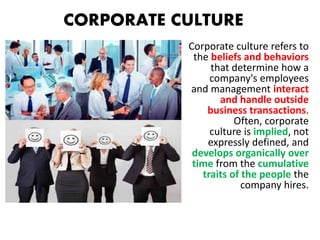
Corporate culture refers to
the beliefs and behaviors
that determine how a
company's employees
and management interact
and handle outside
business transactions.
Often, corporate
culture is implied, not
expressly defined, and
develops organically over
time from the cumulative
traits of the people the
company hires.
CORPORATE CULTURE
Corporate culture is shaped by
 How people dress
 How people act
 How people conduct work
 How people interact with supervisors
 How people interact across departments
 How people interact with public
 How business gets done
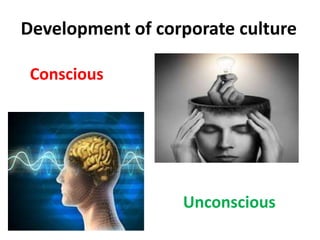
Development of corporate culture
Unconscious
Conscious
Types of corporate culture
1) Team-first Corporate Culture
2) Elite Corporate Culture
3) Horizontal Corporate Culture
4) Conventional Corporate Culture
5) Progressive Corporate Culture
TEAM FIRST CORPORATE CULTURE
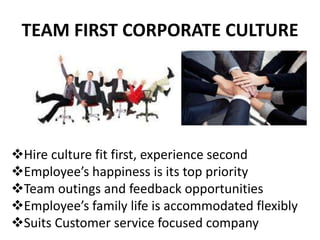
Hire culture fit first, experience second
Employee’s happiness is its top priority
Team outings and feedback opportunities
Employee’s family life is accommodated flexibly
Suits Customer service focused company
TEAM FIRST CORPORATE CULTURE
Employees are friends with people in other dept
Regularly socializing outside of work
Receiving thoughtful feedback from employees
People take pride in their workstations
Larger the company tougher to implement
TEAM FIRST CORPORATE CULTURE
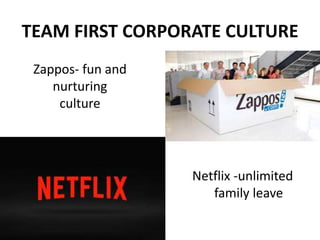
Netflix -unlimited
family leave
Zappos- fun and
nurturing
culture
ELITE CORPORATE CULTURE
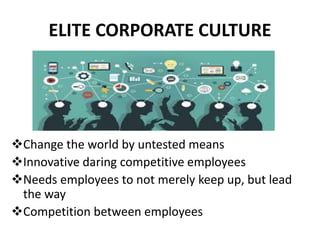
Change the world by untested means
Innovative daring competitive employees
Needs employees to not merely keep up, but lead
the way
Competition between employees
Employees aren’t afraid to question things
that could be improved
Employees make work their top priority, often
working long hours
Top talent moves up the ranks quickly
Highly qualified job applicants to choose from
ELITE CORPORATE CULTURE
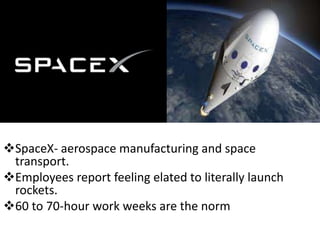
SpaceX- aerospace manufacturing and space
transport.
Employees report feeling elated to literally launch
rockets.
60 to 70-hour work weeks are the norm
HORIZONTAL CORPORATE CULTURE
Startups
More flexible and able to change based on
market research or customer feedback
Lack of direction and accountability
Teammates discuss new product ideas in the
break room
Everybody does a little bit of everything
The CEO makes his or her own coffee
You still have to prove your product’s worth to
critics
HORIZONTAL CORPORATE CULTURE
Basecamp maintains a startup-like mindset.
Basecamp announced that it would focus
exclusively on its most popular product and
maintain its relative small size rather than grow
into something much bigger and broader.
HORIZONTAL CORPORATE CULTURE
There are strict guidelines for most departments
and roles
People in different departments generally don’t
interact
Major decisions are left up to the CEO
CONVENTIONAL CORPORATE CULTURE
Clearly defined hierarchies
In the learning curve for communicating through
new mediums.
Cut-and-dry approach leaves little room for
inspiration or experimentation, which can result in a
lack of passion from employees for being
micromanaged.
Getting employees to understand the company’s
larger mission and putting more trust in employees
to work toward it can combat that.
 Founded in 1892, GE is about as traditional as they come.
 Recently, however, the company eliminated its traditional
performance review in favor of more frequent
conversations between managers and employees.
 GE is even launching an app to help facilitate feedback,
which shows that traditional doesn’t have to
mean stagnant.
CONVENTIONAL CORPORATE CULTURE
PROGRESSIVE CORPORATE CULTURE
Uncertainty is the definitive trait of a progressive
culture, because employees often don’t know
what to expect next
 It can instill fear in employees for obvious
reasons. Any change in management or
ownership even if it’s a good thing for the
company isn’t always a seen as a good thing.
Communication is crucial in easing these fears.
It’s also a good opportunity to hear feedback and
concerns from employees and keep top talent
engaged.
Employees talk openly about the competition and
possible buyouts
Company has a high turnover rate
Most of your funds come from advertisers, grants
or donations
Changes in the market are impacting your revenue
PROGRESSIVE CORPORATE CULTURE
 LinkedIn’s $1.5 billion
acquisition of Lynda.com is
one recent example of
companies in transition.
 Companies’ goals are in
alignment with one another,
and LinkedIn’s users benefit
from the partnership.
 By being straightforward and
showing how these changes
will ultimately lead to greater
benefits, both LinkedIn and
Lynda.com can thrive.
PROGRESSIVE CORPORATE CULTURE
Benefits of Strong Corporate Culture
Employee engagement
Customer loyalty
Financial growth
Hiring
Trust and transparency
Competitive advantage
Intangible asset
“You must adapt to the culture and not expect
the company to adapt to you.”
Thank you

Corporate culture ppt

  • 1.
    Done by V.Santhosh,Law Student, VIT University Chennai
  • 2.
    Corporate culture refersto the beliefs and behaviors that determine how a company's employees and management interact and handle outside business transactions. Often, corporate culture is implied, not expressly defined, and develops organically over time from the cumulative traits of the people the company hires. CORPORATE CULTURE
  • 3.
    Corporate culture isshaped by  How people dress  How people act  How people conduct work  How people interact with supervisors  How people interact across departments  How people interact with public  How business gets done
  • 4.
    Development of corporateculture Unconscious Conscious
  • 5.
    Types of corporateculture 1) Team-first Corporate Culture 2) Elite Corporate Culture 3) Horizontal Corporate Culture 4) Conventional Corporate Culture 5) Progressive Corporate Culture
  • 6.
    TEAM FIRST CORPORATECULTURE Hire culture fit first, experience second Employee’s happiness is its top priority Team outings and feedback opportunities Employee’s family life is accommodated flexibly Suits Customer service focused company
  • 7.
    TEAM FIRST CORPORATECULTURE Employees are friends with people in other dept Regularly socializing outside of work Receiving thoughtful feedback from employees People take pride in their workstations Larger the company tougher to implement
  • 8.
    TEAM FIRST CORPORATECULTURE Netflix -unlimited family leave Zappos- fun and nurturing culture
  • 9.
    ELITE CORPORATE CULTURE Changethe world by untested means Innovative daring competitive employees Needs employees to not merely keep up, but lead the way Competition between employees
  • 10.
    Employees aren’t afraidto question things that could be improved Employees make work their top priority, often working long hours Top talent moves up the ranks quickly Highly qualified job applicants to choose from ELITE CORPORATE CULTURE
  • 11.
    SpaceX- aerospace manufacturingand space transport. Employees report feeling elated to literally launch rockets. 60 to 70-hour work weeks are the norm
  • 12.
    HORIZONTAL CORPORATE CULTURE Startups Moreflexible and able to change based on market research or customer feedback Lack of direction and accountability
  • 13.
    Teammates discuss newproduct ideas in the break room Everybody does a little bit of everything The CEO makes his or her own coffee You still have to prove your product’s worth to critics HORIZONTAL CORPORATE CULTURE
  • 14.
    Basecamp maintains astartup-like mindset. Basecamp announced that it would focus exclusively on its most popular product and maintain its relative small size rather than grow into something much bigger and broader. HORIZONTAL CORPORATE CULTURE
  • 15.
    There are strictguidelines for most departments and roles People in different departments generally don’t interact Major decisions are left up to the CEO CONVENTIONAL CORPORATE CULTURE
  • 16.
    CONVENTIONAL CORPORATE CULTURE Clearlydefined hierarchies In the learning curve for communicating through new mediums. Cut-and-dry approach leaves little room for inspiration or experimentation, which can result in a lack of passion from employees for being micromanaged. Getting employees to understand the company’s larger mission and putting more trust in employees to work toward it can combat that.
  • 17.
     Founded in1892, GE is about as traditional as they come.  Recently, however, the company eliminated its traditional performance review in favor of more frequent conversations between managers and employees.  GE is even launching an app to help facilitate feedback, which shows that traditional doesn’t have to mean stagnant. CONVENTIONAL CORPORATE CULTURE
  • 18.
    PROGRESSIVE CORPORATE CULTURE Uncertaintyis the definitive trait of a progressive culture, because employees often don’t know what to expect next  It can instill fear in employees for obvious reasons. Any change in management or ownership even if it’s a good thing for the company isn’t always a seen as a good thing. Communication is crucial in easing these fears. It’s also a good opportunity to hear feedback and concerns from employees and keep top talent engaged.
  • 19.
    Employees talk openlyabout the competition and possible buyouts Company has a high turnover rate Most of your funds come from advertisers, grants or donations Changes in the market are impacting your revenue PROGRESSIVE CORPORATE CULTURE
  • 20.
     LinkedIn’s $1.5billion acquisition of Lynda.com is one recent example of companies in transition.  Companies’ goals are in alignment with one another, and LinkedIn’s users benefit from the partnership.  By being straightforward and showing how these changes will ultimately lead to greater benefits, both LinkedIn and Lynda.com can thrive. PROGRESSIVE CORPORATE CULTURE
  • 21.
    Benefits of StrongCorporate Culture Employee engagement Customer loyalty Financial growth Hiring Trust and transparency Competitive advantage Intangible asset
  • 22.
    “You must adaptto the culture and not expect the company to adapt to you.”
  • 23.

Editor's Notes

  • #3 UNDERLYING BELIEFS values and assumptions It reflects what companies considered important and what it considers unimportant
  • #5 Conscious : Steps taken to define intended culture Codified – mission vision and values Foundation for development of business strategy Employees know company‘ s expectation public knows what to expect from a company Un conscious: Develops based on actions, communications and values of senior leader or business founder Inconsistencies in the perception of employees and public with the perception of leader Reduced employee engagement
  • #9 You may have a team-first culture if: Employees are friends with people in other departments Your team regularly socializes outside of work You receive thoughtful feedback from employees in surveys People take pride in their workstations Pitfalls – larger the company tougher to implement
  • #10 You may have an elite culture if: Employees aren’t afraid to question things that could be improved Employees make work their top priority, often working long hours Your top talent moves up the ranks quickly You have many highly qualified job applicants to choose from
  • #13 You may have a horizontal culture if: Teammates discuss new product ideas in the break room Everybody does a little bit of everything The CEO makes his or her own coffee You still have to prove your product’s worth to critics
  • #17 You may have a conventional culture if: There are strict guidelines for most departments and roles People in different departments generally don’t interact Major decisions are left up to the CEO Your company corners the market
  • #19 You may have a progressive culture if: Employees talk openly about the competition and possible buyouts Your company has a high turnover rate Most of your funds come from advertisers, grants or donations Changes in the market are impacting your revenue